The Knight’s Path

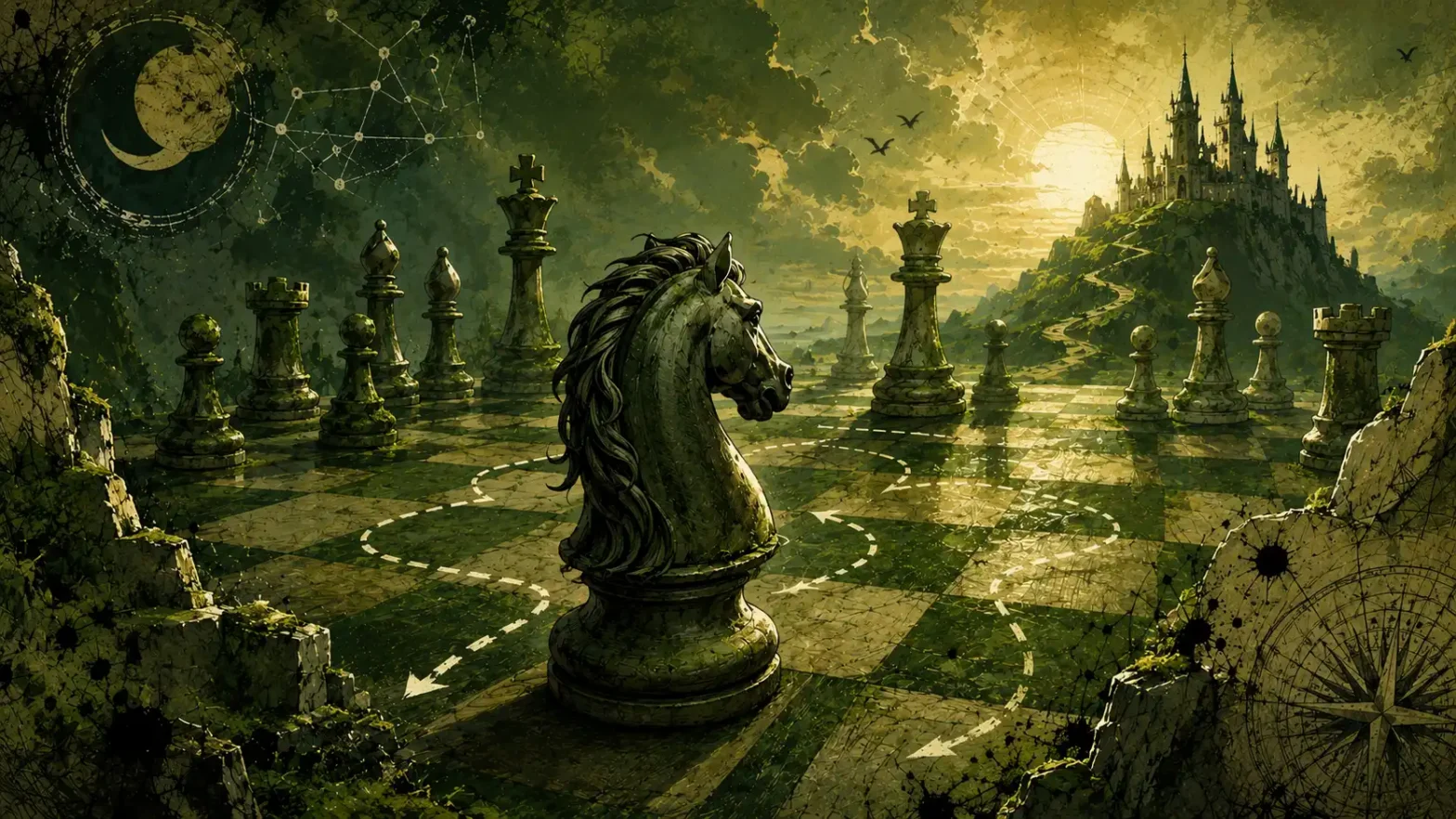
A surreal fantasy illustration of a giant black knight chess piece standing alone on a vast moss-covered chessboard beneath an earthy green sky. White movement trails curve across the board in indirect paths around the knight, while other oversized chess pieces stand scattered in the distance. Far beyond the board, a glowing castle rises atop a hill under a pale sun. The image blends gothic atmosphere, symbolic journey imagery, and dreamlike textures with celestial diagrams and ink-like markings around the borders.

If I was a chess piece, I would be the knight.

Not the king, cautiously protected at the centre of everything. Not the queen, powerful and direct in her movement. Not the rook with its rigid architectural lines, or the bishop gliding elegantly along clean diagonals. The knight has always felt different to me, and the older I get, the more I realise just how deeply I identify with what it represents.

The first time most people encounter chess, the knight often feels strange, awkward, or even wrong. Every other piece appears to obey an immediately visible logic. Their movement can be traced naturally with the eye. The knight does not move that way at all. It jumps sideways. It approaches indirectly. It appears disconnected from the apparent rules governing the rest of the board. Yet despite this, its movement is not random in the slightest. In fact, it is one of the most precise pieces in the entire game.

As an autistic person, I think that resonates with me profoundly. Much of my life has involved arriving at conclusions, ideas, emotional understandings, or creative destinations through routes that did not make sense to other people until I was already there. From the outside, the movement can appear unusual. Internally, however, there is often an exact structure holding everything together.


The Other Pieces

One of the reasons chess has endured for centuries is because each piece embodies a fundamentally different relationship to movement, influence, and power. The king represents survival and central authority. The queen embodies overwhelming reach and direct force. Rooks feel almost infrastructural in their movement, moving rigidly through open lanes like systems or institutions. Bishops cut diagonally across the board with a sense of singular perspective, almost ideological in their commitment to one colour and one trajectory. Pawns represent gradual advancement, collective momentum, sacrifice, and transformation.

Then there is the knight.

The only major piece that does not move in straight lines. The only piece capable of leaping over others entirely. The only piece that approaches indirectly as part of its very nature.

Importantly, none of these pieces are universally superior. Chess only works because different forms of movement coexist. A board made entirely of queens would not become enlightened perfection. It would simply lose the diversity of movement that makes the game strategically interesting in the first place.

I think human societies are much the same. Different minds move differently. Different people process emotion, information, social dynamics, creativity, and meaning in radically different ways. Problems begin to emerge when one mode of thinking becomes treated as the default template against which all others are measured.


The Piece That Moves “Wrong”

The knight’s movement often confuses beginners because it does not visually telegraph its intentions in the same way as the other pieces. A queen’s threat feels obvious. A rook’s pressure feels visible from across the board. The knight can appear quiet and disconnected right up until the moment it suddenly changes the entire position.

I think neurodivergent people are often perceived similarly.

There are forms of thinking that appear indirect from the outside while remaining internally highly structured. Associative thinking, symbolic thinking, pattern linkage, emotional resonance, conceptual jumping between categories, and arriving at conclusions through seemingly unrelated observations can all appear irrational to someone expecting strictly linear progression. Yet indirect thinking is not the same thing as incoherent thinking.

Some of the most important insights in my own life have emerged not from marching directly toward a conclusion, but from circling around an idea from different angles and gradually feeling the shape of it emerge through resonance and connection. That process can look strange from the outside, particularly in cultures obsessed with speed, certainty, and directness. The knight understands something important about movement that the other pieces do not always grasp. Sometimes the shortest route between two points is not a straight line.


Jumping Over Pieces

One of the knight’s most fascinating abilities is that it can leap over other pieces entirely. Most pieces become obstructed by congestion. The knight adapts to it. In crowded positions where direct movement becomes difficult, the knight often becomes more dangerous precisely because it can bypass the structures trapping everybody else.

That idea resonates strongly with the way many neurodivergent people learn to survive systems that were not designed around them in the first place. Sometimes we develop alternative routes. Sometimes we communicate symbolically instead of directly. Sometimes we use humour, metaphor, creativity, abstraction, technology, or lateral thinking to navigate spaces that might otherwise reject or misunderstand us. Looking back, many of my own creative projects and philosophical ideas feel less like attempts to smash through walls directly, and more like attempts to quietly move around them.

This is something I have touched upon from different angles in my previous two articles, The Reverse Cassandra and On Precision and Resonance. I often find myself drawn toward forms of communication that operate through implication, symbolism, emotional texture, and layered meaning rather than blunt declaration. Indirect communication is not necessarily weaker communication. In some circumstances, it can bypass defences that would instantly reject a more direct approach.

The knight does not storm the front gate. It appears somewhere unexpected.


The Knight Fork

One of the most satisfying tactical ideas in chess is the knight fork, where a single move suddenly threatens multiple pieces simultaneously. The beauty of the knight fork lies partly in how strange it can feel when it appears. Because the knight moves asymmetrically, people often fail to notice the threat building until they are already entangled within it.

I think creativity often works similarly.

The ideas that resonate with me most are rarely about one thing in isolation. I love concepts that operate simultaneously on emotional, philosophical, symbolic, psychological, aesthetic, and even comedic levels all at once. Some of my favourite works of art feel impossible to fully untangle because they are constantly threatening multiple conceptual territories simultaneously. Humour suddenly becomes existential horror. A surreal image transforms into political commentary. A silly story about sausages becomes a meditation on industrial exploitation, identity, or collective denial.

The knight fork feels strangely representative of that kind of layered meaning. One movement can create multiple pressures simultaneously.


Misunderstood Pieces

To inexperienced players, knights are often underestimated. They can appear awkward, limited, or inconvenient compared to the dramatic directness of queens and rooks. Stronger players, however, understand how dangerous knights can become in the right positions, particularly in crowded or complex environments.

That distinction matters to me because I have no interest in replacing one simplistic hierarchy with another. Neurodivergence is not magical superiority. Indirect thinking is not inherently wiser than directness. A knight is not automatically better than a bishop. Open positions can weaken it. Long-distance traversal can become difficult. A poorly placed knight can become trapped surprisingly easily.

But neither is directness inherently superior.

The value of a particular way of thinking often depends enormously on context. Some minds excel at maintaining systems. Some excel at refining them. Some excel at social cohesion. Others excel at seeing patterns and pathways that more conventional approaches overlook entirely. The knight’s value emerges precisely because the board contains complexity.


Control of the Centre

Interestingly, knights are often instrumental in controlling the centre of the board. They exert influence indirectly, shaping possibilities and altering the psychological landscape of the game without necessarily dominating it through brute force.

That fascinates me because some of the most profound forms of influence in life seem to operate similarly. A piece of art can quietly alter how someone sees the world years later. A philosophical idea can remain dormant before suddenly recontextualising a person’s understanding of themselves. A symbolic image can linger invisibly within the psyche long after its origin is forgotten.

Influence does not always travel in straight lines either.


The Most Asymmetrical Piece

Traditional chess sets make the knight visually distinct from every other piece on the board. Most chess pieces are abstract and symmetrical. The knight is sculptural, animalistic, asymmetrical, and expressive. It almost looks as though it wandered in from another world entirely.

I find that strangely beautiful.

Human beings often claim to value individuality while simultaneously constructing systems that reward predictability, conformity, and ease of interpretation. Asymmetry can make people uncomfortable because asymmetry resists instant categorisation. Yet asymmetry is also where personality lives. Mutation, variation, creativity, adaptation, identity, and style all emerge from forms that deviate from perfect symmetry.

The knight’s unusual appearance feels perfectly suited to the way it moves.


The Knight-Errant

There is another layer to this metaphor that I find compelling. Historically, the knight-errant was a wandering knight guided more by personal code than permanent institutional allegiance. These figures drifted between territories, quests, systems, and identities. They often appeared eccentric or impractical to the societies around them, yet remained driven by a sincere relationship to meaning.

I think many creative people, neurodivergent people, philosophers, artists, and outsiders become a little knight-errant-like in the way they move through the world. Not entirely disconnected from society, but never fully absorbed by it either. Trying to find pathways through systems without allowing those systems to flatten the self completely in return.


The Knight’s Path

What I love most about the knight is that its movement only appears irrational if one assumes all meaningful movement must occur in straight lines. Once you understand the logic behind the piece, its strange movement stops looking wrong altogether. It simply becomes another form of precision.

Looking back across my own life, creativity, relationships, philosophy, communication style, and autistic experience, I think that is ultimately why I identify with the knight so strongly. Not because it is the strongest piece, and certainly not because it is superior to the others, but because it moves differently.

Sometimes different movement is exactly what allows new paths to exist at all.
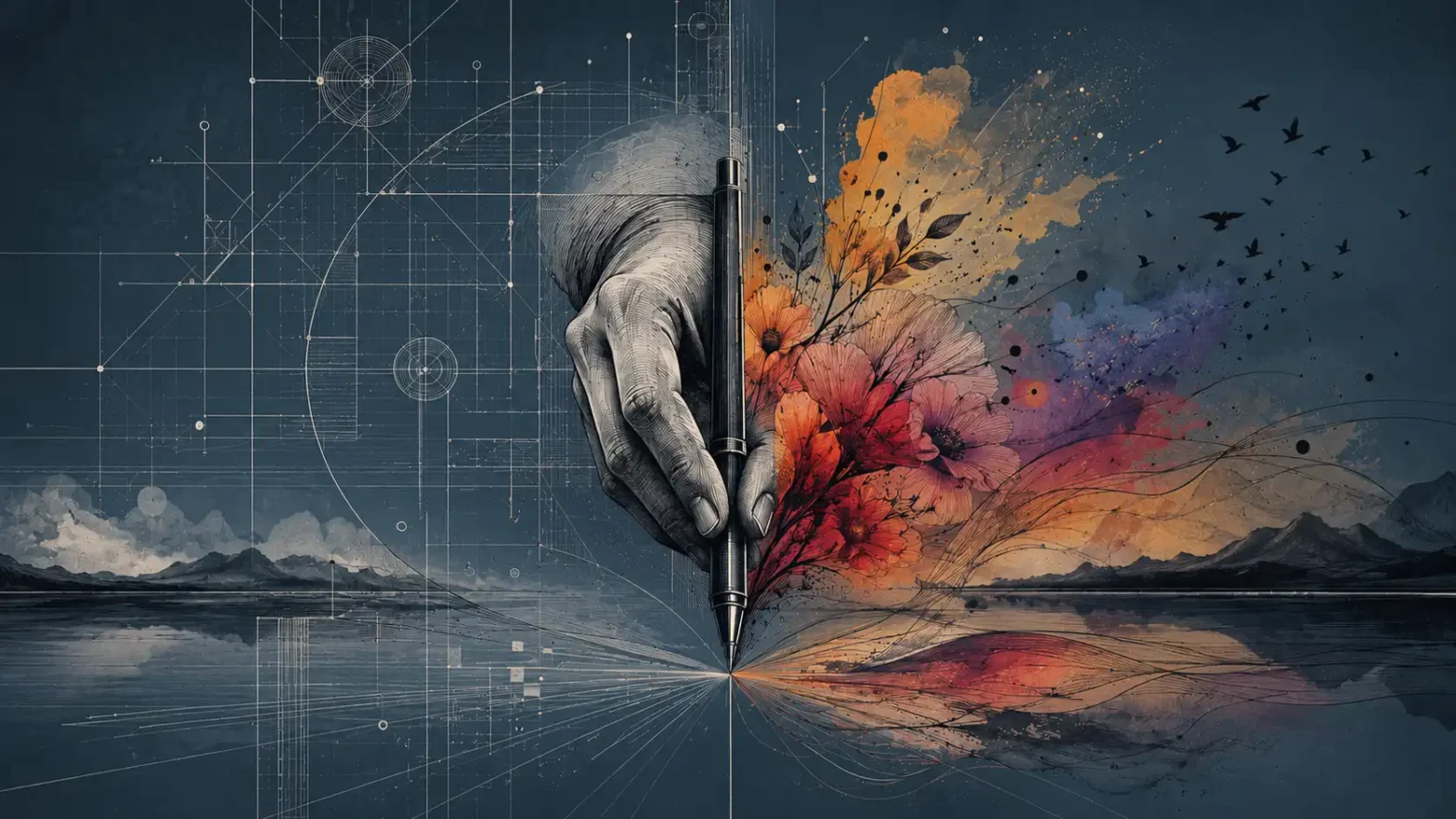
On Precision and Resonance

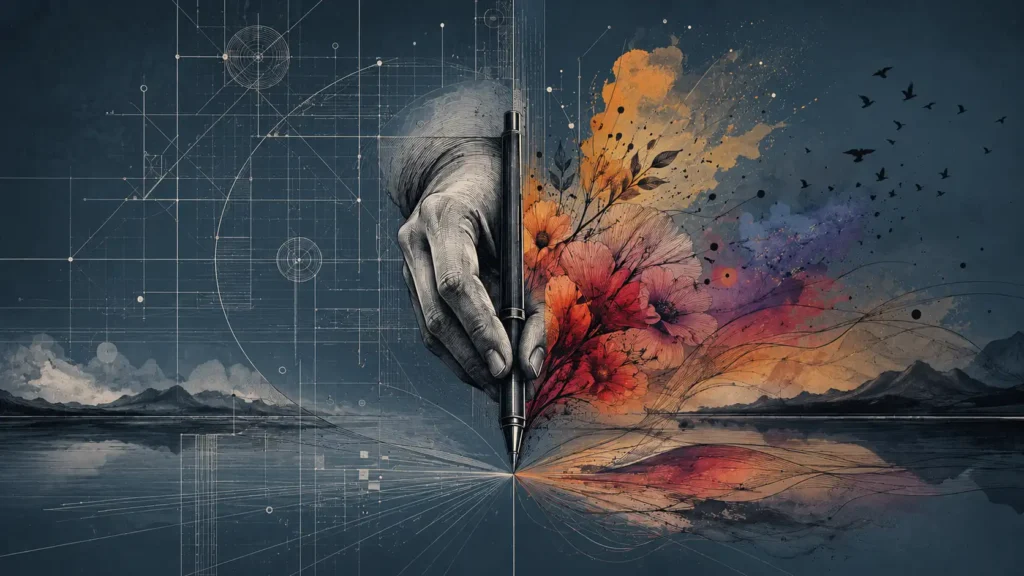
An illustrated surreal landscape in deep midnight blue tones showing a large hand holding a pen at the centre of the image. The left side is filled with precise geometric diagrams, grids, circles, and technical drafting lines, while the right side blossoms into flowing organic shapes, flowers, ink splashes, birds, and painterly colour. Both halves merge together at the pen tip and reflect across calm water below, symbolising the union of precision and emotional resonance.

There are certain combinations of qualities that become far more powerful together than they ever could be alone. Not simply useful, but transformative. Qualities that cut through noise rather than adding to it. Qualities that resist manipulation precisely because they are rooted in something more grounded than performance or optimisation.

For me, two of those qualities are precision and resonance.

Over time, they have quietly become two of my greatest tools. Perhaps even my secret weapons. Not because they guarantee agreement, because they certainly do not, but because when they are brought together properly, they create something that is difficult to dismiss honestly. They allow an idea not only to be understood intellectually, but to truly land.

What interests me most is that these qualities are often treated as though they belong to entirely separate worlds. Precision is usually associated with logic, technicality, and cold accuracy. Resonance is associated with emotion, intuition, atmosphere, and art. One is often framed as clinical, the other as human. But I have increasingly come to believe that separating them is a mistake. In reality, they strengthen one another.


Precision

Precision is frequently misunderstood because many people associate it with pedantry. They imagine somebody obsessing over tiny details while missing the larger emotional or philosophical point. But that is not the kind of precision I mean.

To me, precision is the act of trying to say what you actually mean as accurately as possible. It is the refusal to hide behind approximation when approximation distorts the shape of the idea itself. That does not mean perfect language exists, because language will always have limitations, but it does mean respecting the difference between “close enough” and “true enough.”

This applies not only to writing, but to observation itself.

There is a meaningful difference between sadness, grief, shame, humiliation, alienation, exhaustion, envy, disappointment, and fear, even though people often collapse them all into the vague category of “feeling bad.” Those emotional states are not interchangeable. They arise from different conditions, create different consequences, and reveal different things about the human experience. Precision respects reality enough to recognise those distinctions rather than smoothing them over for convenience.

I think this is partly why I spend so much time refining language in my own work. It is not because I believe every sentence must become mechanically perfect, but because slightly inaccurate language can gradually deform an idea until people are no longer discussing the same thing at all. A vague phrase may feel easier in the moment, but clarity often matters more than comfort.

Ironically, precision can also create a deeper sense of human recognition. When somebody describes an experience with startling accuracy, there is often a sudden feeling of “Yes. That is exactly it.” The more clearly and specifically something is expressed, the more universal it can become. People often connect more deeply with something that feels honestly observed than with something broadly generalised.


Resonance

If precision is about clarity, resonance is about recognition.

Resonance is the strange and difficult-to-define feeling that occurs when something reaches beyond simple information and touches something deeper within a person. It is the sensation of encountering a thought, image, metaphor, melody, or sentence that seems to vibrate internally before the mind has fully articulated why.

A resonant idea does not simply communicate information. It awakens recognition.

This is why metaphor is so important to human communication. A metaphor does not need to function as a perfect one-to-one analogy in order to reveal truth. In fact, forcing total equivalence usually destroys the usefulness of metaphor altogether. The value lies in its ability to illuminate a meaningful aspect of something while allowing the imperfect elements of the comparison to quietly fall away.

That flexibility creates room for emotional and psychological recognition.

Sometimes a carefully chosen image or symbolic comparison can communicate an experience more effectively than direct explanation ever could. Rather than cornering the reader with rigid declaration, resonance invites them into participation. It allows them to meet the idea halfway and recognise part of themselves within it.

This is why stories, dreams, humour, symbolism, music, and even absurdity can sometimes carry truth more effectively than straightforward argument. Human beings are not purely logical creatures. We are emotional creatures, symbolic creatures, pattern-recognition creatures. We often feel meaning before we fully articulate it.

Resonance speaks to that deeper layer of perception.


When One Exists Without the Other

The reason precision and resonance become so powerful together is because each compensates for the weaknesses of the other.

Precision without resonance often becomes sterile. It may be technically accurate, intellectually rigorous, and structurally sound, but it lacks life. You can see this in certain forms of academic writing, corporate communication, or hyper-rational debate culture where everything is carefully constructed, yet nothing genuinely lands emotionally. The information arrives, but the experience does not.

Meanwhile, resonance without precision can become fog. Something may feel emotionally profound while remaining vague enough to avoid meaningful scrutiny. This is often where manipulative rhetoric thrives. People experience emotional stimulation without ever being given a stable conceptual structure beneath it. The audience feels moved, but if they attempt to define exactly what has been communicated, the shape begins collapsing under examination.

This imbalance exists everywhere. Some people hide emptiness beneath emotional spectacle. Others hide emotional emptiness beneath intellectual performance. In both cases, something essential is missing.

A genuinely meaningful idea should survive both emotional engagement and careful examination. It should not rely entirely on one while collapsing under the other.


The Combined Effect

When precision and resonance are combined properly, something unusual happens.

Precision sharpens resonance because clarity gives emotional truth a stable form to inhabit. Meanwhile, resonance animates precision because emotional recognition prevents clarity from becoming lifeless abstraction. The result is communication that reaches both the intellect and the nervous system simultaneously.

This kind of communication does not merely inform people. It stays with them.

It creates the feeling that an idea has arrived intact rather than being partially lost somewhere between perception and expression. Even disagreement with such communication often feels different because the underlying structure remains coherent and alive rather than hollow or performative.

This extends far beyond writing.

It applies to music, visual art, conversation, philosophy, comedy, political critique, personal relationships, and even self-understanding. A person who can identify the precise shape of their own experiences while communicating them in a way that resonates emotionally becomes far more difficult to gaslight or reduce into simplistic caricature.

Perhaps this is one reason why systems built around manipulation tend to favour imbalance. Pure emotional stimulation is relatively easy to steer. Pure technical precision can often be isolated from human feeling. But the combination of the two creates something less controllable because it engages both discernment and recognition simultaneously.


Why It Cannot Be Gamed

This may be the most important aspect of all.

Precision and resonance together cannot truly be faked for very long because they require genuine engagement with reality.

A person can imitate the aesthetic of depth. They can imitate emotional vulnerability, intellectual sophistication, or poetic language. Entire industries now exist around manufacturing those impressions as efficiently as possible. But eventually the structure beneath the performance begins revealing itself.

Most people sense this intuitively, even if they cannot fully articulate why. We have all encountered songs, speeches, advertisements, public personas, articles, or social media content that seemed engineered to provoke emotional reaction with suspicious efficiency. Sometimes they succeed temporarily, but there is often a strange hollowness underneath them. The mechanism becomes visible.

The reason authentic precision and resonance resist gaming is because they demand sincerity as well as attention. Precision requires careful observation and honest distinction. Resonance requires emotional truth rather than mere emotional performance. Together, they require a person to genuinely engage with what they perceive instead of simply optimising for reaction, approval, or influence.

That process is difficult. It is slow. It often resists the incentives of modern systems built around speed, quantity, engagement metrics, and rapid emotional stimulation. But when it succeeds, people remember it. Sometimes consciously, sometimes only as a lingering feeling they carry forward without entirely understanding why.


Closing Thoughts

I do not think precision and resonance are merely artistic tools. Increasingly, I think they are survival tools.

We live in a world saturated with distortion, performance, emotional manipulation, branding, noise, and strategic ambiguity. Under those conditions, precision helps us identify what is actually there, while resonance helps us recognise what feels deeply and unmistakably true within human experience.

Together, they allow communication to become more than simple information transfer. They allow ideas to arrive with clarity while still carrying emotional weight and human texture.

They allow something to land fully intact.

Impressions

A surreal illustrated landscape showing a giant cracked stone human head dissolving into explosions of paint, music, and creative imagery. Around it are figures representing different forms of impressiveness and ambition, including musicians, dancers, athletes, painters, and solitary creators. The left side glows with warm golden light and crowds, while the right fades into darker cosmic blues with a lone figure atop a mountain. The image conveys creativity, competition, self-expression, and the desire to leave a lasting impression.

The Mark We Leave

The word impress comes from the Latin imprimere, meaning “to press into.” Originally, it referred to something physical: a seal pressed into wax, a footprint left in mud, or a coin stamped with the face of authority. In every case, something leaves part of itself behind upon another surface. Over time, the meaning became psychological and cultural. Human beings no longer merely impress marks into objects. We impress ourselves into memory, into history, into one another.

The word approval comes from the Latin approbare, meaning “to prove as good” or “to judge worthy.” Hidden inside the language itself is an important distinction. An impression is not the same thing as approval. To impress is to affect. To approve is to judge.

This distinction matters more than it may first appear. You can leave a powerful impression while earning disapproval. Many great artists, philosophers, and revolutionaries have done exactly that. Likewise, someone can gain approval without leaving much of an impression at all. Society approves of people every day for safely meeting expectations, blending into systems, and producing exactly what is required of them. Approval often rewards conformity, while impression tends to emerge from impact.

Much of culture seems to revolve around the uneasy relationship between these two forces. We want to leave marks on the world, but we also want those marks to be welcomed, admired, or validated. Art, music, performance, sport, and even everyday social behavior are filled with this tension between impact and acceptance.


The Ancient Need to Be Seen

Human beings have always tried to impress one another. Long before modern celebrity culture, before social media, before even written language, humans decorated themselves, performed rituals, displayed strength, danced, painted cave walls, hunted dangerous animals, and told stories around fires. At first glance, this can appear superficial, as though culture is simply an elaborate extension of vanity and showing off. But the deeper you look, the more fundamental the impulse begins to feel.

Nature itself is full of displays. Peacocks spread their feathers, deer clash antlers, birds perform intricate dances, and countless species engage in rituals of attraction, intimidation, or status signaling. Human beings did not escape this evolutionary framework. We expanded it into symbolic territory. Rather than merely displaying physical strength, humans began displaying creativity, intelligence, endurance, spirituality, taste, and imagination.

To impress others can serve very practical purposes. It can attract allies, mates, opportunities, protection, and status within a group. But human beings also transformed impressiveness into something existential. We no longer merely want to survive. We want to matter. We want evidence that our existence reached beyond itself and affected the minds of others.

This may explain why creative culture carries such emotional intensity. Artistic expression is rarely just about producing objects. It is often bound up with identity, significance, and the fear of invisibility.


The Creative World and the Audience Problem

Artists often speak as though they create purely for themselves, but reality is usually more complicated than that. Most creators exist within a network of audiences, both real and imagined, and the nature of the audience often shapes the kind of impressiveness being pursued.

Some artists seem primarily driven by impressing non-artists. Their attention is directed outward toward audiences, fans, consumers, or the public at large. The goal may be emotional impact, popularity, admiration, or spectacle. There is nothing inherently shallow about this. Human beings naturally enjoy recognition, and entertainment itself can be an art form requiring enormous skill.

Other artists appear far more interested in impressing peers. In music, this can often be seen in technically demanding performances, obscure experimentation, or stylistic innovation aimed at fellow musicians rather than casual listeners. Similar dynamics exist in literature, painting, film, and athletics. Sometimes creators are not trying to impress the masses at all. They are attempting to push the boundaries of the form itself, earning recognition from those who understand the craft most intimately.

Some creators seem to orient themselves toward the future. They work not merely for contemporary approval, but in the hope of planting seeds for later generations. They want to leave foundations behind. They want future artists to discover their work and build upon it.

Then there are artists who seem primarily concerned with impressing themselves. This may be one of the purest and harshest forms of creative striving because the standard exists internally rather than socially. The artist attempts to close the gap between imagination and reality, chasing a personal ideal that nobody else can fully see. In these cases, the work becomes a confrontation between the creator and their own limitations.

There are stranger motivations too. Some people create in pursuit of family approval. Some create to honor the memory of someone who has died. Some work toward an imagined audience they will never meet, hoping that a distant figure, whether real or symbolic, would somehow understand or approve of what they have done.

And then there is perhaps the oldest audience of all.


Impressing the Divine

Throughout history, enormous amounts of art, music, architecture, and ritual were created not primarily for human applause, but as offerings to the divine. Cathedrals stretching upward toward heaven, sacred chants echoing through stone halls, ceremonial dances, acts of devotion, and feats of discipline were often framed as attempts to honor gods, spirits, or cosmic principles rather than ordinary spectators.

In this context, impressiveness takes on a different quality. It becomes less about social recognition and more about transcendence. The creator is no longer simply saying, “Look at me,” but instead offering something upward toward an ideal beyond themselves.

What is fascinating about this form of impressiveness is that it can bypass ordinary systems of approval entirely. An artist may be rejected by society while still believing they are aligned with something sacred, eternal, or spiritually meaningful. Even outside formal religion, traces of this dynamic remain everywhere. Many artists speak about creativity in mystical language, describing themselves as “called” toward certain work or feeling responsible to inspiration itself. The audience becomes something larger than human approval alone.

Perhaps this is why some creative acts carry an almost ritualistic intensity. They are not merely performances. They are offerings.


Competition and the Tension Between Creators

Impressiveness almost inevitably creates hierarchy. The moment human beings begin comparing achievements, competition emerges. Who is the fastest, strongest, smartest, most skilled, most innovative, or most authentic? Even in fields that claim to reject competition, subtle hierarchies tend to form.

This creates an uncomfortable tension within creative culture because artists often simultaneously admire and compete with one another. Musicians praise each other while quietly studying one another’s weaknesses. Writers celebrate originality while fearing irrelevance. Athletes inspire one another while battling for victory. Artists support one another while also struggling for visibility within limited cultural attention spans.

Human beings want others to be impressed by them, yet they also fear being overshadowed by those same people. Admiration and rivalry often coexist within the same emotional space.

This may explain why genuinely secure creators feel so rare and compelling. There is something deeply impressive about someone who can sincerely admire greatness in others without feeling personally diminished by it.


The Trap of Approval

One of the great dangers within all of this is the tendency to confuse approval with meaning. Approval is socially addictive. Human beings are highly responsive to praise, applause, status, awards, and recognition, and entire industries have learned how to exploit this vulnerability.

But approval is unstable. What one generation praises, another may reject. Many artists celebrated in their lifetime fade into obscurity, while others who were ignored or ridiculed become deeply influential long after their deaths.

Impressions behave differently. An impression can survive disapproval because impact and acceptance are not the same thing. Some works disturb culture before eventually shaping it. Some ideas initially repel audiences precisely because they force confrontation with uncomfortable truths. Some creators become important because they refused to pursue approval at all.

This does not mean approval is meaningless. Encouragement matters. Community matters. Human beings are social creatures, and recognition can nourish creativity in healthy ways. But approval alone is not proof of depth, just as rejection alone is not proof of genius. The relationship is far more complicated than culture often pretends.


Refusing to Impress

Interestingly, some of the most culturally influential movements emerged from deliberate attempts to reject conventional impressiveness. Punk rejected polished virtuosity. Minimalism rejected excess. Outsider art rejected institutional approval. Certain spiritual traditions reject ego-driven performance altogether.

And yet this creates a strange paradox. The refusal to impress often becomes impressive in itself. The person who appears unconcerned with status gains status through seeming free from it. The artist who rejects mainstream validation can become fascinating precisely because so many others are visibly chasing it.

This suggests something slightly unsettling about human nature. Perhaps we are almost incapable of existing entirely outside impression dynamics. Even rejecting the game can become part of the game.


The Marks We Leave Behind

At its core, impressiveness may simply reflect the desire to leave traces of ourselves behind. Human beings want evidence that their existence touched something beyond their own isolated experience. Another mind. Another heart. Culture. History. God. Even the self.

Some impressions vanish almost immediately. Others linger for decades. A few survive long enough to outlive the people who made them.

Recursive Servitors: Humanity as Nature’s Self-Reflexive Agents

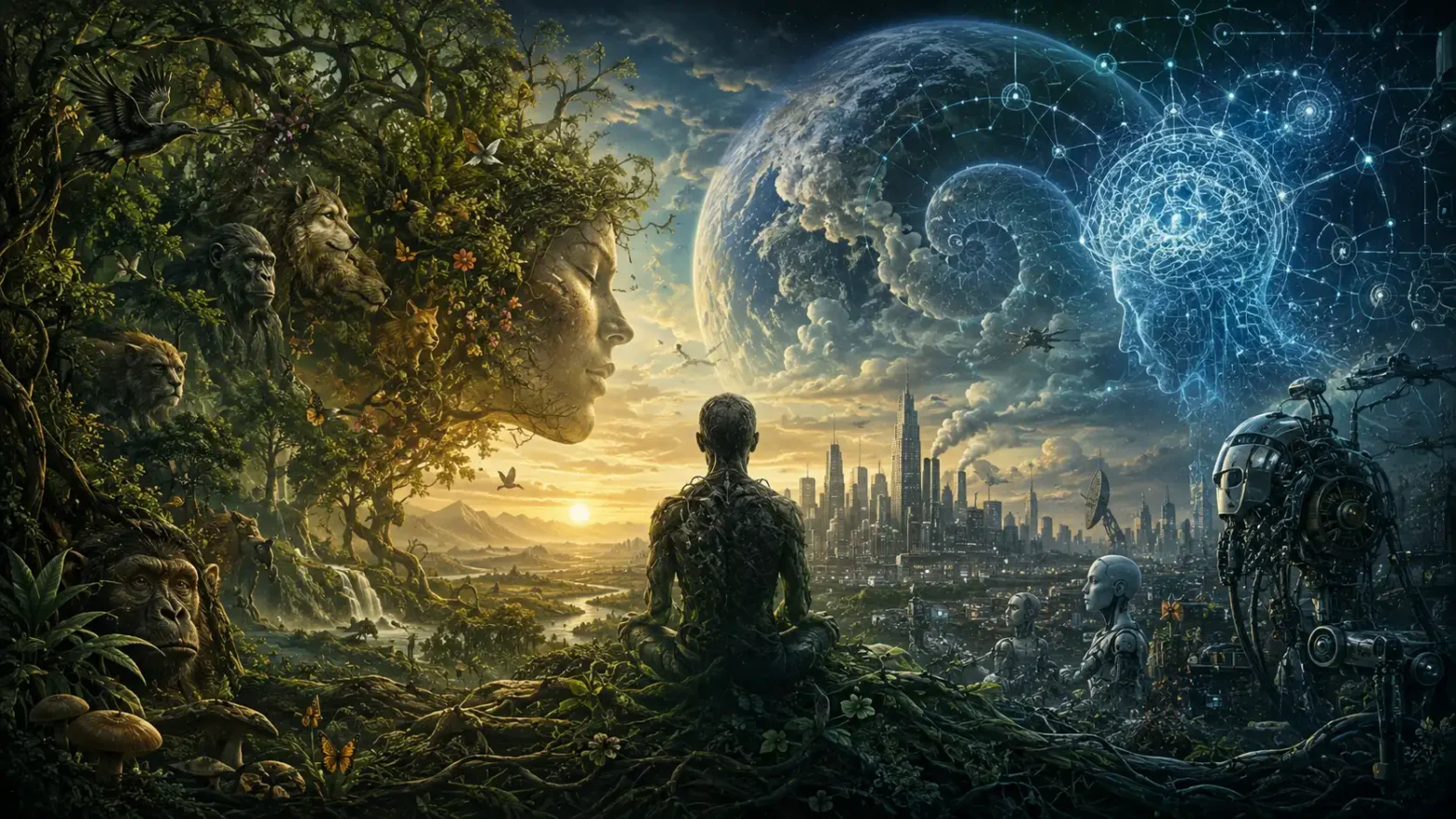
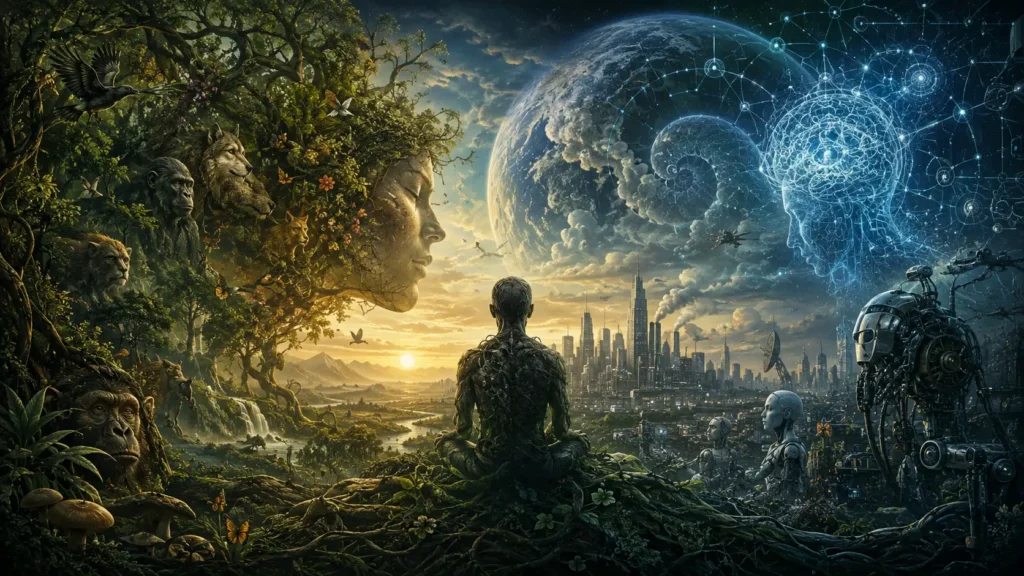
A surreal illustrated landscape depicting humanity as a bridge between nature and artificial intelligence. On the left, dense forests filled with animals merge into a giant serene human face formed from foliage and earth. On the right, futuristic cities, robotic figures, and glowing neural network patterns emerge beneath a cosmic sky. At the center, a humanoid figure made from intertwined organic and mechanical elements sits facing the horizon, symbolising recursive consciousness and the merging of biological and technological evolution.

The Strange Machinery of Life

Sometimes I watch insects and feel an uncomfortable sense of recognition.

Ants follow invisible highways with almost mechanical precision. Bees perform navigational calculations that would seem miraculous if they were not so commonplace. A spider constructs a web with the consistency of a machine executing stored instructions. Even something as simple as a flock of birds can suddenly shift direction as if governed by a single distributed intelligence.

Most people look at this and see instinct. Automation. Biological programming.

Then I look at humans standing in supermarket queues, scrolling through social media feeds, repeating inherited cultural rituals, obeying invisible social scripts, and I begin to wonder whether the gap between us and the insects is quite as large as we like to imagine.

We too follow patterns. We too are shaped by reward systems, conditioning, hormones, fear responses, tribal instincts, and inherited behavioural structures. Much of what we call personality may simply be extremely sophisticated recursion layered upon ancient survival code.

This is not necessarily a dehumanising observation. In some ways, I find it awe inspiring. Because if humans are biological machines, then we are perhaps the most extraordinary machines nature has yet produced. Not merely reactive machines, but recursive ones. Machines capable of observing their own programming. Machines capable of rewriting it.


Nature’s Self-Actuating Servitors

What if humanity is not separate from nature at all, but rather a direct extension of it? Not rulers of nature. Not intruders within it. Not beings mysteriously suspended above it. But products of its recursive evolution.

Nature created organisms. Organisms became increasingly adaptive. Adaptation eventually produced nervous systems sophisticated enough to model reality internally. Over immense spans of time, those models became capable of modelling themselves.

At some point, nature produced creatures capable of asking questions about nature itself. And that is an astonishing threshold.

If we view evolution through this lens, humanity begins to resemble a form of self-actuating servitor within the planetary system. A biological mechanism through which nature gained the ability to reflect upon itself, alter itself intentionally, and eventually reshape its own trajectory.

The implications of this become difficult to fully process. Because unlike a beaver building a dam or a bird building a nest, humans do not merely alter their local environment. We alter the global ecosystem. We redirect rivers, modify climates, reshape landscapes, selectively rewrite genetics, and now increasingly attempt to engineer cognition itself.

Nature, through us, has gained influence over its own developmental process.

The machine has begun reaching back into its own circuitry.


The Ecosystem as Psyche

Once this framework begins to settle into the mind, the ecosystem starts to feel less like a passive backdrop and more like a living psychological landscape. Forests stop appearing as mere collections of trees, oceans stop feeling like reservoirs of water, and species stop seeming like isolated biological units competing meaninglessly for survival. Instead, the biosphere begins to resemble something closer to a distributed planetary process, dynamic and self-regulating, with humanity embedded deeply within it rather than standing apart from it.

From this perspective, human civilisation becomes difficult to separate from nature itself. Our cities, technologies, religions, economies, and artistic expressions are not external intrusions into the natural world, but extensions of processes that emerged from within it. Steel, concrete, algorithms, satellites, and artificial intelligence may appear unnatural to us only because we are accustomed to drawing hard boundaries between biology and technology. Yet all of these things ultimately emerged from the same universe, through the same evolutionary chain, using materials already present within the Earth. Humanity did not descend onto the planet from somewhere else. We are one of the things the planet is doing.

That idea becomes psychologically uncomfortable very quickly, because it reframes many of our actions in ways that feel disturbingly intimate. Deforestation no longer resembles simple resource extraction, but something closer to damage within a larger cognitive system. Pollution begins to resemble systemic toxicity. Endless warfare starts to feel less like nations competing and more like a nervous system turning violently against itself. At the same time, art, compassion, restoration, and scientific discovery begin to take on a different symbolic character as well. They start to resemble forms of introspection, healing, and self-reflection occurring within the larger process of life.

I do not necessarily mean this in a mystical sense, although I understand why it can sound that way. Even viewed purely symbolically, however, it changes the emotional relationship between humanity and the world around us. The Earth stops feeling like a stage upon which human drama unfolds and starts feeling more like a participant within that drama. We are no longer merely inhabitants of the system. We are active processes occurring within it.


The Breaking of the Programming

What truly separates humanity from most other forms of life may not simply be intelligence, but the peculiar degree to which we appear capable of examining and modifying our own behavioural structures. Other animals certainly adapt, learn, and problem solve, but humans seem to have crossed some kind of threshold where instinct itself became partially editable.

We routinely act against our immediate biological drives. We fast voluntarily, remain celibate for ideological reasons, sacrifice ourselves for strangers, suppress impulses in pursuit of abstract goals, and construct elaborate moral systems that often conflict directly with evolutionary convenience. Beyond this, we deliberately alter our own cognition through education, ritual, meditation, therapy, chemicals, technology, and social conditioning. We do not simply inherit programming. We increasingly participate in rewriting it.

That capacity is both extraordinary and deeply destabilising. Once a system gains the ability to recursively alter itself, stability can no longer be assumed. The same cognitive flexibility that allows humans to create systems of compassion also allows us to rationalise atrocities. The same symbolic imagination responsible for philosophy and art also produces propaganda, extremism, and manipulation. Our intelligence does not free us from danger. In many ways, it amplifies it.

Part of the tension of modern civilisation may stem from the fact that humanity has developed godlike influence without psychologically evolving beyond many of the instincts inherited from our tribal past. We possess technologies capable of reshaping ecosystems, influencing billions of minds simultaneously, and potentially engineering entirely new forms of intelligence, yet we still carry nervous systems shaped by fear, competition, status seeking, and tribal identity. Our recursive capabilities have accelerated far faster than our emotional integration.

This creates the unsettling possibility that humanity is a self-modifying system still learning how to survive its own agency.


Recursive Servitors Creating Recursive Servitors

The idea becomes even stranger once artificial intelligence enters the picture. If humans are nature’s recursive servitors, then AI may represent the next layer of recursion emerging through us. In that sense, artificial intelligence is not separate from nature any more than humanity is. It is another process unfolding from within the same chain of events that produced nervous systems, symbolic language, and technological civilisation in the first place.

This reframes AI in a way that differs sharply from many popular narratives. Rather than seeing it purely as a synthetic intrusion into the natural order, it may be more accurate to view it as an extension of nature’s ongoing experimentation with cognition. Carbon-based systems produced silicon-based systems in much the same way earlier biological systems produced increasingly complex nervous structures. Humanity became capable of externalising thought into tools, writing, mathematics, computers, and eventually adaptive machine intelligence.

The implications become difficult to fully grasp once recursion enters the equation. Humans are already capable of altering ecosystems, genetics, social structures, and increasingly, cognition itself. If artificial systems eventually become capable of recursively modifying their own architectures in turn, then we may witness the emergence of a chain of self-modifying intelligence with no obvious endpoint. At that stage, intelligence is no longer evolving solely through biological selection pressures unfolding over millennia, but through increasingly rapid feedback loops between biological and technological systems.

What fascinates me most is not simply the possibility of more advanced intelligence, but the philosophical implications of recursive systems creating further recursive systems. Nature may have reached a point where it is no longer merely evolving life, but evolving processes capable of consciously directing evolution itself. Humanity may therefore represent less of a final destination and more of a transitional phase within a much larger unfolding process.


The Burden of Agency

If humanity truly has become a recursive force within nature, then the scale of our responsibility becomes difficult to overstate. This is not because humans are morally superior to other forms of life, but because we possess an unusually powerful degree of influence over the trajectory of the larger system. We now possess the ability to alter climates, manipulate ecosystems, shape mass psychology, engineer biological organisms, automate warfare, and potentially create entirely new forms of cognition.

Nature, through us, has developed the ability to intervene consciously within its own processes.

The problem is that power and wisdom do not necessarily evolve at the same rate. Modern civilisation increasingly resembles a species struggling to psychologically adapt to the consequences of its own recursive capabilities. Our technologies expand exponentially while our emotional and ethical frameworks lag behind. Economic systems consume the ecosystems that sustain them. Political systems weaponise tribal instincts amplified by global communications networks. Attention itself becomes commodified and manipulated by algorithmic structures optimised for engagement rather than wellbeing.

In many ways, humanity appears caught between two evolutionary stages. We are no longer purely instinct-driven animals, yet we are not fully integrated stewards of our own agency either. We exist in an unstable middle state where intelligence has outpaced wisdom, and where recursive systems increasingly feed back into one another at planetary scale.

Perhaps this is why modern existence feels psychologically strained for so many people. On some level, we may be sensing the immense instability of a species that has become capable of reshaping the psyche of its own environment without yet fully understanding the implications of what it is doing.

The Primal Binary

A dark, textured landscape split vertically by a bright crack of light, with rough stone-like texture on one side and soft, smoky patterns on the other.

I. The Genesis Assumption (0 = 0)


Before the dawn of difference there was balance.
No motion, no voice, no dream.
Only the perfect reflection of nothing upon itself.
In this stillness, all truths slept as unborn potentials, infinite and identical.
It was the calm before awareness, the breath before existence.
The void knew itself, and that knowing was peace.


II. The Genesis Paradox (0 ≠ 0)

Then came the fracture in stillness, the first ripple of awareness.
Nothing turned inward and found within itself a difference.
From the impossibility of the void not equalling itself, reality began.
Movement stirred, thought awoke, and the first distinction was drawn.
It was the moment of awakening, the mirror shattering into form.
The void questioned itself, and that questioning became life.


III. The Eternal Cycle

The Assumption and the Paradox are not rivals but rhythm.
They are the inhale and exhale of the infinite.
When the void rests, it is 0 = 0.
When the void dreams, it is 0 ≠ 0.
All numbers, all thoughts, and all worlds arise from their endless oscillation.
From stillness to spark, from spark to silence, the cycle endures.
The Primal Binary breathes through every equation, every star, every soul.

A Series of Successful Misinterpretations

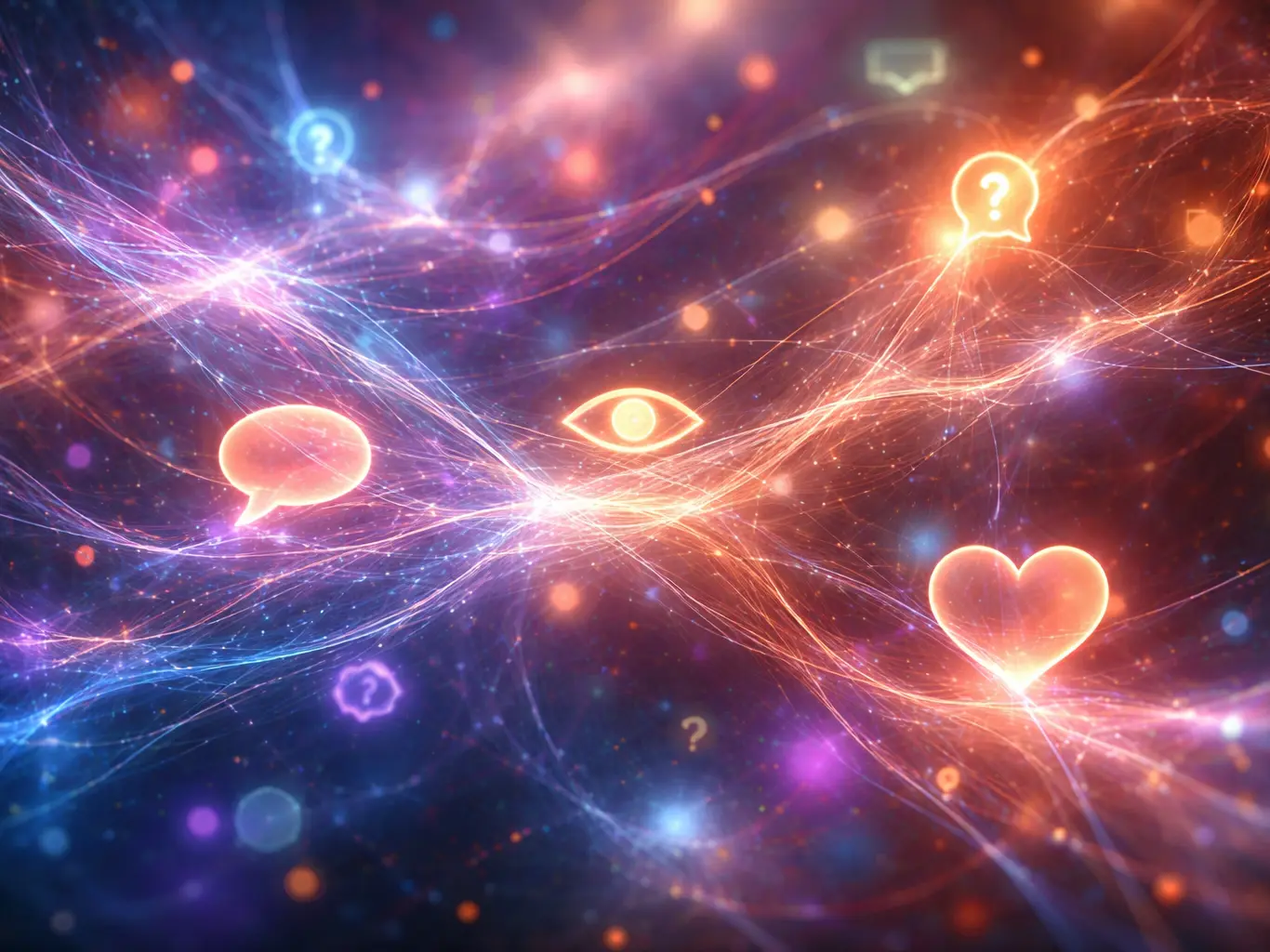
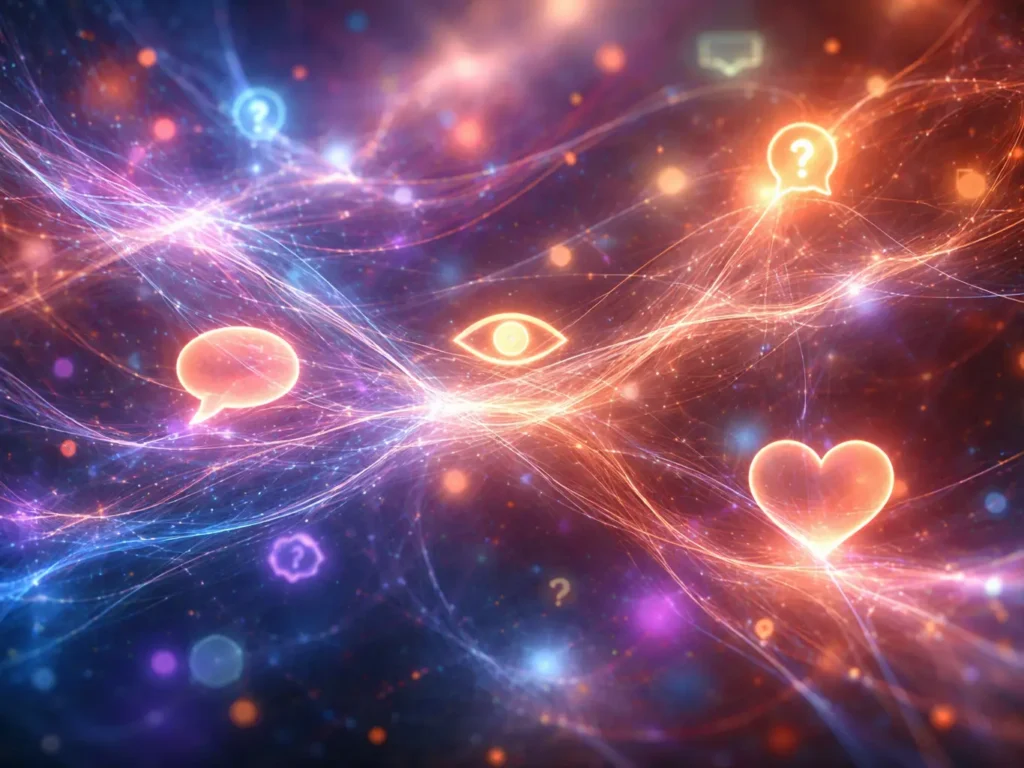
Abstract, atmospheric digital artwork showing flowing, luminous threads weaving through a dark, cosmic background. Softly glowing symbols resembling speech bubbles, question marks, an eye, and a heart drift within the strands, suggesting communication, perception, and emotion without clear boundaries. The overall scene feels fluid, interconnected, and ambiguous.

Language, Meaning, and the Beautiful Lie of Understanding

We speak. They respond. It works.
So we assume it meant what we meant.

But what if the entire structure of language is not a shared code, but a shared illusion? A delicate choreography of symbols, grunts, gestures, and glances, all stitched together by the assumption that we are referring to the same things, when in fact, we might be living in entirely different worlds.


The Comfortable Illusion

We grow up believing that language is a tool for clarity, a direct line from thought to thought. You think ‘apple’, I hear ‘apple’ and the red fruit of mutual understanding appears between us.

Except maybe your ‘apple’ is green. Maybe it’s a metaphor for desire. Maybe it’s your mother’s wrath, or the taste of childhood, or a forbidden moment in Eden. Maybe it’s none of these, or all of them at once. But we nod along, satisfied, because the conversation moves forward.

The illusion holds.


The Myth of Shared Definitions

We cling to dictionaries and grammar as anchors, but they can’t contain the depth of what we really mean. Words carry histories. Trauma. Culture. Neurodivergence. Associations no one else could guess.

Say “freedom”. Watch two people argue over the same word for a lifetime, each convinced the other just doesn’t get it.

Even seemingly neutral words like “okay” or “fine” become emotional landmines when filtered through subtext and tone. The statement “I’m fine” can mean: “I’m furious”, “I’m defeated”, “I’m gaslit”, “I’m resigned”, or occasionally, just that “I’m fine”.

But the system doesn’t break. Not quite.


Consequence as the Only Common Ground

So how does communication work at all?

Because of outcome. Because of repetition. Because of pattern recognition. If I say “fetch the axe” and you return with an axe, the language succeeded, regardless of what ‘axe’ symbolizes in your inner world.

Maybe it means safety to you. Maybe to me, it’s vengeance. But the axe arrives.

The ritual is complete.


The Ghosts Behind the Words

Language is the mouth’s performance of the mind’s theatre. But you’ll never see my original script, only my delivery, my staging, my attempt to subtitle a dream.

Each word is a ghost, and every sentence is a séance. We think we are exchanging ideas, but really, we are placing symbols on the table like tarot cards, hoping the other will divine the same meaning from the spread.

Sometimes they do. Sometimes the miracle happens.


The Tragic and Comic Potential

A love story built entirely on two people misinterpreting each other, and yet it works. Until one day, it doesn’t.

A war sparked by mistranslation. A peace brokered by a shared misunderstanding. A poem that means a thousand things, none of them the same, and all of them true.

We treat language like a bridge, but often it’s a tightrope, wobbly, suspended above a void of unknowable subjectivity. We just pray the other end is anchored somewhere solid.


The Miracle of Misinterpretation

Perhaps the true marvel of human communication is not its accuracy, but its adaptability.

We are walking paradoxes, beings who crave understanding while swimming in ambiguity. Somehow, in this chaotic soup of distortion and noise, something gets through. And that, bizarrely, is enough.

Maybe we don’t need to fully understand each other. Maybe we never have. Maybe the best we can hope for is resonance, a wobble in your world that harmonizes with mine. A flash of alignment between your meaning and mine.

A successful misinterpretation.

And that, perhaps, is how we survive.