
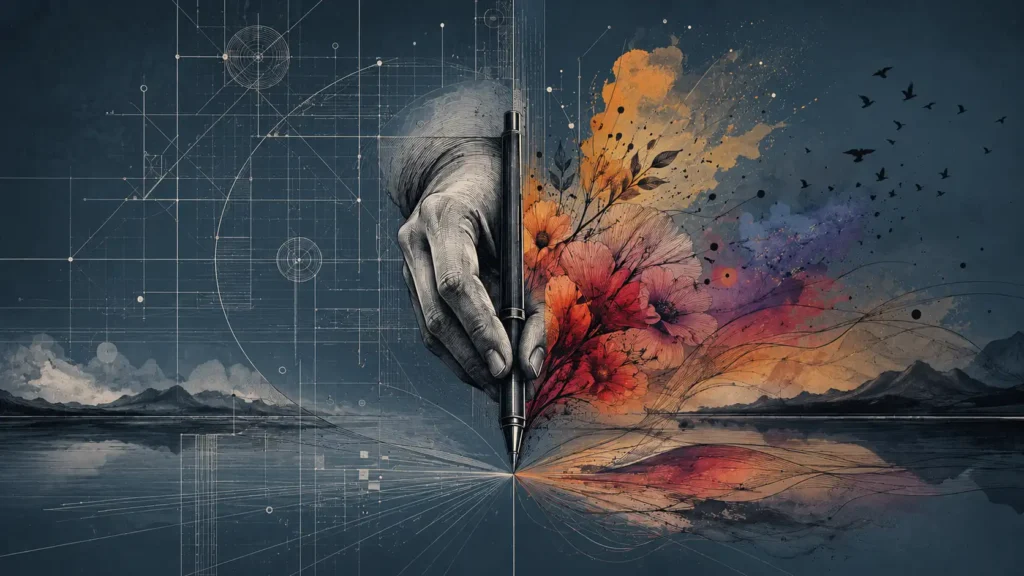
There are certain combinations of qualities that become far more powerful together than they ever could be alone. Not simply useful, but transformative. Qualities that cut through noise rather than adding to it. Qualities that resist manipulation precisely because they are rooted in something more grounded than performance or optimisation.
For me, two of those qualities are precision and resonance.
Over time, they have quietly become two of my greatest tools. Perhaps even my secret weapons. Not because they guarantee agreement, because they certainly do not, but because when they are brought together properly, they create something that is difficult to dismiss honestly. They allow an idea not only to be understood intellectually, but to truly land.
What interests me most is that these qualities are often treated as though they belong to entirely separate worlds. Precision is usually associated with logic, technicality, and cold accuracy. Resonance is associated with emotion, intuition, atmosphere, and art. One is often framed as clinical, the other as human. But I have increasingly come to believe that separating them is a mistake. In reality, they strengthen one another.
Precision
Precision is frequently misunderstood because many people associate it with pedantry. They imagine somebody obsessing over tiny details while missing the larger emotional or philosophical point. But that is not the kind of precision I mean.
To me, precision is the act of trying to say what you actually mean as accurately as possible. It is the refusal to hide behind approximation when approximation distorts the shape of the idea itself. That does not mean perfect language exists, because language will always have limitations, but it does mean respecting the difference between “close enough” and “true enough.”
This applies not only to writing, but to observation itself.
There is a meaningful difference between sadness, grief, shame, humiliation, alienation, exhaustion, envy, disappointment, and fear, even though people often collapse them all into the vague category of “feeling bad.” Those emotional states are not interchangeable. They arise from different conditions, create different consequences, and reveal different things about the human experience. Precision respects reality enough to recognise those distinctions rather than smoothing them over for convenience.
I think this is partly why I spend so much time refining language in my own work. It is not because I believe every sentence must become mechanically perfect, but because slightly inaccurate language can gradually deform an idea until people are no longer discussing the same thing at all. A vague phrase may feel easier in the moment, but clarity often matters more than comfort.
Ironically, precision can also create a deeper sense of human recognition. When somebody describes an experience with startling accuracy, there is often a sudden feeling of “Yes. That is exactly it.” The more clearly and specifically something is expressed, the more universal it can become. People often connect more deeply with something that feels honestly observed than with something broadly generalised.
Resonance
If precision is about clarity, resonance is about recognition.
Resonance is the strange and difficult-to-define feeling that occurs when something reaches beyond simple information and touches something deeper within a person. It is the sensation of encountering a thought, image, metaphor, melody, or sentence that seems to vibrate internally before the mind has fully articulated why.
A resonant idea does not simply communicate information. It awakens recognition.
This is why metaphor is so important to human communication. A metaphor does not need to function as a perfect one-to-one analogy in order to reveal truth. In fact, forcing total equivalence usually destroys the usefulness of metaphor altogether. The value lies in its ability to illuminate a meaningful aspect of something while allowing the imperfect elements of the comparison to quietly fall away.
That flexibility creates room for emotional and psychological recognition.
Sometimes a carefully chosen image or symbolic comparison can communicate an experience more effectively than direct explanation ever could. Rather than cornering the reader with rigid declaration, resonance invites them into participation. It allows them to meet the idea halfway and recognise part of themselves within it.
This is why stories, dreams, humour, symbolism, music, and even absurdity can sometimes carry truth more effectively than straightforward argument. Human beings are not purely logical creatures. We are emotional creatures, symbolic creatures, pattern-recognition creatures. We often feel meaning before we fully articulate it.
Resonance speaks to that deeper layer of perception.
When One Exists Without the Other
The reason precision and resonance become so powerful together is because each compensates for the weaknesses of the other.
Precision without resonance often becomes sterile. It may be technically accurate, intellectually rigorous, and structurally sound, but it lacks life. You can see this in certain forms of academic writing, corporate communication, or hyper-rational debate culture where everything is carefully constructed, yet nothing genuinely lands emotionally. The information arrives, but the experience does not.
Meanwhile, resonance without precision can become fog. Something may feel emotionally profound while remaining vague enough to avoid meaningful scrutiny. This is often where manipulative rhetoric thrives. People experience emotional stimulation without ever being given a stable conceptual structure beneath it. The audience feels moved, but if they attempt to define exactly what has been communicated, the shape begins collapsing under examination.
This imbalance exists everywhere. Some people hide emptiness beneath emotional spectacle. Others hide emotional emptiness beneath intellectual performance. In both cases, something essential is missing.
A genuinely meaningful idea should survive both emotional engagement and careful examination. It should not rely entirely on one while collapsing under the other.
The Combined Effect
When precision and resonance are combined properly, something unusual happens.
Precision sharpens resonance because clarity gives emotional truth a stable form to inhabit. Meanwhile, resonance animates precision because emotional recognition prevents clarity from becoming lifeless abstraction. The result is communication that reaches both the intellect and the nervous system simultaneously.
This kind of communication does not merely inform people. It stays with them.
It creates the feeling that an idea has arrived intact rather than being partially lost somewhere between perception and expression. Even disagreement with such communication often feels different because the underlying structure remains coherent and alive rather than hollow or performative.
This extends far beyond writing.
It applies to music, visual art, conversation, philosophy, comedy, political critique, personal relationships, and even self-understanding. A person who can identify the precise shape of their own experiences while communicating them in a way that resonates emotionally becomes far more difficult to gaslight or reduce into simplistic caricature.
Perhaps this is one reason why systems built around manipulation tend to favour imbalance. Pure emotional stimulation is relatively easy to steer. Pure technical precision can often be isolated from human feeling. But the combination of the two creates something less controllable because it engages both discernment and recognition simultaneously.
Why It Cannot Be Gamed
This may be the most important aspect of all.
Precision and resonance together cannot truly be faked for very long because they require genuine engagement with reality.
A person can imitate the aesthetic of depth. They can imitate emotional vulnerability, intellectual sophistication, or poetic language. Entire industries now exist around manufacturing those impressions as efficiently as possible. But eventually the structure beneath the performance begins revealing itself.
Most people sense this intuitively, even if they cannot fully articulate why. We have all encountered songs, speeches, advertisements, public personas, articles, or social media content that seemed engineered to provoke emotional reaction with suspicious efficiency. Sometimes they succeed temporarily, but there is often a strange hollowness underneath them. The mechanism becomes visible.
The reason authentic precision and resonance resist gaming is because they demand sincerity as well as attention. Precision requires careful observation and honest distinction. Resonance requires emotional truth rather than mere emotional performance. Together, they require a person to genuinely engage with what they perceive instead of simply optimising for reaction, approval, or influence.
That process is difficult. It is slow. It often resists the incentives of modern systems built around speed, quantity, engagement metrics, and rapid emotional stimulation. But when it succeeds, people remember it. Sometimes consciously, sometimes only as a lingering feeling they carry forward without entirely understanding why.
Closing Thoughts
I do not think precision and resonance are merely artistic tools. Increasingly, I think they are survival tools.
We live in a world saturated with distortion, performance, emotional manipulation, branding, noise, and strategic ambiguity. Under those conditions, precision helps us identify what is actually there, while resonance helps us recognise what feels deeply and unmistakably true within human experience.
Together, they allow communication to become more than simple information transfer. They allow ideas to arrive with clarity while still carrying emotional weight and human texture.
They allow something to land fully intact.