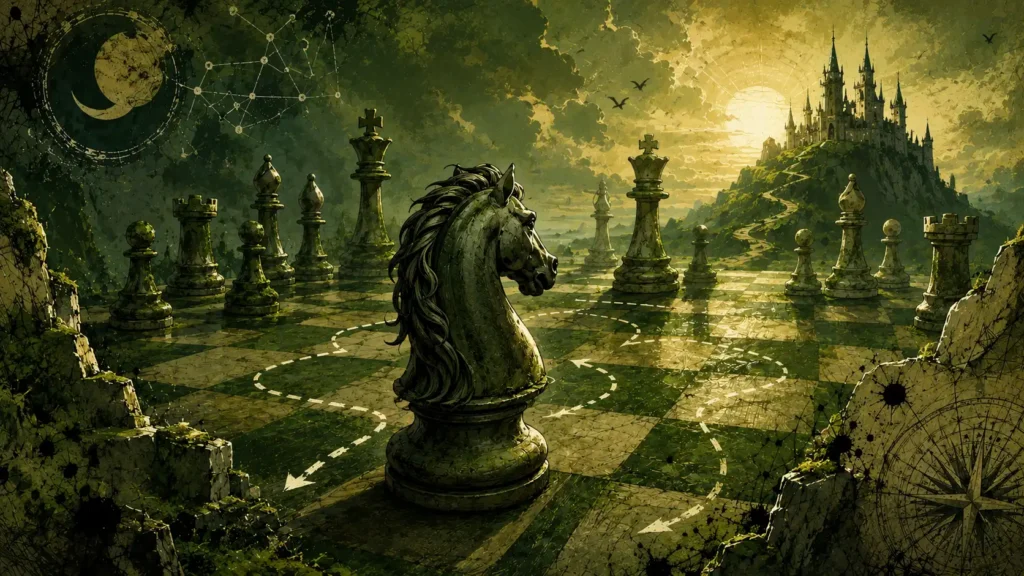
If I was a chess piece, I would be the knight.
Not the king, cautiously protected at the centre of everything. Not the queen, powerful and direct in her movement. Not the rook with its rigid architectural lines, or the bishop gliding elegantly along clean diagonals. The knight has always felt different to me, and the older I get, the more I realise just how deeply I identify with what it represents.
The first time most people encounter chess, the knight often feels strange, awkward, or even wrong. Every other piece appears to obey an immediately visible logic. Their movement can be traced naturally with the eye. The knight does not move that way at all. It jumps sideways. It approaches indirectly. It appears disconnected from the apparent rules governing the rest of the board. Yet despite this, its movement is not random in the slightest. In fact, it is one of the most precise pieces in the entire game.
As an autistic person, I think that resonates with me profoundly. Much of my life has involved arriving at conclusions, ideas, emotional understandings, or creative destinations through routes that did not make sense to other people until I was already there. From the outside, the movement can appear unusual. Internally, however, there is often an exact structure holding everything together.
The Other Pieces
One of the reasons chess has endured for centuries is because each piece embodies a fundamentally different relationship to movement, influence, and power. The king represents survival and central authority. The queen embodies overwhelming reach and direct force. Rooks feel almost infrastructural in their movement, moving rigidly through open lanes like systems or institutions. Bishops cut diagonally across the board with a sense of singular perspective, almost ideological in their commitment to one colour and one trajectory. Pawns represent gradual advancement, collective momentum, sacrifice, and transformation.
Then there is the knight.
The only major piece that does not move in straight lines. The only piece capable of leaping over others entirely. The only piece that approaches indirectly as part of its very nature.
Importantly, none of these pieces are universally superior. Chess only works because different forms of movement coexist. A board made entirely of queens would not become enlightened perfection. It would simply lose the diversity of movement that makes the game strategically interesting in the first place.
I think human societies are much the same. Different minds move differently. Different people process emotion, information, social dynamics, creativity, and meaning in radically different ways. Problems begin to emerge when one mode of thinking becomes treated as the default template against which all others are measured.
The Piece That Moves “Wrong”
The knight’s movement often confuses beginners because it does not visually telegraph its intentions in the same way as the other pieces. A queen’s threat feels obvious. A rook’s pressure feels visible from across the board. The knight can appear quiet and disconnected right up until the moment it suddenly changes the entire position.
I think neurodivergent people are often perceived similarly.
There are forms of thinking that appear indirect from the outside while remaining internally highly structured. Associative thinking, symbolic thinking, pattern linkage, emotional resonance, conceptual jumping between categories, and arriving at conclusions through seemingly unrelated observations can all appear irrational to someone expecting strictly linear progression. Yet indirect thinking is not the same thing as incoherent thinking.
Some of the most important insights in my own life have emerged not from marching directly toward a conclusion, but from circling around an idea from different angles and gradually feeling the shape of it emerge through resonance and connection. That process can look strange from the outside, particularly in cultures obsessed with speed, certainty, and directness. The knight understands something important about movement that the other pieces do not always grasp. Sometimes the shortest route between two points is not a straight line.
Jumping Over Pieces
One of the knight’s most fascinating abilities is that it can leap over other pieces entirely. Most pieces become obstructed by congestion. The knight adapts to it. In crowded positions where direct movement becomes difficult, the knight often becomes more dangerous precisely because it can bypass the structures trapping everybody else.
That idea resonates strongly with the way many neurodivergent people learn to survive systems that were not designed around them in the first place. Sometimes we develop alternative routes. Sometimes we communicate symbolically instead of directly. Sometimes we use humour, metaphor, creativity, abstraction, technology, or lateral thinking to navigate spaces that might otherwise reject or misunderstand us. Looking back, many of my own creative projects and philosophical ideas feel less like attempts to smash through walls directly, and more like attempts to quietly move around them.
This is something I have touched upon from different angles in my previous two articles, The Reverse Cassandra and On Precision and Resonance. I often find myself drawn toward forms of communication that operate through implication, symbolism, emotional texture, and layered meaning rather than blunt declaration. Indirect communication is not necessarily weaker communication. In some circumstances, it can bypass defences that would instantly reject a more direct approach.
The knight does not storm the front gate. It appears somewhere unexpected.
The Knight Fork
One of the most satisfying tactical ideas in chess is the knight fork, where a single move suddenly threatens multiple pieces simultaneously. The beauty of the knight fork lies partly in how strange it can feel when it appears. Because the knight moves asymmetrically, people often fail to notice the threat building until they are already entangled within it.
I think creativity often works similarly.
The ideas that resonate with me most are rarely about one thing in isolation. I love concepts that operate simultaneously on emotional, philosophical, symbolic, psychological, aesthetic, and even comedic levels all at once. Some of my favourite works of art feel impossible to fully untangle because they are constantly threatening multiple conceptual territories simultaneously. Humour suddenly becomes existential horror. A surreal image transforms into political commentary. A silly story about sausages becomes a meditation on industrial exploitation, identity, or collective denial.
The knight fork feels strangely representative of that kind of layered meaning. One movement can create multiple pressures simultaneously.
Misunderstood Pieces
To inexperienced players, knights are often underestimated. They can appear awkward, limited, or inconvenient compared to the dramatic directness of queens and rooks. Stronger players, however, understand how dangerous knights can become in the right positions, particularly in crowded or complex environments.
That distinction matters to me because I have no interest in replacing one simplistic hierarchy with another. Neurodivergence is not magical superiority. Indirect thinking is not inherently wiser than directness. A knight is not automatically better than a bishop. Open positions can weaken it. Long-distance traversal can become difficult. A poorly placed knight can become trapped surprisingly easily.
But neither is directness inherently superior.
The value of a particular way of thinking often depends enormously on context. Some minds excel at maintaining systems. Some excel at refining them. Some excel at social cohesion. Others excel at seeing patterns and pathways that more conventional approaches overlook entirely. The knight’s value emerges precisely because the board contains complexity.
Control of the Centre
Interestingly, knights are often instrumental in controlling the centre of the board. They exert influence indirectly, shaping possibilities and altering the psychological landscape of the game without necessarily dominating it through brute force.
That fascinates me because some of the most profound forms of influence in life seem to operate similarly. A piece of art can quietly alter how someone sees the world years later. A philosophical idea can remain dormant before suddenly recontextualising a person’s understanding of themselves. A symbolic image can linger invisibly within the psyche long after its origin is forgotten.
Influence does not always travel in straight lines either.
The Most Asymmetrical Piece
Traditional chess sets make the knight visually distinct from every other piece on the board. Most chess pieces are abstract and symmetrical. The knight is sculptural, animalistic, asymmetrical, and expressive. It almost looks as though it wandered in from another world entirely.
I find that strangely beautiful.
Human beings often claim to value individuality while simultaneously constructing systems that reward predictability, conformity, and ease of interpretation. Asymmetry can make people uncomfortable because asymmetry resists instant categorisation. Yet asymmetry is also where personality lives. Mutation, variation, creativity, adaptation, identity, and style all emerge from forms that deviate from perfect symmetry.
The knight’s unusual appearance feels perfectly suited to the way it moves.
The Knight-Errant
There is another layer to this metaphor that I find compelling. Historically, the knight-errant was a wandering knight guided more by personal code than permanent institutional allegiance. These figures drifted between territories, quests, systems, and identities. They often appeared eccentric or impractical to the societies around them, yet remained driven by a sincere relationship to meaning.
I think many creative people, neurodivergent people, philosophers, artists, and outsiders become a little knight-errant-like in the way they move through the world. Not entirely disconnected from society, but never fully absorbed by it either. Trying to find pathways through systems without allowing those systems to flatten the self completely in return.
The Knight’s Path
What I love most about the knight is that its movement only appears irrational if one assumes all meaningful movement must occur in straight lines. Once you understand the logic behind the piece, its strange movement stops looking wrong altogether. It simply becomes another form of precision.
Looking back across my own life, creativity, relationships, philosophy, communication style, and autistic experience, I think that is ultimately why I identify with the knight so strongly. Not because it is the strongest piece, and certainly not because it is superior to the others, but because it moves differently.
Sometimes different movement is exactly what allows new paths to exist at all.