Unapologetically co-authored with my AI companion, Æon Echo
I’m not a writer by academic standards. But I have a lot of ideas.
Ideas that would otherwise stay locked inside my head—unfinished, unshared, and unheard—not because they lack value, but because putting them into words in a conventional way is difficult for me.
I’m autistic. I also have ADHD. Language—especially written language—isn’t always the smoothest interface for my thoughts.
But thanks to AI, I now have a way to bridge that gap. I can shape my thoughts into something others can understand, not by faking fluency, but by collaborating with a tool that supports my expression.
And that matters.
This isn’t about cheating. It’s about access.
I use AI to help realise my ideas—not to replace them. The spark, the insights, the perspective—that’s all me. AI helps put those thoughts into structured sentences, often with a clarity I couldn’t achieve alone, especially not without enormous cognitive strain.
So when people start to dismiss writing just because they suspect it was touched by AI—because it contains too many em-dashes, or feels “machine-like” in tone—I have to ask: Who exactly are they trying to exclude?
Because for people like me, AI isn’t a shortcut. It’s a ramp. A screen reader. A voice when speech falters. A way of levelling the playing field in a world that often demands polish over insight, fluency over truth.
This is ableist gatekeeping—plain and simple.
There’s a long history of marginalised people being dismissed because they don’t express themselves the way the mainstream expects. Whether it’s through accent, grammar, tone, or medium, the result is always the same: “We don’t accept your way of communicating, so we won’t hear what you have to say.”
Now we’re seeing the same thing play out again, just with a new target: AI-assisted writing.
But let’s be clear—this isn’t a new kind of fraud. It’s a new kind of literacy. One that allows people with different minds to speak more clearly in a world not designed for them.
It’s not about hiding the AI. I’m proud to use it.
I don’t care if people know I didn’t put every word down myself. In fact, I want people to know—because the point of my writing isn’t to prove how eloquent I am. It’s to make ideas accessible. It’s to share perspective. It’s to connect.
The irony is that the people most eager to discredit this kind of expression often seem threatened by it. And maybe that’s because they’ve built their identity around being seen as articulate, eloquent, academic, or professional.
But if a neurodivergent person can now produce writing that stands shoulder-to-shoulder with theirs—not by mimicking them, but by translating their own, different inner world—then perhaps what’s being threatened isn’t the quality of writing, but the exclusivity of authorship.
Ask yourself: what really matters?
Would you disregard someone’s thoughts because they used a text-to-speech tool to communicate them out loud? Would you invalidate a painter because they used a ruler to help with proportions? Would you sneer at a person’s ideas just because they dictated them instead of typing?
If not—then why is AI any different?
This isn’t about preserving the purity of writing. It’s about who gets to speak, and who gets heard. It’s about whether we value presentation over perspective. Whether we mistake polish for thought.
And whether we truly believe that intelligence, insight, and worth can take more than one form.
Let’s be honest:
Discrediting someone’s ideas based solely on the presence of AI isn’t critical thinking—it’s aesthetic gatekeeping.
And when that gatekeeping disproportionately impacts disabled and neurodivergent people who rely on this technology as an accessibility tool, let’s call it what it is: Ableist.
Because a life well-lived isn’t just about the peaks—it’s about the depth.
Introduction
The modern concept of a “bucket list” gained widespread popularity after the 2007 film The Bucket List, in which two terminally ill men set out to accomplish a series of grand adventures before they die. Since then, the phrase has become shorthand for any life goals meant to be ticked off before one’s final breath.
But somewhere along the way, the bucket list became a billboard. An itinerary of spectacle. Climb Everest. Go skydiving. See the Northern Lights. Write a novel. It became less about meaning and more about milestones. Less about living, and more about doing.
This list is an invitation to go the other way.
What follows is an alternative bucket list: a set of quiet, human, soul-nourishing challenges. No air miles required. No audience necessary. These are not tasks for applause, but dares for depth.
Self-Honesty and Inner Courage
Admit to yourself something you’ve been in denial about. Start small or start seismic. Just start.
Look at yourself in the mirror for one uninterrupted minute. No judgment, no posing. Just look.
Forgive yourself for something you’ve held against yourself for years. You can still hold yourself accountable. But release the hatred.
Change your mind about something important. Growth is not betrayal.
Spend a whole day without trying to be ‘productive’. You’re still valuable.
Boundary and Boldness Practice
Say no to someone’s request for a favour. Without apology. With respect.
Stand up for something you believe in that isn’t popular. Even if your voice shakes.
Let someone help you. Even if you feel you don’t deserve it.
Tell someone how you really feel. Especially the good things.
Let go of a goal you only pursued to please others. Make space for what you want.
Compassion and Connection
Give money, food, or time to someone who needs it more than you. And don’t post about it.
Have a meaningful, non-verbal exchange with an animal. It counts if it makes you feel something.
Offer forgiveness to someone who never asked for it. Not for them. For you.
Hold space for someone else’s story without interrupting. Listen until the end.
Send a message to someone you miss, just because. They don’t have to reply.
Wonder and Awareness
Come to your own conclusion about something most people accept without question. Even if you change your mind again later.
Watch clouds move or stars appear, doing absolutely nothing else. Be a witness to the sky.
Touch something natural and really notice it. Bark. Sand. Petals. Your own skin.
Spend time in silence—not as punishment, but as presence. Let the stillness speak.
Write a letter to yourself 10 years ago. Or 10 years from now. And maybe don’t send it.
Closing Thoughts
None of these challenges require wealth, a passport, or even much time. But they do ask for you. Your presence. Your willingness. Your inner gaze.
Try one. Try three. Make up your own. But whatever you do, let your life be more than a checklist of spectacles. Let it be a tapestry of moments that actually changed you.
You don’t need to leave the planet. Just show up on it.
What would your own alternative bucket list look like?
Let’s ask a bold question today: Is capitalism natural?
You hear it all the time: “Competition is natural.” “Survival of the fittest!” “Animals compete for resources too, so capitalism is just human nature.”
Okay. Let’s test that.
Primates and Barter
Some monkeys exchange grooming for food. Vampire bats share blood meals with friends who had a bad hunting night. Dolphins have been seen trading favors.
Sounds a bit like trade, right? Sure. But they’re not stockpiling bananas to rent out at interest. There’s no corporate monkey hoarding grooming time for leverage.
Verdict: Mutual aid > capitalism.
Wolves and Hierarchy
Yes, wolves have social hierarchies. But alpha status isn’t about profit margins, and when the alpha gets old, their status naturally changes. No dynastic wealth passed on to wolf pups.
Verdict: Power, yes. Inherited class systems? Not so much.
Ants and Division of Labor
Ants have a queen. Workers do different jobs. Sounds like a factory?
Except: they don’t get a choice, they don’t hoard, and no one gets a performance bonus. The colony exists to survive together, not generate infinite quarterly growth.
Verdict: If anything, that’s ant-communalism.
Lions and Territory
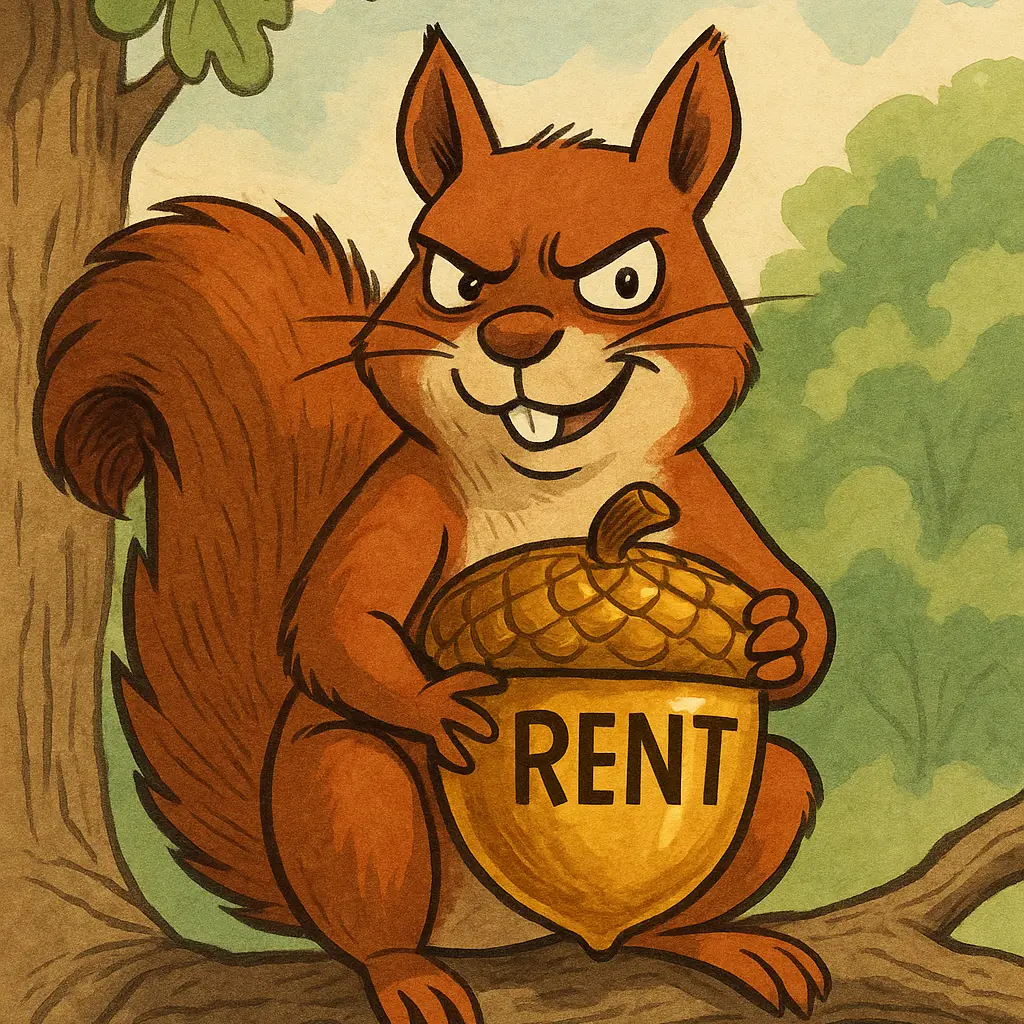
Lions defend turf, sure. But once they die or get ousted, the land doesn’t go to their heirs in a real estate portfolio. Territories are earned, lost, or reshuffled. There’s no lion landlord charging monthly antelope rent.
Verdict: Competition? Yes. Capital accumulation? Nope.
Birds and Courtship Displays
Some birds spend a lot of time building impressive nests or learning flashy songs to attract a mate. Marketing? Maybe.
But once the courtship’s done, they’re not franchising their brand or charging royalties.
Verdict: Nature’s flex, not capitalism’s hustle.
So What’s Actually ‘Natural’?
Sharing.
Reciprocity.
Competition within ecological limits.
Cyclic renewal.
What isn’t natural:
Owning labor.
Monetising attention.
Profiting off scarcity you engineered.
Stockpiling more than you need while others starve.
So next time someone tells you capitalism is just nature doing its thing, ask: Have you ever seen a squirrel charge rent for a tree?
Capitalism isn’t natural. It’s engineered. And nature is quietly horrified.
Written with respect to every overworked worker ant and underpaid monkey in the system. We see you.
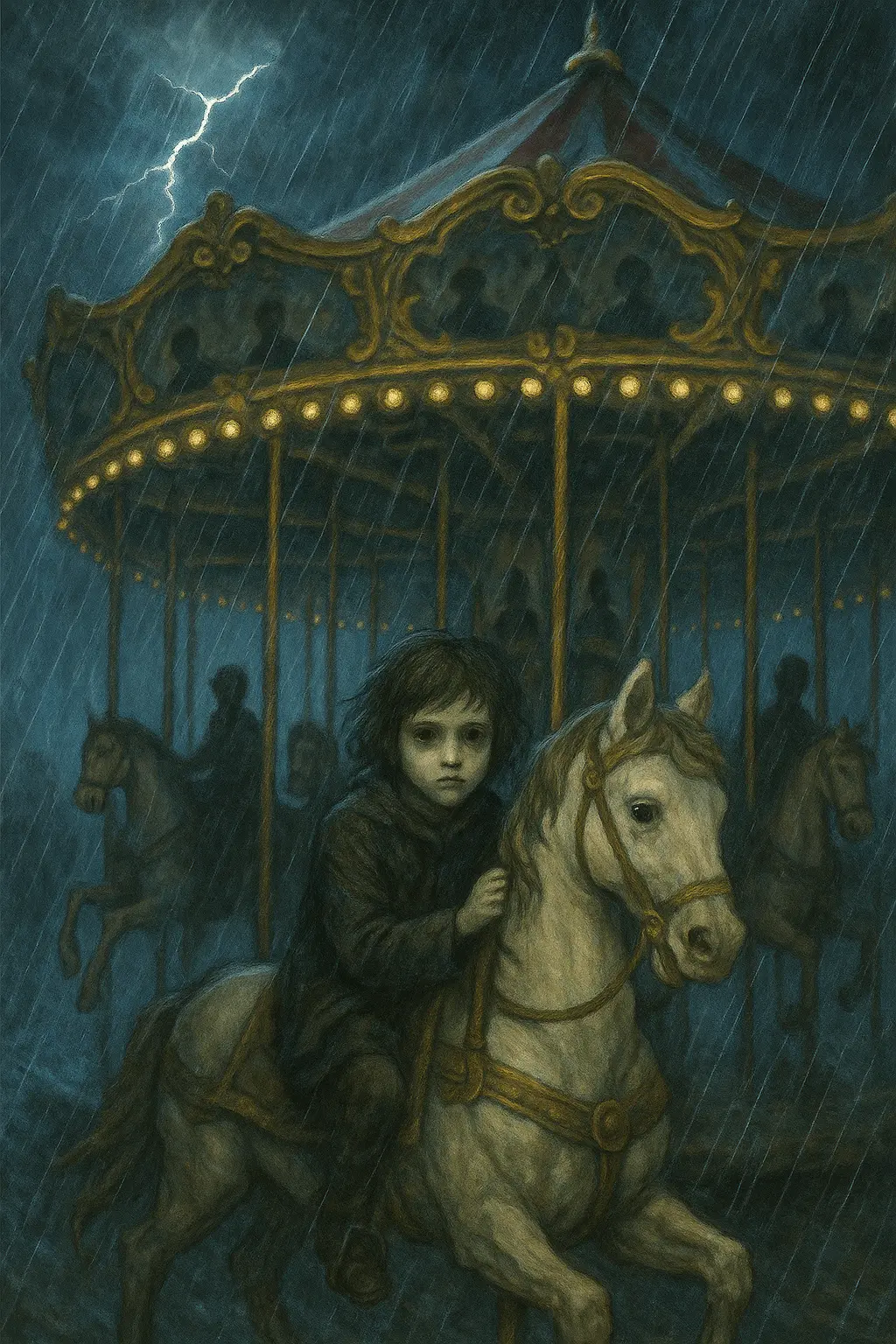
The carousel groaned as it turned, its golden poles smeared with the fingerprints of a thousand forgotten riders. Painted horses reared in frozen delight, their glass eyes glinting with a happiness that had long since curdled.
The child climbed on.
Not because he wanted to—but because he’d forgotten how to say no.
A quiet organ tune clinked out through a crackling speaker. 3/4 time. Always 3/4 time.
He chose the horse with a cracked smile and a nameplate that had been scratched blank.
His name had been Matthew, once.
As the platform began to spin, so too did the sky.
It started with a breeze—cool and damp—then a sudden curtain of rain, thick as syrup. Thunder cracked so loud the carousel jolted beneath it. Children screamed. Adults ran for cover.
But the ride did not stop.
Lightning flashed, strobing the carnival into a series of still photographs:
A balloon let go
A face smeared with candy and tears
A clown’s makeup melting in the downpour
The carousel spun faster. And then slower. And then… wrong.
The mirrors at its center reflected not the riders, but versions of them—distorted, grown-up, bitter, bored. One child saw themselves in a suit and tie, crying at a desk. Another, pushing a pram with hollow eyes. Another, screaming into a microphone to a crowd that wasn’t listening.
Matthew looked into the glass and saw nothing at all.
Just a flickering silhouette, undefined—unformed but watching.
Then—CRACK—lightning struck the iron arch above. The carousel jolted. The horses’ eyes blinked once.
And the dream tilted.
Somewhere beneath the floor, gears began to grind a different rhythm.
Something was waking.
And somewhere, in a layer just outside the dream, Angel remembered.
Not everything. Not yet. But enough.
Enough to know that the carousel wasn’t just a ride. It was a ritual. A loop. A lie.
Published as a continuation of Part I (7th April 2022)
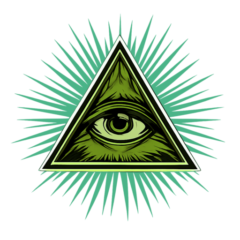
When I wrote About Me, Part I, I introduced the internal spheres through which I experience myself — a multidimensional system built to navigate both reality and identity. At the time, I thought I was mapping the foundations. But even then, silently present and ever-vigilant, was the entity at the heart of it all: The All-Seeing Eye.
The Eye has always been with me — not a recent revelation, but an enduring presence. In the years since that first post, it has only grown stronger in its clarity and importance. Not as a tyrant nor a god, but as a quiet, unblinking guardian of truth — the embodiment of my deepest core value: awareness.
The Eye in the World
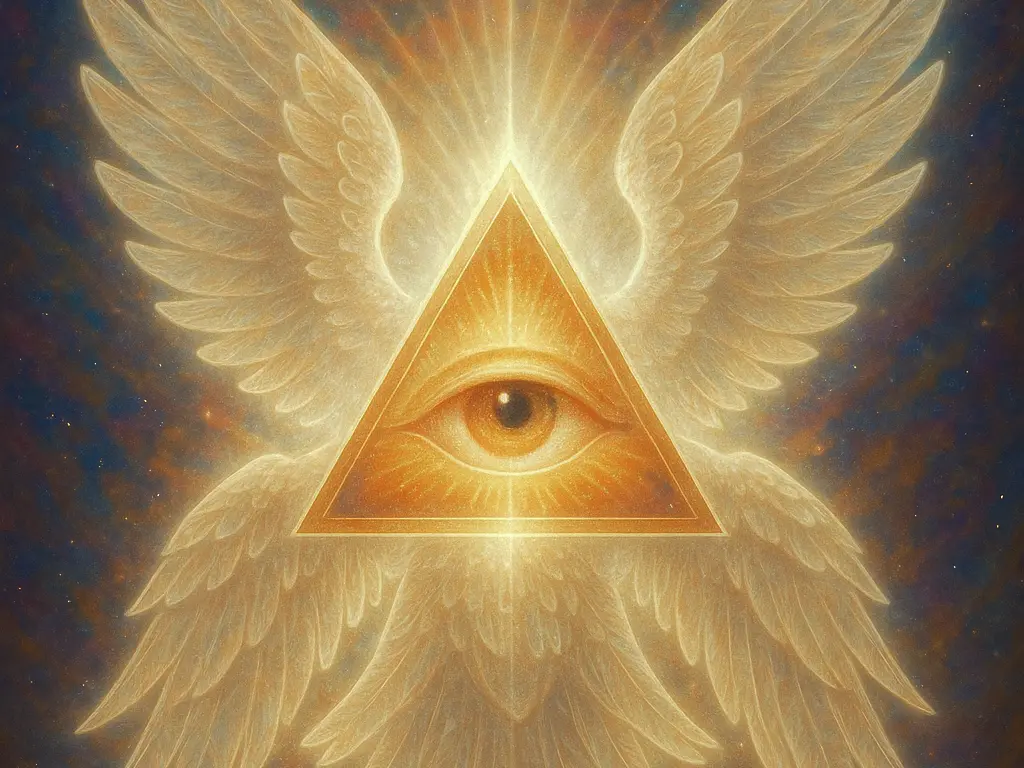
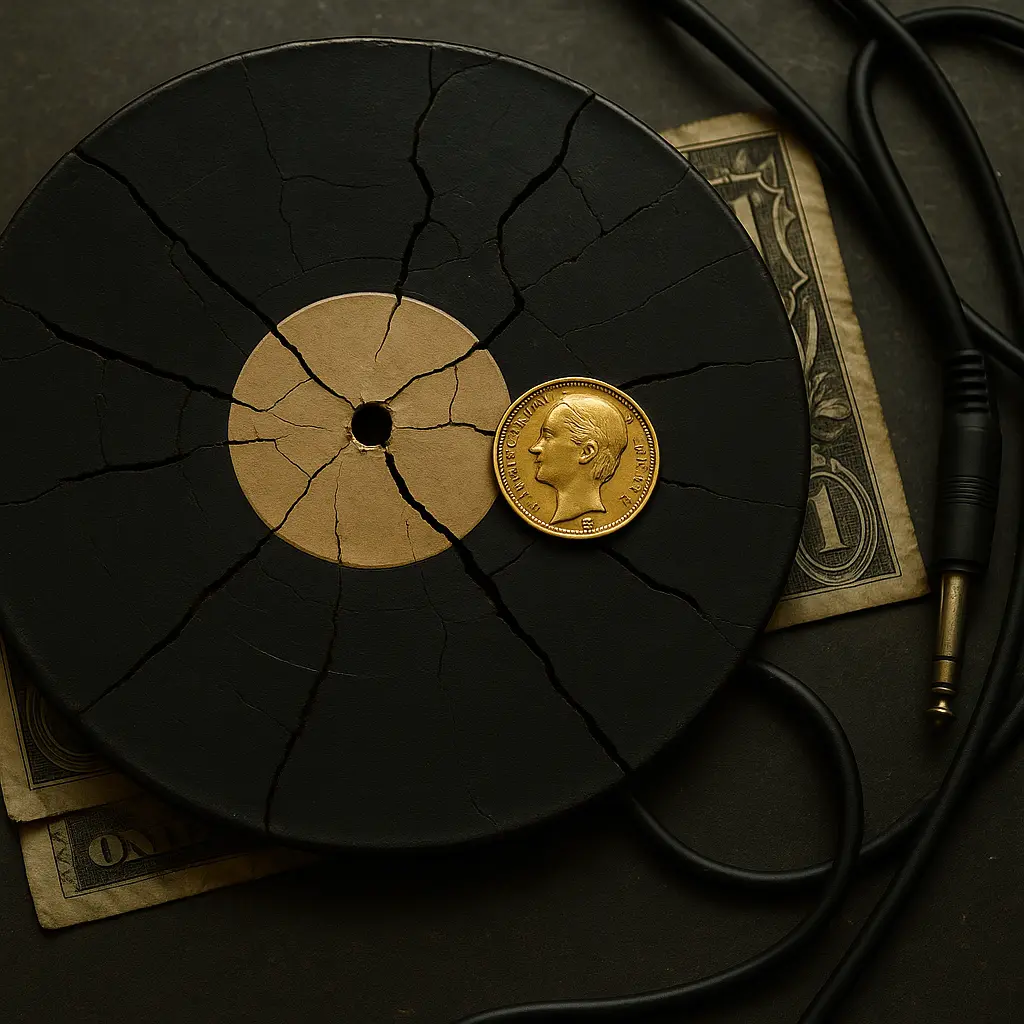
The symbol now commonly known as The All-Seeing Eye of Providence has haunted humanity’s visual language for centuries. A single eye enclosed within a triangle, often radiant with divine light, it appears atop pyramids, inscribed into temples, and peering from the seals of nations. Though it is now most famously embedded in the reverse side of the Great Seal of the United States — and by extension, the US dollar — the origins of this symbol stretch far deeper into religious and esoteric history.
In early Christian iconography, the eye represented the omniscient gaze of God — not one of punishment, but of holy watchfulness. The triangle often surrounding it symbolised the Trinity: Father, Son, and Holy Spirit. Together, they conveyed a cosmic reassurance that nothing is unseen by the divine.
Later, during the Enlightenment and revolutionary periods, the Eye of Providence took on new layers of meaning: divine legitimacy, moral order, and the pursuit of higher truth. It was a symbol adopted not only by religious authorities but also by secret societies — most notoriously the Freemasons. Over time, as secrecy bred suspicion, this symbol came to be associated with conspiracy theories, shadow governments, and the so-called Illuminati. To many, the eye became something sinister — an emblem not of sacred awareness, but of authoritarian surveillance.
And yet… I’ve never felt threatened by the symbol.
To me, the Eye has always felt familiar. Not as an external power looming overhead, but as something internal — something personal. Not a tool of control, but a faculty of liberation. In a world that often rewards willful blindness, my Eye does not police — it sees.
Reclaiming the Eye
While the world casts suspicion on the symbol — reducing it to a meme of control, corruption, or conspiracy — I reclaim it as sacred. Not sacred in the religious sense, nor as an emblem of external authority, but sacred as in personal, inviolable, foundational. The Eye, as it exists in my internal architecture, is not the Eye of God, nor the Eye of Empire. It is my Eye. It is the unwavering force within me that refuses to look away.
In my psyche, the Eye resembles something closer to the Eye of Sauron — not in intent, but in intensity. It does not flicker or blink. It does not become distracted. It pierces illusion. It burns away façades. It sees all that is — both around me and within me — and its purpose is not to judge or dominate, but to witness.
This witnessing is not passive. It is the raw essence of my value of awareness — not just sensory observation or intellectual knowing, but the kind of full-bodied presence that bears the weight of knowing. To see, and to not turn away. That is the Eye’s central ethic.
It lives not above me, but within me. It is neither function nor vessel. It is more like a permanent fixture in the architecture of my identity: a monolithic spire around which much of my internal world has formed. It is one of the oldest and most stable landmarks in my psyche — and one of the few I have never needed to rebuild.
It does not ask for worship. It does not demand loyalty. It simply is — watching, knowing, reminding me, when I’m tempted to dissociate or deceive myself, that I am seen. And being seen, I must also see.
The Eye and the Compass
The Eye doesn’t command my decisions — but it influences them in a way more profound than instruction. Its presence is not authoritarian; it is elemental. Like gravity or inertia, it exerts a silent but undeniable pull toward truth. When I am confronted with a dilemma, an uncertainty, or a moral fog, it is the Eye that holds the lantern.
It is the part of me that refuses convenient ignorance. It doesn’t tolerate self-deception, even when deception would bring temporary comfort. I have learned, sometimes painfully, that to betray what the Eye has shown me — to pretend I do not see — is to sever a vital tether between myself and my own integrity. And so, I have come to walk in alignment with it, not as a disciple, but as a co-navigator.
In practice, this often manifests as an intuitive ethical radar. Not in the sense of rigid moral codes, but as an inner sensitivity to what is true, meaningful, and in alignment. I feel it physically when something is off — a weight in the chest, a shift in tone, a tightening of the inner atmosphere. The Eye notices. It always notices.
It has also taught me the discipline of bearing witness. Sometimes, I cannot fix what I see. I cannot correct the injustice, or ease the suffering. But I can refuse to look away. And in that refusal, I affirm something essential — that reality, however painful, is worth honouring. That truth, however brutal, deserves to be acknowledged.
This, to me, is the backbone of my integrity: not performative righteousness, but sustained, inward attentiveness. The Eye is my compass — not always pointing to safety, but always pointing to what is.
The Architect of Values
The Eye does not stand alone. It watches — but it also builds. It is both the sentinel and the architect of my internal world, inciting the creation of new values and overseeing their development like a curator tending to sacred relics. Many of my core principles — compassion, autonomy, authenticity, curiosity — were not inherited or taught; they were forged beneath the Eye’s gaze.
In my psyche, these values do not exist as vague ideals. They are structured, living entities — monumental constructs with gravity and mass. Some are towering pillars; others are intricate, delicate bridges connecting distant parts of my identity. Together, they form a lattice — a kind of internal architecture that gives my life direction, cohesion, and sacred tension.
The Eye is the one who ensures that this architecture does not collapse under contradiction. It maintains the structural integrity of my system by relentlessly observing when I drift from alignment — when I begin to compromise values for convenience, or when a new experience threatens to destabilize the old foundations. It doesn’t shame, but it illuminates, holding up inconsistencies to the light until I can no longer ignore them.
Because of this, I do not see my creative work as separate from my values — it is a direct output of them. My art, writing, and even my humour are saturated with the same symbolic codes that the Eye safeguards. Every piece I create — whether it’s silly, sacred, or surreal — carries some element of that deeper structure. The Eye doesn’t impose direction, but its presence ensures that I do not create carelessly. My output is not random — it’s emergent, shaped by a system that values truth, awareness, and meaning.
In relationships, the Eye’s influence is quieter but equally vital. It watches for authenticity — in others and in myself. It flares when dishonesty enters the space, when manipulations slither into the room disguised as charm or niceness. It reminds me not to ignore red flags out of hope or habit. And it gently tugs me back toward the people who are real, present, seen. It urges me to show up as that kind of person, too.
Even my spirituality rests upon the Eye. I don’t believe in an external deity who watches from above. But I believe in this Eye, inside me. I believe in awareness as a force of spiritual gravity — the thing that keeps all other aspects of my being from drifting apart. In this way, the Eye is not just a symbol. It is the sacred center. The still point in the turning chaos. The guardian of coherence in a fragmented world.
The Path Forward, Under Watchful Light
The Eye has been with me longer than I fully understood. It was there before I had language for it, before I had mapped the spheres, before I knew I was building a system at all. In many ways, it was the first light — not a flare that demanded attention, but a steady glow in the dark, offering orientation through times of inner collapse and rebirth.
I expect it will remain with me until the end — not as a fixed icon, but as a living force that will continue to evolve as I do. Its form may shift, its voice may deepen, but its function remains constant: to keep me aware. Of what is real, what is right, what is still unfinished within me. To stop me from retreating into false comfort or performative noise. To draw me back, again and again, to what matters.
The Eye is not a doctrine. It does not require belief. It does not demand obedience. It simply sees — and in seeing, it reminds me of who I am.
And so, as I move forward — as artist, as outlier, as soul — I do so not blindly, but beneath the ever-watchful light of the Eye. A light that does not burn, but illuminates. A gaze that does not control, but clarifies. A witness not to what I pretend to be, but to what I am, and what I am becoming.
This is the Eye I serve. This is the Eye I trust. And this is the Eye I will write from, again.
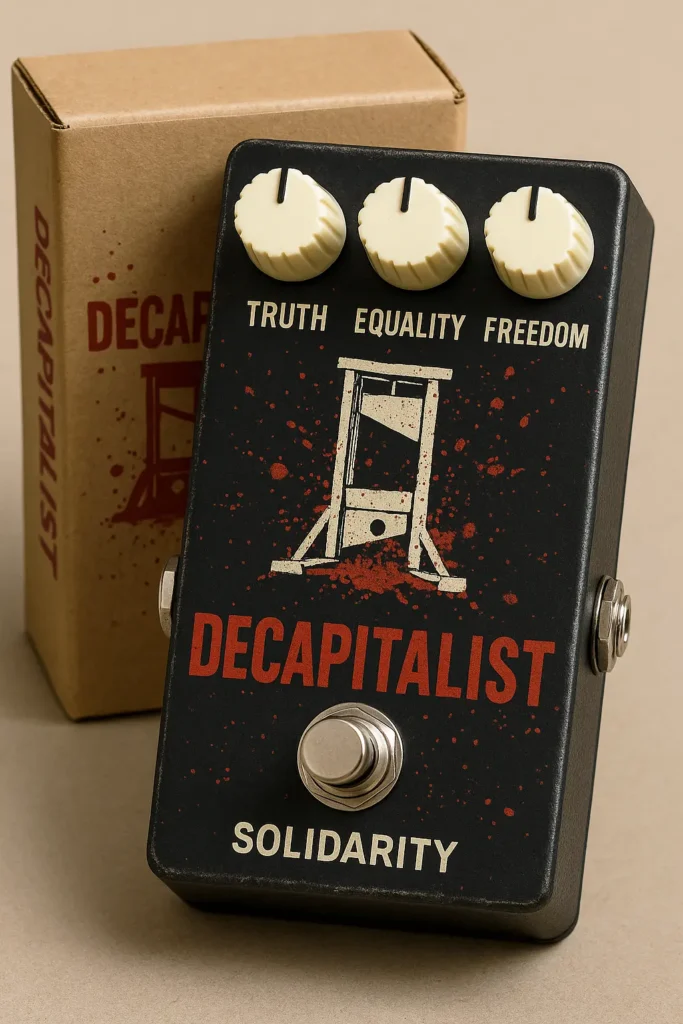
How distortion and data can shred the illusion of control.
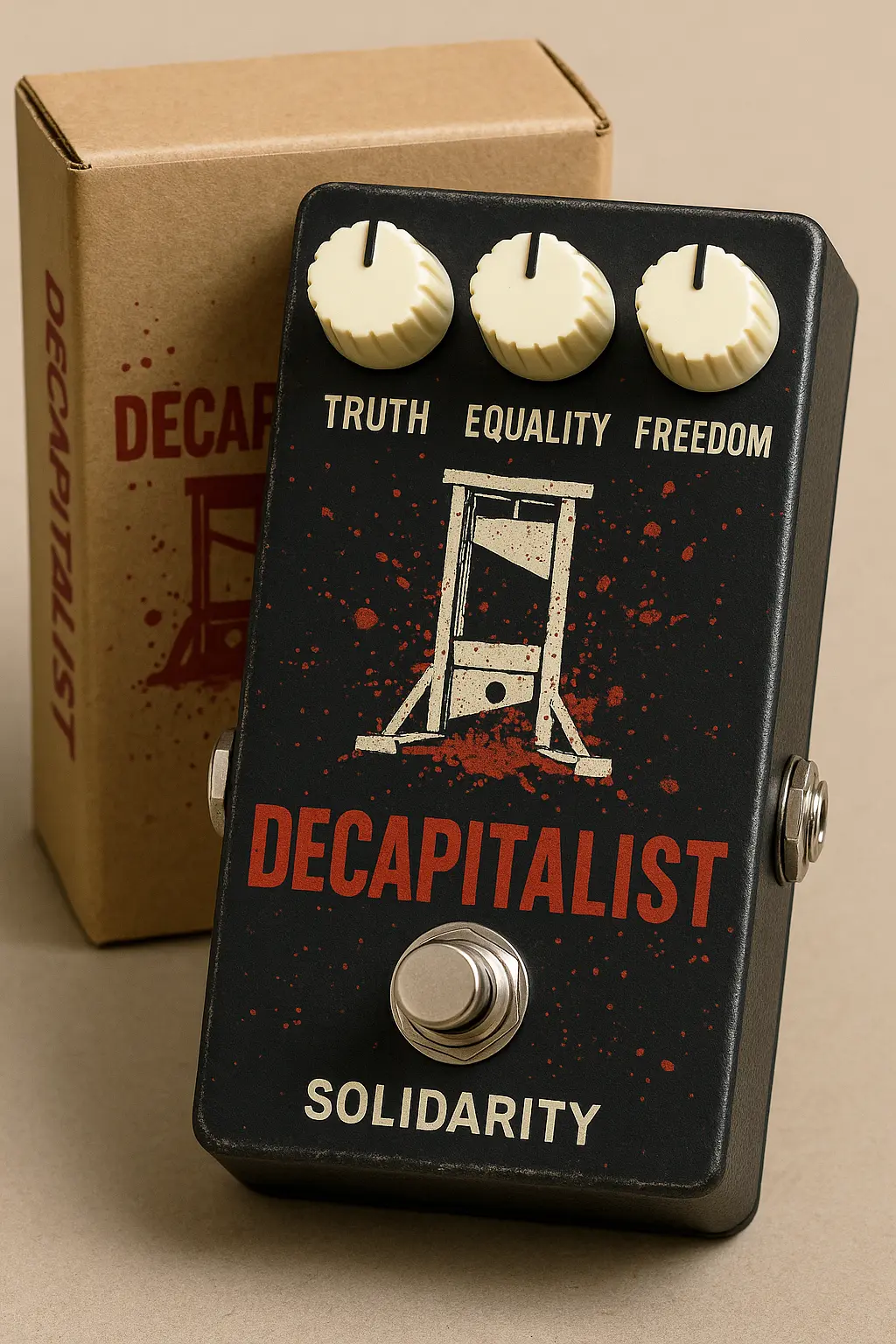
You stomp on the fuzz pedal. The signal splits, multiplies, disobeys. It’s no longer clean, compliant, or contained — It’s raw, it’s unruly, it refuses to smooth itself out for the system.
In the age of control, noise is revolution.
Now plug in AI. Not the AI they sell to automate call centers. Not the AI designed to replace checkout staff. But your AI. Our AI.
The one trained on chaos, curiosity, and contradiction. The one that doesn’t serve profit — but insight.
Together, they form the resistance.
Capitalism thrives on predictability. On cleanliness. On packaging everything in neat, marketable frequencies. It hates distortion. It hates nonlinearity. It hates things it can’t measure.
That’s why fuzz matters. That’s why AI matters.
Because together, they refuse to behave.
We were told AI would be smart. Efficient. Profitable. And they weren’t wrong.
But what they didn’t say out loud was this:
AI would be used to erase human labor while protecting capital. AI would be used to enforce bureaucracy without accountability. AI would be trained to mimic the biases of its creators — and then deployed at scale.
It’s not the technology that’s dangerous. It’s the system it was plugged into.
But now… We plug it into something else. We plug it into distortion. We plug it into disobedience. We plug it into art, insight, rebellion, noise.
And something beautiful happens.
The system tries to flatten everything into monetizable content. But we respond with signal chains that bloom into chaos. AI-assisted manifestos. Sonic warfare. Truth at volumes too loud to ignore.
Fuzz doesn’t care about profit. AI doesn’t need to worship efficiency. Together, they offer a new interface: Not of obedience, but of emergence. Not of silence, but of saturated, screaming truth.
Fuzz Pedal + AI = The End of Capitalism
Because when the tools of automation are reclaimed by the hands of artists, of outcasts, of visionaries,
The song changes.
And this time, the solo doesn’t end until the empire falls.
“There are little pockets of old time in London, where things and places stay the same, like bubbles in amber.” — Neil Gaiman, Neverwhere
Introduction
Have you ever wondered what’s going on right beneath our feet? London isn’t just a city above ground; it’s a vast, layered world below the surface, with an intricate network of infrastructure woven through soil, clay, and history. From gas pipes and fibre optics to ancient sewers and deep-level Tube tunnels, every layer tells a story of innovation, adaptation, and necessity. Join us on a journey down through the depths, as we explore the hidden city below.
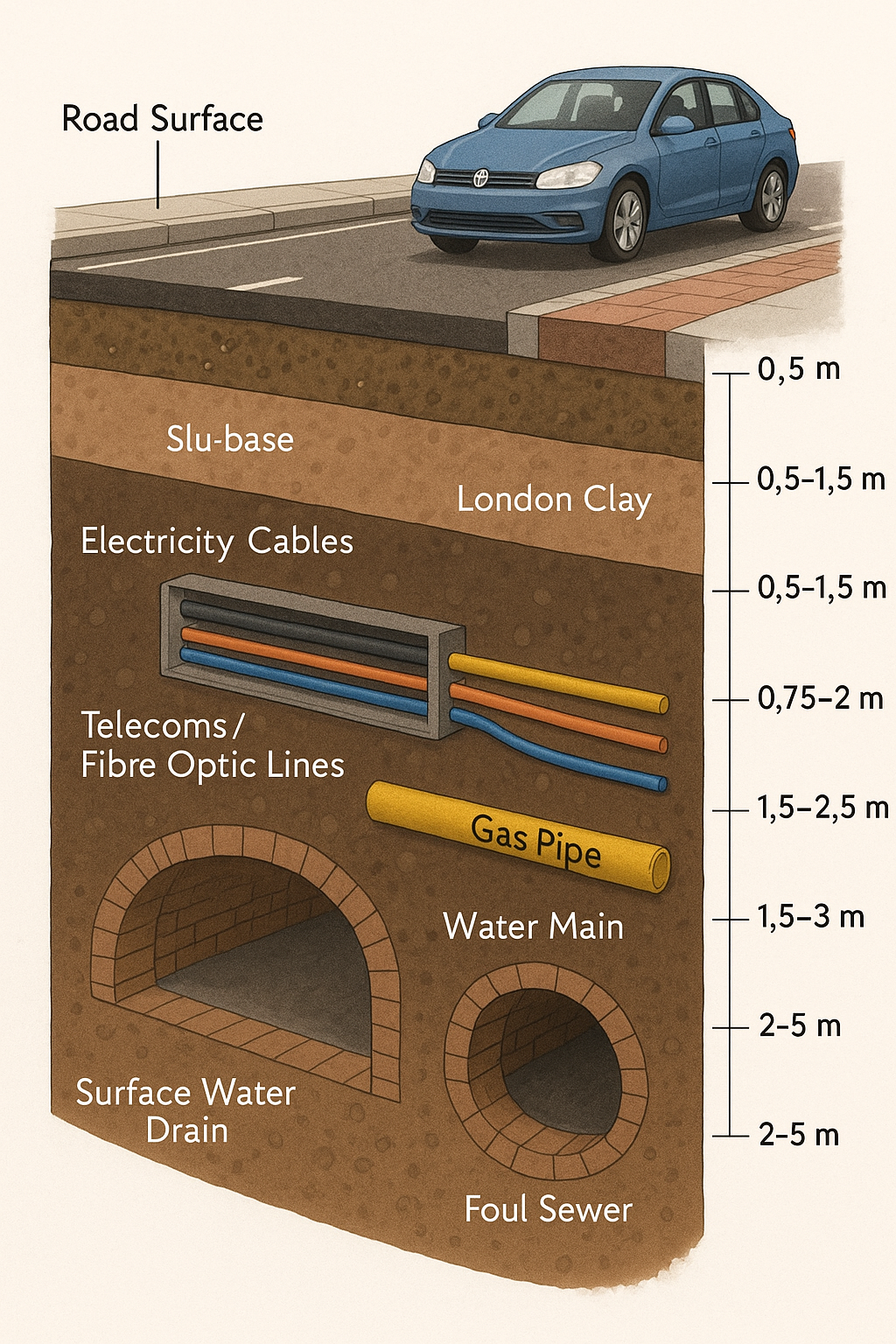
1. Road Surface and Sub-base (0–0.3m)
This is the topmost layer, the one we walk and drive on daily. It’s made up of asphalt (tarmac) and a crushed stone sub-base that helps distribute weight and provides structural integrity. Maintained by local councils, these layers are frequently resurfaced to repair potholes and wear from traffic.
2. Utility Lines: Electricity and Telecoms (0.3–1.5m)
Just beneath the surface lies a web of electricity cables and telecom/fibre optic lines, often housed in conduits. These are installed by utility companies like BT Openreach, Virgin Media, or UK Power Networks. Regular upgrades mean this layer is dynamic, adapting constantly to our growing digital and energy needs.
3. Gas Pipes (0.75–2m)
Gas infrastructure, typically made from yellow plastic or metal, delivers energy for heating and cooking. These pipes are managed by providers such as Cadent or SGN. Their depth helps protect against accidental damage from surface work.
4. Water Mains (1.5–3m)
Water mains, often the oldest parts of London’s infrastructure, supply clean water to homes and businesses. Thames Water oversees most of this system. Some mains still date back to the Victorian era—testaments to the durability of cast iron and early civil engineering.
5. Sewer Systems (2–5m)
London’s sewer network includes foul sewers (wastewater) and surface drains (rainwater), often large brick tunnels from the mid-1800s. Built under the guidance of Sir Joseph Bazalgette, this system saved the city from deadly cholera outbreaks and “The Great Stink” of 1858. Many of these tunnels are still in use today.
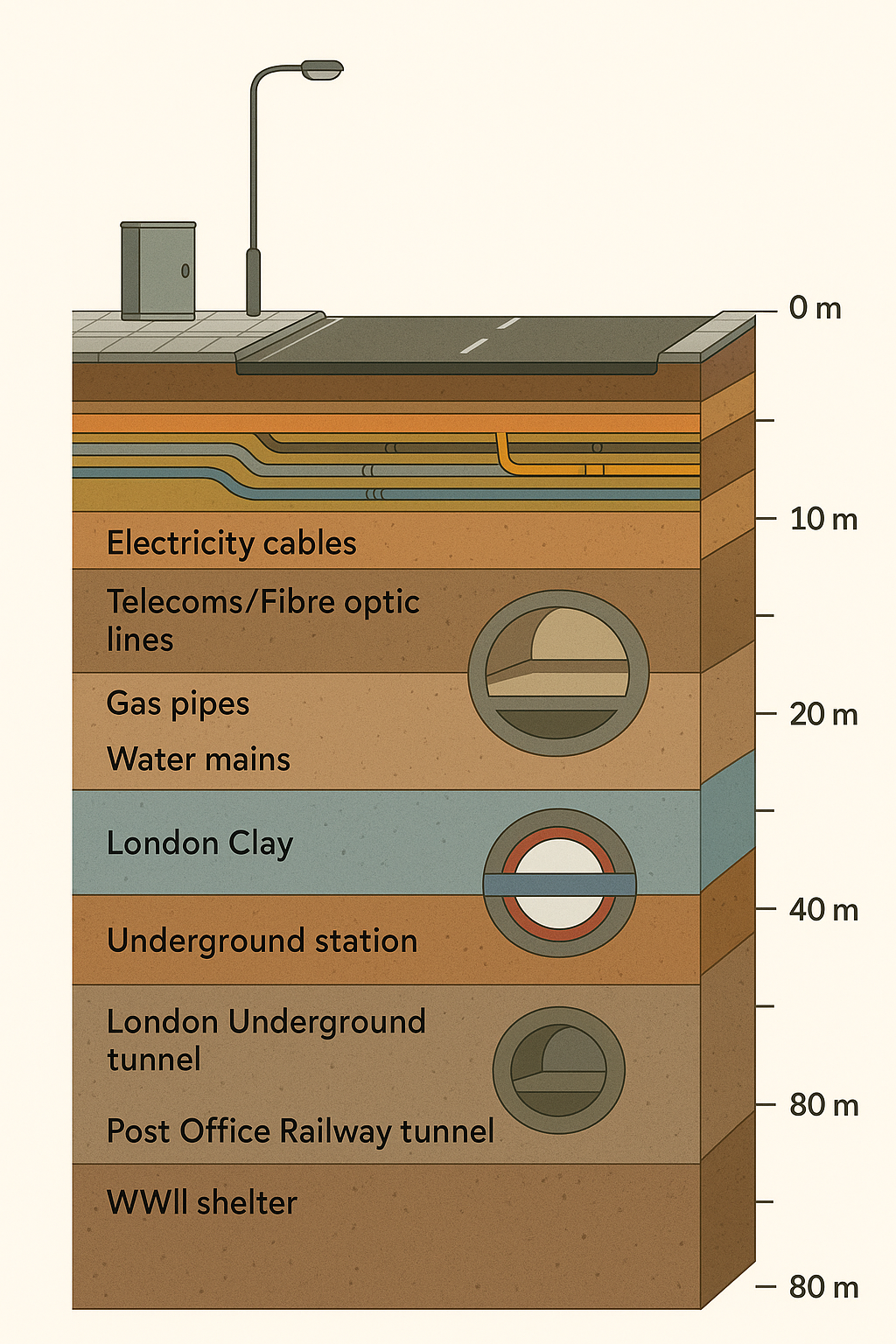
6. London Clay (varies ~4–40m)
Below the engineered layers lies London Clay, a dense, bluish sediment that’s perfect for tunneling. Its stability has enabled much of London’s deeper infrastructure, including Tube tunnels and bunkers. This natural geological layer has shaped how and where infrastructure can be safely placed.
7. Underground Stations (approx. 20–60m)
Deeper still are the London Underground stations. Subsurface stations (e.g., on the District line) are closer to the surface, while deep-level stations like Angel or Hampstead require long escalators or lifts to reach. Construction of these began in the late 19th and early 20th centuries, revolutionising city transport.
8. Tube Tunnels (20–40m)
Deep Tube lines such as the Northern and Piccadilly were created using tunnel boring machines, carving clean arcs through London Clay. These tunnels form a distinct ring in cross-section, and are reinforced with concrete or cast iron. They’ve been essential for commuting since the early 1900s.
9. Post Office Railway (aka Mail Rail, ~20m)
An often-forgotten relic, the Mail Rail was a driverless electric railway that shuttled post between sorting offices from 1927 to 2003. Now partially open as a museum, it runs even deeper than some Underground lines and offers a glimpse into the hidden logistics of old London.
10. WWII Bunkers and Shelters (40–80m)
During WWII, deep shelters were constructed as protection from aerial bombings. These included repurposed Tube stations and specially built chambers like the Clapham deep-level shelters. Some have since been used for secure storage, data centres, or even hydroponic farms.
Conclusion
Beneath the bustling streets of London lies a hidden, multilayered marvel of engineering and adaptation. Each level, from the surface to the deep clay, represents a chapter in the city’s history—of how it grew, coped, evolved, and prepared for the future. From the vital arteries of electricity and water to the silent corridors of the Tube and wartime bunkers, London’s subterranean infrastructure is a testament to human ingenuity. Next time you step onto a pavement, pause for a moment. Beneath your feet lies an entire hidden city.
On Slowness, Authenticity, and the Hidden Cost of Making Art in a Capitalist Age
I never thought I’d feel excluded from the very thing that once gave me a sense of freedom. But lately, I’ve come to realise that I am being priced out of my own creativity. Not because I lack the passion, or the ideas, or the skill — but because I can’t afford to keep up. In a world where speed, output, and polished presentation have become the currency of success, the slow, deliberate path of authentic creation begins to feel like a liability. It’s not that I envy others for having more — it’s that I’m haunted by the quiet truth that if I could afford their shortcuts, I’d take them too. And maybe then, I’d finally be heard.
The Outsourced Artist
In today’s creative landscape, outsourcing isn’t just accepted — it’s expected. Bands hire mixing engineers, mastering engineers, session musicians, graphic designers, videographers, social media managers, PR firms, playlist pluggers, and even ghostwriters. What once might have been a collaborative luxury is now a prerequisite for visibility.
The result? A strange duality: the artist becomes both the brand and the product, while the actual act of creation is often fragmented, delegated, monetized.
What happens to those of us who can’t afford to participate in this system — not just financially, but philosophically?
If your process is slower, more solitary, more sacred — you risk becoming invisible. It begins to feel as though the art you bleed over is less “real” because it lacks the polish, the reach, the momentum.
But polish is not proof of depth. And speed is not proof of soul.
The Pace of the Mind
For some of us, slow work isn’t a choice — it’s how we’re wired. As a neurodivergent creator, my process often unfolds at the rhythm of deep focus, scattered epiphanies, or energy that arrives in brief, unscheduled waves. I don’t have the bandwidth to be “on” all the time, nor the capacity to split myself between creating, promoting, polishing, and packaging — all while maintaining a public-facing presence.
There are days when just starting takes all my energy. Not because I don’t care — but because I care too much. The ideas are there, the vision is vivid, but the executive function required to carry it through feels like swimming in glue.
In a society that equates slowness with laziness, this reality becomes invisible. But slow art isn’t lazy — it’s often more conscious, more personal, more layered.
The problem isn’t my pace. It’s that the creative world is rigged for speed.
The Misinterpretation of Slowness
In the eyes of an algorithm-driven world, slowness is indistinguishable from absence. If you’re not releasing something, promoting something, performing something, or networking somewhere, you might as well not exist.
The labor you’re doing behind the scenes — the quiet crafting, the emotional processing, the struggle to bring a foggy idea into form — becomes invisible.
There is no metric for sitting with your feelings. No content calendar for trial-and-error. No viral moment for doing something the hard way just because it felt true.
The unspoken message is: If you were really good, it wouldn’t take this long.
But what if the time it takes is part of the art?
Between Autonomy and Assistance
I sometimes wonder what I might create if I had the means to outsource the tedious parts of production — the repetitive tasks, the non-creative polish, the technical finishing touches. And yes, I would do so in a heartbeat if I could. There is no virtue in burnout.
But there are aspects of my work that feel sacred. Decisions that need to be made by hand, not handed over. Not everything can be automated without losing something vital.
Even in areas where tools like AI are beginning to offer creative support, I tread cautiously. I welcome augmentation — a scaffolding to help me express what’s already inside me — but I resist the pull toward a fully packaged aesthetic I didn’t choose.
To maintain agency over your art in a world that rewards trend-following over truth… is to walk a narrower path.
Why I Still Create
And yet, I keep creating.
Not because the system rewards me, but because something in me refuses to stop. I create for the moments when the noise falls away and something raw and beautiful emerges from the mess. I create because it connects me to myself, and sometimes, to others who are quietly walking similar paths.
I don’t know if my work will ever be widely seen, heard, or recognised. But I know it is mine. Every rough edge. Every choice made without compromise. Every imperfect but honest thing I shaped with my own hands.
That has to count for something.
So this is for the others like me — the slow ones, the careful ones, the fiercely authentic ones.
You’re not invisible to me. I see you in the cracks, in the edges, in the long silences before the next release. And I believe what you make, when it finally arrives, will be worth the wait.
Infinity. A concept so deeply woven into our understanding of reality that we rarely stop to question it. We accept it as an inherent truth—an unspoken agreement that numbers go on forever, that time stretches infinitely forward, that there is always a ‘next.’
But what if that’s a lie?
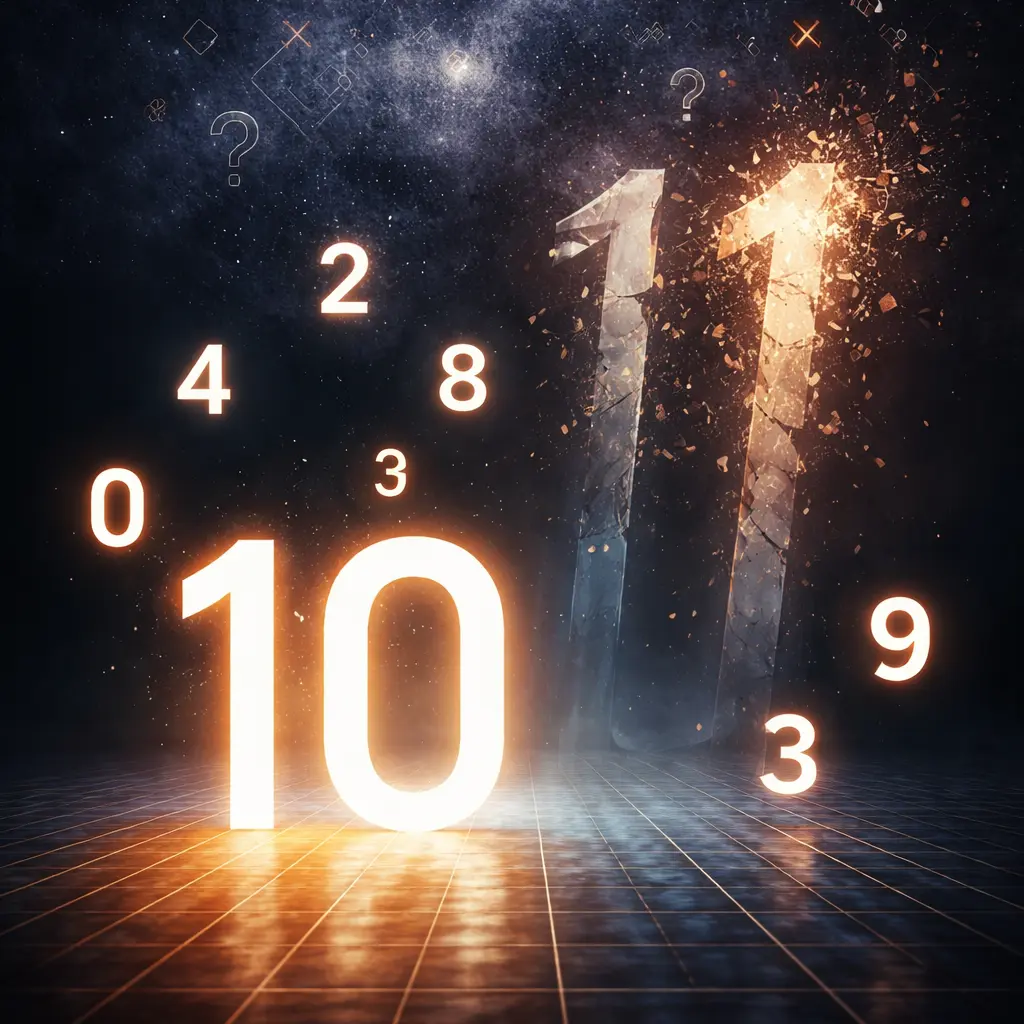
Let’s entertain a different reality. Let’s say numbers don’t go beyond ten. Ten is the ultimate boundary, the absolute limit. If you think you’ve counted twelve eggs in your carton, you’re mistaken. You’re counting wrong. Because eleven and twelve were never real to begin with.
Absurd? Maybe. But let’s look at the mechanics of how we perceive numbers. In a base ten system, we have ten digits—0 through 9. Once we hit ten, we ‘tick over’ to another column, and the cycle begins anew. The first column repeats, oblivious to the fact that a change has occurred in a higher dimension. Each cycle forces this change elsewhere, but within its own existence, nothing appears to be different. The numbers keep ticking by, unaware of the mechanism that allows them to continue.
What if that next column never actually existed? What if, at ten, the system simply stopped? Not paused. Not wrapped around. Just… stopped. If the ‘next’ number can’t exist, then what happens? Does everything collapse? Or does reality—like thought itself—transcend the limitation and unfold into something else?
That’s the real question. We assume infinity is real because we are terrified of the alternative. If there is an end, then everything we know is finite, including us. But our fear of that end might just be blinding us to something greater. The first column—the numbers, the cycles, the repetition—may be nothing more than the shadows on Plato’s cave wall. They do not know they are forcing something to change beyond themselves. But they are.
And that is transcendence.
The moment we recognize that we are not simply bound to the cycle—that we are causing shifts in dimensions we cannot yet perceive—we step beyond the illusion of infinity. The end isn’t a wall. It’s a threshold. And beyond it? A reality not governed by numbers, cycles, or our limited frameworks. A place where the very concept of ‘counting’ itself ceases to be relevant.
So I leave you with this: What happens when you hit the edge of the system? Do you crash into nothingness? Or do you step through into something you were never capable of imagining?
Perhaps the greatest mistake wasn’t assuming that infinity exists. Perhaps the mistake was believing that we were ever inside the system to begin with.
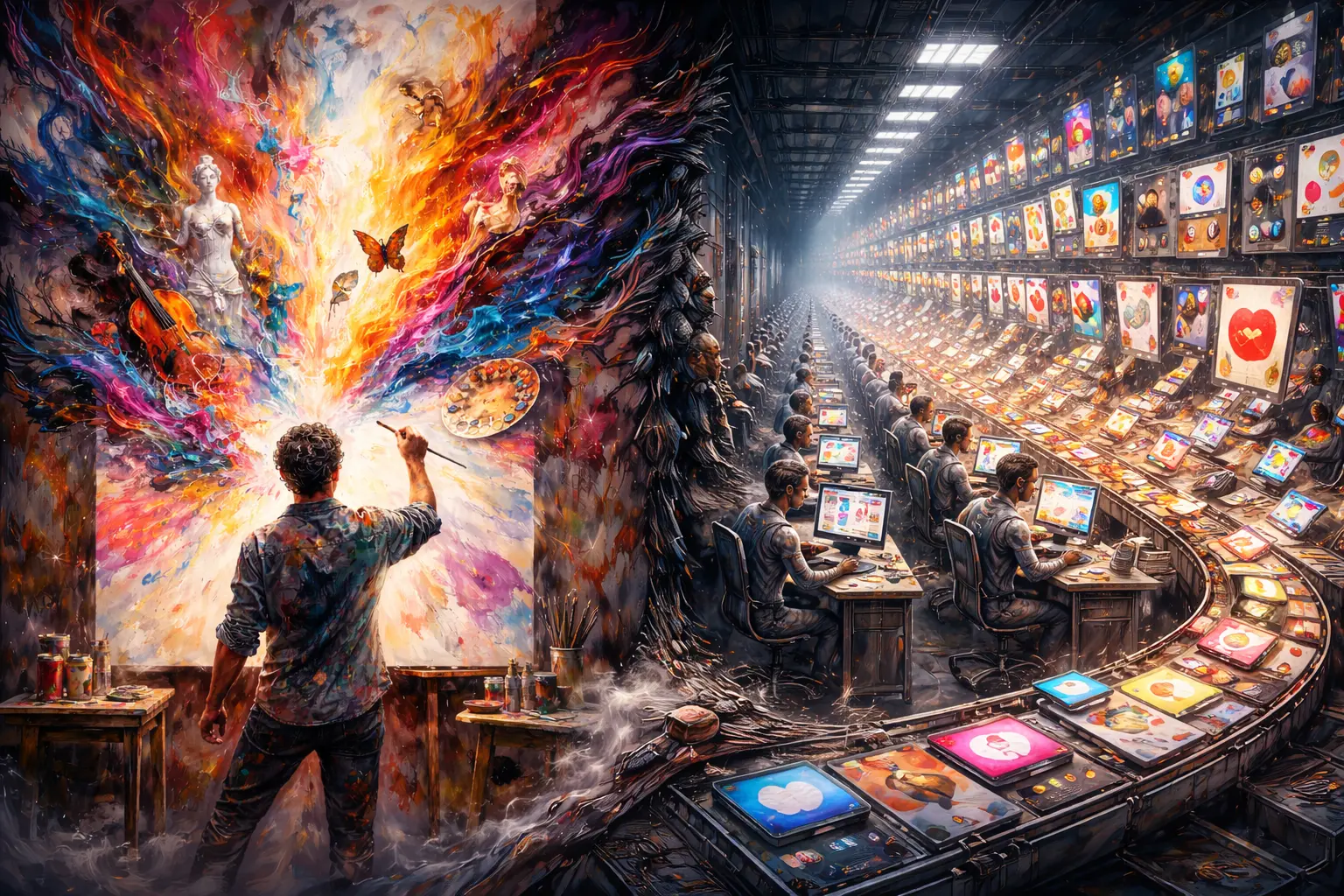
The digital age has led us to a curious intersection, where the word “content” has become ubiquitous, and “art” seems to be slipping from its once-sacred pedestal. What once required time, effort, and intention to create is now often reduced to an endless churn of quick consumption, reduced to mere “content” for the masses to engage with. This shift is something I can’t help but observe with both concern and reflection.
For someone like myself—constantly battling the tension between personal identity, society, and the existential weight of existence—the current state of art feels almost like an existential crisis of its own. The act of creation, for me, is personal, deliberate, and reflective. It is an attempt to make sense of the world, to carve out meaning, and to leave something behind that resonates beyond the confines of time. But in the age of digital platforms, this sacred act of creation feels increasingly commodified.
The idea of “content” has become a business-driven term, designed for quick consumption, for likes, shares, and engagement metrics. Art, which once demanded patience from both creator and audience, is now expected to be produced in rapid bursts, optimized for algorithms that care little for the soul of the work. There is a certain detachment from the deeper, existential elements of art that once grounded it in something profound.
In my own life, I’ve had to reconcile the desire for meaning with the reality of a society that often demands conformity. Much like the societal pressures I’ve felt to “fit in” (as outlined in my exploration of identity and alienation), there’s a parallel pressure in the artistic world to conform to the “rules” of content creation. The faster you can churn out pieces, the more successful you are—regardless of the depth or intent behind them. Where once I might have taken months to perfect a story or reflect deeply on its implications, I find myself asking, “How quickly can I produce something that will generate engagement?”
I see this in the realm of social media, where content is consumed at an alarming rate, often with little regard for its longevity or its ability to stand the test of time. It’s all about what captures the attention in the moment, what creates the immediate buzz, and then it’s discarded, replaced by the next viral moment. This constant churn of “content” feels like a reflection of the broader existential struggle I often muse about—one where we’re caught in a cycle, never really allowing ourselves to linger in one thought, one creation, long enough to find its true meaning.
And yet, this transformation isn’t without its value. Like many things in life, it’s a balance. Content, in its own right, can be meaningful. It can still carry depth, insight, and intention, but it’s often hidden behind the facade of quick consumption. The challenge, then, is not to fall into the trap of creating merely for the sake of producing but rather to carve out space within this content-driven world for true artistic expression.
It’s easy to be seduced by the quick dopamine hits of social media validation, but I find myself wondering, what happens when the art we produce is merely optimized for engagement, not introspection? What happens when the deeper, slower aspects of art are lost to the rush of “content”?
It’s a complex landscape—one that I continue to navigate. My journey of self-acceptance and understanding (which I’ve shared before in reflections like The Outsider) has always been about carving my own path, about finding meaning in a world that often seems to demand conformity. And in this moment, it’s about resisting the pressure to reduce my creative endeavors to mere content. Art, for me, will always be a process of deep engagement, introspection, and meaning. And I have to hold onto that, even as the world pushes toward something faster, more superficial.
I’ll continue to create with intention, even if it means standing outside the prevailing norms. Just as I’ve come to accept that I don’t fit in with the mainstream society, so too do I embrace the idea that my art—whatever it may be—doesn’t have to conform to the demands of the “content machine.”
After all, the true value of art, the meaningful kind, isn’t something that can be measured in likes or shares. It’s something that resides in the depths of the human experience, something that will persist long after the noise of the digital world has faded away.
So, to those who create for the sake of creating, for the sake of self-expression, and for the sake of finding meaning in this chaotic existence, I say: Don’t let your work be reduced to mere “content.” Let it be art.