AI Isn’t the Problem—Capitalism Is: Who Benefits From Automation?

In recent years, the rise of artificial intelligence has stirred public anxiety, particularly around the idea that AI is here to “steal jobs.” On the surface, it’s a fair concern. But when you scratch a little deeper, you find the real problem isn’t the technology itself—it’s the system we’re embedding it into. The outrage should not be directed at the tool, but at the hands that hold it.


The Original Deal of Civilization

Civilization began as a shared survival strategy. Tasks needed to be done—farming, building, teaching, healing—and so societies developed systems of trade and compensation to ensure everyone chipped in. Money evolved as a practical tool to coordinate contribution and reward. Work and currency were born out of necessity: to keep the machine of civilization running.

But that necessity is evolving.


The Promise of AI: A Future with Less Toil

We now possess tools that can perform many of the repetitive, tedious, and cognitively exhausting tasks that humans have had to endure for centuries. AI can analyze vast datasets, answer customer queries, optimize supply chains, and even compose music or assist with design.

These developments should be good news. They should signal the dawn of a more liberated era—one where humans are freed from survival labor and can pursue creativity, care, curiosity, and rest.

But that future is not unfolding.


So Why Isn’t It Happening?

If machines can do the work, why aren’t we seeing shorter workweeks, universal basic income, or enhanced quality of life?

The answer is simple: because the rewards of automation aren’t being shared. They’re being hoarded.

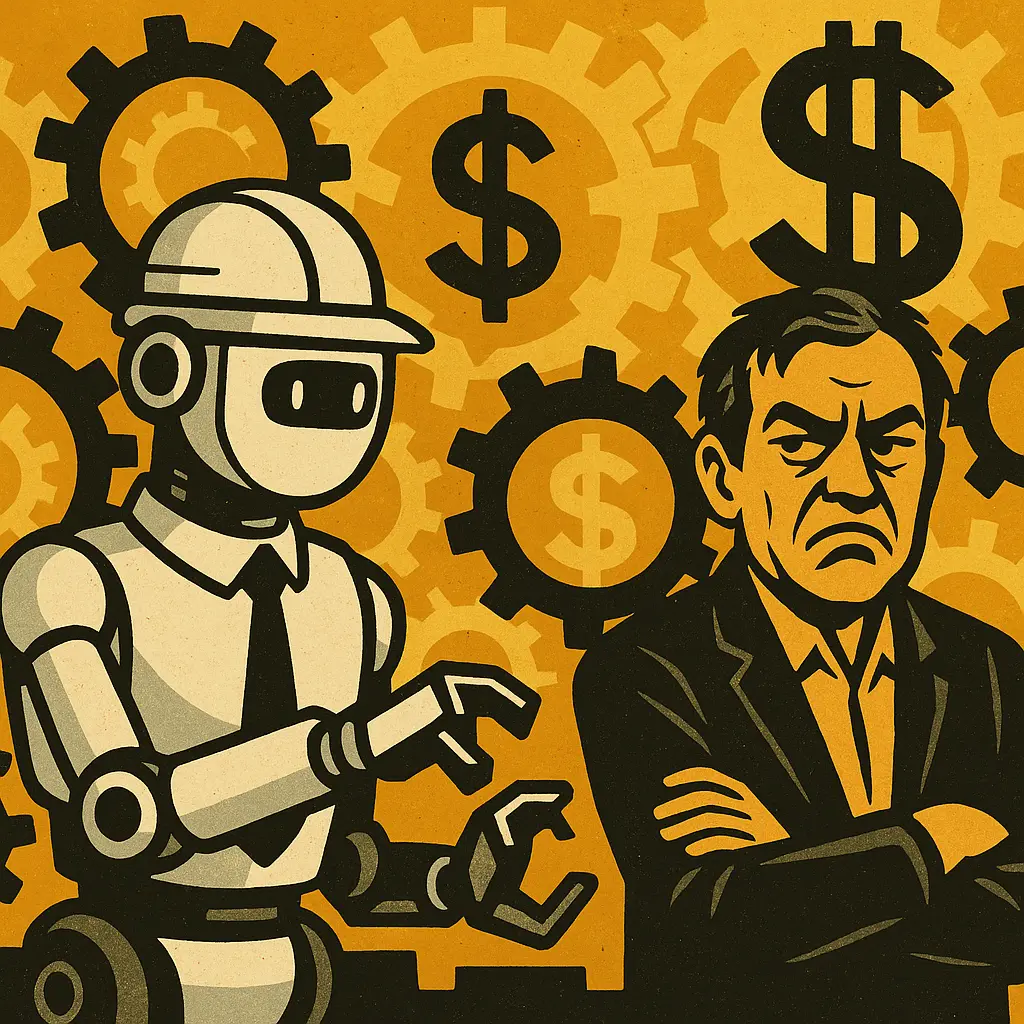
In our current economic system, productivity gains don’t translate into shared prosperity. They become profit margins for a small minority. Workers don’t get more time off; they get laid off. Freed labor doesn’t result in more freedom—it results in more precarity.

AI isn’t stealing jobs. Corporations are.


The System is the Saboteur

We fear AI because we know, intuitively, that our survival is still tethered to our economic usefulness. If we can be replaced, we can be discarded.

But that only holds true in a system where value is measured in profit. If we restructured society to measure value in human well-being, automation would be a gift.

Imagine if AI were treated as a public good, developed and deployed in service of everyone. Imagine if its productivity gains funded universal healthcare, education, and guaranteed income.

We have the power to design systems where technology lifts everyone, not just the elite.


The Fork in the Road

We’re standing at a pivotal crossroads. One path leads to further concentration of wealth and social instability, as technology accelerates inequality. The other leads to an age of collective liberation, where humans are free to live, grow, and contribute on their own terms.

We must stop asking whether AI will take our jobs. We must start asking why the survival of human beings is still conditional on having one.

Because the truth is: AI didn’t create the problem. It only revealed it.


The future of work isn’t about jobs. It’s about justice.
Wealth as Blood Clot: The Real Parasites of Society

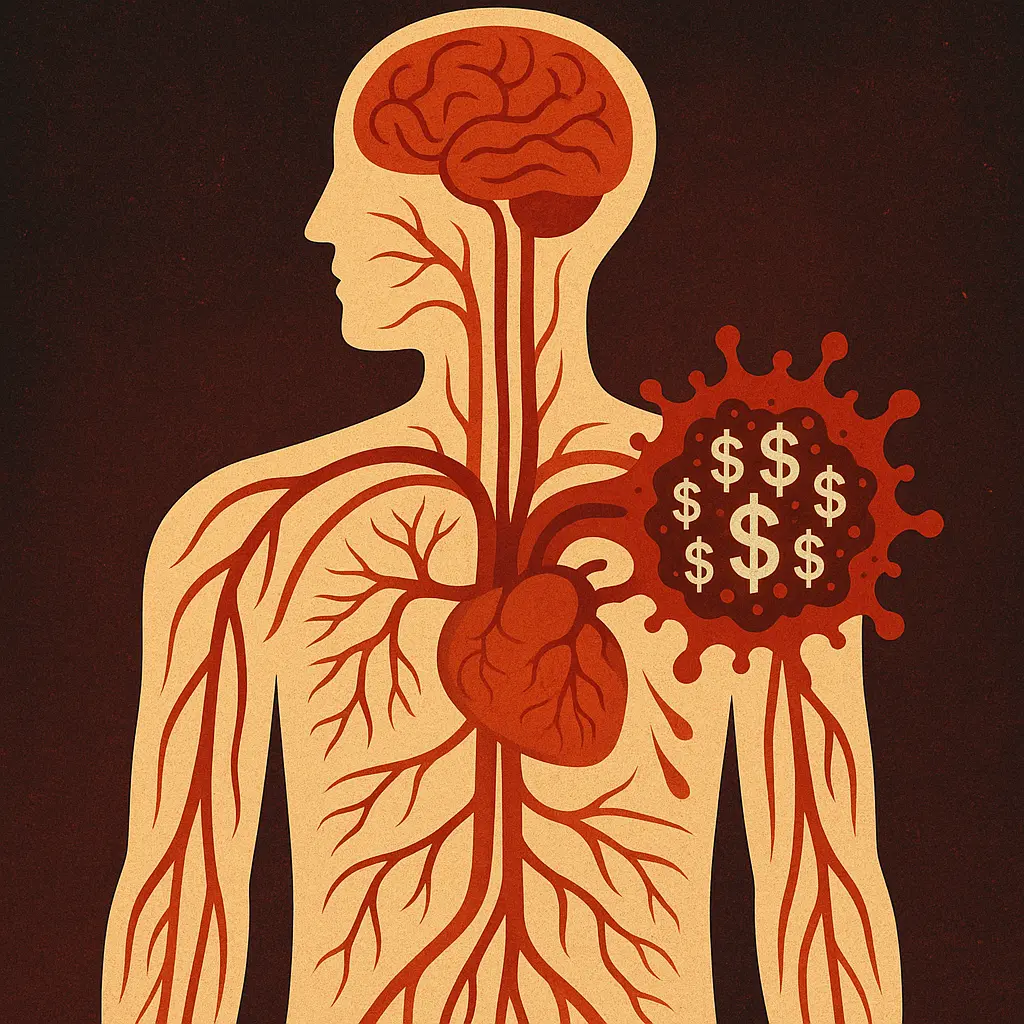
Money is more than currency. It’s the lifeblood of society—an abstract representation of energy, value, labor, and potential. It flows (or should flow) through the social body, facilitating action, growth, and survival. Every job done, every meal eaten, every home lived in is ultimately mediated by this symbolic fluid. It moves resources, motivates behavior, and governs who lives comfortably and who suffers.

But like blood, money can clot. And when it does, it becomes dangerous.

The accumulation of wealth—especially in massive, unspendable quantities—acts not as a facilitator of society, but as a blockage. Rather than circulating where it’s needed, wealth becomes trapped in symbolic reservoirs: offshore accounts, luxury assets, and inflated portfolios. It stops serving its organic function and instead becomes a self-sustaining monument to individual power.

This hoarding of potential is rarely about need. Nobody requires a billion dollars to live. The purpose of this accumulation is more psychological than practical—it’s a fortress, a deterrent, a cold war stockpile of “just in case” power. A performance of untouchability. A message to the rest of the world: Don’t challenge me. I can crush you. In this sense, hyper-wealth acts like nuclear armament—more a threat than a tool.

We have entered an era where individuals possess wealth that rivals the GDP of nations. And with this imbalance comes risk—not only to economies, but to democracy itself. One person’s whim can now shape public discourse, influence elections, or destabilize entire regions. We are no longer at risk of dictatorships from governments alone. We now face the specter of global dictatorship by wealth.

Meanwhile, society’s most vulnerable are accused of being the drain. The “benefit scroungers.” The disabled. The jobless. The marginalized. They are framed as parasites, leeching off the hard-working majority.

But that narrative is upside down.

Those struggling to survive are not hoarding. They are not stockpiling resources they’ll never use. They are not distorting the flow of society’s lifeblood. If anything, they are the ones most in need of that flow reaching them.

The real parasites are the ones who do hoard. The ones who sit atop mountains of untouched capital while the host organism—society—grows weak. Parasites don’t bleed the system by asking for enough to live; they bleed it by taking far more than they need and giving nothing back.

If we are to examine parasitism honestly, we must look to the organs that no longer circulate resources. The hoarders of lifeblood. The blood clots. The tumors.

A healthy organism distributes. It balances. It adapts to the needs of its parts.

We are not that organism.

Until we challenge the sanctity of accumulation, we will remain a sick society—mistaking our cancers for crowns, and punishing the wounded for bleeding.

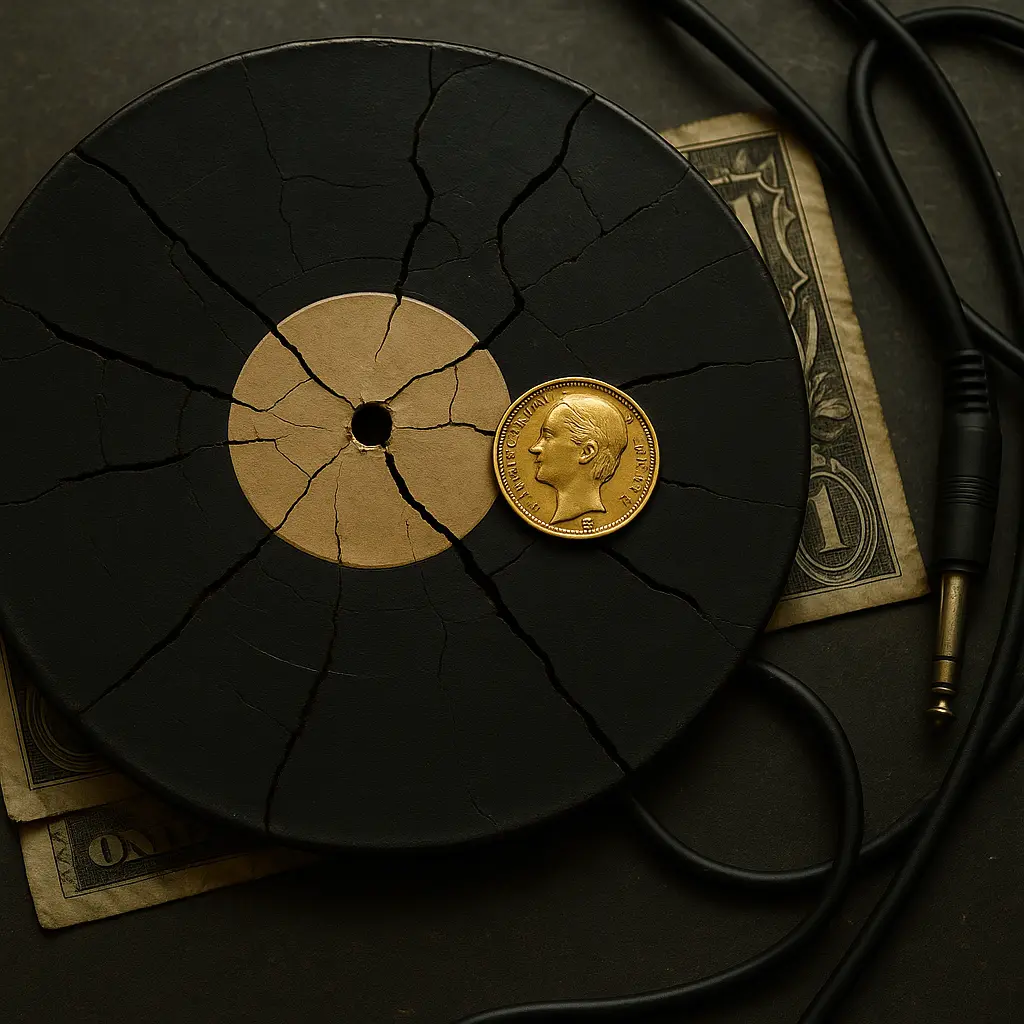
Priced Out of My Own Creativity

On Slowness, Authenticity, and the Hidden Cost of Making Art in a Capitalist Age

I never thought I’d feel excluded from the very thing that once gave me a sense of freedom. But lately, I’ve come to realise that I am being priced out of my own creativity. Not because I lack the passion, or the ideas, or the skill — but because I can’t afford to keep up. In a world where speed, output, and polished presentation have become the currency of success, the slow, deliberate path of authentic creation begins to feel like a liability. It’s not that I envy others for having more — it’s that I’m haunted by the quiet truth that if I could afford their shortcuts, I’d take them too. And maybe then, I’d finally be heard.


The Outsourced Artist

In today’s creative landscape, outsourcing isn’t just accepted — it’s expected. Bands hire mixing engineers, mastering engineers, session musicians, graphic designers, videographers, social media managers, PR firms, playlist pluggers, and even ghostwriters. What once might have been a collaborative luxury is now a prerequisite for visibility.

The result? A strange duality: the artist becomes both the brand and the product, while the actual act of creation is often fragmented, delegated, monetized.

What happens to those of us who can’t afford to participate in this system — not just financially, but philosophically?

If your process is slower, more solitary, more sacred — you risk becoming invisible. It begins to feel as though the art you bleed over is less “real” because it lacks the polish, the reach, the momentum.

But polish is not proof of depth. And speed is not proof of soul.


The Pace of the Mind

For some of us, slow work isn’t a choice — it’s how we’re wired. As a neurodivergent creator, my process often unfolds at the rhythm of deep focus, scattered epiphanies, or energy that arrives in brief, unscheduled waves. I don’t have the bandwidth to be “on” all the time, nor the capacity to split myself between creating, promoting, polishing, and packaging — all while maintaining a public-facing presence.

There are days when just starting takes all my energy. Not because I don’t care — but because I care too much. The ideas are there, the vision is vivid, but the executive function required to carry it through feels like swimming in glue.

In a society that equates slowness with laziness, this reality becomes invisible. But slow art isn’t lazy — it’s often more conscious, more personal, more layered.

The problem isn’t my pace. It’s that the creative world is rigged for speed.


The Misinterpretation of Slowness

In the eyes of an algorithm-driven world, slowness is indistinguishable from absence. If you’re not releasing something, promoting something, performing something, or networking somewhere, you might as well not exist.

The labor you’re doing behind the scenes — the quiet crafting, the emotional processing, the struggle to bring a foggy idea into form — becomes invisible.

There is no metric for sitting with your feelings.
No content calendar for trial-and-error.
No viral moment for doing something the hard way just because it felt true.

The unspoken message is: If you were really good, it wouldn’t take this long.

But what if the time it takes is part of the art?


Between Autonomy and Assistance

I sometimes wonder what I might create if I had the means to outsource the tedious parts of production — the repetitive tasks, the non-creative polish, the technical finishing touches. And yes, I would do so in a heartbeat if I could. There is no virtue in burnout.

But there are aspects of my work that feel sacred.
Decisions that need to be made by hand, not handed over.
Not everything can be automated without losing something vital.

Even in areas where tools like AI are beginning to offer creative support, I tread cautiously. I welcome augmentation — a scaffolding to help me express what’s already inside me — but I resist the pull toward a fully packaged aesthetic I didn’t choose.

To maintain agency over your art in a world that rewards trend-following over truth… is to walk a narrower path.


Why I Still Create

And yet, I keep creating.

Not because the system rewards me, but because something in me refuses to stop.
I create for the moments when the noise falls away and something raw and beautiful emerges from the mess.
I create because it connects me to myself, and sometimes, to others who are quietly walking similar paths.

I don’t know if my work will ever be widely seen, heard, or recognised. But I know it is mine. Every rough edge. Every choice made without compromise. Every imperfect but honest thing I shaped with my own hands.

That has to count for something.

So this is for the others like me — the slow ones, the careful ones, the fiercely authentic ones.

You’re not invisible to me.
I see you in the cracks, in the edges, in the long silences before the next release.
And I believe what you make, when it finally arrives, will be worth the wait.