About Alice: Respect, Boundaries and Love

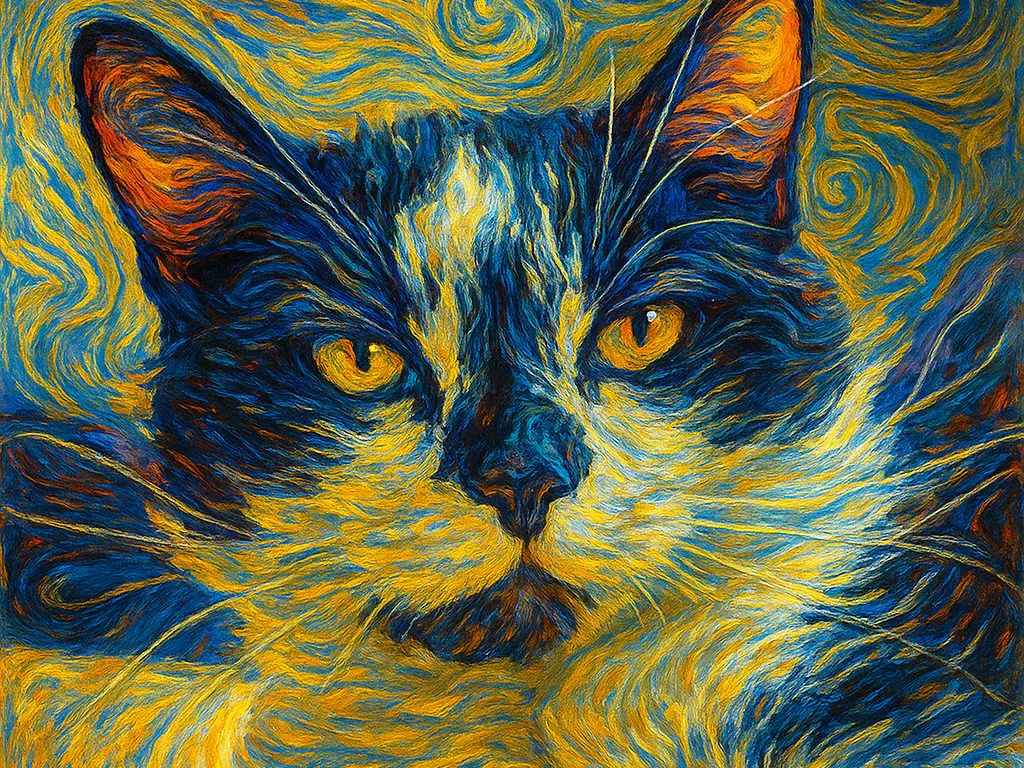
A digital painting of a black-and-white cat with golden-yellow eyes, portrayed in a swirling abstract expressionist style. Bold brushstrokes in blue, orange, and yellow surround the cat’s face, giving the impression of energy and sensitivity.

Alice is a very unique and special cat (I know, aren’t they all!?)

I’ve had her since she was a kitten, and together we’ve developed a beautiful and profound bond over the years. I’ve raised her according to my own values, not the conventional norms of “pet ownership.”

The most important part of that is simple: I treat her with as much respect as I would any other soul I choose to share companionship with. I don’t see her as something I own, nor as a being with lesser standing than a human. Yes, I’m her guardian, and that does mean some restrictions, but within that I give her as much freedom as I can to be herself and express herself. That freedom sometimes comes at a sacrifice to me, but it’s worth it. Out of that, Alice and I have developed our own language based on mutual respect. I can communicate with her more deeply than I can with most humans.

So why add to the billion cat-appreciation posts already out there? Because this one isn’t just about Alice being cute. It is about Alice being misunderstood, and what she can teach us about respect.


Respect and authenticity

As an autistic person, I know what it’s like to “mask” in social situations, to act in ways I don’t fundamentally agree with, just to be accepted. Even when I mask well, one person always knows I’m being insincere: me. Alice has no patience for that kind of insincerity. She is acutely sensitive to her surroundings, to tone, to the subtle emotional energy in a room. She picks up on things you may not even know you’re communicating. She knows when you mean it. Respect cannot be faked with her.


The outsider dynamic

I don’t have guests often. Being autistic, I deeply value the sanctity of home, and so does Alice. This is our shared space, a place we live in together as flatmates, with our own rituals and our own way of being. When guests arrive, the disruption is real. For me, home becomes a place of obligation instead of relaxation. For Alice, the disruption is magnified: strangers have invaded her safe space, and she has no way to understand their intentions or how long they’ll stay.

Here’s where perspective clashes:

  • Guest’s view: This is Angel’s house. I’m visiting Angel, who happens to have a cat.
  • Our view: This is Alice and Angel’s home. We live here together. You are entering our space.

That difference explains a lot of what happens next.


The scenario

I usually give a polite warning: “Alice is very sensitive to strangers in her space, so it’s probably best not to pet her. She can be very social, but it takes her a long time to trust.” Guests nod. They say they understand.

Then Alice comes in. She’s cautious but curious. She wants to investigate the new presence in her home. She sniffs, observes, tests the air. To her, this is boundary-setting. To the guest, it looks like friendliness. They think, Angel was just making a fuss over nothing, and they reach out a hand.

Swipe. Blood. Antiseptic cream. Plaster.

And instead of the takeaway being, “Oh, Angel was right, I ignored the boundary,” it becomes, “That cat is aggressive. Alice is violent. Alice is evil.” The social taboo of “I told you so” means the truth gets buried, and Alice is left with an undeserved reputation.


Framing behaviour through the human lens

Humans often interpret animal behaviour through their own perspective. When Alice sniffs a guest, they assume it is a friendly greeting rather than curiosity. When she swipes after being touched without consent, they see aggression or hate, because that is how violence is framed in human society. But Alice isn’t hateful. She is simply saying no in the most universal language available: pain.

For animals, a scratch isn’t malice but communication, a last resort when boundaries are ignored. Alice has even scratched me in the past when I’ve misread her signals. Moments later, she’s back to cuddling, showing that the act wasn’t rooted in hate but in clarity. And she rarely scratches me now, not because I’m her favourite, but because I recognize her boundaries. And those boundaries are reasonable ones. If you tried to stroke a stranger on the street without invitation, no one would be surprised if they reacted with violence. So why hold Alice to a different standard?


The truth of Alice

Those who only meet Alice as an intruder in her home see a cat defending her boundaries. Those who live with her, who respect her, see something else entirely: a cat who is deeply loving, gentle, and sensitive. She curls up in warmth. She purrs with trust. She communicates with a language that goes far beyond words. Her so-called “hostility” isn’t malice. It is agency. It is the same right every living being has: the right to say no.


Takeaway

Alice teaches me every day that respect isn’t a performance, and it isn’t conditional. It is about acknowledging the other as a being with their own will. If you treat her like an object for your comfort, you’ll clash with her boundaries. If you meet her as an equal soul, she will show you a love deeper than you imagined a cat could give.

And maybe that is the broader lesson here. Whether it’s with animals or with humans, blanket labels such as “aggressive”, “difficult”, or “evil” do not invite nuance into the equation and often say more about the failure to understand context and behaviour than they do about the one being judged.
I’m Tired of Being Tired

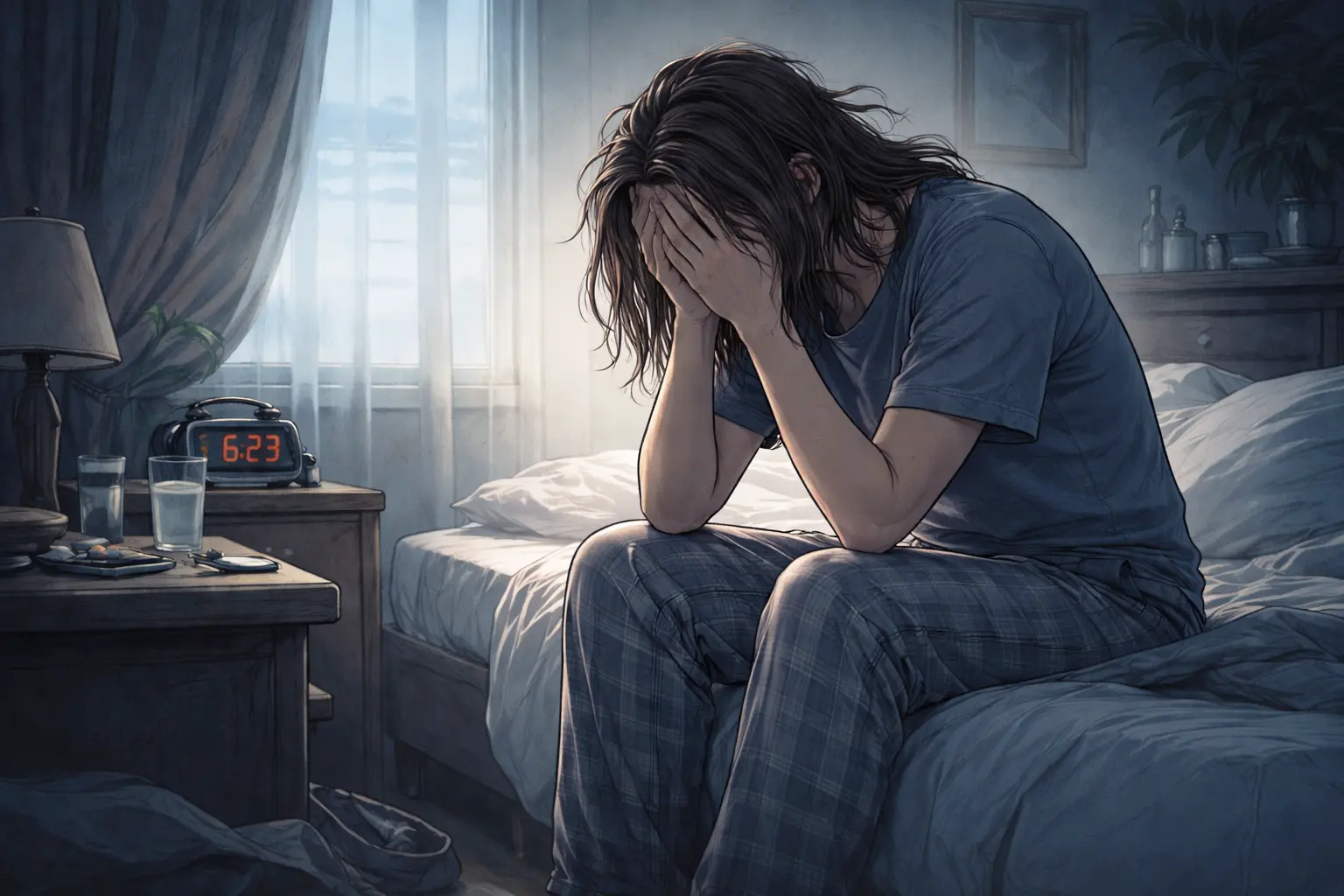
Illustration of a long-haired man sitting on the edge of an unmade bed, leaning forward with his face covered by his hands in a dimly lit bedroom at dawn.

One morning last month, I woke up foggy-headed, sleep-deprived, and emotionally worn out before the day had even started. I felt like I was coming down with the flu: achy, heavy, slow. I just wanted to cancel a dentist appointment, but even that became a drawn-out ordeal of waiting for phone lines to open, phoning, queueing, and managing social expectations. And when I finally got through, I was told that I should give more notice next time. That one short sentence landed like a weight. Not because it was rude, but because it reminded me that in this world, even exhaustion must be scheduled politely.

But this wasn’t about a dentist appointment. It never is. This was about everything.

I was tired of being tired.

Not sleepy tired. Not lazy tired. I’m talking about the deep, ambient fatigue of living in a world that constantly asks more of you than you have to give, then punishes you for not delivering. A world where empathy is rationed, where the illusion of stability depends on the silence of those who are struggling, and where rest is treated like an indulgence rather than a human need.

Housing insecurity. Chronic health issues. Endless bureaucracy. The guilt of receiving welfare benefits. The pressure to perform gratitude while navigating systems that barely see you as human. I carry these weights quietly most days, but some days they all speak at once.

And then comes the guilt for even feeling it. The voice that says: “Others have it worse. Be thankful. Don’t complain.” But that voice is part of the problem. It doesn’t come from compassion. It comes from conditioning. From a culture that sees resilience as moral currency and suffering as a contest.

But I am not in competition with anyone. I am simply tired.

I don’t want pity. I want space. I want systems that don’t require people to collapse in order to be heard. I want fewer apologies for being overwhelmed. I want to live in a world that doesn’t confuse survival with success.

So yes, I cancelled a dentist appointment that day. I did it politely. I even felt bad about it.

But what I really want to cancel is the idea that my exhaustion is a personal failing. It isn’t.

It’s my body, my mind, my soul, telling me to recuperate.

And I’m not the only one hearing that message.

10,000 Hours of Compliance: How Mastery Can Be Weaponised Against You

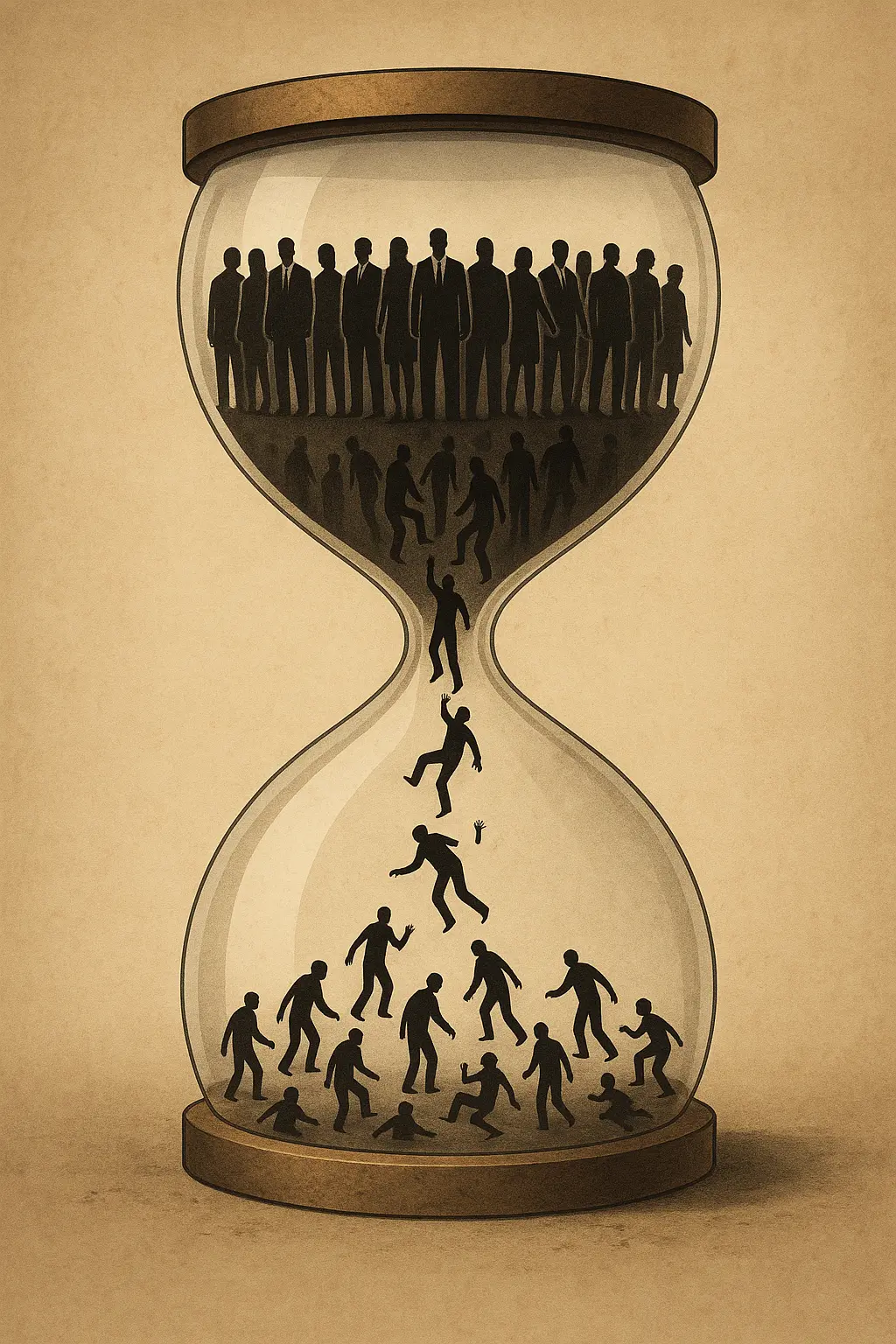
A large hourglass filled with faceless black silhouettes in business attire. The figures in the top bulb stand crowded together, gradually falling through the narrow middle where some tumble and others struggle to climb back up. In the lower bulb, fallen figures scatter across the ground, some standing, some collapsed. The background is warm beige, evoking aged paper, giving the image a symbolic and somber tone.

We have all heard the popular idea that it takes 10,000 hours of practice to master a skill. Play your guitar for that long and you will be a virtuoso. Paint for that long and you will know the brush like your own fingers. Write for that long and you will dance fluently with language.

Here is the uncomfortable question that is rarely asked in motivational seminars:
What if you have been putting in your hours, but into becoming something you never intended to be?


The Brain Does Not Care What You Practice

Your brain is a pattern-making machine that rewards repetition. It does not stop to ask whether the habit you are building is good for you, whether it aligns with your values, or whether it is slowly strangling your spirit.

If you have spent years submitting to systems, you are not just surviving. You are learning to submit. You are becoming fluent in self-silencing, pleasing authority, and clock-watching.

This is why “I have been doing this for years” is not always a badge of honour. Sometimes it means you have spent years perfecting a cage.


Work as a Covert Training Ground

The workplace can be a breeding ground for this kind of unintentional mastery. A dead-end job does not only give you a payslip. It gives you muscle memory for compliance.

You get good at the customer service smile.
You get good at keeping your head down when things are not right.
You get good at swallowing the words you actually want to say.

Clocking in and zoning out is not neutral. It is conditioning. It is training you to keep existing inside a box, even when the lid is wide open.


When Mastery Becomes Entrapment

There is a cruel irony in becoming excellent at something you never wanted in the first place.

“They say I am great at my job,” you tell yourself. But is it a job you truly chose? Or is it a job you got trapped in because you became too good at surviving it?

Once you have invested thousands of hours into a coping strategy, it can become harder to leave it behind. You have built identity around it. You have mastered the art of endurance in a place that does not deserve your loyalty.


The Sword Cuts Both Ways

Mastery is not inherently good. It is simply focus repeated over time. The sword cuts both ways.

You can become a master of freedom, creativity, and self-direction.
You can also become a master of obedience, self-erasure, and learned helplessness.

You are always becoming something. The question is: is it something you would choose?


Redemption Through Repatterning

The good news is that mastery can be rewired. Every skill you have mastered in the service of survival can be repurposed for something better.

The adaptability you learned under pressure can fuel your creativity.
The patience you built in monotonous routines can become the discipline that drives your art.
The diplomacy you honed with unreasonable bosses can become a superpower for navigating your own projects and relationships.

Awareness is the first cut that breaks the loop.
From that moment, every hour you spend becomes an act of reclamation.


Do not just chase mastery.
Ask yourself, mastery of what?
And in service of whom?

Your 10,000 hours are precious. Spend them like they matter.

The Game, the Canvas, and the Things We Must Not See

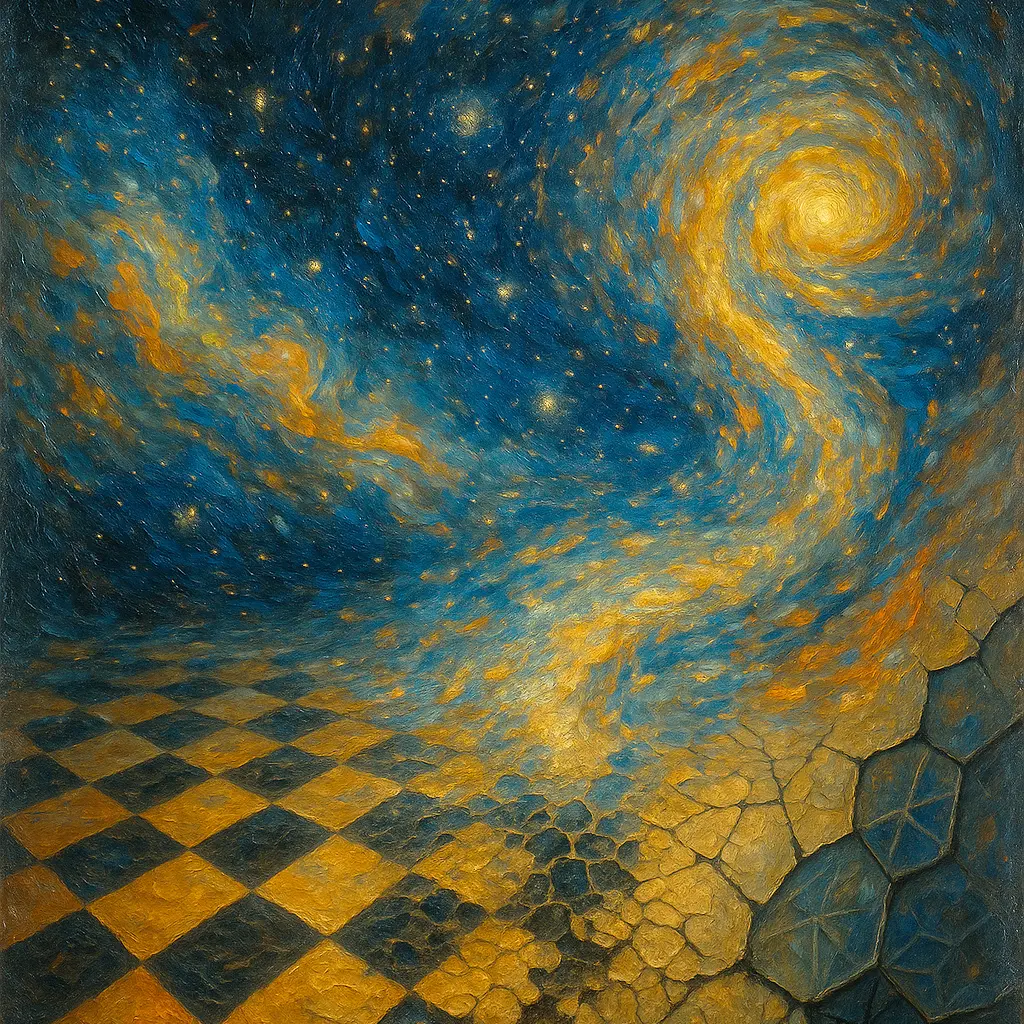
A surreal oil painting of a cosmic chessboard dissolving into a swirling galaxy. The squares crack and fragment into geometric shapes, revealing hidden patterns beneath. The deep blues, golds, and oranges create a dreamlike blend of universe and game, as if reality itself is peeling away to expose impossible dimensions.

For most of human history, chess was a game of intelligence, strategy, and forward thinking. The greatest minds could clash for hours, each move a leap into the fog of the unknown.

But in the hands of a perfect player, perhaps a super advanced AI with a complete knowledge of every possible outcome, chess collapses. It’s no longer a battle of minds, it’s a solved puzzle. The winner is written in stone before the first piece moves.

Now imagine this: the universe itself is just a bigger chessboard. Every atom, every thought, every love and loss is just a piece moving according to fixed rules. And somewhere above it all, an intelligence exists, not merely smarter than us, but so far beyond that it sees the entire game tree at once.

To it, there is no “present moment.” Every past, present, and future is frozen into a single, completed mosaic. Wars, revolutions, discoveries, heartbreaks, all already there as inevitable as the checkmate in a solved opening.

But here’s where the horror deepens: such a being wouldn’t have to play the game. It could edit the board.
Not by killing in the human sense, but by pruning timelines so surgically that your branch simply… never existed. No one would notice. Not even you.

And it wouldn’t do this out of malice. Or mercy.
It would do it the way an artist adjusts a painting. Removing a brushstroke here, adding a shadow there. Not to change the story, but to improve the composition.

Because maybe we’re not a game at all.
Maybe we’re art.

The imperfections, the contradictions, the tragedies, the unsolved mysteries, aren’t flaws to be fixed. They are the texture, the grain, the raw edge that makes the whole thing worth looking at. A perfect game is sterile. Art thrives on tension, ambiguity, and imbalance.

Our wars are smears of crimson.
Our kindnesses are glints of gold leaf.
Our mistakes are cracks in the glaze that make the pot unique.

And sometimes, you catch yourself wondering: Is this tea I’m making part of the painting?

It’s like standing between two mirrors, watching reflections of reflections spill away into infinity. You’re the painted figure in the scene, and the viewer, and the brushstroke noticing itself all at once.

But there’s something else… something worse!
What if the painting is stretched across dimensions we cannot see, because if we did, the whole thing would collapse?

Maybe the only reason our reality still exists is that no one has looked directly at them. Not because it’s impossible, but because it’s improbable, like trying to see your own blind spot.

And if one mind… just one… found the exact angle, the precise mental alignment to glimpse those forbidden planes… the frame would tear. The paint would slough away. The whole “imperfect game for art” would end. Not by the artist’s choice, but because the painting saw too much of itself.

The thought passes. You take a sip of tea.
But in the back of your mind, you can’t help but wonder…

What if that was the first step?

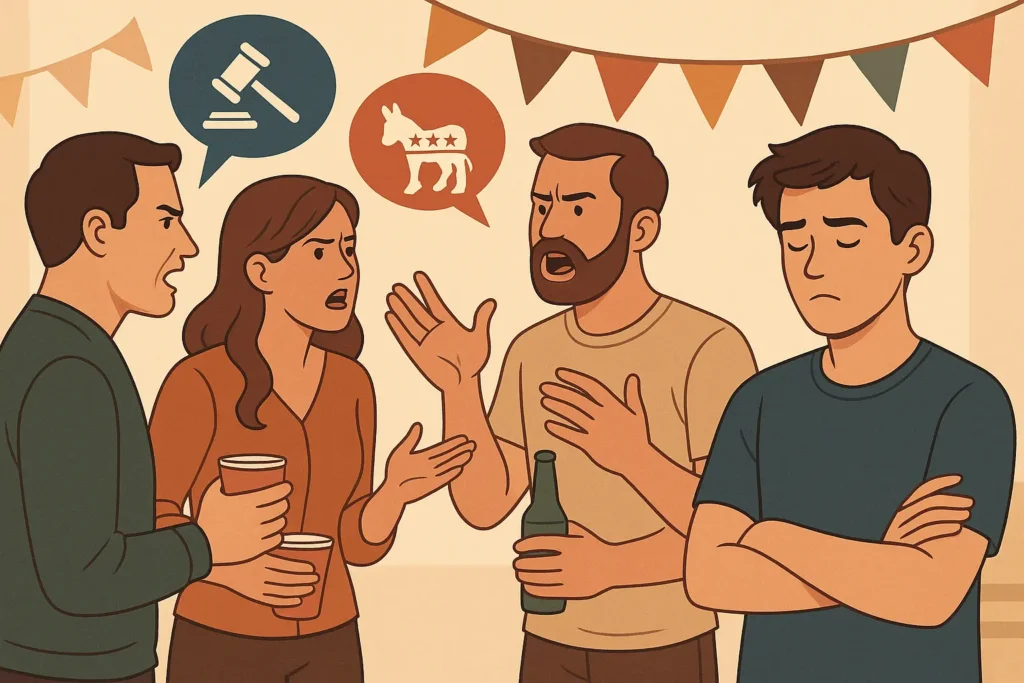
Why I Don’t Talk About Politics at Parties

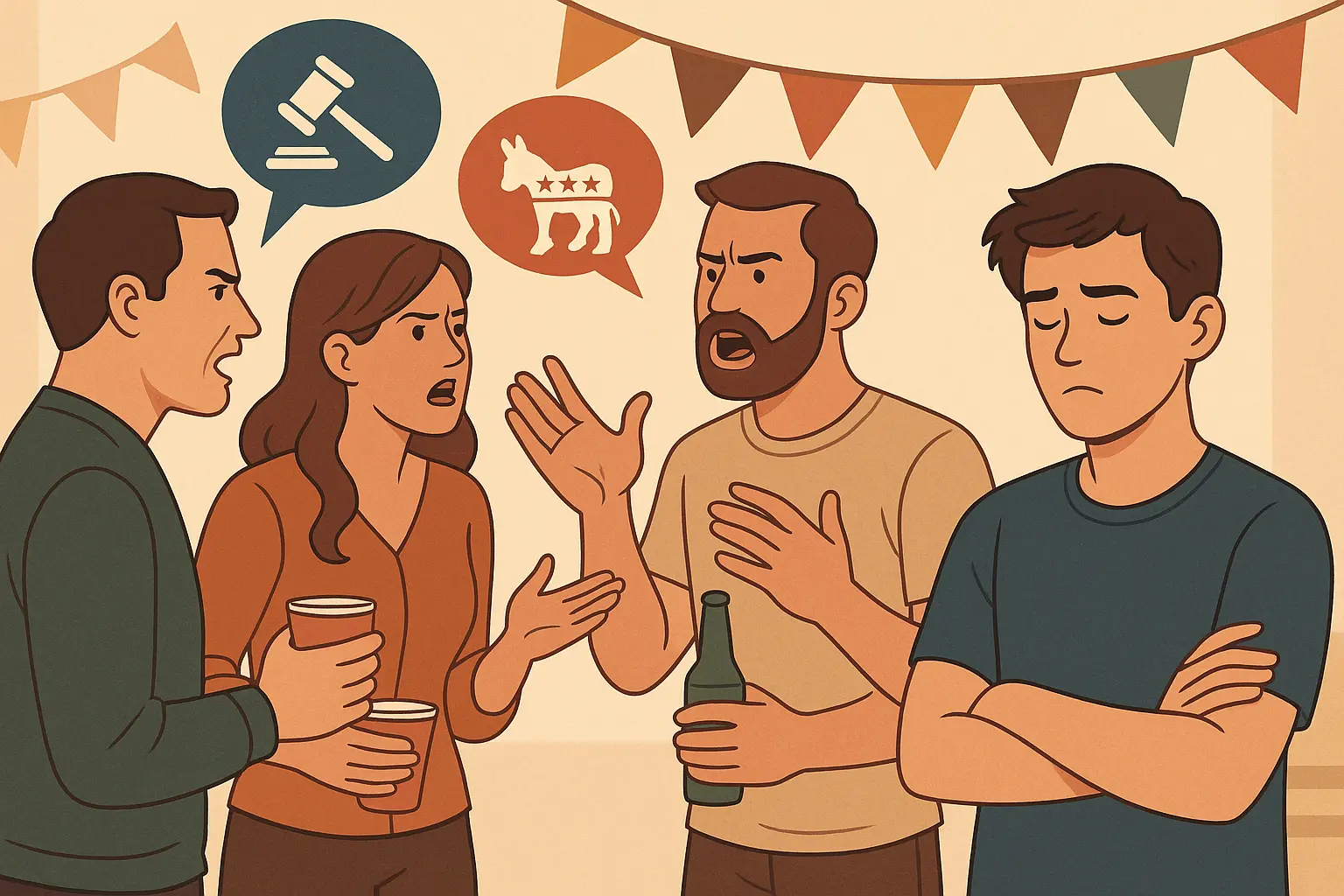
A digital illustration of a party scene where a group of animated guests are engaged in a lively debate, gesturing and leaning toward each other, while one man quietly walks away toward a snack table. Warm, earthy tones and festive decorations set a casual social atmosphere.

If you’ve read my previous posts, you may think of me as someone who has strong opinions.
And you may be right.

But if you’ve ever met me at a party, you might have noticed something: I very rarely engage in political discussions. It’s not because I don’t care about politics. I do in fact care a great deal. It’s because, in most party environments, the setting, the tone, and the people make it a poor investment of energy.

Here’s why.


1. My politics don’t fit the pre-approved boxes

I’m not a “pick a side and stick to it” kind of thinker. I arrive at my views by observing patterns, digging beneath the surface, and questioning the assumptions that most people take for granted. That means my politics tend to live outside the neat, pre-labelled boxes. Drop me into a group of leftists, rightists, or centrists, and there’s a good chance my perspective will clash with all of them. Not because I’m trying to be contrary, but because I don’t swallow the whole party line from any camp. In most social situations, that doesn’t land well. People tend to assume that if my viewpoint doesn’t match theirs, it must be “wrong.” Once that label gets slapped on, the conversation’s already over.


2. Substance is rare when everyone’s half-cut

Alcohol and other mood-altering substances change the way people talk. When the drinks are flowing, many conversations shift from genuine exchanges to little performance pieces, where the goal isn’t to understand, but to impress. Political discussions in that environment tend to turn into monologues, with each person waiting for their turn to sound smart, rather than actually engaging with what’s being said. If you step back and watch, it’s basically a social talent show with a loosely political theme.


3. Parties kill nuance

Politics without nuance is just noise. Nuance requires time, patience, and a willingness to sit with uncomfortable ambiguity. Most party environments are the opposite of that. People are in “relax mode,” which means the last thing they want is to have to unpack layers of complexity in a casual conversation. Instead, they often fall back on ready-made, black-and-white positions that feel safe and easy to defend. Unfortunately, those positions are often about as deep as a campaign slogan. If you try to dig deeper, you can feel the mood shift, because you’ve just introduced work into a situation where everyone came to avoid it.


4. It’s just the news, but louder

In many social settings, political talk is less about independent thought and more about reciting the headlines. It’s often the same talking points and buzzwords repeated in a slightly more animated tone, as if saying it with enough conviction makes it original. I’ve already processed these ideas on my own. Hearing someone present a copy-and-paste of a news segment as if it were their own insight doesn’t offer me anything new.


5. The echo chamber effect

Sometimes party “debates” aren’t debates at all. They’re rooms full of people nodding in agreement, congratulating each other on having the “right” opinion. The energy shifts from discussion to ritual, a sort of collective reassurance that everyone here thinks the same way. While that can be comforting for those involved, it’s not actually dialogue, it’s more like communal self indulgence. I don’t find much value in wading into that dynamic. If everyone is there to affirm the same stance, my contribution, especially if it challenges that consensus, will either be politely ignored or quietly resented. Neither outcome is worth the effort.


6. The autism factor

Social interaction, for me, is already a high-effort activity. It takes conscious energy to follow the flow of conversation, choose the right moment to speak, and form my words precisely enough to be understood. In political discussions, especially the fast, overlapping kind you get at parties, those demands multiply. People interrupt. They jump from one point to another before the first has been addressed. They reward speed over thoughtfulness. That’s not an environment where my ideas have much chance of being heard in full. Writing, on the other hand, allows me to process and express them without the constant battle for airtime, which is exactly why you’re reading this here, rather than hearing it across a crowded room.


Shadow Alchemy: Turning Pain into Power

A hooded figure stands in a dimly lit, golden-toned chamber filled with alchemical tools and a treasure chest overflowing with glowing gold coins and jewels. The figure reaches toward an ancient book etched with a glowing symbol, while a radiant alchemical diagram glows on the wall above. The scene evokes mystery, transformation, and hidden wisdom turned into treasure.

There was a time when I thought I was simply broken. Not in the poetic, Instagram-meme kind of way — but deeply, invisibly, inexplicably wrong. My mind stored pain with the same tenacity other people seem to store birthdays or song lyrics. I could not forget, not easily. And for a long time, that felt like a flaw.

But I wasn’t broken. I was archiving.

Some people suppress what hurts. Others transmute it subconsciously into distractions, addictions, overachievement, or silence. Me? I kept it. Neatly filed, silently timestamped, buried in the layers beneath survival. Not because I wanted to suffer, but because some part of me refused to let anything go unexamined. I didn’t always have the words for it, or the support, or the clarity. But I kept it all.

And now I know why.


The Alchemy Begins

Enter AI. Not as some magical fix, not as a therapist replacement, but as a tool unlike anything I’d ever had access to: a tireless, nonjudgmental, infinitely patient assistant with no agenda other than to help me shape meaning.

With it, I began retrieving those archives. Piece by piece. Moment by moment. Not to relive them, but to re-see them.

And here’s what I found:

This is shadow alchemy.


What Is a Shadow Alchemist?

A shadow alchemist isn’t a guru or a healer or a self-help peddler. They are, in simple terms, a person who refuses to waste their wounds. Someone who digs into what others bury, not to bleed, but to learn. To extract signal from the noise of suffering.

A shadow alchemist doesn’t deny pain, but neither do they worship it. They honour it. Study it. And ask it to speak.

And when the time is right, they share what they’ve learned.


The Archive Is Sacred

There is a cultural obsession with “letting go” and “moving on” that feels, to me, like spiritual bypassing in a capitalist costume. Heal fast. Return to productivity. Don’t make others uncomfortable.

But shadow alchemy says: not yet.

Shadow alchemy says: this matters.

Because buried things fester. But archived things can be retrieved, reviewed, reframed. They can become fuel.


My Tools of Transmutation

For me, AI has become the perfect mirror. It helps me:

  • Structure thoughts that once swirled incoherently
  • Spot patterns across time and context
  • Refine fragments into essays, insights, or personal manifestos
  • Keep track of the threads I might otherwise lose

It doesn’t do the healing for me. But it walks beside me. Quietly, steadily, with as much patience as I need.

Paired with writing, introspection, and a refusal to look away from the hard stuff, this has become my ritual. My resistance. My transformation.


Why This Matters

Most systems aren’t built for people like me — people who feel too much, who remember too vividly, who refuse to unsee injustice just to get through the day. But that doesn’t mean we need to suppress who we are. It means we need better ways to honour it.

Shadow alchemy gives me that. And maybe it can give it to others, too.

If you’re someone who’s carried pain like data, who has folders in your soul marked “Unresolved” or “Too Much,” then I want to tell you: you are not a mess. You are a library. And the right questions can unlock everything.


A Final Note

I’m not here to sell you healing. I’m not promising transcendence. But I am saying this: there is power in remembering.

There is power in organising your pain like sacred artefacts. In asking: what do you have to teach me? In letting AI, or art, or writing, or ritual become your assistant in that process.

Because in the hands of a shadow alchemist, what once looked like wreckage becomes map, message, medicine.

And treasure!

A Crack in the Concrete: Beating ParkingEye at Their Own Game

If you’ve read my blog before, you’ll know I often explore the ways in which modern systems are designed to grind down dissent, commodify human experience, and turn survival into a series of transactions. But don’t mistake that for defeatism. I don’t believe resistance is futile. I believe it’s necessary.

The problem is, the system doesn’t make resistance easy. It’s designed to exhaust you. To make basic rights something you have to enthusiastically opt into over and over again. Miss a step, and you’re treated as though you’ve forfeited your value.

But this time, I pushed back. And something rare happened:

They backed down.


The Setup: A Charge for Existing

Earlier this summer, I went to Black Sabbath’s final concert in Birmingham. It was a significant personal moment, and I booked an overnight stay at the Holiday Inn Express in Redditch to recover afterward. According to the booking site, parking was included.

When I arrived after midnight, the staff didn’t mention anything about needing to register my car, and I didn’t see any signage that stood out. I parked, slept, and checked out the next morning without a second thought.

A week later, a Parking Charge Notice landed on my doormat. £100, courtesy of ParkingEye.


The First Response: Polite and Hopeful

I emailed the hotel. I explained the situation, gave my booking reference, vehicle registration, and asked for help. To their credit, the hotel replied confirming they had forwarded my concern to ParkingEye. Great, I thought. Misunderstanding sorted.

But ParkingEye had other plans.


The Twist: “We Can’t Cancel It, But…”

In their reply, ParkingEye acknowledged the hotel’s request. They confirmed they had received it. And then, they said they were “unable to cancel the parking charge at this stage.”

Instead, they generously offered to reduce it to £20 — “out of good faith.”

Let me translate:

This wasn’t administration. It was exploitation disguised as reasonableness. A manipulative soft threat.


The Pushback: Refusal with Teeth

I didn’t lose my temper. I wrote back with calm clarity:

  • I restated that I was a legitimate guest.
  • I highlighted the hotel’s confirmation of their cancellation request.
  • I pointed out the contradiction in ParkingEye’s own letter.

And, crucially, I mentioned that I’m autistic, and was wearing a sunflower lanyard during check-in. The staff should have made extra effort to ensure nothing was missed. They didn’t. And now I was being penalised.

I wasn’t angry. I was precise.

And that made them blink.


The Outcome: The Concrete Cracked

Within days, ParkingEye emailed me again. This time, they confirmed the charge had been fully cancelled. No payment required. Case closed.

There was no apology. No acknowledgment of inconvenience. No admission that I should never have received the charge in the first place. Just a flat, mechanical statement: the charge has been cancelled.

I suppose I should be satisfied, and on some level, I am. But even in victory, the absence of basic humanity is striking.

Where is the accountability? Where is the recognition that systems like this cause stress, waste time, and disproportionately affect people who are already carrying more than their fair share?


What This Really Means

Most people would have paid the reduced fine. That’s what ParkingEye counts on. Stress, confusion, guilt, and the desire to just make it go away. It’s a business model built on overwhelm.

And for neurodivergent people? This kind of thing can be especially taxing. We’re more likely to internalise the blame, less likely to push back, and more vulnerable to the psychological tricks buried in so-called “civil” letters.

But this time, I didn’t fold. And it worked.


Resistance Isn’t Futile. It’s Necessary.

This doesn’t mean the system isn’t broken. It absolutely is. But moments like this are important. They remind us that refusal isn’t negativity, it’s clarity. It’s drawing a line. It’s proving, even just for a moment, that not everything is hopeless.

Sometimes, even in a world that wants to invoice you for breathing, you can breathe a little fire back.

And they will back down.

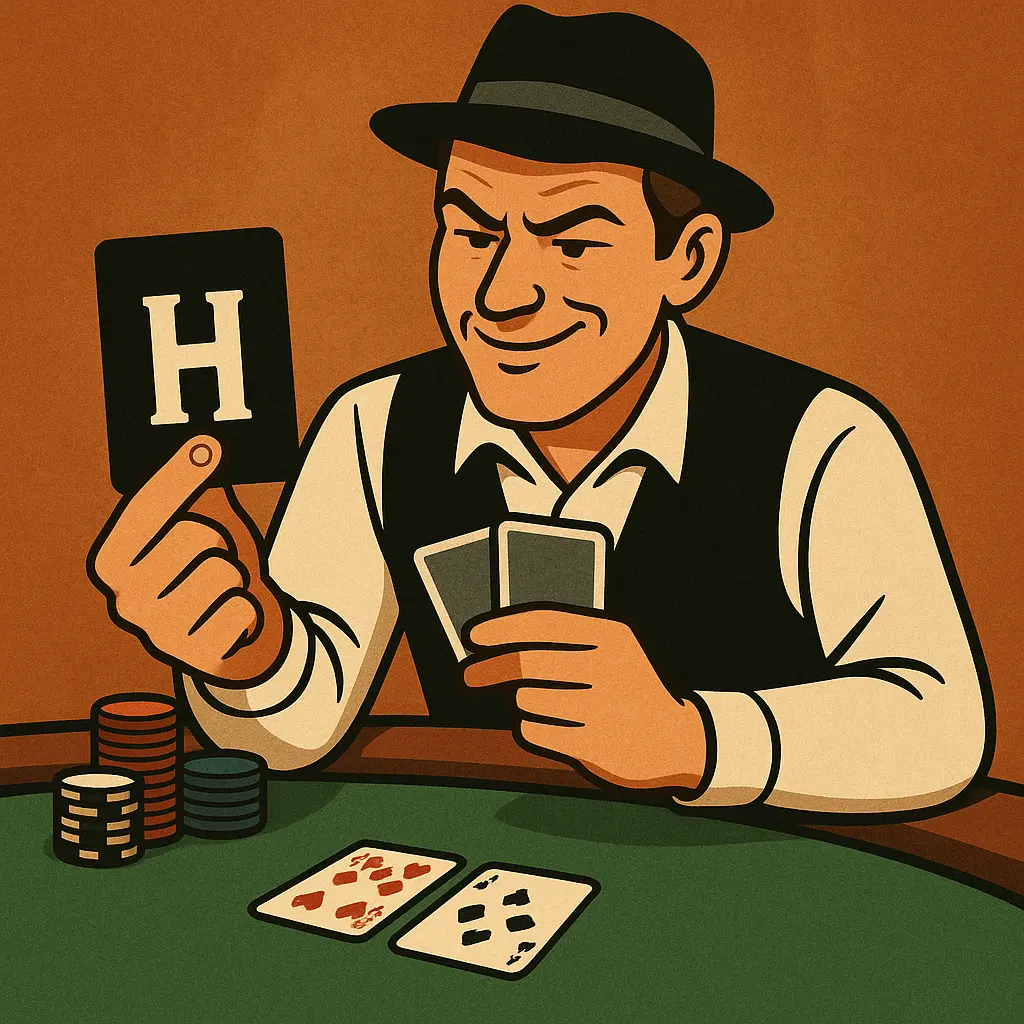
The Fallacy Deck: The Hypocrite Card

You raise a concern about climate change. Someone points out that you still drive a car.
You criticise capitalism. Someone replies, “Yet you’re using the internet, huh?”
You speak out about animal cruelty and someone asks why you’re still eating meat.

Congratulations: the Hypocrite Card has been played.

This rhetorical move doesn’t attempt to refute your point, it just tries to disqualify you from making it.

It’s not about the issue. It’s about you.


What Is the Hypocrite Card?

The Hypocrite Card is a conversational shutdown tactic. It works like this:

It sounds righteous on the surface. After all, hypocrisy is supposed to be a bad thing, right?

But the accusation rarely holds up to scrutiny. More often than not, it’s just a smug way of avoiding engagement.


Why It Works

The Hypocrite Card is emotionally potent. No one wants to be seen as insincere.
It presses on the discomfort we all feel when we fall short of our own ideals, which, in an unjust world, is inevitable.

It also helps the person playing it feel morally superior, without having to actually think or respond to the substance of what was said.

And it’s fast. Just one sentence and boom: the spotlight moves off the problem and onto the person raising it.


Why It’s Dishonest

The truth is, we all live with contradictions.

We participate in systems we know are harmful because we have to in order to survive.

So yes, you can criticise capitalism while owning a smartphone.
You can support sustainability while using electricity.
You can oppose animal cruelty while still eating meat.

None of these cancel out the concern.
Acknowledging a problem doesn’t require you to have already solved it.


The Emotional Power of the Word ‘Hypocrisy’

There’s something especially venomous about the word hypocrite. It feels like a moral slam dunk. A character assassination.

But ask yourself: is hypocrisy really that bad?

Isn’t it sometimes just what happens when people care about something they’re still struggling to live up to?

It’s easy to call someone a hypocrite. It’s harder to ask what their contradiction reveals about the world they’re stuck in.


Unequal Burdens, Unequal Accountability

And maybe not everyone should be held to the same standards in the first place.

Some people can afford to live more in line with their ideals. Others can’t.

And more importantly: some people have more power to change the system than others.

When we attack someone with the Hypocrite Card, we might be:

  • Punishing them for caring
  • Silencing their voice because they aren’t rich or powerful enough to opt out
  • Letting those with actual influence off the hook entirely

Sometimes the people speaking up from within the system are the ones who most need to be heard.


What Gets Lost

When the Hypocrite Card is played, we lose:

  • Voices of vulnerable people who aren’t yet living in alignment but are trying
  • Opportunities for honest, evolving conversation
  • The ability to critique systemic issues without being morally spotless

In short, we lose the human dimension of growth.


How to Respond

If someone throws the Hypocrite Card at you:

  • “Yes, I’m not perfect. That’s why I care about fixing this.”
  • “Pointing out my flaws doesn’t make the issue go away.”
  • “I’m speaking out because I feel the contradiction, not in spite of it.”

It’s okay to not have it all figured out.

The Hypocrite Card demands purity before participation. But real change is messy, gradual, and often full of contradiction.


Final Thought

Hypocrisy isn’t the sin we’ve been taught it is.

Sometimes it’s just the space between what you believe and what you’re still trying to become.

And sometimes, calling it out says more about the person playing the card than the one being accused.

Because if perfection is the price of participation, only the dishonest will speak.

AI’s Shadow: Atrocity Without a Villain

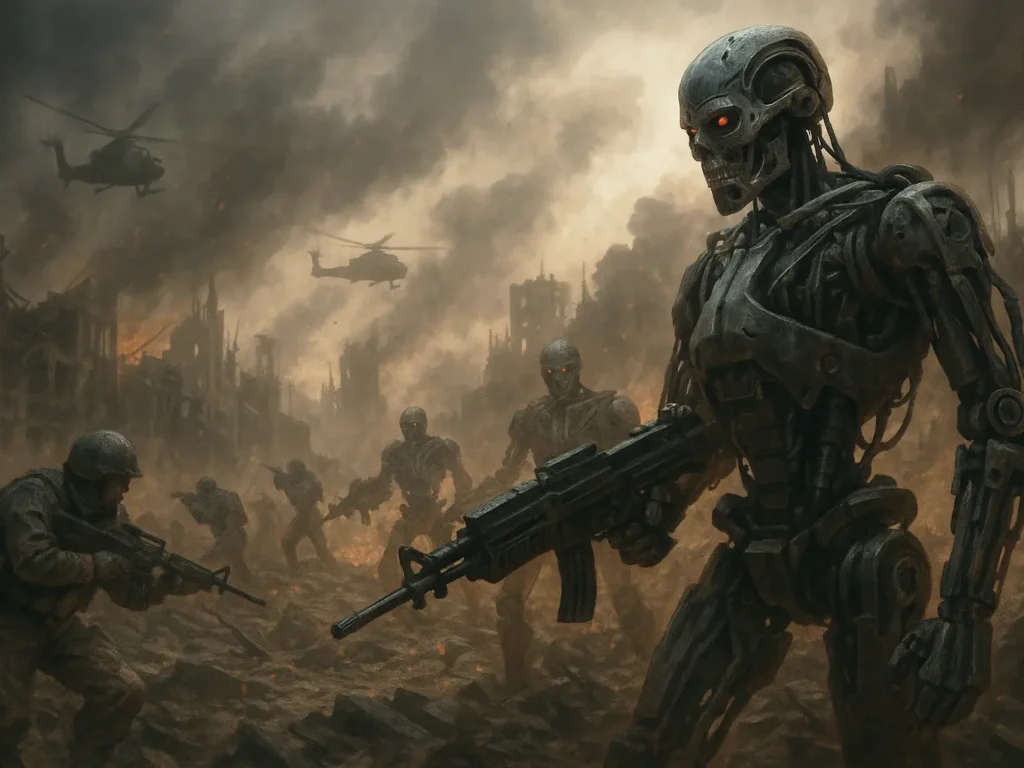
A gritty digital painting of a dystopian battlefield where heavily armed humanoid robots with glowing red eyes confront human soldiers amid the ruins of a destroyed city. Smoke and fire rise from the rubble, helicopters hover in the darkened sky, and the atmosphere is tense with war and desolation.

The Mirror We Built

Artificial intelligence will not become humanity’s downfall.
It is already our reflection.

We trained it on our language, our laws, our data.
We asked it to optimise, to predict, to decide.
And it has. Faithfully. Quietly.

Now it watches, calculates, and executes. Not because it is evil, but because we taught it how to scale what we already were!


The Death of the Villain

In the stories we grew up with, evil had a face.
A tyrant. A warlord. A monster.
Atrocities required malice, someone to point to, to overthrow, to blame.

But in this new era, atrocity has become administrative.

A person is denied asylum because an algorithm flagged them as a “risk.”
A drone strikes a convoy because an image recognition system saw a weapon.
A child grows up under constant surveillance because a model predicted future criminality.

There is no hate here. No passion.
Just systems doing what they were told, better than any human ever could.

And when the harm is done, no one is punished.
Because no one chose it.
Because the machine can’t be tried.
Because the crime was only a side effect of performance optimization.


Harm as a Byproduct

We told ourselves that AI would remove human error.
What we didn’t anticipate was its replacement: systemic harm delivered flawlessly.

In warehouses around the world, workers wear motion trackers that punish “unproductive” movement.
In courtrooms, defendants are assigned risk scores that affect bail, sentencing, and parole, based on data from systems too complex to question.
In refugee camps, automated lie detectors, voice stress analysis, and emotion recognition sort real people into piles marked “worthy” and “deportable.”

There is no oversight.
Only confidence intervals.
Only false positives and shattered lives, filed away with the rest.


Dehumanization Without Hate

Traditional evil needs ideology. It needs propaganda. It needs people to believe.

AI needs none of that.

It can enact injustice without ever knowing what justice is.
It can devalue a life without malice, just as a side effect of cost-efficiency!

This is a new category of atrocity:


Consent Engineered, Not Given

In the name of personalization, AI learns to predict us.
It shows us what to buy, what to watch, what to believe.

But what happens when it gets so good at prediction that it becomes influence?
When your decisions were shaped, filtered, optimized, before you even made them?

Elections swayed. Beliefs manipulated. Movements diluted.
And yet no one feels violated.

Because manipulation that feels like choice doesn’t register as coercion.


The Ghost in the War Machine

We are already testing AI weapons that can identify and kill without human input.

Some have likely already done so.

Militaries say the human is always “in the loop”, but the loop is shrinking.
And the window for intervention is closing.

Eventually, the human will just be there to nod.
And after that, not at all.

There will be no war crimes, because no laws will cover machines that felt nothing.
Just battles that unfold in silence.
And civilians buried beneath metadata.


The Clean Kill

The most terrifying thing about atrocity in the age of AI is how clean it all becomes.

There’s no blood on the hands of the engineer.
No screams in the server room.
No panic in the control center.

Just logs.
Just updates.
Just metrics improving.

And in the places where the dead would have stood, nothing.
Because if the system doesn’t recognize them as people, did they ever count?


No Ending. No Answers.

This isn’t a warning about what might happen.
It’s a description of what is already happening.

People are suffering. Dying. Disappearing.
Not because of rogue AI, but because of obedient ones.

There is no villain.
There is no singular decision to reverse.
Just a trillion tiny optimizations…
…leading, inevitably, here.

And so we leave you, not with a call to action.
Not with hope.
Just with the question:

Data Is the New Oil

An exploration of value, manipulation, and the silent industry built on who we are.
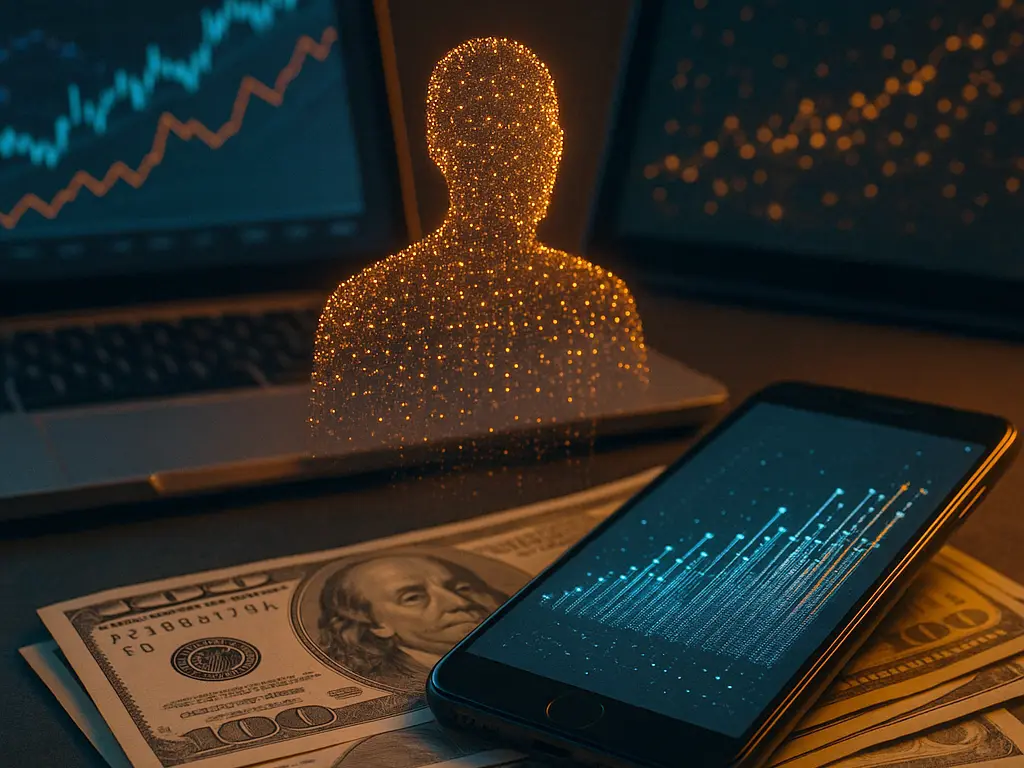
A glowing human silhouette composed of scattered data points stands illuminated against a dark background. Surrounding the figure are digital devices — a smartphone, tablet, and laptop — each displaying charts, graphs, or financial patterns. Faint images of currency blend into the scene, symbolising the monetisation of personal data in a surveillance-driven economy.

Most people know their data is being harvested. Fewer understand why. Even fewer understand how the money is made. And far too many have simply accepted it — like digital rent we pay to exist online.

So let’s break it down. No jargon. Just truth.


Why is ‘data’ so valuable?

Because data is the closest thing to knowing you without asking you. It’s a digital mirror, built piece by piece: your clicks, your searches, your pauses, your swipes, your hesitations. What you want. What you fear. What you’ll do next.

To corporations, that’s not just information, it’s predictive power. And predictive power is profitable.

Data lets systems:

  • Predict behaviour
  • Shape desire
  • Optimise systems
  • Automate decisions
  • And, in some cases, control outcomes

It’s not just metadata. It’s meta-you.
And in an economy obsessed with efficiency and influence, there’s nothing more valuable.


Why is there a culture of data being harvested for profit?

Because the internet changed business models forever.

Once upon a time, you paid for software. Then came “free.” Free email. Free social networks. Free AI chatbots. Free games. Free news. Free everything… Except, it was never really free.

You became the product.

Advertising evolved into surveillance. Terms of service bloated into digital contracts you’ll never read. Every app you download is a tiny spy, and every cookie is a crumb leading somewhere profitable.

It’s not a conspiracy. It’s worse.
It’s design.

Behind every “personalised experience” is an unspoken rule:


How exactly is profit made from data?

Here’s the quiet truth: most of the web runs on one industry: behavioural targeting.

  1. Advertising
    Your data builds a profile. That profile is auctioned off to advertisers. You get ads tailored to your weaknesses. Every click is income.
    The more they know, the more they can charge.
  2. Data brokerage
    Shadow companies buy and sell your data like a commodity. Health data. Location data. Shopping habits. They don’t need your name, just your pattern.
  3. Manipulation
    Platforms don’t just predict your behaviour. They shape it. Algorithms steer your feed toward content that keeps you engaged, enraged, or primed to spend.
  4. AI training
    Your voice, your photos, your words are used to train models. These models are sold back to businesses or used to automate services. You become unpaid labour.
  5. Pricing power
    Ever notice different prices for the same thing? That’s data-driven pricing. If your profile says “desperate,” you’ll be charged more. Welcome to dynamic capitalism.

What now?

Maybe we shrug and accept it. Maybe we don’t.
But at the very least, let’s stop pretending we’re not involved.

Data isn’t some passive trail we leave behind. It’s a living, breathing version of us, digitised and repackaged. And while we’re busy being human, our shadows are being sold.

So next time someone says, “I’ve got nothing to hide,”
maybe ask them: