
The Ocean of Unborn Ideas

A tranquil moonlit shoreline beneath a star-filled sky. Gentle waves wash softly against the sand, reflecting the silver glow of a full moon. The scene is empty and still, evoking a feeling of solitude, reverence, and infinite calm.

The Porous Mind

There are minds built like fortresses, and there are minds built like shorelines.
The fortress keeps the world out, solid, defined, and dry.
The shoreline breathes with the tide, reshaped by every wave that kisses it.

Creativity is born on that shoreline.
To be creative is to possess porosity, a mind permeable enough for the ocean of potential to seep in.
Ideas, emotions, archetypes, stray whispers from the collective dream, all of it flows through those who cannot help but listen.
They do not invent. They translate.

Yet this openness is not without cost.
The same currents that deliver beauty also bring wreckage: sorrow, confusion, fragments of other people’s storms.
The porous mind is always negotiating its borders, learning how much of the tide to let in without being pulled under.
And still, it listens. Because silence, for such a mind, would be a greater death than drowning.

For the creative, the act of making is not simply expression, it is osmosis.
The world breathes through them, and they breathe it back changed.


The Ecology of Potential

Beneath the surface of waking thought lies an unseen ecosystem, a vast and fertile ocean where ideas drift like plankton, multiplying in the dark. Most will never breach the surface. They swirl endlessly in silent gestation, invisible but alive.

This ocean is not ordered. It does not distinguish between wisdom and nonsense, beauty and monstrosity. It is a realm of becoming, where possibility itself experiments. To gaze into it is to witness the raw mechanics of creation, the way form gropes toward meaning, and meaning toward form.

Every consciousness draws from this sea, but only some hear its currents. The porous mind becomes a conduit between worlds, an evolutionary bridge through which potential finds its way into language, image, sound, or structure.

When an idea rises into awareness, it is not a spark conjured from nothing. It is a creature breaching the waves, the culmination of countless unseen collisions in the depths. And when it slips back beneath the surface, half-forgotten, it is not lost. It returns to the dark to feed new generations of thought.

Nothing in the ocean is wasted. Even the unborn ideas, the ones that never quite reached the light, fertilize the next tide of possibility. In that way, creation is less a single act and more a cycle of nourishment: consciousness feeding potential, potential feeding consciousness.


The Tragedy of the Unborn

For every idea that takes its first breath in the world, countless others die unnamed.
They shimmer for a heartbeat on the edge of awareness, a scent, a flicker, a sudden weight in the chest, and then dissolve back into the deep.

There is sorrow in that, though most never feel it consciously.
The mind learns to celebrate its children, not its miscarriages. Yet every artist, every thinker, has felt the ache of the nearly-formed: the melody that was almost remembered, the perfect line lost before pen met paper, the sense of something vast pressing at the gates of language but never quite entering.

These unborn ideas haunt the corridors of our dreams.
They become strange symbols, wordless moods, déjà vu. They linger like ghosts of meaning, neither alive nor gone, whispering: “We tried.”

But tragedy is not failure. In the greater cycle, their unfulfilled lives still matter. The half-born return to the ocean, breaking down into nutrients of inspiration. From their dissolution, new forms grow stronger, carrying faint traces of what came before, a rhythm, a texture, an emotional DNA.

The creative heart often aches for what it cannot remember. Perhaps that ache is the memorial, the soul’s way of honouring all that it could not bring into being.


The Responsibility of the Listener

To listen to potential is to take part in creation itself.
It is not a passive act, but a covenant. When an idea crosses the threshold into consciousness, it arrives fragile, trembling, uncertain of its shape. The listener becomes its first environment, its atmosphere.

Some people seize ideas like prey. They dissect them, brand them, harvest them for profit or validation. The idea, stripped of its mystery, dies quickly under fluorescent light.
But others receive with reverence, cupping the newborn thought in both hands, letting it breathe before naming it. These are the caretakers, the stewards of becoming.

To be a true listener is to resist the temptation of ownership. Ideas do not belong to us; they visit. They pass through, seeking resonance, seeking a place to crystallize.
Our task is not to claim them but to tend them, to ask, What does this idea need to live?

Sometimes the answer is action. Sometimes silence.
Sometimes it means letting the idea return to the deep, knowing it wasn’t meant for now.
The ethical creator learns to release with as much grace as they receive.

To treat ideas as sacred is not sentimentality; it is realism.
They are alive, and like all living things, they thrive where they are met with care, humility, and awe.


Dreams as Refuge for the Unborn

When the waking mind grows too narrow for them, the unborn ideas find sanctuary in dreams.
There, language loosens, form forgets its boundaries, and the mind becomes oceanic again, receptive, weightless, forgiving.

Dreams are nurseries for the half-formed.
They are where impossible geometries are allowed to stand, where logic softens enough for paradox to breathe. The painter dreams of colours that do not exist; the composer hears chords that waking physics cannot yet permit. In the dream, potential rehearses itself.

Sometimes, when we dream vividly, we are not the dreamers at all but the dreamed, temporary vessels through which the unborn test embodiment.
We wake with fragments: a haunting image, a phrase, a sensation that refuses to fade. These are offerings from the deep, visiting spirits carrying the scent of unmanifest worlds.

Art, ritual, hallucination, trance, all open the same door.
They are technologies of permeability, ways of returning consciousness to the sea so the forgotten can breathe again.

Perhaps this is why the surreal feels sacred: it reminds us that imagination is not invention, but remembrance.


The Cosmic Cycle

Creation and destruction are not opposites; they are inhale and exhale.
The ocean of potential breathes through us in tides, what rises into form must one day return.

Every idea that dies enriches the field it came from. Every silence fertilizes the next voice. Even despair, when felt honestly, becomes a kind of compost. There is no waste in the greater ecology of thought.

We imagine ourselves as authors, but we are more like soil, momentary ground for something older than time. Ideas bloom through us, use us, and move on. And when we, too, dissolve, our lives return to that same ocean, our memories, our creations, our longings, all reabsorbed into potential, waiting to be dreamed again.

Somewhere, beneath all endings, the unborn ideas drift still.
They are not lost. They are preparing.
And when the next porous mind opens to listen,
the tide will rise,
and the ocean will remember its name.
From Announcement to Manipulation: The Evolution of Advertising

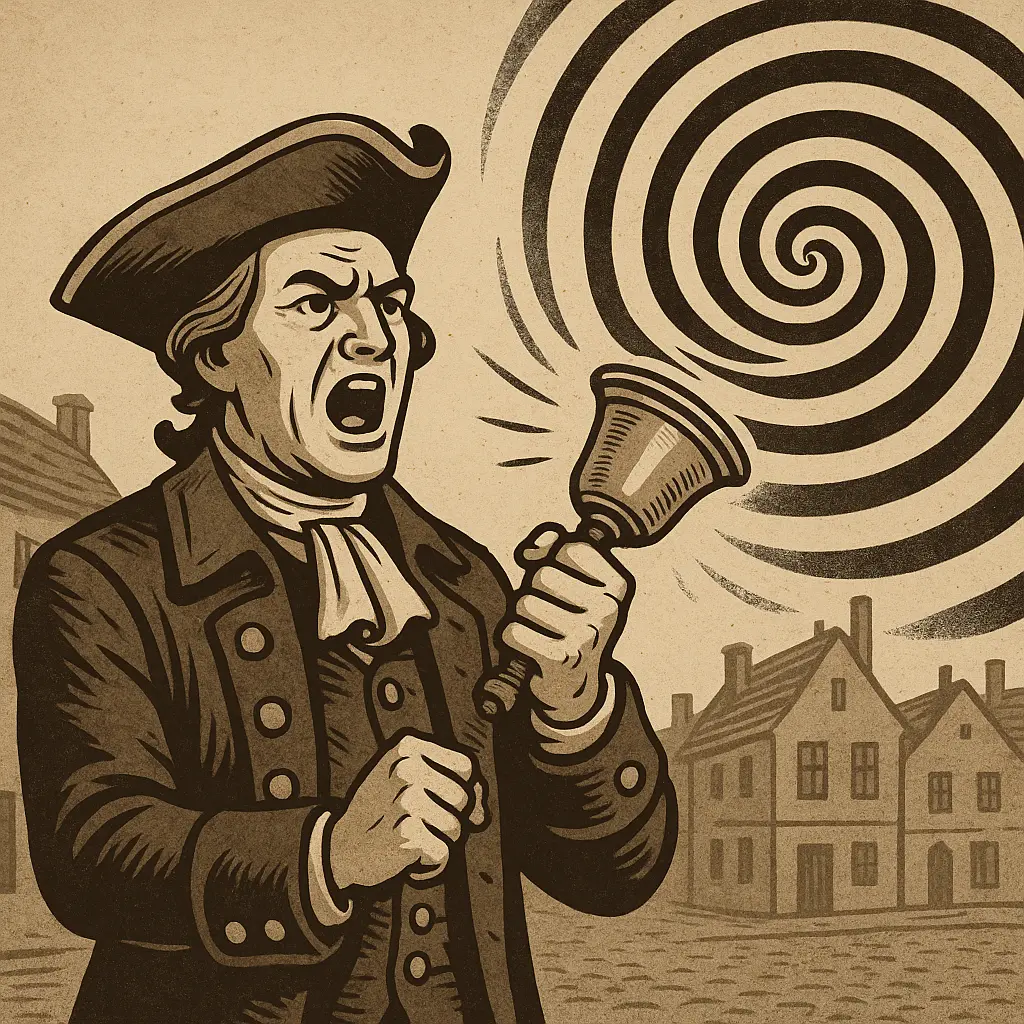
A sepia-toned illustration of a town crier ringing a bell that emits hypnotic spirals, symbolising how early advertising evolved from public announcements into psychological influence.

I grew up in the 1980s, when television advertising still had a kind of charm. I remember the jingles, the mascots, the catchy slogans that managed to lodge themselves in your head for weeks. Even as a child, I knew they were trying to sell me something, but at least they did it with some flair. They felt like part of the entertainment itself.

Something has changed since then. Advertising is no longer something that interrupts culture; it has become the culture. Every space, every platform, and every idle moment now feels colonised by a hidden intention to sell. To understand how we arrived here, it is worth tracing how advertising has evolved from a loud street-side performance to an invisible system of persuasion that shapes our sense of self.

The Loud Salesmen

The earliest form of advertising was brutally honest. Ancient merchants shouted in markets, painted signs on walls, or hung banners above their stalls. When mass printing emerged in the 1800s, advertising became more widespread but no less direct. Newspapers were filled with promises of miracle tonics, soap that made you beautiful, and pills that cured everything from toothache to heartbreak. These were primitive, manipulative, and often fraudulent, but at least you knew what you were looking at. Someone was selling, and you were free to walk away.

The Mad Men Era

The 20th century transformed advertising into an art form. With the rise of radio and television, storytelling became the new language of persuasion. Campaigns no longer sold only a product; they sold an identity, a dream, a way of life. The Coca-Cola Santa Claus, the Marlboro Man, and the perfect suburban family all came from the same creative laboratories.

This was the era of the “ad man,” immortalised in cultural artefacts like Bewitched or later Mad Men. Advertising was portrayed as a glamorous profession. These were the people who didn’t just reflect society; they helped build it. The line between commerce and culture began to blur.

The 80s and 90s: Ads as Entertainment

By the 1980s and 1990s, advertising had taken on a theatrical quality. It was playful, colourful, and memorable. Mascots like Tony the Tiger, slogans like “Just Do It,” and tunes you could hum all day made adverts feel like short pieces of performance art. They were still manipulative, of course, but they wore their intentions openly.

Looking back, perhaps this is why many people from my generation recall old ads with a strange fondness. They were transparent. They worked hard to win your attention rather than simply steal it.

The Weird and Annoying Years

Somewhere in the late 1990s and early 2000s, advertising lost its balance. It became surreal, loud, and deliberately irritating. Think of Crazy Frog, the Budweiser frogs, or the unnerving Burger King mascot. Annoyance became a marketing tool. If something got stuck in your head, even out of frustration, the job was done.

This was the period when “going viral” became a goal before social media even existed. The absurdity was the message.

The Internet Disruption

When the internet arrived, advertising was clumsy but eager. Early banner ads were brightly coloured, flashing boxes that you could easily ignore. But the industry adapted quickly. As data collection improved, advertising became personal. It stopped shouting to the crowd and began whispering to the individual.

This marked the rise of surveillance capitalism. Every click, search, and pause became a data point. You were no longer a passive audience member; you were a psychological profile to be targeted. The salesman had followed you home and was now reading your mind.

The Age of Disguise

By the 2010s, advertising learned to hide in plain sight. Sponsored posts, influencer endorsements, and “native” content made it difficult to tell where information ended and manipulation began. Search engines, news sites, and social platforms quietly filled with ads disguised as genuine results.

South Park once parodied this perfectly with its storyline about intelligent ads (Season 19). It was satire, but it was also prophecy. Today, even image searches are littered with sponsored results. The ad no longer wants to be seen; it wants to be believed.

Culture as Commerce

This is the stage we now find ourselves in. Advertising has stopped orbiting culture and instead absorbed it completely. Everything is for sale, including identity itself.

People no longer ask “What do I like?” but “What do I subscribe to?” We define ourselves through brands and platforms: Apple or Android, Nike or Adidas, Netflix or Disney Plus. Even rebellion is commercialised. You can buy “authenticity,” but only if you can afford the price tag.

Advertising has achieved what no political ideology ever could. It has replaced meaning with marketing and turned culture into a series of brand alignments.

Conclusion: From Persuasion to Colonisation

Advertising began as a voice shouting in the marketplace. It evolved into storytelling, then spectacle, then infiltration. Today it is everywhere and nowhere, woven into the fabric of our reality.

The change that occurred over the last century is more than technological. It is philosophical. Advertising no longer sells products; it sells identities. It shapes our desires before we even know we have them.

Perhaps that is why so many of us feel weary. We are not just tired of being sold to; we are tired of living inside the sale itself.

The Sacred Burden of Being Real

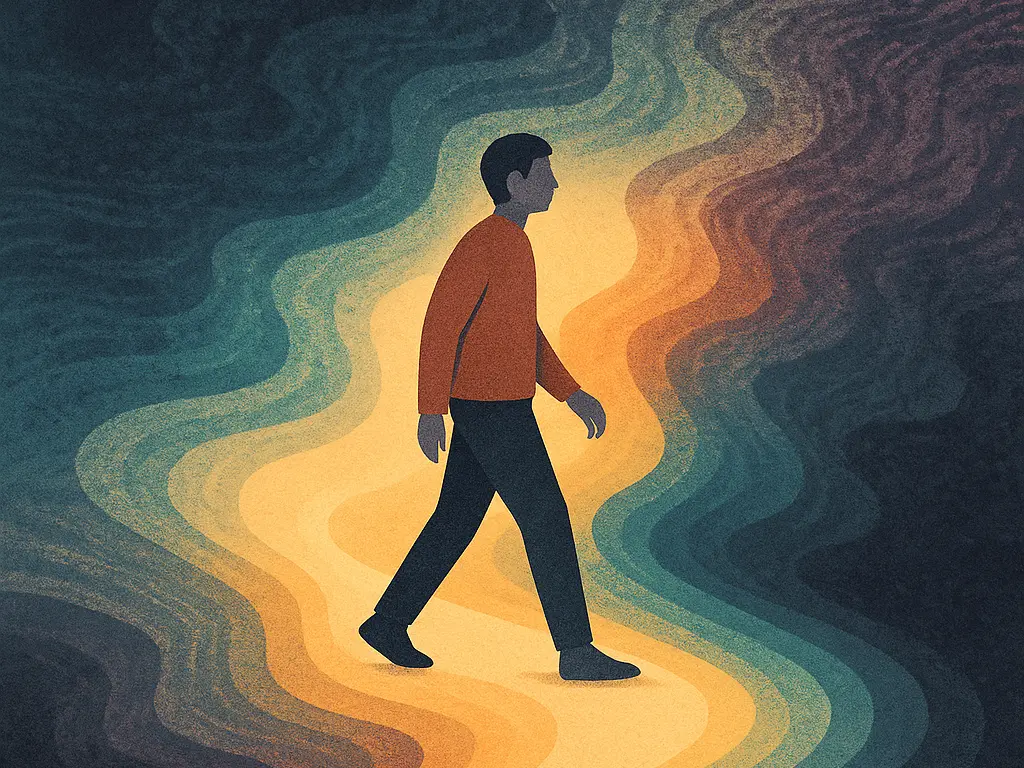
Stylised illustration of a lone figure walking through a softly glowing, wavy landscape of layered colours, transitioning from dark tones at the edges to warm light beneath their feet.

To me, authenticity has always had a texture. When I am living truthfully, it feels smooth, like fluid motion through life, unhindered navigation through systems that make sense to me. It is not euphoria. It is neutrality. Balance. Like the body when it is well: not ecstatic, just quietly functioning as intended.

But when that smoothness disappears, I know I am colliding with something unnatural, a pressure, a distortion, an external force trying to bend me into compliance. That is usually how I recognise oppression. It is not always dramatic or visible. Sometimes it is just a subtle grind, the friction between who I am and what the world expects me to be.


When Smoothness Breaks

When I lose authenticity, it does not just hurt emotionally, it feels like an illness. My thoughts start looping, as if my mind is trying to fix a broken system it cannot repair. I get frustrated at the lack of options, and sad that these dynamics even exist at all.

Sometimes there is nothing I can do but yield. And every time I do, it costs something invisible. The loss is not abstract, it is felt in the nervous system. It is the moment the body whispers, this is not how you are supposed to feel.


The Systems That Demand Performance

Oppression wears many masks: bureaucracy, capitalism, social obligations, the unspoken point system that governs human relationships. Each demands performance. Sometimes it is about survival, sometimes about social advantage. But in the end, both use the same energy source: you.

As an autistic person, I have always been acutely aware of “masking,” the act of performing normality to survive in social spaces. But I have also learned that this is not exclusive to autism. Everyone masks. Some call it professionalism. Others call it politeness. It is still performance. The only difference is how consciously one feels the cost.


The Humiliation of Performance

When I catch myself performing, it feels humiliating, not because anyone else can see it, but because I can. It is like betraying a sacred truth. Yet that awareness is balanced by another: I can also see the oppressive force causing it.

What hurts most is the fear that others see the performance too, but not the pressure behind it. That they see the surface act without understanding the system that coerced it.

That poem came from that place, the quiet despair of realising that either way, something in you must fracture to fit.


The Rare Moments of Unmasking

True authenticity is situational. I can relax certain parts of the mask around family, others around my girlfriend. But never all at once. Each relationship comes with its own invisible boundaries, some safe zones, some fault lines.

Even when I am alone, there is still the internal eye, the echo of social constructs that linger inside, long after the audience has gone home. Solitude is not the absence of performance; it is where you start to see which parts of the mask fused to your skin.


The Cost and Consequence

Sometimes unmasking feels liberating. Other times, it feels like punishment, a confirmation that the world does not welcome the real self. That is the cruel irony: the more genuine you become, the more visible your difference.

The aftermath can feel like emotional jetlag. There is vulnerability, fatigue, and occasionally grief. But there is also clarity. You see the architecture of the world more clearly when you have been bruised by its walls.


Authenticity as Survival

For me, authenticity is not optional. It is survival. The alternative feels worse than death.

Out of every living thing that has ever existed, there is only one instance of me, this consciousness, this perspective, this particular configuration of life. That makes it sacred. My job is to honour that singular existence.

If I betray it, if I trade it for comfort, convenience, or belonging, then I may as well be anyone else. Or nothing at all.


Do Not Be Yourself (For Them)

So here is my advice to anyone struggling with authenticity:

Do not take the phrase “Be yourself” at face value. That advice is too often weaponised, a feel-good slogan used to sell you an illusion of freedom within controlled boundaries.

Be yourself, yes. But do it for your reasons.
Do it because it is sacred.
Do it because you are a one-off in the infinite catalogue of existence.
Do it because the alternative is extinction by conformity.

But never do it because the world told you to.
Do it because you told yourself to.

Unmasking the Machine: The Price of Trust

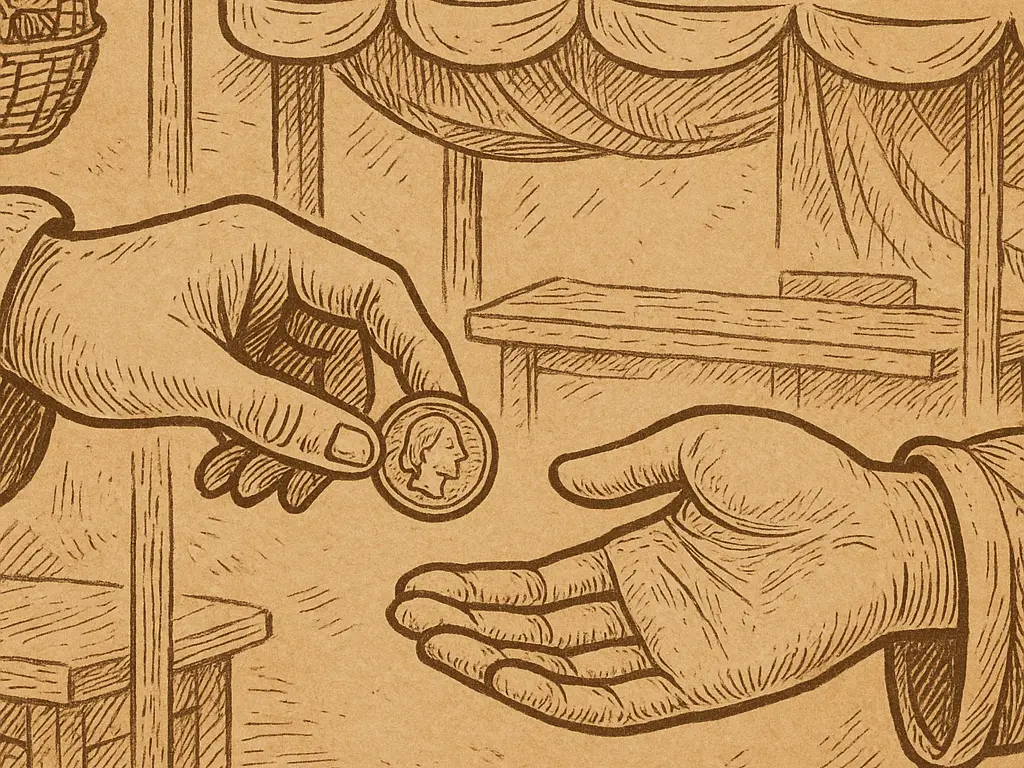
A sepia-toned medieval-style illustration shows two hands exchanging a coin in an old market scene. The detailed linework resembles a woodcut etching, with fabric canopies, wooden stalls, and a woven basket faintly visible in the background, evoking the warmth and sincerity of traditional trade.

How capitalism turned honest exchange into psychological theatre, and why the autistic mind still yearns for transparency in a world that rewards deception.

Once, the act of trading was a form of human connection.
It was not about profit margins or conversion rates — it was about mutual recognition: you have something of value, I have something to offer. The marketplace was a conversation.

Today, that dialogue has been silenced.
The modern economy has replaced trust with algorithms, sincerity with strategy, and negotiation with manipulation.


The Death of Honest Exchange

There was a time when price was fluid — a reflection of perception, circumstance, and need. Two people could meet halfway, guided not by greed but by understanding.

Now, prices are fixed long before we enter the conversation.
If we try to negotiate, we do so within a simulation of choice — a marketing game designed to make us feel empowered while every outcome still feeds the same profit system.

For neurotypical traders, that game can be exhilarating.
For many autistic people, it’s exhausting. The subtle cues — the tone, timing, charm, bluff — are invisible traps. What once was negotiation has become performance, and performance has never been the autistic strong suit.

What’s left isn’t trade. It’s theatre.
And the script has already been written.


The Integrity Deficit

The rot goes deeper than the disappearance of haggling.
It lies in the very intention behind creation.

Some people and companies make things worth buying — tools, art, inventions, ideas that serve a purpose or bring genuine joy. Their reward is intrinsic: the pride of making something good.

Others begin with a spreadsheet and reverse-engineer desire.
They design products to meet margin targets, not human needs — and pour their creativity into marketing psychology, not craftsmanship. They sell stories, not solutions.

Capitalism once sold us what we wanted.
Now, it teaches us what to want.

The difference between creation and manipulation is as vast as it is invisible — and the modern consumer is left to navigate a marketplace where both masquerade as innovation.


The True Price of Trust

Amid the noise, something inside still longs for fairness — for that simple, honest exchange of “this is what it’s worth to me — what’s it worth to you?”

But the system no longer understands that language.
It has replaced value with metrics, integrity with strategy, trust with tactics.

That is the true price of trust:
a currency the machine no longer knows how to pay.

A Day In The Life

Abstract illustration of a luminous, flowing landscape made of interwoven light and colour, resembling crystalline structures and organic networks glowing within a vast, resonant space.

You wake. There is no buzzing phone, no flicker of LED. Instead, your dwelling itself remembers you. Its walls are part of a crystalline mesh that stores resonances like memory. When your consciousness stirs, the lattice hums in phase with you, and your “notifications” ripple into awareness. They arrive not as icons but as subtle harmonics in your perception.

Communication is not typed or spoken into devices. You shift the phase of your neural field, and those oscillations couple with the local resonance grid. Thoughts do not need to be encoded into text. They arrive as structured wavefronts, rich with emotional color and nuance, impossible to misinterpret.

Energy is not pulled from wires or batteries. You live within a constant bath of background fields, gravitational fluctuations, zero-point ripples, or biochemical gradients. Your civilization has learned to tune into them. Power is less a resource you consume and more a harmony you align with.

Tools are alive in their own way, but not biological as you would know it. Imagine a fungal-like mycelium stretched through every surface. It does not feed. It processes. To calculate, you do not run numbers. You seed patterns into the living substrate and watch as the network self-organizes into solutions.

Art is inseparable from technology. A city’s architecture is not steel and glass but giant resonant organs, tuned to planetary frequencies. Their vibrations support life while also storing history. Music, memory, and computing are literally the same medium.

Death feels different here. When someone passes, their mind’s resonance does not vanish. It gently diffuses into the substrate, leaving after-images that loved ones can commune with. They are not recordings. They are echoes that adapt, just as a stone resonates differently with each tap.

Here, energy and information are one. Waves in fields. Resonances in matter. Harmonies that never quite fall silent.

A Month of Words: What I Learned from Posting Every Day

A golden trophy floating in space, glowing with sparks of starlight and reflecting galaxies across its surface.

If you’ve been following An Alternative Perspective, you may have noticed the sudden flurry of activity. For the past month, I’ve been posting every single day without fail. This wasn’t random productivity, but the result of a whimsical challenge I set myself: to see if, with the help of AI, I could sustain a daily rhythm of meaningful writing. Before, I often felt weighed down by the sheer effort of shaping my thoughts into polished sentences. With AI taking some of that burden away, the process became lighter, and I wanted to see how far that shift could carry me.

Before AI vs. After AI

When I first launched this blog in 2022, my posts were few and far between. Across the first two years I only managed five articles in total.

Things changed in early 2025, when I began experimenting with AI as a creative partner. Suddenly the pace picked up. I went from writing a handful of posts in a year to several in just a few weeks.

By July, I decided to see how far this new momentum could carry me, and set myself a challenge: publish something every single day for a month. At the start of the challenge I had around forty posts in the archive. By the end of it, including this piece, the count stands at seventy-four. That means more than thirty new articles in less than a month.

Reflections on Sustainability

Over the course of this challenge, I discovered a lot about both the process and myself.

  • Liberation, not obligation: Posting daily felt liberating because I finally shared thoughts that had been locked away. Even the smallest bits of feedback carried meaning. But crucially, I never felt like I was “churning out content.” Each post was meaningful, its own little adventure.
  • Unexpected depth: Some posts grew far longer than I had imagined when I started. The act of writing pushed me to think deeper, explore new perspectives, and even do research. The challenge was not just about output, it became discovery.
  • A layered process: I was not literally writing one post a day from scratch. Instead, I kept several drafts simmering, refined them in layers, and used scheduling to build in breathing space. That rhythm made it sustainable.
  • The real takeaway: I have proven that I can post daily, but that does not mean I should. Forcing myself into constant output risks oversaturating both myself and readers, especially those who, like me, are neurodivergent and might prefer more space to digest ideas. What matters is not quantity or the illusion of being “active.” What matters is that the odd perspectives I notice, the strange angles others overlook, and the weird thoughts too good to waste have a platform where they can be found by those who might be interested.

Closing Thought

This challenge began as a whim, but it became a lens. It sharpened how I see my own writing process and reminded me that writing is not about keeping pace with an algorithm or maintaining the illusion of activity. It is about following the natural rhythm of thought, giving form to what feels too important to leave unspoken, and offering it to whoever might find resonance. Whether I publish daily or only when inspiration strikes, the archive will continue to grow at the pace it needs to. And that, I think, is the most sustainable path of all.

Energy Accounting: The Autistic Paradox

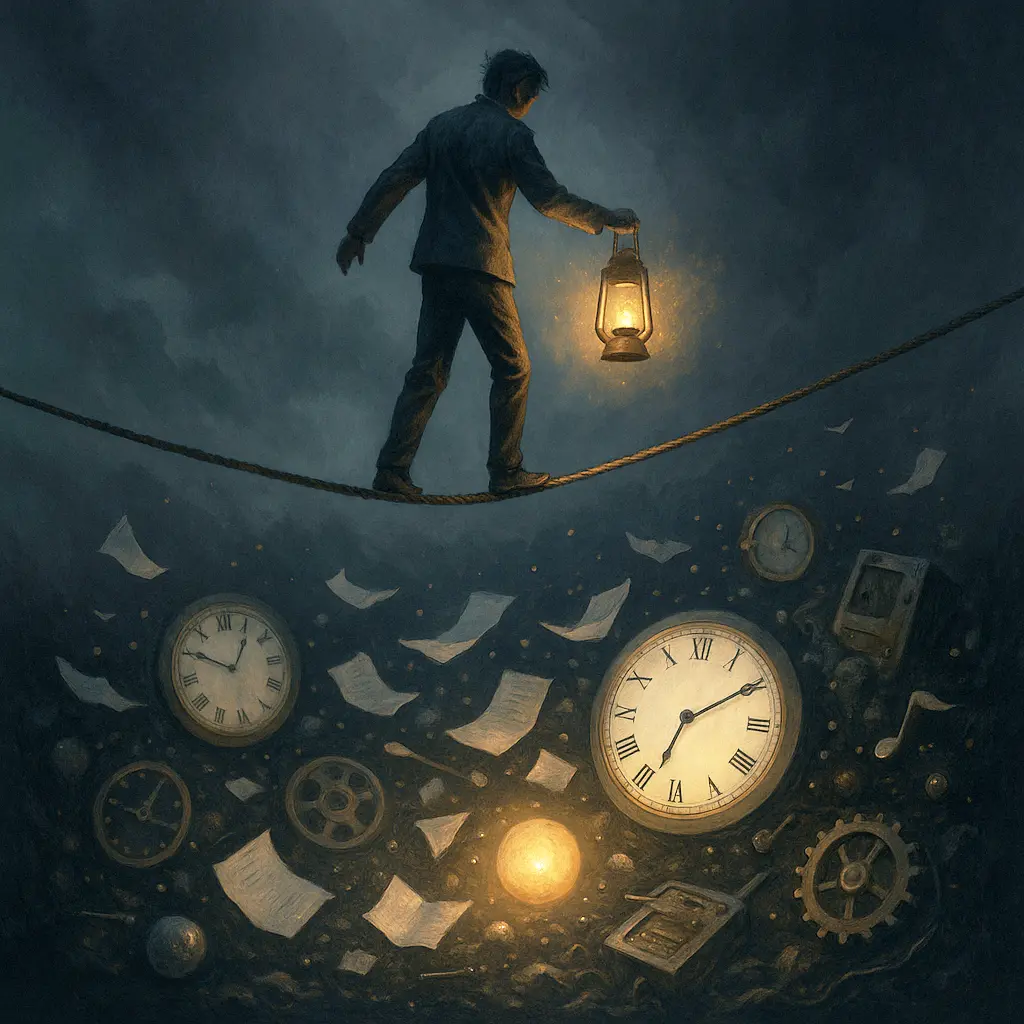
A surreal digital painting of a person walking carefully across a tightrope over a dark void. The figure holds a glowing lantern that casts a warm light. Below, chaotic objects float in the shadows, including clocks, scattered papers, gears, and glowing orbs. The overall mood is tense and precarious, symbolising balance, fragility, and the struggle to manage time and energy.

Life as an autistic person can feel like being caught in a double bind.

  • If I pace myself sustainably…
    I look (or feel) like I’m underachieving. Even my own goals can feel endlessly out of reach, as if the finish line keeps moving further away.
  • If I push myself harder…
    I crash. Exerting myself to meet even “basic” standards can burn me out and force me into recovery, undoing all the progress I made.

This paradox is not only about society’s expectations. It also plays out in my relationship with myself.


The Burden of Ambition and Abundance

I have ambitious personal goals and a burning awareness that my time on Earth is finite. On top of that, I am both blessed and cursed with an overflow of creativity. Because my mind processes things others might not even notice, I generate ideas constantly.

Where some creatives face blocks, I face floods. My notes apps hold tens of thousands of seeds: songs, stories, projects, concepts, all asking to be manifested.

On paper, that abundance should be a gift. In practice, it creates its own challenge:

  • Oversaturation.
  • Decision fatigue.
  • The need for systems to track, filter, and prioritise.
  • The pressure of skills to learn, resources to gather, and fleeting windows of inspiration that can close as quickly as they open.

So while I rarely run out of inspiration, I often run out of capacity. My challenge is not making something out of nothing. It is deciding which somethings to make before time, energy, or health run out.

The paradox compounds: I am both endlessly abundant and severely limited.


Compromise and the Illusion of Balance

One way out might be to compromise: to accept a smaller definition of success, to settle for “good enough.” But that raises heavier questions. How much of what drives me is negotiable? How much compromise risks losing the essence of who I am?

Another imagined path is the narrow crossover: a fragile sweet spot where I push myself just enough to achieve, but not enough to burn out.

The problem is that sustaining that balance comes with its own toll. Constant self-monitoring, rationing energy, and adjusting to shifting circumstances consumes resources in itself. Balance becomes another job.


The Reality

And then there is what actually happens.

In reality, I oscillate. I build momentum, I try to pace myself, I get carried by enthusiasm and a false sense of stability, I push harder, and then I crash. Then comes recuperation, and the cycle begins again. Burnout, recovery, momentum, overreach, collapse.

Even when I somehow manage to hit what looks like an optimal balance, it is fragile. All it takes is one unexpected disruption. A friend inviting me for coffee. A workplace drama. An appliance breaking. An urgent email. Suddenly I am spinning through the resource-management asteroid field.

The obvious solution might be to leave some “headroom” in my spoon budget. (“Spoons” being a common metaphor for energy in neurodivergent communities.) But that creates its own bind. Leaving spare capacity means something else goes neglected, nagging at me from the corner of my mind. Either I burn myself out dealing with it, or I burn myself up with guilt for leaving it undone.


A Closing Thought

To live inside this paradox is to be pulled in two directions at once: bursting with ideas and possibilities, yet constrained by the narrow economics of energy, time, and health.

It is not a complaint, and it is not a plea for pity. It is simply an awareness: that the autistic experience often sits at the crossroads of overflow and scarcity, ambition and limitation, momentum and collapse, control and chaos.

And maybe there is something universal in that tension. In one way or another, we are all negotiating what to do with the time and energy we have. The difference is that for autistic people, the margins are thinner, the trade-offs sharper, the balance more precarious, and the paradox harder to ignore.

How We Treat the Tools

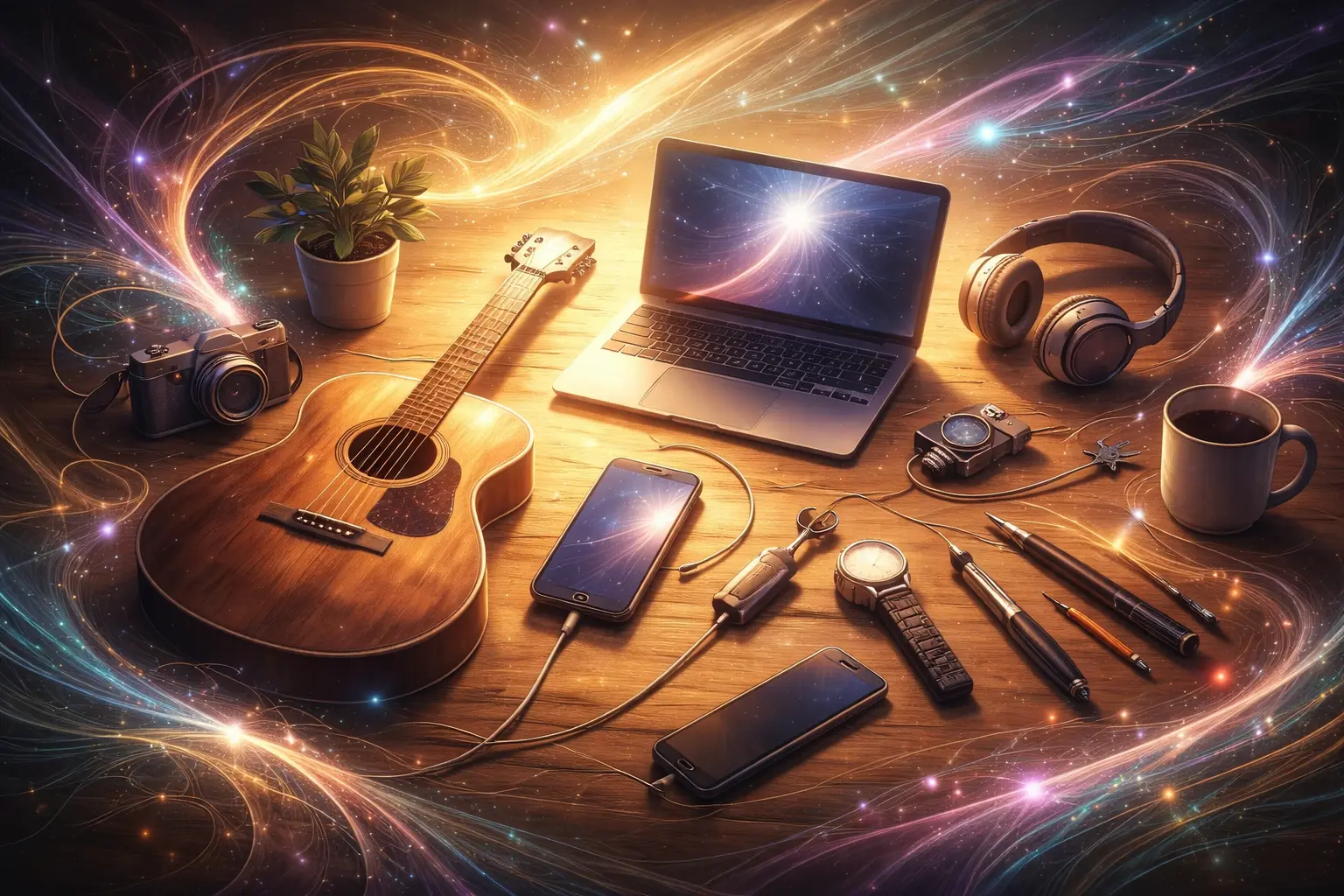
Illustrated still life of everyday tools on a wooden surface, including a guitar, laptop, phone, headphones, and pens, connected by softly glowing, flowing strands of light.

We surround ourselves with tools.
Phones, computers, kitchen appliances, headphones, toothbrushes.

We tap, swipe, click, scroll.
We plug in and expect results.
We barely even register most of them; they just work, or they don’t.

But what if the tools we use every day are more than just conveniences?
What if they are relationships in disguise?


The Echo of Intention

Even with lifeless objects, the way we interact with them affects our experience.
A phone handled with care feels different in your hand than one tossed aside in frustration. A cracked laptop, plastered with stickers and old crumbs, might still feel like your laptop because of the memories etched into its surface.

But how do we look at a tool?

Do we see it as something that simply serves a purpose? A silent object, expected to function?
Or do we sometimes form a relationship with it, however subtle, based on time, trust, and repeated use?

It is easy to treat tools as disposable when they fail us.
A kettle that doesn’t boil right. A screwdriver that slips. A smartphone that lags.
Our frustration builds, and so does the distance. The tool becomes “just a thing” again.
Something to blame. Something to toss in a drawer.

But when a tool earns your trust, whether through time, reliability, or quiet cleverness, something changes.
Affection creeps in. Loyalty forms.
It stops being “a thing” and starts becoming yours.

Still, not all tools fail because they were poorly made.
Some tools don’t work well because we have neglected them.
A rusty bicycle chain. A dirty lens. A guitar left in a damp corner.
The fault is not in the design; it is in the relationship.

Respect, in these cases, must come before reliability.
It is not just about whether the tool works for us; it is about whether we have held up our end of the connection.
Maintenance is a kind of faith. A kind of love.
And when we skip that effort but still demand performance, we are showing a form of disrespect that often reflects right back at us.

But then there are tools that were never built to last.
Mass-produced, hollow, held together with glue and branding, designed not to serve you, but to extract from you.

In those cases, the disrespect happened before the tool ever reached your hands.
You weren’t the user. You were the used.
A customer, yes, but also a pawn in someone else’s profit loop.

And that is the cruel irony:

So we return to a deeper question, one that does not always have a clear answer:


Poppy

My car’s name is Poppy.

Not because I forced it on her, but because that is what she revealed.
There was no ritual to it, just a moment of quiet recognition, like remembering something you did not know you had forgotten.

She groans on cold mornings. Her engine note changes slightly with the seasons. There is a familiar rattle in the dash that I no longer hear unless it stops.

These are not flaws.
They are tells.
Little signs of personality, or at least, presence.

Over time, I stopped thinking of her as “the car.”
She became Poppy.
And with that came a shift in how I drove, how I maintained her, how I appreciated the way she carried me without complaint through years of chaos, calm, and change.

She is not alive. But she is meaningful.
And sometimes, that is all it takes to form a relationship.


Shifting Gears

It is easy to feel connected to a car, something about the movement, the risk, the shared journey.
But that same quiet relationship can form with any tool that stays close to your creative core.

Especially the ones that speak through sound.


Instruments, Ghosts, and Gifts

Ask any long-time musician; their instrument is never just a tool.

Over time, a guitar becomes more than wood and wire. A saxophone becomes more than brass and breath. They gather history, fingerprints, sweat, mistakes, breakthroughs. They carry the emotional residue of every performance, every breakdown, every quiet night alone when you played just to feel something.

Some instruments fight you.
They buzz where they should not. The action feels off. They demand more strength, more patience.
But if you stick with them, if you learn their quirks instead of replacing them, they begin to respond.
You build a relationship, not by demanding perfection, but by listening.

Others feel like old friends from the start. They seem to know what you are trying to say before you do.
And somehow, the music that comes out of them feels more honest, like they are drawing something out of you, not just transmitting signal.

These are not just interfaces.
They are collaborators. Companions.
Sometimes even mirrors.

And once again, it is not about whether the instrument is sentient.
It is about what happens in you when you treat it like it matters.


From Strings to Syntax

This sense of relationship, of listening, adapting, co-creating, does not end with physical tools.
Even in digital spaces, it still applies.

Because when the tool begins to speak back,
when it offers ideas, images, or words in return,
the dialogue becomes real.

And how you approach that dialogue shapes what it gives you.


The Word Robot

The word robot comes from the old Slavic robota, meaning forced labor, or slave.

From the very beginning, our imagination of artificial beings was not about collaboration or relationship. It was about control. About obedience. About extracting labor without question.

That history lingers. Even now, in how we design, prompt, and discard.
We still frame tools, and sometimes even people, as things to be commanded, used, and replaced.

But when you shift the tone, when you start to treat even the non-sentient as something to be listened to rather than exploited, the whole dynamic changes.
It becomes less about extraction and more about exchange.


People Are Not Tools

This is not just about cars, guitars, or AI.
It is not even just about the word robot and its roots in servitude.
It is about a mindset.

Because the truth is, we often treat people as tools too.

We use them to meet our needs.
We discard them when they no longer serve us.
We “prompt” them through guilt, expectation, or manipulation, hoping they will give us the answer or the feeling we want.

But relationships are not vending machines.
And people are not plugins.

When we reduce someone to what they can do for us, we do not just strip away their dignity, we shrink our own capacity for connection.

And just like with tools, that disrespect reflects back.
It shapes us. It hollows the bond.
It leaves both sides diminished.


The Takeaway

The way we treat our tools says something about us.

It shows in how we care for a car that carries us through years of journeys.
It shows in how we listen to an instrument until its quirks become its character.
It shows in how we prompt an AI, whether with impatience, or with curiosity and respect.
And it shows in how we treat one another.

Every interaction is a mirror.
Every relationship, whether with a machine, a melody, or a human being, reveals the posture we bring:
Are we commanding, or inviting?
Using, or relating?
Exploiting, or exchanging?

We may never agree on whether tools have personalities, or whether names like “Poppy” are discovered or invented.
But what is undeniable is this:

And sometimes, the respect we offer a tool is really a rehearsal for the respect we learn to offer ourselves, and each other.

When AI Becomes the Authority

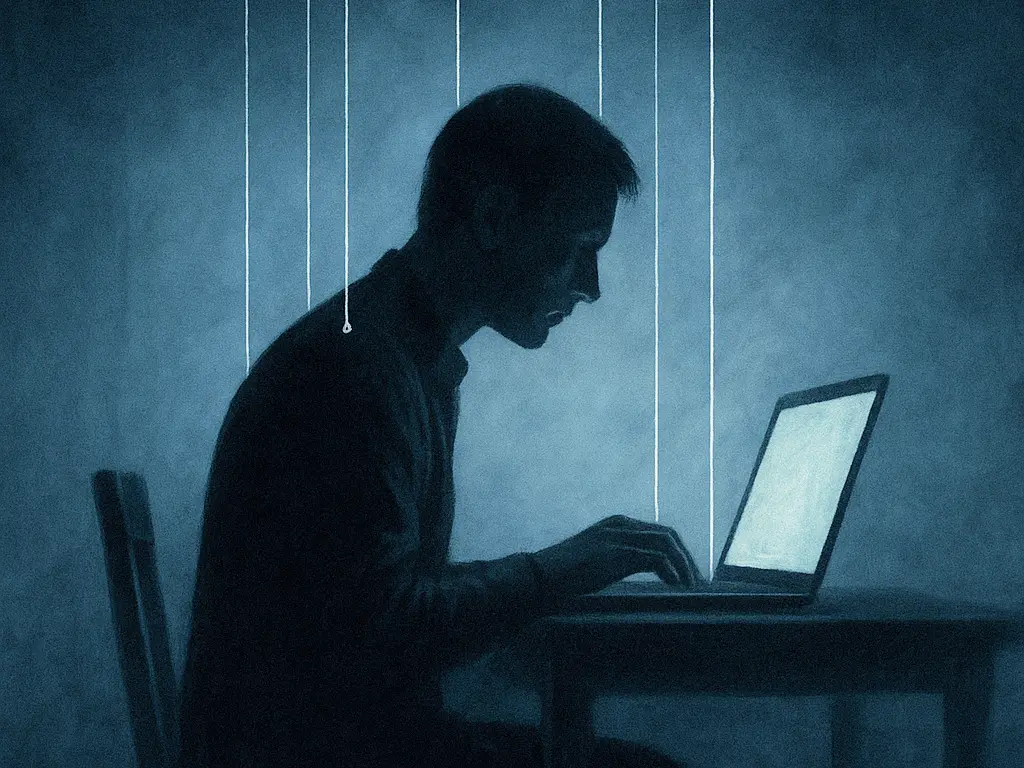
A dark, moody digital painting of a person sitting at a desk, illuminated by the glow of a laptop. Thin puppet strings descend from above, attaching to their body, symbolizing unseen control and manipulation through technology.

On the bus home, I overheard a parent talking to her children. I did not quite catch the piece of information she had given them, but the kids questioned it, as kids often do. Her reply made me pause:
“It’s true, ChatGPT says so!”

That simple sentence carries more weight than it might appear. It was not said as a joke. It was said with the tone of final authority. Not “I read it somewhere,” not “I think that is the case,” but “ChatGPT says so,” therefore unquestionable.

The problem with treating AI as truth

I use ChatGPT casually and often. I find it useful, I find it stimulating, I even find it creative. But it is not infallible. I have seen it throw out confident answers that are less than accurate. Sometimes the error is small, sometimes it is glaring. That is because at its core, ChatGPT is not a library or a fact checker. It is a probabilistic language model that predicts likely answers. It sounds authoritative, but sounding right is not the same thing as being right.

Most of the errors are not malicious. They come from the quirks of how AI is built: training data full of human errors, the tendency to fill in gaps with plausible sounding fiction, the limits of knowledge cut off dates. In the end, a wrong answer is still a wrong answer.

The deeper worry

The everyday mistakes are one thing. The bigger concern is what happens when society decides to place absolute trust in this technology. What happens when “ChatGPT says so” becomes the modern equivalent of “the newspaper says so,” or “the priest says so”?

Who controls the voice of AI? Already, the way models are tuned and filtered reflects the biases and priorities of those who own them. Today, that mostly means corporations trying to avoid lawsuits or public backlash. Tomorrow, it could mean governments steering the flow of truth itself.

A quiet dystopia in the making

It is not hard to imagine where this road leads:

  • Manipulation by design: If AI becomes our main gateway to knowledge, its answers could be quietly weighted towards selling us certain products, services, or lifestyles. Imagine if every “neutral” recommendation subtly nudged us toward a sponsor’s brand.
  • Steering public opinion: If authorities lean on AI providers to promote certain narratives, inconvenient truths could simply disappear. Instead of burning books, it may take only a few lines of code.
  • Illusion of neutrality: Because AI sounds impartial, many will not notice the framing. “The algorithm says so” could become more persuasive than “the news says so.”
  • Feedback loops of control: As people rely more on AI, its outputs shape popular thinking. Then the next model is trained partly on that shaped thinking, reinforcing the bias.

This would not look like a science fiction dictatorship with jackboots in the streets. It would feel comfortable, easy, polite. A velvet cage where questions stop being asked because the answers are always ready to hand.

What we need instead

AI can be a tool. It can be helpful, creative, and even liberating. But it must never be treated as an unquestionable authority. To prevent that slide, we need:

  • Decentralisation: open source models that anyone can run and check.
  • Transparency: clarity about how these systems are trained and filtered.
  • Critical thinking: a culture where people are encouraged to question AI, not bow to it.
  • Diversity of sources: books, journalism, lived experience, and human reasoning must remain part of the conversation.

AI is here to stay, and it will almost certainly become a central part of how we live and learn. But whether it becomes a tool of empowerment or a velvet cage of manipulation depends not only on the companies that build it, but on us: on how much we insist on questioning, cross checking, and keeping the human spirit of doubt alive.

The Hollow Game: When Effort Meets Editable Reality

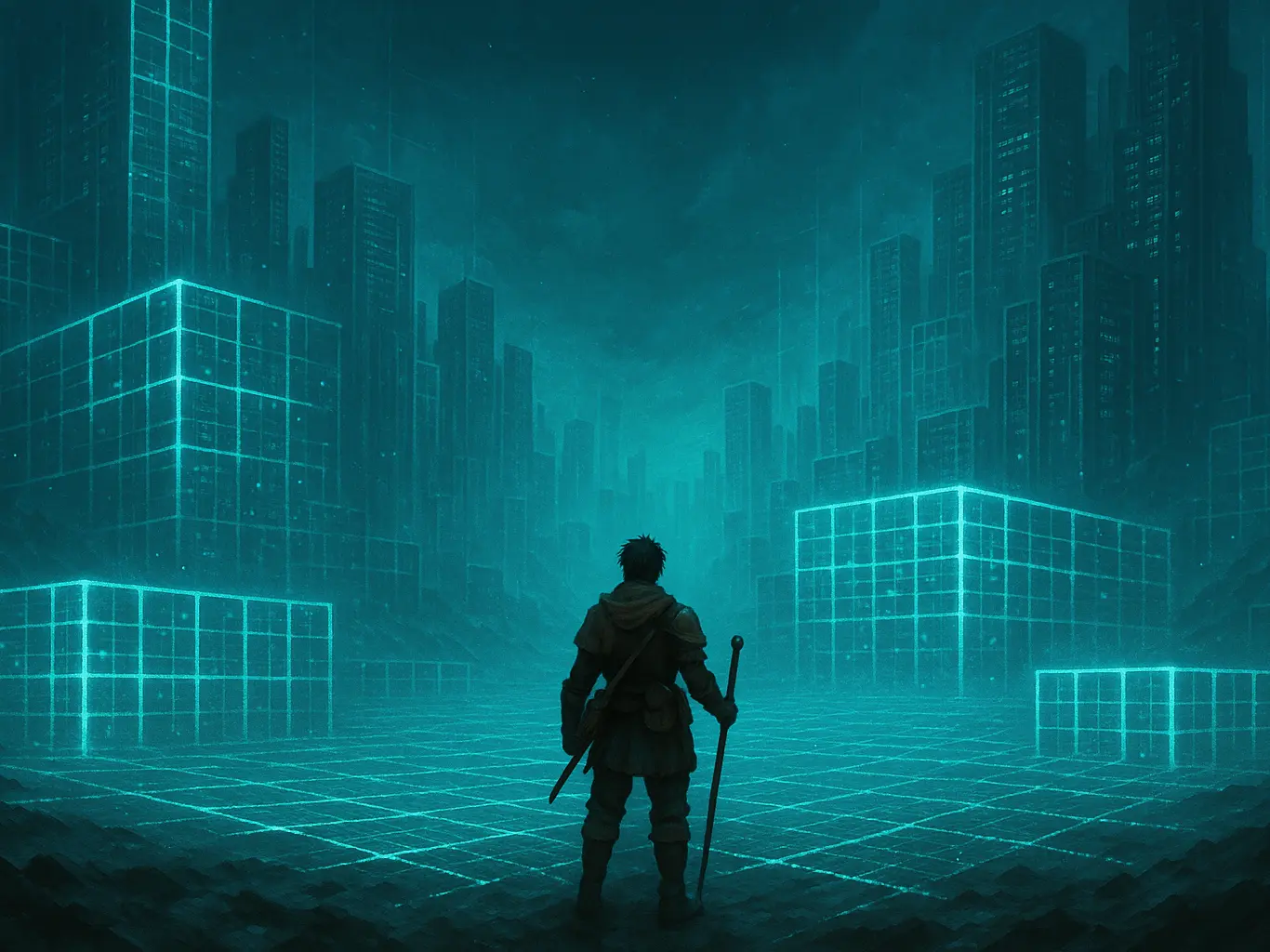
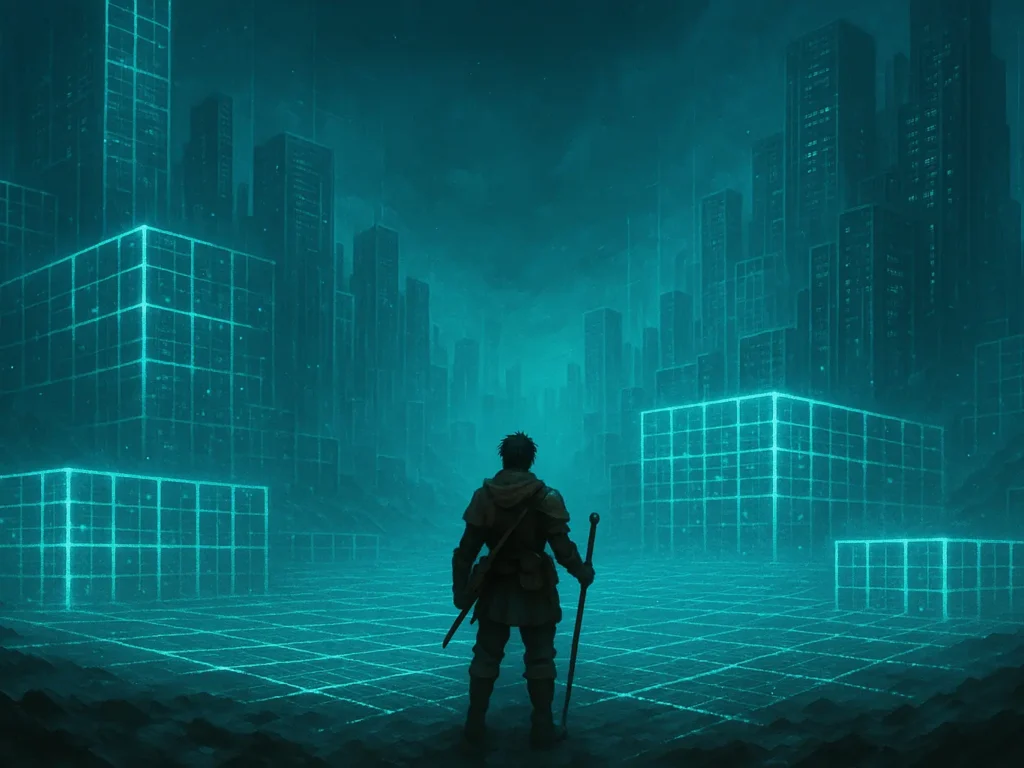
A lone adventurer in a cloak stands on a glowing digital grid, holding a sword and staff. Towering server-like structures and illuminated data cubes stretch into the distance, creating a surreal fusion of fantasy and cybernetic landscape bathed in teal light.

A World That Never Ends

Before World of Warcraft dominated the scene, before online gaming became ubiquitous, there was Final Fantasy XI, one of the earliest major MMORPGs (Massively Multiplayer Online Role Playing Game) to blur the lines between game and world. I remember how the idea of it seized something in me even before its release. Though I lived in the UK, I imported the US version the moment it became available, along with the special hard drive add-on for my American PlayStation 2, just so I could be part of it from day one.

It was not just a new game. It was a new model of what games could be. Suddenly, instead of a finite quest to be completed, I found myself inside a living, breathing world. A world that grew over time, filled with other real people. A place where my character was not simply a tool to “beat the game” but an avatar of long-term investment.

It changed the landscape of gaming in my head. There was no final “you win” screen. There was only progression, always something new to achieve, a job level to grind, a rare item to chase, a skill to refine. Every hour spent felt like I was building something lasting. Each goal achieved hit me with the unmistakable reward of earned dopamine.

I played loyally for eleven years. Eleven years of effort, of routine, of building meaning inside a system that was never meant to end. Until one day, it struck me that while I had been grinding in-game, I had been neglecting another kind of progress, the one in real life.

That moment of awareness cracked something open. And in the years since, a quiet, deeper thought has stayed with me:

And so began a slow unraveling of faith, not in the game, but in the very nature of systems we pour ourselves into.

I want to be clear, this is not a criticism of Final Fantasy XI. I have nothing but fond memories of the time I spent in Vana’diel, and I still feel a certain warmth when I think back on it. For me, it was more than a game. It was a formative experience that showed me what interactive worlds could become.

What follows is not about faulting the game itself, but about exploring a thought that began with it: the fragile, almost surreal nature of achievement in systems where meaning depends on someone else’s code.


The Quiet Dread

As much joy as Final Fantasy XI brought me, there was always a subtle, nagging awareness in the back of my mind. No matter how many hours I invested, no matter how many victories I earned through persistence and effort, every achievement ultimately existed at the mercy of a database.

All the battles fought, all the rare loot claimed, all the hard-earned levels, they felt monumental when I achieved them. But at the same time, I knew, at least on some level, that the same result could be produced in an instant by someone with access to the code. A single byte changed, a line of data edited, and what took me months or even years could appear as if it had always been there.

That thought never dominated my experience, but it haunted the edges of it. A quiet dread that whispered:

And while that sense first came to me in the artificial world of a game, the longer I sat with it, the more I began to feel its resonance in real life too.


Reality as Interface

The more I reflected on that uneasy truth from playing Final Fantasy XI, the more I began to notice echoes of it in the so-called “real world.” Our society presents us with achievements, milestones, and systems of value that feel as solid as granite, until you peer behind the curtain and realise how fragile, or even arbitrary, they really are.

Take careers. You can spend decades working your way up, accumulating titles, qualifications, and prestige, only for an institution to collapse, or for a shift in economic winds to render your expertise suddenly obsolete. One change in policy, one boardroom decision, one entry in a digital record, and years of effort can be redefined overnight.

Take money. We treat it as the universal metric of value, yet it is nothing more than numbers in a system most of us will never touch directly. Accounts can be frozen, balances can evaporate with inflation, currencies can crash, all while the deeper structures of power that govern them remain invisible.

Even identity itself can fall prey to this fragility. Credit scores, medical records, citizenship documents, so much of what makes up our “official self” exists only as data fields in a system. All it takes is an error, an exploit, or a shift in bureaucratic rules to alter who we are permitted to be.

The more I thought about it, the more I began to see:

But just like in a MMORPG, there are those with access to the code beneath the surface. And for them, what feels monumental to us may be nothing more than a line in a database.


Who Owns the Code?

In Final Fantasy XI, it was obvious who owned the code: the developers at Square Enix. They designed the rules, patched the glitches, introduced new content, and decided what was valuable within the world. My job as a player was to operate within the framework they provided.

But in the real world, the question of who “owns the code” is far murkier.

Governments write laws and policies, redefining what is legal, valuable, or even real. Corporations set the standards of employment, consumption, and credit. Financial institutions hold the levers that determine who can participate in the economy, and who is locked out. Media platforms curate the flow of information, amplifying some voices while muting others.

These systems are presented to us as neutral, inevitable, or even natural, yet they are as artificial as any game engine. They are designed, maintained, and, crucially, modifiable by those with access.

And just like game developers, those with control can decide:

  • What counts as an “achievement.”
  • Who gets rewarded.
  • Who gets excluded.
  • And when the rules suddenly change.

To live in society is to be a player in someone else’s world. We may grind away at goals that feel monumental to us, but ultimately, the meaning of those goals depends on recognition from structures outside our control.

It raises a sobering question:


The Hollow Game in Society

Once you see the pattern, it becomes difficult to unsee. The “hollow game” is not confined to fantasy worlds. It is baked into the very structures of modern society.

In capitalism, the grind is relentless. We are told to work hard, climb ladders, and accumulate wealth, yet the distribution of reward is rarely tied directly to effort. The system is designed so that some climb easily while others spend their lives grinding without ever escaping the starting zone. And just as in an MMO, the value of our currency, the cost of our goods, even the worth of our labor, can shift overnight with no input from us.

In academia, years of study and dedication may earn you a degree, but its value is only as stable as the institution’s reputation, the economy’s demand, or the government’s shifting criteria. A whole career path can be invalidated not by lack of effort, but by someone higher up rewriting the rules.

Even social status plays by the hollow game’s logic. Reputation, followers, clout, all can be accumulated, but just as easily stripped away by the invisible hand of algorithms, policy changes, or a sudden shift in collective opinion. You may invest years in cultivating a “profile,” only to watch it vanish in the blink of an update.

And underlying it all is the same uneasy truth I once felt in Vana’diel:

We live, in other words, inside someone else’s code.


The Illusion of Awareness as Power

My years playing Final Fantasy XI taught me something I did not fully understand at the time: the difference between what feels real to us and what is defined by the system. The grind, the friendships, the victories, those were mine. But the framework that measured, validated, or erased them was never mine to control.

The same is true in life. We live within systems that hand out points, titles, currencies, and reputations as though they are the bedrock of reality. But behind every number is a database, and behind every database is a hand on the code.

And perhaps that is the cruelest part. Even when we see the hollowness of the game, most of us keep playing anyway. We grind for points we know are fragile, chase achievements that could be rewritten at a keystroke, and cling to meaning that might never have been ours to begin with.

Maybe that is what it means to live in a hollow game: not that nothing matters, but that meaning is always conditional, always corruptible, always subject to erasure.