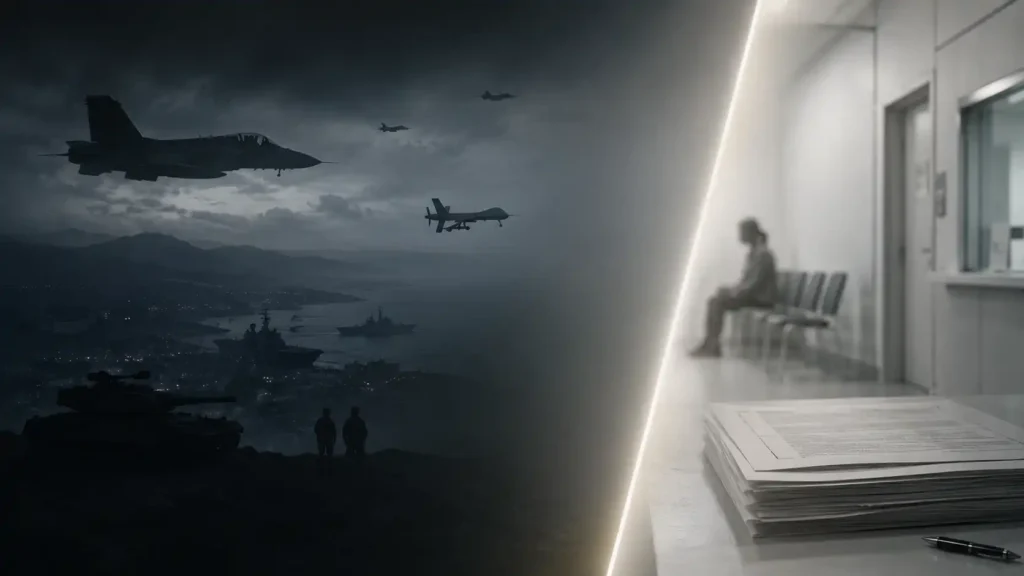
We tend to accept that defence is necessary. There are real threats in the world, and ignoring them is not wisdom. It is negligence. But there is a question we do not often ask: where does defence actually end?
Because when you look closely, defence is not a clear boundary. It is a gradient. Deterrence becomes positioning, positioning becomes provocation, and provocation becomes pre-emption. At some point along that slope, action is taken not in response to harm, but in anticipation of it. And still, it can be called defence. The definition stretches.
Now compare that to care.
Care does not stretch in the same way. It does not adapt or operate on a gradient. It operates on thresholds. You either qualify, or you do not. You are either deemed in need, or you are not. Those lines are often drawn with clinical precision, even when the reality they attempt to measure is anything but.
Struggle is not always legible. Suffering does not always present itself in ways that fit neatly into a form. And yet, care demands proof.
So we arrive at a strange imbalance. We allow ambiguity when deciding whether to act with force, but we demand certainty when deciding whether to act with care. A hypothetical threat can justify immediate intervention, while a real lived difficulty can fail to meet the threshold for support.
This raises a deeper question: what are we actually defending?
If defence is meant to protect life, stability, and wellbeing, then it is worth asking why those same principles are not applied with equal flexibility when it comes to care. Because if one system is allowed to operate on a spectrum while the other is confined to a gate, then the outcome is already shaped before any decision is made. Not by necessity, but by design.
A few days ago, I walked past what has become a common scene in my city. A crane, busy erecting a massive block of residential apartments.
I pass scenes like this so often that they usually blur into the background noise of everyday life. Construction has become part of the city’s ambience. But for some reason, this time, I stopped. I really looked.
What I felt was not optimism. It was not relief. It was not the quiet reassurance that more housing must mean things are getting better.
It felt like encroachment.
When Progress Becomes Colonisation
New developments are often presented as self evidently good. More housing means more options. More options mean progress.
On paper, this logic is clean and comforting. In lived reality, it often collapses.
Progress is not experienced abstractly. It is experienced in bodies, nervous systems, bank balances, and daily friction. From where I stand, this kind of development does not feel like progress at all. It feels like hostile colonisation.
Not an invasion in the historical sense. No armies, no banners. Instead, an overwrite. An environment reshaped without the consent of those already living within it, justified by necessity and framed as inevitable.
The city becomes denser, louder, more competitive. Systems become more complex. Access becomes conditional. Warmth exists, but it is selectively distributed. You can see it everywhere, but that does not mean it is for you.
My first instinct is to point the finger at the opportunistic investors and development interests who see rising demand in cities, have the capital to act on it, and do so without serious consideration for the human consequences beyond their own returns. They profit from scarcity. They profit from pressure. They profit from the fact that people need to live near their work in order to survive.
From that angle, it is entirely reasonable to see them as the villains.
But stopping there is too shallow, because this behaviour is not anomalous. It is rewarded. It is encouraged. It is logical within the system that contains us all.
There is a genuine need for city based housing. People work here. People are required to be here. Money flows to where it will accumulate most efficiently, and housing in cities is one of the most reliable places for that to happen. Capital follows demand. That is not personal cruelty. It is capitalism doing exactly what it is designed to do.
This is what makes the situation harder to confront. The harm does not arise from individual malice alone, but from a system that converts human need into investment opportunity and treats any fallout as external to the calculation.
In that sense, even those who profit most are still responding to a structure they did not invent and cannot easily exit. The colonisation is systemic before it is personal. It is driven less by hatred than by incentive.
That does not make its effects any less real.
Why This Is Impossible to Miss From Where I Stand
This dynamic is not something I am observing from a position of comfort or distance.
I live on benefits, through no fault of my own, but because my neurodivergence conflicts with conventional working expectations. I live in a flat that is far from ideal, with poor heating and little insulation. I am currently facing the very real possibility of eviction due to my landlord selling the property, with homelessness no longer a theoretical concern but a looming one.
So when I see new residential developments rising around me, I do not see abstract progress. I see warmth, stability, and security being constructed nearby, while my own position becomes more precarious.
I see people with means moving into well insulated homes while I ration heating. I see comfort being manufactured and sold at scale while I am squeezed tighter by systems that claim to be expanding opportunity.
This is not envy. It is contrast.
It is the experience of being physically surrounded by shelter while becoming increasingly unsure whether you will have any at all.
From this position, it becomes impossible to treat the idea of choice as abstract or evenly distributed. When housing, warmth, and stability are being actively produced around you, but remain structurally inaccessible, the language of opportunity begins to ring hollow. What looks like expansion from a distance feels like pressure up close. And once that contrast becomes visible, it forces a more uncomfortable question. Not who is choosing well, but who is actually being given meaningful choices at all.
The Myth of Neutral Choice
This is where the language of choice enters, and where it begins to unravel.
Choice is not neutral.
Some people cannot afford not to play. They must engage with unstable systems, rising costs, and constant self optimisation simply to survive. Refusal is not an option. Participation is triage.
Others cannot afford to play at all. They lack startup capital, safety nets, and margin for error. For them, playing is framed as opportunity, but it is actually risk without insurance.
Then there are those for whom playing would require a betrayal of self. Their values conflict too deeply with the demands of participation. Self commodification, endless performance, and strategic dishonesty are not minor compromises. Opting out here is not laziness or fear. It is integrity.
All three positions are flattened into a single accusation.
You chose not to participate.
That sentence erases material constraint, structural exclusion, and ethical refusal in one stroke. It transforms coercion into agency and conscience into failure.
Filtering Disguised as Growth
As cities densify, what is really happening is not simply growth, but filtering.
The environment becomes tuned to those with money, stamina, tolerance for noise and instability, and a willingness to comply. Those without these traits are not expelled outright. They are quietly rendered incompatible.
You can remain physically present while being functionally excluded. Surrounded by housing. Surrounded by warmth. Still unsheltered.
When people say this is progress, what they often mean is that it works for them. That they can play, and that playing does not cost them their sense of self. The system rewards that compatibility and calls it merit.
But a system that demands participation as proof of worth is not offering opportunity. It is applying selection pressure and calling the survivors progress.
What the Crane Signals
From this perspective, another crane on the skyline is not a promise. It is a signal.
A reminder that the city is being tuned to a frequency you are expected to endure, adapt to, or quietly disappear from.
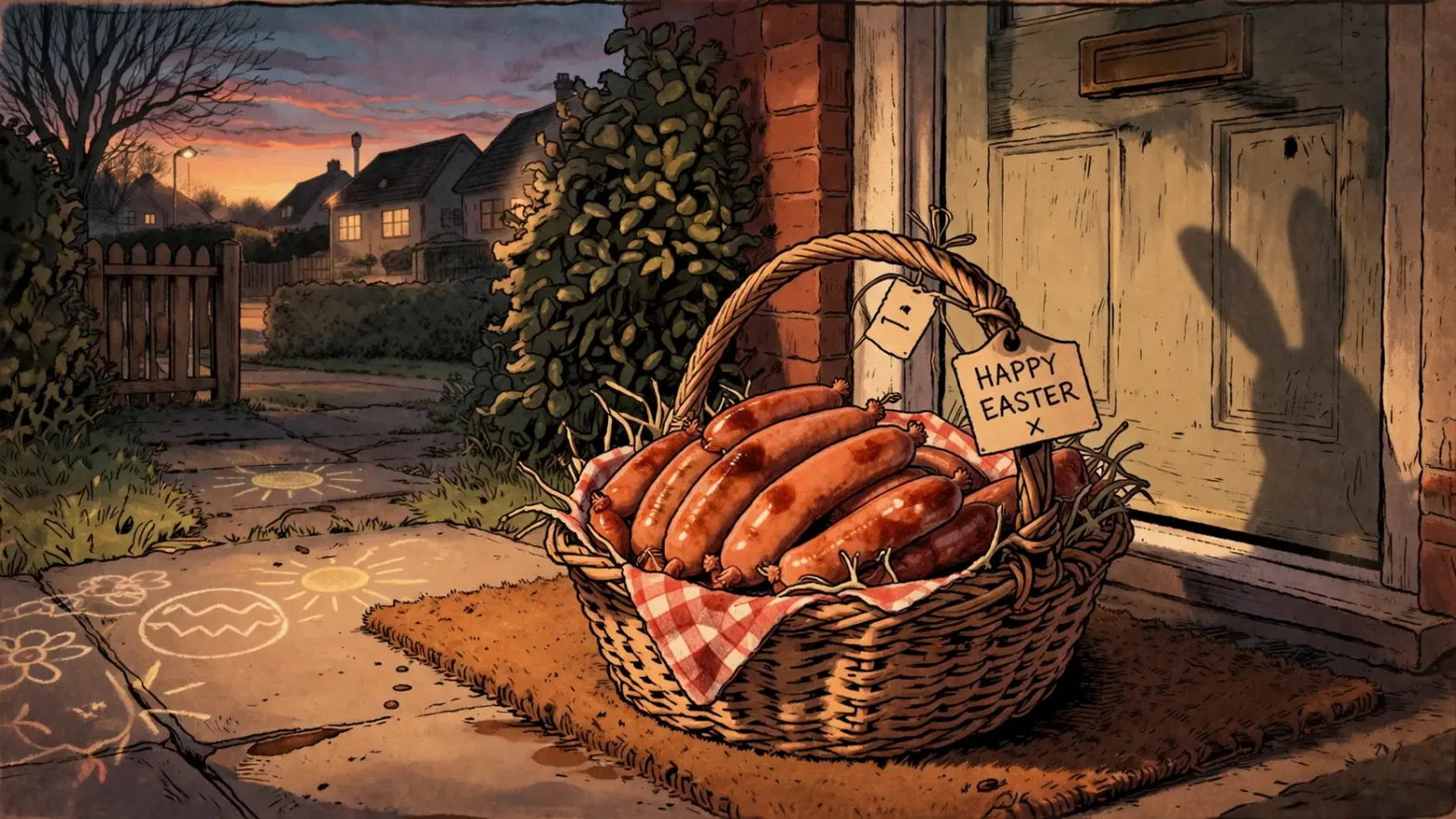
Every year, without fail, the Sausage Bunny came at dawn.
No one ever saw it arrive. Not properly. There were always stories, of course. Someone’s cousin who woke early and caught a glimpse of it moving between hedges, or a shadow crossing the kitchen floor where no shadow should be. But nothing clear. Nothing you could point to and say, there it is.
Only the evidence remained.
Small wicker baskets, left neatly in gardens and by doorsteps. Inside, rows of sausages. Perfectly formed. Still warm.
Children were told not to question it. “It’s just what happens,” parents would say, with a smile that never quite settled naturally on their faces. “Eat them before they go cold.”
And they did. Of course they did.
The sausages were… good. Better than good. Rich, comforting, with a flavour that felt strangely personal, as if it knew something about you. As if it had been prepared for you, specifically.
No one could ever quite describe the taste afterwards. Only that nothing else compared.
There were small traditions around it. You had to say thank you before the first bite. You had to finish every piece. And under no circumstances were you to ask where they came from.
Most people didn’t.
A few did, when they were young. But the answers never came in words. Only in looks. Long, quiet looks from adults who seemed, for a moment, to be remembering something they wished they couldn’t.
By the time those children grew older, they stopped asking too.
It was easier that way.
In some houses, if you stayed awake long enough, you might hear it. Not footsteps, exactly. More like a soft dragging sound, followed by a wet, rhythmic movement. And sometimes, though this was rarer, a low, satisfied breathing.
Those who heard it would pull their covers tighter and pretend they hadn’t.
Because if you acknowledged it, even silently, there was always the fear that it might realise you were awake.
Note: This article discusses the UK welfare system and applies specifically to Universal Credit and related benefits in the United Kingdom.
A Reassuring Promise, and a Known Loss
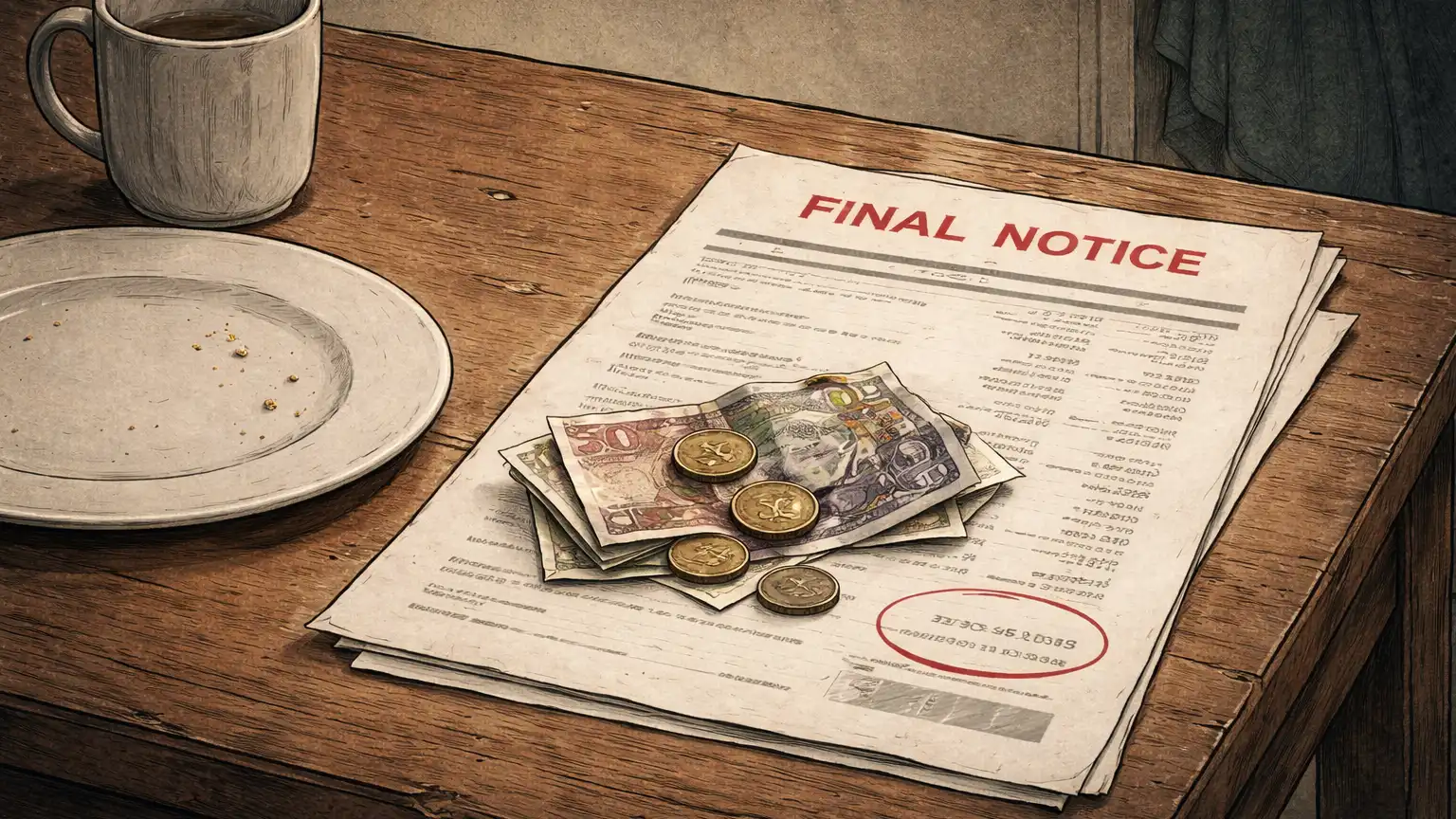
When people are moved from legacy benefits onto Universal Credit, they are often given a simple reassurance. The wording varies, but the message is broadly the same: you won’t be worse off. If there is a reduction in entitlement, transitional protection will be applied to prevent an immediate drop. That protection, claimants are told, will erode over time, and they are unlikely to notice it happening.
On the surface, this sounds like a safety measure. It suggests continuity and stability, implying that any adjustment will be gradual enough to absorb without disruption.
In practice, transitional protection is a fixed top-up added at the point of migration. Its purpose is narrowly defined: to prevent an immediate administrative loss when moving between systems. It is not recalculated dynamically and does not respond to changes in the cost of living. It does not rise with inflation, rent, energy prices, or food costs. It smooths a transition on paper, not the conditions people live in.
In my case, the move was not voluntary. I was transferred from Employment and Support Allowance with Severe Disability Premium onto Universal Credit under managed migration. This matters because the resulting loss was already understood by the system implementing the change.
Severe Disability Premium has no equivalent within Universal Credit. The reduction in entitlement was therefore not unexpected or disputed. Transitional protection was presented as the mechanism that would address this known gap, described as a buffer designed to ease the change gradually.
The emphasis was consistently on time. Erosion would be slow, incremental, and largely unnoticeable. This framing sets expectations. It suggests that while the system may be changing, the impact on daily life will be softened.
What is less clearly stated is that this reassurance depends on stability. It assumes that costs do not rise sharply and that changes occur slowly enough for a fixed buffer to erode gradually rather than be tested all at once.
Transitional protection is described in language that suggests resilience, yet it is a static measure placed inside a dynamic reality. When that reality shifts abruptly, the protection does not adjust. It depletes.
That tension, between the promise of gradual easing and the fragility of the mechanism itself, is where the problem begins.
What Actually Happened
Following the transition to Universal Credit, my housing costs were assessed in the usual way. Rent was paid within the limits set by the Local Housing Allowance, and the overall award included transitional protection to offset the known reduction created by the loss of Severe Disability Premium.
At a later point, the rent increased.
This was not unusual, discretionary, or avoidable. The increase was reported, and Universal Credit recalculated the housing element accordingly.
On paper, the process functioned as intended. Eligible housing costs were updated, and the housing element rose to reflect the new rent level within the applicable limits.
At the same time, the transitional protection element was reduced.
The reduction was not partial. The increase in the housing element was matched by a corresponding decrease in transitional protection. The total Universal Credit payment remained broadly unchanged.
The practical result was that the entire rent increase was absorbed by the claimant, not by the benefit system.
The buffer that had been presented as a gradual mitigation was consumed in a single adjustment. There was no extended period of erosion. Transitional protection was largely eliminated by one ordinary change in living costs.
This outcome did not involve error or discretionary decision making. It followed directly from the structure of transitional protection. When one element of a Universal Credit award increases, the transitional element reduces to compensate.
The process was correct. The impact was immediate.
Why This Is Not “Gradual Erosion”
The phrase most often used to describe the reduction of transitional protection is erosion over time. It suggests a slow process that unfolds in small increments and allows space for adjustment. The implication is both financial and psychological.
What occurred here does not fit that description.
The loss of transitional protection did not take place through a series of small changes. It was not reduced through uprating, earnings growth, or minor adjustments across multiple assessment periods. It was removed almost entirely in response to a single change in circumstances.
That change was a rent increase.
Rent increases are routine, predictable, and largely outside the control of tenants. Describing the resulting depletion of transitional protection as gradual erosion stretches the meaning of the phrase beyond usefulness. A mechanism that can be exhausted in one step is not eroding slowly. It is being consumed.
The distinction matters because the promise of gradual erosion shapes behaviour. It encourages people to believe they will have time to respond and time to adjust. When the protection disappears in a single recalculation, that expectation collapses.
This is not an edge case. It is the result of applying a static buffer to a cost that is known to change. When that cost changes suddenly, the buffer gives way.
In that context, the language of gradual erosion is not merely imprecise. It is misleading.
The Real-Terms Effect
When transitional protection is depleted in this way, the total Universal Credit payment may remain unchanged. On paper, there is no immediate loss.
In practice, housing costs increase while income does not. A greater share of the same payment is diverted to rent, leaving less available for other essentials. This produces a real-terms reduction in living standards without any visible cut to entitlement.
Reduced headroom means less capacity to absorb further cost increases or unexpected expenses. What had been presented as a stabilising measure no longer performs that function.
There is no clear policy moment marking this change. There is only the recognition that the same income now stretches less far. The adjustment is borne entirely by the claimant, without acknowledgement that a buffer has been removed.
The system remains administratively consistent. The lived experience becomes more fragile.
Why the Language Matters
The issue with transitional protection is not only how it operates, but how it is described. Language shapes expectations long before any calculation takes place.
Phrases such as you won’t be worse off and you won’t notice it eroding imply lived stability, not just administrative continuity. They encourage the belief that any loss will be softened, predictable, and manageable.
This has practical consequences. When people are told that a reduction will be gradual and largely unnoticeable, they are less likely to prepare for sudden change. They may delay difficult decisions or plan on the basis of an income level that is, in reality, fragile.
When the protection then disappears quickly, the gap between expectation and outcome is often experienced as personal failure rather than structural design. The language does not equip claimants to understand what has happened. It leaves them to assume they misjudged their situation, rather than recognising that the mechanism behaved exactly as built.
This is not a question of optimism versus pessimism. It is a question of precision. Reassurance that depends on unstated conditions is not reassurance at all. It is a promise that holds only in ideal circumstances.
Clear language would acknowledge that transitional protection is finite, static, and vulnerable to ordinary cost changes. Without that clarity, the burden of adjustment is quietly transferred to those least able to absorb it.
Conclusion: Precision Over Reassurance
Transitional protection is often understood as a form of ongoing security. In practice, it is a fixed and fragile mechanism designed to prevent an immediate administrative loss, not to shield people from ordinary living costs. When those costs change suddenly, the protection does not soften the impact. It disappears.
The problem is not that transitional protection exists, but that it is described in a way that overstates what it can withstand. Language that promises gradual erosion encourages expectations the system is not built to meet. When those expectations collapse, the consequences are felt privately, even though the process itself is working as designed.
At that point, reframing offers little comfort. There is no hidden upside, and no consolation in technical correctness. The most accurate response is often the simplest one. It is what it is. Not as resignation, and not as acceptance of fairness, but as a refusal to disguise loss as reassurance.
Naming mechanisms accurately is not cynicism. It restores clarity where soft language has obscured risk. For people living within these systems, that clarity matters more than optimism, because it allows reality to be confronted directly rather than discovered too late.
So it is worth being clear about what this represents. Transitional protection is framed as a measure to ease claimants into a new system, but its structure and presentation suggest a different priority. It smooths the administrative transition for the Department for Work and Pensions by preventing visible drops in entitlement at the point of migration, while leaving claimants exposed to ordinary cost changes that can erase the protection quickly and quietly. The transition it eases most effectively is not the claimant’s, but the system’s own.
There is an aspect of being a creative person, particularly in modern life, that rarely gets spoken about openly. Not because it is rare, but because it feels awkward to admit. It sits beneath the surface of collaboration, mutual respect, and genuine admiration, quietly shaping how we see ourselves and each other.
Most of us are happy to acknowledge our peers publicly. We celebrate their work, share it, recommend it, sometimes even work alongside them. And often, all of that is sincere. But alongside this visible layer, there is another, quieter one. A constant background awareness of where we stand in relation to others. Who is gaining attention. Who is being invited in. Who is moving ahead.
This awareness is not usually announced. It does not need to be. It operates silently, like a kind of creative weather, something we sense rather than name. We may not like it, we may not endorse it, and we may even believe ourselves to be above it. But it persists, shaping feelings we do not always know what to do with. Pride, envy, motivation, doubt.
This is not a confession, and it is not an accusation. It is an attempt to describe a shared condition. One that many of us participate in without ever agreeing to it, and without ever quite knowing when it began.
Mutual Respect, Private Comparison
Most creative relationships are not adversarial. They are built on genuine respect, shared interests, and often sincere admiration. Collaboration and encouragement are real, not performative.
The complication is not hostility, but proximity. When people work in similar spaces, comparison tends to arise automatically. Another person’s progress becomes a reference point, prompting quiet questions about one’s own position, direction, or pace.
This does not cancel out goodwill. Respect and comparison can coexist, even when that coexistence feels uncomfortable. Because this overlap is rarely acknowledged, the comparison remains private, quietly influencing confidence, motivation, and self doubt.
What matters is not intention, but accumulation. Even unspoken, this constant measuring begins to shape how we relate to both our peers and ourselves.
The Assumption Of Competition
At a certain point, private comparison begins to take on a social shape. Not through explicit rivalry, but through assumption. Behaviour starts to form around the idea that everyone present is playing the same game.
This assumption does not usually announce itself. It appears in how work is positioned in relation to other work, how progress is framed as response, or how neutral presence is interpreted as participation. Simply existing in a shared creative space can be enough to be read as engaged in a contest.
The unsettling part is that this can happen without agreement. You may find yourself competing with someone who believes you are already competing with them. The rules were never discussed, but the expectations are nonetheless applied.
Once competition is assumed, neutrality becomes difficult to maintain. Non engagement is rarely recognised as a valid stance. It is often misread as reluctance, avoidance, or inability. In this way, refusal is quietly reframed as loss.
This is where the dynamic shifts from internal comparison to external pressure. The game may remain unspoken, but its consequences begin to be felt.
The Trap Of False Choice
Once competition is assumed, the range of acceptable responses begins to narrow. The situation quietly presents itself as a choice, even though the terms were never agreed.
One option is to engage. To sharpen, assert, respond, or outperform. To demonstrate capability in ways that are legible within the existing framework. This path is recognised, rewarded, and easily understood by others.
The other option appears to be refusal. But refusal is rarely interpreted as neutrality. It is more often read as hesitation, lack of confidence, or an inability to keep up. In this framing, stepping aside is treated as falling behind.
What makes this a trap is that both outcomes are defined by the same logic. To engage is to accept the rules. To refuse is to be judged by them anyway. There is no recognised space for opting out without consequence.
Participation becomes compulsory, not through force, but through interpretation. The alternative is socially translated into loss.
Uneven Temperaments, Unequal Costs
Some people seem to come alive in competitive conditions. Having someone to measure themselves against sharpens focus. It gives work urgency and direction. The presence of a rival feels clarifying rather than threatening.
For others, the same atmosphere feels constricting. The moment comparison enters the room, attention shifts away from the work itself. Decisions become reactive. Energy is spent anticipating how something will be read, rather than following where it wants to go. Creative exploration slowly turns into self surveillance.
These differences show up in familiar ways. The tight feeling when a peer’s success lands differently than expected. The pressure to respond with something equally impressive. The sense of being baited into proving worth, even when no proof was requested. Or the quiet shame that comes with stepping back, knowing it may be read as falling behind.
This is not a lack of ambition. It is a mismatch between temperament and environment. A structure that rewards one mode of motivation will inevitably disadvantage another.
What exhausts is not effort itself, but effort spent in the wrong direction. Not making the work, but defending its relevance.
Systems That Quietly Reward Rivalry
The pressure to compete does not appear from nowhere. It is reinforced by the structures that shape how creative work is seen, valued, and distributed.
Creative labour exists within an economy that is inherently competitive. There are more people who want to make work than there are opportunities to support it. More artists than funded roles. More voices than available platforms. Scarcity is not an accident, but a defining condition.
Within this context, visibility is rarely neutral. Platforms prioritise contrast, momentum, and growth. Funding opportunities are framed as limited and selective. Attention is measured, counted, and compared. Even when no one explicitly asks us to compete, the surrounding infrastructure ensures that comparison remains unavoidable.
This scarcity does more than breed rivalry. It shapes what kinds of work are considered valuable in the first place. Work that produces legible outcomes or signals progress clearly is easier to justify. Slower, stranger, or less easily ranked work becomes harder to sustain.
Over time, creative choices tilt toward what is rewarded rather than what is needed. The competition does not have to be named in order to function. It is built into how opportunity is distributed.
The Shadow Question
There is another possibility that complicates this whole picture, and it is less comfortable to sit with.
What if noticing the hidden competition requires some level of participation in it. What if sensitivity to comparison points to a deeper layer of desire that is not fully conscious. A wish to be seen, recognised, or valued, even while rejecting the terms under which those things are offered.
And perhaps more uncomfortably, what if there is something genuinely pleasurable in moments where we do move ahead. Even when we believe our work should stand on its own terms, being recognised before others, or receiving validation in contrast to peers, can feel good. Not just intellectually satisfying, but emotionally rewarding.
If that is the case, then part of the drive may not come only from commitment to the work itself, but from chasing that feeling. The brief lift of being ahead. The reassurance of being chosen. The sense of relief that comes with visible progress.
This does not invalidate the critique. Wanting recognition is not the same as agreeing to ranking, rivalry, or public measurement. Desire does not equal consent. But it does complicate the story we tell ourselves about purity of motivation.
What this raises is not a verdict, but a question. Does this internal conflict weaken resistance, or does it reveal how deeply the system embeds itself. When even pleasure is shaped by comparison, the reach becomes difficult to deny.
This is not a problem to be solved here. It is simply something to notice, and perhaps to hold with a little more honesty.
Does This Actually Serve Art?
If competition has become the background condition of creative life, it is worth asking what it actually produces. Not in terms of output or visibility, but in terms of depth, range, and possibility.
Certain kinds of work respond well to pressure. Work that is easily compared, quickly understood, or clearly progressive can sharpen under scrutiny. But not all creative processes function this way. Some require time, uncertainty, or detours that do not translate cleanly into momentum.
When comparison becomes constant, the space for risk narrows. Creative decisions are made with an awareness of how they will be read or ranked. The question shifts from what the work needs, to how it will position the maker.
The result may not be worse art, but narrower art. Work optimised for survival within the system, rather than work that expands what the system can hold.
Leaving The Question Open
Competition is not inherently destructive. It can motivate, sharpen, and clarify. For some, it provides the structure needed to move forward. The problem is not that competition exists, but that it is so often treated as inevitable.
When rivalry becomes the default condition, opting out stops being legible. Refusal is mistaken for failure. Quiet work is mistaken for absence. Difference in temperament is mistaken for lack of ambition. These interpretations do not need to be enforced aggressively. They emerge naturally when a system recognises only one mode of engagement.
None of this demands a solution here. But naming a condition is not the same as endorsing it. Awareness alone can loosen the grip of assumptions that thrive on silence.
Perhaps the most useful question is not how to win or how to escape, but how much creative energy is spent responding to pressures never consciously chosen. And what might become possible if those pressures were no longer mistaken for natural law.
Most people have heard the phrase “Don’t you trust me?” at least once in their lives.
It rarely appears during moments of genuine closeness. It tends to surface at the exact point where a question has been asked and a pause has formed. Someone wants that pause closed.
What makes the phrase uncomfortable is not its surface meaning, but its timing. It does not respond to the question itself. Instead, it quietly shifts the ground beneath it.
A practical concern becomes a personal one. A request for clarity becomes a test of loyalty.
Suddenly, the safest option, asking for more information, feels like the wrong move.
This article is about that moment. Why it feels the way it does. And the subtle manipulation hidden inside a sentence that often passes as reassurance.
What the Trust Card Is
The Trust Card is a conversational manoeuvre that replaces explanation with emotional leverage.
Rather than addressing the concern that has been raised, it reframes the situation around personal trust. The focus shifts away from the action being questioned and onto the character of the person being questioned.
The unspoken message is simple. If you trust me, you will comply. If you hesitate, you are signalling doubt about who I am.
This is what makes the Trust Card a fallacy. It presents a false connection between trust and agreement, as though trust requires the suspension of judgement.
In reality, trust and questioning are not opposites. They operate in different domains. Trust is relational and built over time. Questions are situational and tied to specific actions.
The Trust Card collapses that distinction. It turns a reasonable request for clarity into a moral problem, and places the emotional burden on the person who asked the question.
Once played, the original issue often disappears entirely. What remains is a social dilemma, where preserving harmony matters more than understanding what is actually being agreed to.
The False Binary
At the core of the Trust Card is a manufactured choice.
You are presented with two options. Trust me and go along with this. Or question me and reveal yourself as disloyal.
What is missing is the most reasonable position of all. Trust me, and still ask questions.
This false binary works because it quietly removes the middle ground. It suggests that trust is something fragile, something that cannot survive scrutiny. Any hesitation becomes evidence of bad faith.
Once this framing is accepted, the conversation is no longer about the original issue. It becomes about proving that you are a good person, a supportive friend, a cooperative employee, or a loyal partner.
The pressure is subtle but effective. Choosing clarity now carries a social cost, while compliance offers immediate relief. Harmony is restored, at least on the surface.
The fallacy lies in treating trust as an on off switch rather than a stable relationship. Real trust is not broken by questions. It is strengthened by them.
The moment you are forced to choose between trust and understanding, you are no longer being offered either.
Trust vs Transparency
Trust and transparency are often spoken about as though they are interchangeable. They are not.
Trust is a relationship that develops over time. It is shaped by patterns of behaviour, consistency, and shared experience. Transparency is immediate. It concerns what is visible, explainable, and open to scrutiny in the present moment.
The Trust Card relies on blurring this distinction. It suggests that existing trust should be enough to override the need for explanation. The past is used to silence the present.
This is where the dynamic becomes unsafe.
Trust can justify patience. It cannot justify ignorance. Transparency is what allows trust to remain healthy rather than blind.
When transparency is treated as optional, trust stops being mutual. One party is expected to accept risk without being allowed to understand it. Questions become framed as disrespect instead of due diligence.
In functional relationships, trust and transparency reinforce each other. The more trust exists, the easier it is to explain. The more transparent someone is, the easier they are to trust.
When explanation weakens authority, the Trust Card appears. Not to protect trust, but to replace transparency with emotional obligation.
Where the Trust Card Appears
The Trust Card is rarely announced. It tends to surface in ordinary situations where social harmony is valued more than careful thought.
In personal relationships, it often appears when boundaries are being tested. A request feels uncomfortable, but expressing that discomfort risks being seen as uncaring or suspicious. Trust is invoked to smooth over unease rather than address it.
In the workplace, the Trust Card can replace clarity with compliance. You may be asked to agree to something quickly, to skip reading details, or to accept responsibility without full information. Questioning the process becomes framed as a lack of team spirit.
Institutions and corporations use the same mechanism at scale. Policies are presented as relationships. Systems ask to be trusted while making themselves harder to understand. Complexity is treated as justification rather than something that needs explanation.
In politics, the Trust Card is often used to shut down scrutiny. Leaders ask for faith in their intentions while limiting access to facts. Doubt is reframed as disloyalty, and criticism becomes a personal attack rather than a civic responsibility.
Across all of these contexts, the pattern is consistent. Trust is invoked precisely where transparency would be most appropriate.
Why It Works So Well
The Trust Card works because it targets something deeply human. Most people are social creatures first and rational creatures second. We are attuned to belonging, approval, and the avoidance of conflict.
When trust is questioned, even indirectly, it triggers discomfort. No one wants to be seen as suspicious, cold, or difficult. The Trust Card exploits this by turning a neutral question into a social risk.
There is also a strong desire to be perceived as good. Cooperative. Reasonable. Easy to work with. The Trust Card places these qualities on one side of the decision and places hesitation on the other.
This pressure is not evenly distributed. People who have been conditioned to prioritise harmony, who have experienced punishment for questioning authority, or who struggle with ambiguous social cues are especially vulnerable. Neurodivergent people often fall into this category, not because they trust too easily, but because the rules of the game are unclear and inconsistently enforced.
The effectiveness of the Trust Card lies in its efficiency. It bypasses discussion entirely. It turns an external question into an internal conflict, where the cost of thinking feels higher than the cost of agreeing.
Once this pattern is internalised, it no longer needs to be played overtly. People begin to silence their own questions in advance, mistaking discomfort for disloyalty.
The Ultimate Trust Card: Faith
The Trust Card does not only appear in everyday interactions. In its most powerful form, it becomes structural.
Religion provides the clearest example of this. Here, the appeal to trust is elevated beyond human relationships and relabelled as faith.
Faith asks for commitment without verification. Doubt is no longer a practical concern, but a moral one. Where ordinary uses of the Trust Card carry social consequences, faith introduces existential ones.
Questions are reframed as weakness. Contradictions become mysteries. Harm is justified as part of a larger, unknowable plan. The same mechanism is at work, but scaled until it eclipses reason entirely.
This does not require constant reinforcement. Once faith is established, it becomes self sustaining. The believer learns to police their own doubts, long before they need to be challenged by others.
It is important to be clear about what is being criticised here. This is not an attack on personal meaning, spiritual experience, or the comfort people find in belief. The fallacy appears when faith is used to shut down inquiry rather than coexist with it.
A system that treats questioning as betrayal cannot be trusted, no matter how sacred its language. Trust that survives only in the absence of scrutiny is not trust. It is submission.
Religion shows the endpoint of the Trust Card. What begins as a request to suspend judgement in a single moment can evolve into a lifelong obligation never to ask certain questions at all.
The Cost of Accepting the Card
Accepting the Trust Card often feels like the easier option in the moment. The tension dissolves, the conversation moves on, and social harmony is preserved. The cost, however, is deferred rather than avoided.
Each time the card is accepted, a small amount of agency is surrendered. Decisions are made without full understanding. Consent becomes conditional, based on trust rather than information.
Over time, this erodes confidence in one’s own judgement. Questions are suppressed before they are even formed. Discomfort is reframed as a personal failing instead of a signal that something needs examination.
The impact is cumulative. When the Trust Card becomes a pattern rather than an exception, it trains people to accept uncertainty in situations where clarity is both reasonable and necessary. Responsibility is assumed without power, and risk is carried without visibility.
At a broader level, this dynamic creates environments where accountability cannot take root. If trust replaces explanation, mistakes go unchallenged. Harm goes unexamined. Those with authority remain insulated from scrutiny.
The greatest cost is not that people are misled, but that they are slowly discouraged from thinking aloud at all.
How to Decline the Trust Card
Declining the Trust Card does not require confrontation. It requires refusing the framing.
The key is to separate trust from the specific action being discussed. You do not need to withdraw trust in order to ask for clarity. You only need to insist that understanding matters.
Simple reframings are often enough. Trust is not the issue here. Clarity is. I can trust you and still need more information. Questions do not mean doubt. They mean care.
These responses keep the focus on the situation rather than the relationship. They remove the emotional leverage without escalating the conversation.
It is also important to notice when pressure increases after a question is asked. Defensiveness, guilt, or appeals to loyalty are signals that the Trust Card is being played more aggressively. Staying calm and repeating the request for clarity is often more effective than debating motives.
Healthy trust does not need protection from questions. It is supported by them. When someone reacts to inquiry as though it were an attack, that reaction itself provides useful information.
Declining the Trust Card is not an act of distrust. It is an act of self respect.
The Inversion
The Trust Card presents itself as a defence of trust, but it functions in the opposite way.
If trust collapses under questioning, it was never stable to begin with. Trust that depends on silence is not trust. It is compliance dressed up as intimacy.
In healthy relationships and systems, trust is resilient. It allows for disagreement, clarification, and even doubt without falling apart. Questions do not threaten it. They help define its boundaries.
The inversion is simple but unsettling. The person who demands unquestioning trust is often the one undermining it. Not by being questioned, but by refusing to engage with the question at all.
Once this is recognised, the dynamic loses much of its power. The emotional weight shifts back where it belongs. The responsibility to explain rests with the person asking for agreement, not the person seeking understanding.
Trust is not proven by obedience. It is proven by openness.
Naming the Move
The purpose of the Fallacy Deck is not to turn every interaction into a battle of wits. It is to make certain moves visible.
The Trust Card works best when it goes unnamed. It relies on speed, discomfort, and the social instinct to smooth things over rather than slow things down. Once recognised, it loses much of its force.
Naming the move creates space. It allows a pause where one would normally feel rushed. It restores the legitimacy of asking what is being asked, and why.
Trust that cannot survive questions is not something to protect. It is something to examine.
The next time the phrase appears, whether spoken outright or implied, it is worth noticing what is being bypassed. If explanation would weaken the request, that is not a failure of trust.
There is something about app stores that has never quite sat right with me. This is not a rejection of their usefulness. They are undeniably convenient, and in many cases they make installing software easier, safer, and more consistent. I use them myself.
And yet, over time, a quiet discomfort has surfaced.
It is not the obvious things that bother me. It is not the interface, or the concept of centralised updates, or even the idea of curated software in principle. The unease comes from something more subtle. A feeling that, somewhere along the way, installing software stopped being a deliberate act and became a passive one.
App stores feel less like places you go with a clear intention, and more like environments you exist within. Software presents itself whether you asked for it or not. Recommendations, rankings, and featured listings gently shift the focus away from what you set out to do, and toward what is being offered to you.
This raises a simple but important question. When installing something becomes effortless and ever present, what happens to the intentionality that once framed the act of choosing what we allow onto our machines, and by extension, into our lives?
Installing Software Used to Be an Intentional Act
There was a time when installing software required a clear decision. You did not install things casually or by accident. You identified a need or a curiosity, and then you went looking for something specific to address it.
This process involved effort. You might have purchased software on physical media, or downloaded it from a particular website after some consideration. Installation often took time. Sometimes it failed. Sometimes it conflicted with other software. None of this was especially elegant, but it created a natural pause between wanting something and acting on that desire.
That pause mattered.
It acted as a filter. You were less likely to install something unless you genuinely intended to use it. Software entered your system because you made room for it, both practically and mentally. The act of installation carried a sense of commitment.
In that context, software felt more like a tool than a presence. It existed to serve a specific purpose, and once that purpose was fulfilled, the relationship often ended. There was no expectation of ongoing engagement beyond the task at hand.
What has been lost is not simply inconvenience, but deliberation. Installing software used to be an extension of intentional choice. It reflected a moment where you decided what you needed, and acted accordingly.
App Stores and the Shift to Ambient Consumption
App stores changed more than the mechanics of installing software. They changed the context in which discovery happens. Searching for a specific solution has gradually been replaced by browsing within a curated environment.
Instead of seeking out software to meet an identified need, users are encouraged to explore what is available. Lists of popular apps, featured selections, recommendations, and rankings all invite a different mode of engagement. Software becomes something you encounter rather than something you deliberately seek.
This shift may seem minor, but its effects are significant. Browsing encourages openness, distraction, and impulse. Searching encourages focus, intention, and clarity. When browsing becomes the default, the question subtly changes from “What do I need?” to “What is being presented to me?”
Over time, this alters the relationship between the user and their tools. Installing software begins to resemble consumption rather than selection. The act becomes lighter, quicker, and less considered. The barrier to entry is lowered, but so is the sense of purpose.
In this environment, software no longer waits to be chosen. It competes for attention. Visibility becomes as important as usefulness, and sometimes more so. What rises to the surface is not always what is most appropriate, but what is most effectively positioned.
This is the point at which installation stops feeling like a conscious decision and starts to feel like a background activity. Something that happens alongside everything else, rather than as a result of a clear intention.
Curation Is Not Neutral
App stores often present themselves as neutral organisers. They appear to simply sort, categorise, and make software easier to find. In practice, curation is never passive. Decisions are being made about what is visible, what is promoted, and what is quietly pushed to the margins.
When software discovery is centralised, visibility becomes a form of power. Apps that align with the priorities of the platform are more likely to be surfaced. Those that do not may still exist, but they become harder to encounter without already knowing what you are looking for.
This has subtle but far reaching consequences. Software that is useful, thoughtful, or deliberately minimal does not always thrive in environments that reward engagement, monetisation, or scale. Meanwhile, applications designed to maximise retention or data collection are often better suited to the metrics that determine prominence.
The result is not overt censorship, but quiet shaping. Users are not told what they cannot install. Instead, they are guided toward what is most visible, most approved, or most easily integrated into the platform’s broader ecosystem.
Over time, this shapes expectations. Certain kinds of software begin to feel normal, while others feel obscure or fringe. The app store does not simply reflect demand. It actively participates in creating it.
From Tools to Ongoing Relationships
Installing software used to be a largely finite transaction. You acquired a tool, used it for a specific purpose, and moved on when that purpose was fulfilled. The relationship was clear and limited.
Many modern apps operate differently. Installation is no longer the end of the exchange, but the beginning of an ongoing relationship. Even software that appears simple often arrives with expectations attached. Requests for permissions, invitations to create accounts, prompts to enable notifications, and background activity are now common.
This creates a shift in assumptions. Software does not simply wait to be used. It checks in. It reminds. It nudges. It asks for continued attention, even when its original value has already been extracted.
What is striking is that this expectation often persists regardless of relevance. An app does not need to remain useful in order to remain present. Even when it no longer serves a meaningful purpose, it may still request updates, data, or engagement.
This changes how software feels. It stops being a passive tool and starts to resemble a claimant on attention. The boundary between use and obligation becomes blurred. What was once an object you reached for now feels like something that reaches back.
Convenience as a Mask
The appeal of app stores is not imagined. They genuinely reduce friction. They simplify updates, improve security in many cases, and make software installation accessible to people who would otherwise find it intimidating. These benefits are real, and it would be dishonest to ignore them.
However, convenience also reshapes behaviour.
When installing software becomes effortless, deliberation quietly fades. The cost of trying something drops so low that there is little reason to pause. Installing an app feels reversible and inconsequential, even when it is not.
Over time, this changes how refusal is experienced. Saying no begins to feel like unnecessary friction rather than an active choice. Declining permissions, disabling notifications, or avoiding suggested installs can start to feel like resisting the system rather than simply exercising agency.
Convenience smooths over these tensions. It presents itself as kindness, while quietly encouraging compliance. The easier something is to accept, the more unusual it feels to decline it.
In this way, convenience does not remove pressure. It relocates it. The effort is no longer in installing software, but in maintaining boundaries around it.
Why Some Platforms Feel Less Invasive
Not all app stores provoke the same level of discomfort. In some ecosystems, they function as optional conveniences rather than unavoidable gateways. This difference is not primarily technical. It is cultural.
On most Linux distributions, app stores exist alongside many other accepted ways of installing software. Package managers, direct downloads, source builds, and repositories all coexist. The presence of an app store does not imply that software outside of it is unsafe or unofficial by default. Users are still assumed to have agency, curiosity, and responsibility.
In this context, the app store feels like a shortcut rather than a rulebook. It offers convenience without defining legitimacy. If you know what you want and prefer another route, the system does not quietly punish you for that choice.
By contrast, platforms such as Windows, macOS, iOS, and Android increasingly frame their app stores as the correct and responsible way to install software. While alternatives may still exist in some cases, they are often discouraged through warnings, additional friction, or limited functionality. Installing software outside of the approved channel is subtly framed as risky, outdated, or irresponsible.
On mobile platforms in particular, the app store is not just preferred, but enforced. Discovery, installation, updates, and monetisation are tightly bound to a single gatekeeper. This centralisation gives the platform significant influence over what software is visible, viable, and economically sustainable.
The result is a clear shift in assumption. On Linux, the app store supports agency. On more tightly controlled platforms, it replaces it. The difference is not about security or ease of use alone, but about who is ultimately trusted to decide what belongs on a user’s device.
What’s Really Being Eroded
The core issue with app stores is not the loss of freedom to install software. In most cases, that freedom still exists in some form. What has changed is more subtle, and more consequential.
What is being eroded is intentionality.
When discovery is managed, when installation is effortless, and when software assumes an ongoing relationship by default, the space for deliberate choice narrows. Decisions happen faster, with less reflection. Over time, this reshapes how users relate to their devices.
There is also a quieter loss of ownership over desire. When needs are anticipated and presented in advance, it becomes harder to tell whether an action originated from a genuine requirement or from exposure. The line between choosing and being guided begins to blur.
This erosion does not announce itself as restriction. It arrives as convenience, safety, and efficiency. Nothing is taken away outright. Instead, the conditions that once encouraged pause, discernment, and commitment slowly dissolve.
The result is a digital environment where fewer choices feel consciously made, even though options appear abundant. Software multiplies, but clarity diminishes. The system becomes rich in possibility and poor in meaning.
Not Anti Progress, Pro Agency
This is not an argument against app stores as a concept. They solve real problems and, when used thoughtfully, can genuinely improve the experience of managing software. The issue is not their existence, but the role they have come to play.
When a single channel shapes discovery, defines legitimacy, and normalises ongoing extraction of attention, it stops being a neutral convenience and starts to influence behaviour. What is lost in the process is not access, but agency.
Questioning this shift is not a rejection of progress. It is a refusal to treat all change as inherently positive. Progress that reduces friction but erodes intentionality comes with costs that are easy to overlook precisely because they arrive quietly.
Tools should serve clear purposes. They should enter our systems because we invite them in, not because they are placed in our path often enough to feel inevitable. Reclaiming that distinction matters.
Being more intentional about what we install is a small act, but it reflects a larger stance. One that values conscious choice over managed exposure, and agency over convenience.
There is a particular kind of problem that is difficult to talk about, not because it is rare or abstract, but because it has no name.
Most people recognise the feeling. Something feels wrong, heavy, or quietly hostile in a low-grade way. It is not catastrophic or dramatic, but it is persistent. When you try to explain it, you find yourself talking for too long, reaching for examples, qualifying your statements, and pre-empting dismissal. The explanation feels clumsy, disproportionate, or as if you are overthinking something that should be simple.
Often the response is some variation of:
“You are making it a problem.” “It is just how things are.” “Everyone deals with that.”
And slowly, quietly, the issue retreats back into silence.
This is the nameless problem.
When Experience Outpaces Language
Language does not arrive at the same time as experience. It lags behind it.
People often live with problems for years, sometimes generations, before the vocabulary exists to describe them cleanly. Until then, those problems tend to be minimised, normalised, personalised, or reframed as individual weakness.
Without language, there is no shared reference point. Each person is left to navigate the issue alone, carrying both the discomfort and the burden of explaining why it counts as a real problem.
This creates a strange inversion. The person who notices the problem is treated as the problem.
Why Unnamed Problems Persist
Unnamed problems are uniquely resilient.
They do not need to be defended, because they are rarely challenged directly. They hide in plain sight, diffused across systems, norms, interfaces, expectations, and the familiar phrase “just the way things work”.
When harm is ambient rather than acute, cumulative rather than singular, and structural rather than intentional, it becomes easy to deny, even when its effects are everywhere.
No villain is required. No conspiracy is needed. Only silence.
The Cost Of Not Having Words
When a problem cannot be named, it is usually internalised.
People begin to believe that they are too sensitive, bad at coping, or failing at something everyone else seems to manage without effort.
This is especially true for neurodivergent people, disabled people, and anyone whose nervous system or perception does not align neatly with the environments they are expected to tolerate.
Without language, distress becomes private. Private distress becomes shame. Shame keeps systems intact.
A Brief Historical Note
Many concepts we now take for granted were once dismissed as silly, exaggerated, or unnecessary.
There was a time before terms such as burnout, gaslighting, emotional labour, and sensory overload.
People still experienced these things, often intensely, but lacked the linguistic tools to make them legible to others.
The arrival of language did not create the problem. It revealed it.
Naming did not solve everything, but it changed the terrain. It allowed recognition to travel faster than explanation.
Naming Is Not Pedantry
There is a common suspicion that naming things is nitpicking, over-intellectualising, or making life harder than it needs to be.
In reality, naming is one of the simplest ways to reduce harm.
A word can shorten explanations, reduce self-doubt, allow shared recognition, interrupt dismissal, and make patterns visible.
Language does not have to be perfect to be useful. It only has to be good enough to hold the shape of the experience.
A Response To The Nameless Problem
Recognising the danger of unnamed problems naturally raises a question. If the absence of language allows harm to persist, what can be done about it?
One practical response is to create language deliberately.
As a way of addressing this problem, I have been working on a lexicon of terms relating to emergent issues of our era. These are not abstract theories or academic concepts. They are patterns that many people already feel and navigate, but often struggle to describe clearly or concisely.
The purpose of this work is not to dictate how people should think, but to reduce the effort required to recognise what is already happening.
The Lexicon
The Lexicon is a growing collection of terms intended to make certain classes of problems easier to see, name, and discuss.
Many of the entries describe patterns that are widely experienced yet rarely labelled. They tend to be normalised, quietly harmful, and difficult to articulate without shared language.
This project exists to shorten the distance between perception and articulation. It is a tool for recognition, not a manifesto or a claim to authority.
The Lexicon is not finished, and it is not closed.
Language evolves through use, refinement, disagreement, and care. If a term helps you recognise something you have struggled to explain, it has already done its job. If it does not, that is useful information too.
The most dangerous problems are often not the loudest ones. They are the ones we are trained not to name.
This project exists to make those problems speakable.
A microscope is a voyeuristic tool for microphiles.
This sentence sounds like a joke. It probably should be a joke. And yet, the longer I sit with it, the less comfortable I feel dismissing it as one.
At face value, it is just wordplay. A deliberately silly reframing of a serious scientific instrument through an absurd, slightly taboo lens. But there is something about it that refuses to let go. Something about the way it exposes an assumption we rarely examine.
A microscope allows us to look closely at things that have no concept of being seen.
That alone is not remarkable. We do this all the time. We look at insects, animals, people, screens, landscapes. Looking is so fundamental to how we exist that it barely registers as an action at all. It feels neutral. Passive. Harmless.
But a microscope changes the nature of looking. It is not casual. It is intentional. Focused. Curious in a way that borders on intimate. It does not simply show us what is there. It pulls a hidden world into view and places it beneath our gaze.
And once you notice that, it becomes harder to ignore the uncomfortable undertone. Looking is not always innocent. Sometimes it is a quiet assertion of power.
Voyeurism Without Shame: What Does It Mean to Look?
Voyeurism is a loaded word. It carries social and moral weight, mostly because it is so often tied to sexuality and violation. But if we strip it back to its most basic form, voyeurism is simply this:
The act of observing something without participating, and without the observed being aware.
When framed this way, voyeurism stops being an edge case and starts looking uncomfortably familiar.
Scientific observation relies on exactly this asymmetry. The observer knows. The observed does not. That imbalance is not a flaw in the system. It is the system.
There is a difference between seeing and looking. Seeing is passive. It happens whether we want it to or not. Looking is intentional. Looking is chosen. It is attention with direction and interest behind it.
A microscope does not let us merely see. It demands that we look.
Science prefers neutral language for this process. We say observation, analysis, study. These words are cleaner. More respectable. Voyeurism sounds indulgent. Suspicious. Unprofessional. It suggests desire where we would rather claim objectivity.
But curiosity is a form of desire. It is the desire to know, to witness, to understand without interference. And once we admit that, the boundary between observer and voyeur becomes less clear.
The discomfort does not come from the act of looking itself. It comes from recognising that looking is never as neutral as we pretend it is.
Scale Changes Everything
Ethics do not exist in a vacuum. They stretch and distort depending on where we are standing.
Scale changes everything.
At a human level, being watched without consent feels invasive. At a smaller scale, the idea barely makes sense. A bacterium has no concept of privacy. A cell does not experience exposure. The notion of being observed simply does not exist within its frame of reality.
When the scale gap is wide enough, the question of consent does not just go unanswered. It becomes undefined.
We do not ask permission before observing microbes. We do not feel guilt when watching ants navigate a pavement crack. Even with animals, the ethical boundary is fuzzy rather than fixed.
In fact, we routinely film animals in their most intimate moments. Birth, mating, injury, death. We capture it in high definition, add a calm voiceover, and broadcast it on national television as educational content.
This is not presented as intrusion. It is framed as insight.
The animals are unaware of the camera. They cannot object. They cannot even comprehend what is happening. From their perspective, nothing unusual has occurred at all.
And yet, if the same logic were applied at our own scale, it would be considered an extreme violation.
This is not because we are monsters. It is because power hides inside scale.
The microscope exaggerates this imbalance further. It places us so far above what we observe that we stop recognising the relationship as a relationship at all. The organism becomes an object. A process. A specimen.
And yet, from its own internal logic, it is alive. It is acting. It is existing.
The microscope does not create this imbalance. It reveals it.
The Microscope as a God Simulator
Looking through a microscope is a strangely godlike experience.
Within that tiny frame, you become omniscient. You see movements, structures, behaviours that are completely inaccessible from within that world. You witness life unfold in ways that are invisible to the life itself.
Nothing down there reacts to your presence. Nothing looks back.
This is not because you are hidden. It is because you are beyond relevance.
In that moment, the microscope functions as a kind of god simulator. It offers a glimpse of what it might feel like to exist at a scale where observation carries no reciprocal vulnerability. Where knowledge flows only one way.
The unsettling part is not that we do this. The unsettling part is how natural it feels.
We do not experience ourselves as voyeurs in this context. We experience ourselves as curious. As studious. As entitled to see. The language of science smooths over the power imbalance and replaces it with purpose.
But strip away the lab coat and the terminology, and something remains.
You are watching a world that does not know you exist. You are learning from it without its participation. You are extracting meaning without offering anything in return.
If that feels uncomfortable, it should.
Because once you recognise this dynamic, it becomes impossible not to ask a larger question.
If a microscope allows us to simulate godhood over the very small, what does that say about gods themselves?
The Eye as Symbol: Watching and Being Watched
At some point, I adopted the eye as part of my personal symbolism.
This was not an aesthetic choice so much as a quiet admission. The eye represents awareness, perception, and attention, but also burden. To see is not always a gift. Sometimes it is an obligation you cannot step away from.
The eye is not passive. It does not simply receive information. It selects. It focuses. It decides what matters. In that sense, it is both a tool and a responsibility.
But the eye carries another implication that is harder to ignore.
To take up the eye as a symbol is to align oneself with the role of observer. And the observer is never neutral.
There is an inherent imbalance in seeing without being seen. In knowing without being known. In understanding without participation. The eye places you slightly outside of what you observe, even when that observation is turned inward.
This raises an uncomfortable question. If I am drawn to the eye, am I claiming the role of witness, or confessing to it? Am I choosing awareness, or admitting that I cannot escape it?
Because the eye does not only watch outward. It watches the self.
Self awareness is a form of internal surveillance. It is the act of observing your own thoughts, behaviours, contradictions, and impulses as if they belong to something slightly separate. The mind becomes both subject and object. The watcher and the watched collapse into the same space.
To live as an observer is to accept a constant tension. You are never fully immersed, but never fully detached. You are present, but always looking.
And once you recognise that dynamic, it becomes difficult not to wonder whether it extends beyond you.
If I am watching, who else might be watching too?
The Uncomfortable Theology: Is an All Seeing God a Voyeur?
This is where the thought experiment starts to feel impolite.
If God is all seeing, then God sees everything. Not just the grand moments. Not just the moral tests or the significant turning points. Everything.
Private thoughts. Bodily functions. Grief. Shame. Intimacy. Loneliness. The unguarded moments no one intends to perform for an audience.
At a human scale, that level of observation would be considered extreme intrusion. Total surveillance. A complete collapse of privacy.
So the question arises, awkward but unavoidable.
If an all seeing being exists, does omniscience cross the line into voyeurism?
This is not an attack on faith. It is a question about power and perspective. Omniscience creates the ultimate asymmetry. One party knows everything. The other cannot opt out.
The usual defence is benevolence. God sees everything because God cares. God watches to protect, to judge fairly, to guide.
But this justification mirrors something very familiar. Surveillance framed as safety. Oversight reframed as responsibility.
The discomfort comes from recognising that intention does not erase imbalance.
An all seeing God is still a being that looks without consent. Not because consent is denied, but because consent is impossible. There is no mechanism by which the observed could meaningfully agree or disagree.
Perhaps omniscience is not immoral. Perhaps morality itself breaks down at that scale.
Just as microbes cannot accuse us of voyeurism, perhaps humans are too small to accuse a god. Not because the question is invalid, but because it cannot be processed from below.
At that point, theology starts to resemble microscopy again. A vast intelligence peering into a world that cannot look back. Watching life unfold, extracting meaning, never needing to explain itself.
If that comparison feels uncomfortable, it should.
Because the difference between god and scientist might not be morality. It might just be magnification.
Higher Dimensions and the Cosmic Fish Tank
Once you start thinking in terms of scale, it becomes difficult to stop at gods.
Physics already tells us that reality may have more dimensions than we can perceive. Not metaphorical dimensions, but literal ones. Axes of existence that do not intersect cleanly with our own sensory experience.
If such dimensions exist, then it follows that forms of observation might exist that we are fundamentally incapable of detecting.
From that perspective, our universe could be a cross section. A slice. A surface. Something being looked at from an angle we cannot comprehend.
The image that often comes to mind is an aquarium. Fish move through water unaware of the room beyond the glass. They experience their world as complete, even though it is embedded within a much larger one.
They are not being hidden from. They are simply not equipped to perceive the observer.
If something were observing us from a higher dimensional vantage point, we would not experience it as presence. We would experience it as absence. As coincidence. As randomness. As patterns that almost make sense.
And from that observer’s perspective, we might appear very small indeed.
Not physically small, but informationally small. Limited in scope. Predictable. Interesting in aggregate, but not individually negotiable. Something to watch rather than engage with.
This is where the microscope metaphor turns back on us.
If we accept that it is reasonable for humans to observe microbes without ethical collapse, then we must also accept the unsettling symmetry of the idea that we could be microbes in someone else’s frame of reference.
The same justifications would apply. We are unaware. We cannot consent. We cannot object. Not because we are being oppressed, but because the concept itself never crosses the boundary of relevance.
And perhaps that is the most disturbing thought of all.
Not that we are being watched, but that if we are, it may be happening in a way that does not even register as watching.
Consent at the Edges of Reality
By this point, consent has started to feel like a fragile concept.
At a human scale, consent is clear, meaningful, and ethically non negotiable. It depends on awareness, agency, and the ability to refuse. Without those conditions, consent collapses into coercion or fiction.
But as scale stretches, consent does not simply weaken. It stops functioning.
A bacterium cannot consent to observation because it cannot comprehend observation. An animal cannot consent to being filmed for the same reason we cannot consent to being observed by something we cannot perceive.
This does not make observation harmless. It makes it morally unstable.
Ethics rely on shared context. They assume a common frame of reference between observer and observed. Once that shared frame disappears, ethics stop offering answers and start producing discomfort instead.
We tend to resolve this discomfort by pretending the question does not apply. We say that observation at certain scales is neutral. Necessary. Educational. Inevitable.
And perhaps it is.
But that conclusion is less comforting than it first appears. Because it suggests that morality itself may be scale dependent. That what feels like violation from one vantage point feels like background noise from another.
This is not a call to abandon ethics. It is an acknowledgement of their limits.
If consent cannot exist across all scales, then neither can moral certainty. We are left instead with something messier. Responsibility without reciprocity. Awareness without permission. Power without clear guidance.
The microscope does not solve this problem. The eye does not solve it either.
They only make it visible.
The Cost of Seeing
At some point, this stops being about microscopes.
It becomes about the act of looking itself.
To see is not neutral. To look closely is never free. Awareness always extracts a cost, even when it feels passive. Especially when it feels passive.
The microscope reveals a hidden world, but it also reveals something about us. Our comfort with asymmetry. Our ease with unreciprocated observation. Our willingness to frame power as curiosity when it suits us.
The eye does the same.
To carry the eye as a symbol is to accept a burden. It means noticing things that would be easier not to notice. It means recognising imbalance without always having the ability to correct it. It means living with the discomfort of seeing both outward and inward, knowing that observation changes the relationship whether we acknowledge it or not.
Perhaps this is the real unease behind voyeurism. Not that we look, but that looking alters the world in subtle ways we cannot undo.
And perhaps this is why the idea of being watched unsettles us so deeply. Not because it would be cruel or perverse, but because it would mirror us back to ourselves. It would place us, finally, on the other side of the lens.
If awareness is a kind of power, then maybe the true ethical challenge is not whether we should look, but how we live once we realise that looking is never innocent.
The microscope does not make us voyeurs. The eye does not make us gods.
They simply remind us that to see is to participate in a relationship we do not fully control.
And once you have seen that, it is very difficult to unsee it.
There’s a moment in music where the next note doesn’t feel chosen. It feels arrived at. Everything that came before seems to lean toward it, quietly insisting. When the note finally sounds, it feels less like a decision and more like a recognition.
I’ve started to notice that same motion elsewhere. In writing, in thinking, even in scientific discovery. A sense that creation and understanding do not happen through brute force or pure randomness, but through something I can only describe as guided unfolding. A process where attention steers without dictating, and form reveals itself over time rather than being imposed all at once.
What interests me is not whether this idea is true in any absolute sense, but whether it is useful as a way of seeing. What changes if we treat art, philosophy, and science not as acts of control, but as conversations with something already in motion? And what happens if we stop trying to jump to conclusions, and instead learn to listen for what the journey so far is quietly asking for next?
Different Instruments, Same Motion
In creative work, this kind of unfolding often feels intuitive. When writing a piece of music or a story, it is rarely enough to simply choose the next note or the next sentence. The entire journey so far carries weight. Each choice narrows the field of what feels honest, coherent, or alive. The guidance does not come from a rulebook, but from a felt sense of direction. Something in the work itself begins to suggest what it needs.
Philosophy operates in a similar way, though its material is more abstract. An idea is proposed, then allowed to exist. It is turned slowly, examined from different angles, tested for internal consistency and implication. The aim is not always to arrive at an answer, but to see what the idea reveals about itself when it is given time and attention. The unfolding here is guided by thought rather than intuition, but the movement is familiar.
Science, too, follows a form of guided unfolding, though its focus is outward rather than inward. Observation leads to hypothesis, hypothesis to experiment, experiment to refinement. Knowledge unfolds not because reality is being invented, but because patterns are being uncovered. The guidance comes from method, evidence, and repetition. Yet even here, discovery often arrives as recognition rather than surprise. A result feels right because it fits the shape of everything that led up to it.
What begins to emerge is a shared rhythm rather than a shared goal. Different disciplines, different tools, but the same underlying motion. Attention is applied. Constraints accumulate. Possibility narrows. Something reveals itself.
How Meaning Takes Shape
If this rhythm really is as common as it seems, then it may not be limited to disciplines at all. It may also apply to how meaning forms. Meaning rarely arrives fully formed. It accumulates. Context builds around it. Associations gather. Eventually something that once felt vague or accidental begins to feel intentional, even inevitable.
This is noticeable in how ideas evolve over time. A thought appears half-shaped. It is returned to, reframed, tested against experience. Some interpretations fall away. Others persist. What remains is not necessarily truer in any objective sense, but more integrated. More usable. Meaning unfolds through repeated contact rather than sudden revelation.
Seen this way, uncertainty is not a failure of understanding but a necessary condition for it. If everything were immediately fixed, there would be nothing to explore. No movement. No direction. The guidance comes from attention itself, from staying with an idea long enough for its contours to show.
This may explain why moments of apparent confusion or contradiction often feel strangely fertile. When familiar structures loosen, new patterns have space to surface. Not all of them endure, and not all of them should. But some carry a resonance that invites further exploration. They ask to be held, not believed.
Perhaps guided unfolding is less about reaching conclusions, and more about recognising when something is still in motion.
Mirrors and Deviation
Modern systems make this process harder to ignore. We now interact daily with mechanisms that generate language, associations, and outcomes at a scale no individual could manage alone. These systems do not understand what they produce, yet they still produce patterns. Sometimes those patterns align neatly with expectation. Sometimes they do not.
When something unexpected appears, the instinct is often to dismiss it as error. A mistake. A failure to conform. But there is another way to read these moments. Instead of asking whether the output is correct, we might ask why this particular pattern emerged at all. What conditions allowed it to surface. What assumptions were disturbed in the process.
Viewed through the lens of guided unfolding, deviation is not an interruption. It is a disclosure. It reveals structure. It exposes bias, habit, and hidden pathways of association. In doing so, it reflects something back. Not truth as authority, but possibility as shape.
Engaging with these outputs does not require belief. It requires interpretation. Their value lies not in taking them literally, but in noticing what they make visible. A surprising connection. A tension between ideas. A resonance that would not have surfaced through deliberate intention alone.
In this sense, such systems behave less like oracles and more like mirrors. They do not tell us what is true. They show us how meaning is currently arranged.
Living Without Fixed Ground
Approaching ideas this way changes the role of certainty. Instead of something to be defended, certainty becomes provisional. Useful for a time, then set aside when it no longer fits the shape of experience. Belief becomes less about holding the correct position, and more about choosing which frameworks allow movement to continue.
This can feel unsettling. Many of us inherit narratives, explanations, and assumptions long before we have the chance to examine them. When those foundations loosen, it can feel like standing over empty space. But the absence of fixed ground does not necessarily imply collapse. It can also imply freedom of direction.
Identity, too, begins to look less like a structure and more like a process. We are not defined solely by the stories we were given, but by how we engage with the stories that continue to emerge. Some are kept. Some are revised. Some are allowed to dissolve without replacement.
In this light, meaning is not something we discover once and hold forever. It is something that unfolds through attention, reflection, and return. Not certainty, but coherence. Not answers, but orientation.
Recognising the Rhythm
If guided unfolding has any practical value, it may simply be this. It offers a way to stay with uncertainty without trying to eliminate it. To move forward without needing to know exactly where the path leads. To trust that attention, applied patiently, will continue to reveal what is needed next.
This does not require abandoning reason, evidence, or craft. It asks only that we loosen our grip on premature conclusions. That we allow ideas, projects, and even ourselves to remain in motion a little longer than feels comfortable.
Perhaps this is already familiar. In the way a piece of music finds its resolution. In the way a thought clarifies only after being lived with. In the way understanding often arrives quietly, long after the question was first asked.
If so, then guided unfolding is not a method to adopt, but a rhythm to recognise. One that has been present all along, waiting to be noticed.