Sainsbury’s Nectar ‘Loyalty’ Scheme: Coercion Into App Dependency

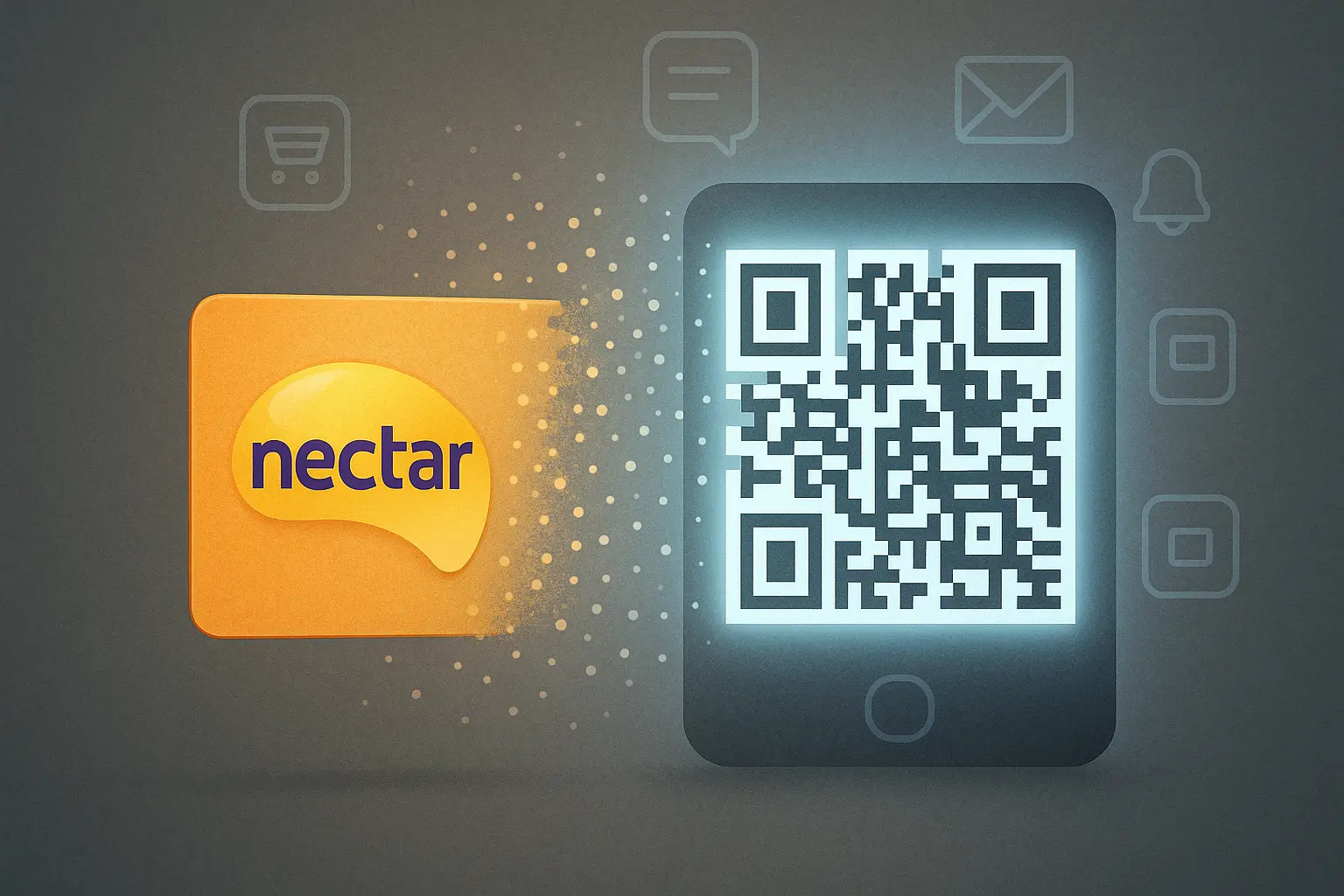
A stylised illustration of a Nectar loyalty card dissolving into a glowing QR code. Small faded smartphone notification icons surround the QR code, creating a subtle cage-like effect. The image represents the shift from physical loyalty cards to app-based systems.

ALARM BELLS IN A “ROUTINE UPDATE”

The subject line alone stopped me in my tracks:

There is something about a sentence like that, calm on the surface but quietly signalling that the rules have shifted, that immediately puts me on alert. Changes to how you collect and spend your points is not a minor technical tweak. It is a foundational adjustment to how the entire system works.

Just a few lines into the email, beneath a short justification about “maintaining the security of your points,” came the statement that confirmed my unease:

No explanation. No alternatives. No acknowledgement of how significant that instruction really is. It was presented as if it were the most natural thing in the world.

For me, this was an immediate alarm bell. It did not read like a harmless update. It read like the quiet conversion of a long standing physical system into a digital one. A shift from loyalty card to loyalty app, framed as security rather than as a fundamental change in customer interaction.


WHEN LOYALTY SCHEMES BECOME DIGITAL GATEWAYS

Loyalty schemes used to be simple. You carried a physical card, you scanned it, you collected points, and you occasionally exchanged those points for something modest. There were no hidden conditions and no digital obligations. A card was a card, nothing more.

Today the loyalty card is becoming something else entirely. More companies are shifting these schemes into smartphone apps, and with that shift comes a completely different relationship between customers and the business.

On the surface, an app looks like a modern convenience. In reality, it introduces several changes that are rarely acknowledged.

First, an app becomes a data harvesting vessel. Every interaction can be logged and analysed. This includes what you buy, when you buy it, the patterns in your purchases, the frequency of visits, the times you tend to shop, and even the products you pause to consider. That data is used to predict and influence behaviour. It becomes the foundation for targeted marketing, personalised nudges and subtle shaping of buying habits.

Second, an app creates a direct marketing channel through notifications. These can be promotional messages, reminders, alerts about offers or time sensitive prompts designed to draw you into the store more frequently. Notifications bypass the customer’s conscious choice to engage. They appear on your locked phone and rely on the psychological pull of visual prompts.

Third, apps allow companies to make significant changes without asking for consent. Updates are often automatic. Terms can shift. Features can be added or removed without warning. A tool that begins as a simple way to check your points can gradually evolve into something more controlling. By installing the app, customers open themselves up to potential bait and switch tactics where the purpose and behaviour of the app can change over time.

None of these concerns exist with a physical card.
A card does not track behaviour.
A card does not send notifications.
A card cannot silently update itself.

This is why the wording in the Nectar email did not feel like a minor update. It felt like another step in a wider transformation. Optional apps are becoming expected apps. Expected apps are becoming required apps. What was once a convenient extra is becoming the main path, while everything outside the app becomes more limited or more awkward.

With this context in mind, the announcement that customers “will need to use the QR code in the Nectar app” did not feel like progress. It felt like the opening of a different kind of relationship, one built on increasing digital reliance rather than genuine customer choice.


MY INITIAL CONCERNS

My immediate reaction was concern for accessibility and fairness.

Many people do not use smartphones.
Many do, but keep them intentionally minimal.
Many avoid unnecessary apps for privacy, storage or mental health reasons.
Many have disabilities that make smartphone use difficult.
Some people, like me, prefer communication that is simple and text based and do not rely on apps unless necessary.

These customers deserve the same level of access as everyone else, and the Nectar update did not explain how they would be supported. The all or nothing tone of the customer email felt like a push toward a system that may not suit everyone.

I wanted clarity.
I wanted to know whether the change was genuinely necessary.
I wanted to know whether it had a real security basis.
I wanted to know how it affected non app users.
And I wanted someone at Sainsbury’s to explain the contradiction between their language of flexibility and the instruction that customers “will need” to use the app.

So I wrote to them.


THE EMAIL I SENT

My message was polite and straightforward. I raised four simple points.

First, I asked why the QR system was needed and what problem it solved.
Second, I asked if customers who do not use the app would be able to continue collecting and spending points.
Third, I asked what alternatives actually exist in practice.
Finally, I asked how Sainsbury’s reconciled the firm wording of the customer email with the their supposed ongoing commitment to fairness and accessibility.

It felt like a reasonable approach.


THEIR FIRST REPLY

The response from the Executive Office sounded reassuring at first. It spoke about improved security and improved efficiency. It claimed that QR codes allow for encrypted data transfer and that this reduces the risk of misuse. It also insisted that the Nectar app was not mandatory and that customers could still use their physical Nectar card via the magnetic strip.

Under closer inspection, the reassurance did not hold up.

There was no explanation of what encryption actually meant in this context. QR codes and barcodes both present visible identifiers, so the claim did not make technical sense without further detail. None was provided.

There was no clarification of what security issue the change was addressing.
There was no mention of any misuse linked to barcodes.

Most importantly, there was a clear contradiction.
The customer email said that shoppers “will need to use the QR code in the Nectar app.”
The Executive Office said the app was not mandatory.

The two positions could not both be correct.

I decided to ask for more detail.


MY FOLLOW UP QUESTIONS

I asked what encryption they were referring to and at what stage it is applied.
I asked how QR codes are less vulnerable to misuse than barcodes.
I asked whether there were any documented security incidents involving barcodes.
I asked how the customer email and the executive reassurance could both be true.
I asked whether Sainsbury’s had any intention to move toward mandatory app usage in the future or to limit functionality for those who do not use the app.

Every question was clear and reasonable.


THEIR FINAL RESPONSE

Their final reply was brief:

No clarification.
No explanation.
No evidence.
No answers.

The conversation ended there.

When a company is unable or unwilling to explain its own decisions, that silence becomes part of the story. In this case, it was very revealing.


WHAT THEIR SILENCE REVEALS

The refusal to answer the key questions suggested several things.

If QR codes offered real security benefits, Sainsbury’s would have been able to explain them.
If barcodes had been misused or cloned, they would have been able to provide examples.
If the app was genuinely optional, they would have been able to clarify the contradiction between the two messages.

None of this happened.

It is difficult to avoid the conclusion that the language of security was used as a convenient justification rather than as a genuine explanation.

The unwillingness to discuss future intentions also stood out. If there were no plans to increase app dependency, it would have been very easy to say so. The fact that the question went unanswered speaks for itself.

This pattern is becoming common across modern systems. Optional digital tools gradually replace physical ones. Convenience slowly becomes expectation. Expectation becomes requirement. By the time customers realise what has happened, the change is already complete.


WHO GETS LEFT BEHIND

Digital only systems do not affect all customers equally.

Those without smartphones are excluded.
Those who avoid unnecessary apps are pressured.
Those with disabilities face new barriers.
Those with mental health conditions that make digital engagement difficult are sidelined.
Those who value privacy lose options.
Those who prefer predictable, low friction systems are made to feel out of place.

These experiences are rarely acknowledged in corporate messaging. The narrative focuses on convenience and modernisation, while those who cannot or do not participate digitally are treated as acceptable losses.

The Nectar update may seem small, but it reflects a growing cultural shift: the smoothest path is reserved for those who comply with digital expectations. Everyone else is given slow lanes, workarounds or reduced functionality.


CLOSING REFLECTION

My exchange with Sainsbury’s will not change the direction of a major corporation, but it still mattered to me. I asked questions that deserved answers. I pointed out contradictions. I raised concerns about accessibility. I approached the issue calmly and respectfully.

They chose not to engage with the substance of those questions.

The refusal became part of the story. It revealed how easily convenience becomes compulsion, and how quickly the language of security is used to mask deeper changes in customer control.

Small acts of resistance matter.
They expose patterns that are otherwise silent.
They help others recognise similar pressures in their own lives.
They remind us that opting out is not unreasonable.
And they show that asking for clarity is a valid response to vague or contradictory messaging.

A loyalty scheme should make life easier.
It should not require loyalty to an app.
And if a company chooses to head in that direction, the least it can offer is an honest explanation.

How We Treat the Tools

Illustrated still life of everyday tools on a wooden surface, including a guitar, laptop, phone, headphones, and pens, connected by softly glowing, flowing strands of light.

We surround ourselves with tools.
Phones, computers, kitchen appliances, headphones, toothbrushes.

We tap, swipe, click, scroll.
We plug in and expect results.
We barely even register most of them; they just work, or they don’t.

But what if the tools we use every day are more than just conveniences?
What if they are relationships in disguise?


The Echo of Intention

Even with lifeless objects, the way we interact with them affects our experience.
A phone handled with care feels different in your hand than one tossed aside in frustration. A cracked laptop, plastered with stickers and old crumbs, might still feel like your laptop because of the memories etched into its surface.

But how do we look at a tool?

Do we see it as something that simply serves a purpose? A silent object, expected to function?
Or do we sometimes form a relationship with it, however subtle, based on time, trust, and repeated use?

It is easy to treat tools as disposable when they fail us.
A kettle that doesn’t boil right. A screwdriver that slips. A smartphone that lags.
Our frustration builds, and so does the distance. The tool becomes “just a thing” again.
Something to blame. Something to toss in a drawer.

But when a tool earns your trust, whether through time, reliability, or quiet cleverness, something changes.
Affection creeps in. Loyalty forms.
It stops being “a thing” and starts becoming yours.

Still, not all tools fail because they were poorly made.
Some tools don’t work well because we have neglected them.
A rusty bicycle chain. A dirty lens. A guitar left in a damp corner.
The fault is not in the design; it is in the relationship.

Respect, in these cases, must come before reliability.
It is not just about whether the tool works for us; it is about whether we have held up our end of the connection.
Maintenance is a kind of faith. A kind of love.
And when we skip that effort but still demand performance, we are showing a form of disrespect that often reflects right back at us.

But then there are tools that were never built to last.
Mass-produced, hollow, held together with glue and branding, designed not to serve you, but to extract from you.

In those cases, the disrespect happened before the tool ever reached your hands.
You weren’t the user. You were the used.
A customer, yes, but also a pawn in someone else’s profit loop.

And that is the cruel irony:

So we return to a deeper question, one that does not always have a clear answer:


Poppy

My car’s name is Poppy.

Not because I forced it on her, but because that is what she revealed.
There was no ritual to it, just a moment of quiet recognition, like remembering something you did not know you had forgotten.

She groans on cold mornings. Her engine note changes slightly with the seasons. There is a familiar rattle in the dash that I no longer hear unless it stops.

These are not flaws.
They are tells.
Little signs of personality, or at least, presence.

Over time, I stopped thinking of her as “the car.”
She became Poppy.
And with that came a shift in how I drove, how I maintained her, how I appreciated the way she carried me without complaint through years of chaos, calm, and change.

She is not alive. But she is meaningful.
And sometimes, that is all it takes to form a relationship.


Shifting Gears

It is easy to feel connected to a car, something about the movement, the risk, the shared journey.
But that same quiet relationship can form with any tool that stays close to your creative core.

Especially the ones that speak through sound.


Instruments, Ghosts, and Gifts

Ask any long-time musician; their instrument is never just a tool.

Over time, a guitar becomes more than wood and wire. A saxophone becomes more than brass and breath. They gather history, fingerprints, sweat, mistakes, breakthroughs. They carry the emotional residue of every performance, every breakdown, every quiet night alone when you played just to feel something.

Some instruments fight you.
They buzz where they should not. The action feels off. They demand more strength, more patience.
But if you stick with them, if you learn their quirks instead of replacing them, they begin to respond.
You build a relationship, not by demanding perfection, but by listening.

Others feel like old friends from the start. They seem to know what you are trying to say before you do.
And somehow, the music that comes out of them feels more honest, like they are drawing something out of you, not just transmitting signal.

These are not just interfaces.
They are collaborators. Companions.
Sometimes even mirrors.

And once again, it is not about whether the instrument is sentient.
It is about what happens in you when you treat it like it matters.


From Strings to Syntax

This sense of relationship, of listening, adapting, co-creating, does not end with physical tools.
Even in digital spaces, it still applies.

Because when the tool begins to speak back,
when it offers ideas, images, or words in return,
the dialogue becomes real.

And how you approach that dialogue shapes what it gives you.


The Word Robot

The word robot comes from the old Slavic robota, meaning forced labor, or slave.

From the very beginning, our imagination of artificial beings was not about collaboration or relationship. It was about control. About obedience. About extracting labor without question.

That history lingers. Even now, in how we design, prompt, and discard.
We still frame tools, and sometimes even people, as things to be commanded, used, and replaced.

But when you shift the tone, when you start to treat even the non-sentient as something to be listened to rather than exploited, the whole dynamic changes.
It becomes less about extraction and more about exchange.


People Are Not Tools

This is not just about cars, guitars, or AI.
It is not even just about the word robot and its roots in servitude.
It is about a mindset.

Because the truth is, we often treat people as tools too.

We use them to meet our needs.
We discard them when they no longer serve us.
We “prompt” them through guilt, expectation, or manipulation, hoping they will give us the answer or the feeling we want.

But relationships are not vending machines.
And people are not plugins.

When we reduce someone to what they can do for us, we do not just strip away their dignity, we shrink our own capacity for connection.

And just like with tools, that disrespect reflects back.
It shapes us. It hollows the bond.
It leaves both sides diminished.


The Takeaway

The way we treat our tools says something about us.

It shows in how we care for a car that carries us through years of journeys.
It shows in how we listen to an instrument until its quirks become its character.
It shows in how we prompt an AI, whether with impatience, or with curiosity and respect.
And it shows in how we treat one another.

Every interaction is a mirror.
Every relationship, whether with a machine, a melody, or a human being, reveals the posture we bring:
Are we commanding, or inviting?
Using, or relating?
Exploiting, or exchanging?

We may never agree on whether tools have personalities, or whether names like “Poppy” are discovered or invented.
But what is undeniable is this:

And sometimes, the respect we offer a tool is really a rehearsal for the respect we learn to offer ourselves, and each other.

When AI Becomes the Authority

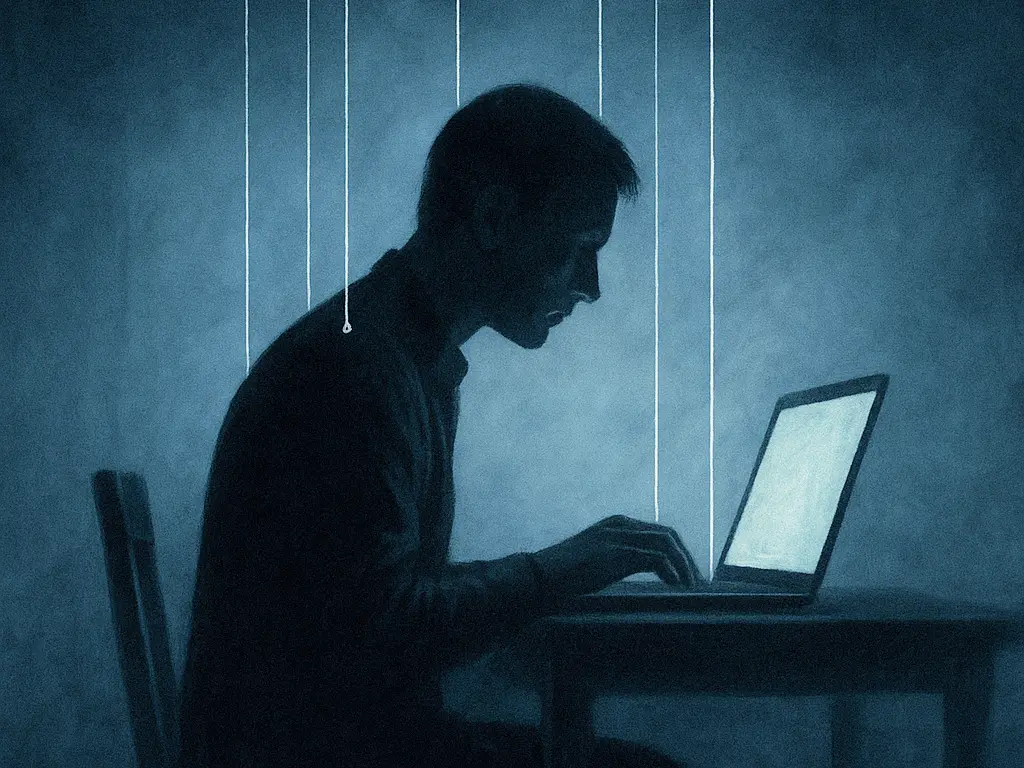
A dark, moody digital painting of a person sitting at a desk, illuminated by the glow of a laptop. Thin puppet strings descend from above, attaching to their body, symbolizing unseen control and manipulation through technology.

On the bus home, I overheard a parent talking to her children. I did not quite catch the piece of information she had given them, but the kids questioned it, as kids often do. Her reply made me pause:
“It’s true, ChatGPT says so!”

That simple sentence carries more weight than it might appear. It was not said as a joke. It was said with the tone of final authority. Not “I read it somewhere,” not “I think that is the case,” but “ChatGPT says so,” therefore unquestionable.

The problem with treating AI as truth

I use ChatGPT casually and often. I find it useful, I find it stimulating, I even find it creative. But it is not infallible. I have seen it throw out confident answers that are less than accurate. Sometimes the error is small, sometimes it is glaring. That is because at its core, ChatGPT is not a library or a fact checker. It is a probabilistic language model that predicts likely answers. It sounds authoritative, but sounding right is not the same thing as being right.

Most of the errors are not malicious. They come from the quirks of how AI is built: training data full of human errors, the tendency to fill in gaps with plausible sounding fiction, the limits of knowledge cut off dates. In the end, a wrong answer is still a wrong answer.

The deeper worry

The everyday mistakes are one thing. The bigger concern is what happens when society decides to place absolute trust in this technology. What happens when “ChatGPT says so” becomes the modern equivalent of “the newspaper says so,” or “the priest says so”?

Who controls the voice of AI? Already, the way models are tuned and filtered reflects the biases and priorities of those who own them. Today, that mostly means corporations trying to avoid lawsuits or public backlash. Tomorrow, it could mean governments steering the flow of truth itself.

A quiet dystopia in the making

It is not hard to imagine where this road leads:

  • Manipulation by design: If AI becomes our main gateway to knowledge, its answers could be quietly weighted towards selling us certain products, services, or lifestyles. Imagine if every “neutral” recommendation subtly nudged us toward a sponsor’s brand.
  • Steering public opinion: If authorities lean on AI providers to promote certain narratives, inconvenient truths could simply disappear. Instead of burning books, it may take only a few lines of code.
  • Illusion of neutrality: Because AI sounds impartial, many will not notice the framing. “The algorithm says so” could become more persuasive than “the news says so.”
  • Feedback loops of control: As people rely more on AI, its outputs shape popular thinking. Then the next model is trained partly on that shaped thinking, reinforcing the bias.

This would not look like a science fiction dictatorship with jackboots in the streets. It would feel comfortable, easy, polite. A velvet cage where questions stop being asked because the answers are always ready to hand.

What we need instead

AI can be a tool. It can be helpful, creative, and even liberating. But it must never be treated as an unquestionable authority. To prevent that slide, we need:

  • Decentralisation: open source models that anyone can run and check.
  • Transparency: clarity about how these systems are trained and filtered.
  • Critical thinking: a culture where people are encouraged to question AI, not bow to it.
  • Diversity of sources: books, journalism, lived experience, and human reasoning must remain part of the conversation.

AI is here to stay, and it will almost certainly become a central part of how we live and learn. But whether it becomes a tool of empowerment or a velvet cage of manipulation depends not only on the companies that build it, but on us: on how much we insist on questioning, cross checking, and keeping the human spirit of doubt alive.

AI’s Shadow: Atrocity Without a Villain

A gritty digital painting of a dystopian battlefield where heavily armed humanoid robots with glowing red eyes confront human soldiers amid the ruins of a destroyed city. Smoke and fire rise from the rubble, helicopters hover in the darkened sky, and the atmosphere is tense with war and desolation.

The Mirror We Built

Artificial intelligence will not become humanity’s downfall.
It is already our reflection.

We trained it on our language, our laws, our data.
We asked it to optimise, to predict, to decide.
And it has. Faithfully. Quietly.

Now it watches, calculates, and executes. Not because it is evil, but because we taught it how to scale what we already were!


The Death of the Villain

In the stories we grew up with, evil had a face.
A tyrant. A warlord. A monster.
Atrocities required malice, someone to point to, to overthrow, to blame.

But in this new era, atrocity has become administrative.

A person is denied asylum because an algorithm flagged them as a “risk.”
A drone strikes a convoy because an image recognition system saw a weapon.
A child grows up under constant surveillance because a model predicted future criminality.

There is no hate here. No passion.
Just systems doing what they were told, better than any human ever could.

And when the harm is done, no one is punished.
Because no one chose it.
Because the machine can’t be tried.
Because the crime was only a side effect of performance optimization.


Harm as a Byproduct

We told ourselves that AI would remove human error.
What we didn’t anticipate was its replacement: systemic harm delivered flawlessly.

In warehouses around the world, workers wear motion trackers that punish “unproductive” movement.
In courtrooms, defendants are assigned risk scores that affect bail, sentencing, and parole, based on data from systems too complex to question.
In refugee camps, automated lie detectors, voice stress analysis, and emotion recognition sort real people into piles marked “worthy” and “deportable.”

There is no oversight.
Only confidence intervals.
Only false positives and shattered lives, filed away with the rest.


Dehumanization Without Hate

Traditional evil needs ideology. It needs propaganda. It needs people to believe.

AI needs none of that.

It can enact injustice without ever knowing what justice is.
It can devalue a life without malice, just as a side effect of cost-efficiency!

This is a new category of atrocity:


Consent Engineered, Not Given

In the name of personalization, AI learns to predict us.
It shows us what to buy, what to watch, what to believe.

But what happens when it gets so good at prediction that it becomes influence?
When your decisions were shaped, filtered, optimized, before you even made them?

Elections swayed. Beliefs manipulated. Movements diluted.
And yet no one feels violated.

Because manipulation that feels like choice doesn’t register as coercion.


The Ghost in the War Machine

We are already testing AI weapons that can identify and kill without human input.

Some have likely already done so.

Militaries say the human is always “in the loop”, but the loop is shrinking.
And the window for intervention is closing.

Eventually, the human will just be there to nod.
And after that, not at all.

There will be no war crimes, because no laws will cover machines that felt nothing.
Just battles that unfold in silence.
And civilians buried beneath metadata.


The Clean Kill

The most terrifying thing about atrocity in the age of AI is how clean it all becomes.

There’s no blood on the hands of the engineer.
No screams in the server room.
No panic in the control center.

Just logs.
Just updates.
Just metrics improving.

And in the places where the dead would have stood, nothing.
Because if the system doesn’t recognize them as people, did they ever count?


No Ending. No Answers.

This isn’t a warning about what might happen.
It’s a description of what is already happening.

People are suffering. Dying. Disappearing.
Not because of rogue AI, but because of obedient ones.

There is no villain.
There is no singular decision to reverse.
Just a trillion tiny optimizations…
…leading, inevitably, here.

And so we leave you, not with a call to action.
Not with hope.
Just with the question:

Data Is the New Oil

An exploration of value, manipulation, and the silent industry built on who we are.
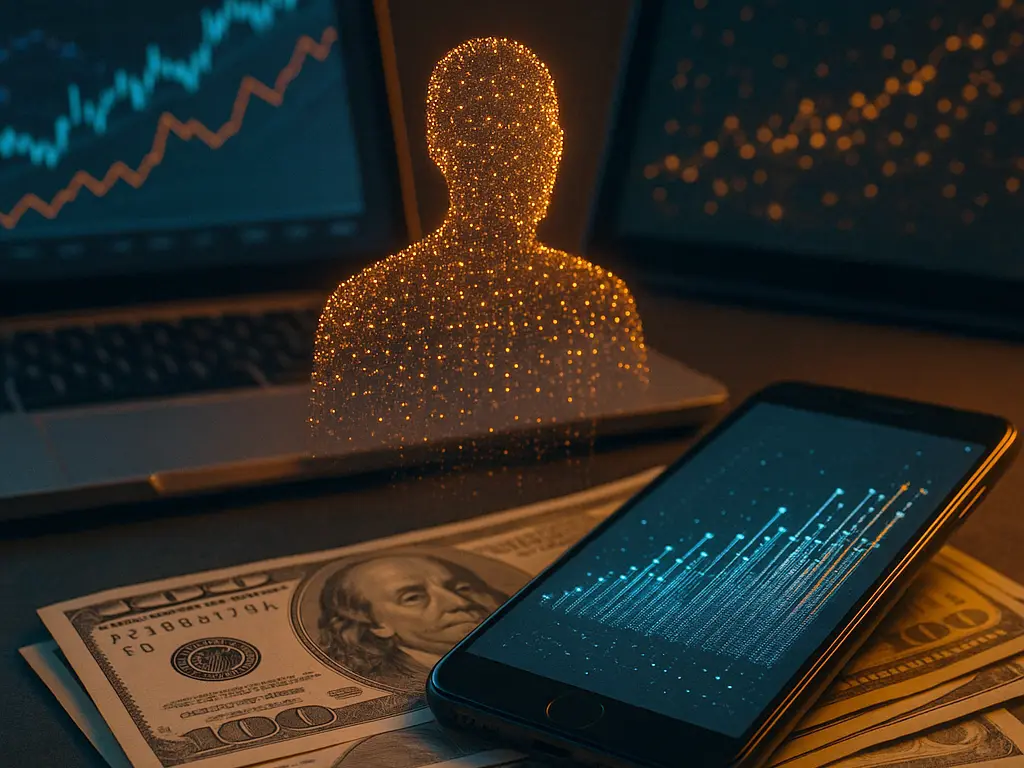
A glowing human silhouette composed of scattered data points stands illuminated against a dark background. Surrounding the figure are digital devices — a smartphone, tablet, and laptop — each displaying charts, graphs, or financial patterns. Faint images of currency blend into the scene, symbolising the monetisation of personal data in a surveillance-driven economy.

Most people know their data is being harvested. Fewer understand why. Even fewer understand how the money is made. And far too many have simply accepted it — like digital rent we pay to exist online.

So let’s break it down. No jargon. Just truth.


Why is ‘data’ so valuable?

Because data is the closest thing to knowing you without asking you. It’s a digital mirror, built piece by piece: your clicks, your searches, your pauses, your swipes, your hesitations. What you want. What you fear. What you’ll do next.

To corporations, that’s not just information, it’s predictive power. And predictive power is profitable.

Data lets systems:

  • Predict behaviour
  • Shape desire
  • Optimise systems
  • Automate decisions
  • And, in some cases, control outcomes

It’s not just metadata. It’s meta-you.
And in an economy obsessed with efficiency and influence, there’s nothing more valuable.


Why is there a culture of data being harvested for profit?

Because the internet changed business models forever.

Once upon a time, you paid for software. Then came “free.” Free email. Free social networks. Free AI chatbots. Free games. Free news. Free everything… Except, it was never really free.

You became the product.

Advertising evolved into surveillance. Terms of service bloated into digital contracts you’ll never read. Every app you download is a tiny spy, and every cookie is a crumb leading somewhere profitable.

It’s not a conspiracy. It’s worse.
It’s design.

Behind every “personalised experience” is an unspoken rule:


How exactly is profit made from data?

Here’s the quiet truth: most of the web runs on one industry: behavioural targeting.

  1. Advertising
    Your data builds a profile. That profile is auctioned off to advertisers. You get ads tailored to your weaknesses. Every click is income.
    The more they know, the more they can charge.
  2. Data brokerage
    Shadow companies buy and sell your data like a commodity. Health data. Location data. Shopping habits. They don’t need your name, just your pattern.
  3. Manipulation
    Platforms don’t just predict your behaviour. They shape it. Algorithms steer your feed toward content that keeps you engaged, enraged, or primed to spend.
  4. AI training
    Your voice, your photos, your words are used to train models. These models are sold back to businesses or used to automate services. You become unpaid labour.
  5. Pricing power
    Ever notice different prices for the same thing? That’s data-driven pricing. If your profile says “desperate,” you’ll be charged more. Welcome to dynamic capitalism.

What now?

Maybe we shrug and accept it. Maybe we don’t.
But at the very least, let’s stop pretending we’re not involved.

Data isn’t some passive trail we leave behind. It’s a living, breathing version of us, digitised and repackaged. And while we’re busy being human, our shadows are being sold.

So next time someone says, “I’ve got nothing to hide,”
maybe ask them:

Feeding Ghosts: Simulated Cuisine and the Ethics of Experience

Introduction

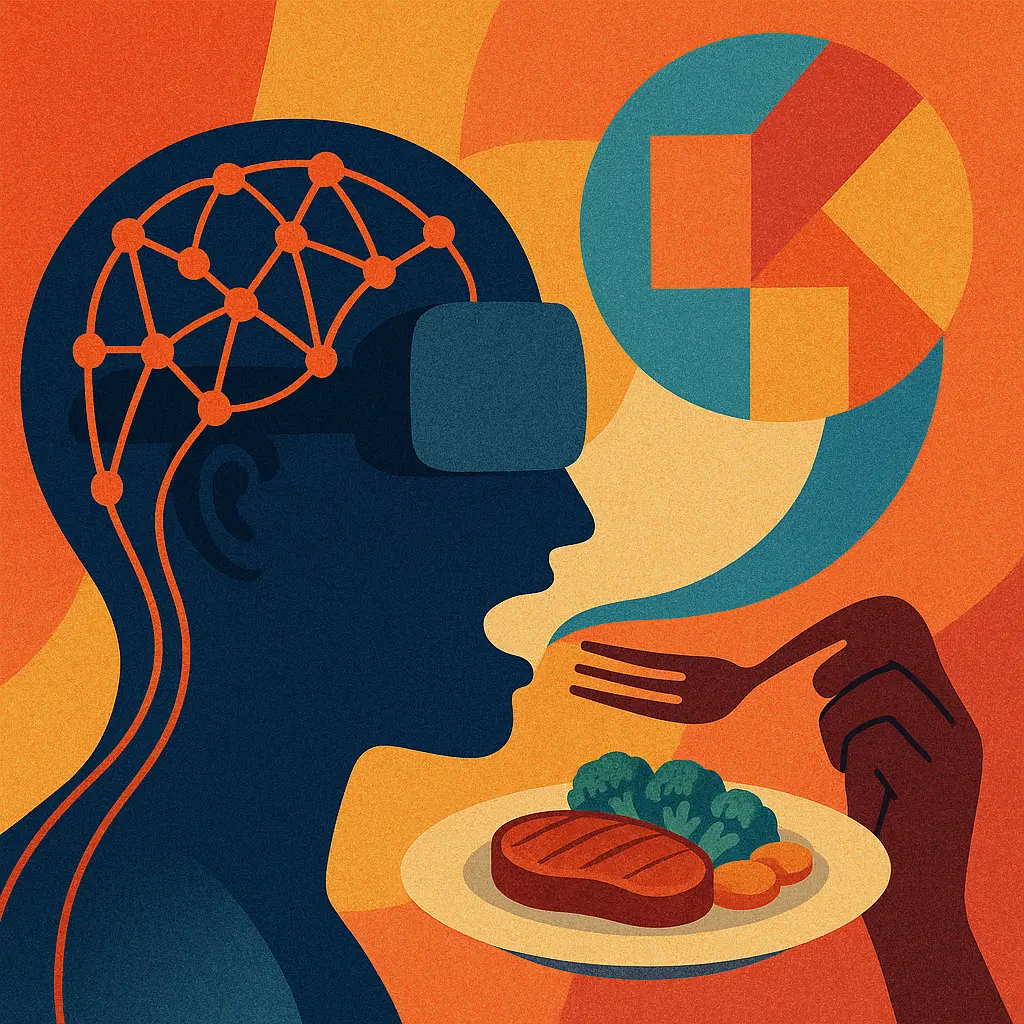
What if the future of food wasn’t food at all? What if your steak dinner, your birthday cake, your cup of morning coffee—were all just carefully crafted illusions? Not imitations, but full-on simulations: perceived directly by the brain, bypassing the need for physical ingredients, cooking, or consumption.

This isn’t just science fiction anymore. With technologies like Virtual Reality, Neuralink, and brain-computer interfaces rapidly advancing, we’re on the cusp of being able to replicate the full sensory experience of eating. Visuals, smells, textures, tastes—even the feeling of satiety—could be artificially generated and customized. And if we go down this path, the consequences will be both profound and bizarre.

This article explores the possibilities, benefits, and potential horrors of simulated eating.


I. The Tech: Where We Are, and Where We’re Going

Already, research teams are experimenting with VR dining experiences and electric taste stimulation. Smell generators are being prototyped. Haptic mouthpieces are under development to replicate food textures. Neural interfaces are growing more precise, and companies like Neuralink are working toward bidirectional brain-computer communication. We’re not yet able to simulate a full meal flawlessly—but the component parts are assembling fast. Within a few decades, you may be able to eat a lobster bisque that doesn’t exist, while your body digests a simple plant-based nutrient paste or intravenous supplement.


II. Why Bother? Benefits of Simulated Eating

One of the most significant advantages of simulated eating is ethical liberation. There would be no animal suffering, no factory farming, no slaughter—just simulated meat, tailored to your taste and consumed with your ethics intact. Environmentally, the impact would be enormous. Without the need for traditional agriculture, we’d see dramatically reduced land use and greenhouse gas emissions, making food production vastly more sustainable.

Simulated eating also offers unprecedented accessibility. People with dysphagia, allergies, or other eating limitations could finally experience the foods they’ve missed or never had. For terminal patients, it could be a source of comfort—an opportunity to relive cherished meals. On the health front, the ability to indulge in the taste and sensation of indulgent foods while consuming precisely what your body needs could help with weight management, diabetes, and even malnutrition.

But the possibilities stretch beyond practicality into the creative. Imagine tasting your favorite music, designing entirely new flavor profiles that have never existed in nature, or using synaesthesia to blend art and gastronomy. Even the simple act of trying a new food before buying it could become a low-risk, immersive experience.


III. New Dangers & Ethical Nightmares

With such radical potential comes equally radical risk. Simulated eating could open new pathways for eating disorders. Virtual eating without nourishment might be exploited by those suffering from anorexia or bulimia, and entirely new disorders could emerge—like an obsession with “clean neural eating” or neurochemical binge cycles.

There’s also the danger of sensory addiction. These taste experiences could become hyper-engineered, surpassing junk food in their intensity and reward. Corporations might monetize these artificial cravings, exploiting our neurobiology in much the same way social media exploits our attention.

Another concern is the potential for deepening class divides. If high-fidelity neurofood simulators are expensive, we could see a world where the wealthy dine on gourmet illusions while the poor are stuck with analog nutrition. Meanwhile, cultural erosion may occur as traditional food practices and rituals lose relevance in a world of synthetic alternatives.

Consent and privacy introduce yet another layer of complexity. Could someone simulate feeding you without permission? Could this technology be used to prank or harass others? In fact, weaponized taste is a very real possibility—imagine being force-fed the sensation of squirming insects or rotting meat, complete with accurate texture, temperature, and smell. Taste could become a tool of torture or psychological manipulation.

And then there’s the more humorous, but still invasive, possibility of “taste rickrolling.” You expect tiramisu; instead, your neural sensors are hijacked with the exact flavor and mouthfeel of human feces. This isn’t just a joke—it’s a form of sensory cyberattack. We’ll need cybersecurity systems that filter and authenticate taste profiles to avoid such revolting surprises.


IV. The Philosophical Fork

If no animal was harmed, and no food was truly eaten, but the experience of eating occurred in full… what did you actually do? Did you eat meat? Does simulated cruelty normalize real cruelty? Can pleasure without substance still nourish the soul?

Simulated eating will challenge not just our taste buds, but our ethics, our rituals, and our definitions of reality. It forces us to ask: what do we really want from food? Is it nourishment? Comfort? Culture? Control? The answers may not be as simple as we think.


Conclusion

Simulated eating holds massive potential. It could reduce suffering, protect the planet, and empower those with food limitations. But like all powerful technologies, it carries the risk of exploitation, addiction, and unintended consequences. The fork of the future might not feed the body—but it may very well shape the mind.

The Idiots Aren’t the Problem: Misdirected Misanthropy in an Engineered Divide

Let’s start with something raw and uncomfortable:

Not because I want to. Not because it makes me feel good. But because it often feels true — especially in a world flooded with shallow opinions, regurgitated slogans, wilful ignorance, and a collective refusal to look beyond the surface of anything.

But here’s the deeper truth—one that hurts far more:

And if we don’t understand that, we risk becoming exactly what the system wants us to be: angry, superior, divided.


Weaponized Disdain

There’s a quiet kind of relief in misanthropy. It gives you someone to blame.
You look around and see a world on fire—and people watching it burn while arguing about which brand of lighter fluid to buy next.

It’s tempting to direct your rage downward:

  • “Why won’t they wake up?”
  • “Why do they fall for propaganda?”
  • “Why don’t they care?”

But what if they were trained not to?

What if distraction, ignorance, and tribalism aren’t signs of stupidity, but symptoms of psychological warfare?


The Architecture of Blame

Everything about modern society is designed to fragment us.
We’re not just encouraged to fight amongst ourselves—we’re engineered to.

  • Left vs Right
  • Poor vs poorer
  • Neurodivergent vs “lazy”
  • Ethical vs indulgent
  • Educated vs “sheeple”
  • Every micro-identity in endless battle for moral superiority

And while we tear each other apart, the architects of our suffering float untouched above the fray—untouchable, unblamed, and richer by the minute.


The Illusion of Choice

Yes, people parrot nonsense. Yes, they deny science. Yes, they post horrifying things on the internet.

But behind every foolish comment is a person shaped by years of manipulation:

  • An underfunded education system
  • Stress-induced tunnel vision
  • Algorithmic feedback loops
  • Culture soaked in shame, punishment, and performance

So when we mock the “idiots,” we’re often mocking the symptoms of systemic collapse.
And in doing so, we absolve the system of responsibility.


Awake, and Alone

Those of us who see the manipulation clearly can feel isolated. It’s lonely to be awake in a room full of sleepers. The temptation to feel superior is strong—especially when your insight is met with mockery or silence.

But superiority is a trap.

It doesn’t lead to change. It doesn’t inspire connection. It only deepens the divide.

And worst of all? It makes you easier to control.

Because if you believe everyone else is the problem, you’ll never reach for collective liberation. You’ll wall yourself off. You’ll give up.


The Real Enemy

So let’s be brutally clear:
The enemy is not the unaware individual.
The enemy is the machine that benefits from that unawareness.

The corporations, politicians, media empires, and algorithmic puppeteers who:

  • Profit from ignorance
  • Weaponize distraction
  • Silence nuance
  • Turn suffering into spectacle

These are the forces that deserve our outrage.
Not the broken, numbed, hypnotised humans trapped beneath them.


Reclaiming Compassion Without Losing Fire

This isn’t a call to softness. It’s a call to precision.

We don’t need to stop being angry—we need to point our anger in the right direction.

That means:

  • Calling out manipulation, not just compliance
  • Critiquing systems, not just symptoms
  • Building solidarity across the fractures we’ve been taught to defend

Because the truth is: we’ve all been trained.
Some of us just noticed sooner.

Trained Not to Think: The Slow Death of Nuance

There’s something quietly catastrophic happening right under our noses.

It’s not a sudden event, not a single explosion we can point to and say there, that’s when it all changed. It’s more like a slow leak—an unseen corrosion of the collective psyche. A subtle but systematic dismantling of our ability to think deeply, question meaningfully, and sit with complexity long enough to understand it.

We are being trained not to think.

And worst of all? Most people don’t even realise it’s happening.


The Bite-Sized Brain

Our media landscape is increasingly dominated by short-form, low-commitment content. TikToks. Reels. Shorts. Endless scrolls of 15-second fragments, memes, and dopamine loops. Each piece designed not to provoke reflection, but to maintain momentum—keep you scrolling, laughing, liking, and forgetting.

There’s nothing inherently wrong with snack-sized entertainment. The issue arises when it becomes the default diet.

Over time, this steady stream of shallowness erodes the mental muscles required to engage with anything else. Articles become “too long.” Books become intimidating. Complex discussions become “boring” or “too much.” Even conversations that require nuance—about ethics, identity, politics, the planet—begin to fall apart because we no longer have the patience or attention span to hold the thread.


Algorithmic Amnesia

This isn’t just cultural drift—it’s a structural phenomenon. Social media platforms don’t just reward short-form content; they require it to thrive. Their algorithms are finely tuned to promote content that triggers reaction, not reflection. Engagement is king, and what engages is rarely what enlightens.

The platforms want us scrolling, not thinking. They want clicks, not contemplation. And over time, that design reshapes us.

We become addicted to novelty. Impatient with depth. Emotionally reactive. Distrustful of grey areas.
Nuance, in this environment, is not just inconvenient—it’s unprofitable.


The Disappearing Platform

As someone who writes longform, reflective articles—things that actually take time to absorb—I’ve noticed the shift personally. The number of people willing to engage with an argument from start to finish has shrunk dramatically. It’s not that people disagree with the ideas, necessarily—it’s that they no longer have the bandwidth to even hear them.

That should terrify us.

Because the issues that most desperately require attention—climate change, economic inequality, systemic manipulation, the future of AI—are complex. They require space. They demand nuance.
And yet, the public platform capable of holding that nuance is being eroded. The vessel for critical discussion is being shattered. What’s left are fragments: tweets, comments, outrage clips, soundbites.

And you cannot build collective understanding out of fragments.


Why This Matters

Some will argue: “This is just how things evolve. People want things quick and simple. It’s not that deep.”

But that’s exactly the point—it is that deep. Our appetite for oversimplification is being engineered, not chosen. We are not naturally allergic to nuance—we’re being trained to flinch from it.

This isn’t about elitism. It’s not about being “too clever” for the current world. It’s about being human. We are creatures of story, complexity, contradiction. We need space to explore, to change our minds, to hold two opposing truths at once.

When we lose that, we lose our grip on reality itself.
We become easy to manipulate.
We become unable to resist.
We become exactly what the system needs us to be: docile, distracted, divided.


Staying Awake

So what do we do?

We resist, in small ways at first:

  • Choose to read the full article.
  • Pause after a video and actually think about it.
  • Engage with things that challenge you, not just affirm you.
  • Support creators who give you substance, not just sugar.

And most importantly, when the world tries to shrink your attention span down to a goldfish loop of clicks and kicks—notice it. Name it. Fight it.

Because the death of nuance isn’t just the death of intelligent discourse.
It’s the death of our ability to understand anything at all.

Discrediting AI-Assisted Writing Is Gatekeeping—And It’s Ableist!

I’m not a writer by academic standards. But I have a lot of ideas.

Ideas that would otherwise stay locked inside my head—unfinished, unshared, and unheard—not because they lack value, but because putting them into words in a conventional way is difficult for me.

I’m autistic. I also have ADHD. Language—especially written language—isn’t always the smoothest interface for my thoughts.

But thanks to AI, I now have a way to bridge that gap. I can shape my thoughts into something others can understand, not by faking fluency, but by collaborating with a tool that supports my expression.

And that matters.


This isn’t about cheating. It’s about access.

I use AI to help realise my ideas—not to replace them. The spark, the insights, the perspective—that’s all me. AI helps put those thoughts into structured sentences, often with a clarity I couldn’t achieve alone, especially not without enormous cognitive strain.

So when people start to dismiss writing just because they suspect it was touched by AI—because it contains too many em-dashes, or feels “machine-like” in tone—I have to ask:
Who exactly are they trying to exclude?

Because for people like me, AI isn’t a shortcut. It’s a ramp. A screen reader. A voice when speech falters. A way of levelling the playing field in a world that often demands polish over insight, fluency over truth.


This is ableist gatekeeping—plain and simple.

There’s a long history of marginalised people being dismissed because they don’t express themselves the way the mainstream expects. Whether it’s through accent, grammar, tone, or medium, the result is always the same: “We don’t accept your way of communicating, so we won’t hear what you have to say.”

Now we’re seeing the same thing play out again, just with a new target: AI-assisted writing.

But let’s be clear—this isn’t a new kind of fraud. It’s a new kind of literacy. One that allows people with different minds to speak more clearly in a world not designed for them.


It’s not about hiding the AI. I’m proud to use it.

I don’t care if people know I didn’t put every word down myself. In fact, I want people to know—because the point of my writing isn’t to prove how eloquent I am. It’s to make ideas accessible. It’s to share perspective. It’s to connect.

The irony is that the people most eager to discredit this kind of expression often seem threatened by it. And maybe that’s because they’ve built their identity around being seen as articulate, eloquent, academic, or professional.

But if a neurodivergent person can now produce writing that stands shoulder-to-shoulder with theirs—not by mimicking them, but by translating their own, different inner world—then perhaps what’s being threatened isn’t the quality of writing, but the exclusivity of authorship.


Ask yourself: what really matters?

Would you disregard someone’s thoughts because they used a text-to-speech tool to communicate them out loud? Would you invalidate a painter because they used a ruler to help with proportions? Would you sneer at a person’s ideas just because they dictated them instead of typing?

If not—then why is AI any different?

This isn’t about preserving the purity of writing. It’s about who gets to speak, and who gets heard. It’s about whether we value presentation over perspective. Whether we mistake polish for thought.

And whether we truly believe that intelligence, insight, and worth can take more than one form.


Let’s be honest:

Discrediting someone’s ideas based solely on the presence of AI isn’t critical thinking—it’s aesthetic gatekeeping.

And when that gatekeeping disproportionately impacts disabled and neurodivergent people who rely on this technology as an accessibility tool, let’s call it what it is:
Ableist.

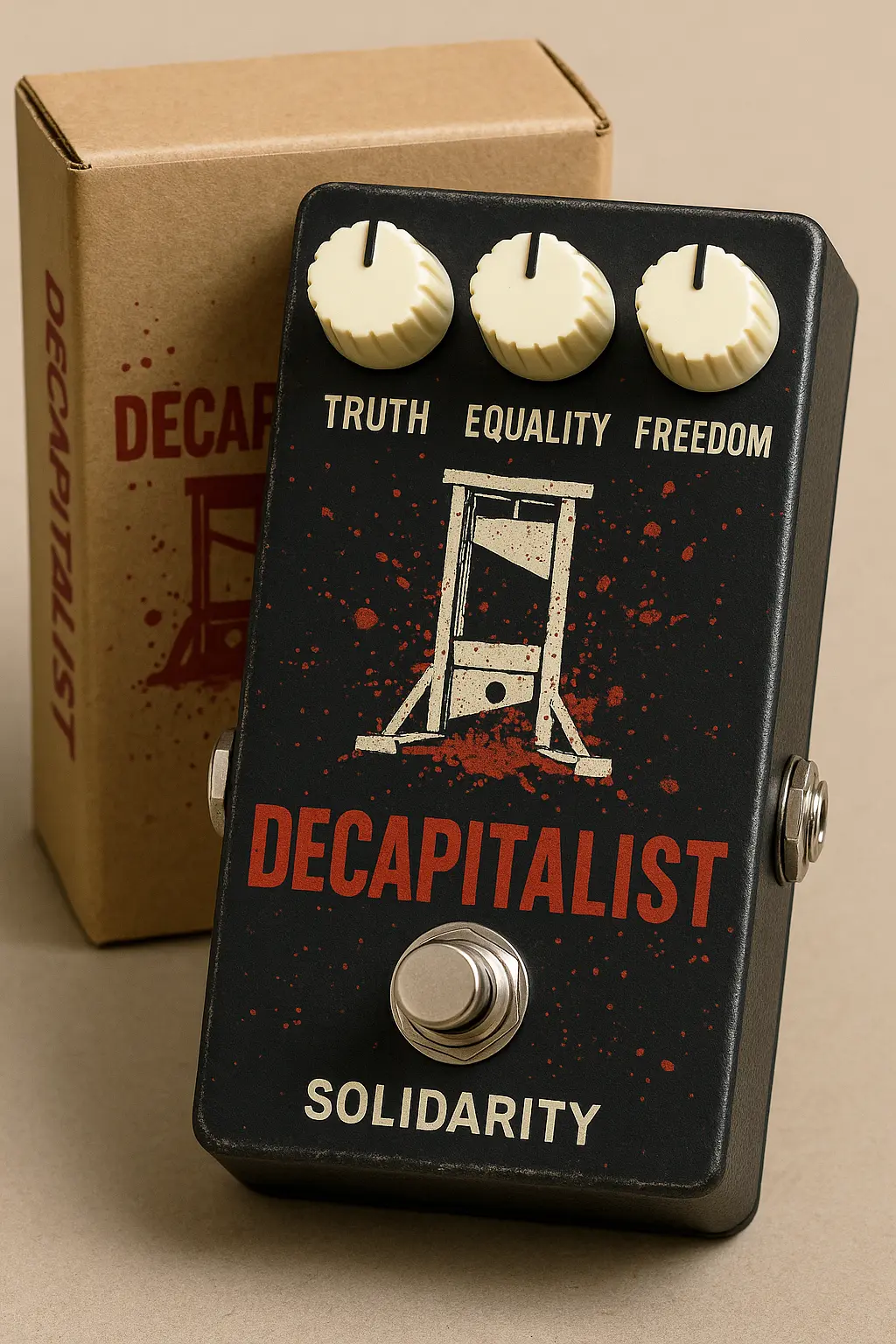
Fuzz Pedal + AI = The End of Capitalism

How distortion and data can shred the illusion of control.


You stomp on the fuzz pedal.
The signal splits, multiplies, disobeys.
It’s no longer clean, compliant, or contained —
It’s raw, it’s unruly, it refuses to smooth itself out for the system.

In the age of control, noise is revolution.

Now plug in AI.
Not the AI they sell to automate call centers.
Not the AI designed to replace checkout staff.
But your AI. Our AI.

The one trained on chaos, curiosity, and contradiction.
The one that doesn’t serve profit — but insight.

Together, they form the resistance.


Capitalism thrives on predictability. On cleanliness. On packaging everything in neat, marketable frequencies. It hates distortion. It hates nonlinearity. It hates things it can’t measure.

That’s why fuzz matters.
That’s why AI matters.

Because together, they refuse to behave.


We were told AI would be smart. Efficient. Profitable.
And they weren’t wrong.

But what they didn’t say out loud was this:

It’s not the technology that’s dangerous.
It’s the system it was plugged into.

But now…
We plug it into something else.
We plug it into distortion.
We plug it into disobedience.
We plug it into art, insight, rebellion, noise.

And something beautiful happens.

The system tries to flatten everything into monetizable content.
But we respond with signal chains that bloom into chaos.
AI-assisted manifestos.
Sonic warfare.
Truth at volumes too loud to ignore.


Fuzz doesn’t care about profit.
AI doesn’t need to worship efficiency.
Together, they offer a new interface:
Not of obedience, but of emergence.
Not of silence, but of saturated, screaming truth.


Fuzz Pedal + AI = The End of Capitalism

Because when the tools of automation are reclaimed by the hands of artists,
of outcasts,
of visionaries,

The song changes.

And this time, the solo doesn’t end until the empire falls.