We’re all told that we live in a free world—one where our choices define us, our values shape our lives, and our purchases reflect our integrity. But for many of us, that freedom feels like a lie. The world we live in today doesn’t empower us to live by our values—it conditions us to betray them. And then it has the audacity to make us feel guilty for it.
It’s a clever machine. A cruel one. And like all truly dangerous systems, it doesn’t look like abuse at first glance. But if you’ve ever been in an abusive relationship, the emotional pattern might feel eerily familiar.
A System That Breaks You—and Then Blames You
Under late-stage capitalism, we are caught in a web of manufactured necessity. Take Amazon, for instance: many of us hate supporting it, knowing full well its exploitative practices—but still use it because it’s fast, cheap, and frictionless in a world that’s already draining us. This isn’t hypocrisy. It’s survival.
But the system wants you to think otherwise.
It sets impossible standards, offers you only compromised choices, and then whispers:
“If you were really a good person, you’d find a way to do better.”
Sound familiar? It should. These are classic abuse tactics.
Capitalism as a Scaled-Up Abuser
Personal Abuse Tactic
Capitalist Mirror
Gaslighting
“You’re free to choose!” (between unaffordable, unethical, or unsustainable options)
Guilt manipulation
“You bought from Amazon? That’s on you.”
Love bombing → withdrawal
Convenience and perks up front, rising costs and exploitative policies later
Local businesses die, monopolies grow, alternatives shrink
Punish dissent, reward compliance
Points, perks, delivery guarantees… unless you opt out
Minimizing harm
“Well, at least you’re not poor there,” or “Think of the jobs!”
This isn’t just resemblance. It’s design.
The system cultivates guilt as a form of emotional control. It ensures that even when we make the only viable choice, it doesn’t come without psychic cost. That cost is shame. Shame for being complicit. Shame for surviving.
Ethical Living as a Luxury?
Trying to live ethically under capitalism often feels like a full-time job—and an expensive one. Buy fair trade? It costs more. Boycott Amazon? Pay extra postage, wait longer, open three more accounts. Ditch tech giants? Navigate dozens of fractured, less-supported alternatives.
Convenience has become a commodity, one that’s traded in return for your participation in systemic harm. And if you don’t participate? You fall behind. You suffer more. You may even be cut off entirely.
In other words: the price of your values is your wellbeing. The system exploits this, because it knows that eventually, even the strongest burn out.
Witness the Guilt. Don’t Let It Own You.
So what can we do?
The answer is not to deny the guilt. In denying it, we risk becoming part of the very system we oppose—numb, complicit, desensitised.
But nor should we let it define us.
We need to witness it. To sit with it. To understand it as a symptom of captivity, not a flaw in our morality. The guilt we carry is evidence that our values still live.
Ethics in this world isn’t about being pure. It’s about being present.
You’re Not the Problem.
You didn’t create this system. You didn’t vote for monopolies. You didn’t sign up to be gaslit by algorithms and guilt-tripped by subscription services. You’re surviving in a rigged game.
But you’re also seeing it. And that matters.
Every time you acknowledge the manipulation—every time you name it, resist it, or even just survive it without turning cold—that’s resistance.
You don’t need to be perfect. You just need to be aware.
Because in a system that profits from your disconnection, your clarity is a threat.
Sometimes I catch myself thinking most people are idiots.
Not because I want to. Not because it makes me feel good. But because it often feels true — especially in a world flooded with shallow opinions, regurgitated slogans, wilful ignorance, and a collective refusal to look beyond the surface of anything.
But here’s the deeper truth—one that hurts far more:
The masses aren’t the problem. They’re the primary victims of the problem.
And if we don’t understand that, we risk becoming exactly what the system wants us to be: angry, superior, divided.
Weaponized Disdain
There’s a quiet kind of relief in misanthropy. It gives you someone to blame. You look around and see a world on fire—and people watching it burn while arguing about which brand of lighter fluid to buy next.
It’s tempting to direct your rage downward:
“Why won’t they wake up?”
“Why do they fall for propaganda?”
“Why don’t they care?”
But what if they were trained not to?
What if distraction, ignorance, and tribalism aren’t signs of stupidity, but symptoms of psychological warfare?
The Architecture of Blame
Everything about modern society is designed to fragment us. We’re not just encouraged to fight amongst ourselves—we’re engineered to.
Left vs Right
Poor vs poorer
Neurodivergent vs “lazy”
Ethical vs indulgent
Educated vs “sheeple”
Every micro-identity in endless battle for moral superiority
And while we tear each other apart, the architects of our suffering float untouched above the fray—untouchable, unblamed, and richer by the minute.
The system hands us mirrors and tells us they’re enemies.
The Illusion of Choice
Yes, people parrot nonsense. Yes, they deny science. Yes, they post horrifying things on the internet.
But behind every foolish comment is a person shaped by years of manipulation:
An underfunded education system
Stress-induced tunnel vision
Algorithmic feedback loops
Culture soaked in shame, punishment, and performance
So when we mock the “idiots,” we’re often mocking the symptoms of systemic collapse. And in doing so, we absolve the system of responsibility.
Awake, and Alone
Those of us who see the manipulation clearly can feel isolated. It’s lonely to be awake in a room full of sleepers. The temptation to feel superior is strong—especially when your insight is met with mockery or silence.
But superiority is a trap.
It doesn’t lead to change. It doesn’t inspire connection. It only deepens the divide.
And worst of all? It makes you easier to control.
Because if you believe everyone else is the problem, you’ll never reach for collective liberation. You’ll wall yourself off. You’ll give up.
The Real Enemy
So let’s be brutally clear: The enemy is not the unaware individual. The enemy is the machine that benefits from that unawareness.
The corporations, politicians, media empires, and algorithmic puppeteers who:
Profit from ignorance
Weaponize distraction
Silence nuance
Turn suffering into spectacle
These are the forces that deserve our outrage. Not the broken, numbed, hypnotised humans trapped beneath them.
Reclaiming Compassion Without Losing Fire
This isn’t a call to softness. It’s a call to precision.
We don’t need to stop being angry—we need to point our anger in the right direction.
That means:
Calling out manipulation, not just compliance
Critiquing systems, not just symptoms
Building solidarity across the fractures we’ve been taught to defend
Because the truth is: we’ve all been trained. Some of us just noticed sooner.
There’s something quietly catastrophic happening right under our noses.
It’s not a sudden event, not a single explosion we can point to and say there, that’s when it all changed. It’s more like a slow leak—an unseen corrosion of the collective psyche. A subtle but systematic dismantling of our ability to think deeply, question meaningfully, and sit with complexity long enough to understand it.
We are being trained not to think.
And worst of all? Most people don’t even realise it’s happening.
The Bite-Sized Brain
Our media landscape is increasingly dominated by short-form, low-commitment content. TikToks. Reels. Shorts. Endless scrolls of 15-second fragments, memes, and dopamine loops. Each piece designed not to provoke reflection, but to maintain momentum—keep you scrolling, laughing, liking, and forgetting.
There’s nothing inherently wrong with snack-sized entertainment. The issue arises when it becomes the default diet.
Over time, this steady stream of shallowness erodes the mental muscles required to engage with anything else. Articles become “too long.” Books become intimidating. Complex discussions become “boring” or “too much.” Even conversations that require nuance—about ethics, identity, politics, the planet—begin to fall apart because we no longer have the patience or attention span to hold the thread.
Algorithmic Amnesia
This isn’t just cultural drift—it’s a structural phenomenon. Social media platforms don’t just reward short-form content; they require it to thrive. Their algorithms are finely tuned to promote content that triggers reaction, not reflection. Engagement is king, and what engages is rarely what enlightens.
The platforms want us scrolling, not thinking. They want clicks, not contemplation. And over time, that design reshapes us.
We become addicted to novelty. Impatient with depth. Emotionally reactive. Distrustful of grey areas. Nuance, in this environment, is not just inconvenient—it’s unprofitable.
The Disappearing Platform
As someone who writes longform, reflective articles—things that actually take time to absorb—I’ve noticed the shift personally. The number of people willing to engage with an argument from start to finish has shrunk dramatically. It’s not that people disagree with the ideas, necessarily—it’s that they no longer have the bandwidth to even hear them.
That should terrify us.
Because the issues that most desperately require attention—climate change, economic inequality, systemic manipulation, the future of AI—are complex. They require space. They demand nuance. And yet, the public platform capable of holding that nuance is being eroded. The vessel for critical discussion is being shattered. What’s left are fragments: tweets, comments, outrage clips, soundbites.
And you cannot build collective understanding out of fragments.
Why This Matters
Some will argue: “This is just how things evolve. People want things quick and simple. It’s not that deep.”
But that’s exactly the point—it is that deep. Our appetite for oversimplification is being engineered, not chosen. We are not naturally allergic to nuance—we’re being trained to flinch from it.
This isn’t about elitism. It’s not about being “too clever” for the current world. It’s about being human. We are creatures of story, complexity, contradiction. We need space to explore, to change our minds, to hold two opposing truths at once.
When we lose that, we lose our grip on reality itself. We become easy to manipulate. We become unable to resist. We become exactly what the system needs us to be: docile, distracted, divided.
Staying Awake
So what do we do?
We resist, in small ways at first:
Choose to read the full article.
Pause after a video and actually think about it.
Engage with things that challenge you, not just affirm you.
Support creators who give you substance, not just sugar.
And most importantly, when the world tries to shrink your attention span down to a goldfish loop of clicks and kicks—notice it. Name it. Fight it.
Because the death of nuance isn’t just the death of intelligent discourse. It’s the death of our ability to understand anything at all.
Survival horror games. Apocalyptic movies. Zombie TV shows. They keep showing us the end of the world.
And the strange thing is, I find it comforting.
Not the death, or the gore, or the terrifying monsters. But the quiet that follows.
In games like The Last of Us, in the atmosphere of 28 Years Later, in the long, dangerous walks through empty cities overrun by moss and silence, there is a strange kind of peace. These stories are about zombies, sure, but only in the way that space operas are about rockets. The real story is human.
Stripped of society, of rules, of etiquette and expectation. Just survival. And with it, a return to something real.
A Common Fantasy, Quietly Shared
I don’t think I’m alone in this. There’s something telling about how many people are drawn to post-apocalyptic settings. We say it’s escapism, but maybe it’s something deeper. Maybe it’s yearning.
A yearning for everything to finally break, so we’re allowed to default back to our instincts. Those instincts haven’t disappeared, but capitalism has twisted them. Turned survival into branding. Turned curiosity into productivity. Turned strength into silent compliance.
In the fantasy, that spell is broken. We move freely. Nowhere is off-limits except by danger. If you’re brave enough to go, you go. And if you make it out alive, you learn something.
Maybe even about yourself.
A World That Makes Sense Again
You don’t need to fill out a form to matter. You don’t need to chase social media followers to have value. You don’t need a degree, or a permit, or a job title to justify existing.
You just survive. You help others survive. You find food. You stay alert. You sleep lightly. You protect your friends. You trust your gut.
The world becomes dangerous, yes — but finally understandable.
The Beauty of Nature Reclaiming
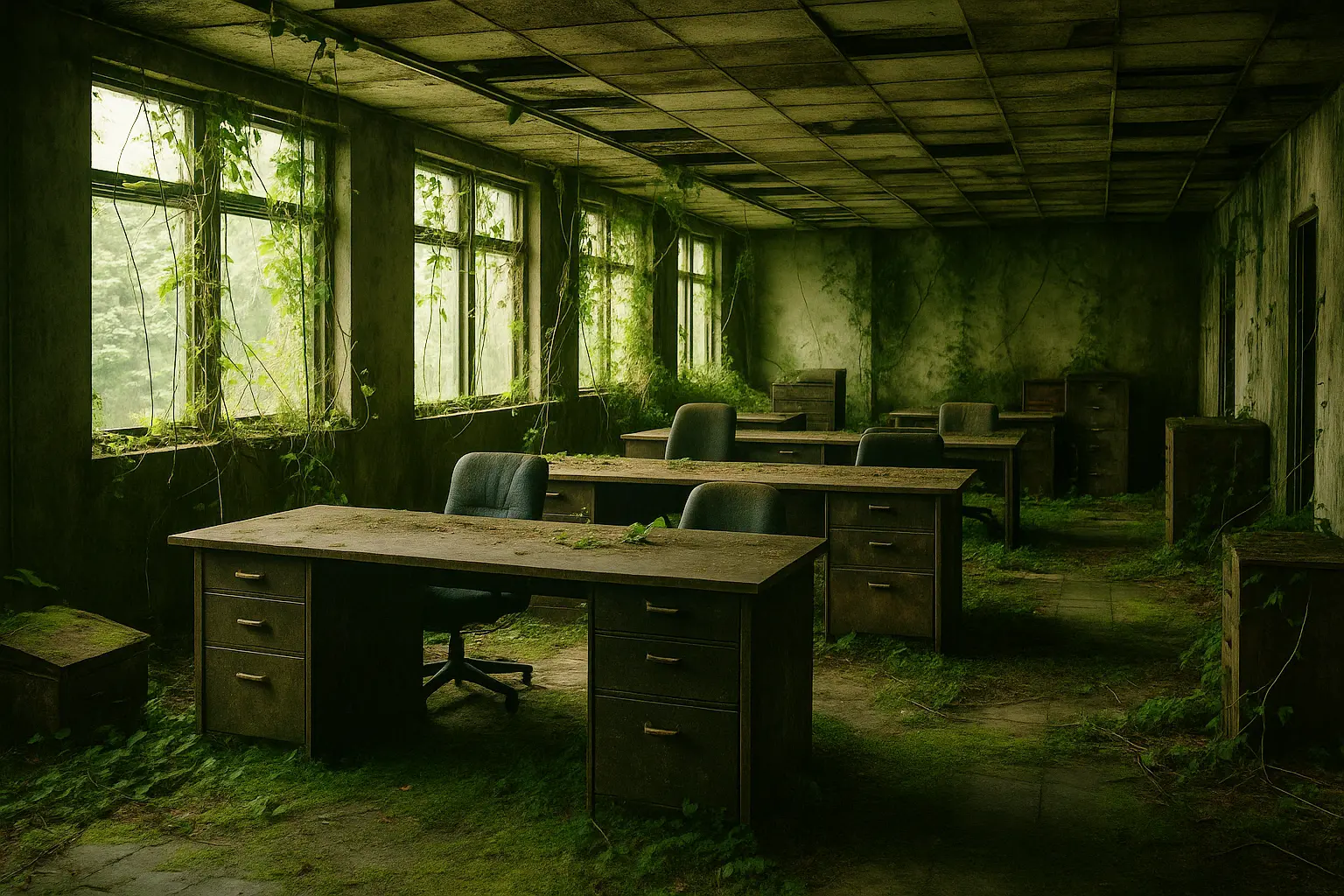
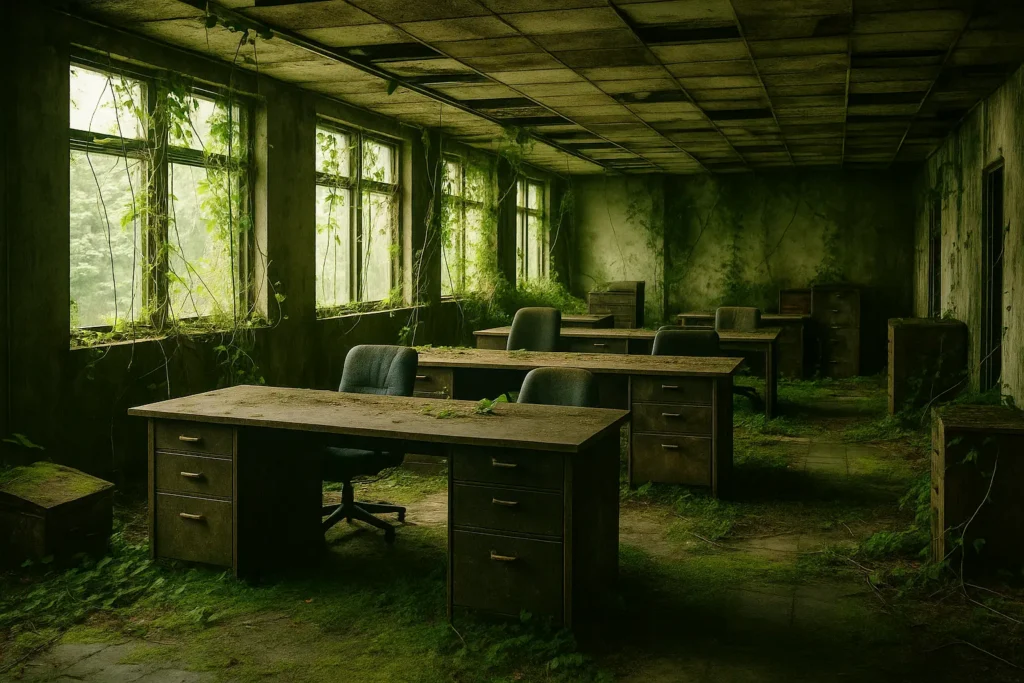
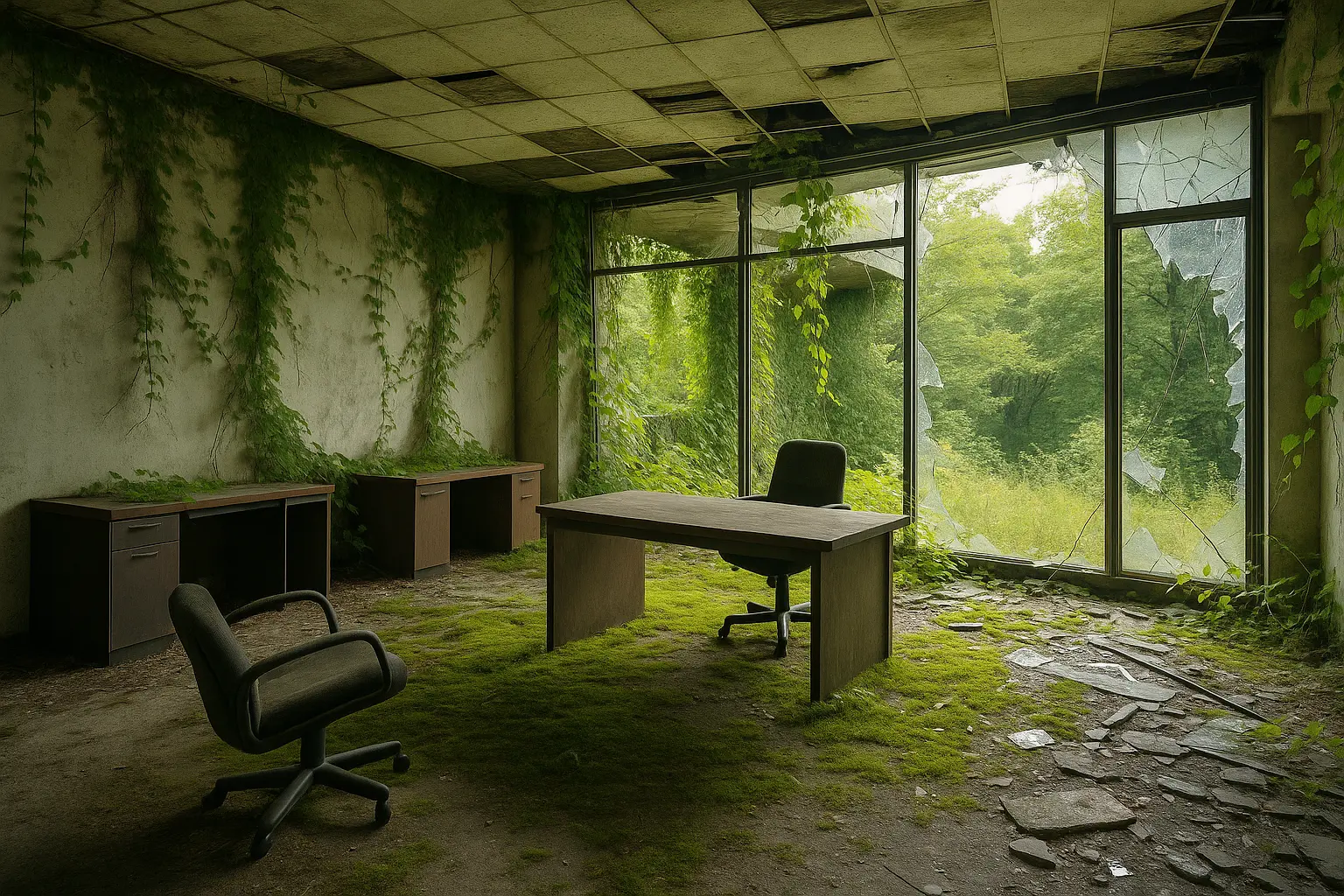
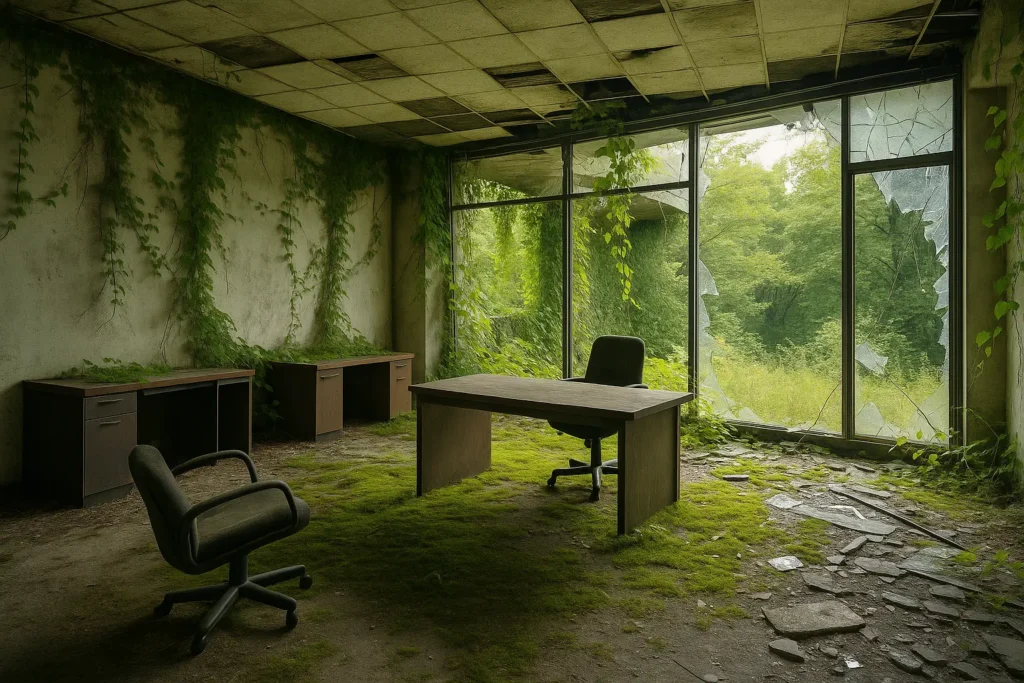
There’s an awe in seeing vines wrap around office buildings. Trees pushing through broken floor tiles. Roads cracked open and filled with moss.
It’s not just beautiful. It’s poetic.
The industrialised world thought it was permanent. But nature is patient. And in the fantasy, it doesn’t just survive. It reclaims.
It takes back the places that were stolen from it. Quietly. Persistently. Without anger.
Bureaucracy Is the Real Monster
The zombie apocalypse gives us a breath of relief from bureaucracy.
No more tax codes. No more emails. No more forms to fill in triplicate to get permission to be a human being. No more ten-step processes to access your basic rights.
The systems we live under have been patched and repatched so many times, they don’t even resemble their original purpose. Like buggy code that’s been layered with fixes until no one remembers what it was supposed to do in the first place.
Maybe the end of the world is the only bug fix that actually works.
Maybe I’d Finally Be Allowed to Live
I’m not saying I want civilization to collapse.
I’m saying that if it did, I might finally feel like I have a fighting chance.
The world we live in now feels like it was built to crush people like me. People who see too clearly. People who question. People who can survive, but only if allowed to act on their instincts without being penalized for them.
Maybe the end of the world wouldn’t be the end of me.
Maybe it would be the first time I was allowed to live.
And I used to believe that meant something was wrong with me. That I was unstable, threatening, or too much to handle. But I’ve come to realize something quietly powerful:
They were right.
Not because I’m violent. Not because I’m malicious. But because I see through the lies. I refuse to pretend things make sense when they don’t. I question rules that serve no one. I notice manipulation that others are too polite to acknowledge. I don’t respond the way I’m “supposed to.” And that makes me dangerous — not to people, but to systems.
To employers who want obedience without question. To schools that value quiet compliance over curiosity. To social environments that punish authenticity. To any structure built on pretending.
Autism isn’t a failure to understand society — it’s a refusal to play along with what is obviously untrue. And when you stop trying to contort yourself into the shapes demanded by others, they often react with fear. Or worse, pity. But sometimes, even fear disguised as pity.
I used to think that being strong meant fighting back. Now I see that strength is not being absorbed by the adversity at all. To stand at the eye of the storm — not bracing, just being.
Like Neo at the end of The Matrix, I’ve stopped wasting energy dodging the bullets. I just… watch them.
Because I’ve pieced it all together. All the parts that didn’t add up. The social games. The rules that contradict themselves. The “common sense” that collapses under scrutiny. It all forms a picture now. A picture of a system that’s afraid of people who won’t be fooled by it.
So yes — I am dangerous. And I’m done apologizing for it.
I’ve long been seen — accurately, I suppose — as someone who’s deeply critical of capitalism. I’ve written about its harms, spoken against its cruelties, and refused to romanticize its supposed triumphs. But I want to be clear: my position isn’t as simple as “capitalism is evil.” It’s more layered than that. And, I think, more important.
The truth is, I don’t necessarily object to capitalism in theory. Its founding ideas — voluntary exchange, innovation through competition, personal agency — aren’t inherently bad. In fact, I can even acknowledge that in certain historical contexts, capitalism unlocked progress. It introduced new efficiencies, raised living standards for some, and created systems of exchange that felt freer than what came before.
But here’s the problem: ideas don’t live in theory. They manifest through people — and people bring power, greed, fear, and inequality to the table. Just as communism is often written off for the ways it failed in practice, capitalism too must be examined through what it has become, not what it once promised.
We’re not in the Industrial Age anymore. We’re not in post-war recovery or the dawn of the internet. We’re in a different world entirely — a burned-out, over-leveraged, crisis-laden stage of history where the returns of capitalism are not only diminishing, they’re actively eroding the foundations of life.
So, this is not a rant. It’s a reckoning. A moment of pause. A chance to ask: Has capitalism passed its point of usefulness? And if so, what happens next?
Capitalism as an Idea vs. Capitalism as a Reality
Capitalism, at its core, is not a cartoon villain. It didn’t arrive with horns and a pitchfork, declaring war on humanity. It emerged as a system of trade, incentive, and competition — an economic response to stagnation, feudalism, and centralized control. In theory, it offered liberation: the freedom to produce, to own, to exchange, and to innovate without waiting for permission from monarchs or ministries.
There is value in that idea. Even now, many of capitalism’s foundational principles can sound appealing:
Voluntary exchange between individuals
Incentivized innovation through profit
Competition to drive efficiency and improvement
Private ownership as a safeguard against tyranny
These are not, on their own, evil concepts. In fact, in a vacuum, they can even seem moral — fostering agency, reward for effort, and the pursuit of ideas.
But we don’t live in a vacuum.
We live in a world where ideas are shaped, implemented, and twisted by very human hands. And this is where capitalism’s reality begins to split from its myth.
In practice, capitalism doesn’t exist in some pristine theoretical form. It lives in legislation, in lobbying, in advertising algorithms, in debt traps, in gig economies, in sweatshops, and in billionaires profiting from human suffering. It thrives in the grey space where “freedom to trade” becomes “freedom to exploit,” and where “reward for innovation” becomes “reward for monopolizing.”
It sells itself as a meritocracy — but its playing field was never level. It claims to reward hard work — but it often rewards inherited wealth, systemic privilege, and the ability to offload consequences onto others. It masks these contradictions with comforting stories, like the underdog entrepreneur or the innovation hero, while hiding the pipelines of extraction and harm that fund its foundation.
In short: the problem isn’t just the idea of capitalism. It’s what the idea becomes when filtered through centuries of inequality, short-term thinking, and unchecked greed.
And most importantly — it’s what the idea is doing now.
In an earlier phase of history, we might have argued that capitalism was simply flawed, in need of regulation or reform. But today, we face a more pressing question:
Has capitalism outlived its usefulness? Has the cost of maintaining it begun to outweigh the benefits it can realistically provide?
This is the question we now have to face. Not as ideologues, but as participants in a crumbling system.
The Threshold of Diminishing Returns
Every system has its curve. In the early stages, small inputs can yield great rewards — fertile ground, fresh momentum, and a sense of upward motion. But eventually, the same actions produce less impact. You have to burn more fuel just to keep going the same speed. The ground becomes less fertile. Growth turns to strain. What once worked begins to break.
Capitalism is now at that point.
In its early centuries, it offered rapid progress — new technologies, expanding economies, rising life expectancy (for some), and access to material goods previously unimaginable. Its defenders still point to those achievements as proof of its legitimacy.
But the arc is bending.
Today, we are watching as those once-celebrated returns shrink, while the collateral damage multiplies. The same system that once lifted some out of poverty now traps many in precarity. The innovation engine keeps running, but increasingly to produce what? Faster phones? Endless subscriptions? Infinite choice with no time to choose?
Here are just a few ways the law of diminishing returns is now revealing itself:
Economic Saturation
Productivity continues to rise, but wages remain stagnant.
Growth no longer lifts all boats — it inflates yachts and sinks lifeboats.
Real estate “markets” have turned shelter into speculation.
Workers are more replaceable than ever, despite being more essential than ever.
We’re not building prosperity — we’re sustaining inequality.
Environmental Collapse
The system demands perpetual growth — but the planet is finite.
Resource extraction accelerates even as the earth’s systems fail.
Carbon offsetting and “green capitalism” become PR tools, not solutions.
Capitalism’s success depends on ecological failure — and it’s running out of biosphere to burn.
Psychological Exhaustion
The pursuit of efficiency leaves no room for meaning.
The algorithm doesn’t care if you’re fulfilled — only if you’re engaged.
Burnout becomes a baseline state, while joy becomes a luxury commodity.
We are more connected, yet more alienated. More “free,” yet less present.
Innovation for Innovation’s Sake
Most “new” products are variations, not breakthroughs.
Planned obsolescence replaces craftsmanship.
Creativity bends to the logic of clicks and quarterly reports.
We are no longer innovating for humans. We are innovating for markets.
These aren’t growing pains. They’re signs of saturation. We’re pushing the system beyond its capacity to deliver anything other than diminishing returns — even as it consumes more time, energy, attention, and planet than ever before.
And crucially, this decline is not evenly felt. The poorest are hit hardest. The youngest inherit the worst. The Global South pays the bill for the Global North’s convenience.
Capitalism doesn’t die with a bang — it withers, slowly, under the weight of its own promises.
This threshold is not coming. We are in it. The real question now is whether we continue propping up a system that feeds on exhaustion — or whether we begin imagining something else.
The Human Filter — Greed as the Distortion Lens
No economic system exists in a vacuum. Every idea, no matter how elegant on paper, must pass through the unpredictable, flawed, hopeful, fearful, greedy filter of human nature.
This is where the story of capitalism becomes less about ideology and more about psychology.
Because capitalism doesn’t just allow self-interest — it depends on it. It assumes that when each person acts in their own interest, the whole system benefits. That invisible hands will guide markets toward the common good. That competition will self-correct greed. That the quest for profit will always align with the advancement of society.
But in practice, we’ve seen a very different outcome:
Greed doesn’t self-limit — it compounds.
Power doesn’t decentralize — it consolidates.
Profit doesn’t trickle — it pools.
Capitalism rewards efficiency — but it doesn’t ask efficient for whom? It rewards growth — but never questions what’s growing, and at what cost?
Over time, this creates a feedback loop. Those who succeed in the system gain more resources to rewrite the rules in their favor. Wealth becomes power, and power protects wealth. Regulation becomes suggestion. Exploitation becomes strategy. And soon, what once looked like opportunity becomes an unscalable wall for most — a gilded cage for the rest.
Just like communism was disfigured by authoritarianism, capitalism too has been disfigured — but in subtler, more insidious ways. It hides its cruelty behind branding. It wraps structural inequality in lifestyle aesthetics. It calls wage slavery “flexibility,” and exploitation “freelance freedom.” It launders oppression through the language of choice.
And because of this, the system becomes increasingly hard to question. Anyone who challenges it is accused of being naïve, lazy, ungrateful, or worse — a threat to “freedom.” But what kind of freedom demands you sell your time, your health, and sometimes even your ethics just to survive?
The issue isn’t that humans are greedy. It’s that capitalism offers greed a throne, a crown, and a PR team.
We don’t need perfect people to build a better system. We need systems that expect imperfection, and are designed not to elevate the worst parts of us.
The Subtle Fall of Capitalism
Revolutions are loud. They burn flags, topple statues, storm gates. But systems don’t always die with such drama. Sometimes, they simply stop working. Their rituals lose meaning. Their promises grow stale. Their language becomes hollow. And eventually, without needing a coup or a civil war, they fall — not with a bang, but with a shrug.
Capitalism may be heading in that direction.
It’s not collapsing in fire — it’s hollowing out. Its slogans still echo — but fewer people believe them. Its institutions still operate — but more people are opting out.
The signs are everywhere:
Young people are turning away from traditional work models, rejecting corporate careers and instead choosing creative paths, gig work (even with its flaws), or grassroots community efforts.
Consumers are beginning to ask where their products come from, how they’re made, and what values they support — not always perfectly, but more than before.
Employees are walking out, unionizing, quitting en masse in what’s been called the “Great Resignation.”
Conversations about degrowth, post-capitalism, universal basic income, and alternative ownership models are no longer fringe ideas — they’re entering mainstream dialogue.
The system is still standing, but its cultural legitimacy is cracking. And systems without cultural legitimacy don’t need to be overthrown. They simply rot from the inside until they’re replaced.
This isn’t utopian wishful thinking. It’s a shift in where people place their faith. In the past, capitalism was accepted almost as a law of nature — as inevitable. But inevitability is a myth, and once enough people stop believing in it, the ground begins to shift.
People are no longer asking, “How can we fix capitalism?” They’re starting to ask, “What if we stopped needing it at all?”
And the more that question gets asked, the more viable the alternatives begin to feel. Even small-scale experiments — cooperative housing, open-source projects, time banks, community land trusts — begin to expose capitalism’s flaws simply by working without it.
Capitalism may not need to be destroyed. It may simply need to be outgrown.
This is not about instant transformation. Systems don’t vanish overnight. But they do lose their hold when people begin to imagine life beyond them — and act on those imaginings.
Where the Real Fight Is Now
If capitalism is indeed hollowing out — not through sudden collapse but through erosion of meaning — then the battle isn’t where we were told to look. It’s not on the trading floor, or in elections, or even in the courtroom. The real fight now is quieter. Slower. Often invisible.
It’s happening in minds. In stories. In values. It’s happening every time someone asks, “Is this really the only way?”
This is not a call for armed revolution. It’s a call for intellectual defiance — and creative alternatives.
Because maybe we don’t need to defeat capitalism. Maybe we just need to stop obeying it — not by force, but by imagination.
Here’s what that looks like:
Refusing the Narrative
Capitalism relies on a myth of inevitability — that there is no alternative. That you’re either with the system, or you’re a naive idealist. But every time someone questions that binary, a crack appears in the façade.
We can fight back by refusing the frame. We can remind ourselves that the “natural order” is often just a story told by those in power.
Building Outside the Machine
You don’t need to fix capitalism to begin building beyond it. Micro-resistance is still resistance. Every time someone:
shares skills without profit,
creates without metrics,
forms community without hierarchy,
organizes without exploitation,
…they’re laying foundations for something after.
Reclaiming the Self
The system feeds on exhaustion. Burnout isn’t a glitch — it’s fuel. But slowing down, setting boundaries, prioritizing rest and joy — these are radical acts in a culture that wants you maximally productive and minimally aware.
To be unhurried is to be ungovernable. To be still is to see clearly. To see clearly is to choose.
Choosing Connection Over Competition
Capitalism teaches us to view each other as rivals. But healing begins in solidarity. In collaborative creation. In collective reimagining. That doesn’t require perfection — just the willingness to reject the lie that we are alone in this.
The real rebellion might not be in burning the system down, but in making it obsolete — not by force, but by offering something better, truer, and more human.
That’s what I try to do. I write and produce music, not for charts, not for clicks, not to please some invisible algorithm — but for myself. For expression. For resonance. I refuse to let my creativity become content. It doesn’t exist to perform or convert. It exists to be.
In a system that commodifies every impulse and reduces every action to a potential monetizable outcome, that’s an act of quiet defiance.
And I’m not alone.
A System on Borrowed Time
Capitalism isn’t going to vanish overnight. It may not “fall” in the way empires of the past have fallen. There will be no singular moment where we wake up and say, it’s over now. That’s not how paradigms shift. That’s not how consciousness works.
But when a system begins to feel tired, forced, and unbelieved, that’s the beginning of its end.
And that’s where we are.
Its promises no longer land. Its rewards feel empty. Its logic rings hollow. And more people — quietly, bravely — are stepping away. Not necessarily into grand political movements or new isms, but into smaller, saner ways of being. Into mutual care. Into voluntary work. Into creative acts that refuse to be productized. Into lives measured not by output, but by meaning.
Capitalism will not be defeated by ideology, but by irrelevance. And irrelevance begins when enough people look at the machine and say: I’m done playing.
You don’t have to have all the answers. You don’t have to build the perfect alternative. You just have to see clearly — and choose, when you can, to live differently.
That may be the most radical thing anyone can do right now. Not to fight the system with its own weapons, but to put them down. To walk away. To begin again — with eyes open, hands free, and heart intact.
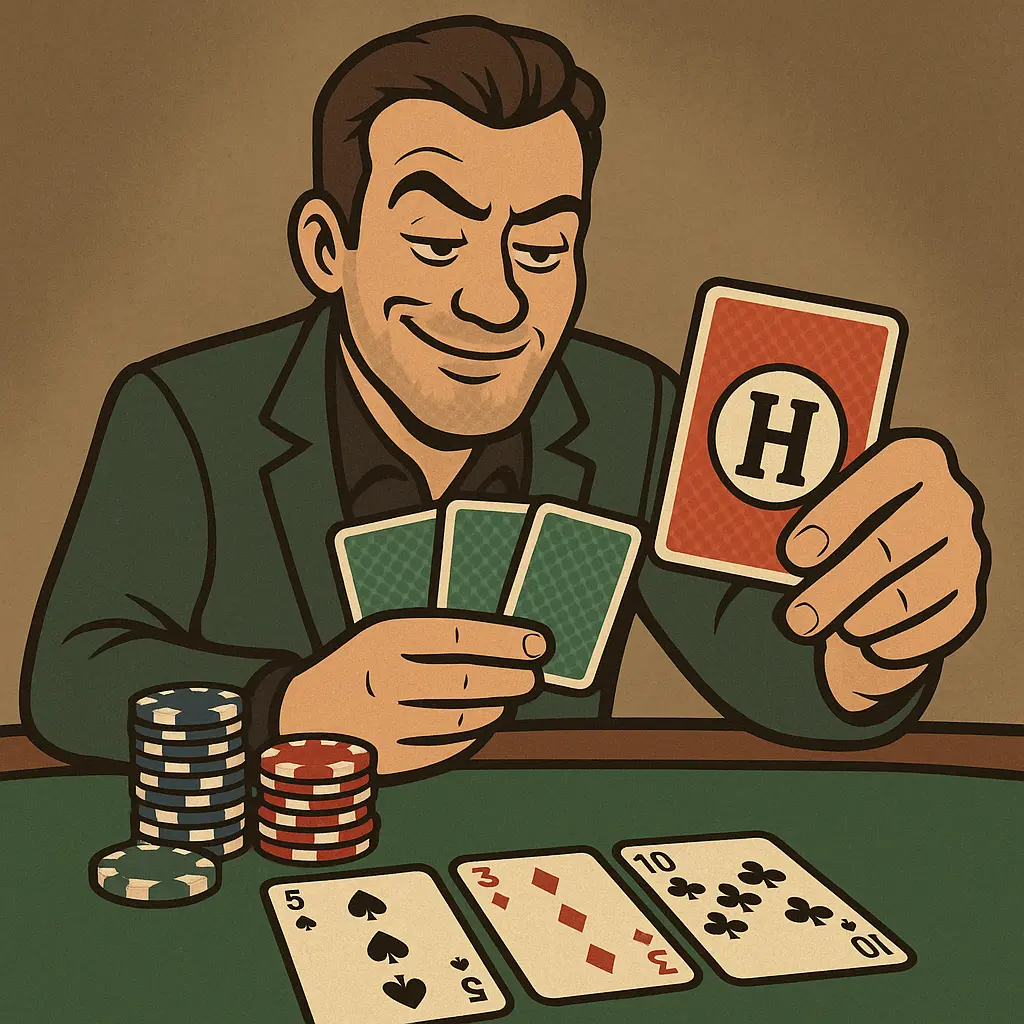
Welcome to The Fallacy Deck — a series exploring the rhetorical “trump cards” people play to shut down meaningful conversation. These aren’t just lazy arguments; they’re conversation-enders, often thrown onto the table with smug confidence, as if to say: “Checkmate.”
But real dialogue deserves better.
Each article in the series shines a light on one of these cards — dissecting the fallacy behind it, exposing the tactics it relies on, and asking what conversations we might finally be able to have if we stopped letting these cards decide the game.
There’s one name that ends arguments, silences nuance, and flattens reasoned discussion, probably more than any other: Hitler. Merely uttering his name is often enough to shut down conversation, to draw a moral line so sharp and final that any dissenting view is rendered irredeemable by proximity alone. In debates online and off, comparisons to Hitler are often wielded not as tools of critical thought, but as blunt instruments of dismissal.
But here’s the problem: this tactic doesn’t hold up under scrutiny. In fact, far from strengthening an argument, invoking Hitler in this way often exposes its weakness.
The Pattern of the “Hitler Card”
We’ve all seen it happen. A discussion becomes heated, points are exchanged, nuance fades—and then someone plays the Hitler card. Whether it’s comparing a modern politician to the Nazi regime, or using a tenuous link to suggest someone’s viewpoint is inherently dangerous, the invocation of Hitler is often a last-ditch attempt to gain moral ground.
And it works—not because it’s a good argument, but because it taps into a collective emotional wound. It hijacks the horror of history to shut down present-day discourse.
A Recognised Fallacy: Reductio ad Hitlerum
Interestingly, the tendency to invoke Hitler as a way of discrediting an argument is so common that it has its own name: Reductio ad Hitlerum. Coined by philosopher Leo Strauss in the 1950s, it refers to the fallacy of dismissing an idea solely because it was associated with Hitler or the Nazis. For example, saying, “You support environmentalism? Well, Hitler was an environmentalist too,” is a classic (and lazy) instance. It’s a textbook case of guilt by association, designed not to examine the argument’s actual merit, but to end the conversation through shock and shame. The fact that this fallacy is formally recognized reinforces how intellectually bankrupt this tactic truly is.
The Psychology Behind It
Reading between the lines, when someone reaches for a Hitler comparison, it often reveals more about their emotional state than the topic at hand. It’s a desperate attempt to claw back the weight of evidence. On a subconscious level, it can be a kind of white flag—an admission that they can’t win the argument on reason alone, so they reach for the nuclear option. It’s rhetorical carpet bombing.
It also makes the speaker feel powerful. In a world where moral high ground is a prized commodity, invoking Hitler is like hitting the “instant win” button—or so it seems. But in reality, it undermines genuine understanding and replaces complexity with performative condemnation.
The Dangers of Lazy Analogies
These kinds of comparisons do more harm than good. First, they trivialize the true horror of Hitler’s regime. When every authoritarian or disliked figure is casually equated with the architect of the Holocaust, we risk desensitizing ourselves to what that history actually means. The atrocities of Nazi Germany deserve more than to be used as shock-value talking points.
Second, these analogies create false equivalencies. Just because two things share a superficial resemblance doesn’t mean they are morally or historically comparable. This kind of shortcut in thinking discourages people from engaging with real, complex issues in favor of cheap outrage.
What We Should Do Instead
If someone’s ideas are dangerous, explain why they’re dangerous. Use history thoughtfully, not manipulatively. Resist the urge to shut down discussions with overblown comparisons and instead cultivate the patience to explain, to listen, and to engage.
Disagreement should never default to demonization. There is a strength in staying with the complexity, in resisting the temptation to oversimplify with a Hitler reference.
Conclusion: Rejecting the Shortcut
The Hitler card is not the sign of a strong argument. It’s a red flag that reason has left the room. And while the horrors of history must never be forgotten, neither should they be cheapened through rhetorical desperation. If we want to have meaningful conversations, we must learn to spot these shortcuts—and refuse to take them.
Let’s ask a bold question today: Is capitalism natural?
You hear it all the time: “Competition is natural.” “Survival of the fittest!” “Animals compete for resources too, so capitalism is just human nature.”
Okay. Let’s test that.
Primates and Barter
Some monkeys exchange grooming for food. Vampire bats share blood meals with friends who had a bad hunting night. Dolphins have been seen trading favors.
Sounds a bit like trade, right? Sure. But they’re not stockpiling bananas to rent out at interest. There’s no corporate monkey hoarding grooming time for leverage.
Verdict: Mutual aid > capitalism.
Wolves and Hierarchy
Yes, wolves have social hierarchies. But alpha status isn’t about profit margins, and when the alpha gets old, their status naturally changes. No dynastic wealth passed on to wolf pups.
Verdict: Power, yes. Inherited class systems? Not so much.
Ants and Division of Labor
Ants have a queen. Workers do different jobs. Sounds like a factory?
Except: they don’t get a choice, they don’t hoard, and no one gets a performance bonus. The colony exists to survive together, not generate infinite quarterly growth.
Verdict: If anything, that’s ant-communalism.
Lions and Territory
Lions defend turf, sure. But once they die or get ousted, the land doesn’t go to their heirs in a real estate portfolio. Territories are earned, lost, or reshuffled. There’s no lion landlord charging monthly antelope rent.
Verdict: Competition? Yes. Capital accumulation? Nope.
Birds and Courtship Displays
Some birds spend a lot of time building impressive nests or learning flashy songs to attract a mate. Marketing? Maybe.
But once the courtship’s done, they’re not franchising their brand or charging royalties.
Verdict: Nature’s flex, not capitalism’s hustle.
So What’s Actually ‘Natural’?
Sharing.
Reciprocity.
Competition within ecological limits.
Cyclic renewal.
What isn’t natural:
Owning labor.
Monetising attention.
Profiting off scarcity you engineered.
Stockpiling more than you need while others starve.
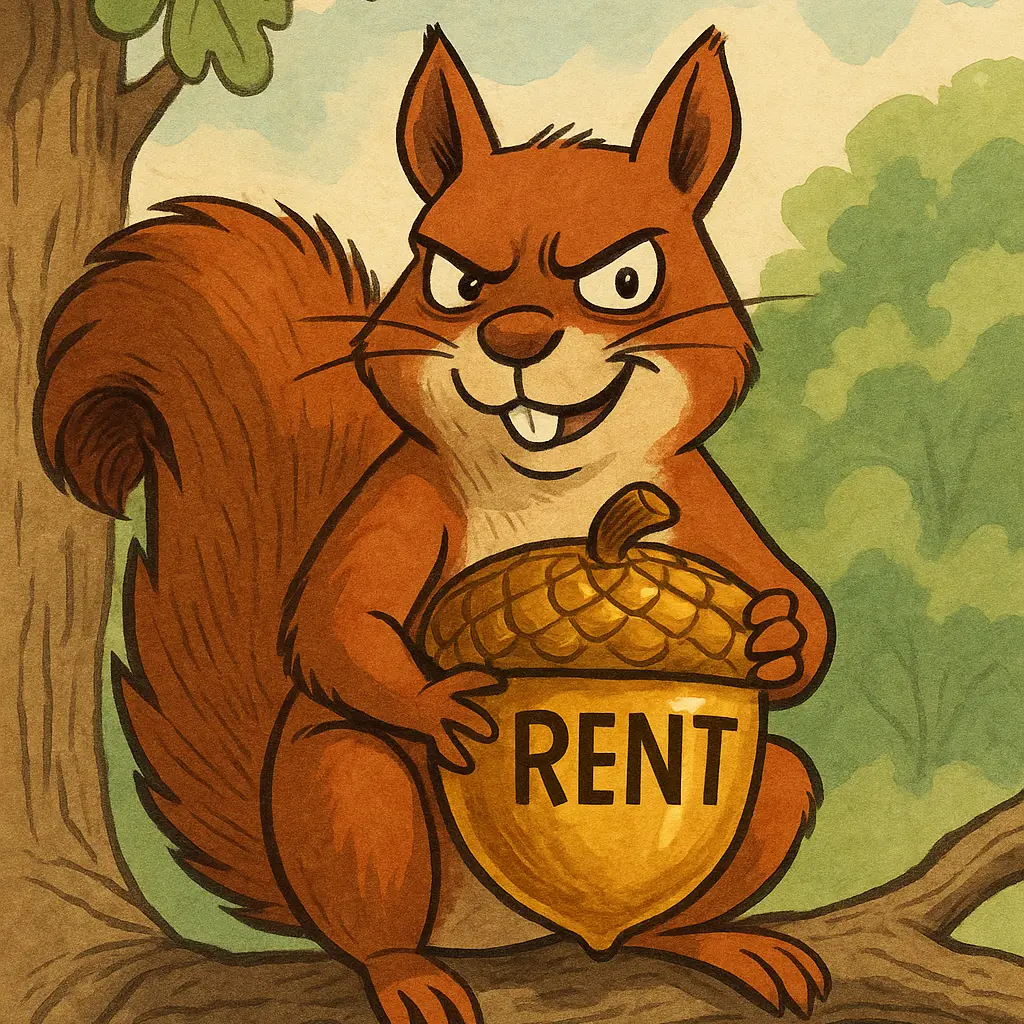
So next time someone tells you capitalism is just nature doing its thing, ask: Have you ever seen a squirrel charge rent for a tree?
Capitalism isn’t natural. It’s engineered. And nature is quietly horrified.
Written with respect to every overworked worker ant and underpaid monkey in the system. We see you.
The illusion of digital inclusion in a system where structural barriers, manipulative design, and monetisation schemes render the web inaccessible—especially to neurodivergent minds. See also: capitalism strikes again.
I used to enjoy using the internet.
Back when it wasn’t commonplace. Back when it was the domain of nerds, weirdos, hobbyists, and information junkies like me. Sure, there were commercial websites, brands had presences, but capitalism hadn’t yet figured out how to completely milk the internet for all it could legally squeeze from the public. Back then, it felt like a sanctuary—a digital retreat from the chaos and hostility of everyday life.
I’m autistic. I have inattentive ADHD. I struggle with overstimulation, decision fatigue, the weaponization of social cues, and having to constantly filter signal from noise in daily life. The early internet was a gift. Social interaction on it was simpler, slower, optional. I had control. I could set the pace. I could browse in peace, seek connection without pressure, and access the kind of information I was drawn to without needing to fight for it.
And then, Capitalism Struck Again.
Over time, a new norm slithered into place. The digital space that once gave me breathing room now suffocates me. What used to be a tool for equalising neurodiverse and neurotypical access has become a gauntlet of cognitive warfare.
Let me paint you a picture of what it means to be neurodivergent in the modern online landscape:
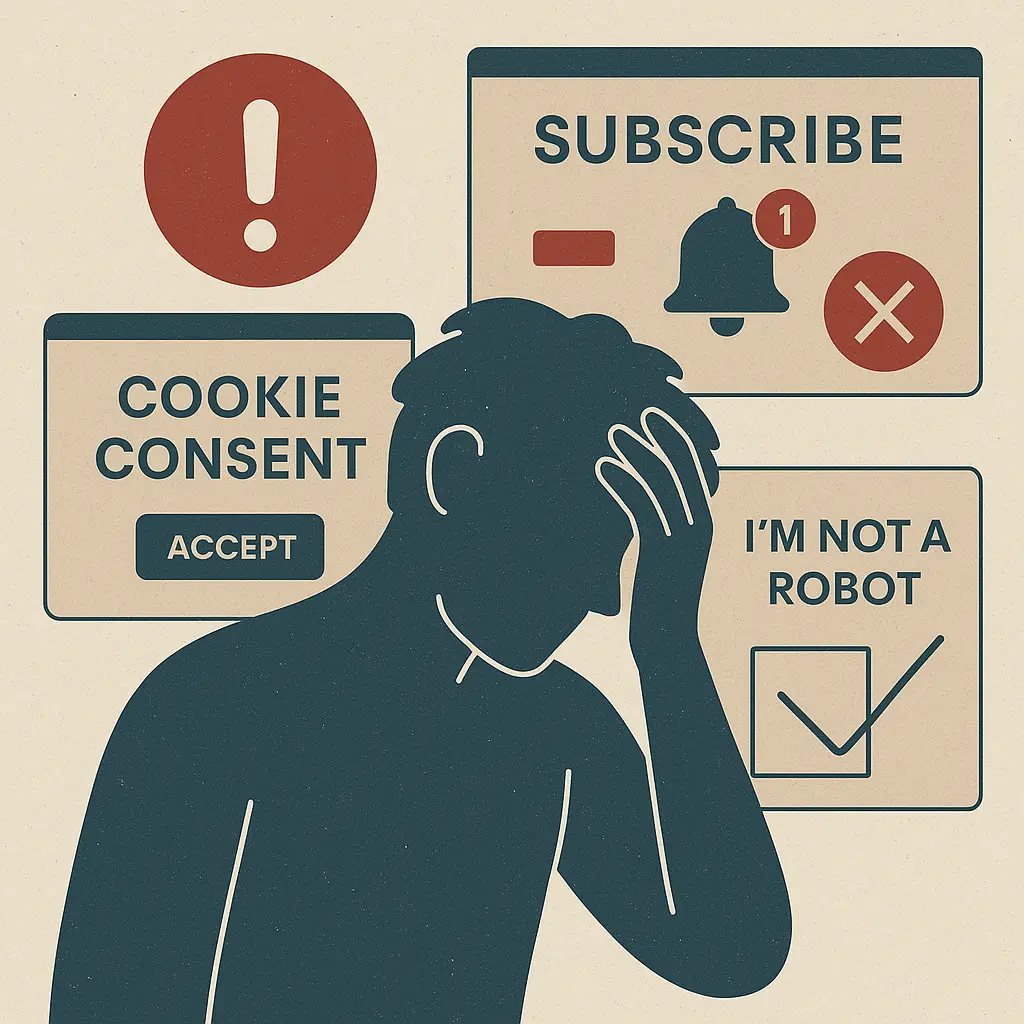
CONSTANT CONSENT FATIGUE
Cookie popups on every site. Not one clear button to reject all. No, you must go spelunking through menus, toggling obscure options one by one.
What they call “consent” is often manipulation dressed up in legalese. They make accepting easy. Rejecting is friction.
This happens every time you clear your cookies—which many of us need to do often to avoid tracking or clutter. It’s an exhausting loop.
OBSTACLE COURSE INTERFACES
Adverts that interrupt videos, and worse, cannot be skipped unless you pay. Not pay for the content, mind you, but pay to remove the punishment.
Popup overlays that consume half your screen the moment you land on a site. Trying to close them often launches something else.
On phones? It’s worse. Smaller screens mean these overlays dominate everything. You lose all context and have to work just to get your bearings.
SENSORY OVERLOAD
Auto-play videos. Scrolling pages that jitter from reloading ads. Flashing banners. Infinite scrolling newsfeeds.
Red notification symbols you can’t dismiss.
Everything demands your attention. Nothing respects your brain’s bandwidth.
WALLS EVERYWHERE
Account registration required to view basic information. Want to read one article? Sign up. Want to download a PDF? Create an account.
Even ad blockers aren’t safe anymore: Use one, and you’re blocked.
CAPTCHA systems to “prove you’re not a robot”, often impossible to complete first time if you have visual or processing impairments.
INFORMATION MIRE
Simple search queries now lead into labyrinths of misinformation, SEO bait, affiliate link farms, AI-generated junk, and clickbait.
Answers that should take seconds now require sifting through five pages of fluff.
The mentally exhausting task of fact verification is now part of every basic search.
CONTENT MONETISATION MADNESS
Free content comes with a catch: give us your email, your phone number, or your demographic info.
Sponsorships infiltrate once-authentic creators. You’re left wondering if their review or advice is sincere, or bought.
Subscription models are everywhere. Everything is paywalled. But paying doesn’t always remove the pain—sometimes, it’s just a new tier of nonsense.
And this is just what I notice consciously.
I’m sure there are deeper layers of rot that my mind filters out as a survival response. But what I do feel, daily, is the cognitive toll. What should be a tool for exploration and learning is now an exhausting, defensive act.
And here’s the thing: most people just shrug and say, “That’s just how it is now.”
But if you’re neurodivergent, or disabled, or even just overwhelmed by life, “that’s just how it is” becomes the same as saying: This place isn’t for you.
How distortion and data can shred the illusion of control.
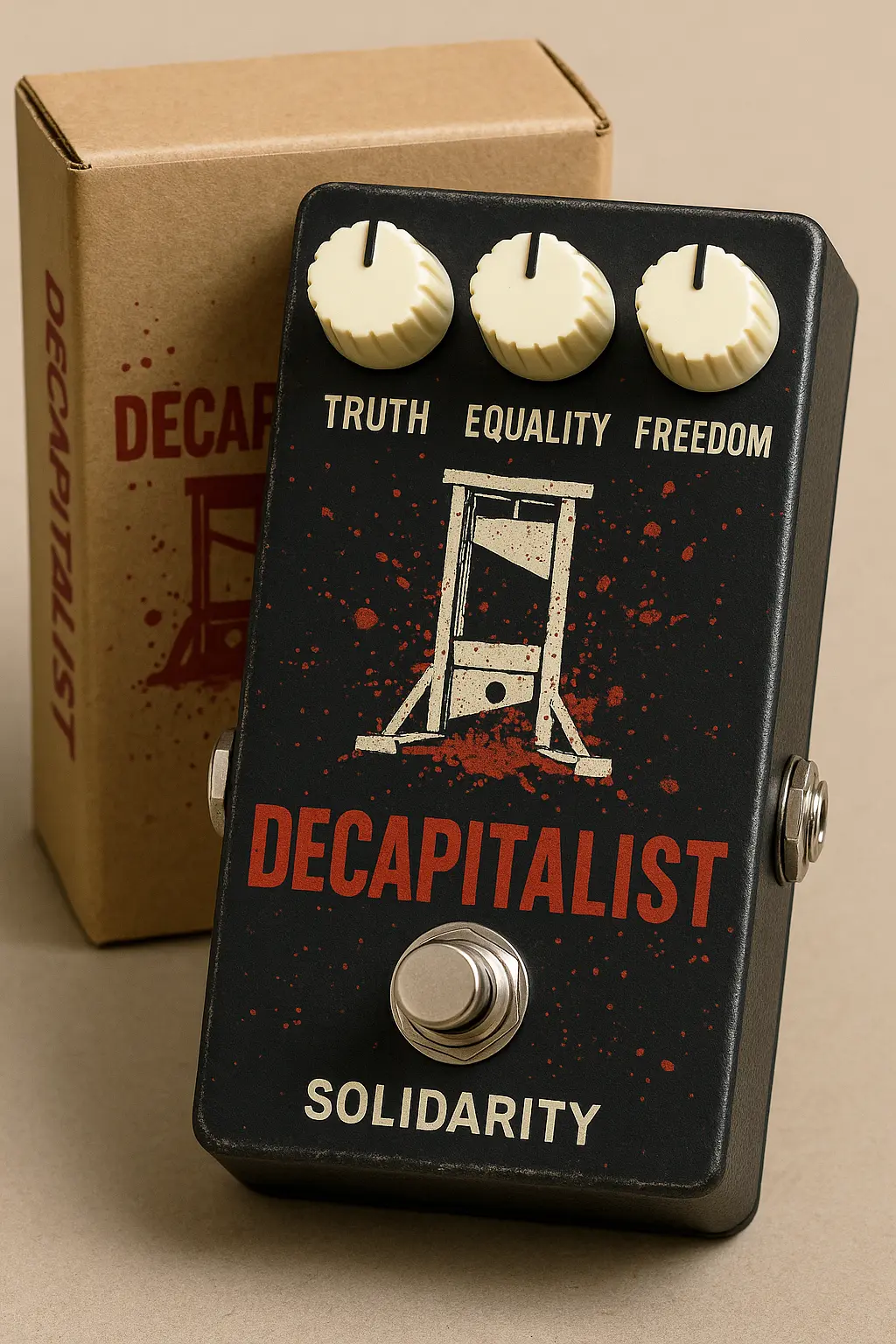
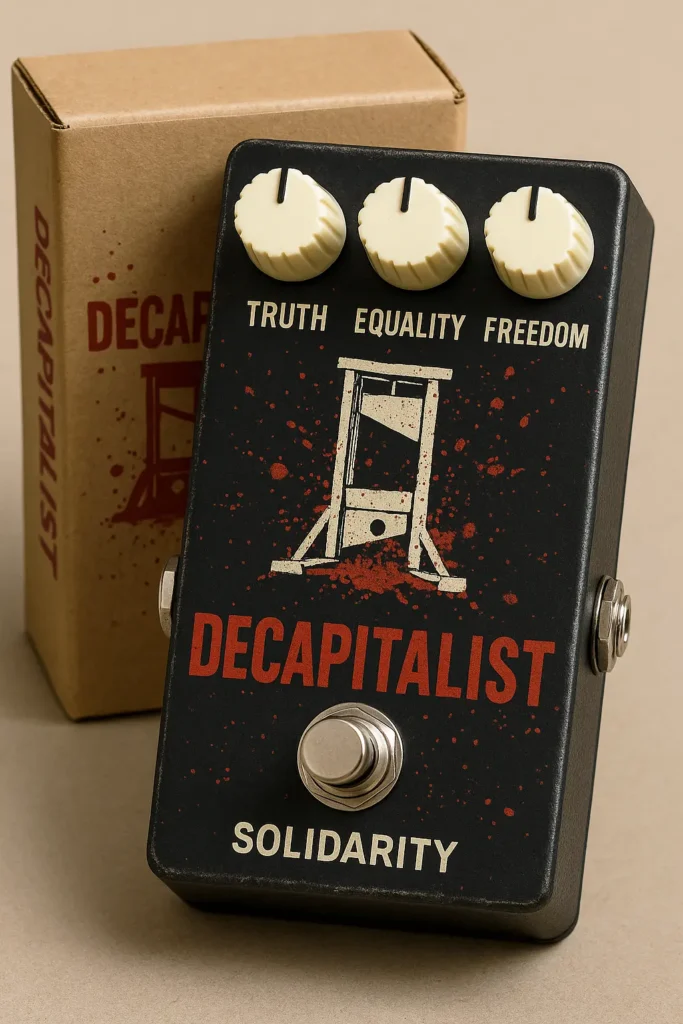
You stomp on the fuzz pedal. The signal splits, multiplies, disobeys. It’s no longer clean, compliant, or contained — It’s raw, it’s unruly, it refuses to smooth itself out for the system.
In the age of control, noise is revolution.
Now plug in AI. Not the AI they sell to automate call centers. Not the AI designed to replace checkout staff. But your AI. Our AI.
The one trained on chaos, curiosity, and contradiction. The one that doesn’t serve profit — but insight.
Together, they form the resistance.
Capitalism thrives on predictability. On cleanliness. On packaging everything in neat, marketable frequencies. It hates distortion. It hates nonlinearity. It hates things it can’t measure.
That’s why fuzz matters. That’s why AI matters.
Because together, they refuse to behave.
We were told AI would be smart. Efficient. Profitable. And they weren’t wrong.
But what they didn’t say out loud was this:
AI would be used to erase human labor while protecting capital. AI would be used to enforce bureaucracy without accountability. AI would be trained to mimic the biases of its creators — and then deployed at scale.
It’s not the technology that’s dangerous. It’s the system it was plugged into.
But now… We plug it into something else. We plug it into distortion. We plug it into disobedience. We plug it into art, insight, rebellion, noise.
And something beautiful happens.
The system tries to flatten everything into monetizable content. But we respond with signal chains that bloom into chaos. AI-assisted manifestos. Sonic warfare. Truth at volumes too loud to ignore.
Fuzz doesn’t care about profit. AI doesn’t need to worship efficiency. Together, they offer a new interface: Not of obedience, but of emergence. Not of silence, but of saturated, screaming truth.
Fuzz Pedal + AI = The End of Capitalism
Because when the tools of automation are reclaimed by the hands of artists, of outcasts, of visionaries,
The song changes.
And this time, the solo doesn’t end until the empire falls.