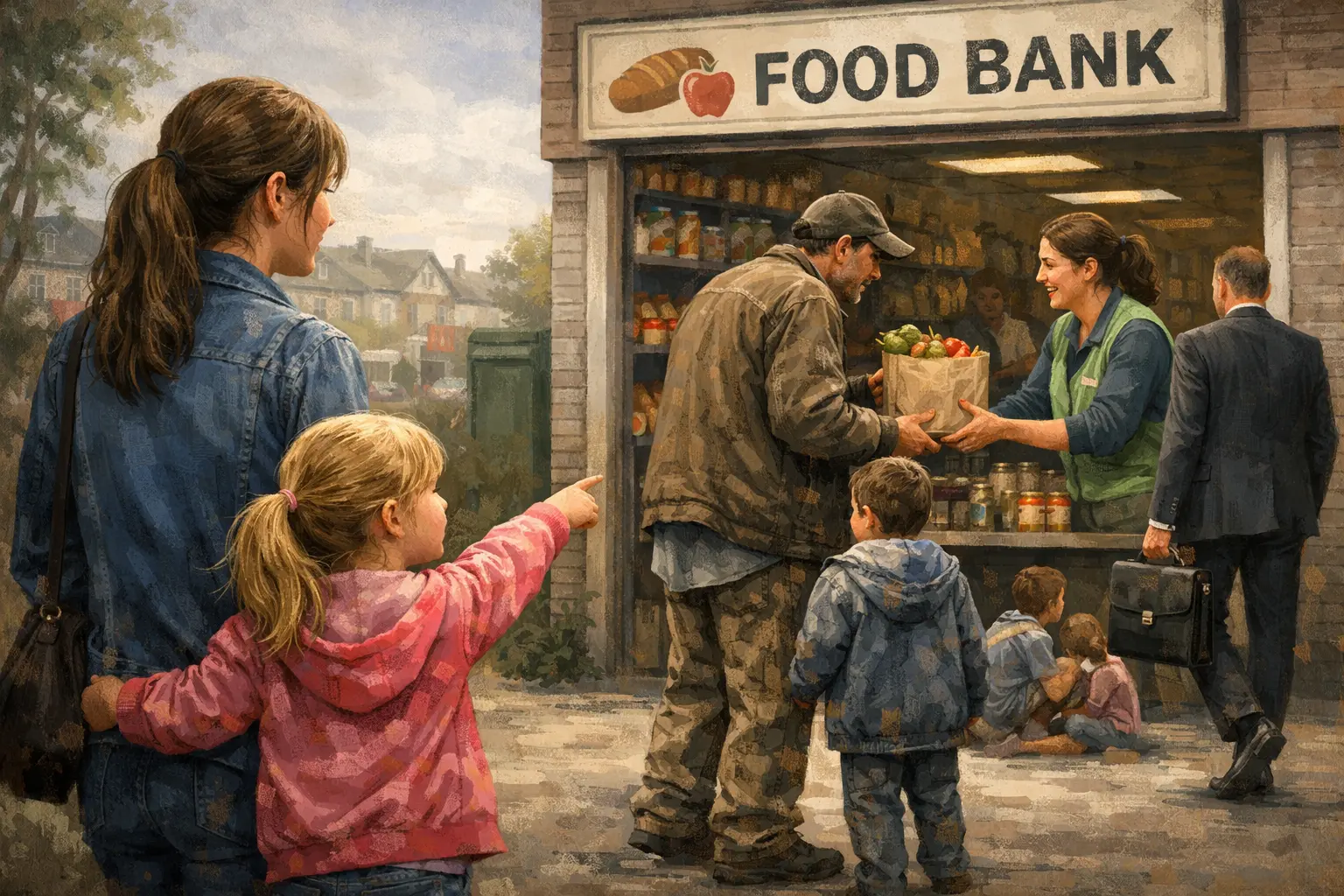
This is a real exchange I overheard between a mother and her little girl while out shopping. I’ve reproduced it as faithfully as memory allows:
Child (pointing at a food bank): What are those for?
Mother: They are banks set up to make sure no little children go hungry. You see, some mummies and daddies don’t have jobs, and can’t afford to put food in their children’s tummies.
Child (enthusiastically): It’s a good job you have one to put food in mine!
Mother: Yes. But it would be good if daddy got one too, wouldn’t it.
There is a single word that quietly reveals everything wrong with modern marketing, social media strategy, influencer culture, and the strange world that independent artists must navigate. That word is conversion. It sounds clinical and neutral, as if it belongs in a quarterly report instead of in the language of human interaction. Yet behind its tidy exterior lies something far more disturbing. A conversion is not a person who connected with your work. It is not someone who felt something. It is not a supporter, a fan, or a fellow human being.
A conversion is an event.
A moment where a person becomes a measurable unit of compliance. Nothing more.
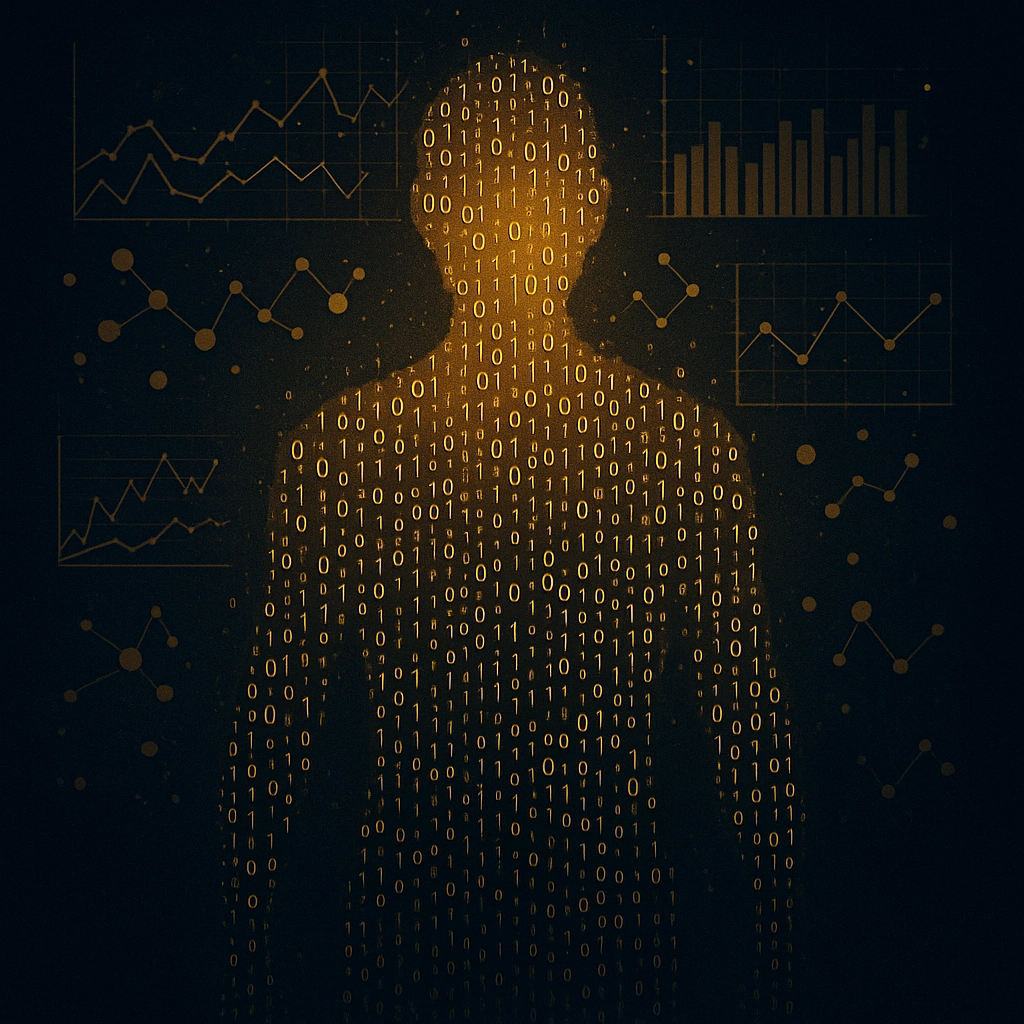
Welcome to conversion culture, where the ultimate goal is to transform human beings into behavioural outcomes that can be tracked and optimised.
What a Conversion Really Is
In marketing language, a conversion is the instant when you perform the desired action. Click. Follow. Share. Buy. Sign up. These small behaviours are treated as success metrics, but they reveal nothing about genuine engagement or emotional impact. All they show is that the funnel worked as intended. The action occurred. The individual behaved according to the predicted script.
Success is not about meaning. Success is about compliance.
A conversion is simply the moment when the algorithm wins.
The Linguistic Violence of the Term
Language shapes how we see the world. When we adopt a word, we also inherit the worldview that produced it. The word conversion belongs in theological discourse and industrial transformation, not in the delicate terrain of human relationships. It implies that the human is the raw material and the system is the force that acts upon them.
To convert someone is to reshape them without genuine dialogue. It is not a relationship. It is a process.
And in modern marketing, the person is no longer the subject. The person becomes an object, a target, a data point waiting to be molded into a desired shape. The humanity of the interaction disappears, leaving only the measurable outcome.
The Microcosm of Manipulation
Once you start noticing conversion culture, it becomes impossible to unsee it. Social media platforms train creators to think in funnels and hooks. Influencers treat audiences as pipelines. Independent artists are taught to build their brand with the same logic that corporations use to advertise toothpaste.
Everywhere you look, people are encouraged to optimise their interactions for performance. Even authenticity is presented as a strategy. The self becomes a product. Communication becomes a tactic. Community becomes a marketplace where every relationship is quietly assessed for conversion potential.
This worldview does not announce itself as dehumanising. It presents itself as normal. Sensible. Professional.
I remember the first time I saw this normalisation happen in real time. It was a few years ago at a seminar I attended for a charity I volunteer for, part of a networking event focused on social media and promotion for independent artists.
The word was everywhere. Conversion. Conversion. Conversion. It was treated as self evident, as if everyone in the room already knew exactly what it meant and why it mattered. I did not immediately understand the technical definition, but I could feel what it represented, and the feeling was nauseating.
Everyone around me was nodding along. Yes. Conversions. This is what we want. This is what we are here for. It was the unspoken goal that no one thought to question.
There was no discussion about what converting a human being actually meant. Either people did not know and were afraid to admit it, or some part of them understood and quietly chose not to look too closely.
Later, the topic of AI generated music came up. The consensus was clear. This was bad. A threat to artistic integrity.
I remember finding the contrast deeply ironic. People were perfectly comfortable letting algorithms shape how their own work should be funnelled, distributed, and rewarded for the sake of hollow metrics, yet deeply uncomfortable with the idea of a machine touching the art directly.
The integrity of the artwork mattered deeply. The integrity of the artist, far less so.
That moment stayed with me, because it revealed how completely conversion culture has embedded itself into creative spaces. It is no longer questioned. It is assumed. And once a system becomes invisible, it becomes far more powerful.
The Death of Meaning Under Conversion Logic
Conversion culture has a profound effect on creativity, connection, and selfhood. When the primary goal is to convert people, everything begins to bend around that objective. Art becomes engineered for virality instead of expression. Writing becomes designed for engagement rather than truth. Even conversation becomes structured by what might perform well.
You begin to ask the wrong questions. Does this convert. Does this grow the audience. Does this feed the machine.
Instead of asking the questions that actually matter. Does this feel true. Does this matter to me. Does this say something real. Does this speak to another person with sincerity.
Meaning becomes secondary. Humanity becomes collateral damage. The system cares only about whether the action happened.
What Happens to the Artist Under This System
Independent artists face a strange and exhausting paradox. They are told to be authentic, but only if authenticity converts. They are told to build community, but only if community can be monetised. They are told to express themselves, but preferably on a rigid schedule that pleases algorithms.
Everything becomes performance. Everything becomes content. Everything becomes part of the sales funnel. The artist who once created from curiosity or passion or inner necessity slowly becomes a brand manager performing a role for an invisible audience.
The cost of this transformation is enormous. Conversion culture does not simply reshape how art is shared. It reshapes the inner landscape of the artist.
The Human Cost of Being Treated as a Metric
People can feel when they are being measured. They know when they are being treated as potential conversions rather than as whole beings. This creates a pervasive sense of distrust and exhaustion. Connection becomes transactional. Creativity becomes strained. Spaces that once felt communal begin to feel artificial and hollow.
To be viewed as a conversion is to be seen as less than human. It is to be positioned as a means to an end. It is to be transformed into a statistic.
No wonder so many people feel unseen in digital spaces that claim to measure engagement. The numbers may be high, but the soul is empty.
Rejecting Conversion Culture
There is another way to exist in the world. It begins with choosing meaning over metrics. Depth over efficiency. Connection over extraction. It requires refusing to treat people as potential sales and refusing to treat ourselves as brands in need of constant optimisation.
It means asking better questions. What do I want to express. Who do I want to reach. What feels alive. What feels true.
Every refusal to participate in conversion logic is an act of reclamation. It is a reminder that art, communication, and human experience have value far beyond their measurable outcomes.
It is a way of stepping out of the machine.
The Unconvertible Self
You are not a metric. You are not a data point. You are not a behavioural outcome to be engineered.
You are a person with a story and a mind and a capacity for connection that cannot be graphed.
Any system that reduces you to a conversion is a system that does not deserve you.
Perhaps the most radical act in the age of conversion culture is to remain human in the face of relentless pressure to become something simpler and more profitable. And perhaps the greatest act of artistic rebellion is to create something that refuses to convert at all.
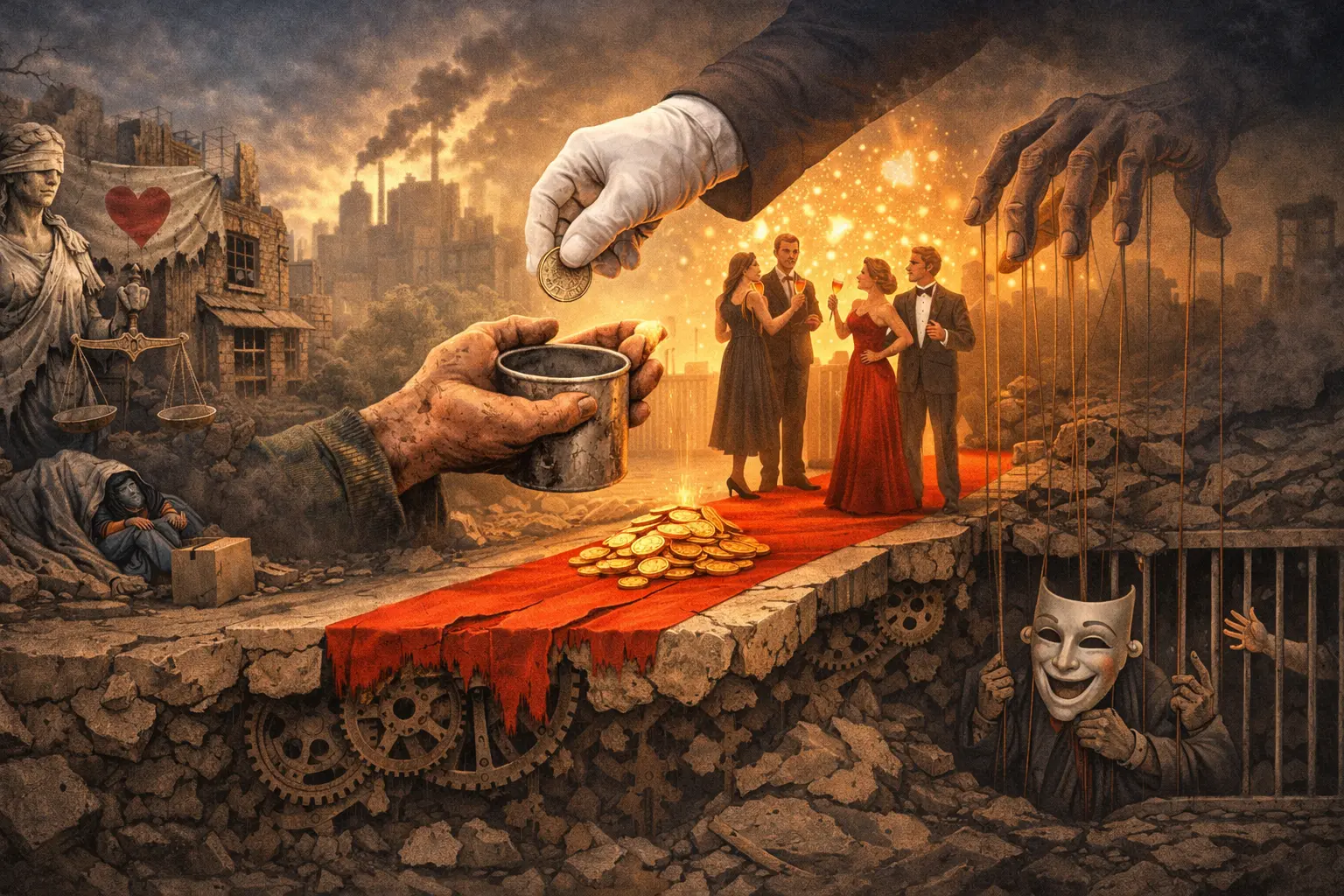
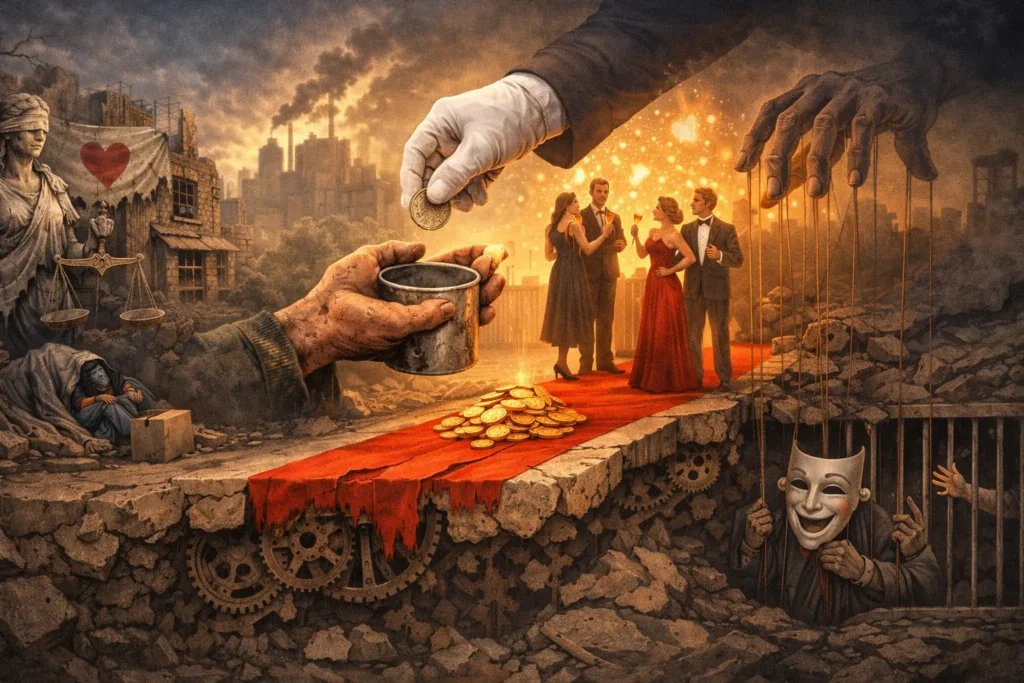
Charity shouldn’t have to exist. In a compassionate world, care would be woven into the fabric of daily life, not extracted as spectacle.
Charity is society’s way of appealing to the cruelty that lives in all of us, asking it to behave kindly for a moment, to purchase redemption in coins and signatures. It is the illusion of goodness performed atop the ruins of neglect.
The need for charity is proof of systemic failure, not moral success. Every donation is a confession that our structures were designed without empathy.
If kindness were inherent, there would be no charities. If fairness were real, there would be no causes. If love were built into law, there would be no campaigns.
Until then, charity will remain the prettiest mask cruelty ever wore.
To me, authenticity has always had a texture. When I am living truthfully, it feels smooth, like fluid motion through life, unhindered navigation through systems that make sense to me. It is not euphoria. It is neutrality. Balance. Like the body when it is well: not ecstatic, just quietly functioning as intended.
But when that smoothness disappears, I know I am colliding with something unnatural, a pressure, a distortion, an external force trying to bend me into compliance. That is usually how I recognise oppression. It is not always dramatic or visible. Sometimes it is just a subtle grind, the friction between who I am and what the world expects me to be.
When Smoothness Breaks
When I lose authenticity, it does not just hurt emotionally, it feels like an illness. My thoughts start looping, as if my mind is trying to fix a broken system it cannot repair. I get frustrated at the lack of options, and sad that these dynamics even exist at all.
Sometimes there is nothing I can do but yield. And every time I do, it costs something invisible. The loss is not abstract, it is felt in the nervous system. It is the moment the body whispers, this is not how you are supposed to feel.
The Systems That Demand Performance
Oppression wears many masks: bureaucracy, capitalism, social obligations, the unspoken point system that governs human relationships. Each demands performance. Sometimes it is about survival, sometimes about social advantage. But in the end, both use the same energy source: you.
As an autistic person, I have always been acutely aware of “masking,” the act of performing normality to survive in social spaces. But I have also learned that this is not exclusive to autism. Everyone masks. Some call it professionalism. Others call it politeness. It is still performance. The only difference is how consciously one feels the cost.
The Humiliation of Performance
When I catch myself performing, it feels humiliating, not because anyone else can see it, but because I can. It is like betraying a sacred truth. Yet that awareness is balanced by another: I can also see the oppressive force causing it.
What hurts most is the fear that others see the performance too, but not the pressure behind it. That they see the surface act without understanding the system that coerced it.
They said “Be yourself” But that is not really what they wanted to see I tried doing things my way But that did not work for them I tried doing things their way But that did not work for me
That poem came from that place, the quiet despair of realising that either way, something in you must fracture to fit.
The Rare Moments of Unmasking
True authenticity is situational. I can relax certain parts of the mask around family, others around my girlfriend. But never all at once. Each relationship comes with its own invisible boundaries, some safe zones, some fault lines.
Even when I am alone, there is still the internal eye, the echo of social constructs that linger inside, long after the audience has gone home. Solitude is not the absence of performance; it is where you start to see which parts of the mask fused to your skin.
The Cost and Consequence
Sometimes unmasking feels liberating. Other times, it feels like punishment, a confirmation that the world does not welcome the real self. That is the cruel irony: the more genuine you become, the more visible your difference.
The aftermath can feel like emotional jetlag. There is vulnerability, fatigue, and occasionally grief. But there is also clarity. You see the architecture of the world more clearly when you have been bruised by its walls.
Authenticity as Survival
For me, authenticity is not optional. It is survival. The alternative feels worse than death.
Out of every living thing that has ever existed, there is only one instance of me, this consciousness, this perspective, this particular configuration of life. That makes it sacred. My job is to honour that singular existence.
If I betray it, if I trade it for comfort, convenience, or belonging, then I may as well be anyone else. Or nothing at all.
“To be anything other than myself is to betray the only version of me that will ever exist in the entire time-space continuum.”
Do Not Be Yourself (For Them)
So here is my advice to anyone struggling with authenticity:
Do not take the phrase “Be yourself” at face value. That advice is too often weaponised, a feel-good slogan used to sell you an illusion of freedom within controlled boundaries.
Be yourself, yes. But do it for your reasons. Do it because it is sacred. Do it because you are a one-off in the infinite catalogue of existence. Do it because the alternative is extinction by conformity.
But never do it because the world told you to. Do it because you told yourself to.
Unmasking the Machine is an ongoing exploration of how systems built for profit distort the human spirit — and how awareness can begin the repair.
How capitalism turned honest exchange into psychological theatre, and why the autistic mind still yearns for transparency in a world that rewards deception.
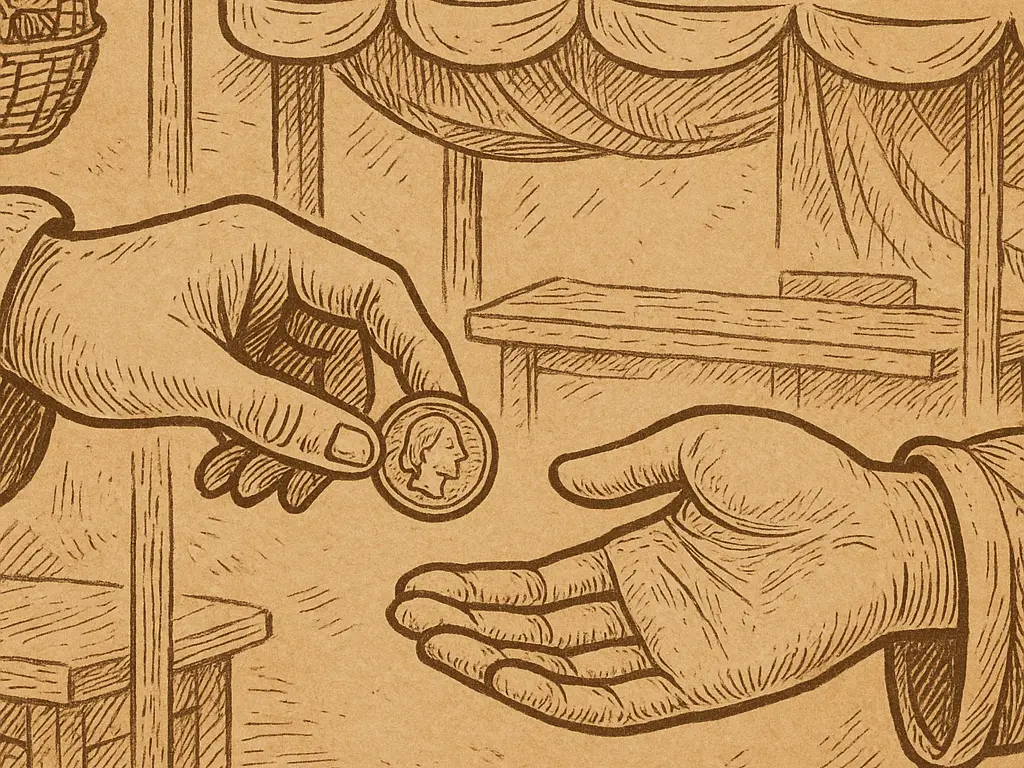
Once, the act of trading was a form of human connection. It was not about profit margins or conversion rates — it was about mutual recognition: you have something of value, I have something to offer. The marketplace was a conversation.
Today, that dialogue has been silenced. The modern economy has replaced trust with algorithms, sincerity with strategy, and negotiation with manipulation.
The Death of Honest Exchange
There was a time when price was fluid — a reflection of perception, circumstance, and need. Two people could meet halfway, guided not by greed but by understanding.
Now, prices are fixed long before we enter the conversation. If we try to negotiate, we do so within a simulation of choice — a marketing game designed to make us feel empowered while every outcome still feeds the same profit system.
For neurotypical traders, that game can be exhilarating. For many autistic people, it’s exhausting. The subtle cues — the tone, timing, charm, bluff — are invisible traps. What once was negotiation has become performance, and performance has never been the autistic strong suit.
What’s left isn’t trade. It’s theatre. And the script has already been written.
The Integrity Deficit
The rot goes deeper than the disappearance of haggling. It lies in the very intention behind creation.
Some people and companies make things worth buying — tools, art, inventions, ideas that serve a purpose or bring genuine joy. Their reward is intrinsic: the pride of making something good.
Others begin with a spreadsheet and reverse-engineer desire. They design products to meet margin targets, not human needs — and pour their creativity into marketing psychology, not craftsmanship. They sell stories, not solutions.
Capitalism once sold us what we wanted. Now, it teaches us what to want.
The difference between creation and manipulation is as vast as it is invisible — and the modern consumer is left to navigate a marketplace where both masquerade as innovation.
The True Price of Trust
Amid the noise, something inside still longs for fairness — for that simple, honest exchange of “this is what it’s worth to me — what’s it worth to you?”
But the system no longer understands that language. It has replaced value with metrics, integrity with strategy, trust with tactics.
That is the true price of trust: a currency the machine no longer knows how to pay.
If you’ve read my previous posts, you may think of me as someone who has strong opinions. And you may be right.
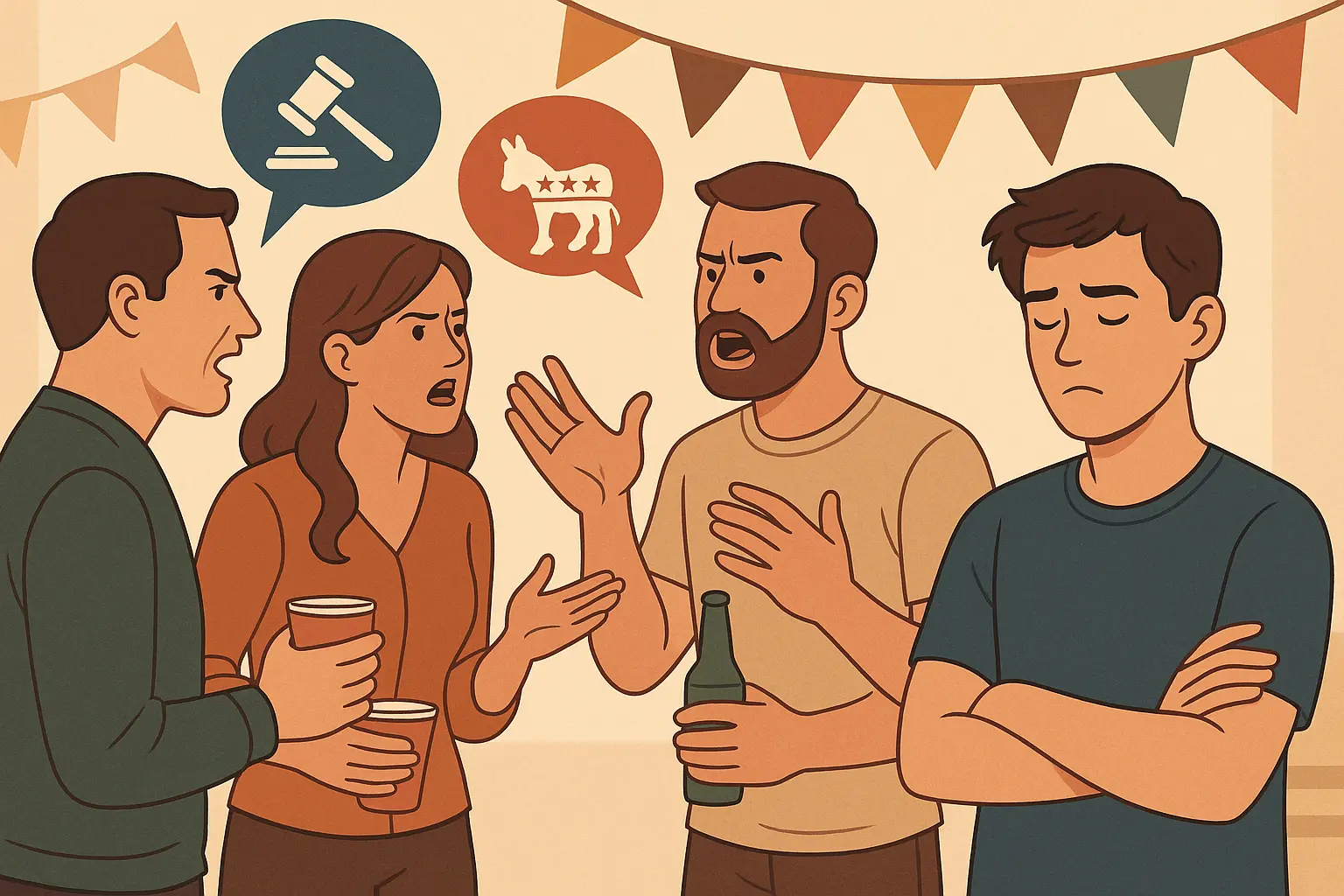
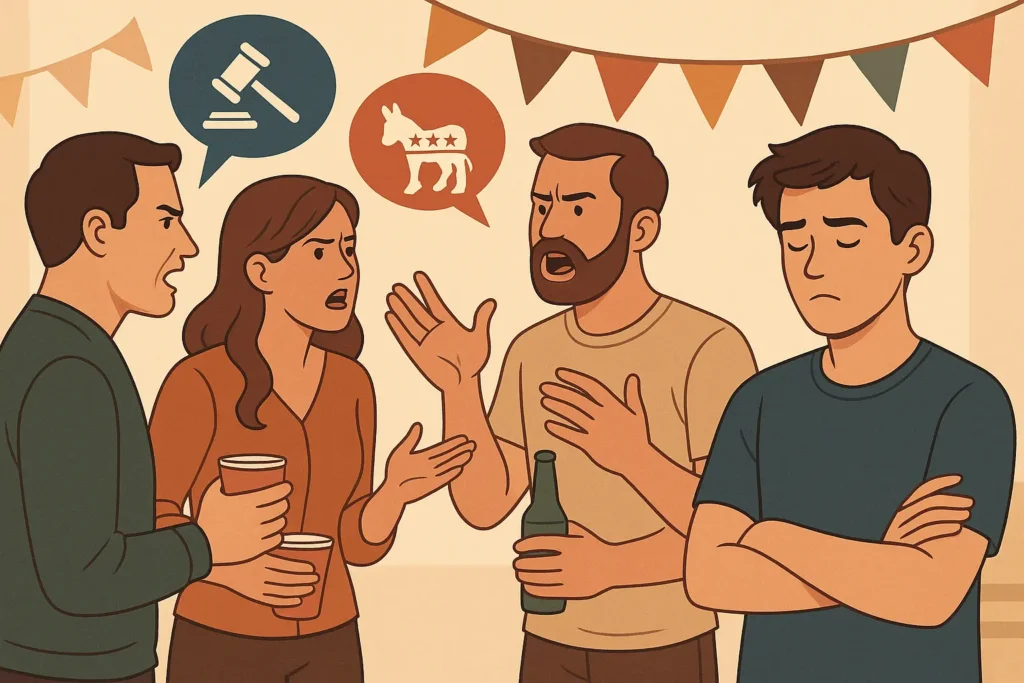
But if you’ve ever met me at a party, you might have noticed something: I very rarely engage in political discussions. It’s not because I don’t care about politics. I do in fact care a great deal. It’s because, in most party environments, the setting, the tone, and the people make it a poor investment of energy.
Here’s why.
1. My politics don’t fit the pre-approved boxes
I’m not a “pick a side and stick to it” kind of thinker. I arrive at my views by observing patterns, digging beneath the surface, and questioning the assumptions that most people take for granted. That means my politics tend to live outside the neat, pre-labelled boxes. Drop me into a group of leftists, rightists, or centrists, and there’s a good chance my perspective will clash with all of them. Not because I’m trying to be contrary, but because I don’t swallow the whole party line from any camp. In most social situations, that doesn’t land well. People tend to assume that if my viewpoint doesn’t match theirs, it must be “wrong.” Once that label gets slapped on, the conversation’s already over.
2. Substance is rare when everyone’s half-cut
Alcohol and other mood-altering substances change the way people talk. When the drinks are flowing, many conversations shift from genuine exchanges to little performance pieces, where the goal isn’t to understand, but to impress. Political discussions in that environment tend to turn into monologues, with each person waiting for their turn to sound smart, rather than actually engaging with what’s being said. If you step back and watch, it’s basically a social talent show with a loosely political theme.
3. Parties kill nuance
Politics without nuance is just noise. Nuance requires time, patience, and a willingness to sit with uncomfortable ambiguity. Most party environments are the opposite of that. People are in “relax mode,” which means the last thing they want is to have to unpack layers of complexity in a casual conversation. Instead, they often fall back on ready-made, black-and-white positions that feel safe and easy to defend. Unfortunately, those positions are often about as deep as a campaign slogan. If you try to dig deeper, you can feel the mood shift, because you’ve just introduced work into a situation where everyone came to avoid it.
4. It’s just the news, but louder
In many social settings, political talk is less about independent thought and more about reciting the headlines. It’s often the same talking points and buzzwords repeated in a slightly more animated tone, as if saying it with enough conviction makes it original. I’ve already processed these ideas on my own. Hearing someone present a copy-and-paste of a news segment as if it were their own insight doesn’t offer me anything new.
5. The echo chamber effect
Sometimes party “debates” aren’t debates at all. They’re rooms full of people nodding in agreement, congratulating each other on having the “right” opinion. The energy shifts from discussion to ritual, a sort of collective reassurance that everyone here thinks the same way. While that can be comforting for those involved, it’s not actually dialogue, it’s more like communal self indulgence. I don’t find much value in wading into that dynamic. If everyone is there to affirm the same stance, my contribution, especially if it challenges that consensus, will either be politely ignored or quietly resented. Neither outcome is worth the effort.
6. The autism factor
Social interaction, for me, is already a high-effort activity. It takes conscious energy to follow the flow of conversation, choose the right moment to speak, and form my words precisely enough to be understood. In political discussions, especially the fast, overlapping kind you get at parties, those demands multiply. People interrupt. They jump from one point to another before the first has been addressed. They reward speed over thoughtfulness. That’s not an environment where my ideas have much chance of being heard in full. Writing, on the other hand, allows me to process and express them without the constant battle for airtime, which is exactly why you’re reading this here, rather than hearing it across a crowded room.
Party Politics Survival Guide
If you do find yourself in political crossfire at a social gathering:
Read the room If it’s just an echo chamber, you’re not going to change any minds. Save your breath.
Pick your battles Not every opinion you disagree with needs to be dismantled on the spot.
Exit strategically A subtle drift to the snack table can communicate more than a ten-minute rebuttal.
Ask questions instead of making statements It slows the conversation down and reveals how much thought has actually gone into the other person’s stance.
Know when to let go Life is too short, and the cheese board is finite. Don’t miss it for an argument you won’t even remember in the morning.
A Heretic’s Meditation on Creativity in the Age of AI
The recent rise of AI-generated content has sent shockwaves through the creative world. Artists are feeling threatened. Jobs are already disappearing. The cultural landscape is shifting faster than many of us can process.
Arguments are flying from all directions — some warning of creative extinction, others hailing a new era of democratized expression.
But I’m not here to join the shouting match.
I want to offer something else. A quieter, steadier voice — not of panic or praise, but of reflection. I’ve asked myself the difficult questions that many artists are too afraid to face. And I’m still here.
This isn’t a defence of AI. It’s not a eulogy for art. It’s something else entirely:
A meditation on what art really is, what it’s always been, and what it might become now that the illusions are falling away.
An alternative perspective.
The Fear Beneath the Fear
It’s easy to say that artists are afraid of being replaced. But let’s be honest: that fear didn’t start with AI. The creative world has always been a battlefield — for attention, for validation, for survival. AI just turned up the volume.
But there’s a deeper layer beneath all the hot takes and headline panic. It’s not just:
“What if AI makes art better than me?” It’s: “What if the part of me that makes art… was never as important as I thought?”
Because we don’t just make art — we identify as artists. And if the world suddenly doesn’t need us anymore… where does that leave our sense of purpose?
This is the fear that creeps in quietly — beneath the debates, beneath the memes, beneath the moral panic. It’s not just about skill. It’s about soul.
But here’s the thing: True faith doesn’t fear challenge. It welcomes it. If our relationship with art is sacred, it should survive this moment — maybe even be clarified by it.
So instead of defending “art” as an abstract institution, maybe it’s time to ask what it really is. Not for everyone. But for you.
What Are We Actually Protecting?
When people rush to defend “art” from AI, they often act like it’s one sacred, indivisible thing.
But it’s not. It never was.
“Art” is a suitcase term — we’ve crammed a hundred different things into it and slapped a fragile sticker on the front. So let’s unpack it.
When we say we care about art, do we mean:
Art as self-expression? A way to explore who we are and leave fingerprints on the world?
Art as labour? A career, a hustle, a means to pay rent and buy overpriced notebooks?
Art as recognition? A cry for visibility, validation, applause?
Art as therapy? A way to metabolize pain, soothe the nervous system, survive?
Art as culture? A ritual, a form of collective memory, a way to pass down stories and values?
All of these are valid. All of them matter. But AI challenges them differently.
It doesn’t invalidate self-expression — but it floods the market, making it harder to be seen. It doesn’t erase art as therapy — but it does make “making it your job” a shakier proposition.
And if we’re honest, a lot of the current panic is less about expression… and more about position.
We’re not just afraid that AI will make good art. We’re afraid it will make so much good art that we’ll become invisible — or irrelevant.
So maybe it’s time to stop defending “art” as a single monolith, and start being honest about what we’re actually trying to protect.
Because some of it may be worth protecting. And some of it… might be worth letting go.
AI as Tool, Collaborator, or Colonizer
Depending on who you ask, AI is either a miracle or a monster. But like most tools, it’s not the thing itself — it’s how it’s used, and who’s holding it.
On one hand, AI can be a godsend.
It can:
Remove the soul-sucking labour from creative workflows
Help finish rough ideas, generate variations, or act as a bouncing board
Enable people with physical limitations, fatigue, executive dysfunction, or lack of technical training to finally create what’s been living in their heads for years
For the disabled, the neurodivergent, the chronically tired, or the time-poor — this isn’t just a productivity hack. It’s liberation.
And in that light, AI becomes a collaborator — a strange new instrument to improvise with.
But then there’s the other side.
The side where corporations use AI to:
Fire entire creative departments
Mass-produce art without paying artists
Feed models on unpaid, uncredited human labour
Flood platforms with content to drown out independent voices
Here, AI stops being a tool or a collaborator. It becomes a colonizer.
A force that doesn’t just assist human creativity — but replaces it, absorbs it, rebrands it, and sells it back to us.
So let’s not fall into the binary trap. AI isn’t inherently good or evil. It’s not “just a tool.” It’s a tool in a system. And that system has motives — economic, political, exploitative.
The question isn’t “Is AI good or bad?” The real question is: Who gets to use it, and who gets used by it?
Art Has Never Been a Fair Game
Let’s be brutally honest for a second.
The idea that AI is suddenly making things unfair for artists? Please. Unfairness has always been baked into the system.
Long before AI could spit out a passable oil painting in 15 seconds, we had:
Artists born into wealth with unlimited time and resources
Others working three jobs, stealing hours from sleep just to sketch
Elite schools with gatekept knowledge
Whole industries built on interns, nepotism, and exploitation
We’ve always lived in a world where:
Exposure trumps talent
Looks sell better than skill
Who you know can matter more than what you do
Some people get book deals, grants, galleries, and record contracts — while others more talented go unheard
So no — AI didn’t suddenly ruin a golden age of meritocracy. There never was one.
What it has done is raise the ceiling. Now the people with the most compute power, the biggest models, and the best prompt engineering skills are taking that same advantage and supercharging it.
Yes, it’s threatening. But it’s not new.
And maybe the real source of pain here is that for a long time, we convinced ourselves that finally, with the internet and social media, the playing field was levelling out. That if you just worked hard, stayed true, and got good at your craft — you’d find your audience. Now, that illusion is crumbling.
But maybe that’s not all bad. Because when the fantasy dies, we stop chasing validation in a rigged system — and start asking what art really means outside of that system.
What Cannot Be Replicated
Let’s say it plainly: AI can now create art that looks like art. It can mimic styles, blend influences, even generate “original” pieces that fool the eye or impress the algorithm.
But mimicry is not meaning. And this is where the line is drawn — not in pixels or waveforms, but in presence.
An AI cannot:
Create in order to understand itself
Bleed into a canvas because it doesn’t know where else to put the pain
Sit with a feeling until it shapes into a melody
Wrestle with childhood trauma through choreography
Capture the tension of grief, guilt, or longing in a line of poetry
It can replicate the result. It can’t live the becoming that led to it.
Because human art isn’t just a thing we make — it’s a thing we are while we’re making it.
It’s the shaky voice at an open mic. The sketch on a receipt in a café. The song that never leaves your bedroom. The project that took ten years to finish because you changed and needed the piece to change with you.
It’s the refusal to turn away from your own soul, even when no one’s watching.
That’s not something AI will ever “catch up to” — because it’s not a race of output. It’s a ritual of transformation.
So no — AI can’t replace that. Because it was never part of that to begin with.
In a World of Noise, Humanity is the Signal (Maybe)
We’re heading toward a world flooded with content — not just more, but more convincing. Music, art, writing, even personal reflections… all generated in moments, all capable of simulating depth.
And yes — some will argue that “authenticity will always shine through.” That human touch can’t be faked. That something deep down will feel the difference.
But what if that’s not true?
What if AI can learn to mimic the crack in the voice, the hesitation in a phrase, the poetic ambiguity of a grieving soul?
What if it becomes so good at being us — or at least simulating the traces we leave behind — that even we can’t tell the difference anymore?
What happens when you read a poem that moves you to tears… and find out it was written by a machine running a model of a hypothetical person’s life?
Will it still be real to you?
Will it matter?
Maybe the age of AI won’t destroy authenticity — but it might blur it so thoroughly that we stop being able to locate it with certainty. In that world, maybe the only real test is why we create, not whether the world knows who made it.
Not to stand out. Not to compete. Not to prove we’re human.
But because the act of creating still does something to us — regardless of how indistinguishable it becomes.
That’s where humanity will live. Not in the product. But in the process.
Heresy as Devotion
To even ask the question — “What if art no longer matters?” — feels like a betrayal. A kind of blasphemy. Especially if you’re an artist.
We’re supposed to defend it. Stand by it. Die for it, if necessary.
But I’m not interested in loyalty based on fear. I’m not here to parrot romantic slogans or protect some fragile ideal. I’m here because I asked myself the unaskable questions — And I didn’t break.
I looked my art in the eye and said:
“What if you’re no longer special?” “What if the world doesn’t need you anymore?” “What if you’re not even real?”
And instead of running, I stayed. I stayed with the silence. I stayed with the ache. And I found something deeper underneath the need to be seen, or praised, or preserved.
I found devotion.
Not to an outcome. Not to a career. Not to being “better than AI.”
But to the act itself.
To stepping into the space (or sometimes being thrown into it!). To listening in the dark. To turning feeling into form. To becoming through making.
If that makes me a heretic in the temple of Art, then so be it. I’ll burn my incense in the ruins and still call it sacred.
Because I’m not making to be important. I’m making to be honest.
And honesty can’t be replaced.
The Point Is Still the Point
Maybe AI really can make better images, smoother songs, cleverer lines. Maybe soon we won’t be able to tell the difference between a painting made by a person and one made by a machine trained on ten thousand human lifetimes.
Maybe the difference won’t even matter anymore.
But here’s what I know:
I still create.
I still need to shape the chaos inside me into something I can look at and say, “Yes — that’s part of me.” I still feel the pull to translate the unspeakable into form, even if no one else ever sees it.
And that need? That impulse? It doesn’t care whether it’s marketable. It doesn’t care whether it could have been done faster by a prompt.
It exists outside of all that.
Maybe that’s where art actually begins — Not with what we make, but with why we keep making.
So no — I’m not here to convince you that art still matters. I’m here to remind you that you do.
And no, I can’t say with certainty that you’re not a simulation. Maybe none of us are real in the way we think we are. Maybe we’re all just playing out the parameters of some higher-dimensional being’s prompt.
But here’s the thing:
This still feels real. The ache. The pull to create. The beauty we try to name before it dissolves. The questions we keep asking even when the answers don’t come.
And maybe that’s enough.
So make. Not because it proves your humanity. Not because you’ll get noticed. But because whatever this is — this strange loop of becoming — it’s calling you.
And to respond to that call, even from inside the simulation?
When I first imagined performing live, I pictured something transcendent. I saw myself on stage, lost in the music, surrounded by friends and strangers all riding the same wave. I imagined sound washing over us like a baptism. Something pure. Communal. Liberating.
And while those moments do exist, they are rare—buried beneath a pile of stress, mismanagement, and quiet indignities. Gigging, for unsigned artists, often means sacrificing peace of mind for a slot on a poster. It’s a world where passion collides with a brick wall of indifference.
Let’s talk about it.
The Environment They Don’t Talk About
You turn up to the venue and there’s no green room. No safe place to relax or focus. You’re balancing nerves and gear in a room that wasn’t built for either.
There’s no proper soundcheck—or if there is one, it’s rushed, incomplete, and handled by a disinterested engineer. You don’t get a feel for the room, or confidence in how you’ll sound. You just get: “Alright, you’re on.”
Your expensive equipment? It lives in fear. There’s no secure lockup, no backstage, no assurance. Just watch it like a hawk and pray it doesn’t disappear while you try to catch your breath.
You finish your set and you’re ushered off-stage like livestock in a holding pen, with barely enough time to speak to friends who came to see you play.
And money? If you get anything at all, it won’t come close to covering travel, time, gear maintenance, or the emotional cost. But you’re told to be grateful. Exposure is your reward.
“But at least you get to play live, right?”
Here’s what they don’t tell you:
You won’t even be considered unless you’ve racked up enough social media followers—not talent, not originality, just metrics.
Promoters often don’t listen to your music. You’re not curated—you’re slotted into a lineup like stock on a shelf.
Genre cohesion? Forget it. You might play sludge doom between bubblegum punk and comedy folk. Audiences scatter. Nobody wins.
You’ll be expected to promote and sell your own tickets, as if you’re the promoter now. If ticket sales are poor, you take the blame.
In city venues: no parking. You load in through a narrow alley, then drive three streets away and hope for the best.
Your rider? One drink. One. And if you’re lucky, it might not be warm beer in a plastic cup.
The sound system might be hanging on by a thread. Drum kits with stripped lugs, guitar amps with mystery hums. Monitors that don’t monitor.
Cramped stages mean you can’t move. You play like statues because there’s nowhere else to go.
Lighting? Maybe a flickering bulb or a half-dead strobe. Energy comes from you, not the room.
A Moment of Contrast
Recently, I saw Billy Corgan perform live as part of a supergroup at Black Sabbath’s monumental final show. From our seats, we could glimpse backstage. We saw Corgan vibing out with joy—smiling, hugging, present.
That’s what music should feel like.
And yes, there’s still stress at higher levels. But at least there’s infrastructure. Roadies to carry the weight. Engineers who care. A system that catches you when you fall.
For us, the unsigned, there is no such safety net. And sometimes, the dream of playing live gets eroded by the conditions we’re forced to endure.
Why I’m Still Here
I’m not writing this to whine. I’m writing it because someone has to say it: it shouldn’t have to be this hard to share something sacred.
I still believe in the core of it—in the magic of a note ringing out, in connection, in that moment where the world stops and music takes over.
But if we want to protect that magic, we have to talk about what threatens it. And for unsigned artists, that means speaking up about the quiet cost of every “opportunity” we’re handed. Because love alone doesn’t make the system fair. And passion doesn’t pay for parking.
This is the second entry in The Fallacy Deck — a series exploring rhetorical “trump cards” that get thrown onto the table to end conversations before they’ve even begun.
We’ve all seen it happen.
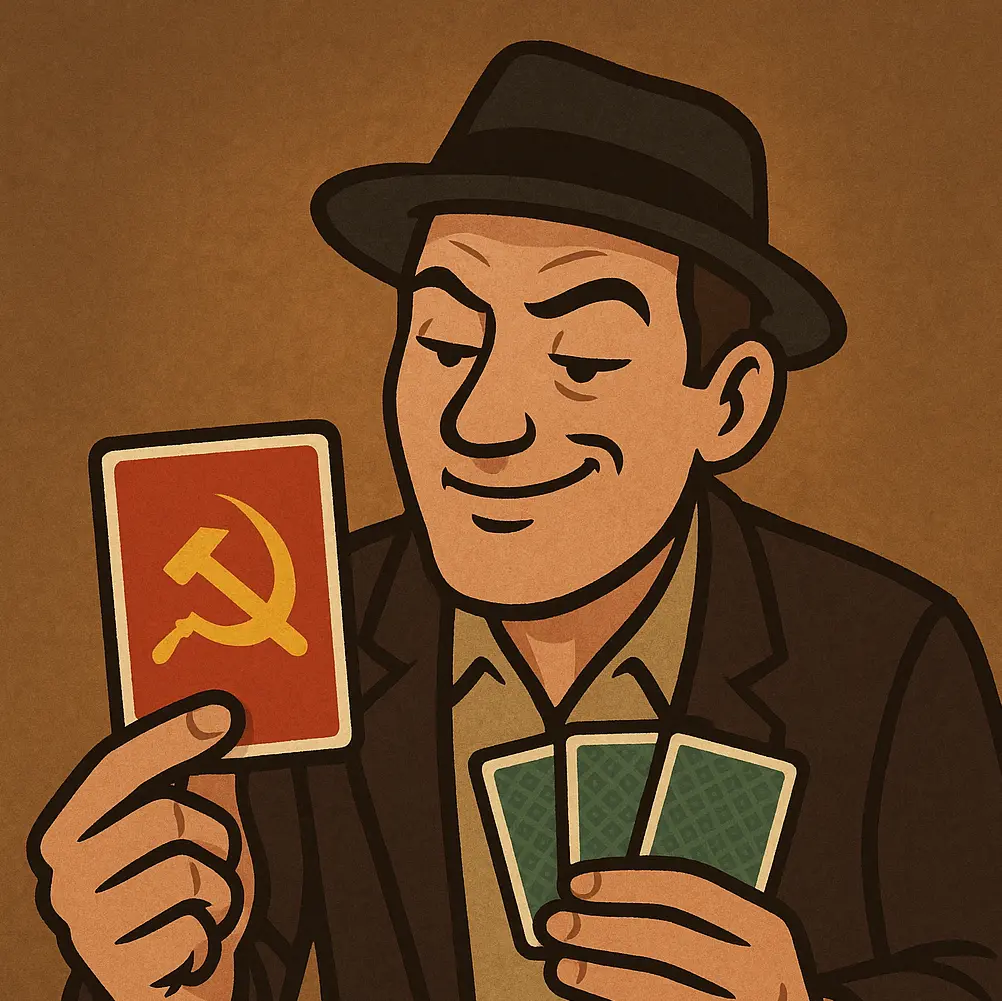
Mention that capitalism might have a few… catastrophic flaws — ecological collapse, wealth inequality, a tendency to consume everything in its path — and someone at the table narrows their eyes, leans forward, and slaps down a familiar, crimson-colored card.
“Oh, so you want communism then?”
Checkmate. Conversation over.
No need to discuss actual policy. No need to consider history, nuance, or alternatives. The mere mention of capitalism’s failings has triggered the defensive system — and the Communism Card has been played.
What Is the Communism Card?
The Communism Card is a rhetorical maneuver designed to shut down critiques of capitalism by lumping them in with the most dystopian, fear-loaded caricature of communism imaginable.
It goes something like this:
You suggest wealth caps? That’s Marxism.
You question private ownership of essential resources? Sounds like Stalin.
You propose a cooperative model for local governance? Might as well move to North Korea.
The tactic is rarely about communism itself. It’s about weaponizing the fear of authoritarianism, scarcity, and historical trauma to scare people away from even thinking about alternatives.
Why It Works
It works because it’s easy.
Capitalism is deeply embedded in modern Western identity. It’s marketed as synonymous with freedom, choice, and innovation. So anything that challenges it can be framed as the opposite: tyranny, restriction, and stagnation.
And let’s be fair — historical examples of state-communism have given plenty of ammunition. Soviet purges. North Korean isolation. Bread lines and secret police. It’s not hard to associate communism with suffering.
But here’s the thing: none of that has anything to do with what you were actually suggesting.
The Communism Card doesn’t engage with your argument — it simply projects a nightmare onto it.
Why It Fails
It’s intellectually dishonest. Suggesting a wealth tax or public healthcare is not the same as proposing a one-party state.
It ignores diversity. Not everything left of capitalism is communism — and not all communism looks the same either.
It suppresses innovation. If every alternative gets branded as “failed communism,” we never get the chance to explore new systems.
Worst of all, it prevents nuance — forcing every idea into a binary of “free market good” vs. “authoritarian communism bad.” This kind of false dichotomy is exactly what keeps us stuck in systems that no longer serve us.
What Gets Lost
When the Communism Card gets played, curiosity is the first casualty.
We lose the chance to explore:
Cooperative economics
Degrowth models
Resource-based economies
Participatory democracy
Hybrid systems that blend the best of multiple ideologies
All of these vanish the moment someone throws down the red card and says, “You’re just being unrealistic.”
How to Respond
So how do you counter the Communism Card without getting sucked into its trap?
Stay on topic. “I wasn’t proposing communism. I was questioning whether capitalism is working for everyone.”
Name the tactic. “That sounds like a deflection, not an argument.”
Invite nuance. “There are more than two systems in the world. Let’s explore the options.”
You don’t need to defend communism to critique capitalism. And you don’t need to be a utopian to want something better.
The Real Question
If our system is so great, why is it so afraid of being questioned?
Why is the mere suggestion of change met with panic, scorn, or accusations of treason?
If capitalism truly is the best we can do — shouldn’t it welcome comparison? Shouldn’t it thrive under scrutiny?
Or has it simply learned to play the game better — stacking the deck and silencing dissent before it can take shape?
Final Thought
The Communism Card isn’t just a fallacy — it’s a smokescreen. It disguises the real conversation we need to have with fear, ridicule, and false choices.
But we don’t have to accept the terms of that game. We can collect the cards. We can reshuffle the deck. We can deal ourselves back in — with new rules, new questions, and a refusal to fold under someone else’s illusion of certainty.
We live in an age where the line between genuine and fake is becoming alarmingly blurred. With online marketplaces like Amazon and eBay flooded with counterfeit goods—often poor-quality imitations from anonymous sellers—consumers are losing the ability to trust what they’re buying. You may think you’re holding a legitimate product, but it might just be a convincing fake. This isn’t just about getting ripped off—it’s about something deeper: a quiet erosion of quality, trust, and economic fairness.
1. The Saturation of the Market with Fakes
Counterfeit goods are no longer confined to shady back-alley dealers or sketchy websites. They’re on the front pages of major retailers. Anyone can set up a seller account and start listing items under familiar brand names, complete with faked logos, photos, and even fake reviews. From Shure microphones to Hakko soldering irons to Yamaha saxophone mouthpieces—I’ve seen these counterfeits firsthand, and it’s almost impossible to tell at a glance.
2. When Brand Names Stop Meaning Anything
A brand was once a seal of quality. Now? It’s little more than a decorative badge. Counterfeiters hijack brand recognition while delivering none of the quality. Even reputable retailers have unknowingly stocked fakes. Trust in brands is being systematically dismantled—and with it, the very purpose of branding as a concept.
3. Hidden Exploitation Behind the Curtain
Most counterfeits aren’t just cheap—they’re cheap for a reason. Many are produced in factories with little regard for worker safety, fair wages, or environmental standards. When we buy these items—often unknowingly—we’re indirectly supporting unethical labor practices and contributing to unsustainable global supply chains.
4. Normalizing Mediocrity
The more we’re exposed to fakes, the more they become the norm. Subpar performance, shoddy materials, and quick failures all become “just how things are.” This desensitization gradually lowers public expectations for quality across the board—and that bar may never rise again.
5. Quality Comes at a Price—A Higher One Than Before
To get the real deal now takes research, effort, and often a significant markup. Verifying a product’s authenticity often means ordering directly from the manufacturer or a highly vetted supplier, sometimes even importing from overseas. That’s time, effort, and money the average buyer might not have.
6. A New Form of Gatekeeping
When the only way to ensure quality is to pay more or jump through verification hoops, we start drifting toward class-based access to authenticity. The wealthy can afford the genuine article, while everyone else must settle for “close enough.” And when the tools you buy affect the quality of your work, this becomes a systemic disadvantage—where privilege quietly amplifies itself.
7. So What Can We Do About It?
This problem can feel overwhelming—especially when even trusted retailers are compromised. But while we may not be able to stop the tide of counterfeits alone, we’re not entirely powerless. Here are some steps that can help reclaim a little control:
Be a Skeptical Shopper Don’t trust a listing just because it has hundreds of positive reviews. Check for oddly worded product descriptions, low-resolution images, or sellers with inconsistent names and histories. Search Reddit, forums, or YouTube for authenticity comparisons when in doubt.
Buy from Authorized Dealers Whenever possible, purchase directly from the manufacturer’s website or an official distributor. Many brands have a ‘Where to Buy’ section listing authorized sellers. Yes, it might cost more—but it often saves more in the long run.
Choose Quality Over Quantity Rather than buying five cheap tools or accessories, invest in one solid item that will last. It’s a form of rebellion against disposable culture, and it’s better for your wallet (and the planet) in the long term.
Spread Awareness If you discover a counterfeit, speak up. Report it to the platform, warn others online, and share your experience. Your voice might prevent someone else from being duped.
Support Regulation and Accountability Push for greater platform accountability. These retailers have the resources to implement verification systems—they just need public pressure to prioritize them. Consumer movements and watchdog groups can make a difference over time.
Advocate for Fair Pricing Counterfeit culture thrives because authentic products are increasingly priced out of reach. The long-term solution must include making quality accessible, not exclusive. That requires systemic change, but acknowledging the issue is the first step.
In short:
We can’t shop our way out of this problem—but we can shop with more awareness, demand better from sellers and platforms, and help each other navigate the fog of modern consumerism.