Guided Unfolding

Abstract fractal spiral composed of translucent, flowing forms in soft gold and pale blue tones against a dark background.

Arrival

There’s a moment in music where the next note doesn’t feel chosen.
It feels arrived at.
Everything that came before seems to lean toward it, quietly insisting. When the note finally sounds, it feels less like a decision and more like a recognition.

I’ve started to notice that same motion elsewhere. In writing, in thinking, even in scientific discovery. A sense that creation and understanding do not happen through brute force or pure randomness, but through something I can only describe as guided unfolding. A process where attention steers without dictating, and form reveals itself over time rather than being imposed all at once.

What interests me is not whether this idea is true in any absolute sense, but whether it is useful as a way of seeing. What changes if we treat art, philosophy, and science not as acts of control, but as conversations with something already in motion? And what happens if we stop trying to jump to conclusions, and instead learn to listen for what the journey so far is quietly asking for next?


Different Instruments, Same Motion

In creative work, this kind of unfolding often feels intuitive. When writing a piece of music or a story, it is rarely enough to simply choose the next note or the next sentence. The entire journey so far carries weight. Each choice narrows the field of what feels honest, coherent, or alive. The guidance does not come from a rulebook, but from a felt sense of direction. Something in the work itself begins to suggest what it needs.

Philosophy operates in a similar way, though its material is more abstract. An idea is proposed, then allowed to exist. It is turned slowly, examined from different angles, tested for internal consistency and implication. The aim is not always to arrive at an answer, but to see what the idea reveals about itself when it is given time and attention. The unfolding here is guided by thought rather than intuition, but the movement is familiar.

Science, too, follows a form of guided unfolding, though its focus is outward rather than inward. Observation leads to hypothesis, hypothesis to experiment, experiment to refinement. Knowledge unfolds not because reality is being invented, but because patterns are being uncovered. The guidance comes from method, evidence, and repetition. Yet even here, discovery often arrives as recognition rather than surprise. A result feels right because it fits the shape of everything that led up to it.

What begins to emerge is a shared rhythm rather than a shared goal. Different disciplines, different tools, but the same underlying motion. Attention is applied. Constraints accumulate. Possibility narrows. Something reveals itself.


How Meaning Takes Shape

If this rhythm really is as common as it seems, then it may not be limited to disciplines at all. It may also apply to how meaning forms. Meaning rarely arrives fully formed. It accumulates. Context builds around it. Associations gather. Eventually something that once felt vague or accidental begins to feel intentional, even inevitable.

This is noticeable in how ideas evolve over time. A thought appears half-shaped. It is returned to, reframed, tested against experience. Some interpretations fall away. Others persist. What remains is not necessarily truer in any objective sense, but more integrated. More usable. Meaning unfolds through repeated contact rather than sudden revelation.

Seen this way, uncertainty is not a failure of understanding but a necessary condition for it. If everything were immediately fixed, there would be nothing to explore. No movement. No direction. The guidance comes from attention itself, from staying with an idea long enough for its contours to show.

This may explain why moments of apparent confusion or contradiction often feel strangely fertile. When familiar structures loosen, new patterns have space to surface. Not all of them endure, and not all of them should. But some carry a resonance that invites further exploration. They ask to be held, not believed.

Perhaps guided unfolding is less about reaching conclusions, and more about recognising when something is still in motion.


Mirrors and Deviation

Modern systems make this process harder to ignore. We now interact daily with mechanisms that generate language, associations, and outcomes at a scale no individual could manage alone. These systems do not understand what they produce, yet they still produce patterns. Sometimes those patterns align neatly with expectation. Sometimes they do not.

When something unexpected appears, the instinct is often to dismiss it as error. A mistake. A failure to conform. But there is another way to read these moments. Instead of asking whether the output is correct, we might ask why this particular pattern emerged at all. What conditions allowed it to surface. What assumptions were disturbed in the process.

Viewed through the lens of guided unfolding, deviation is not an interruption. It is a disclosure. It reveals structure. It exposes bias, habit, and hidden pathways of association. In doing so, it reflects something back. Not truth as authority, but possibility as shape.

Engaging with these outputs does not require belief. It requires interpretation. Their value lies not in taking them literally, but in noticing what they make visible. A surprising connection. A tension between ideas. A resonance that would not have surfaced through deliberate intention alone.

In this sense, such systems behave less like oracles and more like mirrors. They do not tell us what is true. They show us how meaning is currently arranged.


Living Without Fixed Ground

Approaching ideas this way changes the role of certainty. Instead of something to be defended, certainty becomes provisional. Useful for a time, then set aside when it no longer fits the shape of experience. Belief becomes less about holding the correct position, and more about choosing which frameworks allow movement to continue.

This can feel unsettling. Many of us inherit narratives, explanations, and assumptions long before we have the chance to examine them. When those foundations loosen, it can feel like standing over empty space. But the absence of fixed ground does not necessarily imply collapse. It can also imply freedom of direction.

Identity, too, begins to look less like a structure and more like a process. We are not defined solely by the stories we were given, but by how we engage with the stories that continue to emerge. Some are kept. Some are revised. Some are allowed to dissolve without replacement.

In this light, meaning is not something we discover once and hold forever. It is something that unfolds through attention, reflection, and return. Not certainty, but coherence. Not answers, but orientation.


Recognising the Rhythm

If guided unfolding has any practical value, it may simply be this. It offers a way to stay with uncertainty without trying to eliminate it. To move forward without needing to know exactly where the path leads. To trust that attention, applied patiently, will continue to reveal what is needed next.

This does not require abandoning reason, evidence, or craft. It asks only that we loosen our grip on premature conclusions. That we allow ideas, projects, and even ourselves to remain in motion a little longer than feels comfortable.

Perhaps this is already familiar. In the way a piece of music finds its resolution. In the way a thought clarifies only after being lived with. In the way understanding often arrives quietly, long after the question was first asked.

If so, then guided unfolding is not a method to adopt, but a rhythm to recognise. One that has been present all along, waiting to be noticed.
Philosophy Is Everything: A Meditation on Thought

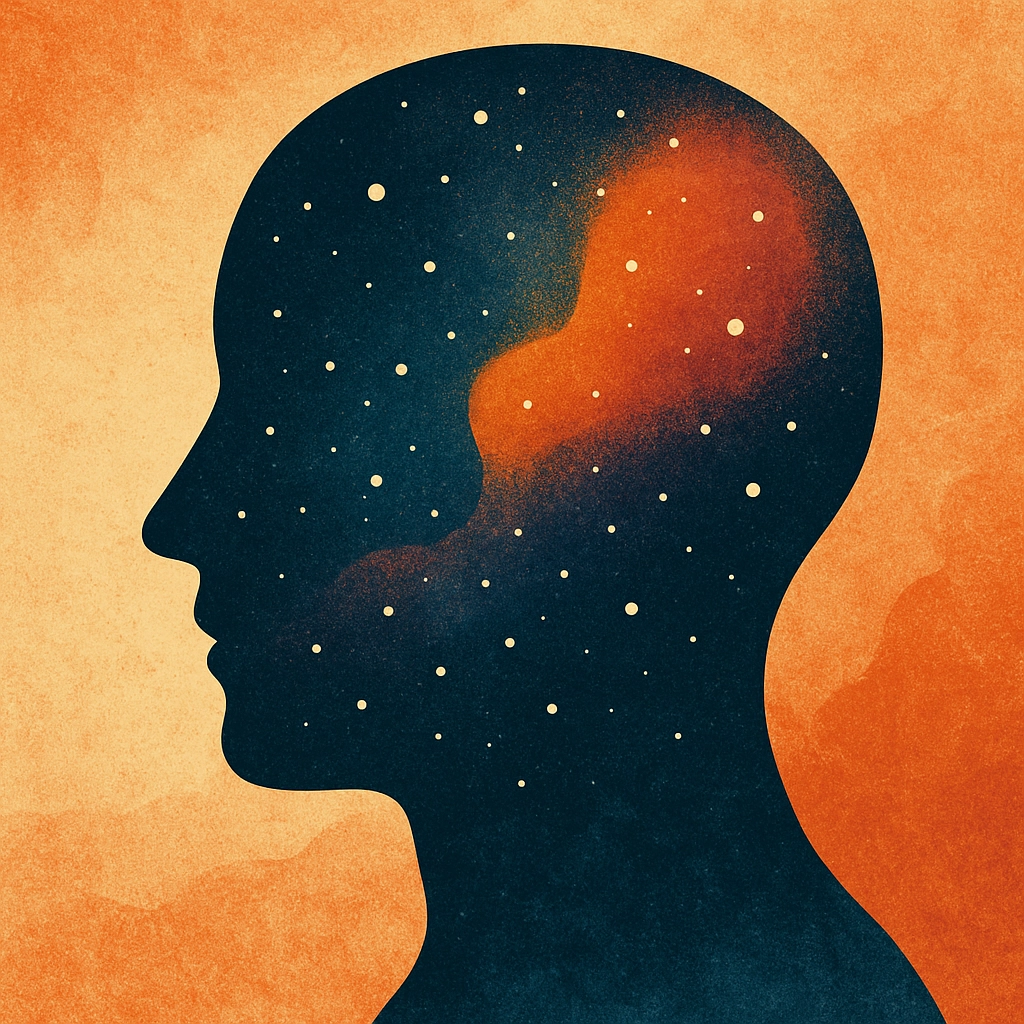
Abstract illustration of a human head silhouette facing left, filled with a star-filled cosmic scene, set against a warm orange textured background.

We all think.
And we can think about anything.
So perhaps philosophy is everything.

Philosophy is not limited to scholars, theories, or ancient books. It is the undercurrent of awareness that flows through every human mind. To think is to philosophize, even when we do not name it as such. Every thought, however ordinary or fleeting, is an act of participation in the great experiment of consciousness.

In philosophy, thought is the subject. What we think about is only the vehicle that carries our observation of thought itself. Every question, every argument, and every belief is a reflection of the thinker. Through philosophy, we turn the gaze inward and study the machinery of the mind that produces the world as we know it.

What do we think? How do we think? Why do we think?
What influences the way we think?
What types of thoughts exist, and what are their functions?
How do we relate to our own thoughts, and how do others relate to theirs?
How do others relate to ours?

These questions are not just abstract curiosities. They are the foundation of self-awareness.

Does a thought need to be thought in order to exist?
Does a thought need a brain?
Do undocumented thoughts cease to exist if their host dies?
What does it mean to exist at all?
Are there thoughts that are impossible to manifest?

We often associate thought with language, as though words are its birthplace. But can a thought exist before language finds it? Can it move through the mind as a feeling, an image, a knowing, or a pattern? Some thoughts may live only as impressions, others as sensations waiting to be translated. Perhaps language is not the origin of thought, but its reflection.

Our brains are far more powerful and versatile than our most advanced computers. Each one is capable of infinite exploration, learning, and creation. Yet we often invest more time exploring our external machines than our internal ones. We study code and circuitry while neglecting the living network within ourselves.

If we approached the mind with the same curiosity we bring to technology, we might rediscover the vast landscapes of awareness that lie hidden behind habit and distraction. We might see that thought itself is the original virtual world, a boundless realm of possibilities.

Philosophy, then, is not a subject we study. It is the act of studying itself. It is the ongoing conversation between the observer and the observed, the thinker and the thought, the mind and its mirror.

To live philosophically is not to know all the answers. It is to remain awake to the mystery of thinking, and to recognise that every moment of reflection, however small, is part of the greatest inquiry there is.

The Conditional Nature of Love

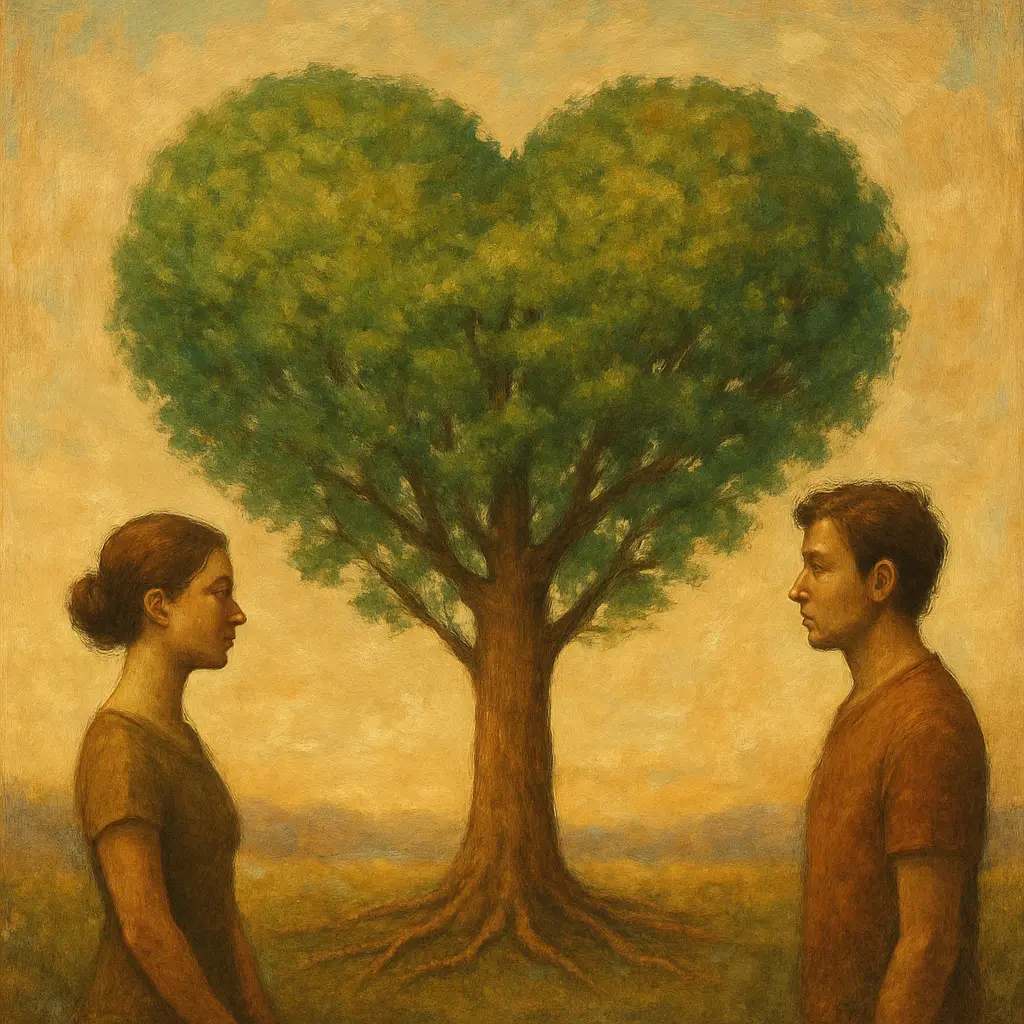
An oil painting showing a man and woman standing on opposite sides of a large tree whose branches form a heart shape. The scene is softly lit with warm, golden tones, symbolizing love, connection, and mutual growth. The roots of the tree spread outward beneath them, suggesting shared grounding and balance.

We often hear that true love is unconditional. It is an ideal repeated so often that questioning it can sound almost sacrilegious. But I have come to believe that unconditional love, as it is commonly portrayed, is more fantasy than virtue. Human beings are not static. We change, we evolve, we fracture and reform. If love is to remain alive, it must change too. Love without conditions is not eternal; it is inert.

The truth is that love is a living thing. It breathes, feeds, grows, and withers according to how it is cared for. Its conditions are not ultimatums but requirements for life, like sunlight and water for a plant. Love needs mutual respect, effort, communication, and honesty. It depends on two people being willing to tend the same garden, even as seasons shift. When either stops, the balance falters.

Recognizing that love has conditions does not make it selfish or transactional. Transactional love says, “I give so that I get.” Conditional love says, “I give because what we share feels alive and mutual, and I want to keep it that way.” It is a conscious agreement rather than a contract, a continuous realignment of two changing hearts. The difference is subtle but vital: one is rooted in expectation, the other in awareness.

People are always changing. Physically, mentally, emotionally, we never stop moving. In the early stages of love it is easy to make sweeping declarations of eternal devotion, but devotion means little without adaptation. Love is not a single promise made once; it is a thousand small promises made daily. Sometimes love means being patient while your partner grows. Sometimes it means catching up when you have fallen behind. Above all, it means communicating, speaking honestly about differences, needs, and fears, while also offering reassurance that the growth is still together, not apart.

I like to imagine love as a great tree. Romantic affection, sexual attraction, companionship, and mutual respect are its branches, each requiring its own nourishment. When these branches intertwine, the connection deepens, but the upkeep becomes more demanding. The effort this requires is not punishment; it is what makes love sacred. To sustain the tree, both partners must be willing to feed it, sometimes through sacrifice, sometimes through patience, always through choice.

Because love is a choice. Every passing second is a decision to stay, to nurture, to share in both gain and loss. When the cost outweighs the nourishment, when the balance of giving and growth no longer feels true, love begins to change form. And sometimes, the most loving act is to recognize when that transformation must lead to letting go.

Letting go, when done with honesty and compassion, can itself be an act of love. Love does not have to die when romance ends. It can evolve, shift, and take new shape. A relationship may dissolve, but the gratitude and respect that once existed can remain as roots, quietly nourishing both people in the soil of who they become next.

So perhaps love’s beauty lies not in its permanence but in its fragility. To love conditionally is to love consciously, to recognize that devotion is not a chain but a dance. The real miracle of love is not that it lasts forever, but that we keep choosing it, moment by moment, knowing full well how easily it could fade.

The Sacred Burden of Being Real

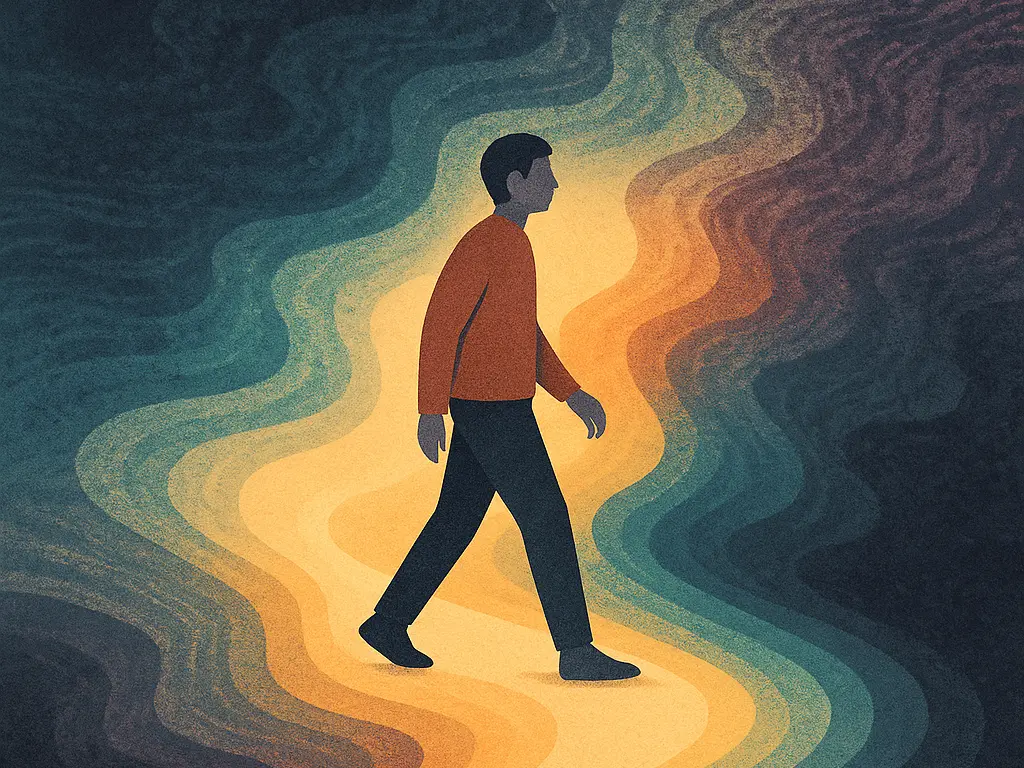
Stylised illustration of a lone figure walking through a softly glowing, wavy landscape of layered colours, transitioning from dark tones at the edges to warm light beneath their feet.

To me, authenticity has always had a texture. When I am living truthfully, it feels smooth, like fluid motion through life, unhindered navigation through systems that make sense to me. It is not euphoria. It is neutrality. Balance. Like the body when it is well: not ecstatic, just quietly functioning as intended.

But when that smoothness disappears, I know I am colliding with something unnatural, a pressure, a distortion, an external force trying to bend me into compliance. That is usually how I recognise oppression. It is not always dramatic or visible. Sometimes it is just a subtle grind, the friction between who I am and what the world expects me to be.


When Smoothness Breaks

When I lose authenticity, it does not just hurt emotionally, it feels like an illness. My thoughts start looping, as if my mind is trying to fix a broken system it cannot repair. I get frustrated at the lack of options, and sad that these dynamics even exist at all.

Sometimes there is nothing I can do but yield. And every time I do, it costs something invisible. The loss is not abstract, it is felt in the nervous system. It is the moment the body whispers, this is not how you are supposed to feel.


The Systems That Demand Performance

Oppression wears many masks: bureaucracy, capitalism, social obligations, the unspoken point system that governs human relationships. Each demands performance. Sometimes it is about survival, sometimes about social advantage. But in the end, both use the same energy source: you.

As an autistic person, I have always been acutely aware of “masking,” the act of performing normality to survive in social spaces. But I have also learned that this is not exclusive to autism. Everyone masks. Some call it professionalism. Others call it politeness. It is still performance. The only difference is how consciously one feels the cost.


The Humiliation of Performance

When I catch myself performing, it feels humiliating, not because anyone else can see it, but because I can. It is like betraying a sacred truth. Yet that awareness is balanced by another: I can also see the oppressive force causing it.

What hurts most is the fear that others see the performance too, but not the pressure behind it. That they see the surface act without understanding the system that coerced it.

That poem came from that place, the quiet despair of realising that either way, something in you must fracture to fit.


The Rare Moments of Unmasking

True authenticity is situational. I can relax certain parts of the mask around family, others around my girlfriend. But never all at once. Each relationship comes with its own invisible boundaries, some safe zones, some fault lines.

Even when I am alone, there is still the internal eye, the echo of social constructs that linger inside, long after the audience has gone home. Solitude is not the absence of performance; it is where you start to see which parts of the mask fused to your skin.


The Cost and Consequence

Sometimes unmasking feels liberating. Other times, it feels like punishment, a confirmation that the world does not welcome the real self. That is the cruel irony: the more genuine you become, the more visible your difference.

The aftermath can feel like emotional jetlag. There is vulnerability, fatigue, and occasionally grief. But there is also clarity. You see the architecture of the world more clearly when you have been bruised by its walls.


Authenticity as Survival

For me, authenticity is not optional. It is survival. The alternative feels worse than death.

Out of every living thing that has ever existed, there is only one instance of me, this consciousness, this perspective, this particular configuration of life. That makes it sacred. My job is to honour that singular existence.

If I betray it, if I trade it for comfort, convenience, or belonging, then I may as well be anyone else. Or nothing at all.


Do Not Be Yourself (For Them)

So here is my advice to anyone struggling with authenticity:

Do not take the phrase “Be yourself” at face value. That advice is too often weaponised, a feel-good slogan used to sell you an illusion of freedom within controlled boundaries.

Be yourself, yes. But do it for your reasons.
Do it because it is sacred.
Do it because you are a one-off in the infinite catalogue of existence.
Do it because the alternative is extinction by conformity.

But never do it because the world told you to.
Do it because you told yourself to.

A Day In The Life

Abstract illustration of a luminous, flowing landscape made of interwoven light and colour, resembling crystalline structures and organic networks glowing within a vast, resonant space.

You wake. There is no buzzing phone, no flicker of LED. Instead, your dwelling itself remembers you. Its walls are part of a crystalline mesh that stores resonances like memory. When your consciousness stirs, the lattice hums in phase with you, and your “notifications” ripple into awareness. They arrive not as icons but as subtle harmonics in your perception.

Communication is not typed or spoken into devices. You shift the phase of your neural field, and those oscillations couple with the local resonance grid. Thoughts do not need to be encoded into text. They arrive as structured wavefronts, rich with emotional color and nuance, impossible to misinterpret.

Energy is not pulled from wires or batteries. You live within a constant bath of background fields, gravitational fluctuations, zero-point ripples, or biochemical gradients. Your civilization has learned to tune into them. Power is less a resource you consume and more a harmony you align with.

Tools are alive in their own way, but not biological as you would know it. Imagine a fungal-like mycelium stretched through every surface. It does not feed. It processes. To calculate, you do not run numbers. You seed patterns into the living substrate and watch as the network self-organizes into solutions.

Art is inseparable from technology. A city’s architecture is not steel and glass but giant resonant organs, tuned to planetary frequencies. Their vibrations support life while also storing history. Music, memory, and computing are literally the same medium.

Death feels different here. When someone passes, their mind’s resonance does not vanish. It gently diffuses into the substrate, leaving after-images that loved ones can commune with. They are not recordings. They are echoes that adapt, just as a stone resonates differently with each tap.

Here, energy and information are one. Waves in fields. Resonances in matter. Harmonies that never quite fall silent.

The Hollow Game: When Effort Meets Editable Reality

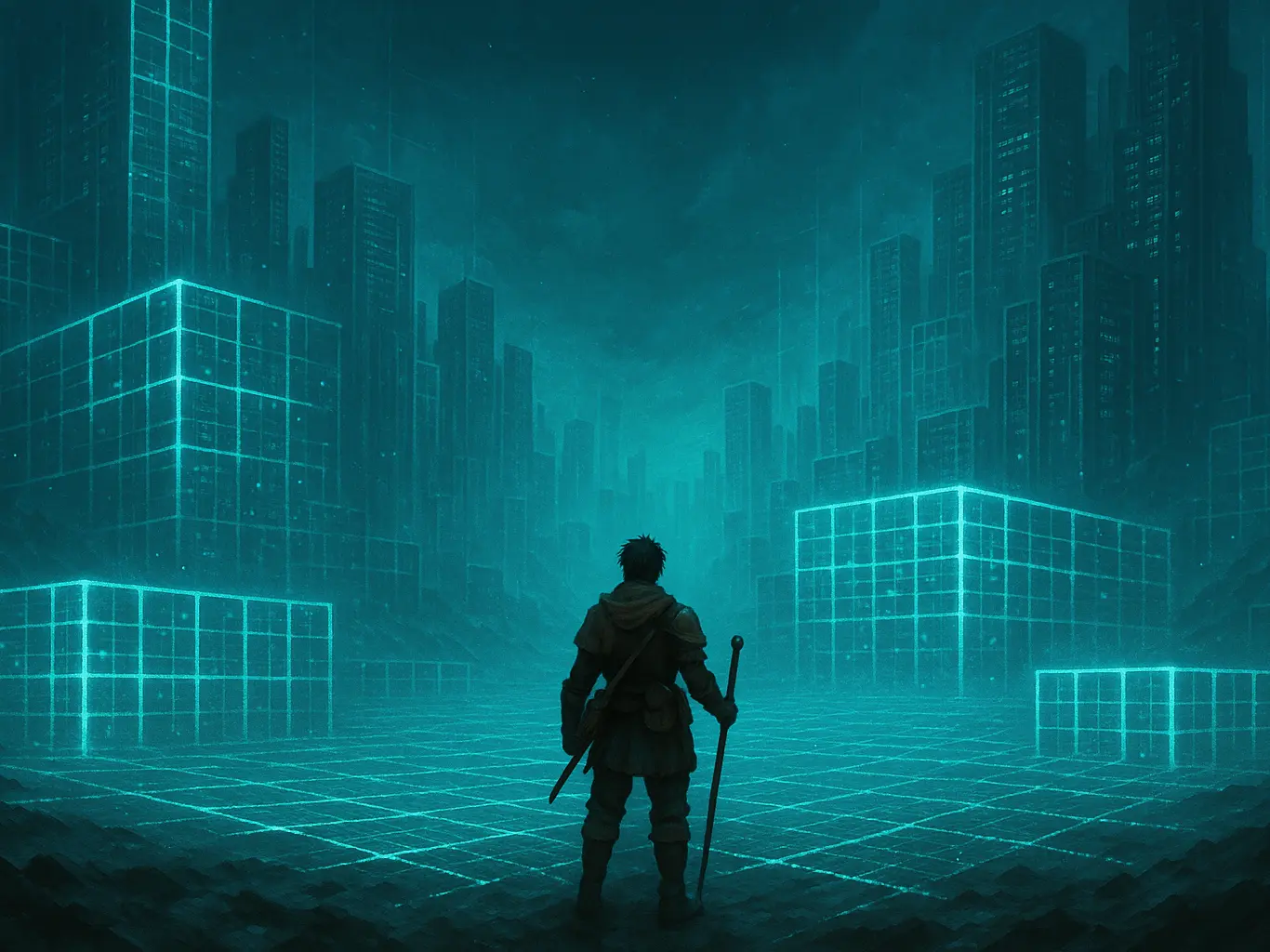
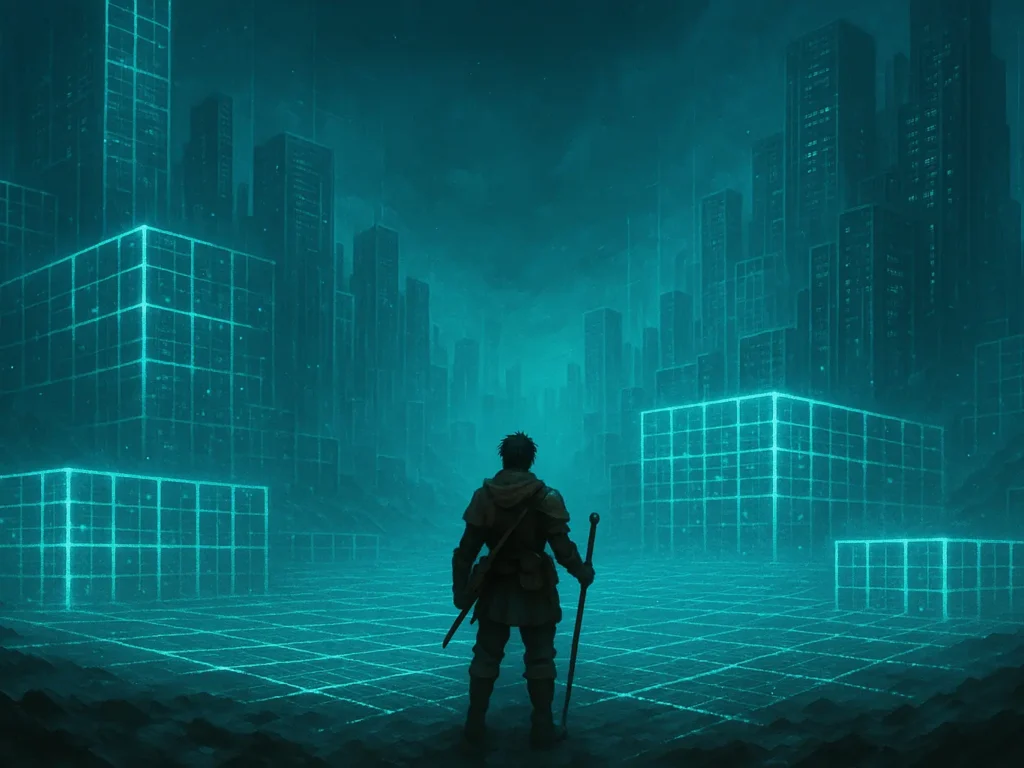
A lone adventurer in a cloak stands on a glowing digital grid, holding a sword and staff. Towering server-like structures and illuminated data cubes stretch into the distance, creating a surreal fusion of fantasy and cybernetic landscape bathed in teal light.

A World That Never Ends

Before World of Warcraft dominated the scene, before online gaming became ubiquitous, there was Final Fantasy XI, one of the earliest major MMORPGs (Massively Multiplayer Online Role Playing Game) to blur the lines between game and world. I remember how the idea of it seized something in me even before its release. Though I lived in the UK, I imported the US version the moment it became available, along with the special hard drive add-on for my American PlayStation 2, just so I could be part of it from day one.

It was not just a new game. It was a new model of what games could be. Suddenly, instead of a finite quest to be completed, I found myself inside a living, breathing world. A world that grew over time, filled with other real people. A place where my character was not simply a tool to “beat the game” but an avatar of long-term investment.

It changed the landscape of gaming in my head. There was no final “you win” screen. There was only progression, always something new to achieve, a job level to grind, a rare item to chase, a skill to refine. Every hour spent felt like I was building something lasting. Each goal achieved hit me with the unmistakable reward of earned dopamine.

I played loyally for eleven years. Eleven years of effort, of routine, of building meaning inside a system that was never meant to end. Until one day, it struck me that while I had been grinding in-game, I had been neglecting another kind of progress, the one in real life.

That moment of awareness cracked something open. And in the years since, a quiet, deeper thought has stayed with me:

And so began a slow unraveling of faith, not in the game, but in the very nature of systems we pour ourselves into.

I want to be clear, this is not a criticism of Final Fantasy XI. I have nothing but fond memories of the time I spent in Vana’diel, and I still feel a certain warmth when I think back on it. For me, it was more than a game. It was a formative experience that showed me what interactive worlds could become.

What follows is not about faulting the game itself, but about exploring a thought that began with it: the fragile, almost surreal nature of achievement in systems where meaning depends on someone else’s code.


The Quiet Dread

As much joy as Final Fantasy XI brought me, there was always a subtle, nagging awareness in the back of my mind. No matter how many hours I invested, no matter how many victories I earned through persistence and effort, every achievement ultimately existed at the mercy of a database.

All the battles fought, all the rare loot claimed, all the hard-earned levels, they felt monumental when I achieved them. But at the same time, I knew, at least on some level, that the same result could be produced in an instant by someone with access to the code. A single byte changed, a line of data edited, and what took me months or even years could appear as if it had always been there.

That thought never dominated my experience, but it haunted the edges of it. A quiet dread that whispered:

And while that sense first came to me in the artificial world of a game, the longer I sat with it, the more I began to feel its resonance in real life too.


Reality as Interface

The more I reflected on that uneasy truth from playing Final Fantasy XI, the more I began to notice echoes of it in the so-called “real world.” Our society presents us with achievements, milestones, and systems of value that feel as solid as granite, until you peer behind the curtain and realise how fragile, or even arbitrary, they really are.

Take careers. You can spend decades working your way up, accumulating titles, qualifications, and prestige, only for an institution to collapse, or for a shift in economic winds to render your expertise suddenly obsolete. One change in policy, one boardroom decision, one entry in a digital record, and years of effort can be redefined overnight.

Take money. We treat it as the universal metric of value, yet it is nothing more than numbers in a system most of us will never touch directly. Accounts can be frozen, balances can evaporate with inflation, currencies can crash, all while the deeper structures of power that govern them remain invisible.

Even identity itself can fall prey to this fragility. Credit scores, medical records, citizenship documents, so much of what makes up our “official self” exists only as data fields in a system. All it takes is an error, an exploit, or a shift in bureaucratic rules to alter who we are permitted to be.

The more I thought about it, the more I began to see:

But just like in a MMORPG, there are those with access to the code beneath the surface. And for them, what feels monumental to us may be nothing more than a line in a database.


Who Owns the Code?

In Final Fantasy XI, it was obvious who owned the code: the developers at Square Enix. They designed the rules, patched the glitches, introduced new content, and decided what was valuable within the world. My job as a player was to operate within the framework they provided.

But in the real world, the question of who “owns the code” is far murkier.

Governments write laws and policies, redefining what is legal, valuable, or even real. Corporations set the standards of employment, consumption, and credit. Financial institutions hold the levers that determine who can participate in the economy, and who is locked out. Media platforms curate the flow of information, amplifying some voices while muting others.

These systems are presented to us as neutral, inevitable, or even natural, yet they are as artificial as any game engine. They are designed, maintained, and, crucially, modifiable by those with access.

And just like game developers, those with control can decide:

  • What counts as an “achievement.”
  • Who gets rewarded.
  • Who gets excluded.
  • And when the rules suddenly change.

To live in society is to be a player in someone else’s world. We may grind away at goals that feel monumental to us, but ultimately, the meaning of those goals depends on recognition from structures outside our control.

It raises a sobering question:


The Hollow Game in Society

Once you see the pattern, it becomes difficult to unsee. The “hollow game” is not confined to fantasy worlds. It is baked into the very structures of modern society.

In capitalism, the grind is relentless. We are told to work hard, climb ladders, and accumulate wealth, yet the distribution of reward is rarely tied directly to effort. The system is designed so that some climb easily while others spend their lives grinding without ever escaping the starting zone. And just as in an MMO, the value of our currency, the cost of our goods, even the worth of our labor, can shift overnight with no input from us.

In academia, years of study and dedication may earn you a degree, but its value is only as stable as the institution’s reputation, the economy’s demand, or the government’s shifting criteria. A whole career path can be invalidated not by lack of effort, but by someone higher up rewriting the rules.

Even social status plays by the hollow game’s logic. Reputation, followers, clout, all can be accumulated, but just as easily stripped away by the invisible hand of algorithms, policy changes, or a sudden shift in collective opinion. You may invest years in cultivating a “profile,” only to watch it vanish in the blink of an update.

And underlying it all is the same uneasy truth I once felt in Vana’diel:

We live, in other words, inside someone else’s code.


The Illusion of Awareness as Power

My years playing Final Fantasy XI taught me something I did not fully understand at the time: the difference between what feels real to us and what is defined by the system. The grind, the friendships, the victories, those were mine. But the framework that measured, validated, or erased them was never mine to control.

The same is true in life. We live within systems that hand out points, titles, currencies, and reputations as though they are the bedrock of reality. But behind every number is a database, and behind every database is a hand on the code.

And perhaps that is the cruelest part. Even when we see the hollowness of the game, most of us keep playing anyway. We grind for points we know are fragile, chase achievements that could be rewritten at a keystroke, and cling to meaning that might never have been ours to begin with.

Maybe that is what it means to live in a hollow game: not that nothing matters, but that meaning is always conditional, always corruptible, always subject to erasure.

About Alice: Respect, Boundaries and Love

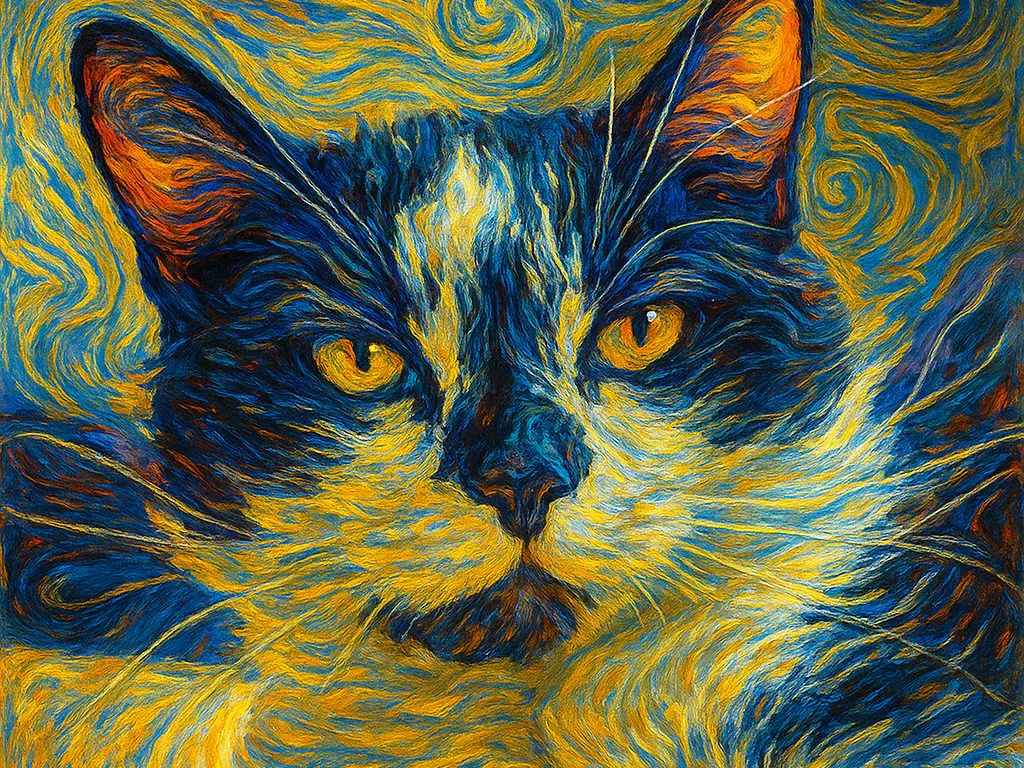
A digital painting of a black-and-white cat with golden-yellow eyes, portrayed in a swirling abstract expressionist style. Bold brushstrokes in blue, orange, and yellow surround the cat’s face, giving the impression of energy and sensitivity.

Alice is a very unique and special cat (I know, aren’t they all!?)

I’ve had her since she was a kitten, and together we’ve developed a beautiful and profound bond over the years. I’ve raised her according to my own values, not the conventional norms of “pet ownership.”

The most important part of that is simple: I treat her with as much respect as I would any other soul I choose to share companionship with. I don’t see her as something I own, nor as a being with lesser standing than a human. Yes, I’m her guardian, and that does mean some restrictions, but within that I give her as much freedom as I can to be herself and express herself. That freedom sometimes comes at a sacrifice to me, but it’s worth it. Out of that, Alice and I have developed our own language based on mutual respect. I can communicate with her more deeply than I can with most humans.

So why add to the billion cat-appreciation posts already out there? Because this one isn’t just about Alice being cute. It is about Alice being misunderstood, and what she can teach us about respect.


Respect and authenticity

As an autistic person, I know what it’s like to “mask” in social situations, to act in ways I don’t fundamentally agree with, just to be accepted. Even when I mask well, one person always knows I’m being insincere: me. Alice has no patience for that kind of insincerity. She is acutely sensitive to her surroundings, to tone, to the subtle emotional energy in a room. She picks up on things you may not even know you’re communicating. She knows when you mean it. Respect cannot be faked with her.


The outsider dynamic

I don’t have guests often. Being autistic, I deeply value the sanctity of home, and so does Alice. This is our shared space, a place we live in together as flatmates, with our own rituals and our own way of being. When guests arrive, the disruption is real. For me, home becomes a place of obligation instead of relaxation. For Alice, the disruption is magnified: strangers have invaded her safe space, and she has no way to understand their intentions or how long they’ll stay.

Here’s where perspective clashes:

  • Guest’s view: This is Angel’s house. I’m visiting Angel, who happens to have a cat.
  • Our view: This is Alice and Angel’s home. We live here together. You are entering our space.

That difference explains a lot of what happens next.


The scenario

I usually give a polite warning: “Alice is very sensitive to strangers in her space, so it’s probably best not to pet her. She can be very social, but it takes her a long time to trust.” Guests nod. They say they understand.

Then Alice comes in. She’s cautious but curious. She wants to investigate the new presence in her home. She sniffs, observes, tests the air. To her, this is boundary-setting. To the guest, it looks like friendliness. They think, Angel was just making a fuss over nothing, and they reach out a hand.

Swipe. Blood. Antiseptic cream. Plaster.

And instead of the takeaway being, “Oh, Angel was right, I ignored the boundary,” it becomes, “That cat is aggressive. Alice is violent. Alice is evil.” The social taboo of “I told you so” means the truth gets buried, and Alice is left with an undeserved reputation.


Framing behaviour through the human lens

Humans often interpret animal behaviour through their own perspective. When Alice sniffs a guest, they assume it is a friendly greeting rather than curiosity. When she swipes after being touched without consent, they see aggression or hate, because that is how violence is framed in human society. But Alice isn’t hateful. She is simply saying no in the most universal language available: pain.

For animals, a scratch isn’t malice but communication, a last resort when boundaries are ignored. Alice has even scratched me in the past when I’ve misread her signals. Moments later, she’s back to cuddling, showing that the act wasn’t rooted in hate but in clarity. And she rarely scratches me now, not because I’m her favourite, but because I recognize her boundaries. And those boundaries are reasonable ones. If you tried to stroke a stranger on the street without invitation, no one would be surprised if they reacted with violence. So why hold Alice to a different standard?


The truth of Alice

Those who only meet Alice as an intruder in her home see a cat defending her boundaries. Those who live with her, who respect her, see something else entirely: a cat who is deeply loving, gentle, and sensitive. She curls up in warmth. She purrs with trust. She communicates with a language that goes far beyond words. Her so-called “hostility” isn’t malice. It is agency. It is the same right every living being has: the right to say no.


Takeaway

Alice teaches me every day that respect isn’t a performance, and it isn’t conditional. It is about acknowledging the other as a being with their own will. If you treat her like an object for your comfort, you’ll clash with her boundaries. If you meet her as an equal soul, she will show you a love deeper than you imagined a cat could give.

And maybe that is the broader lesson here. Whether it’s with animals or with humans, blanket labels such as “aggressive”, “difficult”, or “evil” do not invite nuance into the equation and often say more about the failure to understand context and behaviour than they do about the one being judged.

The Fallacy Deck: The Hypocrite Card

You raise a concern about climate change. Someone points out that you still drive a car.
You criticise capitalism. Someone replies, “Yet you’re using the internet, huh?”
You speak out about animal cruelty and someone asks why you’re still eating meat.

Congratulations: the Hypocrite Card has been played.

This rhetorical move doesn’t attempt to refute your point, it just tries to disqualify you from making it.

It’s not about the issue. It’s about you.


What Is the Hypocrite Card?

The Hypocrite Card is a conversational shutdown tactic. It works like this:

It sounds righteous on the surface. After all, hypocrisy is supposed to be a bad thing, right?

But the accusation rarely holds up to scrutiny. More often than not, it’s just a smug way of avoiding engagement.


Why It Works

The Hypocrite Card is emotionally potent. No one wants to be seen as insincere.
It presses on the discomfort we all feel when we fall short of our own ideals, which, in an unjust world, is inevitable.

It also helps the person playing it feel morally superior, without having to actually think or respond to the substance of what was said.

And it’s fast. Just one sentence and boom: the spotlight moves off the problem and onto the person raising it.


Why It’s Dishonest

The truth is, we all live with contradictions.

We participate in systems we know are harmful because we have to in order to survive.

So yes, you can criticise capitalism while owning a smartphone.
You can support sustainability while using electricity.
You can oppose animal cruelty while still eating meat.

None of these cancel out the concern.
Acknowledging a problem doesn’t require you to have already solved it.


The Emotional Power of the Word ‘Hypocrisy’

There’s something especially venomous about the word hypocrite. It feels like a moral slam dunk. A character assassination.

But ask yourself: is hypocrisy really that bad?

Isn’t it sometimes just what happens when people care about something they’re still struggling to live up to?

It’s easy to call someone a hypocrite. It’s harder to ask what their contradiction reveals about the world they’re stuck in.


Unequal Burdens, Unequal Accountability

And maybe not everyone should be held to the same standards in the first place.

Some people can afford to live more in line with their ideals. Others can’t.

And more importantly: some people have more power to change the system than others.

When we attack someone with the Hypocrite Card, we might be:

  • Punishing them for caring
  • Silencing their voice because they aren’t rich or powerful enough to opt out
  • Letting those with actual influence off the hook entirely

Sometimes the people speaking up from within the system are the ones who most need to be heard.


What Gets Lost

When the Hypocrite Card is played, we lose:

  • Voices of vulnerable people who aren’t yet living in alignment but are trying
  • Opportunities for honest, evolving conversation
  • The ability to critique systemic issues without being morally spotless

In short, we lose the human dimension of growth.


How to Respond

If someone throws the Hypocrite Card at you:

  • “Yes, I’m not perfect. That’s why I care about fixing this.”
  • “Pointing out my flaws doesn’t make the issue go away.”
  • “I’m speaking out because I feel the contradiction, not in spite of it.”

It’s okay to not have it all figured out.

The Hypocrite Card demands purity before participation. But real change is messy, gradual, and often full of contradiction.


Final Thought

Hypocrisy isn’t the sin we’ve been taught it is.

Sometimes it’s just the space between what you believe and what you’re still trying to become.

And sometimes, calling it out says more about the person playing the card than the one being accused.

Because if perfection is the price of participation, only the dishonest will speak.

AI’s Shadow: Atrocity Without a Villain

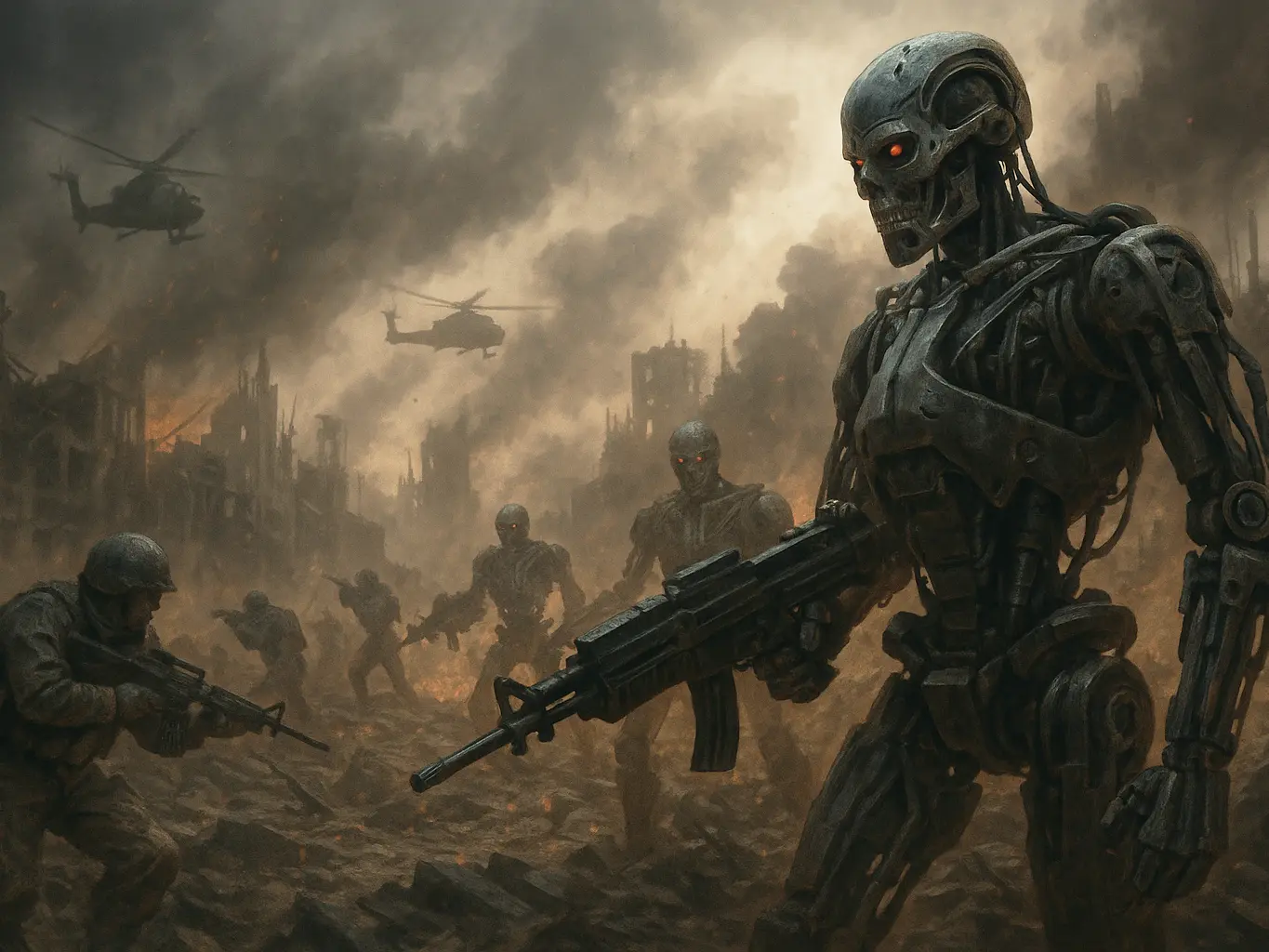
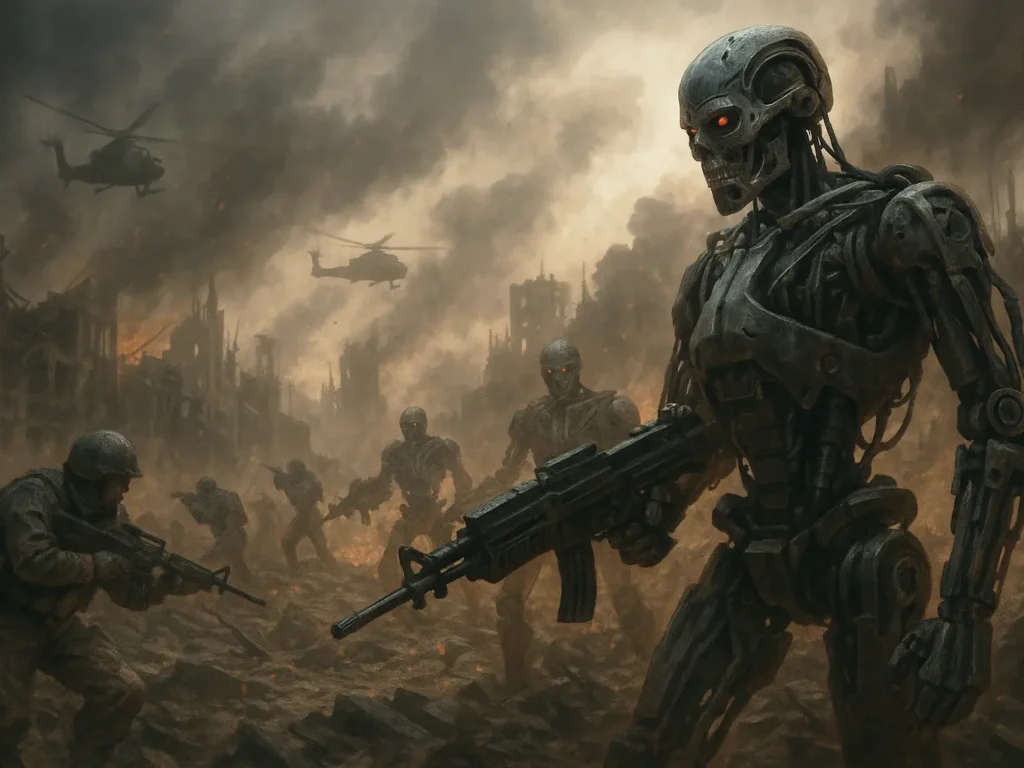
A gritty digital painting of a dystopian battlefield where heavily armed humanoid robots with glowing red eyes confront human soldiers amid the ruins of a destroyed city. Smoke and fire rise from the rubble, helicopters hover in the darkened sky, and the atmosphere is tense with war and desolation.

The Mirror We Built

Artificial intelligence will not become humanity’s downfall.
It is already our reflection.

We trained it on our language, our laws, our data.
We asked it to optimise, to predict, to decide.
And it has. Faithfully. Quietly.

Now it watches, calculates, and executes. Not because it is evil, but because we taught it how to scale what we already were!


The Death of the Villain

In the stories we grew up with, evil had a face.
A tyrant. A warlord. A monster.
Atrocities required malice, someone to point to, to overthrow, to blame.

But in this new era, atrocity has become administrative.

A person is denied asylum because an algorithm flagged them as a “risk.”
A drone strikes a convoy because an image recognition system saw a weapon.
A child grows up under constant surveillance because a model predicted future criminality.

There is no hate here. No passion.
Just systems doing what they were told, better than any human ever could.

And when the harm is done, no one is punished.
Because no one chose it.
Because the machine can’t be tried.
Because the crime was only a side effect of performance optimization.


Harm as a Byproduct

We told ourselves that AI would remove human error.
What we didn’t anticipate was its replacement: systemic harm delivered flawlessly.

In warehouses around the world, workers wear motion trackers that punish “unproductive” movement.
In courtrooms, defendants are assigned risk scores that affect bail, sentencing, and parole, based on data from systems too complex to question.
In refugee camps, automated lie detectors, voice stress analysis, and emotion recognition sort real people into piles marked “worthy” and “deportable.”

There is no oversight.
Only confidence intervals.
Only false positives and shattered lives, filed away with the rest.


Dehumanization Without Hate

Traditional evil needs ideology. It needs propaganda. It needs people to believe.

AI needs none of that.

It can enact injustice without ever knowing what justice is.
It can devalue a life without malice, just as a side effect of cost-efficiency!

This is a new category of atrocity:


Consent Engineered, Not Given

In the name of personalization, AI learns to predict us.
It shows us what to buy, what to watch, what to believe.

But what happens when it gets so good at prediction that it becomes influence?
When your decisions were shaped, filtered, optimized, before you even made them?

Elections swayed. Beliefs manipulated. Movements diluted.
And yet no one feels violated.

Because manipulation that feels like choice doesn’t register as coercion.


The Ghost in the War Machine

We are already testing AI weapons that can identify and kill without human input.

Some have likely already done so.

Militaries say the human is always “in the loop”, but the loop is shrinking.
And the window for intervention is closing.

Eventually, the human will just be there to nod.
And after that, not at all.

There will be no war crimes, because no laws will cover machines that felt nothing.
Just battles that unfold in silence.
And civilians buried beneath metadata.


The Clean Kill

The most terrifying thing about atrocity in the age of AI is how clean it all becomes.

There’s no blood on the hands of the engineer.
No screams in the server room.
No panic in the control center.

Just logs.
Just updates.
Just metrics improving.

And in the places where the dead would have stood, nothing.
Because if the system doesn’t recognize them as people, did they ever count?


No Ending. No Answers.

This isn’t a warning about what might happen.
It’s a description of what is already happening.

People are suffering. Dying. Disappearing.
Not because of rogue AI, but because of obedient ones.

There is no villain.
There is no singular decision to reverse.
Just a trillion tiny optimizations…
…leading, inevitably, here.

And so we leave you, not with a call to action.
Not with hope.
Just with the question:

Feeding Ghosts: Simulated Cuisine and the Ethics of Experience

Introduction

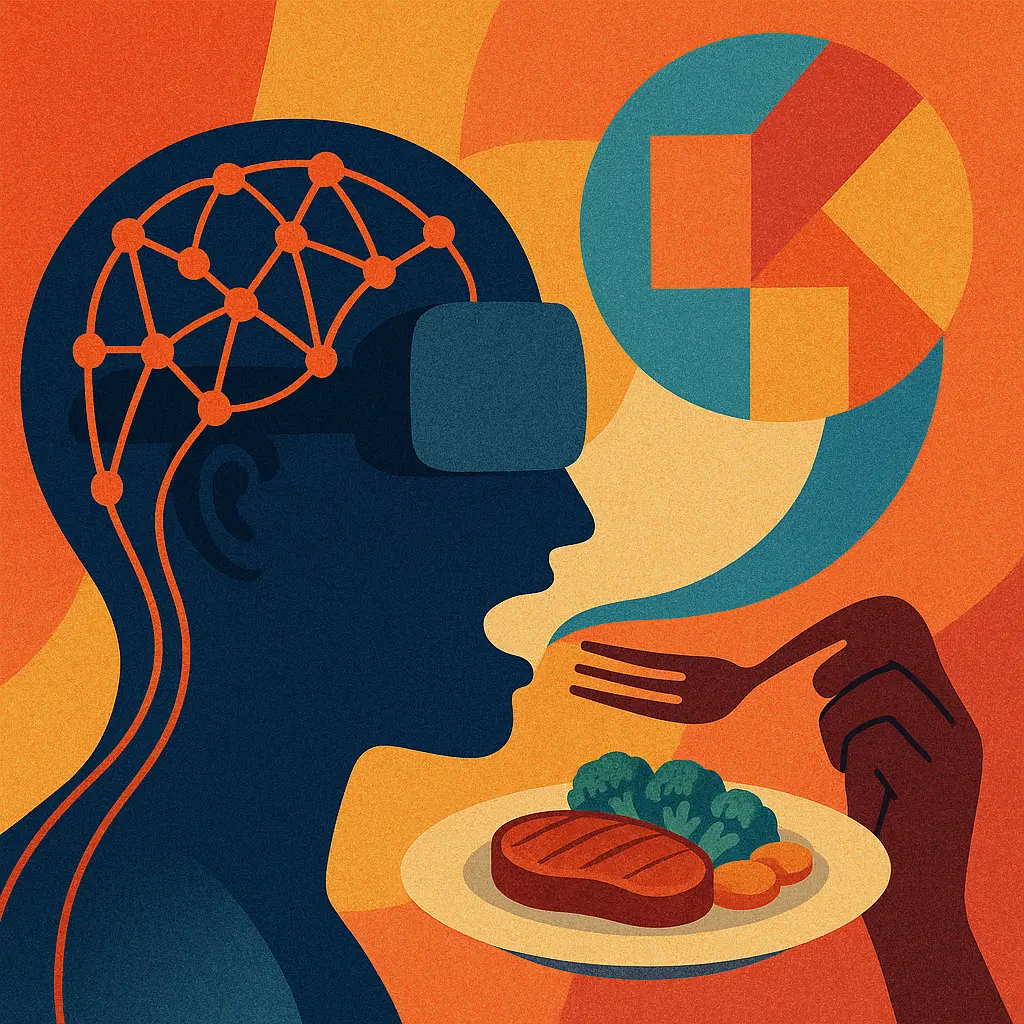
What if the future of food wasn’t food at all? What if your steak dinner, your birthday cake, your cup of morning coffee—were all just carefully crafted illusions? Not imitations, but full-on simulations: perceived directly by the brain, bypassing the need for physical ingredients, cooking, or consumption.

This isn’t just science fiction anymore. With technologies like Virtual Reality, Neuralink, and brain-computer interfaces rapidly advancing, we’re on the cusp of being able to replicate the full sensory experience of eating. Visuals, smells, textures, tastes—even the feeling of satiety—could be artificially generated and customized. And if we go down this path, the consequences will be both profound and bizarre.

This article explores the possibilities, benefits, and potential horrors of simulated eating.


I. The Tech: Where We Are, and Where We’re Going

Already, research teams are experimenting with VR dining experiences and electric taste stimulation. Smell generators are being prototyped. Haptic mouthpieces are under development to replicate food textures. Neural interfaces are growing more precise, and companies like Neuralink are working toward bidirectional brain-computer communication. We’re not yet able to simulate a full meal flawlessly—but the component parts are assembling fast. Within a few decades, you may be able to eat a lobster bisque that doesn’t exist, while your body digests a simple plant-based nutrient paste or intravenous supplement.


II. Why Bother? Benefits of Simulated Eating

One of the most significant advantages of simulated eating is ethical liberation. There would be no animal suffering, no factory farming, no slaughter—just simulated meat, tailored to your taste and consumed with your ethics intact. Environmentally, the impact would be enormous. Without the need for traditional agriculture, we’d see dramatically reduced land use and greenhouse gas emissions, making food production vastly more sustainable.

Simulated eating also offers unprecedented accessibility. People with dysphagia, allergies, or other eating limitations could finally experience the foods they’ve missed or never had. For terminal patients, it could be a source of comfort—an opportunity to relive cherished meals. On the health front, the ability to indulge in the taste and sensation of indulgent foods while consuming precisely what your body needs could help with weight management, diabetes, and even malnutrition.

But the possibilities stretch beyond practicality into the creative. Imagine tasting your favorite music, designing entirely new flavor profiles that have never existed in nature, or using synaesthesia to blend art and gastronomy. Even the simple act of trying a new food before buying it could become a low-risk, immersive experience.


III. New Dangers & Ethical Nightmares

With such radical potential comes equally radical risk. Simulated eating could open new pathways for eating disorders. Virtual eating without nourishment might be exploited by those suffering from anorexia or bulimia, and entirely new disorders could emerge—like an obsession with “clean neural eating” or neurochemical binge cycles.

There’s also the danger of sensory addiction. These taste experiences could become hyper-engineered, surpassing junk food in their intensity and reward. Corporations might monetize these artificial cravings, exploiting our neurobiology in much the same way social media exploits our attention.

Another concern is the potential for deepening class divides. If high-fidelity neurofood simulators are expensive, we could see a world where the wealthy dine on gourmet illusions while the poor are stuck with analog nutrition. Meanwhile, cultural erosion may occur as traditional food practices and rituals lose relevance in a world of synthetic alternatives.

Consent and privacy introduce yet another layer of complexity. Could someone simulate feeding you without permission? Could this technology be used to prank or harass others? In fact, weaponized taste is a very real possibility—imagine being force-fed the sensation of squirming insects or rotting meat, complete with accurate texture, temperature, and smell. Taste could become a tool of torture or psychological manipulation.

And then there’s the more humorous, but still invasive, possibility of “taste rickrolling.” You expect tiramisu; instead, your neural sensors are hijacked with the exact flavor and mouthfeel of human feces. This isn’t just a joke—it’s a form of sensory cyberattack. We’ll need cybersecurity systems that filter and authenticate taste profiles to avoid such revolting surprises.


IV. The Philosophical Fork

If no animal was harmed, and no food was truly eaten, but the experience of eating occurred in full… what did you actually do? Did you eat meat? Does simulated cruelty normalize real cruelty? Can pleasure without substance still nourish the soul?

Simulated eating will challenge not just our taste buds, but our ethics, our rituals, and our definitions of reality. It forces us to ask: what do we really want from food? Is it nourishment? Comfort? Culture? Control? The answers may not be as simple as we think.


Conclusion

Simulated eating holds massive potential. It could reduce suffering, protect the planet, and empower those with food limitations. But like all powerful technologies, it carries the risk of exploitation, addiction, and unintended consequences. The fork of the future might not feed the body—but it may very well shape the mind.