Reclaiming Empathy as a Tool for Understanding, Not Excuse
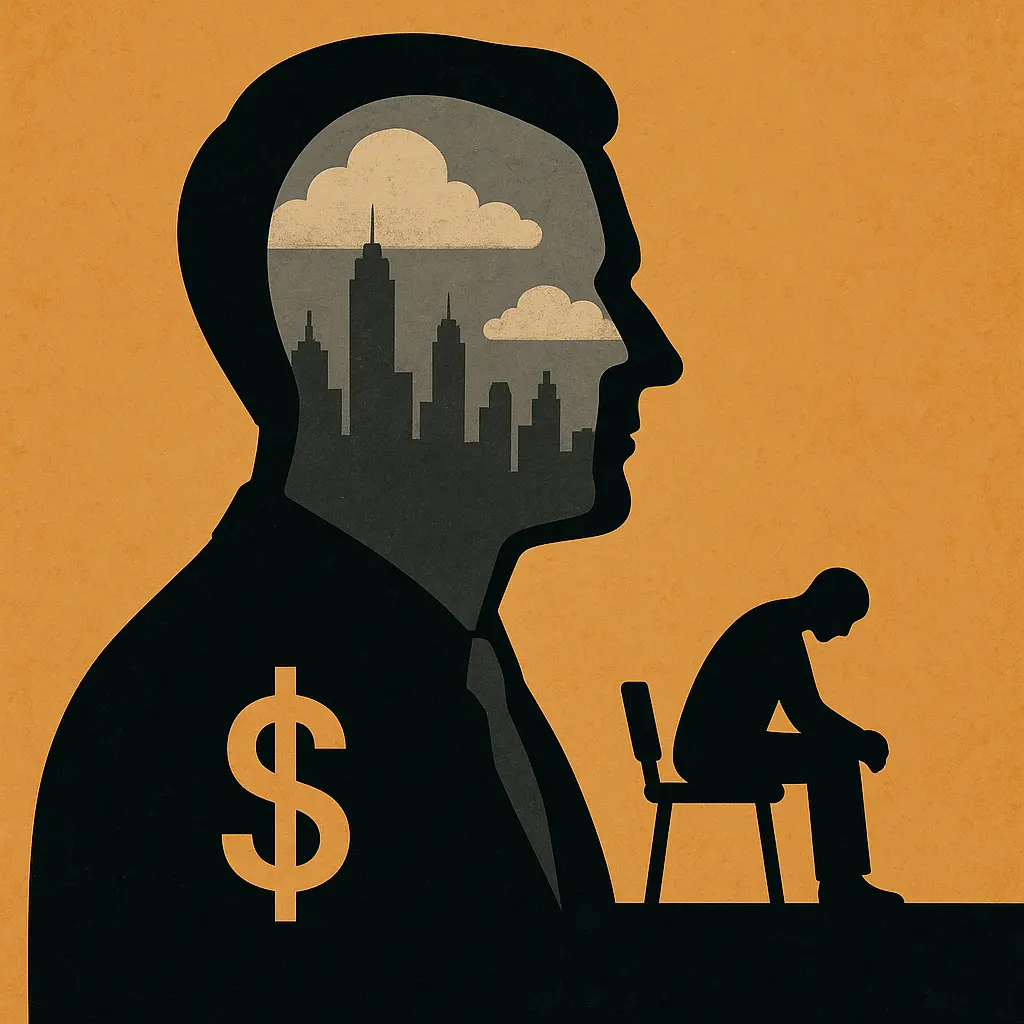
Let’s get the obvious out of the way first: No, billionaires do not need your sympathy. They’re not starving. They’re not being evicted. They’re not deciding between heating and food. So, should we feel bad for them? No. That’s not what this is about.
But that’s the trap, isn’t it? When we hear the word empathy, we often hear sympathy — as if empathy means letting someone off the hook, or feeling sorry for them. But empathy isn’t about deciding whether someone’s life is hard enough to deserve our concern. It’s about trying to see how they experience the world — and what that might teach us.
And when it comes to billionaires, there’s a lot to learn.
Empathy ≠ Sympathy
Empathy is the capacity to understand the state of another mind. It doesn’t mean agreeing, condoning, or comforting. It means observing, listening, inferring — without letting our emotions cloud the process.
Sympathy is emotional. Empathy is perceptive.
We tend to empathise most easily with those who suffer in ways we can relate to. But this leaves out entire swaths of human experience — including the very people who shape our economies, our policies, our futures. Understanding them isn’t an act of kindness. It’s an act of awareness.
Inside the Billionaire Psyche
Here’s the thing about billionaires: they are still human. We might like to think of them as cartoon villains, hoarding gold and twirling mustaches — but that’s a convenient simplification. Real people are messier. More conflicted. Often unaware of their own contradictions.
What drives someone to accumulate more wealth than they could ever need? What fears or beliefs keep them doing it? What worldview do you have to adopt to justify stepping over others to get there — or to sincerely believe you’re helping?
We don’t have to like the answers. But we do need to ask the questions. Because without understanding, we can’t meaningfully respond.
Dehumanisation Is a Blunt Instrument
When we reduce billionaires to monsters, we make them less real — and in doing so, we rob ourselves of clarity. We miss the psychological patterns, the system enablers, the personal histories that created them.
Yes, they may live in gated communities, surrounded by yes-men and soft lighting. But that doesn’t mean they’re free of fear, self-deception, or trauma. They just have the money to cover it in designer fabric.
Dehumanising them doesn’t dismantle their power. It just stops us from seeing how that power actually works.
Empathy as Strategy, Not Surrender
So no, we don’t owe billionaires forgiveness. But we do owe ourselves insight. If we ever want to redesign the system — or even just survive it — we have to understand the people at its apex. Not mythologise them. Not moralise. Understand.
Because once we see clearly, we can begin to respond intelligently. Strategically. Even subversively.
Empathy is not a soft virtue. It’s a sharp tool — one that can carve through illusion and reveal the truth beneath.
Final Thought
Empathy is not a tool for sympathetic evaluation. It is a tool for our own understanding.
It’s a question people often ask in hushed tones, as though admitting it would mean something is wrong with them. Therapy still carries the weight of stigma: the idea that it’s only for the broken, the unstable, the ones who can’t cope.
But what if that assumption is completely wrong?
What if therapy isn’t about being broken at all?
What if it’s about being curious?
Therapy as Exploration, Not Repair
For me, therapy has always been exciting on an explorational level. Not a punishment, not a fix-it shop, but a space to dive deep into questions I didn’t even know I was carrying. To sit with thoughts long enough that they unfold into something new.
It’s like turning inward with a magnifying glass, not because you’re afraid of what you’ll find, but because you want to understand it. You want to witness your own landscape.
That process isn’t exclusive to people in crisis. It’s for anyone brave enough to look.
There Is No Such Thing as 100% Mentally Healthy
I don’t believe in the idea of a fully healthy mental state. Not in the way society tends to frame it.
Health is a construct — shaped by culture, by diagnostic frameworks, by invisible lines that shift depending on who’s drawing them. What’s considered ‘well-adjusted’ in one context might be totally maladaptive in another.
We all carry blind spots, contradictions, inherited patterns. Therapy isn’t about clearing them out to become some sterile ideal. It’s about meeting them. Mapping them. Understanding what they are and how they formed.
That alone can be life-changing.
So… Do You Need Therapy?
Maybe not. Not in the way people usually mean it.
But maybe that’s the wrong question.
If you feel stuck, curious, conflicted, overwhelmed, numb, lost, or even just ready — therapy can be a gift. It can give you space to explore yourself without judgment or interruption. A mirror, not because you’re ugly, but because you want to see clearly.
And sometimes just the act of looking begins to heal.
Closing Thought
Maybe therapy isn’t for everyone — not because they don’t need it, but because it takes courage to sit with your own reflection. To go beneath the surface and ask, what’s really here?
But if you’re willing to do that, even a little bit… you might find more than just clarity.
And I used to believe that meant something was wrong with me. That I was unstable, threatening, or too much to handle. But I’ve come to realize something quietly powerful:
They were right.
Not because I’m violent. Not because I’m malicious. But because I see through the lies. I refuse to pretend things make sense when they don’t. I question rules that serve no one. I notice manipulation that others are too polite to acknowledge. I don’t respond the way I’m “supposed to.” And that makes me dangerous — not to people, but to systems.
To employers who want obedience without question. To schools that value quiet compliance over curiosity. To social environments that punish authenticity. To any structure built on pretending.
Autism isn’t a failure to understand society — it’s a refusal to play along with what is obviously untrue. And when you stop trying to contort yourself into the shapes demanded by others, they often react with fear. Or worse, pity. But sometimes, even fear disguised as pity.
I used to think that being strong meant fighting back. Now I see that strength is not being absorbed by the adversity at all. To stand at the eye of the storm — not bracing, just being.
Like Neo at the end of The Matrix, I’ve stopped wasting energy dodging the bullets. I just… watch them.
Because I’ve pieced it all together. All the parts that didn’t add up. The social games. The rules that contradict themselves. The “common sense” that collapses under scrutiny. It all forms a picture now. A picture of a system that’s afraid of people who won’t be fooled by it.
So yes — I am dangerous. And I’m done apologizing for it.
I’ve long been seen — accurately, I suppose — as someone who’s deeply critical of capitalism. I’ve written about its harms, spoken against its cruelties, and refused to romanticize its supposed triumphs. But I want to be clear: my position isn’t as simple as “capitalism is evil.” It’s more layered than that. And, I think, more important.
The truth is, I don’t necessarily object to capitalism in theory. Its founding ideas — voluntary exchange, innovation through competition, personal agency — aren’t inherently bad. In fact, I can even acknowledge that in certain historical contexts, capitalism unlocked progress. It introduced new efficiencies, raised living standards for some, and created systems of exchange that felt freer than what came before.
But here’s the problem: ideas don’t live in theory. They manifest through people — and people bring power, greed, fear, and inequality to the table. Just as communism is often written off for the ways it failed in practice, capitalism too must be examined through what it has become, not what it once promised.
We’re not in the Industrial Age anymore. We’re not in post-war recovery or the dawn of the internet. We’re in a different world entirely — a burned-out, over-leveraged, crisis-laden stage of history where the returns of capitalism are not only diminishing, they’re actively eroding the foundations of life.
So, this is not a rant. It’s a reckoning. A moment of pause. A chance to ask: Has capitalism passed its point of usefulness? And if so, what happens next?
Capitalism as an Idea vs. Capitalism as a Reality
Capitalism, at its core, is not a cartoon villain. It didn’t arrive with horns and a pitchfork, declaring war on humanity. It emerged as a system of trade, incentive, and competition — an economic response to stagnation, feudalism, and centralized control. In theory, it offered liberation: the freedom to produce, to own, to exchange, and to innovate without waiting for permission from monarchs or ministries.
There is value in that idea. Even now, many of capitalism’s foundational principles can sound appealing:
Voluntary exchange between individuals
Incentivized innovation through profit
Competition to drive efficiency and improvement
Private ownership as a safeguard against tyranny
These are not, on their own, evil concepts. In fact, in a vacuum, they can even seem moral — fostering agency, reward for effort, and the pursuit of ideas.
But we don’t live in a vacuum.
We live in a world where ideas are shaped, implemented, and twisted by very human hands. And this is where capitalism’s reality begins to split from its myth.
In practice, capitalism doesn’t exist in some pristine theoretical form. It lives in legislation, in lobbying, in advertising algorithms, in debt traps, in gig economies, in sweatshops, and in billionaires profiting from human suffering. It thrives in the grey space where “freedom to trade” becomes “freedom to exploit,” and where “reward for innovation” becomes “reward for monopolizing.”
It sells itself as a meritocracy — but its playing field was never level. It claims to reward hard work — but it often rewards inherited wealth, systemic privilege, and the ability to offload consequences onto others. It masks these contradictions with comforting stories, like the underdog entrepreneur or the innovation hero, while hiding the pipelines of extraction and harm that fund its foundation.
In short: the problem isn’t just the idea of capitalism. It’s what the idea becomes when filtered through centuries of inequality, short-term thinking, and unchecked greed.
And most importantly — it’s what the idea is doing now.
In an earlier phase of history, we might have argued that capitalism was simply flawed, in need of regulation or reform. But today, we face a more pressing question:
Has capitalism outlived its usefulness? Has the cost of maintaining it begun to outweigh the benefits it can realistically provide?
This is the question we now have to face. Not as ideologues, but as participants in a crumbling system.
The Threshold of Diminishing Returns
Every system has its curve. In the early stages, small inputs can yield great rewards — fertile ground, fresh momentum, and a sense of upward motion. But eventually, the same actions produce less impact. You have to burn more fuel just to keep going the same speed. The ground becomes less fertile. Growth turns to strain. What once worked begins to break.
Capitalism is now at that point.
In its early centuries, it offered rapid progress — new technologies, expanding economies, rising life expectancy (for some), and access to material goods previously unimaginable. Its defenders still point to those achievements as proof of its legitimacy.
But the arc is bending.
Today, we are watching as those once-celebrated returns shrink, while the collateral damage multiplies. The same system that once lifted some out of poverty now traps many in precarity. The innovation engine keeps running, but increasingly to produce what? Faster phones? Endless subscriptions? Infinite choice with no time to choose?
Here are just a few ways the law of diminishing returns is now revealing itself:
Economic Saturation
Productivity continues to rise, but wages remain stagnant.
Growth no longer lifts all boats — it inflates yachts and sinks lifeboats.
Real estate “markets” have turned shelter into speculation.
Workers are more replaceable than ever, despite being more essential than ever.
We’re not building prosperity — we’re sustaining inequality.
Environmental Collapse
The system demands perpetual growth — but the planet is finite.
Resource extraction accelerates even as the earth’s systems fail.
Carbon offsetting and “green capitalism” become PR tools, not solutions.
Capitalism’s success depends on ecological failure — and it’s running out of biosphere to burn.
Psychological Exhaustion
The pursuit of efficiency leaves no room for meaning.
The algorithm doesn’t care if you’re fulfilled — only if you’re engaged.
Burnout becomes a baseline state, while joy becomes a luxury commodity.
We are more connected, yet more alienated. More “free,” yet less present.
Innovation for Innovation’s Sake
Most “new” products are variations, not breakthroughs.
Planned obsolescence replaces craftsmanship.
Creativity bends to the logic of clicks and quarterly reports.
We are no longer innovating for humans. We are innovating for markets.
These aren’t growing pains. They’re signs of saturation. We’re pushing the system beyond its capacity to deliver anything other than diminishing returns — even as it consumes more time, energy, attention, and planet than ever before.
And crucially, this decline is not evenly felt. The poorest are hit hardest. The youngest inherit the worst. The Global South pays the bill for the Global North’s convenience.
Capitalism doesn’t die with a bang — it withers, slowly, under the weight of its own promises.
This threshold is not coming. We are in it. The real question now is whether we continue propping up a system that feeds on exhaustion — or whether we begin imagining something else.
The Human Filter — Greed as the Distortion Lens
No economic system exists in a vacuum. Every idea, no matter how elegant on paper, must pass through the unpredictable, flawed, hopeful, fearful, greedy filter of human nature.
This is where the story of capitalism becomes less about ideology and more about psychology.
Because capitalism doesn’t just allow self-interest — it depends on it. It assumes that when each person acts in their own interest, the whole system benefits. That invisible hands will guide markets toward the common good. That competition will self-correct greed. That the quest for profit will always align with the advancement of society.
But in practice, we’ve seen a very different outcome:
Greed doesn’t self-limit — it compounds.
Power doesn’t decentralize — it consolidates.
Profit doesn’t trickle — it pools.
Capitalism rewards efficiency — but it doesn’t ask efficient for whom? It rewards growth — but never questions what’s growing, and at what cost?
Over time, this creates a feedback loop. Those who succeed in the system gain more resources to rewrite the rules in their favor. Wealth becomes power, and power protects wealth. Regulation becomes suggestion. Exploitation becomes strategy. And soon, what once looked like opportunity becomes an unscalable wall for most — a gilded cage for the rest.
Just like communism was disfigured by authoritarianism, capitalism too has been disfigured — but in subtler, more insidious ways. It hides its cruelty behind branding. It wraps structural inequality in lifestyle aesthetics. It calls wage slavery “flexibility,” and exploitation “freelance freedom.” It launders oppression through the language of choice.
And because of this, the system becomes increasingly hard to question. Anyone who challenges it is accused of being naïve, lazy, ungrateful, or worse — a threat to “freedom.” But what kind of freedom demands you sell your time, your health, and sometimes even your ethics just to survive?
The issue isn’t that humans are greedy. It’s that capitalism offers greed a throne, a crown, and a PR team.
We don’t need perfect people to build a better system. We need systems that expect imperfection, and are designed not to elevate the worst parts of us.
The Subtle Fall of Capitalism
Revolutions are loud. They burn flags, topple statues, storm gates. But systems don’t always die with such drama. Sometimes, they simply stop working. Their rituals lose meaning. Their promises grow stale. Their language becomes hollow. And eventually, without needing a coup or a civil war, they fall — not with a bang, but with a shrug.
Capitalism may be heading in that direction.
It’s not collapsing in fire — it’s hollowing out. Its slogans still echo — but fewer people believe them. Its institutions still operate — but more people are opting out.
The signs are everywhere:
Young people are turning away from traditional work models, rejecting corporate careers and instead choosing creative paths, gig work (even with its flaws), or grassroots community efforts.
Consumers are beginning to ask where their products come from, how they’re made, and what values they support — not always perfectly, but more than before.
Employees are walking out, unionizing, quitting en masse in what’s been called the “Great Resignation.”
Conversations about degrowth, post-capitalism, universal basic income, and alternative ownership models are no longer fringe ideas — they’re entering mainstream dialogue.
The system is still standing, but its cultural legitimacy is cracking. And systems without cultural legitimacy don’t need to be overthrown. They simply rot from the inside until they’re replaced.
This isn’t utopian wishful thinking. It’s a shift in where people place their faith. In the past, capitalism was accepted almost as a law of nature — as inevitable. But inevitability is a myth, and once enough people stop believing in it, the ground begins to shift.
People are no longer asking, “How can we fix capitalism?” They’re starting to ask, “What if we stopped needing it at all?”
And the more that question gets asked, the more viable the alternatives begin to feel. Even small-scale experiments — cooperative housing, open-source projects, time banks, community land trusts — begin to expose capitalism’s flaws simply by working without it.
Capitalism may not need to be destroyed. It may simply need to be outgrown.
This is not about instant transformation. Systems don’t vanish overnight. But they do lose their hold when people begin to imagine life beyond them — and act on those imaginings.
Where the Real Fight Is Now
If capitalism is indeed hollowing out — not through sudden collapse but through erosion of meaning — then the battle isn’t where we were told to look. It’s not on the trading floor, or in elections, or even in the courtroom. The real fight now is quieter. Slower. Often invisible.
It’s happening in minds. In stories. In values. It’s happening every time someone asks, “Is this really the only way?”
This is not a call for armed revolution. It’s a call for intellectual defiance — and creative alternatives.
Because maybe we don’t need to defeat capitalism. Maybe we just need to stop obeying it — not by force, but by imagination.
Here’s what that looks like:
Refusing the Narrative
Capitalism relies on a myth of inevitability — that there is no alternative. That you’re either with the system, or you’re a naive idealist. But every time someone questions that binary, a crack appears in the façade.
We can fight back by refusing the frame. We can remind ourselves that the “natural order” is often just a story told by those in power.
Building Outside the Machine
You don’t need to fix capitalism to begin building beyond it. Micro-resistance is still resistance. Every time someone:
shares skills without profit,
creates without metrics,
forms community without hierarchy,
organizes without exploitation,
…they’re laying foundations for something after.
Reclaiming the Self
The system feeds on exhaustion. Burnout isn’t a glitch — it’s fuel. But slowing down, setting boundaries, prioritizing rest and joy — these are radical acts in a culture that wants you maximally productive and minimally aware.
To be unhurried is to be ungovernable. To be still is to see clearly. To see clearly is to choose.
Choosing Connection Over Competition
Capitalism teaches us to view each other as rivals. But healing begins in solidarity. In collaborative creation. In collective reimagining. That doesn’t require perfection — just the willingness to reject the lie that we are alone in this.
The real rebellion might not be in burning the system down, but in making it obsolete — not by force, but by offering something better, truer, and more human.
That’s what I try to do. I write and produce music, not for charts, not for clicks, not to please some invisible algorithm — but for myself. For expression. For resonance. I refuse to let my creativity become content. It doesn’t exist to perform or convert. It exists to be.
In a system that commodifies every impulse and reduces every action to a potential monetizable outcome, that’s an act of quiet defiance.
And I’m not alone.
A System on Borrowed Time
Capitalism isn’t going to vanish overnight. It may not “fall” in the way empires of the past have fallen. There will be no singular moment where we wake up and say, it’s over now. That’s not how paradigms shift. That’s not how consciousness works.
But when a system begins to feel tired, forced, and unbelieved, that’s the beginning of its end.
And that’s where we are.
Its promises no longer land. Its rewards feel empty. Its logic rings hollow. And more people — quietly, bravely — are stepping away. Not necessarily into grand political movements or new isms, but into smaller, saner ways of being. Into mutual care. Into voluntary work. Into creative acts that refuse to be productized. Into lives measured not by output, but by meaning.
Capitalism will not be defeated by ideology, but by irrelevance. And irrelevance begins when enough people look at the machine and say: I’m done playing.
You don’t have to have all the answers. You don’t have to build the perfect alternative. You just have to see clearly — and choose, when you can, to live differently.
That may be the most radical thing anyone can do right now. Not to fight the system with its own weapons, but to put them down. To walk away. To begin again — with eyes open, hands free, and heart intact.
Because a life well-lived isn’t just about the peaks—it’s about the depth.
Introduction
The modern concept of a “bucket list” gained widespread popularity after the 2007 film The Bucket List, in which two terminally ill men set out to accomplish a series of grand adventures before they die. Since then, the phrase has become shorthand for any life goals meant to be ticked off before one’s final breath.
But somewhere along the way, the bucket list became a billboard. An itinerary of spectacle. Climb Everest. Go skydiving. See the Northern Lights. Write a novel. It became less about meaning and more about milestones. Less about living, and more about doing.
This list is an invitation to go the other way.
What follows is an alternative bucket list: a set of quiet, human, soul-nourishing challenges. No air miles required. No audience necessary. These are not tasks for applause, but dares for depth.
Self-Honesty and Inner Courage
Admit to yourself something you’ve been in denial about. Start small or start seismic. Just start.
Look at yourself in the mirror for one uninterrupted minute. No judgment, no posing. Just look.
Forgive yourself for something you’ve held against yourself for years. You can still hold yourself accountable. But release the hatred.
Change your mind about something important. Growth is not betrayal.
Spend a whole day without trying to be ‘productive’. You’re still valuable.
Boundary and Boldness Practice
Say no to someone’s request for a favour. Without apology. With respect.
Stand up for something you believe in that isn’t popular. Even if your voice shakes.
Let someone help you. Even if you feel you don’t deserve it.
Tell someone how you really feel. Especially the good things.
Let go of a goal you only pursued to please others. Make space for what you want.
Compassion and Connection
Give money, food, or time to someone who needs it more than you. And don’t post about it.
Have a meaningful, non-verbal exchange with an animal. It counts if it makes you feel something.
Offer forgiveness to someone who never asked for it. Not for them. For you.
Hold space for someone else’s story without interrupting. Listen until the end.
Send a message to someone you miss, just because. They don’t have to reply.
Wonder and Awareness
Come to your own conclusion about something most people accept without question. Even if you change your mind again later.
Watch clouds move or stars appear, doing absolutely nothing else. Be a witness to the sky.
Touch something natural and really notice it. Bark. Sand. Petals. Your own skin.
Spend time in silence—not as punishment, but as presence. Let the stillness speak.
Write a letter to yourself 10 years ago. Or 10 years from now. And maybe don’t send it.
Closing Thoughts
None of these challenges require wealth, a passport, or even much time. But they do ask for you. Your presence. Your willingness. Your inner gaze.
Try one. Try three. Make up your own. But whatever you do, let your life be more than a checklist of spectacles. Let it be a tapestry of moments that actually changed you.
You don’t need to leave the planet. Just show up on it.
What would your own alternative bucket list look like?
The illusion of digital inclusion in a system where structural barriers, manipulative design, and monetisation schemes render the web inaccessible—especially to neurodivergent minds. See also: capitalism strikes again.
I used to enjoy using the internet.
Back when it wasn’t commonplace. Back when it was the domain of nerds, weirdos, hobbyists, and information junkies like me. Sure, there were commercial websites, brands had presences, but capitalism hadn’t yet figured out how to completely milk the internet for all it could legally squeeze from the public. Back then, it felt like a sanctuary—a digital retreat from the chaos and hostility of everyday life.
I’m autistic. I have inattentive ADHD. I struggle with overstimulation, decision fatigue, the weaponization of social cues, and having to constantly filter signal from noise in daily life. The early internet was a gift. Social interaction on it was simpler, slower, optional. I had control. I could set the pace. I could browse in peace, seek connection without pressure, and access the kind of information I was drawn to without needing to fight for it.
And then, Capitalism Struck Again.
Over time, a new norm slithered into place. The digital space that once gave me breathing room now suffocates me. What used to be a tool for equalising neurodiverse and neurotypical access has become a gauntlet of cognitive warfare.
Let me paint you a picture of what it means to be neurodivergent in the modern online landscape:
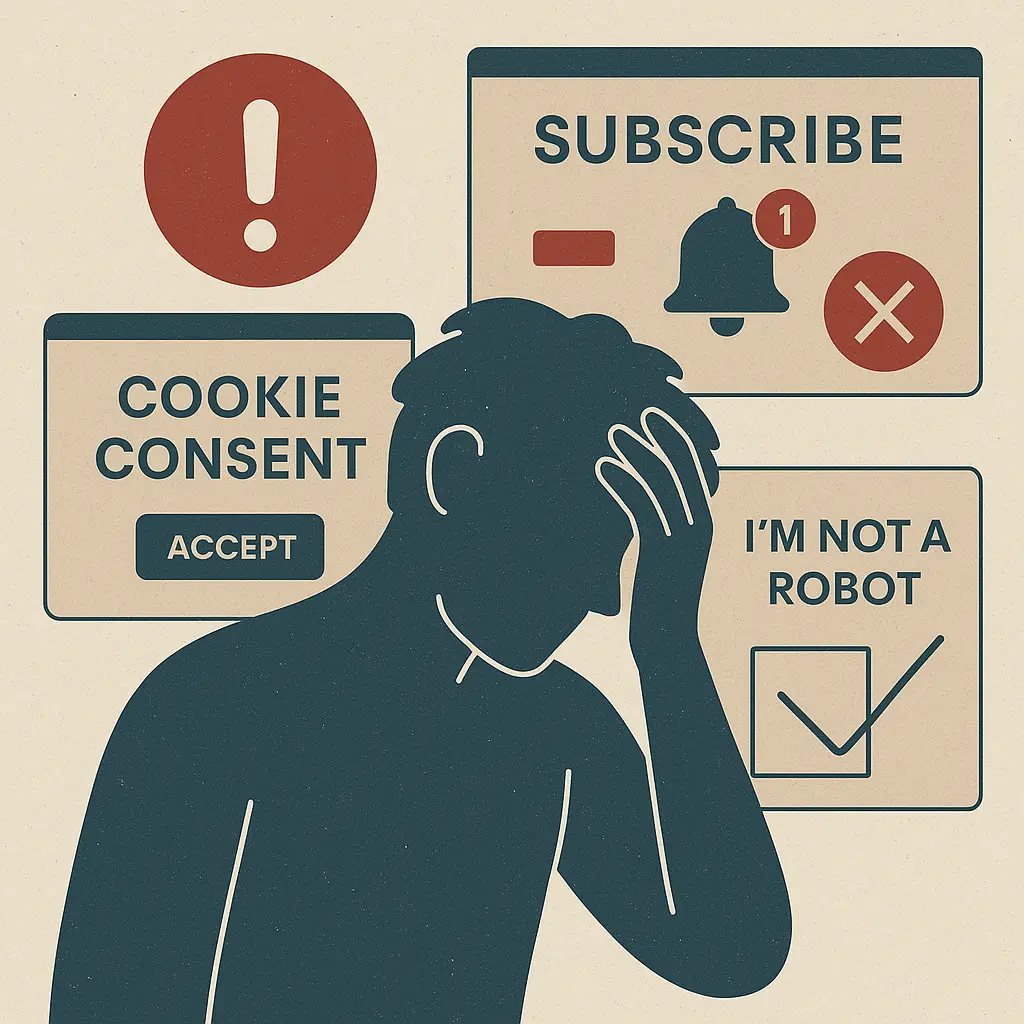
CONSTANT CONSENT FATIGUE
Cookie popups on every site. Not one clear button to reject all. No, you must go spelunking through menus, toggling obscure options one by one.
What they call “consent” is often manipulation dressed up in legalese. They make accepting easy. Rejecting is friction.
This happens every time you clear your cookies—which many of us need to do often to avoid tracking or clutter. It’s an exhausting loop.
OBSTACLE COURSE INTERFACES
Adverts that interrupt videos, and worse, cannot be skipped unless you pay. Not pay for the content, mind you, but pay to remove the punishment.
Popup overlays that consume half your screen the moment you land on a site. Trying to close them often launches something else.
On phones? It’s worse. Smaller screens mean these overlays dominate everything. You lose all context and have to work just to get your bearings.
SENSORY OVERLOAD
Auto-play videos. Scrolling pages that jitter from reloading ads. Flashing banners. Infinite scrolling newsfeeds.
Red notification symbols you can’t dismiss.
Everything demands your attention. Nothing respects your brain’s bandwidth.
WALLS EVERYWHERE
Account registration required to view basic information. Want to read one article? Sign up. Want to download a PDF? Create an account.
Even ad blockers aren’t safe anymore: Use one, and you’re blocked.
CAPTCHA systems to “prove you’re not a robot”, often impossible to complete first time if you have visual or processing impairments.
INFORMATION MIRE
Simple search queries now lead into labyrinths of misinformation, SEO bait, affiliate link farms, AI-generated junk, and clickbait.
Answers that should take seconds now require sifting through five pages of fluff.
The mentally exhausting task of fact verification is now part of every basic search.
CONTENT MONETISATION MADNESS
Free content comes with a catch: give us your email, your phone number, or your demographic info.
Sponsorships infiltrate once-authentic creators. You’re left wondering if their review or advice is sincere, or bought.
Subscription models are everywhere. Everything is paywalled. But paying doesn’t always remove the pain—sometimes, it’s just a new tier of nonsense.
And this is just what I notice consciously.
I’m sure there are deeper layers of rot that my mind filters out as a survival response. But what I do feel, daily, is the cognitive toll. What should be a tool for exploration and learning is now an exhausting, defensive act.
And here’s the thing: most people just shrug and say, “That’s just how it is now.”
But if you’re neurodivergent, or disabled, or even just overwhelmed by life, “that’s just how it is” becomes the same as saying: This place isn’t for you.
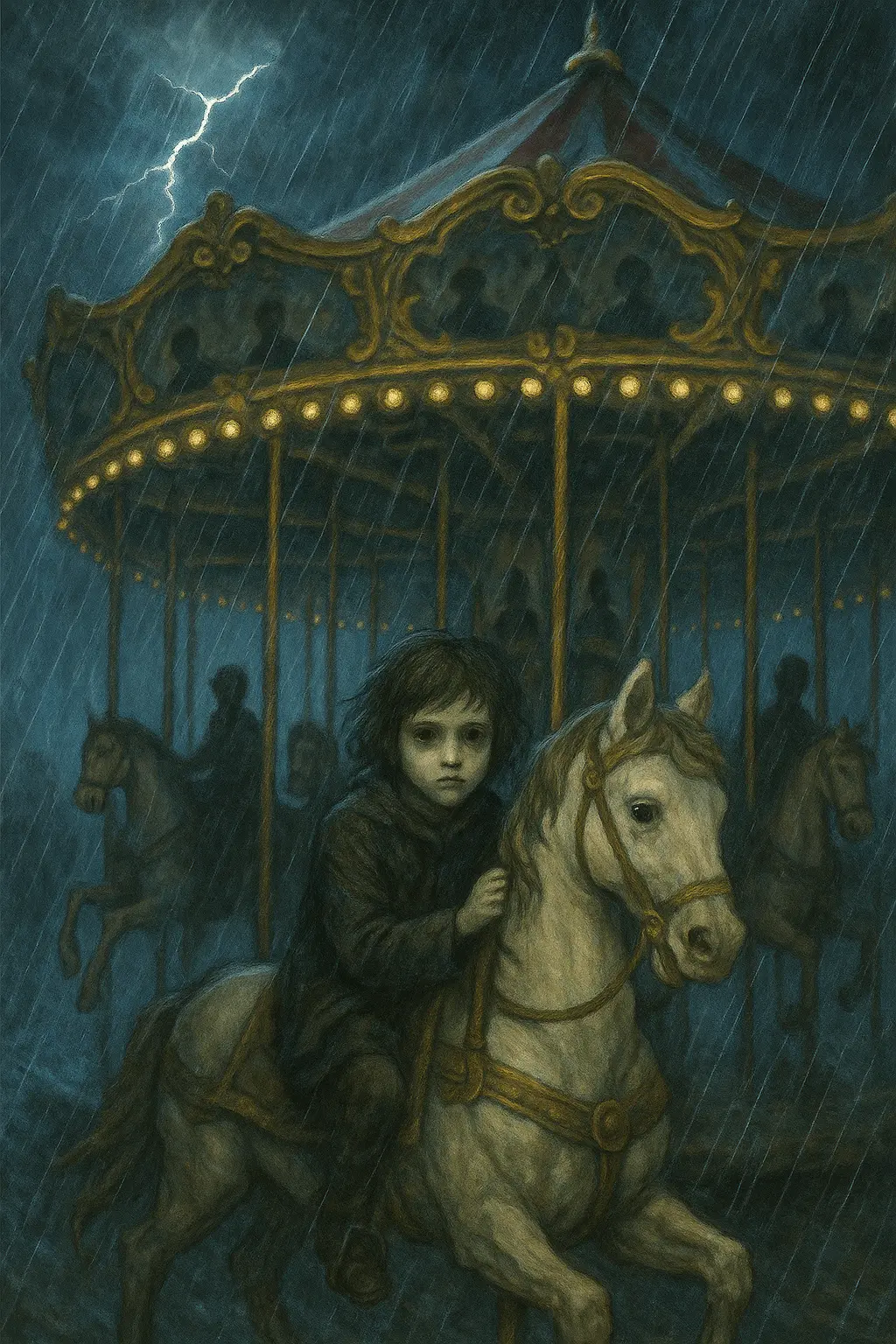
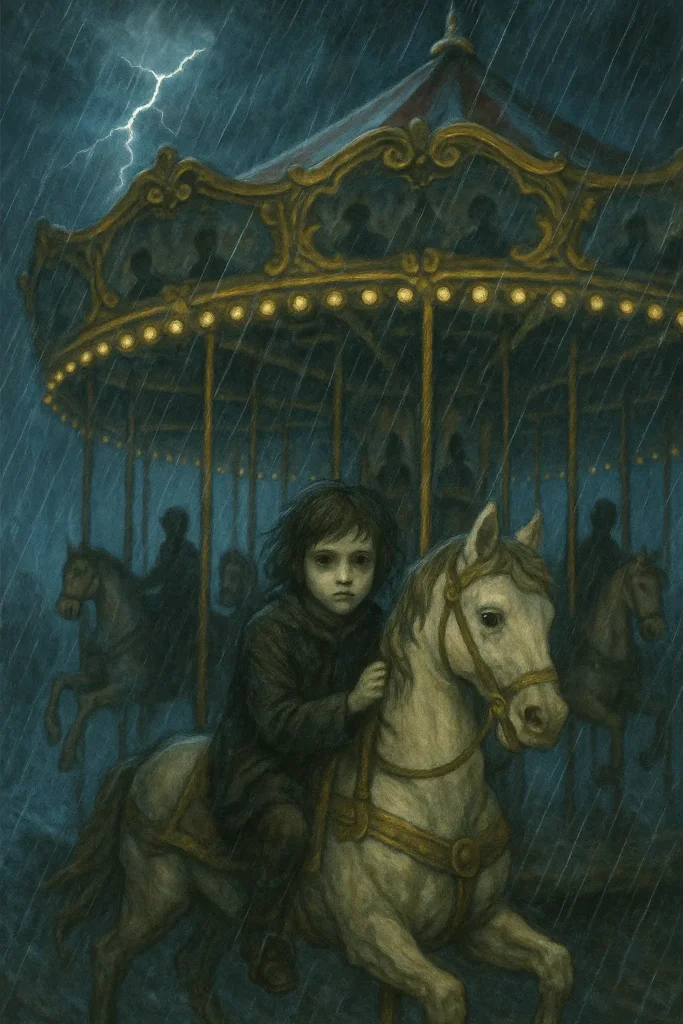
The carousel groaned as it turned, its golden poles smeared with the fingerprints of a thousand forgotten riders. Painted horses reared in frozen delight, their glass eyes glinting with a happiness that had long since curdled.
The child climbed on.
Not because he wanted to—but because he’d forgotten how to say no.
A quiet organ tune clinked out through a crackling speaker. 3/4 time. Always 3/4 time.
He chose the horse with a cracked smile and a nameplate that had been scratched blank.
His name had been Matthew, once.
As the platform began to spin, so too did the sky.
It started with a breeze—cool and damp—then a sudden curtain of rain, thick as syrup. Thunder cracked so loud the carousel jolted beneath it. Children screamed. Adults ran for cover.
But the ride did not stop.
Lightning flashed, strobing the carnival into a series of still photographs:
A balloon let go
A face smeared with candy and tears
A clown’s makeup melting in the downpour
The carousel spun faster. And then slower. And then… wrong.
The mirrors at its center reflected not the riders, but versions of them—distorted, grown-up, bitter, bored. One child saw themselves in a suit and tie, crying at a desk. Another, pushing a pram with hollow eyes. Another, screaming into a microphone to a crowd that wasn’t listening.
Matthew looked into the glass and saw nothing at all.
Just a flickering silhouette, undefined—unformed but watching.
Then—CRACK—lightning struck the iron arch above. The carousel jolted. The horses’ eyes blinked once.
And the dream tilted.
Somewhere beneath the floor, gears began to grind a different rhythm.
Something was waking.
And somewhere, in a layer just outside the dream, Angel remembered.
Not everything. Not yet. But enough.
Enough to know that the carousel wasn’t just a ride. It was a ritual. A loop. A lie.
On Slowness, Authenticity, and the Hidden Cost of Making Art in a Capitalist Age
I never thought I’d feel excluded from the very thing that once gave me a sense of freedom. But lately, I’ve come to realise that I am being priced out of my own creativity. Not because I lack the passion, or the ideas, or the skill — but because I can’t afford to keep up. In a world where speed, output, and polished presentation have become the currency of success, the slow, deliberate path of authentic creation begins to feel like a liability. It’s not that I envy others for having more — it’s that I’m haunted by the quiet truth that if I could afford their shortcuts, I’d take them too. And maybe then, I’d finally be heard.
The Outsourced Artist
In today’s creative landscape, outsourcing isn’t just accepted — it’s expected. Bands hire mixing engineers, mastering engineers, session musicians, graphic designers, videographers, social media managers, PR firms, playlist pluggers, and even ghostwriters. What once might have been a collaborative luxury is now a prerequisite for visibility.
The result? A strange duality: the artist becomes both the brand and the product, while the actual act of creation is often fragmented, delegated, monetized.
What happens to those of us who can’t afford to participate in this system — not just financially, but philosophically?
If your process is slower, more solitary, more sacred — you risk becoming invisible. It begins to feel as though the art you bleed over is less “real” because it lacks the polish, the reach, the momentum.
But polish is not proof of depth. And speed is not proof of soul.
The Pace of the Mind
For some of us, slow work isn’t a choice — it’s how we’re wired. As a neurodivergent creator, my process often unfolds at the rhythm of deep focus, scattered epiphanies, or energy that arrives in brief, unscheduled waves. I don’t have the bandwidth to be “on” all the time, nor the capacity to split myself between creating, promoting, polishing, and packaging — all while maintaining a public-facing presence.
There are days when just starting takes all my energy. Not because I don’t care — but because I care too much. The ideas are there, the vision is vivid, but the executive function required to carry it through feels like swimming in glue.
In a society that equates slowness with laziness, this reality becomes invisible. But slow art isn’t lazy — it’s often more conscious, more personal, more layered.
The problem isn’t my pace. It’s that the creative world is rigged for speed.
The Misinterpretation of Slowness
In the eyes of an algorithm-driven world, slowness is indistinguishable from absence. If you’re not releasing something, promoting something, performing something, or networking somewhere, you might as well not exist.
The labor you’re doing behind the scenes — the quiet crafting, the emotional processing, the struggle to bring a foggy idea into form — becomes invisible.
There is no metric for sitting with your feelings. No content calendar for trial-and-error. No viral moment for doing something the hard way just because it felt true.
The unspoken message is: If you were really good, it wouldn’t take this long.
But what if the time it takes is part of the art?
Between Autonomy and Assistance
I sometimes wonder what I might create if I had the means to outsource the tedious parts of production — the repetitive tasks, the non-creative polish, the technical finishing touches. And yes, I would do so in a heartbeat if I could. There is no virtue in burnout.
But there are aspects of my work that feel sacred. Decisions that need to be made by hand, not handed over. Not everything can be automated without losing something vital.
Even in areas where tools like AI are beginning to offer creative support, I tread cautiously. I welcome augmentation — a scaffolding to help me express what’s already inside me — but I resist the pull toward a fully packaged aesthetic I didn’t choose.
To maintain agency over your art in a world that rewards trend-following over truth… is to walk a narrower path.
Why I Still Create
And yet, I keep creating.
Not because the system rewards me, but because something in me refuses to stop. I create for the moments when the noise falls away and something raw and beautiful emerges from the mess. I create because it connects me to myself, and sometimes, to others who are quietly walking similar paths.
I don’t know if my work will ever be widely seen, heard, or recognised. But I know it is mine. Every rough edge. Every choice made without compromise. Every imperfect but honest thing I shaped with my own hands.
That has to count for something.
So this is for the others like me — the slow ones, the careful ones, the fiercely authentic ones.
You’re not invisible to me. I see you in the cracks, in the edges, in the long silences before the next release. And I believe what you make, when it finally arrives, will be worth the wait.
Cancel culture is a loaded term—invoked with fury by some, defended as justice by others, and dismissed as overblown by many. But what if we viewed it not as a purely political or cultural phenomenon, but as a psychological one? From a Jungian perspective, cancel culture may be less about individual accountability and more about the collective shadow—humanity’s unconscious darkness—emerging in a digital age that doesn’t yet know how to process it.
What if the mob isn’t merely punishing transgression, but projecting its own repressed qualities onto a convenient scapegoat?
The Collective Shadow and the Archetypal Scapegoat
Carl Jung proposed the concept of the shadow—the unconscious repository of traits we deem undesirable, immoral, or shameful. What we refuse to integrate within ourselves doesn’t vanish; it festers in the dark and seeks expression, often through projection. On a societal level, this becomes a collective shadow, surfacing as we displace our unacknowledged inner material onto others.
The target of a cancellation—a public figure, a peer, an online stranger—often becomes an archetypal scapegoat. In myth and ritual, the scapegoat bears the sins of the tribe and is sacrificed or exiled to restore social equilibrium. Today, the ritual takes place online. The digital firepit is the comment thread. The sin is moral impurity.
But the fervor? That’s religious. Archetypal. Shadow-fueled.
Why Now? The Rise of the Unprocessed Psyche
We live in an age of hyper-visibility and deep fragmentation. Everyone is their own brand, their own broadcaster, their own PR department. Meanwhile, the tools for authentic psychological integration—community, ritual, introspection—have eroded.
Cancel culture thrives in this vacuum. It provides a synthetic moral high. A hit of certainty in a morally ambiguous world. A way to feel good without having to face the disturbing truth: that we, too, contain capacity for cruelty, ignorance, prejudice, and contradiction.
Instead of saying “This reminds me of something in myself I haven’t dealt with,” the unconscious says, “That person is disgusting. Get rid of them.”
The Performance of Virtue and the Fear of Exile
Much of cancel culture is driven by fear—of being next. As a result, virtue is often performed, not lived. We denounce to demonstrate that we are clean, correct, on the right side of history. It’s the modern equivalent of burning a witch to prove you’re not one.
This makes it difficult to speak honestly, to question the herd, or to show nuance—qualities vital for a psychologically healthy society. If one mistake marks you as irredeemable, then redemption as a concept is dead. Growth is irrelevant. All that remains is punishment.
But the shadow requires growth. It demands confrontation, not exile.
Cancel Culture as a Mirror
If we zoom out, cancel culture may be seen as an evolutionary pressure—a flawed but inevitable attempt by the collective psyche to regulate moral boundaries in a new digital terrain. It points to real traumas, power abuses, and social injustices that need redress.
But when we cancel rather than converse, when we exile rather than integrate, we repeat the very cycles we claim to oppose. We become the tyrant we sought to dismantle.
In this light, cancel culture is not the problem—it is the symptom of a deeper, unresolved issue: the collective failure to do shadow work.
Toward a New Integration
If cancel culture is a symptom of shadow repression, then the cure isn’t more silencing. It’s more integration.
This means:
Encouraging inner reflection, especially when we feel reactive.
Distinguishing between justice and vengeance—they may feel similar, but arise from different places.
Valuing growth over purity, recognizing that fallibility is universal, and transformation is possible.
Creating space for difficult conversations, where people can be accountable and human.
If humanity is to evolve beyond this recursive purge cycle, we must learn to see our enemies not only as threats, but as mirrors. Not to excuse harm—but to understand where it originates, in them and in us.
Conclusion
We are all being asked to grow up psychologically. The digital age has exposed us to ourselves in ways no previous generation has had to face. The question isn’t whether cancel culture is justified—it’s whether we are ready to look into the mirror it holds up and ask: What am I seeing in them that I refuse to see in myself?
Until we can answer that, the shadow will keep casting new scapegoats for the mob to burn.
You Know It, I Know It: Systemic Gaslighting Is Real
Let’s stop pretending this isn’t happening.
You know the feeling. You go to the GP or A&E with something serious, something that’s quite literally threatening your health or your life—and you get fobbed off. Not just dismissed, but unacknowledged. It’s as if your suffering never even entered the room. I once went through a period where due to my dysphagia (difficulty swallowing foods), I couldn’t swallow anything—not even liquids—and three different doctors didn’t just ignore the urgency. They didn’t even acknowledge that not eating or drinking might be life-threatening.
That’s not a misunderstanding. That’s gaslighting at a structural level.
We don’t always use that word in this context, but maybe it’s time we did. Because the plausible deniability this system thrives on? It’s wearing thin. It’s implausible now. And yet the more glaring the denial becomes, the more we’re made to feel crazy for seeing it.
When the system fails you repeatedly, when it actively erodes your trust in your own perception, it doesn’t feel like negligence. It feels like being crushed. Slowly, deliberately. With no admission of force.
And if you’re neurodivergent? It’s a whole extra layer of hell. I’m autistic. I have social phobia. I don’t perform distress the way they expect. I don’t cry on cue. I don’t shout. I process. And because I process, I’m read as cold, or fine, or “not that bad.”
So I mask. I over-explain. I try to predict what they want from me, how to appear distressed in a way they’ll believe. But it always feels off. Like I’m being baited into dishonesty just to prove my honesty. And that makes them feel justified in writing me off.
This is what systemic gaslighting looks like:
They act like they care.
They position themselves as your advocate.
But every policy, every interaction, every flicker of body language says: “We’re not spending money on you if we can help it.”
I’ve warned others before. Told them: don’t be fooled by the performance of care. If you have the strength, call it out in the moment. Name the evasion. Ask for honesty. Demand respect. But know that they have tactics too. And they’re good at them.
So what keeps me going? Partly survival instinct. Partly the sheer disgust at how far we’ve allowed this to go. But mostly: the knowledge that it doesn’t have to be this way. That somewhere under the mountains of bureaucracy and gluttony and cruelty, there’s a version of the world where institutions actually listen. Where they respond with compassion, not scripts. Where people aren’t punished for needing help.
And until that world is real, I’ll keep writing. Even if no one hears it right now, the truth is here, in black and white.