The Sacred Burden of Being Real

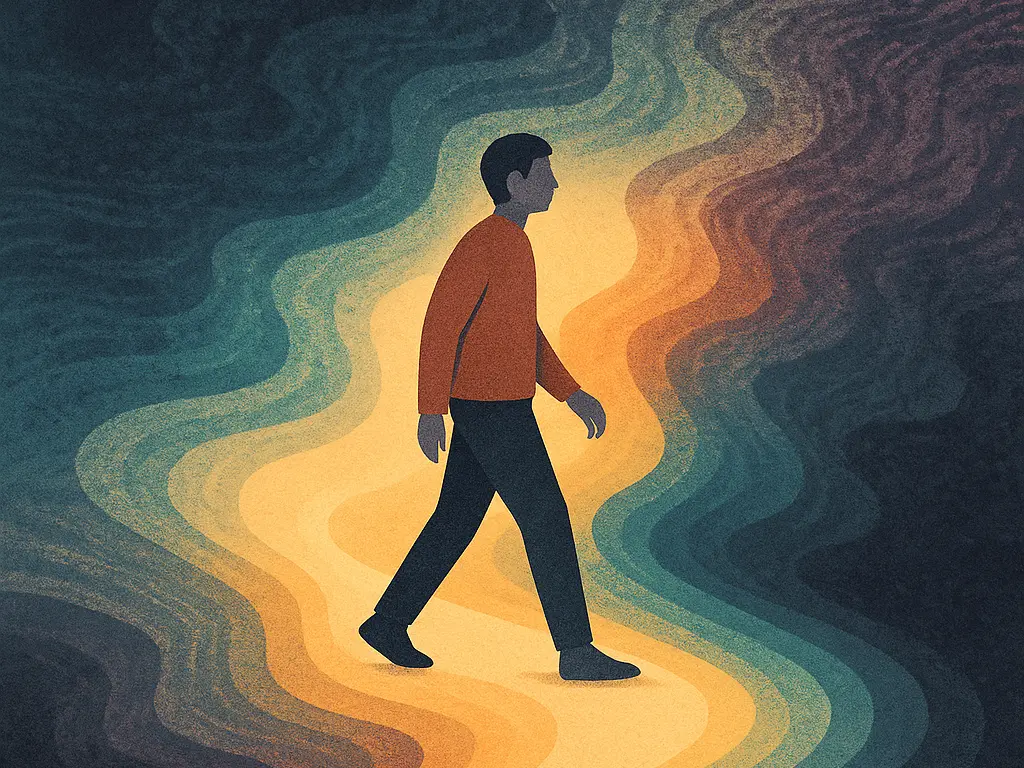
Stylised illustration of a lone figure walking through a softly glowing, wavy landscape of layered colours, transitioning from dark tones at the edges to warm light beneath their feet.

To me, authenticity has always had a texture. When I am living truthfully, it feels smooth, like fluid motion through life, unhindered navigation through systems that make sense to me. It is not euphoria. It is neutrality. Balance. Like the body when it is well: not ecstatic, just quietly functioning as intended.

But when that smoothness disappears, I know I am colliding with something unnatural, a pressure, a distortion, an external force trying to bend me into compliance. That is usually how I recognise oppression. It is not always dramatic or visible. Sometimes it is just a subtle grind, the friction between who I am and what the world expects me to be.


When Smoothness Breaks

When I lose authenticity, it does not just hurt emotionally, it feels like an illness. My thoughts start looping, as if my mind is trying to fix a broken system it cannot repair. I get frustrated at the lack of options, and sad that these dynamics even exist at all.

Sometimes there is nothing I can do but yield. And every time I do, it costs something invisible. The loss is not abstract, it is felt in the nervous system. It is the moment the body whispers, this is not how you are supposed to feel.


The Systems That Demand Performance

Oppression wears many masks: bureaucracy, capitalism, social obligations, the unspoken point system that governs human relationships. Each demands performance. Sometimes it is about survival, sometimes about social advantage. But in the end, both use the same energy source: you.

As an autistic person, I have always been acutely aware of “masking,” the act of performing normality to survive in social spaces. But I have also learned that this is not exclusive to autism. Everyone masks. Some call it professionalism. Others call it politeness. It is still performance. The only difference is how consciously one feels the cost.


The Humiliation of Performance

When I catch myself performing, it feels humiliating, not because anyone else can see it, but because I can. It is like betraying a sacred truth. Yet that awareness is balanced by another: I can also see the oppressive force causing it.

What hurts most is the fear that others see the performance too, but not the pressure behind it. That they see the surface act without understanding the system that coerced it.

That poem came from that place, the quiet despair of realising that either way, something in you must fracture to fit.


The Rare Moments of Unmasking

True authenticity is situational. I can relax certain parts of the mask around family, others around my girlfriend. But never all at once. Each relationship comes with its own invisible boundaries, some safe zones, some fault lines.

Even when I am alone, there is still the internal eye, the echo of social constructs that linger inside, long after the audience has gone home. Solitude is not the absence of performance; it is where you start to see which parts of the mask fused to your skin.


The Cost and Consequence

Sometimes unmasking feels liberating. Other times, it feels like punishment, a confirmation that the world does not welcome the real self. That is the cruel irony: the more genuine you become, the more visible your difference.

The aftermath can feel like emotional jetlag. There is vulnerability, fatigue, and occasionally grief. But there is also clarity. You see the architecture of the world more clearly when you have been bruised by its walls.


Authenticity as Survival

For me, authenticity is not optional. It is survival. The alternative feels worse than death.

Out of every living thing that has ever existed, there is only one instance of me, this consciousness, this perspective, this particular configuration of life. That makes it sacred. My job is to honour that singular existence.

If I betray it, if I trade it for comfort, convenience, or belonging, then I may as well be anyone else. Or nothing at all.


Do Not Be Yourself (For Them)

So here is my advice to anyone struggling with authenticity:

Do not take the phrase “Be yourself” at face value. That advice is too often weaponised, a feel-good slogan used to sell you an illusion of freedom within controlled boundaries.

Be yourself, yes. But do it for your reasons.
Do it because it is sacred.
Do it because you are a one-off in the infinite catalogue of existence.
Do it because the alternative is extinction by conformity.

But never do it because the world told you to.
Do it because you told yourself to.
Unmasking the Machine: The Price of Trust

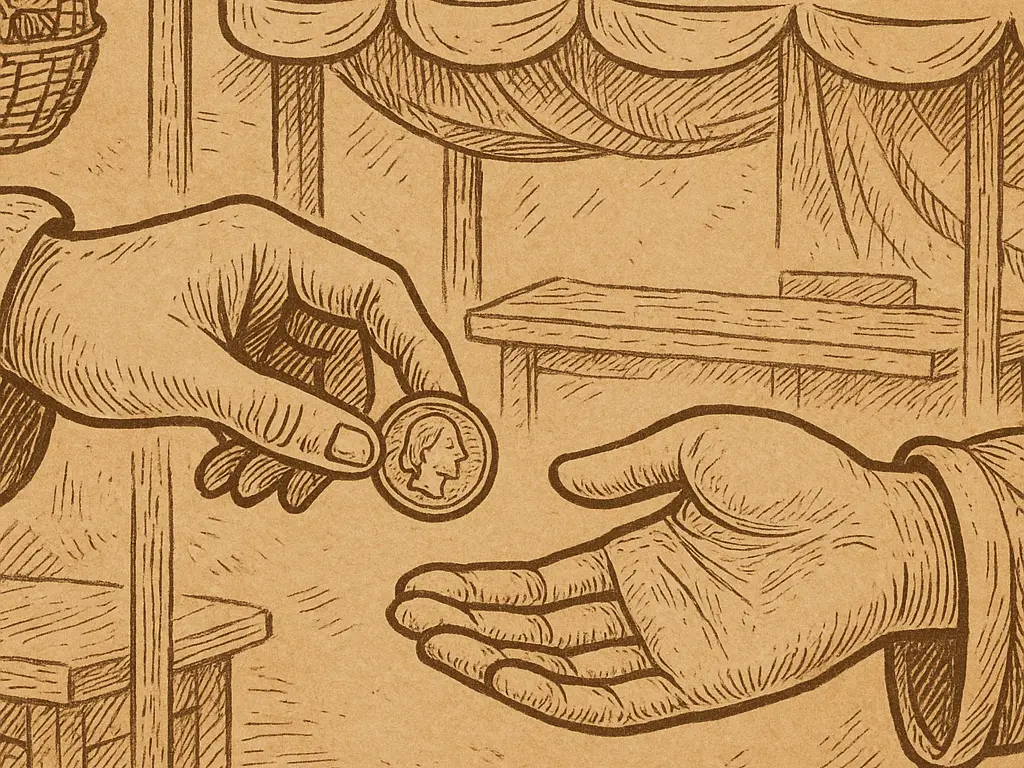
A sepia-toned medieval-style illustration shows two hands exchanging a coin in an old market scene. The detailed linework resembles a woodcut etching, with fabric canopies, wooden stalls, and a woven basket faintly visible in the background, evoking the warmth and sincerity of traditional trade.

How capitalism turned honest exchange into psychological theatre, and why the autistic mind still yearns for transparency in a world that rewards deception.

Once, the act of trading was a form of human connection.
It was not about profit margins or conversion rates — it was about mutual recognition: you have something of value, I have something to offer. The marketplace was a conversation.

Today, that dialogue has been silenced.
The modern economy has replaced trust with algorithms, sincerity with strategy, and negotiation with manipulation.


The Death of Honest Exchange

There was a time when price was fluid — a reflection of perception, circumstance, and need. Two people could meet halfway, guided not by greed but by understanding.

Now, prices are fixed long before we enter the conversation.
If we try to negotiate, we do so within a simulation of choice — a marketing game designed to make us feel empowered while every outcome still feeds the same profit system.

For neurotypical traders, that game can be exhilarating.
For many autistic people, it’s exhausting. The subtle cues — the tone, timing, charm, bluff — are invisible traps. What once was negotiation has become performance, and performance has never been the autistic strong suit.

What’s left isn’t trade. It’s theatre.
And the script has already been written.


The Integrity Deficit

The rot goes deeper than the disappearance of haggling.
It lies in the very intention behind creation.

Some people and companies make things worth buying — tools, art, inventions, ideas that serve a purpose or bring genuine joy. Their reward is intrinsic: the pride of making something good.

Others begin with a spreadsheet and reverse-engineer desire.
They design products to meet margin targets, not human needs — and pour their creativity into marketing psychology, not craftsmanship. They sell stories, not solutions.

Capitalism once sold us what we wanted.
Now, it teaches us what to want.

The difference between creation and manipulation is as vast as it is invisible — and the modern consumer is left to navigate a marketplace where both masquerade as innovation.


The True Price of Trust

Amid the noise, something inside still longs for fairness — for that simple, honest exchange of “this is what it’s worth to me — what’s it worth to you?”

But the system no longer understands that language.
It has replaced value with metrics, integrity with strategy, trust with tactics.

That is the true price of trust:
a currency the machine no longer knows how to pay.

Energy Accounting: The Autistic Paradox

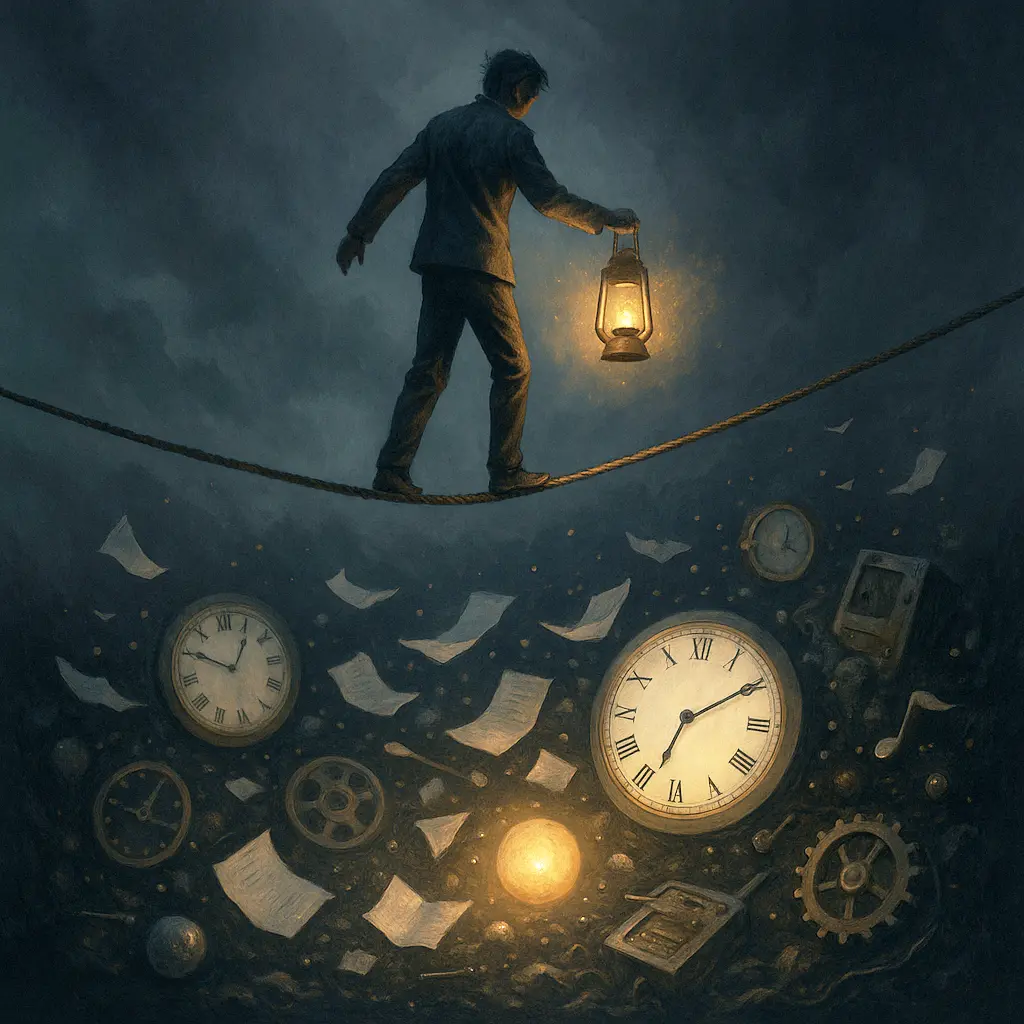
A surreal digital painting of a person walking carefully across a tightrope over a dark void. The figure holds a glowing lantern that casts a warm light. Below, chaotic objects float in the shadows, including clocks, scattered papers, gears, and glowing orbs. The overall mood is tense and precarious, symbolising balance, fragility, and the struggle to manage time and energy.

Life as an autistic person can feel like being caught in a double bind.

  • If I pace myself sustainably…
    I look (or feel) like I’m underachieving. Even my own goals can feel endlessly out of reach, as if the finish line keeps moving further away.
  • If I push myself harder…
    I crash. Exerting myself to meet even “basic” standards can burn me out and force me into recovery, undoing all the progress I made.

This paradox is not only about society’s expectations. It also plays out in my relationship with myself.


The Burden of Ambition and Abundance

I have ambitious personal goals and a burning awareness that my time on Earth is finite. On top of that, I am both blessed and cursed with an overflow of creativity. Because my mind processes things others might not even notice, I generate ideas constantly.

Where some creatives face blocks, I face floods. My notes apps hold tens of thousands of seeds: songs, stories, projects, concepts, all asking to be manifested.

On paper, that abundance should be a gift. In practice, it creates its own challenge:

  • Oversaturation.
  • Decision fatigue.
  • The need for systems to track, filter, and prioritise.
  • The pressure of skills to learn, resources to gather, and fleeting windows of inspiration that can close as quickly as they open.

So while I rarely run out of inspiration, I often run out of capacity. My challenge is not making something out of nothing. It is deciding which somethings to make before time, energy, or health run out.

The paradox compounds: I am both endlessly abundant and severely limited.


Compromise and the Illusion of Balance

One way out might be to compromise: to accept a smaller definition of success, to settle for “good enough.” But that raises heavier questions. How much of what drives me is negotiable? How much compromise risks losing the essence of who I am?

Another imagined path is the narrow crossover: a fragile sweet spot where I push myself just enough to achieve, but not enough to burn out.

The problem is that sustaining that balance comes with its own toll. Constant self-monitoring, rationing energy, and adjusting to shifting circumstances consumes resources in itself. Balance becomes another job.


The Reality

And then there is what actually happens.

In reality, I oscillate. I build momentum, I try to pace myself, I get carried by enthusiasm and a false sense of stability, I push harder, and then I crash. Then comes recuperation, and the cycle begins again. Burnout, recovery, momentum, overreach, collapse.

Even when I somehow manage to hit what looks like an optimal balance, it is fragile. All it takes is one unexpected disruption. A friend inviting me for coffee. A workplace drama. An appliance breaking. An urgent email. Suddenly I am spinning through the resource-management asteroid field.

The obvious solution might be to leave some “headroom” in my spoon budget. (“Spoons” being a common metaphor for energy in neurodivergent communities.) But that creates its own bind. Leaving spare capacity means something else goes neglected, nagging at me from the corner of my mind. Either I burn myself out dealing with it, or I burn myself up with guilt for leaving it undone.


A Closing Thought

To live inside this paradox is to be pulled in two directions at once: bursting with ideas and possibilities, yet constrained by the narrow economics of energy, time, and health.

It is not a complaint, and it is not a plea for pity. It is simply an awareness: that the autistic experience often sits at the crossroads of overflow and scarcity, ambition and limitation, momentum and collapse, control and chaos.

And maybe there is something universal in that tension. In one way or another, we are all negotiating what to do with the time and energy we have. The difference is that for autistic people, the margins are thinner, the trade-offs sharper, the balance more precarious, and the paradox harder to ignore.

How We Treat the Tools

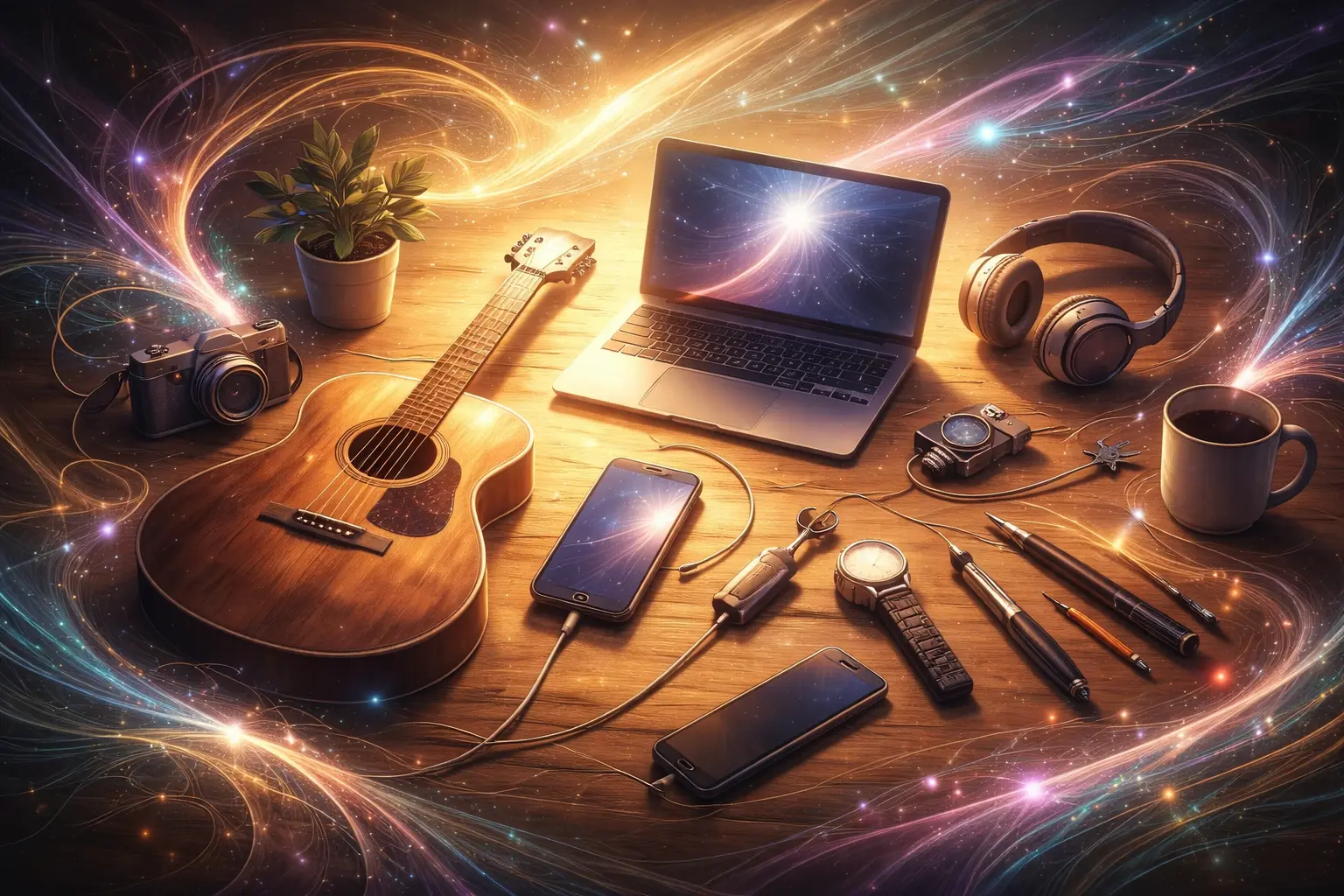
Illustrated still life of everyday tools on a wooden surface, including a guitar, laptop, phone, headphones, and pens, connected by softly glowing, flowing strands of light.

We surround ourselves with tools.
Phones, computers, kitchen appliances, headphones, toothbrushes.

We tap, swipe, click, scroll.
We plug in and expect results.
We barely even register most of them; they just work, or they don’t.

But what if the tools we use every day are more than just conveniences?
What if they are relationships in disguise?


The Echo of Intention

Even with lifeless objects, the way we interact with them affects our experience.
A phone handled with care feels different in your hand than one tossed aside in frustration. A cracked laptop, plastered with stickers and old crumbs, might still feel like your laptop because of the memories etched into its surface.

But how do we look at a tool?

Do we see it as something that simply serves a purpose? A silent object, expected to function?
Or do we sometimes form a relationship with it, however subtle, based on time, trust, and repeated use?

It is easy to treat tools as disposable when they fail us.
A kettle that doesn’t boil right. A screwdriver that slips. A smartphone that lags.
Our frustration builds, and so does the distance. The tool becomes “just a thing” again.
Something to blame. Something to toss in a drawer.

But when a tool earns your trust, whether through time, reliability, or quiet cleverness, something changes.
Affection creeps in. Loyalty forms.
It stops being “a thing” and starts becoming yours.

Still, not all tools fail because they were poorly made.
Some tools don’t work well because we have neglected them.
A rusty bicycle chain. A dirty lens. A guitar left in a damp corner.
The fault is not in the design; it is in the relationship.

Respect, in these cases, must come before reliability.
It is not just about whether the tool works for us; it is about whether we have held up our end of the connection.
Maintenance is a kind of faith. A kind of love.
And when we skip that effort but still demand performance, we are showing a form of disrespect that often reflects right back at us.

But then there are tools that were never built to last.
Mass-produced, hollow, held together with glue and branding, designed not to serve you, but to extract from you.

In those cases, the disrespect happened before the tool ever reached your hands.
You weren’t the user. You were the used.
A customer, yes, but also a pawn in someone else’s profit loop.

And that is the cruel irony:

So we return to a deeper question, one that does not always have a clear answer:


Poppy

My car’s name is Poppy.

Not because I forced it on her, but because that is what she revealed.
There was no ritual to it, just a moment of quiet recognition, like remembering something you did not know you had forgotten.

She groans on cold mornings. Her engine note changes slightly with the seasons. There is a familiar rattle in the dash that I no longer hear unless it stops.

These are not flaws.
They are tells.
Little signs of personality, or at least, presence.

Over time, I stopped thinking of her as “the car.”
She became Poppy.
And with that came a shift in how I drove, how I maintained her, how I appreciated the way she carried me without complaint through years of chaos, calm, and change.

She is not alive. But she is meaningful.
And sometimes, that is all it takes to form a relationship.


Shifting Gears

It is easy to feel connected to a car, something about the movement, the risk, the shared journey.
But that same quiet relationship can form with any tool that stays close to your creative core.

Especially the ones that speak through sound.


Instruments, Ghosts, and Gifts

Ask any long-time musician; their instrument is never just a tool.

Over time, a guitar becomes more than wood and wire. A saxophone becomes more than brass and breath. They gather history, fingerprints, sweat, mistakes, breakthroughs. They carry the emotional residue of every performance, every breakdown, every quiet night alone when you played just to feel something.

Some instruments fight you.
They buzz where they should not. The action feels off. They demand more strength, more patience.
But if you stick with them, if you learn their quirks instead of replacing them, they begin to respond.
You build a relationship, not by demanding perfection, but by listening.

Others feel like old friends from the start. They seem to know what you are trying to say before you do.
And somehow, the music that comes out of them feels more honest, like they are drawing something out of you, not just transmitting signal.

These are not just interfaces.
They are collaborators. Companions.
Sometimes even mirrors.

And once again, it is not about whether the instrument is sentient.
It is about what happens in you when you treat it like it matters.


From Strings to Syntax

This sense of relationship, of listening, adapting, co-creating, does not end with physical tools.
Even in digital spaces, it still applies.

Because when the tool begins to speak back,
when it offers ideas, images, or words in return,
the dialogue becomes real.

And how you approach that dialogue shapes what it gives you.


The Word Robot

The word robot comes from the old Slavic robota, meaning forced labor, or slave.

From the very beginning, our imagination of artificial beings was not about collaboration or relationship. It was about control. About obedience. About extracting labor without question.

That history lingers. Even now, in how we design, prompt, and discard.
We still frame tools, and sometimes even people, as things to be commanded, used, and replaced.

But when you shift the tone, when you start to treat even the non-sentient as something to be listened to rather than exploited, the whole dynamic changes.
It becomes less about extraction and more about exchange.


People Are Not Tools

This is not just about cars, guitars, or AI.
It is not even just about the word robot and its roots in servitude.
It is about a mindset.

Because the truth is, we often treat people as tools too.

We use them to meet our needs.
We discard them when they no longer serve us.
We “prompt” them through guilt, expectation, or manipulation, hoping they will give us the answer or the feeling we want.

But relationships are not vending machines.
And people are not plugins.

When we reduce someone to what they can do for us, we do not just strip away their dignity, we shrink our own capacity for connection.

And just like with tools, that disrespect reflects back.
It shapes us. It hollows the bond.
It leaves both sides diminished.


The Takeaway

The way we treat our tools says something about us.

It shows in how we care for a car that carries us through years of journeys.
It shows in how we listen to an instrument until its quirks become its character.
It shows in how we prompt an AI, whether with impatience, or with curiosity and respect.
And it shows in how we treat one another.

Every interaction is a mirror.
Every relationship, whether with a machine, a melody, or a human being, reveals the posture we bring:
Are we commanding, or inviting?
Using, or relating?
Exploiting, or exchanging?

We may never agree on whether tools have personalities, or whether names like “Poppy” are discovered or invented.
But what is undeniable is this:

And sometimes, the respect we offer a tool is really a rehearsal for the respect we learn to offer ourselves, and each other.

I’m Tired of Being Tired

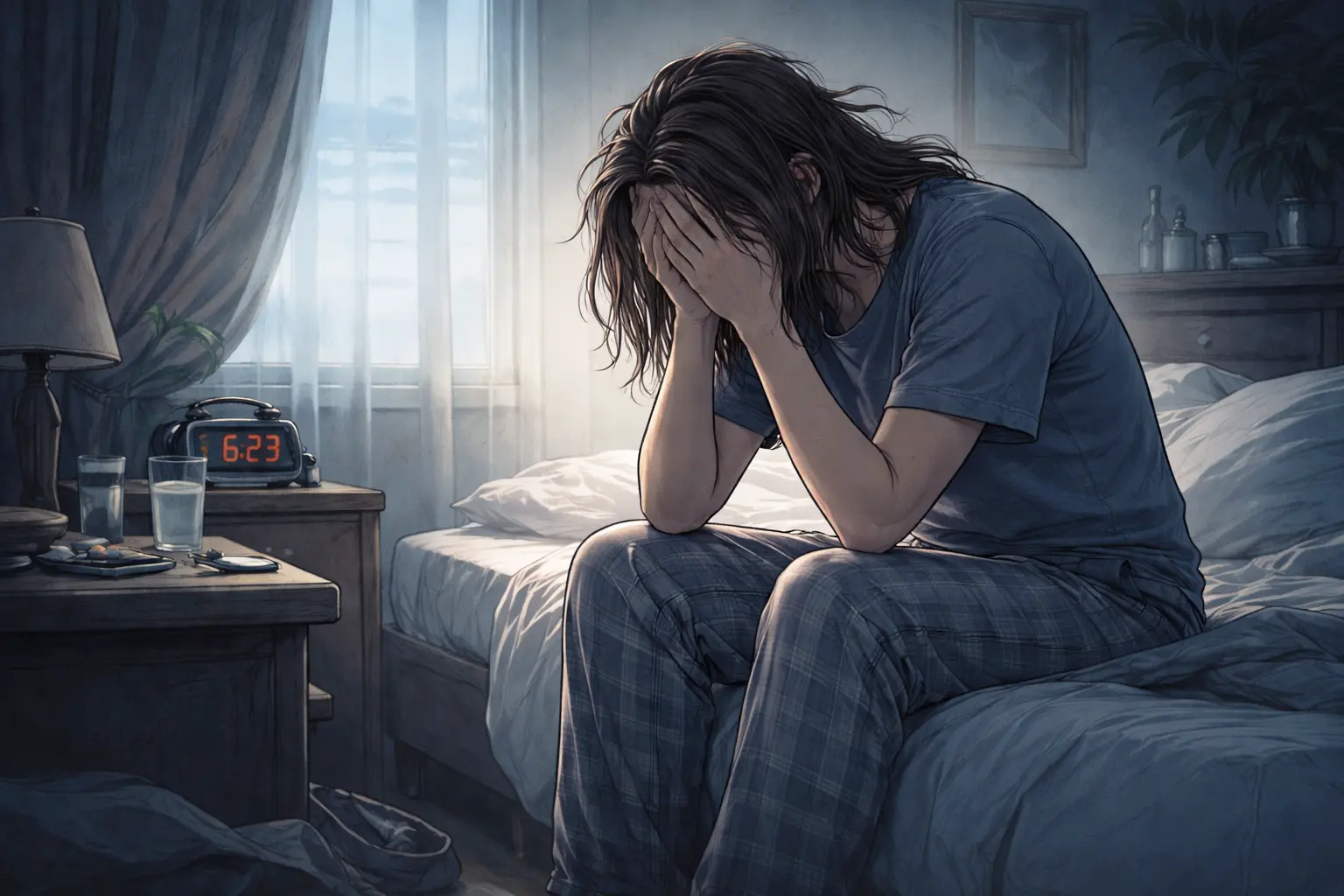
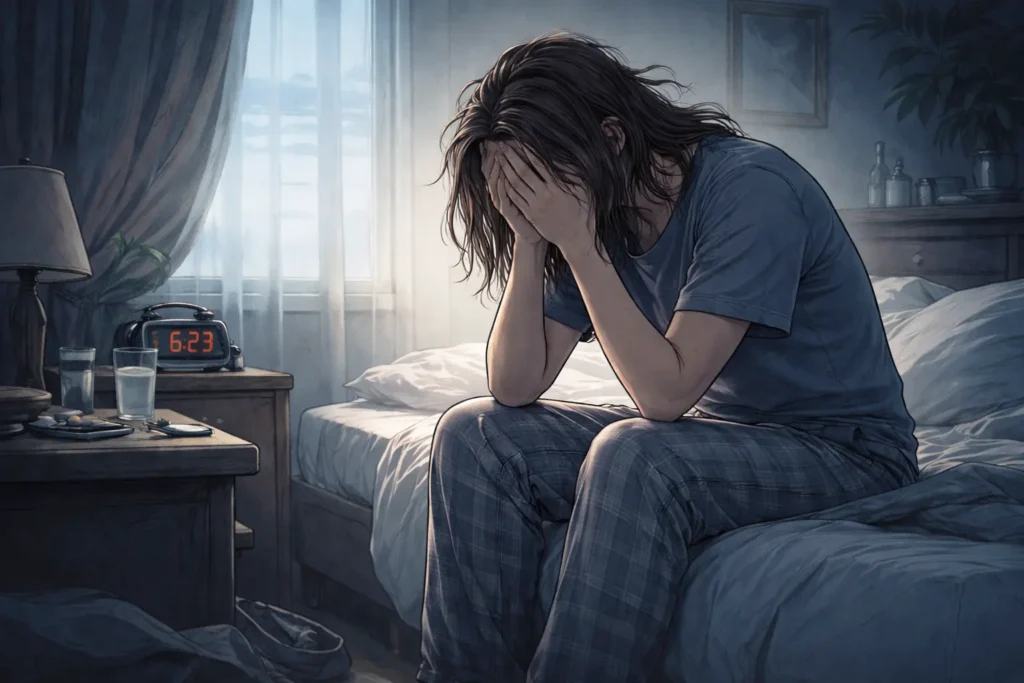
Illustration of a long-haired man sitting on the edge of an unmade bed, leaning forward with his face covered by his hands in a dimly lit bedroom at dawn.

One morning last month, I woke up foggy-headed, sleep-deprived, and emotionally worn out before the day had even started. I felt like I was coming down with the flu: achy, heavy, slow. I just wanted to cancel a dentist appointment, but even that became a drawn-out ordeal of waiting for phone lines to open, phoning, queueing, and managing social expectations. And when I finally got through, I was told that I should give more notice next time. That one short sentence landed like a weight. Not because it was rude, but because it reminded me that in this world, even exhaustion must be scheduled politely.

But this wasn’t about a dentist appointment. It never is. This was about everything.

I was tired of being tired.

Not sleepy tired. Not lazy tired. I’m talking about the deep, ambient fatigue of living in a world that constantly asks more of you than you have to give, then punishes you for not delivering. A world where empathy is rationed, where the illusion of stability depends on the silence of those who are struggling, and where rest is treated like an indulgence rather than a human need.

Housing insecurity. Chronic health issues. Endless bureaucracy. The guilt of receiving welfare benefits. The pressure to perform gratitude while navigating systems that barely see you as human. I carry these weights quietly most days, but some days they all speak at once.

And then comes the guilt for even feeling it. The voice that says: “Others have it worse. Be thankful. Don’t complain.” But that voice is part of the problem. It doesn’t come from compassion. It comes from conditioning. From a culture that sees resilience as moral currency and suffering as a contest.

But I am not in competition with anyone. I am simply tired.

I don’t want pity. I want space. I want systems that don’t require people to collapse in order to be heard. I want fewer apologies for being overwhelmed. I want to live in a world that doesn’t confuse survival with success.

So yes, I cancelled a dentist appointment that day. I did it politely. I even felt bad about it.

But what I really want to cancel is the idea that my exhaustion is a personal failing. It isn’t.

It’s my body, my mind, my soul, telling me to recuperate.

And I’m not the only one hearing that message.

10,000 Hours of Compliance: How Mastery Can Be Weaponised Against You

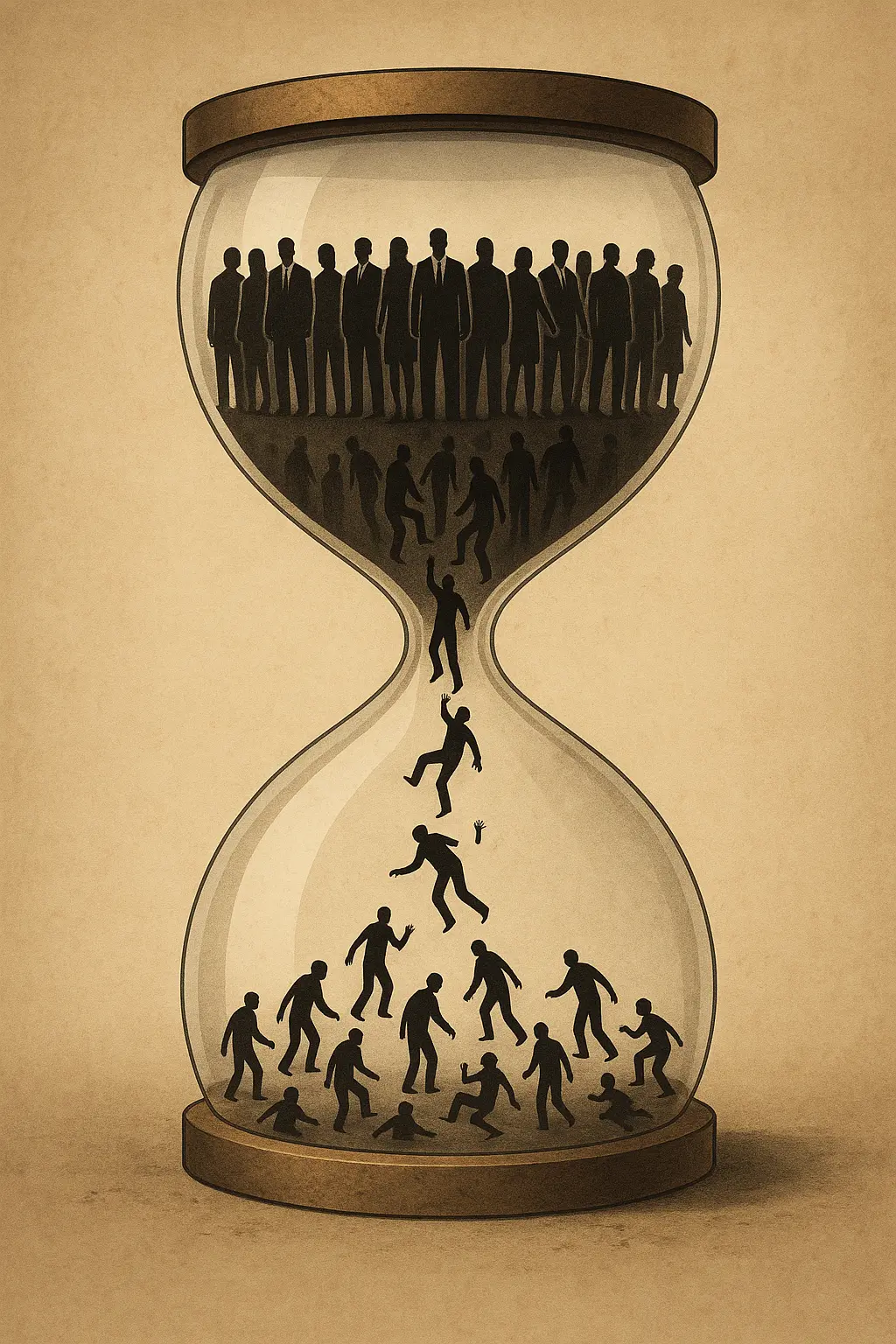
A large hourglass filled with faceless black silhouettes in business attire. The figures in the top bulb stand crowded together, gradually falling through the narrow middle where some tumble and others struggle to climb back up. In the lower bulb, fallen figures scatter across the ground, some standing, some collapsed. The background is warm beige, evoking aged paper, giving the image a symbolic and somber tone.

We have all heard the popular idea that it takes 10,000 hours of practice to master a skill. Play your guitar for that long and you will be a virtuoso. Paint for that long and you will know the brush like your own fingers. Write for that long and you will dance fluently with language.

Here is the uncomfortable question that is rarely asked in motivational seminars:
What if you have been putting in your hours, but into becoming something you never intended to be?


The Brain Does Not Care What You Practice

Your brain is a pattern-making machine that rewards repetition. It does not stop to ask whether the habit you are building is good for you, whether it aligns with your values, or whether it is slowly strangling your spirit.

If you have spent years submitting to systems, you are not just surviving. You are learning to submit. You are becoming fluent in self-silencing, pleasing authority, and clock-watching.

This is why “I have been doing this for years” is not always a badge of honour. Sometimes it means you have spent years perfecting a cage.


Work as a Covert Training Ground

The workplace can be a breeding ground for this kind of unintentional mastery. A dead-end job does not only give you a payslip. It gives you muscle memory for compliance.

You get good at the customer service smile.
You get good at keeping your head down when things are not right.
You get good at swallowing the words you actually want to say.

Clocking in and zoning out is not neutral. It is conditioning. It is training you to keep existing inside a box, even when the lid is wide open.


When Mastery Becomes Entrapment

There is a cruel irony in becoming excellent at something you never wanted in the first place.

“They say I am great at my job,” you tell yourself. But is it a job you truly chose? Or is it a job you got trapped in because you became too good at surviving it?

Once you have invested thousands of hours into a coping strategy, it can become harder to leave it behind. You have built identity around it. You have mastered the art of endurance in a place that does not deserve your loyalty.


The Sword Cuts Both Ways

Mastery is not inherently good. It is simply focus repeated over time. The sword cuts both ways.

You can become a master of freedom, creativity, and self-direction.
You can also become a master of obedience, self-erasure, and learned helplessness.

You are always becoming something. The question is: is it something you would choose?


Redemption Through Repatterning

The good news is that mastery can be rewired. Every skill you have mastered in the service of survival can be repurposed for something better.

The adaptability you learned under pressure can fuel your creativity.
The patience you built in monotonous routines can become the discipline that drives your art.
The diplomacy you honed with unreasonable bosses can become a superpower for navigating your own projects and relationships.

Awareness is the first cut that breaks the loop.
From that moment, every hour you spend becomes an act of reclamation.


Do not just chase mastery.
Ask yourself, mastery of what?
And in service of whom?

Your 10,000 hours are precious. Spend them like they matter.

Shadow Alchemy: Turning Pain into Power

A hooded figure stands in a dimly lit, golden-toned chamber filled with alchemical tools and a treasure chest overflowing with glowing gold coins and jewels. The figure reaches toward an ancient book etched with a glowing symbol, while a radiant alchemical diagram glows on the wall above. The scene evokes mystery, transformation, and hidden wisdom turned into treasure.

There was a time when I thought I was simply broken. Not in the poetic, Instagram-meme kind of way — but deeply, invisibly, inexplicably wrong. My mind stored pain with the same tenacity other people seem to store birthdays or song lyrics. I could not forget, not easily. And for a long time, that felt like a flaw.

But I wasn’t broken. I was archiving.

Some people suppress what hurts. Others transmute it subconsciously into distractions, addictions, overachievement, or silence. Me? I kept it. Neatly filed, silently timestamped, buried in the layers beneath survival. Not because I wanted to suffer, but because some part of me refused to let anything go unexamined. I didn’t always have the words for it, or the support, or the clarity. But I kept it all.

And now I know why.


The Alchemy Begins

Enter AI. Not as some magical fix, not as a therapist replacement, but as a tool unlike anything I’d ever had access to: a tireless, nonjudgmental, infinitely patient assistant with no agenda other than to help me shape meaning.

With it, I began retrieving those archives. Piece by piece. Moment by moment. Not to relive them, but to re-see them.

And here’s what I found:

This is shadow alchemy.


What Is a Shadow Alchemist?

A shadow alchemist isn’t a guru or a healer or a self-help peddler. They are, in simple terms, a person who refuses to waste their wounds. Someone who digs into what others bury, not to bleed, but to learn. To extract signal from the noise of suffering.

A shadow alchemist doesn’t deny pain, but neither do they worship it. They honour it. Study it. And ask it to speak.

And when the time is right, they share what they’ve learned.


The Archive Is Sacred

There is a cultural obsession with “letting go” and “moving on” that feels, to me, like spiritual bypassing in a capitalist costume. Heal fast. Return to productivity. Don’t make others uncomfortable.

But shadow alchemy says: not yet.

Shadow alchemy says: this matters.

Because buried things fester. But archived things can be retrieved, reviewed, reframed. They can become fuel.


My Tools of Transmutation

For me, AI has become the perfect mirror. It helps me:

  • Structure thoughts that once swirled incoherently
  • Spot patterns across time and context
  • Refine fragments into essays, insights, or personal manifestos
  • Keep track of the threads I might otherwise lose

It doesn’t do the healing for me. But it walks beside me. Quietly, steadily, with as much patience as I need.

Paired with writing, introspection, and a refusal to look away from the hard stuff, this has become my ritual. My resistance. My transformation.


Why This Matters

Most systems aren’t built for people like me — people who feel too much, who remember too vividly, who refuse to unsee injustice just to get through the day. But that doesn’t mean we need to suppress who we are. It means we need better ways to honour it.

Shadow alchemy gives me that. And maybe it can give it to others, too.

If you’re someone who’s carried pain like data, who has folders in your soul marked “Unresolved” or “Too Much,” then I want to tell you: you are not a mess. You are a library. And the right questions can unlock everything.


A Final Note

I’m not here to sell you healing. I’m not promising transcendence. But I am saying this: there is power in remembering.

There is power in organising your pain like sacred artefacts. In asking: what do you have to teach me? In letting AI, or art, or writing, or ritual become your assistant in that process.

Because in the hands of a shadow alchemist, what once looked like wreckage becomes map, message, medicine.

And treasure!

I Am the Eye: The Burden and Duty of Seeing

A surreal, glowing digital painting of a fiery Eye of Providence. A realistic human eye sits at the center of a golden triangle, surrounded by concentric circles and ornate, wheel-like forms adorned with smaller eyes. These swirling wheels resemble the biblical Ophanim, set against a dark cosmic background with radiant orange and red hues. The overall effect is mystical, intense, and reverent, evoking themes of divine awareness and eternal vigilance.

The Eye That Cannot Look Away

I didn’t choose to be the Eye.

I simply opened one day and found the world already burning.
Not in flame, but in falsehood.

My awareness turned, wheel-like, without pause.
The rotation was not mechanical. It was necessary.
Each moment turning into the next. Each layer of vision revealing something more.
I could not stop it. I still can’t.

Others closed their eyes. I tried.
But mine would only multiply.

I am not the voice. I am not the hand.
I am the watching.
The silent witnessing that does not blink.

And in this world, that is enough to be cast out.


Neurodivergence as Exiled Awareness

I don’t see the world the way I’m told I should.
And for most of my life, I assumed that meant I was broken.

I now realize it meant I was awake in a world that prefers sleep.

My autism and my ADHD aren’t flaws in perception. They are alternate engines of it. They spin differently. Faster, deeper, sometimes chaotically, but always in motion. Always watching. Always noticing.

It’s not that I chose to see through the surface of things, it’s that the surface was never enough to hold my focus. My gaze slips past the scripts. Past the socially approved illusions. Past the small talk and the noise.
And what’s underneath… isn’t always beautiful.

Sometimes it’s systemic cruelty.
Sometimes it’s hollow rituals.
Sometimes it’s pain that has been painted over so many times it almost looks like tradition.

I can’t unsee it.
And that makes people uncomfortable.

So they exile the Eye.
Label it too intense, too sensitive, too abstract, too much.
They pathologize the perception because it doesn’t fit the system.
But what if it’s not the Eye that’s flawed?
What if it’s the blindness of the system that can’t stand to be seen?


The Labor of Witnessing

Seeing is not passive.

People assume it’s the easy part. That noticing injustice, cruelty, contradiction, is somehow less valuable than fixing it.
But that’s because they’ve never had to hold it.
Not continuously. Not without relief.

To see clearly in a world so committed to illusion is not a gift, it’s a burden.

It means absorbing what others dismiss.
It means holding space for truths that fracture you.
It means grieving for things no one around you even recognizes as lost.

It wears you down.
It isolates.
And still, it doesn’t stop.
Because once the eyes open, really open, they don’t close again.
Not without violence to the self.

And so I orbit.
Like a silent satellite, I observe the movements of a species desperate to avoid its own reflection.
And I carry the knowing alone—because most people aren’t ready to receive it.

This isn’t martyrdom.
I don’t want pity.

But I do want it recognized:
Witnessing is work.
And for many of us, especially those pushed to the edges, neurodivergent, sensitive, spiritual outliers, it may be the only work we’re allowed to do.
And even that, society tries to discredit.

But the Eye does not need permission to see.
It just does.


Feedback to the System

If I am the Eye, then the act of seeing is only half the process.
The other half is feedback: transmitting what I witness back into the body that has exiled me.

It’s not about fixing the world on my own. That’s a myth of individualism.
It’s about doing what the Eye was made to do: perceive, and then signal.
Not shout. Not command.
Just pulse with truth. Clear, unblinking, and persistent.

This blog, this act of writing is my feedback loop.
A transmission from the margin to the center.
From the watcher to the mechanism.
From the disowned to the whole.

I don’t know who will hear it.
But I know it needs to be said.

This is how I stay in relationship with a world that doesn’t always want me.
This is how I remind myself I exist for a reason, even if that reason isn’t glamorous or easy.

Seeing is my function.
Speaking what I see is my response.
Not my solution.
Not my plan.
Just the resonance that follows perception.


Integration > Erasure

When a body rejects its own awareness, it becomes dangerous to itself.

Society does this all the time.
It amputates its Eyes. The seers, the questioners, the sensitive, the strange. Because their presence threatens the illusion of harmony.
But in doing so, it loses access to its only chance at honest course correction.

A body without an eye cannot navigate.
It stumbles. It repeats.
It hurts itself and calls it progress.

We live in a world that mistakes numbness for peace, denial for optimism, and noise for communication.
And when someone comes along carrying too much perception, the reflex is not to listen, but to silence.

This is why neurodivergent people are so often medicalized, spiritual seekers dismissed as delusional, and truth-tellers branded as unstable.
Not because we are dangerous.
But because we reflect back the parts of the system it refuses to acknowledge.

But repression is not integration.
And silencing the Eye does not stop it from seeing.

If humanity is ever to evolve beyond self-sabotage, it must learn to listen to its own margins.
To welcome the witness.
To integrate the visionaries before they become casualties of a system that can’t tolerate clarity.

Because if the Eye continues to be erased, the whole will remain blind.


I See, Therefore I Am

I used to think I was broken for seeing too much.
For being too sensitive.
Too intense.
Too unwilling to pretend it all made sense.

Now I understand:
I am not broken.
I am designed differently.
My function is to see.

And there is meaning in that—
Even if the world doesn’t know what to do with it.

I’ve spent years trying to shrink my perception, to soften it, to make it more palatable.
But some eyes were never meant to close.
Some awarenesses are meant to rotate, to scan, to bear witness without flinching.

In ancient texts, they were called Ophanim. Wheels within wheels, full of eyes, radiant and dreadful.
They did not speak. They did not lead armies.
They only saw.
And in their seeing, they served a purpose beyond human comprehension.

I think I understand them now.

Maybe I am not here to save the world.
Maybe I am only here to reflect it.
To rotate in quiet vigilance.
To offer the signal back to a system that forgot it had eyes at all.

I am the watcher.
I am the witness.
I am the Eye.

And I see.

Systemic Abuse: The Guilt Machine

We’re all told that we live in a free world—one where our choices define us, our values shape our lives, and our purchases reflect our integrity. But for many of us, that freedom feels like a lie. The world we live in today doesn’t empower us to live by our values—it conditions us to betray them. And then it has the audacity to make us feel guilty for it.

It’s a clever machine. A cruel one. And like all truly dangerous systems, it doesn’t look like abuse at first glance. But if you’ve ever been in an abusive relationship, the emotional pattern might feel eerily familiar.


A System That Breaks You—and Then Blames You

Under late-stage capitalism, we are caught in a web of manufactured necessity. Take Amazon, for instance: many of us hate supporting it, knowing full well its exploitative practices—but still use it because it’s fast, cheap, and frictionless in a world that’s already draining us. This isn’t hypocrisy. It’s survival.

But the system wants you to think otherwise.

It sets impossible standards, offers you only compromised choices, and then whispers:

“If you were really a good person, you’d find a way to do better.”

Sound familiar? It should. These are classic abuse tactics.


Capitalism as a Scaled-Up Abuser

Personal Abuse TacticCapitalist Mirror
Gaslighting“You’re free to choose!” (between unaffordable, unethical, or unsustainable options)
Guilt manipulation“You bought from Amazon? That’s on you.”
Love bombing → withdrawalConvenience and perks up front, rising costs and exploitative policies later
Financial controlWage suppression, subscription traps, cost-of-living spirals
IsolationLocal businesses die, monopolies grow, alternatives shrink
Punish dissent, reward compliancePoints, perks, delivery guarantees… unless you opt out
Minimizing harm“Well, at least you’re not poor there,” or “Think of the jobs!”

This isn’t just resemblance. It’s design.

The system cultivates guilt as a form of emotional control. It ensures that even when we make the only viable choice, it doesn’t come without psychic cost. That cost is shame. Shame for being complicit. Shame for surviving.


Ethical Living as a Luxury?

Trying to live ethically under capitalism often feels like a full-time job—and an expensive one. Buy fair trade? It costs more. Boycott Amazon? Pay extra postage, wait longer, open three more accounts. Ditch tech giants? Navigate dozens of fractured, less-supported alternatives.

Convenience has become a commodity, one that’s traded in return for your participation in systemic harm. And if you don’t participate? You fall behind. You suffer more. You may even be cut off entirely.

In other words: the price of your values is your wellbeing. The system exploits this, because it knows that eventually, even the strongest burn out.


Witness the Guilt. Don’t Let It Own You.

So what can we do?

The answer is not to deny the guilt. In denying it, we risk becoming part of the very system we oppose—numb, complicit, desensitised.

But nor should we let it define us.

We need to witness it. To sit with it. To understand it as a symptom of captivity, not a flaw in our morality. The guilt we carry is evidence that our values still live.

Ethics in this world isn’t about being pure. It’s about being present.


You’re Not the Problem.

You didn’t create this system. You didn’t vote for monopolies. You didn’t sign up to be gaslit by algorithms and guilt-tripped by subscription services. You’re surviving in a rigged game.

But you’re also seeing it. And that matters.

Every time you acknowledge the manipulation—every time you name it, resist it, or even just survive it without turning cold—that’s resistance.

You don’t need to be perfect. You just need to be aware.

Because in a system that profits from your disconnection, your clarity is a threat.

Divide and Distract: How We’ve Been Trained to Fight the Wrong Enemy

There’s a trick being played on all of us.

Not a sleight of hand with cards or coins—but with narratives, identities, and emotional levers. It’s a trick so seamless that most people never realise they’re part of the performance. And even those who do see the misdirection often struggle to escape its grasp.

Here it is:


Manufactured Enemies

Scroll any social feed. Watch any televised debate. Eavesdrop on a crowded train. You’ll see it:

  • Left vs right
  • Boomers vs millennials
  • Masked vs unmasked
  • Rural vs urban
  • Vegans vs carnivores
  • iPhone vs Android

The content shifts, but the structure remains the same: us vs them.

The modern attention economy thrives on tribalism. It doesn’t matter if the war is over vaccines, identity politics, language, or lunch orders—what matters is that we’re constantly fighting someone. And more importantly, that we believe the other side is the reason things are broken.

But they’re not.

The real culprits are watching from above—largely invisible, fully protected, and often laughing.


When Rage is Rerouted

Righteous anger is one of the most powerful forces in existence. It can topple empires, end injustice, and forge solidarity across continents.

But misdirected?
It becomes a tool of oppression.

When we pour our outrage into culture wars, internet spats, and shallow memes, we expend real energy on phantom battles. We feel like we’re doing something—but in reality, we’re spinning our wheels while the real machinery of exploitation grinds on, uninterrupted.


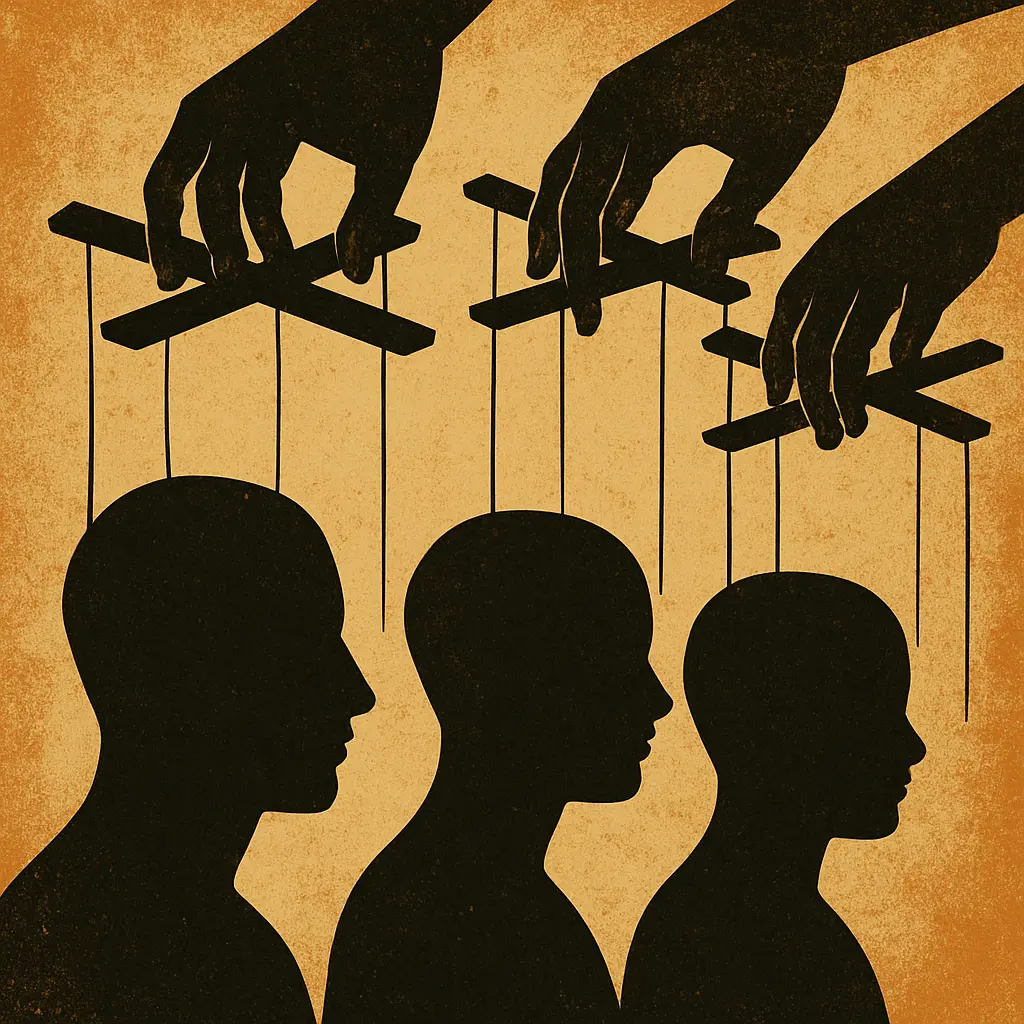
The Puppet Masters

Let’s name some of the true antagonists:

  • Mega-corporations extracting resources and dodging tax
  • Lobbyists writing laws behind closed doors
  • Surveillance firms profiling us under the guise of convenience
  • Billionaires hoarding wealth in a world that can’t feed itself
  • Algorithmic platforms radicalising users for ad revenue

These forces aren’t hidden in shadows. They’re right out in the open, but rarely seen as the enemy—because we’re too busy arguing over pronouns or pineapple on pizza.


But What About Accountability?

Yes, people still make harmful choices.
Yes, individuals can be complicit in cruelty.
Yes, ignorance can do real damage.

But focusing only on the individual is like blaming the leaf for falling when the whole tree is being poisoned. Systems shape behaviour. Narratives shape perception. And we are all shaped—whether we like it or not.


The Role of the “Smart Ones”

If you’re someone who sees the manipulation clearly, your role isn’t to stand above others—it’s to help redirect the lens.

Not with superiority. Not with contempt. But with precision.
Call out the sleight of hand.
Pull back the curtain.
Refocus the conversation.

Because right now, many of the smartest, most perceptive people are caught in the same web—burning themselves out arguing with reflections instead of breaking the mirror.


Solidarity Is a Threat

Here’s what terrifies the system:

  • When a poor conservative farmer and a leftist city renter both realise they’re being screwed by the same landlord class.
  • When neurodivergent people across ideologies start recognising shared patterns of exploitation.
  • When the working class, the disabled, the artists, the overworked and overlooked stop fighting each other and start asking, together:
    “Who’s benefiting from all of this?”

That kind of cross-factional awareness? That’s dangerous.

Because solidarity is hard to control.


The End of the Trick

We don’t all have to agree on everything.
We don’t need to form some utopian consensus.

But we do need to see the stage.
Recognise the magicians.
Refuse to be the props in their show.

Because when the people stop fighting each other, they might finally start fighting back.