
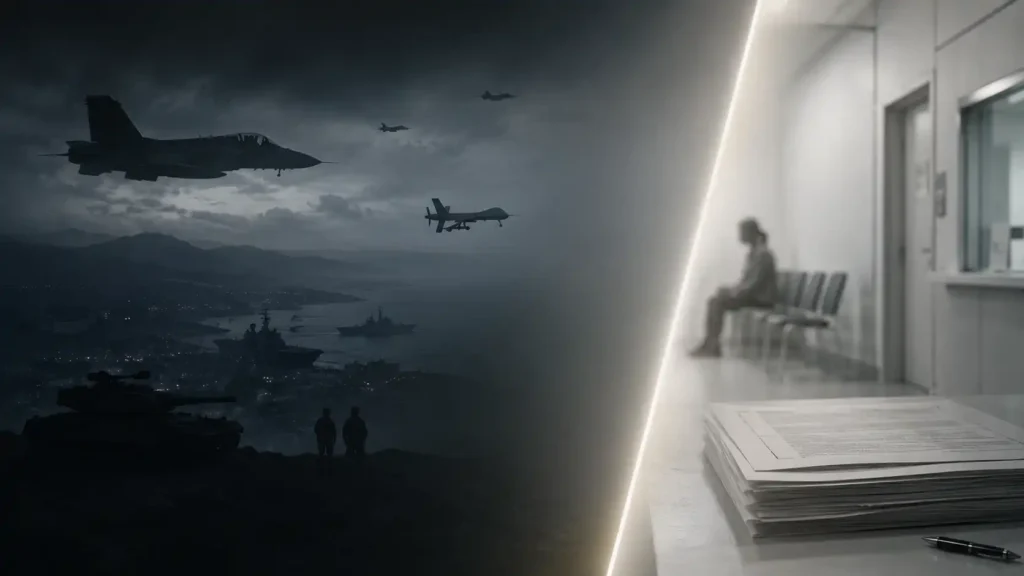
We tend to accept that defence is necessary. There are real threats in the world, and ignoring them is not wisdom. It is negligence. But there is a question we do not often ask: where does defence actually end?
Because when you look closely, defence is not a clear boundary. It is a gradient. Deterrence becomes positioning, positioning becomes provocation, and provocation becomes pre-emption. At some point along that slope, action is taken not in response to harm, but in anticipation of it. And still, it can be called defence. The definition stretches.
Now compare that to care.
Care does not stretch in the same way. It does not adapt or operate on a gradient. It operates on thresholds. You either qualify, or you do not. You are either deemed in need, or you are not. Those lines are often drawn with clinical precision, even when the reality they attempt to measure is anything but.
Struggle is not always legible. Suffering does not always present itself in ways that fit neatly into a form. And yet, care demands proof.
So we arrive at a strange imbalance. We allow ambiguity when deciding whether to act with force, but we demand certainty when deciding whether to act with care. A hypothetical threat can justify immediate intervention, while a real lived difficulty can fail to meet the threshold for support.
This raises a deeper question: what are we actually defending?
If defence is meant to protect life, stability, and wellbeing, then it is worth asking why those same principles are not applied with equal flexibility when it comes to care. Because if one system is allowed to operate on a spectrum while the other is confined to a gate, then the outcome is already shaped before any decision is made. Not by necessity, but by design.