
Stopping to Look
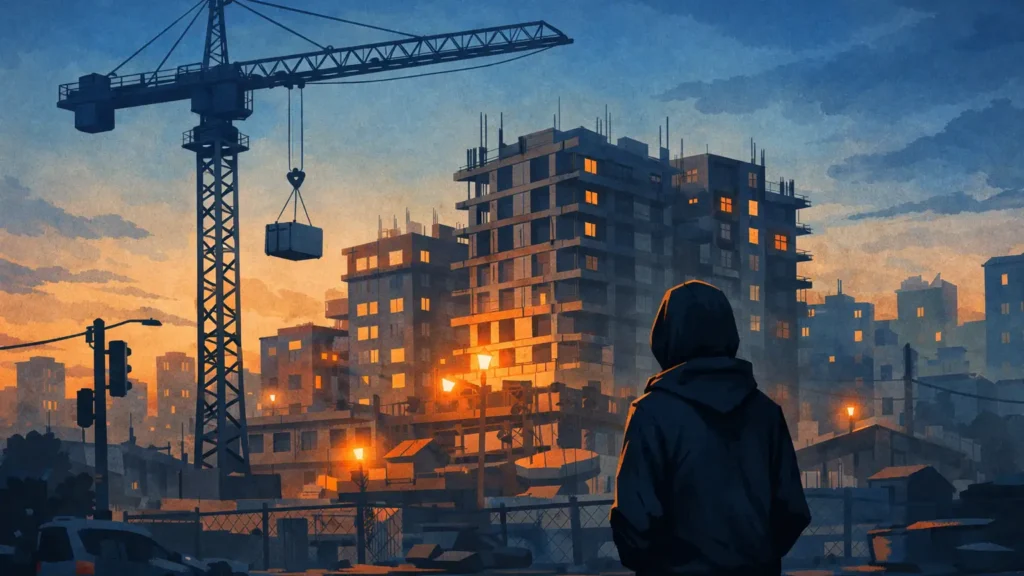
A few days ago, I walked past what has become a common scene in my city. A crane, busy erecting a massive block of residential apartments.
I pass scenes like this so often that they usually blur into the background noise of everyday life. Construction has become part of the city’s ambience. But for some reason, this time, I stopped. I really looked.
What I felt was not optimism. It was not relief. It was not the quiet reassurance that more housing must mean things are getting better.
It felt like encroachment.
When Progress Becomes Colonisation
New developments are often presented as self evidently good. More housing means more options. More options mean progress.
On paper, this logic is clean and comforting. In lived reality, it often collapses.
Progress is not experienced abstractly. It is experienced in bodies, nervous systems, bank balances, and daily friction. From where I stand, this kind of development does not feel like progress at all. It feels like hostile colonisation.
Not an invasion in the historical sense. No armies, no banners. Instead, an overwrite. An environment reshaped without the consent of those already living within it, justified by necessity and framed as inevitable.
The city becomes denser, louder, more competitive. Systems become more complex. Access becomes conditional. Warmth exists, but it is selectively distributed. You can see it everywhere, but that does not mean it is for you.
My first instinct is to point the finger at the opportunistic investors and development interests who see rising demand in cities, have the capital to act on it, and do so without serious consideration for the human consequences beyond their own returns. They profit from scarcity. They profit from pressure. They profit from the fact that people need to live near their work in order to survive.
From that angle, it is entirely reasonable to see them as the villains.
But stopping there is too shallow, because this behaviour is not anomalous. It is rewarded. It is encouraged. It is logical within the system that contains us all.
There is a genuine need for city based housing. People work here. People are required to be here. Money flows to where it will accumulate most efficiently, and housing in cities is one of the most reliable places for that to happen. Capital follows demand. That is not personal cruelty. It is capitalism doing exactly what it is designed to do.
This is what makes the situation harder to confront. The harm does not arise from individual malice alone, but from a system that converts human need into investment opportunity and treats any fallout as external to the calculation.
In that sense, even those who profit most are still responding to a structure they did not invent and cannot easily exit. The colonisation is systemic before it is personal. It is driven less by hatred than by incentive.
That does not make its effects any less real.
Why This Is Impossible to Miss From Where I Stand
This dynamic is not something I am observing from a position of comfort or distance.
I live on benefits, through no fault of my own, but because my neurodivergence conflicts with conventional working expectations. I live in a flat that is far from ideal, with poor heating and little insulation. I am currently facing the very real possibility of eviction due to my landlord selling the property, with homelessness no longer a theoretical concern but a looming one.
So when I see new residential developments rising around me, I do not see abstract progress. I see warmth, stability, and security being constructed nearby, while my own position becomes more precarious.
I see people with means moving into well insulated homes while I ration heating. I see comfort being manufactured and sold at scale while I am squeezed tighter by systems that claim to be expanding opportunity.
This is not envy. It is contrast.
It is the experience of being physically surrounded by shelter while becoming increasingly unsure whether you will have any at all.
From this position, it becomes impossible to treat the idea of choice as abstract or evenly distributed. When housing, warmth, and stability are being actively produced around you, but remain structurally inaccessible, the language of opportunity begins to ring hollow. What looks like expansion from a distance feels like pressure up close. And once that contrast becomes visible, it forces a more uncomfortable question. Not who is choosing well, but who is actually being given meaningful choices at all.
The Myth of Neutral Choice
This is where the language of choice enters, and where it begins to unravel.
Choice is not neutral.
Some people cannot afford not to play. They must engage with unstable systems, rising costs, and constant self optimisation simply to survive. Refusal is not an option. Participation is triage.
Others cannot afford to play at all. They lack startup capital, safety nets, and margin for error. For them, playing is framed as opportunity, but it is actually risk without insurance.
Then there are those for whom playing would require a betrayal of self. Their values conflict too deeply with the demands of participation. Self commodification, endless performance, and strategic dishonesty are not minor compromises. Opting out here is not laziness or fear. It is integrity.
All three positions are flattened into a single accusation.
You chose not to participate.
That sentence erases material constraint, structural exclusion, and ethical refusal in one stroke. It transforms coercion into agency and conscience into failure.
Filtering Disguised as Growth
As cities densify, what is really happening is not simply growth, but filtering.
The environment becomes tuned to those with money, stamina, tolerance for noise and instability, and a willingness to comply. Those without these traits are not expelled outright. They are quietly rendered incompatible.
You can remain physically present while being functionally excluded. Surrounded by housing. Surrounded by warmth. Still unsheltered.
When people say this is progress, what they often mean is that it works for them. That they can play, and that playing does not cost them their sense of self. The system rewards that compatibility and calls it merit.
But a system that demands participation as proof of worth is not offering opportunity. It is applying selection pressure and calling the survivors progress.
What the Crane Signals
From this perspective, another crane on the skyline is not a promise. It is a signal.
A reminder that the city is being tuned to a frequency you are expected to endure, adapt to, or quietly disappear from.
Refusing that story is not negativity.
It is clarity.
:'(