
An Exploration of Authorship in a World of Emergent Complexity
The Comfort of a Single Name
When we admire a work of art, a film, a novel, or a scientific breakthrough, we often look for a single name to attach our admiration to. We want to know who did it. Who made this happen. Who deserves the applause. The poster, the book cover, the article headline all tend to feature one person’s name, as though the work emerged from a vacuum, fully formed and untouched by any other hand.
There’s something comforting about this. It satisfies our desire for stories with clear protagonists. It gives us someone to admire, or to envy. And for the person receiving the credit, it can be deeply validating, offering a sense of pride, identity, and recognition.
But creation rarely works this way. Behind every work lies a web of contributions, both visible and invisible. Assistants, editors, collaborators, tools, influences, and accidents all leave their fingerprints. The idea of a singular creator may be neat and marketable, but it is rarely honest.
This article is an invitation to look beyond the bolded name at the top. It asks us to question how we assign authorship, to consider the complexity of creation in a world where influence flows freely, tools are becoming collaborators, and the old myths about genius are beginning to fall apart.
The Myth of the Singular Genius
From childhood, we’re taught to admire the lone genius. The inventor hunched over a workbench. The composer scribbling in candlelight. The writer with a typewriter and a bottle of whiskey. Our cultural stories often reduce complex achievements to one extraordinary figure, someone who seemingly pulled greatness out of thin air.
Names like Einstein, Picasso, Shakespeare, and Da Vinci have become shorthand for brilliance. Their work was undeniably profound, but the way we isolate them from their influences, their peers, their collaborators, and even the time they lived in creates a kind of distortion. It strips away context and turns humans into myths.
The idea of the singular genius persists because it’s simple. It makes success look like a personal miracle, and by extension, it feeds a fantasy that perhaps we too might become that one name everyone remembers. But this fantasy is not only misleading, it’s unfair to the networks of people and conditions that actually make any creative or intellectual breakthrough possible.
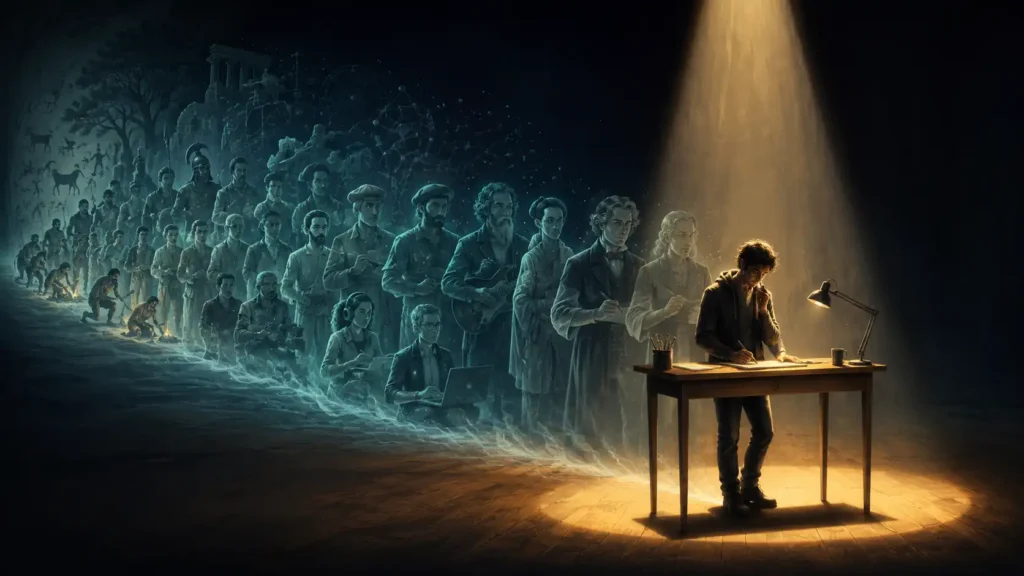
When we tell the story of one genius, we often forget the chorus behind them. We forget the researchers who contributed to the groundwork, the mentors who shaped their thinking, the assistants who executed key tasks, the cultural conditions that allowed their work to thrive, and the less famous peers who were working on the same problems at the same time but didn’t become legends.
This isn’t a call to diminish the greats. It’s a call to see their greatness in fuller context. Real creativity doesn’t happen in a vacuum. It happens in ecosystems.
The Hidden Network of Influence
Behind every creation we admire is a lattice of invisible threads: contributors, influences, tools, and conditions that rarely get seen, let alone acknowledged. Even supposedly “solo” works are saturated with the fingerprints of others.
In the world of film, a director is often seen as the singular creative force, but every frame is the result of hundreds of people working together: lighting technicians, set designers, costume artists, camera operators, editors, stunt coordinators, and even interns fetching coffee while quietly observing the rhythm of production. Some decisions attributed to the director may have originated from necessity, coincidence, or suggestion from someone else entirely.
Anyone who has stayed behind after a movie knows how long the credits can be. Name after name after name, scrolling into the distance. Entire armies of contributors. And yet, how many of us truly absorb them? Most people are already putting their coats on, leaving the cinema, discussing the ending, or waiting to see if there’s a hidden post-credit scene. The credits themselves often become background noise, despite containing the names of the very people who made the experience possible.
The same is true in literature. A novel may bear a single name on the cover, but it passes through the hands of editors, proofreaders, and sensitivity readers. Even before that, the author’s ideas are shaped by every book they’ve read, every conversation they’ve had, and every cultural thread they’ve absorbed. No idea forms in isolation. Every story is built on the bones of older ones.
Then there are the contributors who never make it into the credits at all. The friend who offered a key insight over a late-night conversation. The musician who posted an obscure demo that shifted the tone of a scene. The coder who developed a plugin used in the editing software. The teacher from years ago whose words echoed at just the right time.
And beyond all of this lies the broader world: the socio-political climate, the availability of tools, the limitations of time, the pressure of market trends, the encouragement or resistance from peers. These too shape what something becomes.
To truly see a creative work clearly is to see its full anatomy, not just the silhouette of a single figure at its centre, but the entire ecosystem that allowed it to exist.
Authorship as Parenthood
If the myth of the lone genius feels too neat, too disconnected from reality, then perhaps a more honest metaphor is that of parenthood. To create something — a story, a song, a theory, a tool — is not the same as owning it in full. It is more like giving birth to something that already carries traces of everything that came before.
A parent does not invent a child from nothing. There is inherited DNA, shaped by ancestors, biology, and chance. There are environmental factors — the household, the culture, the education system — that mould the child further. And while a parent may guide and nurture, they cannot claim full authorship over who that child becomes.
The same goes for creative work. Even the most personal, soul-baring piece carries within it echoes of influence — from books read in childhood, from music overheard in a café, from the voice of a loved one, from societal pressure or resistance. These influences do not make the creator less authentic. They make the creation more alive.
Ideas are not objects we forge in silence. They are living systems. They respond, adapt, surprise us. We may initiate the process, and we may shape it along the way, but we are never the sole parent. At best, we are a vital part of a complex lineage.
This perspective does not reduce the significance of the creator. In many ways, it deepens it. It reminds us that to create is to participate in something larger than ourselves — to become a vessel through which countless other voices, histories, and conditions find new form.
The Role of AI in Authorship
If authorship has always been collaborative and entangled, then the arrival of AI does not fundamentally change the picture. What it does is make the hidden network of influence visible in new ways, and harder to ignore.
AI tools are trained on vast amounts of human expression. They carry within them the imprints of thousands of books, artworks, articles, and conversations. When we use them, we are not conjuring something from a void, we are drawing on the collective reservoir of cultural memory. In that sense, AI is less an intruder into authorship and more an amplifier of the truth that authorship was never solitary to begin with.
Yet here we encounter an interesting double standard. When AI is used to assist with art, writing, or music, society often insists that the human is the true author. The AI disappears into the background, treated as no more than a brush or a typewriter. But when AI is used in ways that disturb or frighten us — say, in surveillance, misinformation, or autonomous weapons — suddenly no one is willing to step forward and claim authorship of the consequences.
This asymmetry reveals our hypocrisy. We want the glory when AI helps us create, but we scatter responsibility when AI causes harm. If credit is reserved for humans while blame is dispersed into the fog, then authorship becomes a shield we hide behind rather than a truth we try to tell.
Perhaps what AI really exposes is that our frameworks for credit and accountability were always fragile. We just had the luxury of pretending otherwise.
Why Credit Still Matters
If authorship is always shared, and if AI only makes that reality clearer, we might ask: why bother with credit at all? Why not accept that every work is communal, emergent, and woven from countless threads?
The answer is that credit is not only symbolic. It carries real weight. For the individual, it brings recognition, pride, and identity. To see your name on a book cover, a film poster, or a piece of music is to feel that your effort and imagination have been witnessed. That acknowledgement can be the difference between feeling invisible and feeling validated.
Credit also has practical consequences. Careers are built on it. Opportunities arise from it. Without recognition, artists and thinkers may struggle to sustain themselves, even when their contributions are significant. The marketplace rewards the name attached to the work, often regardless of how collaborative the process really was.
There is also the matter of legacy. Credit becomes part of cultural memory. When we tell the story of history, we remember the names that were written down. Everyone else — the uncredited, the invisible, the overlooked — risks vanishing into silence.
So while the myth of the lone genius is misleading, and while authorship is more entangled than we often admit, credit remains a vital human need. The challenge is not to abandon it, but to make it more honest. To recognise the web of contributors without erasing the individual voice at its centre. To celebrate the ecosystem without pretending it has no heart.
A Call for Honest Attribution
If credit still matters, then the question becomes: how do we assign it in a way that reflects reality more truthfully? The answer is not to erase individuals from the picture, but to move away from the fiction that they ever stood there alone.
An honest approach to attribution begins with recognising the visible and the invisible. It means valuing the editor whose sharp eye reshaped a chapter, the assistant who sparked an idea in passing conversation, the coder whose software made the work possible, and yes, even the machine learning model that helped generate a breakthrough line or melody. None of these diminish the role of the creator. They simply acknowledge that creation is not a solitary act.
This honesty also requires humility. It asks us to let go of the fantasy of complete ownership and embrace the reality of stewardship. To say: I guided this into being, but it carries more voices than mine. In doing so, we preserve the personal pride of authorship while expanding the circle of recognition to include the many forces that make creation possible.
Such a shift does not weaken art. It strengthens it. By admitting the richness of the collaborative fabric, we give greater depth to the very idea of creativity itself. We stop pretending that genius is a spark in isolation and start celebrating it as the light that emerges when countless sparks come together.
Closing Reflection
The story of creation has always been more complex than the names we place on the cover. Every work of art, every discovery, every invention is the child of countless parents, some recognised, some invisible, some long forgotten.
Credit will always matter. We need recognition, both for practical survival and for the deep human need to feel seen. But perhaps we can learn to speak about creation more honestly. Not as the triumph of isolated geniuses, but as something emergent, collaborative, and deeply interconnected.
When we widen the frame, we do not erase the author. We illuminate the chorus.