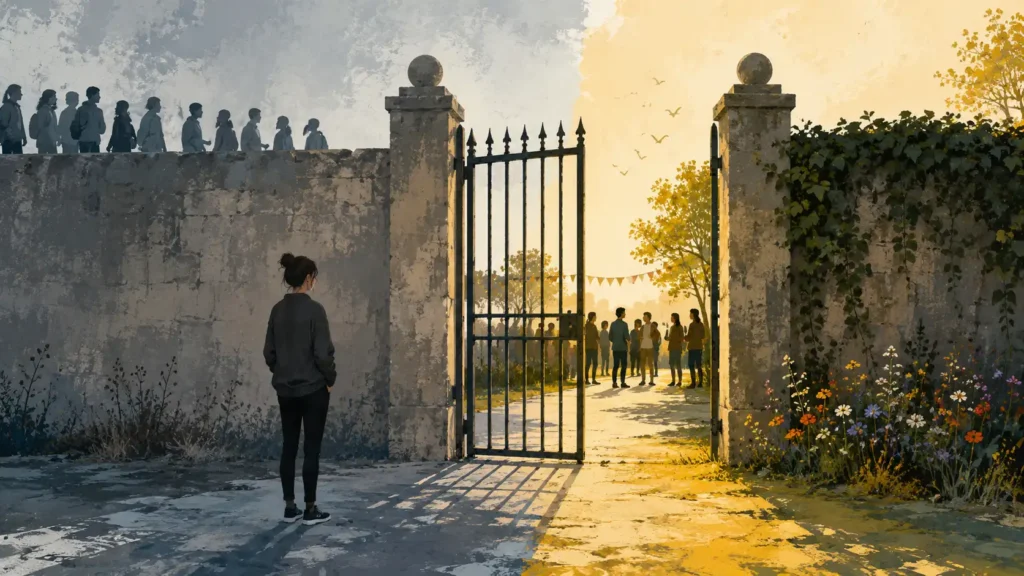
If you have ever felt like you were standing at a locked door, knocking politely while those inside decide whether you are “worthy” to be let in, you have already met the gatekeepers of society.
They come in many forms. Some wear suits and sit behind mahogany desks; others wear name badges and work the front desk. Some you can see: politicians, employers, landlords, editors. Others are invisible, built into algorithms, cultural norms, and policies written in language so dense it might as well be another alphabet. They can be real people, faceless institutions, or even unspoken rules passed down like family heirlooms.
What They Guard
Gatekeepers guard access, sometimes to tangible resources like housing, healthcare, education, or jobs, and sometimes to the intangible currencies of life: legitimacy, belonging, reputation. They decide who gets to speak, who gets to be heard, and who gets to be believed. They filter art, knowledge, and stories, often in ways that shape not just what we consume, but what we believe is possible.
How They Keep the Keys
Power is rarely maintained by accident. Gatekeepers do not just have the keys; they control the locks. They create and maintain systems that keep certain doors difficult or impossible to open. This can be as obvious as requiring credentials most people cannot afford to obtain, or as subtle as changing the rules of entry without telling anyone. Bureaucracy becomes a moat, networking becomes a secret handshake, and politeness and “professionalism” become unwritten codes that quietly push out anyone who does not know them by heart.
For example, I have experienced housing application processes where “pet-friendly” listings suddenly became unavailable the moment my cat was mentioned. I have been in music industry spaces where opportunities were technically “open to all,” but only those who could afford to play unpaid gigs for exposure ever advanced. I have had job interviews where my skills were overlooked because my non-traditional career path did not fit the checkbox criteria. These are all gates, each with their own subtle locks.
And sometimes, the gate is not even visible until you try to walk through it.
Who Gets Locked Out
It is not random. The people kept outside are often those who challenge the very foundation of the system: the neurodivergent, the working class, the chronically ill, migrants, the ones whose appearance, manner, or values do not fit the expected mould. They are the ones who might bring uncomfortable truths to the table, truths the gatekeepers would rather remain outside.
Alternative Gateways
But gates are not the only way in. Some build ladders, tunnels, or whole new doorways. Mutual aid networks, self-publishing, independent art scenes, shadow economies, and digital decentralization are just some of the ways people have bypassed the traditional gatekeepers. AI, for all its risks, is becoming one of these alternative gateways, offering tools that were once locked away behind academic paywalls or corporate systems.
Not all gatekeeping is inherently bad; some gates are there to protect sacred spaces from being exploited. The question is: who decides what is sacred, and whose safety is prioritised in that decision?
The Personal Reckoning
Even though I often find myself on the outside looking in, I do have the experience of being on the inside too. I have felt the cold of the locked door, and I have also found myself, sometimes without meaning to, holding the keys. It is a strange feeling to realise you have become a gatekeeper, even in small ways. The challenge is to be conscious of when we are holding the keys, and to ask whether the lock is protecting something important, or simply keeping people out because that is how it has always been.
Maybe the bigger truth is this: not everyone needs to be let in. Sometimes the best thing we can do is stop knocking, walk away from the door entirely, and build something of our own.
Because once you start noticing the gates, you begin to notice just how much of society is built around them.