
When Weirdness Stops Disrupting
There was a time when absurdity felt genuinely disruptive. Surrealism, dadaism, dream logic, outsider art, existential theatre, and strange experimental comedy often carried the sense that they were interfering with ordinary perception itself. The goal was not simply to be random. Very often the strangeness was connected to something deeper: psychological tension, philosophical uncertainty, symbolic contradiction, subconscious imagery, or emotional realities that resisted direct explanation.
Absurdity functioned as a way of destabilising familiar patterns of interpretation. It interrupted expectation and forced the mind into unfamiliar territory.
The strange thing is that modern internet culture is now saturated with absurdity, and yet much of it no longer feels particularly strange.
The Algorithm Learns Weirdness
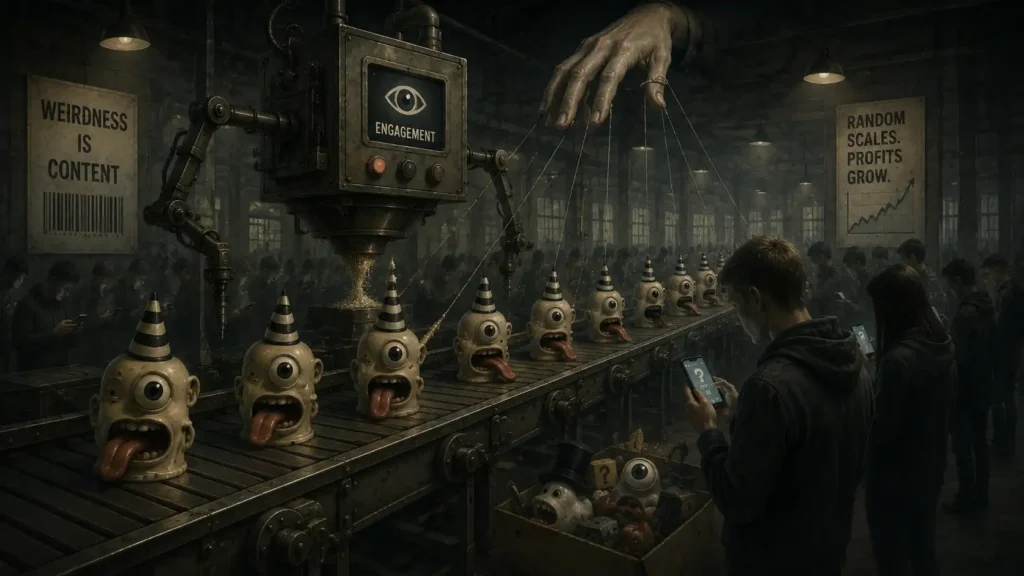
Once online platforms discovered that weirdness generates engagement, absurdity itself slowly became algorithmically valuable. Surreal humour spread rapidly across the internet, and over time randomness gradually evolved into a recognisable aesthetic language. Distorted imagery, fragmented logic, anti-punchlines, chaotic emotional shifts, and deliberately nonsensical juxtapositions became familiar stylistic conventions rather than genuinely unpredictable experiences.
At first this often felt refreshing. Internet absurdity carried an energy that contrasted sharply with more rigid and formulaic forms of humour. But as these aesthetics became increasingly widespread, people were no longer simply creating strange things organically. Increasingly, they were reproducing the appearance of strangeness because “being random” had itself become a culturally recognised style.
And once weirdness becomes culturally expected, part of its disruptive power begins to weaken.
Authentic Weirdness and Performed Weirdness
I think there is an important difference between authentic weirdness and performed weirdness, even if the boundary between the two is difficult to define precisely.
Authentic weirdness tends to feel exploratory. It gives the impression that something unusual is emerging naturally from a genuine artistic, emotional, psychological, or philosophical impulse. Even when the result appears nonsensical, there is often a feeling that the strangeness is connected to discovery.
Performed weirdness feels different. It often feels highly aware of the visual and emotional language of absurdity and intentionally reproduces it. The goal is no longer necessarily to explore unfamiliar territory, but to successfully resemble something already recognised as “weird.”
That distinction matters because one expands perception, while the other imitates the aesthetic surface of expansion.
And because algorithms reward recognisable formats, online culture naturally encourages repeatable weirdness far more effectively than genuinely unpredictable strangeness.
When the Strange Becomes Familiar
Part of what gives absurdity its power is the fact that it can temporarily destabilise ordinary patterns of thought. A surreal image or bizarre emotional juxtaposition can linger in the mind precisely because it resists immediate interpretation.
But when absurdity becomes constant, endlessly repeated, and aesthetically standardised, people gradually adapt to it. The strange begins to lose its ability to interrupt perception because audiences become conditioned to consume weirdness rapidly and superficially.
A genuinely surreal image may now pass through the same endless scrolling environment as disposable “lol random” content, causing both to be processed with similar emotional weight. Instead of dwelling inside the strangeness, people skim over it because the next strange thing is already seconds away.
Over time, absurdity risks becoming decorative rather than transformative.
Fertile Chaos and Algorithmic Noise
None of this means absurdity itself lacks value. In fact, I think absurdity can possess enormous artistic and psychological power. Some forms of surrealism allow people to express things that conventional language struggles to carry. Dreams, contradictions, fears, subconscious tensions, and existential uncertainty can often emerge more honestly through absurdity than through rigid realism.
And importantly, not all artistic value requires direct intellectual meaning. Sometimes aesthetic chaos itself can create emotional texture, imaginative openness, or symbolic possibility without needing to resolve neatly into interpretation.
But there is still a meaningful difference between fertile chaos and algorithmic noise.
Fertile chaos invites exploration. It leaves room for resonance, ambiguity, and discovery. Algorithmic absurdity often behaves differently because the weirdness is designed primarily for rapid consumption rather than psychological depth. The strangeness becomes an aesthetic signal rather than an encounter.
That does not necessarily make it worthless, but it does change the nature of the experience.
The Strange Irony of Modern Weirdness
One of the strangest qualities of algorithmic culture is its ability to absorb almost anything and transform it into consumable content. Subcultures become aesthetics. Rebellion becomes branding. Authenticity becomes performance. Eventually even anti-conformity develops its own recognisable conventions and predictable rhythms.
Absurdity is not immune to this process.
Once weirdness becomes profitable and repeatable, platforms begin rewarding versions of weirdness that can be circulated efficiently. Over time, people begin performing randomness in increasingly familiar ways, often without consciously realising it.
And perhaps that is the real irony at the centre of all this. A culture saturated with weirdness may eventually become less capable of genuinely experiencing the strange at all.