
The Label of “Creative”
Honestly, I cannot even remember anyone calling me “creative”, other than my girlfriend, who is also a creative person, and with whom I share both an individual and collaborative creative identity. What I do remember, however, is plenty of people being willing to make use of my “creative” skills.
As a child, I vaguely remember being referred to as creative by parents and teachers after doing things like drawings or writing quirky little stories. At the time, it made me feel like I stood out somehow, like I had something uniquely my own. I thought perhaps it might even provide me with a place in society where I could eventually find appreciation and understanding. Unfortunately, life did not quite unfold that way.
Back then though, the label felt genuine because it resonated with what I naturally enjoyed doing. It felt less like praise and more like recognition of who I actually was. These days, however, I think I define “creative” very differently to how society tends to use the word. To me, creativity is primarily about generating unique ideas and perspectives. A lot of what society frames as “creative work”, I actually see more as re-creation. Painting an incredibly accurate picture of something that already exists requires skill. Playing somebody else’s music well requires skill. Skill can absolutely support creativity, but I do not think skill and creativity are automatically the same thing.
Early Encounters: Recognition Within a System
One of my earliest experiences of external “creative validation” came when I was a teenager. I entered a Royal Mail competition to design a Christmas card for their employees and, to my surprise, I actually won first prize. The card was printed and distributed nationally.
The judge was Tony Hart from Hartbeat, and I even got to meet him and have lunch with him afterwards. At the time I was so overwhelmed and excited by the entire experience that it never even occurred to me to ask him what it was he actually liked about my design.
The design itself was a painting of a robin, with a snowy street scene and a post office in the background. Very festive. During the award ceremony I was shown around the design offices and printing facilities, and I remember seeing graphic designers making small adjustments to my work before printing. Colour tweaks and contrast adjustments made sense, but there was one thing that stuck with me. They had covered up the “Post Office” sign in the painting with a blob of edited snow.
To this day, I still have no idea why. Maybe there were legal or branding reasons behind it. Maybe it was some strange bureaucratic requirement. But even at that age, there was something oddly disappointing about seeing part of the image quietly altered in order to fit external requirements. It did not ruin the achievement, and I am still proud of winning the competition, but looking back I can also recognise the beginnings of a pattern. Creativity was welcomed and celebrated, but only once it had been gently reshaped to fit comfortably within somebody else’s framework.
Competitions themselves are also strange things when viewed through an adult lens. They sit somewhere between validation and exploitation. Then again, they probably paid Tony Hart considerably more than they paid me. I got a £500 shop voucher.
Creativity as Commodity
That pattern only became clearer in adulthood. Over the years I have had a number of roles with words like “design”, “creative”, or “production” attached to them. I have done design assistant work on short films and live concerts, worked on set design in amateur theatre, completed a trial week as a graphic designer, produced music for a mental health charity, and provided drum composition, mixing and mastering for a friend’s drum and bass project.
On paper, all of these sound like creative jobs. In reality, most of them were not.
The theatre role, for example, was not really “design the set”. It was more “we already know exactly what we want, now go and source or manufacture the pieces we need”. Likewise, on the film projects, the role of “design assistant” largely translated into glorified errand-running. I remember being sent out to find a very specific low-wattage light bulb and being met with frustration when I could only locate a medium one. Another task involved collecting a hundred egg cartons because somebody believed they worked as soundproofing.
They do not.
It was “creative” in title only.
Even music production, something people often romanticise as deeply artistic, frequently ended up functioning more like technical labour. At the charity, a large amount of the work simply involved recording vocals over pre-made YouTube beats. Occasionally somebody would ask me to “work my magic”, but what they usually meant was “put an effect on it”.
The clearest example for me was probably working on a friend’s drum and bass project. I spent time crafting a drum track with its own feel and identity, only for it to immediately be compared against a completely generic stock rhythm with the request: “Can you make it sound more like this?”
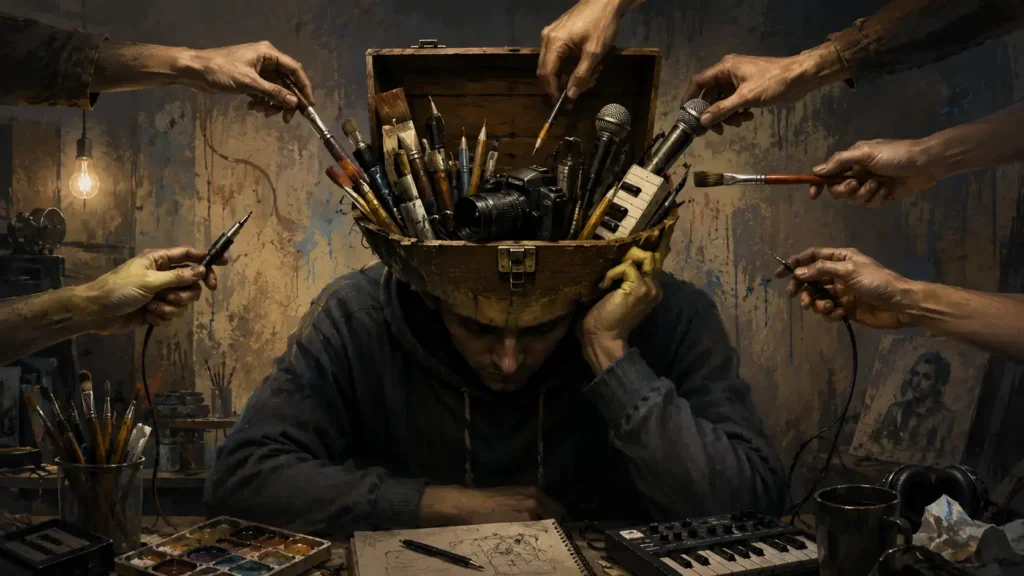
That moment really stayed with me, not because criticism itself is inherently bad, but because it highlighted something important. My creativity was never really the point. My skills were. I was being treated less like an artist and more like a tool.
The Myth of the “Dream Creative Job”
My dream creative job has always been very simple. I want to create what I genuinely feel driven to create, to have it appreciated, and ideally to somehow sustain myself from doing so.
At some point in early adulthood, probably after leaving art college, I realised that this “dream job” does not really exist in the conventional sense. It is not something you can realistically apply for. It is more like an improbable state of alignment that a very small number of people somehow stumble into.
The reality for most creatives is far bleaker than the fantasy.
You simply continue creating anyway, often unpaid, hoping that somehow your work eventually finds enough recognition to become sustainable. And even then, talent is only one small part of the equation. Social dynamics, networking, psychology, timing, algorithms, politics, economics and luck all heavily influence who gets seen and who does not.
Naturally, a compromise begins to emerge. If I cannot get paid for creating my vision, perhaps I can at least get paid for helping realise somebody else’s. Maybe there will be enough overlap to satisfy that creative urge, and if not, I can always continue my own work privately on the side.
This is where the strange hollowness starts creeping in.
I receive praise all the time for helping other people realise their ideas, and while I appreciate the gratitude, it rarely feels like validation of my creativity itself. It feels more like validation of my utility. The skills I developed originally existed to support and externalise my own creative vision. When those same skills are redirected toward fulfilling somebody else’s ideas, the praise can start to feel less like recognition of artistry and more like praise for being an effective tool.
I think this is part of why I struggle to relate to the current culture surrounding creativity online. I see younger generations endlessly chasing likes, follows, engagement metrics and algorithmic approval, still believing that if they work hard enough and develop enough skills, eventually it will all “pay off”. But I cannot help feeling that many people are being lured into the exact same trap.
The bait is validation. The switch is utility.
Reclaiming Creativity
The only times I have ever truly felt like an artist have been when I have initiated projects myself. My own music, my own writing, my own strange ideas. I still write full albums, despite the format supposedly being “dead”, because I care far more about storytelling and cohesion than I do about optimising for algorithms or attention spans.
The key difference is simple. I am not fulfilling somebody else’s brief. I am generating ideas that emerge naturally from my own experience of existing.
When I work on my own terms, there are no arbitrary deadlines, no constant second-guessing, and no pressure to dilute meaningful details because somebody else does not understand why they matter. The only pressure is the pressure to satisfy my own standards and vision, and strangely, that pressure feels healthy. Meaningful. It feels aligned.
Because of that, I do not really need external affirmation in order to feel like an artist. My identity as an artist simply is. I create, therefore I am.
That does not mean collaboration is impossible, but over time I have learned to become extremely selective about who I collaborate with and why. I now pay close attention to whether my ideas are genuinely part of the project, or whether I am simply being used to facilitate somebody else’s vision.
Ironically, not taking payment can sometimes feel liberating. Without money involved, your ideas themselves become part of the currency. Your involvement becomes conditional upon creative alignment rather than financial transaction.
Personally, money has never really felt validating to me anyway. If anything, introducing money into creativity sometimes feels uncomfortably close to prostitution. Not because labour is shameful, but because the emotional and existential core of creativity can become separated from the thing being sold.
The Artist and the Tool
Over time, I think I have learned to clearly separate skills from voice. Skills are tools. They are things I have developed in order to externalise and support my creative vision, but they are not the vision itself.
Ultimately, creativity begins internally. All I truly need in order to be creative is my mind. Externalisation is simply the process through which others are able to witness it.
If I could speak to my younger self, I would probably tell him that he already knows deep down he will never find fulfilment in realising other people’s dreams.
A genuinely creative person, in my eyes, is somebody with an intrinsic drive to manifest the emergent constructs of their psyche. Not for money, not for praise, and not even for validation, but simply because that is what they naturally do.
That, to me, is the difference between the artist and the tool.
So when somebody asks you to do something “creative”, I think it is worth asking yourself a very important question: are they asking for your voice, or are they asking for your skills?
Because if it is only your skills they want, then what they are asking for is not creativity. It is labour. Labour has value, and it should absolutely be respected and compensated appropriately, but it should not be confused with validation of your identity as an artist.
Creativity, in its purest form, was never really theirs to validate in the first place.