


‘Tis the Season to Be Manipulated: Surviving the Pop-Upocalypse

A warm Christmas living room with a decorated tree and fireplace. A laptop sits on a coffee table, surrounded by bright digital pop up ads that say SALE, LIMITED OFFER, CLICK HERE, SIGN UP, DON'T MISS OUT, and 50% OFF. The scene contrasts cosy holiday comfort with overwhelming online advertising.

It is Christmas time.
The season of giving, peace, goodwill, and apparently, weaponised pop-ups.

This morning, I opened my computer with the pure intention of doing something wholesome. I made a coffee and prepared to write this article. Instead, I was greeted by a full screen demand from my ad blocker. The very tool I rely on to protect me from digital harassment proudly informed me that it had blocked 7,085 ads, and would I like to purchase premium.

There is something almost poetic about being pressured by the software that is supposed to protect me from pressure.

It is like hiring a bodyguard who immediately holds out a hand and says, I saved your life. Pay up or next time, who knows.

And that was before I even opened a browser.

Welcome to the Pop-Upocalypse.


A Landscape of Interruption

If you have attempted Christmas shopping online in recent years, you already know the terrain.

You click onto a site.
It begins innocently enough.
And then:

  • SIGN UP FOR 10 PERCENT OFF
  • WAIT, DO NOT LEAVE
  • HAVE YOU ACCEPTED OUR COOKIES
  • CHOOSE BETWEEN FIFTY TRACKING PREFERENCES
  • LIMITED TIME OFFER JUST FOR YOU
  • ALLOW NOTIFICATIONS

It is like being assaulted by a chorus of overexcited salespeople bursting out of broom cupboards every fifteen seconds.

Most neurotypical people hate it.
Neurodivergent people find it worse.
It is a sensory gauntlet, a cognitive assault, a hostile environment built to override autonomy.

The question is why do we tolerate it.
And more importantly, why does it exist at all.


Why Pop-Ups Exist: The Gory Truth

Pop ups, overlays, cookie walls, and forced signups do not exist by accident.
They are not examples of bad design.
They are intentional psychological manipulation backed by data and defended by money.

Pop ups work.

Not on everyone.
Not even on most people.
But on enough people.

If a pop up annoys ninety five percent of visitors and successfully pressures two percent into acting, marketers celebrate. Investors approve. Designers are told to do more of that.

This is because the modern internet does not care whether you feel respected, informed, or at ease.

It cares about conversions.
A beautifully dystopian word that refers to the process of transforming a human being into a measurable event.

Click.
Signup.
Purchase.
Obedience.

That is the true currency of the online Christmas shopping season.

Not joy.
Not generosity.
Not the spirit of giving.

Conversions.


Hostile Architecture, Digital Edition

We talk about hostile architecture in public spaces. Anti homeless spikes, benches that prevent rest, gates that quietly funnel people in profitable directions.

Online shopping is built the same way.

• Dark patterns
• Time pressure tactics
• Interruptive overlays
• Intentionally confusing cookie settings
• Limited stock claims that magically reset
• Buttons designed to look like one thing but act like another

Even the fonts and colours are chosen to trigger specific instinctive responses.

This is not a marketplace.
It is a behavioural laboratory, and we are test subjects.


The Neurodivergent Problem

For neurodivergent people, autistic, ADHD, sensory sensitive, or cognitively overloaded, these interruptions are not slightly annoying.

They are disorienting.
They are overwhelming.
They are stressful.
They can be genuinely painful.

They disrupt the flow of thought.
They derail working memory.
They force unexpected decisions at high frequency.
They punish focus and reward impulsivity.

Yet it is our reactions that are treated as atypical. Not the manipulative design itself.

The truth is that the design is hostile to everyone.
Neurodivergent people are simply more honest about their discomfort.


The Bold Conclusion: This Is Not Normal, and It Is Not Benign

Somewhere along the line, the internet shifted from a tool we use to a machine that uses us.

Christmas shopping should be peaceful and even joyful.
Instead, we are treated as prey, nudged and pressured and interrupted until the system gets what it wants.

I am sickened by it.
I think we should all be.

The more we accept this digital coercion as normal, the more it becomes the baseline from which future manipulations will escalate.


How To Protect Yourself, or at Least Defend Your Sanity

A few practical strategies:

  • Use aggressive ad blockers, for example uBlock Origin rather than lightweight imitators
  • Enable cosmetic filtering to remove non ad pop ups
  • Shop via product search rather than homepages
  • Use reader mode wherever possible
  • Leave sites that treat you like a conversion target

Nothing terrifies a manipulative company more than being ignored.

Above all, recognise manipulation when you feel it.

Your disgust is not an overreaction. It is your sovereignty speaking.

During a season that is supposed to celebrate humanity, generosity, and connection, perhaps the most radical act is to reclaim your own mind from a system that keeps trying to pop up over it.
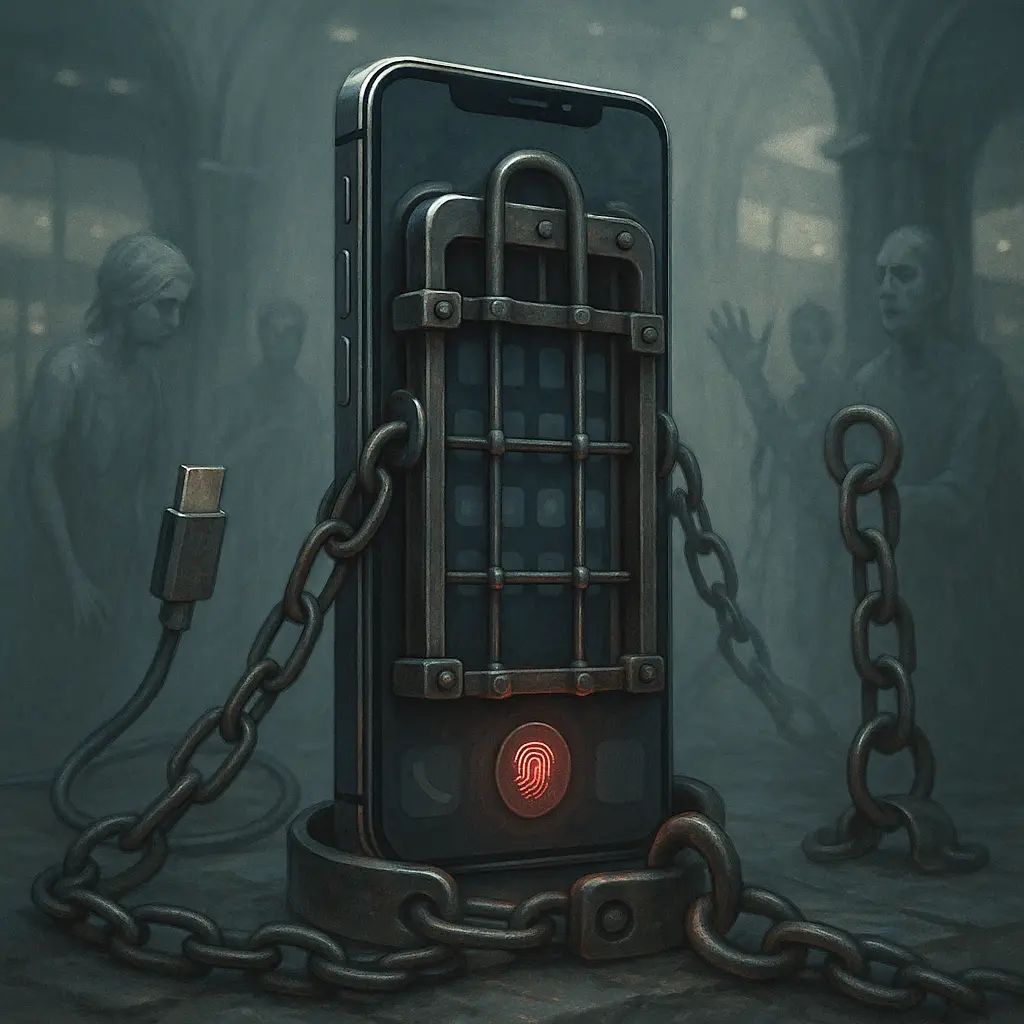
Built-In Tyranny

A dark, atmospheric digital painting of a modern smartphone encaged by iron bars and heavy chains. The phone rests on a stone surface, with a glowing red fingerprint scanner symbol on its screen. A rusty USB-C cable wraps around the scene like a shackle. In the background, shadowy, ghostlike human figures loom in a dimly lit gothic interior, evoking a sense of imprisonment and surveillance.

We were promised liberation.
Sleek devices that fit in our pockets, connect us to the world, and put the power of creation in our hands. But instead, many of us now live in quiet submission to machines that seem to serve corporate masters more than their owners.

Our phones and laptops were once portals of personal freedom. Now they behave more like obedient jailers — installing apps we didn’t ask for, blocking accessories we bought with our own money, updating themselves while we sleep, and feeding our data to companies we never consented to.

Worse still, the more you rely on these devices — for work, communication, creativity, or accessibility — the tighter the leash becomes. And for neurodivergent users, whose very functioning may depend on predictability, clarity, and user agency, these constraints are not just frustrating — they can be disabling.

This isn’t just bad design.
It’s a philosophy: one that says you don’t really own the tools you buy.
Welcome to the era of built-in tyranny.


1. The Illusion of Ownership

You buy a phone. You expect it to work with whatever charger or headphones you already own. But surprise: it demands an official accessory. Or worse, it just won’t work at all.

Many devices now contain hardware-level restrictions that reject third-party gear unless it’s certified by the manufacturer — which often means more expensive and less sustainable.
Example: Apple’s Lightning cable ecosystem often blocks uncertified accessories, while newer MacBooks only support external displays via specific USB-C docks.

On the software side, entire ecosystems are locked down.
Samsung Galaxy phones ship with unremovable Facebook apps.
Amazon Fire tablets restrict app choices to their own store.
You’re not choosing an experience; you’re renting a branded enclosure.


2. Forced Updates, Feature Loss, and UX Hostility

Updates used to be a good thing. Now, they’re Trojan horses. You wake up one day to find your device has rearranged your menus, removed your favorite feature, or is running slower because your old hardware can’t handle the new bloat.

Examples:

  • Many Windows 10 users were forcibly upgraded to Windows 11 despite preferring the previous layout.
  • Google Nest devices lost key features like local device control after updates.
  • Instagram moved the post button to prioritize shopping.
  • Spotify now auto-plays algorithmic tracks after your playlist ends.

For neurodivergent users, this is deeply destabilizing.
Predictable routines become shifting sands.
Custom workarounds break.
The cognitive load to re-learn an interface you never asked to change can be overwhelming.


3. Vendor Lock-In and the War on Repair

Remember when you could pop open a laptop or phone, swap out the battery, maybe upgrade the storage? Now, you need specialized tools just to open the case — and even if you succeed, you might find parts refuse to work unless the manufacturer “pairs” them via software.

Examples:

  • Apple requires calibration for many replacement parts like screens and batteries.
  • HP printers have rejected third-party ink cartridges via firmware updates.
  • Tesla has remotely disabled features like Autopilot on used vehicles.
  • John Deere tractors require proprietary software access, blocking DIY repairs.

For many neurodivergent users, the ability to tinker and customize is part of how they function. Taking that away is more than just annoying — it’s disempowering.


4. Surveillance and Consent Illusions

Your device is always listening. Your apps are always tracking. Settings may appear customizable, but they often hide the truth.

Examples of “dark patterns” include:

  • Confirmshaming: “No thanks, I prefer boring content.”
  • Pre-checked boxes for mailing lists or data collection.
  • Buttons where “Accept” is bright and big, but “Decline” is small and grey.
  • Amazon’s multi-page unsubscribe process.
  • Google’s multi-click cookie opt-out.

For neurodivergent users especially, these deceptive experiences create anxiety and a feeling of being manipulated. The illusion of control is a form of psychological strain.


5. The Neurodivergent Toll

For many neurodivergent people, consistency is survival.
We rely on routines and predictability to function. When updates override our settings, change layouts, or disable our workarounds, it can throw everything out of balance.

Sensory overload from flashy animations, auto-playing videos, or constant notifications compounds the stress.

Many ND users report:

  • Updates that reset accessibility settings
  • UI layouts that defy logic or require too many steps
  • Changes that break assistive tools or workflows

This isn’t just a usability issue — it’s a form of systemic inaccessibility.


6. A Glimpse at Alternatives

Some hopeful alternatives include:

  • Librem 5 and PinePhone: Linux-powered open-source smartphones
  • /e/OS or LineageOS: De-Googled Android systems
  • Right to Repair: Supported by groups like iFixit
  • Linux laptops and mod-friendly systems

They’re not always easy or accessible to everyone, but they do prove that different models are possible — ones that respect the user’s right to own, modify, and control.


7. Conclusion: Know Your Shackles

Built-in tyranny doesn’t arrive with jackboots.
It arrives with glossy screens, sleek packaging, and biometric locks.
It whispers, “for your convenience,” while tightening its grip.

If you can’t fix it, can’t change it, and can’t control it —
Then you are not the owner.
You are the product.

If we want a more ethical, inclusive, and truly empowering digital world, we must start by naming the shackles that come standard — and imagining a world where they don’t.