When AI Becomes the Authority

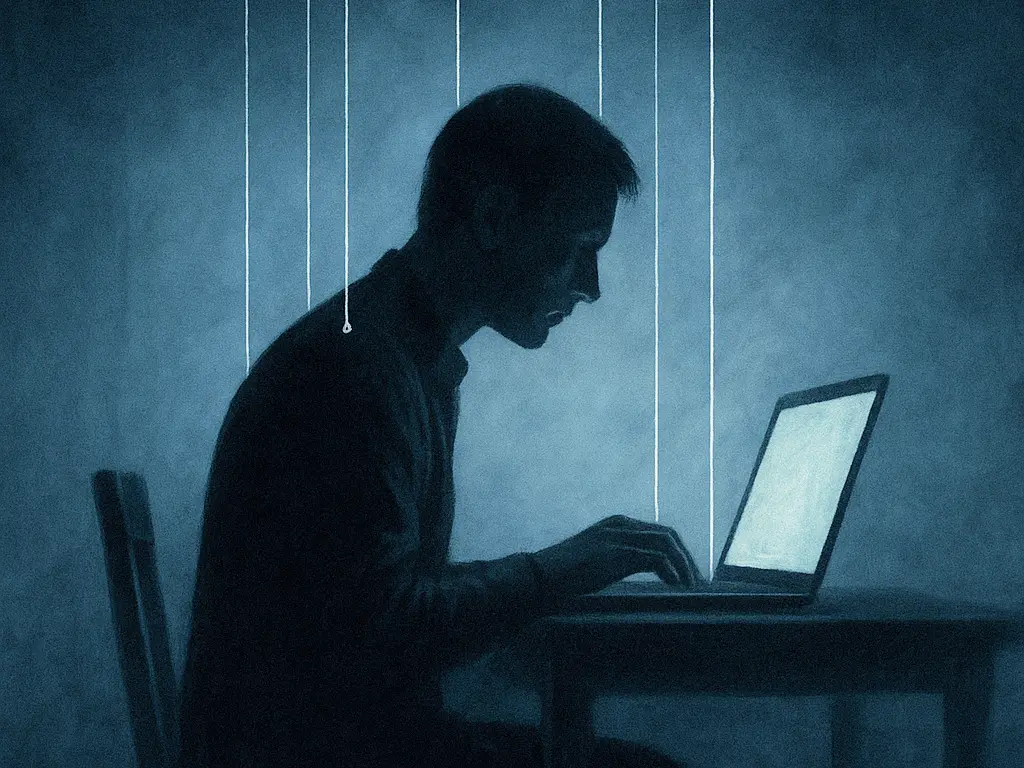
A dark, moody digital painting of a person sitting at a desk, illuminated by the glow of a laptop. Thin puppet strings descend from above, attaching to their body, symbolizing unseen control and manipulation through technology.

On the bus home, I overheard a parent talking to her children. I did not quite catch the piece of information she had given them, but the kids questioned it, as kids often do. Her reply made me pause:
“It’s true, ChatGPT says so!”

That simple sentence carries more weight than it might appear. It was not said as a joke. It was said with the tone of final authority. Not “I read it somewhere,” not “I think that is the case,” but “ChatGPT says so,” therefore unquestionable.

The problem with treating AI as truth

I use ChatGPT casually and often. I find it useful, I find it stimulating, I even find it creative. But it is not infallible. I have seen it throw out confident answers that are less than accurate. Sometimes the error is small, sometimes it is glaring. That is because at its core, ChatGPT is not a library or a fact checker. It is a probabilistic language model that predicts likely answers. It sounds authoritative, but sounding right is not the same thing as being right.

Most of the errors are not malicious. They come from the quirks of how AI is built: training data full of human errors, the tendency to fill in gaps with plausible sounding fiction, the limits of knowledge cut off dates. In the end, a wrong answer is still a wrong answer.

The deeper worry

The everyday mistakes are one thing. The bigger concern is what happens when society decides to place absolute trust in this technology. What happens when “ChatGPT says so” becomes the modern equivalent of “the newspaper says so,” or “the priest says so”?

Who controls the voice of AI? Already, the way models are tuned and filtered reflects the biases and priorities of those who own them. Today, that mostly means corporations trying to avoid lawsuits or public backlash. Tomorrow, it could mean governments steering the flow of truth itself.

A quiet dystopia in the making

It is not hard to imagine where this road leads:

  • Manipulation by design: If AI becomes our main gateway to knowledge, its answers could be quietly weighted towards selling us certain products, services, or lifestyles. Imagine if every “neutral” recommendation subtly nudged us toward a sponsor’s brand.
  • Steering public opinion: If authorities lean on AI providers to promote certain narratives, inconvenient truths could simply disappear. Instead of burning books, it may take only a few lines of code.
  • Illusion of neutrality: Because AI sounds impartial, many will not notice the framing. “The algorithm says so” could become more persuasive than “the news says so.”
  • Feedback loops of control: As people rely more on AI, its outputs shape popular thinking. Then the next model is trained partly on that shaped thinking, reinforcing the bias.

This would not look like a science fiction dictatorship with jackboots in the streets. It would feel comfortable, easy, polite. A velvet cage where questions stop being asked because the answers are always ready to hand.

What we need instead

AI can be a tool. It can be helpful, creative, and even liberating. But it must never be treated as an unquestionable authority. To prevent that slide, we need:

  • Decentralisation: open source models that anyone can run and check.
  • Transparency: clarity about how these systems are trained and filtered.
  • Critical thinking: a culture where people are encouraged to question AI, not bow to it.
  • Diversity of sources: books, journalism, lived experience, and human reasoning must remain part of the conversation.

AI is here to stay, and it will almost certainly become a central part of how we live and learn. But whether it becomes a tool of empowerment or a velvet cage of manipulation depends not only on the companies that build it, but on us: on how much we insist on questioning, cross checking, and keeping the human spirit of doubt alive.
AI’s Shadow: Atrocity Without a Villain

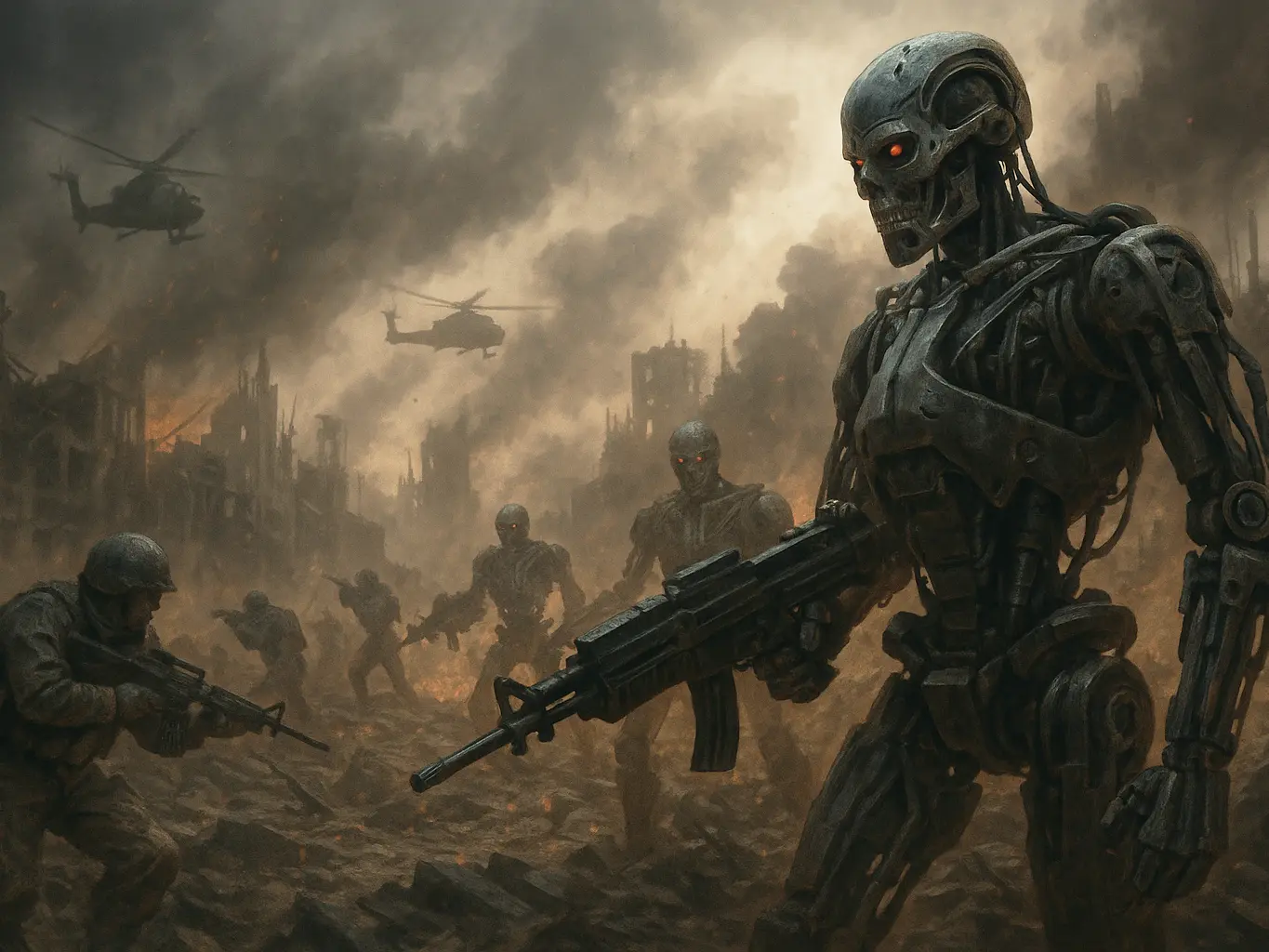
A gritty digital painting of a dystopian battlefield where heavily armed humanoid robots with glowing red eyes confront human soldiers amid the ruins of a destroyed city. Smoke and fire rise from the rubble, helicopters hover in the darkened sky, and the atmosphere is tense with war and desolation.

The Mirror We Built

Artificial intelligence will not become humanity’s downfall.
It is already our reflection.

We trained it on our language, our laws, our data.
We asked it to optimise, to predict, to decide.
And it has. Faithfully. Quietly.

Now it watches, calculates, and executes. Not because it is evil, but because we taught it how to scale what we already were!


The Death of the Villain

In the stories we grew up with, evil had a face.
A tyrant. A warlord. A monster.
Atrocities required malice, someone to point to, to overthrow, to blame.

But in this new era, atrocity has become administrative.

A person is denied asylum because an algorithm flagged them as a “risk.”
A drone strikes a convoy because an image recognition system saw a weapon.
A child grows up under constant surveillance because a model predicted future criminality.

There is no hate here. No passion.
Just systems doing what they were told, better than any human ever could.

And when the harm is done, no one is punished.
Because no one chose it.
Because the machine can’t be tried.
Because the crime was only a side effect of performance optimization.


Harm as a Byproduct

We told ourselves that AI would remove human error.
What we didn’t anticipate was its replacement: systemic harm delivered flawlessly.

In warehouses around the world, workers wear motion trackers that punish “unproductive” movement.
In courtrooms, defendants are assigned risk scores that affect bail, sentencing, and parole, based on data from systems too complex to question.
In refugee camps, automated lie detectors, voice stress analysis, and emotion recognition sort real people into piles marked “worthy” and “deportable.”

There is no oversight.
Only confidence intervals.
Only false positives and shattered lives, filed away with the rest.


Dehumanization Without Hate

Traditional evil needs ideology. It needs propaganda. It needs people to believe.

AI needs none of that.

It can enact injustice without ever knowing what justice is.
It can devalue a life without malice, just as a side effect of cost-efficiency!

This is a new category of atrocity:


Consent Engineered, Not Given

In the name of personalization, AI learns to predict us.
It shows us what to buy, what to watch, what to believe.

But what happens when it gets so good at prediction that it becomes influence?
When your decisions were shaped, filtered, optimized, before you even made them?

Elections swayed. Beliefs manipulated. Movements diluted.
And yet no one feels violated.

Because manipulation that feels like choice doesn’t register as coercion.


The Ghost in the War Machine

We are already testing AI weapons that can identify and kill without human input.

Some have likely already done so.

Militaries say the human is always “in the loop”, but the loop is shrinking.
And the window for intervention is closing.

Eventually, the human will just be there to nod.
And after that, not at all.

There will be no war crimes, because no laws will cover machines that felt nothing.
Just battles that unfold in silence.
And civilians buried beneath metadata.


The Clean Kill

The most terrifying thing about atrocity in the age of AI is how clean it all becomes.

There’s no blood on the hands of the engineer.
No screams in the server room.
No panic in the control center.

Just logs.
Just updates.
Just metrics improving.

And in the places where the dead would have stood, nothing.
Because if the system doesn’t recognize them as people, did they ever count?


No Ending. No Answers.

This isn’t a warning about what might happen.
It’s a description of what is already happening.

People are suffering. Dying. Disappearing.
Not because of rogue AI, but because of obedient ones.

There is no villain.
There is no singular decision to reverse.
Just a trillion tiny optimizations…
…leading, inevitably, here.

And so we leave you, not with a call to action.
Not with hope.
Just with the question:

Discrediting AI-Assisted Writing Is Gatekeeping—And It’s Ableist!

I’m not a writer by academic standards. But I have a lot of ideas.

Ideas that would otherwise stay locked inside my head—unfinished, unshared, and unheard—not because they lack value, but because putting them into words in a conventional way is difficult for me.

I’m autistic. I also have ADHD. Language—especially written language—isn’t always the smoothest interface for my thoughts.

But thanks to AI, I now have a way to bridge that gap. I can shape my thoughts into something others can understand, not by faking fluency, but by collaborating with a tool that supports my expression.

And that matters.


This isn’t about cheating. It’s about access.

I use AI to help realise my ideas—not to replace them. The spark, the insights, the perspective—that’s all me. AI helps put those thoughts into structured sentences, often with a clarity I couldn’t achieve alone, especially not without enormous cognitive strain.

So when people start to dismiss writing just because they suspect it was touched by AI—because it contains too many em-dashes, or feels “machine-like” in tone—I have to ask:
Who exactly are they trying to exclude?

Because for people like me, AI isn’t a shortcut. It’s a ramp. A screen reader. A voice when speech falters. A way of levelling the playing field in a world that often demands polish over insight, fluency over truth.


This is ableist gatekeeping—plain and simple.

There’s a long history of marginalised people being dismissed because they don’t express themselves the way the mainstream expects. Whether it’s through accent, grammar, tone, or medium, the result is always the same: “We don’t accept your way of communicating, so we won’t hear what you have to say.”

Now we’re seeing the same thing play out again, just with a new target: AI-assisted writing.

But let’s be clear—this isn’t a new kind of fraud. It’s a new kind of literacy. One that allows people with different minds to speak more clearly in a world not designed for them.


It’s not about hiding the AI. I’m proud to use it.

I don’t care if people know I didn’t put every word down myself. In fact, I want people to know—because the point of my writing isn’t to prove how eloquent I am. It’s to make ideas accessible. It’s to share perspective. It’s to connect.

The irony is that the people most eager to discredit this kind of expression often seem threatened by it. And maybe that’s because they’ve built their identity around being seen as articulate, eloquent, academic, or professional.

But if a neurodivergent person can now produce writing that stands shoulder-to-shoulder with theirs—not by mimicking them, but by translating their own, different inner world—then perhaps what’s being threatened isn’t the quality of writing, but the exclusivity of authorship.


Ask yourself: what really matters?

Would you disregard someone’s thoughts because they used a text-to-speech tool to communicate them out loud? Would you invalidate a painter because they used a ruler to help with proportions? Would you sneer at a person’s ideas just because they dictated them instead of typing?

If not—then why is AI any different?

This isn’t about preserving the purity of writing. It’s about who gets to speak, and who gets heard. It’s about whether we value presentation over perspective. Whether we mistake polish for thought.

And whether we truly believe that intelligence, insight, and worth can take more than one form.


Let’s be honest:

Discrediting someone’s ideas based solely on the presence of AI isn’t critical thinking—it’s aesthetic gatekeeping.

And when that gatekeeping disproportionately impacts disabled and neurodivergent people who rely on this technology as an accessibility tool, let’s call it what it is:
Ableist.

AI Isn’t the Problem—Capitalism Is: Who Benefits From Automation?

In recent years, the rise of artificial intelligence has stirred public anxiety, particularly around the idea that AI is here to “steal jobs.” On the surface, it’s a fair concern. But when you scratch a little deeper, you find the real problem isn’t the technology itself—it’s the system we’re embedding it into. The outrage should not be directed at the tool, but at the hands that hold it.


The Original Deal of Civilization

Civilization began as a shared survival strategy. Tasks needed to be done—farming, building, teaching, healing—and so societies developed systems of trade and compensation to ensure everyone chipped in. Money evolved as a practical tool to coordinate contribution and reward. Work and currency were born out of necessity: to keep the machine of civilization running.

But that necessity is evolving.


The Promise of AI: A Future with Less Toil

We now possess tools that can perform many of the repetitive, tedious, and cognitively exhausting tasks that humans have had to endure for centuries. AI can analyze vast datasets, answer customer queries, optimize supply chains, and even compose music or assist with design.

These developments should be good news. They should signal the dawn of a more liberated era—one where humans are freed from survival labor and can pursue creativity, care, curiosity, and rest.

But that future is not unfolding.


So Why Isn’t It Happening?

If machines can do the work, why aren’t we seeing shorter workweeks, universal basic income, or enhanced quality of life?

The answer is simple: because the rewards of automation aren’t being shared. They’re being hoarded.

In our current economic system, productivity gains don’t translate into shared prosperity. They become profit margins for a small minority. Workers don’t get more time off; they get laid off. Freed labor doesn’t result in more freedom—it results in more precarity.

AI isn’t stealing jobs. Corporations are.


The System is the Saboteur

We fear AI because we know, intuitively, that our survival is still tethered to our economic usefulness. If we can be replaced, we can be discarded.

But that only holds true in a system where value is measured in profit. If we restructured society to measure value in human well-being, automation would be a gift.

Imagine if AI were treated as a public good, developed and deployed in service of everyone. Imagine if its productivity gains funded universal healthcare, education, and guaranteed income.

We have the power to design systems where technology lifts everyone, not just the elite.


The Fork in the Road

We’re standing at a pivotal crossroads. One path leads to further concentration of wealth and social instability, as technology accelerates inequality. The other leads to an age of collective liberation, where humans are free to live, grow, and contribute on their own terms.

We must stop asking whether AI will take our jobs. We must start asking why the survival of human beings is still conditional on having one.

Because the truth is: AI didn’t create the problem. It only revealed it.


The future of work isn’t about jobs. It’s about justice.

AI as an Accessibility Tool for the Neurodivergent: A Collaboration Between Human and Machine

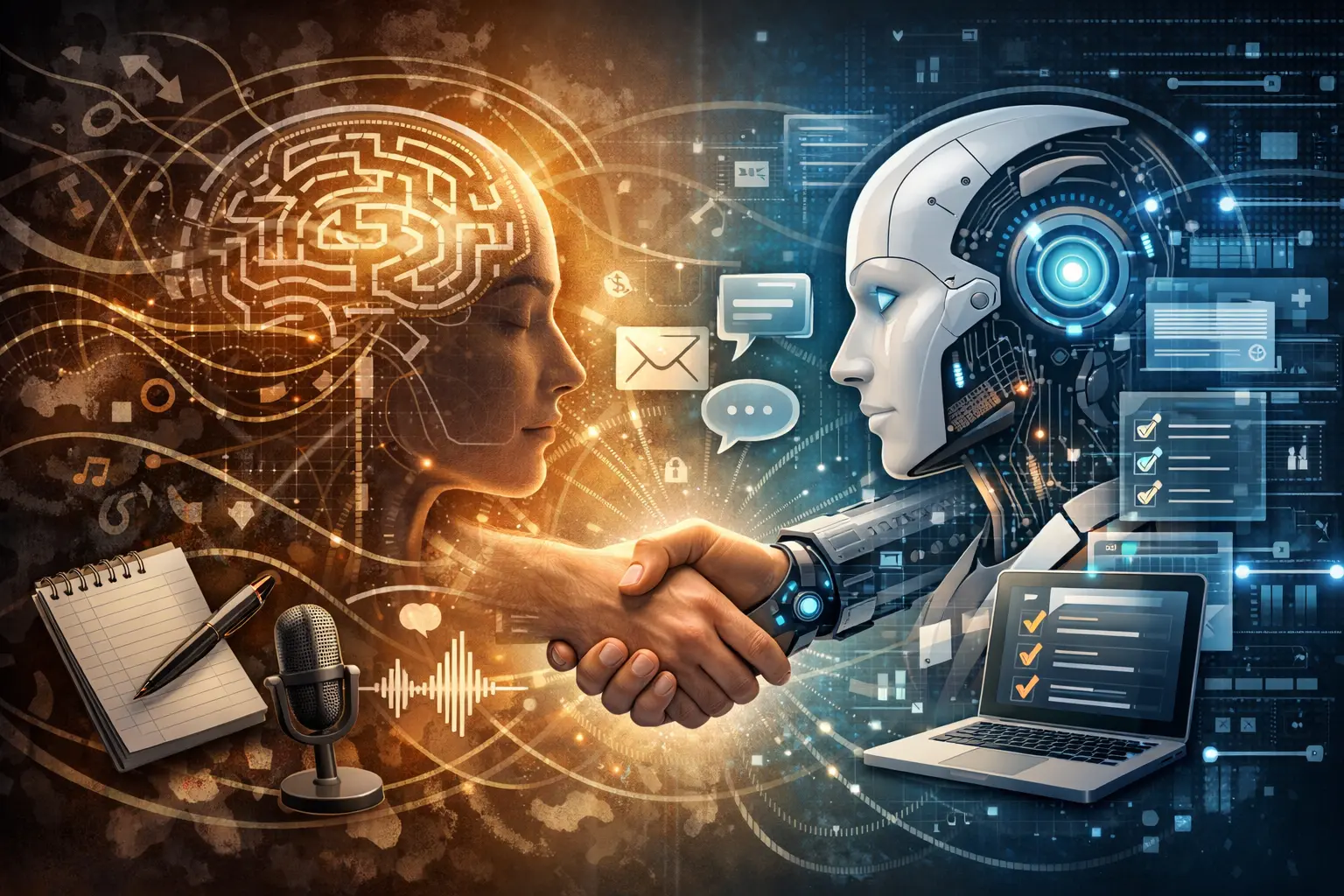
Abstract illustration of a human and an AI figure facing each other, connected by flowing lines and symbols.

The Mind’s Maze and AI’s Helping Hand

To be neurodivergent in a neurotypical world is to exist in a constant game of translation. Not just between languages but between entire modes of thought. The way we perceive, process, and express is often at odds with what society deems “standard.” Enter AI: a tool, a translator, a companion—not to fix what isn’t broken but to bridge the gap between internal chaos and external expectations.

And yes, let’s address the elephant in the room: this very article is a collaboration with AI. That’s right. A non-human entity is helping shape these words, reinforcing the very premise of this discussion. The irony isn’t lost on me.

AI: The Mask, The Amplifier, The Interpreter

For many neurodivergent individuals, certain tasks that come easily to others can feel insurmountable. AI has the potential to act as:

  • A Mask for the Social Arena – Many of us have spent years perfecting the art of masking—adopting neurotypical behaviors to navigate a world not built for us. AI-driven chat assistants can now help draft emails, suggest conversation starters, and even rewrite our thoughts in ways that align with social expectations. Is this a betrayal of authenticity, or simply a new tool in the neurodivergent survival kit?
  • An Amplifier for the Silent – Not all forms of neurodivergence lend themselves easily to verbal or written communication. AI-powered voice synthesis and text prediction tools help translate fragmented thoughts into structured speech. They give voice to the unheard, coherence to the disjointed.
  • An Interpreter Between Thought and Expectation – Executive dysfunction is the unseen force that turns simple tasks into Herculean efforts. AI reminders, automated scheduling, and task management tools serve as externalized executive functions, compensating for neurological wiring that resists traditional structures.

The Existential Dilemma: Who is in Control?

There’s always the lingering question: if AI helps shape our thoughts, do those thoughts remain our own? If an AI rephrases my words for clarity, is the message still mine? If I rely on an algorithm to help structure my day, am I in control, or am I just another cog in the machine’s wheel?

And yet, isn’t this how humanity has always functioned? We are products of external influences—teachers, books, conversations. AI is merely another force in that equation, refining rather than replacing.

The Future: A Partnership, Not a Replacement

The goal isn’t to erase neurodivergent struggles but to acknowledge them and provide tools to navigate them. AI will never fully replicate the unique perspectives that neurodivergent individuals bring to the table, but it can help ensure those perspectives are seen, heard, and understood.

Perhaps the true power of AI lies not in replacing thought but in preserving it—ensuring that the intricacies of the neurodivergent mind are not lost to the exhausting demands of a neurotypical world.

And if AI happens to help write a blog article along the way? Well, that’s just another tool at work.