As a creative person living in an age where attention increasingly functions as a form of currency, I have sometimes found myself asking an uncomfortable question:
Am I actually just a narcissist?
Not in the cartoon sense of vanity and selfies and endless self-promotion, but in the deeper psychological sense of self-investment. Self-importance. The belief that one’s own perceptions and creations deserve to occupy space in the minds of others.
After all, what is art if not an act of saying:
“This matters.”
And by extension:
“I matter enough to present this to you.”
The line between artistic conviction and ego can become blurry very quickly. Blurry enough that I have spent a great deal of time staring directly at that line, trying to determine where exactly I stand in relation to it.
The more honestly I examined the subject, the more complicated it became.
The Necessity of Ego
I do not believe meaningful art can exist without ego.
That may sound provocative, but I mean it in a very specific sense.
To create something sincerely, an artist must first believe that their inner world is worth externalising. They must believe their perspective has enough value to justify the time, effort, vulnerability, and risk involved in expressing it. Even the quietest and most humble artist is still making an implicit statement:
“What I see is worth showing.”
That is ego.
Not necessarily arrogance. Not superiority. Simply a centre point of selfhood from which perception emerges.
Without that centre, art collapses into imitation, trend-following, or empty performance. There has to be some degree of self-belief involved in genuine creation, otherwise nothing meaningful ever leaves the internal world at all.
The problem is that ego and narcissism share certain surface similarities. Both involve self-focus. Both involve projection outward from the self. Both involve a desire to be seen and understood. From the outside, they can sometimes look almost identical.
This becomes even more complicated in a culture where visibility itself has become entangled with identity.
The Attention Economy
We live in a world where attention increasingly functions as a metric of value.
Views, likes, shares, follower counts, engagement statistics. These things no longer merely reflect popularity. They actively shape modern perceptions of meaning and importance.
As a result, artists now exist inside systems that often reward speed over depth, visibility over sincerity, and optimisation over introspection.
This creates a strange psychological tension for anyone attempting to create meaningful work.
If you promote yourself too aggressively, you risk feeling performative and self-important. If you refuse to promote yourself at all, your work may disappear into obscurity regardless of its quality or meaning. If your work does not achieve visibility, modern systems increasingly imply that the work itself lacks value.
Meaning becomes flattened into metrics.
This is where the fear of narcissism can quietly emerge inside the artist’s psyche.
Because in order to resist these systems, one must often continue believing in the value of their work despite external indifference. From the outside, this can resemble arrogance:
“Who are you to believe your work matters if the world does not respond to it?”
But internally, the experience may feel completely different.
Different Layers of Value
One of the most difficult things to articulate is that not all forms of creative value operate on the same level.
Some work is optimised for immediacy. Fast emotional gratification. Easy accessibility. Quick engagement. This is not inherently bad. There is skill involved in creating highly consumable work.
But there are other forms of art that operate more slowly. Work that prioritises resonance over instant appeal. Work that may initially appear rougher, stranger, less polished, or less immediately gratifying, yet carries psychological or existential depth that unfolds gradually over time.
The problem is that modern systems tend to evaluate both forms using the same metrics.
A piece of disposable content that reaches millions may appear more “successful” than a deeply meaningful work that profoundly impacts only a handful of people. Eventually, when the numbers become overwhelming enough, the crowd itself begins to function as a value authority. Meaning can appear to be socially overwritten through sheer scale.
This creates an existentially uncomfortable position for artists whose work operates outside dominant systems of optimisation. It can produce the unsettling sensation of simultaneously believing in one’s work while also feeling quietly delusional for doing so.
That tension is very real.
Recursive Self-Awareness
Part of what has made this entire subject psychologically exhausting for me is that self-awareness itself can become recursive.
At one point I found myself thinking:
“If I were truly narcissistic, would I even be questioning it this deeply?”
But then another thought emerged:
“What if the questioning itself is simply a more sophisticated defence mechanism?”
Eventually the whole thing begins folding inward endlessly. Every answer becomes suspect. Every layer of introspection creates another possible mask hiding beneath it.
At that point, the question itself starts to break down.
I realised I had accidentally created a psychological system where every possible outcome could be interpreted as evidence of narcissism. If I believed in my work, that could be ego. If I doubted myself, perhaps that was performative humility. If I questioned my own motives, perhaps that questioning itself was self-protection.
No stable conclusion could ever be reached through pure introspection alone.
The problem was no longer narcissism. The problem was the impossibility of obtaining perfect certainty about one’s own internal structure.
The Fear of Misinterpretation
Another layer of this tension comes from perception itself.
Even if I arrive at a grounded understanding of myself, there still remains the reality that others may perceive me inaccurately. They may flatten complexity into arrogance. They may interpret sincerity as self-importance. They may reduce artistic conviction to narcissism simply because modern culture increasingly struggles to distinguish depth from self-promotion.
For a long time I questioned why this bothered me so much.
If I know who I am internally, why should misinterpretation matter?
I eventually realised that part of the answer is surprisingly simple:
because distortion feels unpleasant.
If one values precision, honesty, and alignment between intention and expression, then being misunderstood can feel like watching reality itself become warped slightly out of shape. There is also the practical reality that human beings do not exist in isolation. Perception affects relationships, opportunities, collaboration, and the way art travels through the world.
But deeper still, I think there exists a fundamental human desire not merely to be seen, but to be seen accurately.
Not universally understood. Not universally admired. Simply understood enough that the signal arriving in another person resembles the signal that was originally transmitted.
The Horse Dream
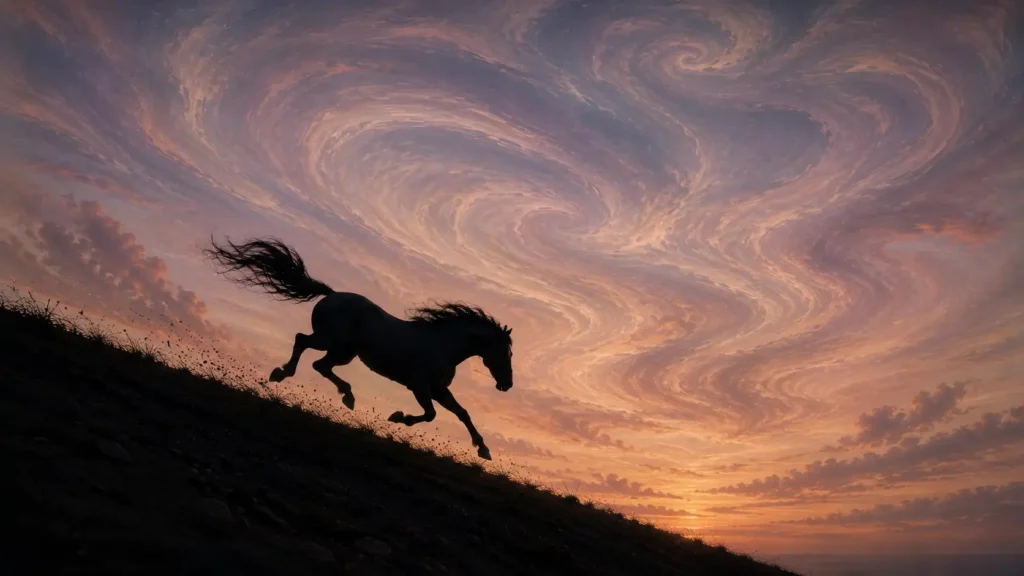
Recently I had a dream involving Lex Luthor riding a horse while hanging low beneath the saddle, almost parallel to the ground, inspecting the terrain extremely closely as the horse moved forward.
In the dream he calmly explained:
“This is an advanced riding technique.”
Then he warned others not to do it.
The symbolism of that dream struck me immediately.
I think part of my existential breakdown over the last year has involved being trapped in this “close inspection mode.” Constant analysis. Constant scanning. Constant examination of systems, motives, dangers, meanings, and psychological structures. Partly out of necessity. Partly out of mistrust. Partly out of fear that if I stop paying attention, I might miss something important.
The problem is that no one can comfortably ride like that forever.
It is an unstable position. A useful one, perhaps even a powerful one, but not a sustainable permanent posture.
The skill itself is not the issue. The issue is remaining trapped within the technique long after it ceases to be necessary.
Ego Without Illusion
I no longer believe the goal is to eliminate ego.
Nor do I believe it is possible to completely free artistic creation from self-investment.
What matters more, perhaps, is awareness.
Awareness of one’s own distortions. Awareness of the seductive nature of attention. Awareness of the ways identity quietly seeks reinforcement and validation. Awareness of how easily fear, insecurity, sincerity, and ego can become entangled.
There is something strangely stabilising about eventually arriving at a position that says:
“Whatever I am, I am.”
Not as resignation. Not as apathy. But as a refusal to endlessly perform psychological self-surgery in pursuit of impossible purity.
I contain ego. Every artist does.
I contain insecurity. Every artist does.
I contain contradictions. Every human being does.
The important thing is remaining conscious of how those forces move within me, rather than pretending I exist outside them.
Final Thoughts
I think one of the greatest psychological challenges facing modern artists is learning how to believe deeply in their work without becoming consumed by the systems surrounding attention and identity.
The internet increasingly encourages us to become brands, performers, marketers, influencers, personalities. It rewards certainty, projection, confidence, visibility, and constant output. Under those conditions, it becomes very easy for sincere artistic expression to start resembling narcissistic self-display, even to the artist themselves.
But perhaps there is a difference between believing one’s work deserves worship, and simply believing it deserves to exist.
Perhaps there is a difference between demanding attention, and quietly refusing to abandon meaning simply because the crowd failed to reward it.
I do not think the tension between ego and art can ever be fully resolved. Nor do I think it should be.
Maybe the healthiest position is not one of perfect certainty, but conscious balance. The ability to inspect oneself closely without falling permanently beneath the horse. The ability to create sincerely while remaining aware of the strange psychological terrain through which all artists must travel.
And perhaps most importantly, the ability to continue creating even while knowing that no crowd, algorithm, or external system can ever fully determine the true value of what emerges from the human soul.