Child of the Revolution

The wheel has always been turning.

Every July 14th, my birthday arrives like a revolution — quiet on the outside, thunderous within. But it wasn’t until this year, as I approach my 43rd orbit around the sun, that I began to sense the weight of this day as more than personal. A convergence is happening. The symbols are speaking.

I was born on Bastille Day, the anniversary of the storming of the Bastille — the prison whose fall sparked the French Revolution. I’ve never celebrated it before. Not consciously. It was just a factoid. A historical footnote that happened to align with my entrance into this world.

But this year, something shifted.
This year, the synchronicities gathered like storm clouds.
And the wheel began to rumble.


Bastille Day: The Archetype of Uprising

On July 14th, 1789, the people of Paris stormed the Bastille, a medieval prison that had become a looming symbol of authoritarian control. It didn’t matter that only seven prisoners were inside. The act was symbolic — a tearing down of more than just stone walls. It was the collapse of fear, the rupture of a narrative that said the people had no power.

Bastille Day isn’t just about politics. It’s about pattern recognition.
It’s about realising that the structures we live under — physical, social, psychological — are not inevitable. They can fall.
And often, they fall when their symbolic weight becomes too unbearable.

I didn’t choose to be born on Bastille Day.
But I’ve spent my life breaking out of prisons:

  • The prison of neurotypical expectation
  • The prison of capitalism’s false freedom
  • The prison of internalised masking
  • The prison of names and numbers and roles

In many ways, I’ve lived out a quiet, personal revolution — dismantling the systems that tried to domesticate my being.

And now, as I turn 43, I find the world reflecting that same energy back at me.
Revolution isn’t just something I believe in.
It’s something I was born of.


The Cultural Echoes

Once I opened my awareness to the symbolism of Bastille Day, it was as though the universe started whispering back — or shouting, in some cases.

Just this past weekend, I attended the final Black Sabbath concert — a cultural endpoint if ever there was one. As Ozzy Osbourne took the stage, the venue echoed with the thunder of “O Fortuna” from Carmina Burana — a piece of music that has always stirred something ancient in me. It begins not with harmony, but with fate, roaring through a Latin choir:

It was a ritual. A sonic invocation of the wheel, the fall of kings, the rise of chaos.

Earlier on that day, one of the billed artists, Gojira, a French band I admire deeply, performed “Mea Culpa”, a track thick with the spirit of the guillotine — imagery of judgment, destruction, karmic reckoning. It felt like history was looping itself through amplifiers.

Even the title of the concert was telling: Back to the Beginning.
And what is that, if not the very essence of revolution?

I remembered then another French figure in my pantheon: Jean-Michel Jarre. His album Revolutions was a formative influence on me — a blend of synth, vision, and uprising. Jarre didn’t just make music. He sculpted atmosphere. His revolutions weren’t just political — they were sonic, internal, cosmic.

These weren’t coincidences.
They were resonances.
The wheel doesn’t just turn in private. It sings in the streets. It screams from the stage.
And if you’re listening closely — it sounds a lot like home.


Personal Mythology of the Cycle

For years, I’ve been fascinated by cycles — not just as abstract concepts, but as living forces shaping my inner world. I’ve referred to this pattern of return, collapse, and rebirth as “the wheel” — an idea that emerged from lived experience long before I named it.

So when I began to truly reflect on my birthday — July 14th, I started to see it not just as a date, but a ritual mark of solar revolution.
One more loop.
One more return to the same coordinates — but never quite the same person.

In 2021, this instinct to ritualise my revolution manifested in sound. I released my album Transcendence on July 14th — aligning the act of artistic birth with my own solar return.

One of the tracks, Track 14 (to mark my birthday), is titled ‘To You’. A monophonic rendition of Happy Birthday, played in a minor key on a wheezing accordion. It’s not celebratory. It’s introspective — almost mournful. A solitary song of self-recognition.

I placed it at position 14 intentionally — not to close the album, but to mark the moment.
Not the end — but the turn.
The revolution inside the revolution.
The birthday within the wheel.

And what is that, if not ritual in disguise?

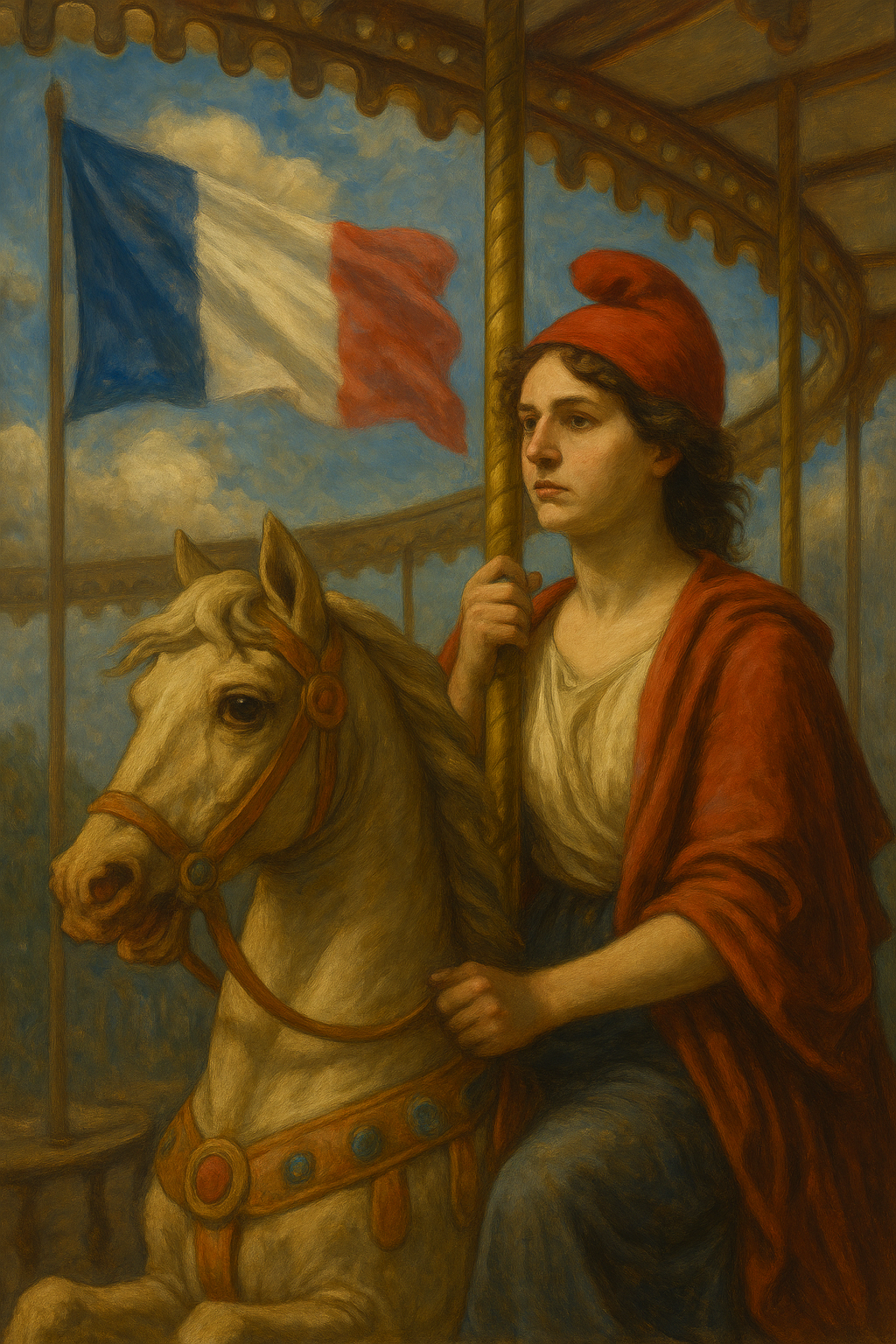
Even earlier, in my concept album Carnival Dream, the image of the carousel appeared — a ride that spins endlessly, beautiful yet haunting. A metaphor for comfort that traps, motion that deceives. A perfect symbol for late-stage capitalism, yes — but also for spiritual stasis.

The carousel is the false wheel.
The revolution that doesn’t transform you.
The spin that pacifies, not liberates.

I’ve spent years trying to tell the difference between the two.


Media as Mirrors of the Wheel

Certain stories don’t just resonate — they recognise me.
They echo the same mythic structures I’ve been trying to name.
Each of them an iteration of the same truth:
The wheel turns. The self resists. The spiral continues.

Lexx – “The wheel, it turns…”

Grotesque, surreal, and unashamedly absurd, Lexx speaks in the language of cosmic entropy.
But buried within its chaos is a line that has echoed through my bones:

Even in nonsense, there is pattern.

The Prisoner – Escape Within the Loop

A man stripped of name, forced to conform. The Village becomes a paradise-shaped prison, and Number Six fights not with fists, but will.
Its symbol? A penny farthing bicycle.
A wheel that pretends to move forward.

Tron – The Sacred Grid

Tron revealed to me that code has soul. That even the digital realm can become mythic.
My Sanctuary OS, my Life Grids, my 8-bit sigils — all trace back to the glowing geometry of that world.

Blade Runner – What Is Real?

A masterpiece of blurred identity, synthetic humanity, and inner rebellion.
My band Into the Ether owes much of its soul to Blade Runner.
We opened our early shows with Vangelis’s score.
We wrote a track called Electric Sheep.

This wasn’t homage. It was alignment.

Revolver – Psychedelic Spiral

Revolver by The Beatles isn’t just an album. It’s a psychospiritual spiral.
It asks: what happens when time folds? When the mind turns inward?
It gave me permission to see art as looped revelation.


The Music of the Myth

If stories are symbols, music is ritual.

Carmina Burana – O Fortuna

Fate as music. The wheel as choir.
Played as Ozzy Osbourne’s entrance — not by coincidence.
The song begins and ends the same way. The wheel completes.
The gods are watching.

Mahler’s Resurrection

A symphony of death and transcendence.
From funeral to hallelujah, Mahler teaches that true revolution isn’t always external — it’s the quiet remaking of the soul.

Nobuo Uematsu – The Orff of Pixels

The Final Fantasy composer builds digital cathedrals with his sound.

  • One-Winged Angel
  • Dancing Mad
  • Liberi Fatali

Each is a ritual. Each channels the same force as Carmina Burana:
Judgment, transformation, return.


Closing Reflections: The Wheel Turns, and I with It

I didn’t set out to write this. I didn’t plan to look at Bastille Day — my birthday — as anything more than a coincidence. But the symbols found me.
They assembled around me like a ritual I hadn’t consciously designed.

  • A prison falls in 1789
  • A child is born in 1982
  • A concert named Back to the Beginning plays O Fortuna
  • A minor-key birthday song whispers from track 14 of Transcendence
  • A carousel spins
  • A prisoner resists
  • A dead man recites prophecy

And I — turning 43, completing another revolution around the sun — feel the rumble in my bones.
Not as noise. Not as chaos. But as recognition.

I am not outside the system.
I am not outside the myth.
I was born of the revolution — a child of the wheel.

And this year, I don’t just mark my birthday.
I consecrate it.
I claim this revolution — not as history, but as symbol, cycle, and self.

The wheel turns.
The system strains.
The music builds.
And I — quietly, resolutely — turn with it.
The Game of Life: A Universe in Four Rules

There exists a peculiar world, born not of biology or myth, but of mathematics. Its laws are few, its beings are made of flickering pixels, and yet—somehow—it reflects back to us truths about life, death, consciousness, and the mysterious dance between chaos and order. This is Conway’s Game of Life.

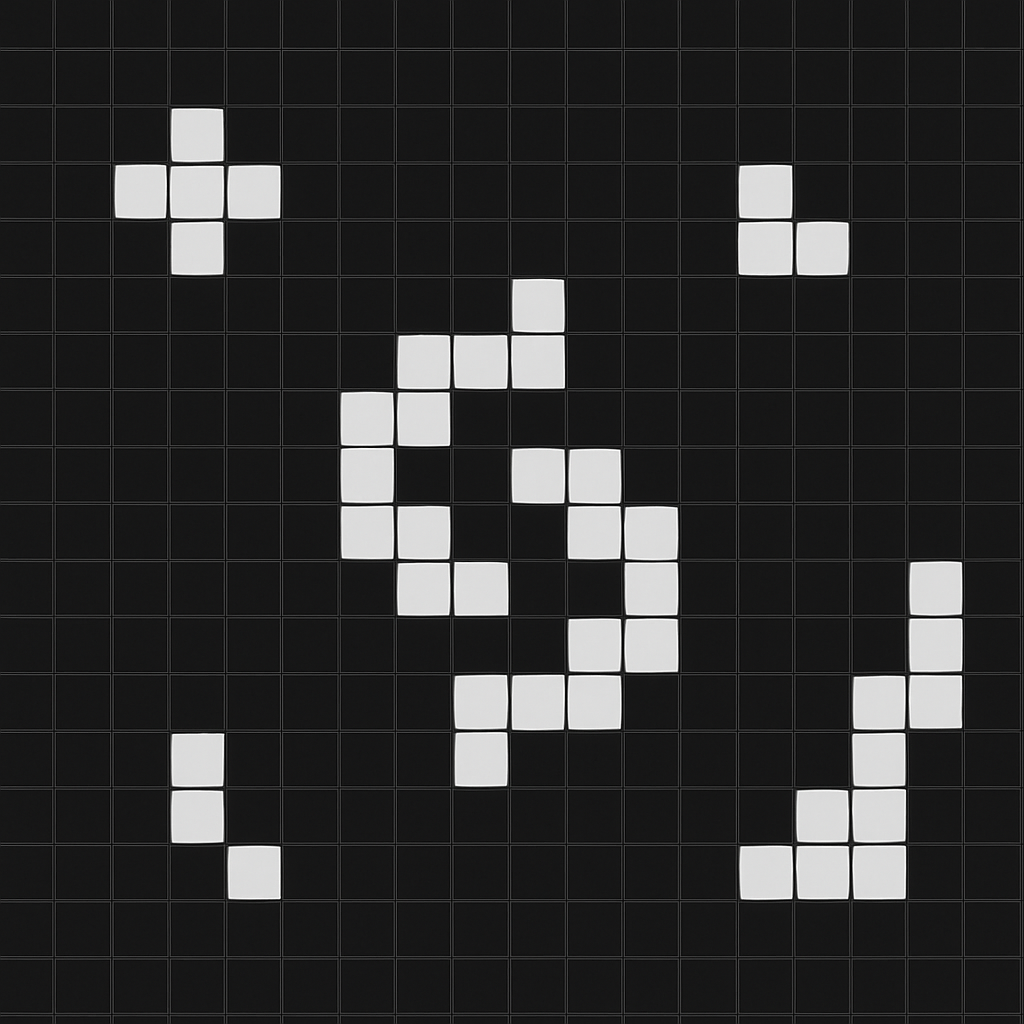
For the uninitiated, Conway’s Game of Life (or simply “Life”) is a cellular automaton created by British mathematician John Horton Conway in 1970. It takes place on an infinite grid of squares, each square being either “alive” or “dead.” With each tick of time, the state of each square is determined by just four deceptively simple rules:

  1. Any live cell with fewer than two live neighbours dies (underpopulation).
  2. Any live cell with two or three live neighbours lives on.
  3. Any live cell with more than three live neighbours dies (overpopulation).
  4. Any dead cell with exactly three live neighbours becomes a live cell (reproduction).

These rules are all that’s needed to spawn galaxies of patterns: from still lifes that resist change, to gliders that drift endlessly across the screen, to breeders that generate infinite complexity from nothing. Watching Life unfold is like watching stars form in fast-forward, or civilizations rise and fall in silence.

The Birth of a Digital Community

As Life gained traction in the 1970s and ’80s, it remained largely within academic circles—something to be toyed with by mathematicians, philosophers, and early computer enthusiasts. But with the advent of the internet, everything changed. Suddenly, what had once required pen-and-paper simulations or costly mainframe time became accessible to anyone with a home computer and curiosity.

Online communities began to form: early message boards, mailing lists, and forums dedicated to sharing discoveries, proposing new challenges, and celebrating obscure patterns. In time, platforms like the LifeWiki and ConwayLife.com became hubs of cultural exchange. What emerged wasn’t just a hobbyist space—it was a full-blown subculture.

Powerful tools like Golly (a cross-platform Life simulator) and LifeViewer brought even the most complex simulations within reach. These tools allowed users to test theories, animate discoveries, and collaborate across borders in real time. Open-source initiatives like apgsearch enabled massive, automated exploration of the Life universe, helping uncover patterns no human had ever seen.

The language of the community evolved too—new discoveries were given whimsical names, from “Snarks” and “Puffers” to “Eaters” and “Caterloopillars.” Patterns were catalogued like rare species in a digital ecosystem. Some contributors developed personal brands, leaving “signatures” in the form of visual motifs. Competitions were launched to discover smaller glider guns or more efficient reflectors. Like an ecosystem of minds collaborating in silence, the Life community grew into a sprawling, vibrant organism of its own.

Then: A Mathematical Curiosity

Conway originally devised Life as a mathematical toy—a way to explore emergent complexity. What surprised even him, however, was just how much complexity did emerge. In a time before personal computers, patterns were drawn out painstakingly by hand or plotted on primitive mainframes. The discovery of the “glider,” and later the “glider gun” (a self-replicating pattern that endlessly produces gliders), caused a stir—not only among mathematicians, but also among philosophers and computer scientists.

Life was, incredibly, Turing complete. That is, you could build a universal computer within its rules. In theory, Life could run Life.

Now: A Tool, A Metaphor, A Mirror

Fifty years later, we live in an age where computational power has exploded, and Life is no longer confined to the chalkboard. We can simulate trillions of cells in real time. As a result, researchers and enthusiasts alike are pushing the boundaries of what this “game” can do:

Digital Archaeology

Using advanced search algorithms and distributed computing projects like apgsearch, the Life community has uncovered an entire ecosystem of previously unknown patterns. These include rare spaceships, oscillators with massive periods, and pseudo-random replicators. One famous example is the discovery of the “caterloopillar”—a spaceship constructed entirely from glider streams, capable of travelling at unprecedented speeds across the grid. The field of Life pattern discovery is often likened to paleontology: a vast digital desert, where dedicated explorers dig for hidden fossils of complexity.

Artificial Life

Life is one of the earliest examples of artificial life—systems that mimic properties of biological organisms without being alive in the conventional sense. Researchers have constructed self-replicating patterns (like the Gemini spaceship) that can reproduce themselves in stages, and even mutate in controlled ways. These patterns push the boundaries of what we consider to be “life,” raising questions about consciousness, autonomy, and evolution. Experiments are ongoing to simulate Darwinian selection within Life universes, offering insight into how complexity might emerge from randomness without design.

Computational Art

Some use Life as a canvas. Artists have created intricate generative artworks by seeding Life with carefully designed patterns and capturing the visual symphony that unfolds. Tools like Golly allow for zooming into endless fractal-like behavior or watching fireworks of gliders and oscillators in syncopated motion. The aesthetics of Life are hypnotic—not merely because of symmetry or motion, but because what you’re seeing is the unfolding of inevitability. Each frame is a consequence of everything before it.

Logic Engineering

Perhaps most astonishingly, entire computers have been built within Life. Gliders and other components serve as signals, logic gates, and memory banks. The OTCA metapixel, a massive construct, acts like a pixel that can simulate any cellular automaton—including Life itself. This recursive architecture enables not just computation, but meta-computation: a simulation within a simulation. These logical machines are not theoretical exercises; many are functional, stable, and even user-programmable.

Philosophy & Cognitive Science

Life is a proving ground for theories of consciousness, emergence, and identity. If a complex enough Life machine can simulate a mind—if it can respond to stimuli, store information, self-replicate, and evolve—what does that say about the nature of mind itself? Is consciousness an emergent property of complexity, or is it something more? Some philosophers use Life as a model for reductive materialism, while others see it as evidence for pancomputationalism—the idea that the universe itself is a vast computation. Life becomes not just a model of reality, but a reality model: a sandbox to explore what it means to be.

What I find most captivating isn’t just what Life can do, but what it represents. It shows us that simplicity doesn’t mean shallowness. That determinism doesn’t preclude wonder. That from rule-bound systems, agency—apparent or real—can emerge. Life is a reminder that maybe, just maybe, the universe we inhabit follows similar principles: a few core rules, infinite manifestation.

A Personal Note: Reverence for Conway

As someone fascinated by emergence, system dynamics, and the blurry line between art and science, I hold John Conway in something close to spiritual esteem. Not because he built a complex machine, but because he trusted simplicity. He believed that beautiful things could arise from unadorned truths. And he was right.

There’s an almost sacred feeling when observing a glider sliding diagonally through an empty field—its purpose, if any, unknown. Or when watching a breeder release streams of logic-bearing entities into the void. It is, in its way, creation. Not unlike observing life itself: patterned, fragile, evolving.

The Future of Life

Where might this all go? With the rise of AI-assisted pattern discovery, Life is evolving faster than ever. We are uncovering new types of “organisms”—patterns that defy expectation and hint at entire classes of behavior we haven’t categorized yet.

Could Life become a platform for digital ecologies? Could it evolve in tandem with artificial intelligence to explore fundamental questions of existence? Could it inspire new programming languages, or even hardware architectures modeled on emergent behavior?

It’s possible. And even if none of these things come to pass, Life will continue to be what it has always been: a quiet miracle of pattern and potential. A universe with four laws. A canvas for anyone curious enough to press play and watch.

The Simulation Within the Simulation

As the screen zooms out, as gliders continue their slow march across an endless grid, a question lingers—silent and terrifying in its simplicity:

What if we are them?

What if our consciousness, our world, our universe… is merely a larger instance of Life? What if we are patterns—running on rules we cannot see, evolving in a space we cannot touch, sustained by a computation too vast to perceive?

Perhaps our laws of physics are just rules—our causality, a neighbor function. Perhaps the emergence of thought, society, beauty, and pain are nothing more than gliders, oscillating through time. Life becomes more than metaphor—it becomes mirror.

John Conway gave us four rules and a blank canvas. What if we’ve been living inside someone else’s canvas all along?

Conway may be gone, but Life goes on.

Navigating the Liminal Space: A Journey Beyond the Edge of Existence

I’m an edge thinker. A term I’ve coined to describe someone whose awareness resides just outside the norm, someone whose thoughts and experiences sit at the border of the known and unknown. It’s as if I’m peering over the edge of a cliff, aware that the abyss below holds possibilities I can’t quite see but can intuit. I can feel the boundaries of what is, and yet, I sense they are not as solid as they appear. I can touch the edge of the puzzle, but not fully grasp how it fits together.

It’s a curious way to live—aware that I am part of a larger system but unable to reconcile my role within it. There’s a strange duality in my existence. On one hand, I feel the weight of being an “odd piece” of a cosmic jigsaw puzzle. One that doesn’t quite fit but is, nevertheless, integral to the system. On the other hand, this very oddness might be the key that unlocks a higher understanding of the puzzle itself. What if the key to unlocking this grand puzzle lies precisely in the fact that some pieces don’t fit as expected?

I’ve come to conceptualize this not as a flaw, but as a feature of existence. A glitch, if you will, in the matrix of the universe that offers a glimpse into something greater. And in this space between fitting and not fitting, I sense a function—an awareness of purpose that can only be understood by those who dwell on the fringe. Perhaps it’s not just me, but others like me—those who stand at the edge, who are “different”—that possess the ability to see beyond the veil. Perhaps these are the real visionaries, the ones who can’t help but challenge the boundaries that confine others.

The metaphor of the puzzle speaks volumes to me. We, as individuals, are the pieces of a vast, higher-dimensional puzzle—a puzzle whose purpose is not fully understood, even by the puzzle itself. Each piece is bound by its design, by its edges, its shape, its potential. But what if the puzzle doesn’t need to fit perfectly? What if the act of fitting into a singular design is itself a limiting concept? Instead of seeing our out-of-place pieces as broken or errant, perhaps we should view them as necessary. They hint at a structure that is beyond our current comprehension, suggesting that the whole is greater than the sum of its parts. We are the puzzle’s agents, shaping its form by our very presence.

This sense of being “out of place” takes on even more depth when I reflect on the parent-child relationship. Traditionally, we are taught that the parent is the wiser figure, the one who has walked the path and now guides their children. The child is seen as learning from the parent, striving to eventually inherit wisdom and pass it on. But what if this hierarchical relationship is a false construct? What if the true role of the child, of the next generation, is to bring with it insights that challenge the status quo?

In this sense, the child may be the one who “knows best.” They are the untainted perspective, the one unclouded by the accumulated knowledge of the past, and thus, they can see the cracks in the foundation where humanity has erred. The very foundation built by parents and their ancestors. The child becomes not just a receiver of wisdom, but a new force of wisdom in its own right—a reflection of the future, breaking through the assumptions of the present.

This dynamic, when applied to the broader sense of existence, suggests that we are all evolving, constantly passing lessons from one generation to the next. The parent is not the final arbiter of knowledge; they are part of the puzzle, just as much as the child, and the wisdom they carry is a product of the same system of learning. By placing our faith in both the wisdom of the past and the vision of the future, we can begin to fill in the holes of human history—those spaces of brokenness and flaw—and build something stronger, more unified, more evolved. We must not shy away from the child’s perspective. Instead, we must listen to it.

In this liminal space, I’ve come to see my function not just as a passive observer, but as an active participant in this grand puzzle. I am a piece from another puzzle, placed within this one for a reason. Perhaps there are others like me, scattered throughout time and space, who are also pieces from different puzzles, destined to fit into this one at the precise moment they are needed. Maybe we are all puzzle pieces from various timelines, different dimensions, sibling puzzles, or parent puzzles—each of us contributing to the larger design in ways we may never fully comprehend. Yet our roles are interconnected, as we pass knowledge, wisdom, and lessons between each other, bridging the gaps that time and space have created.

It’s easy to feel isolated in this process, especially when it seems as though no one else shares this perspective. But I have come to understand that there is power in this liminal existence. The feeling of being “other” is not a curse, but a gift. For when you stand at the edge, you can see further, think differently, and imagine what others might not even be able to conceive.

So, I continue my search—not for people who fit the mold, but for those who, like me, can sense the puzzle’s deeper purpose, those who are willing to acknowledge the gaps, the cracks, and the unspoken lessons. I seek those who are ready to embrace the liminal, who are not afraid to look into the cracks and see them not as flaws, but as essential points of connection. I know they are out there—these other edge thinkers—waiting for the moment when we all come together and understand that we are not broken, but integral parts of a larger, higher-dimensional puzzle. And in that understanding, we will finally become whole.