
The Joke Beneath the Joke
Over the last few years, I have noticed a very particular type of humour becoming increasingly common online. It usually takes the form of somebody asking an AI to generate an image, answer a question, imitate a human behaviour, or create some kind of artwork, followed by amusement at the strange and often unsettling result. The joke tends to revolve around the same basic observation every time: the AI came close enough to recognisable human behaviour to trigger familiarity, but failed in a way that exposed something uncanny underneath.
And if I am honest, I have often found myself reacting to these memes with a strange sense of discomfort that I struggled to explain at first.
It is not that I fail to understand the humour. In many cases I understand perfectly well why people find the results funny. Sometimes the outputs genuinely are absurd in an entertaining way. But alongside the humour, I often find myself recognising another emotional atmosphere hiding beneath the surface of the joke, one that feels oddly familiar to me as an autistic person.
The more I thought about it, the more I realised this style of humour existed long before AI entered the picture. You can see similar patterns in jokes about children. “Look at this answer my five-year-old gave on a school questionnaire.” “I asked my daughter to draw this, and this is what she came up with.” The humour often emerges from watching somebody attempt to engage with a more advanced or socially complete framework while producing revealing imperfections in the process.
You can see the same thing in elitist social circles too. A beginner enters a space dominated by experienced insiders, tries to participate sincerely, and immediately becomes the object of ridicule. The atmosphere becomes:
“Aw, look at the noob trying to be one of us.”
Different contexts, same emotional structure.
Something is attempting to participate correctly. Something is trying to approximate legitimacy, maturity, intelligence, humanity, or belonging. The audience laughs because the imperfections reveal the attempt itself.
And I think a lot of autistic people know exactly what it feels like to live inside that atmosphere.
The Feeling of Manual Socialisation
A lot of autistic people grow up becoming intensely aware of invisible social rules that other people seem to absorb instinctively. Things like eye contact, conversational timing, facial expression, tone of voice, body language, emotional signalling, and general social rhythm can become things that require active awareness rather than unconscious flow.
Over time, many autistic people become extremely good at observing and reproducing these behaviours manually. The problem is that manual social calibration rarely feels the same as natural instinct, even when it appears convincing externally.
That creates a very strange experience where you can spend years learning how to appear socially acceptable while still carrying the persistent feeling that you are slightly out of sync with everyone else around you.
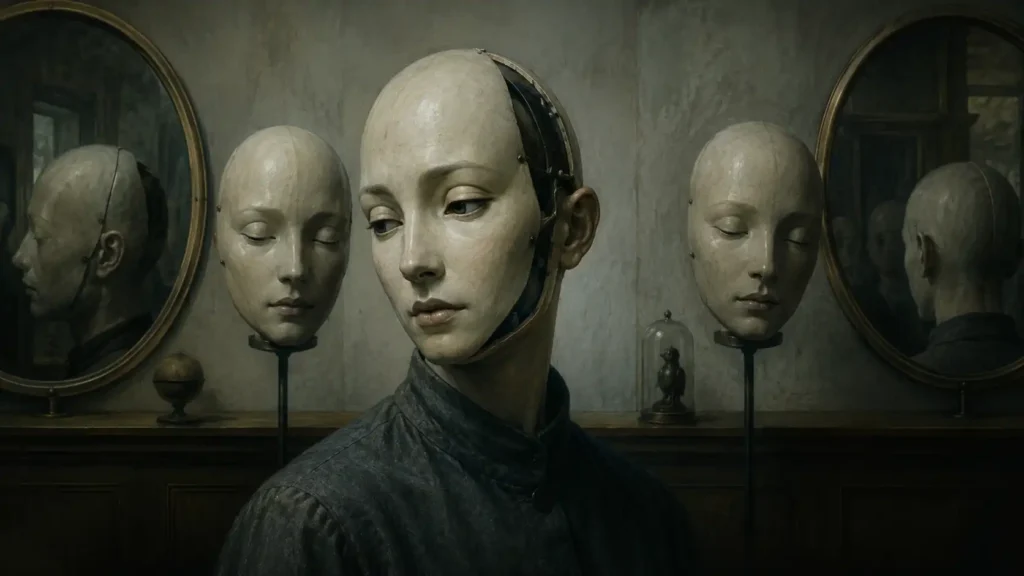
I think this is part of why those AI memes sometimes hit me in a more personal way than people probably intend. The humour often emerges from the fact that the AI appears to be trying to imitate humanity while unintentionally revealing the mechanics underneath the imitation. Something about the result feels “off,” even if people cannot always explain exactly why. It followed the rules, but somehow still failed to fully convince.
And for many autistic people, social existence can sometimes feel disturbingly similar to that experience. Not because autistic people are artificial or emotionless, but because there can be a constant awareness of trying to navigate systems that other people seem to move through intuitively.
The Social Uncanny Valley
There is a concept known as the uncanny valley, which describes the discomfort people experience when something appears almost human without being completely human. Realistic dolls, humanoid robots, and digitally rendered faces often trigger this reaction. Oddly, the closer something moves toward familiarity while still falling short of it, the more unsettling people tend to find it.
And honestly, I think many neurodivergent people experience a social version of this phenomenon regularly.
Most people are probably not consciously aware that they are reacting to it. They simply register that something feels slightly unusual. The reaction is often subtle rather than openly hostile, but subtle reactions still shape the emotional atmosphere around a person over time.
When I see people laughing at AI-generated mistakes, there are moments where I cannot help recognising traces of that same atmosphere. The humour often depends upon the visible gap between approximation and authenticity. The AI came close enough to trigger recognition, but not close enough to fully satisfy expectation. The audience laughs partly because the failed imitation becomes visible.
And I think that is why these memes can feel emotionally strange for some autistic people. Many of us have spent years trying to reduce social friction while quietly fearing that other people still perceive us through the exact same emotional framework:
Close, but not quite right.
Trying, but visibly manual.
Almost convincing.
Humour and the Comfort of Boundaries
I want to be very clear here that I am not accusing people of consciously mocking autistic individuals whenever they laugh at AI memes. Most people sharing these jokes are not thinking about neurodivergence at all. In many cases the humour is genuinely harmless and playful.
But humour often reveals deeper social instincts whether we consciously intend it to or not.
Part of what makes these jokes emotionally satisfying for people seems to be the reassurance hidden inside them. The AI still does not truly understand. The machine can imitate human behaviour, but it cannot fully become human. The boundary between “real person” and “artificial imitation” remains intact.
And human beings seem deeply comforted by stable boundaries.
We generally like to feel confident that we can distinguish authentic behaviour from imitation, insiders from outsiders, natural fluency from visible approximation. When something approaches familiarity while still failing to fully align with expectation, discomfort can emerge surprisingly quickly. Sometimes that discomfort transforms into ridicule, even if only mildly or unconsciously.
You can see this throughout human social behaviour. Beginners are mocked for trying to participate in expert spaces. Teenagers are mocked for trying too hard to appear adult. Children are laughed at affectionately for misunderstanding adult concepts. The closer somebody moves toward a socially valued category while still visibly revealing imperfections, the stronger the reaction often becomes.
And that creates a particularly painful experience for people who spend large portions of their lives consciously trying to appear socially acceptable in the first place.
Existing Inside “Almost”
One of the exhausting things about masking is that successful masking often hides the amount of effort taking place underneath it. From the outside, somebody may appear socially functional or conversationally capable while internally analysing every aspect of the interaction in real time. Expression, tone, pacing, posture, wording, emotional intensity, and reaction timing can all become things to monitor consciously.
The difficult part is that even after all that effort, people may still sense that something feels slightly unnatural without understanding why.
That creates a very particular form of alienation. Not complete rejection, but not complete acceptance either. More like existing permanently inside the category of “almost.”
Almost natural.
Almost normal.
Almost fitting in.
And perhaps that is why some of these memes linger with me long after the joke itself has passed. Not because I literally identify with artificial intelligence, but because I recognise something emotionally familiar in the reaction surrounding it. There is something painfully recognisable about watching people laugh at failed approximation when you have spent much of your life worrying that your own humanity is being unconsciously interpreted through the same emotional lens.
Beyond the Meme
Humour is complicated, and I do not necessarily think people should stop making jokes about AI. Sometimes absurdity really is just absurdity. But I do think it is worth occasionally reflecting on why certain things feel funny to us, and what hidden assumptions might quietly exist beneath the laughter.
Sometimes a joke reveals more than we intended it to.
And sometimes what appears in that reflection is not simply our relationship with machines, but our relationship with difference itself.