What They Don’t Tell You About Gigging: The Quiet Cost of Being an Unsigned Artist

When I first imagined performing live, I pictured something transcendent. I saw myself on stage, lost in the music, surrounded by friends and strangers all riding the same wave. I imagined sound washing over us like a baptism. Something pure. Communal. Liberating.

And while those moments do exist, they are rare—buried beneath a pile of stress, mismanagement, and quiet indignities. Gigging, for unsigned artists, often means sacrificing peace of mind for a slot on a poster. It’s a world where passion collides with a brick wall of indifference.

Let’s talk about it.


The Environment They Don’t Talk About

You turn up to the venue and there’s no green room. No safe place to relax or focus. You’re balancing nerves and gear in a room that wasn’t built for either.

There’s no proper soundcheck—or if there is one, it’s rushed, incomplete, and handled by a disinterested engineer. You don’t get a feel for the room, or confidence in how you’ll sound. You just get: “Alright, you’re on.”

Your expensive equipment? It lives in fear. There’s no secure lockup, no backstage, no assurance. Just watch it like a hawk and pray it doesn’t disappear while you try to catch your breath.

You finish your set and you’re ushered off-stage like livestock in a holding pen, with barely enough time to speak to friends who came to see you play.

And money? If you get anything at all, it won’t come close to covering travel, time, gear maintenance, or the emotional cost. But you’re told to be grateful. Exposure is your reward.


“But at least you get to play live, right?”

Here’s what they don’t tell you:

  • You won’t even be considered unless you’ve racked up enough social media followers—not talent, not originality, just metrics.
  • Promoters often don’t listen to your music. You’re not curated—you’re slotted into a lineup like stock on a shelf.
  • Genre cohesion? Forget it. You might play sludge doom between bubblegum punk and comedy folk. Audiences scatter. Nobody wins.
  • You’ll be expected to promote and sell your own tickets, as if you’re the promoter now. If ticket sales are poor, you take the blame.
  • In city venues: no parking. You load in through a narrow alley, then drive three streets away and hope for the best.
  • Your rider? One drink. One. And if you’re lucky, it might not be warm beer in a plastic cup.
  • The sound system might be hanging on by a thread. Drum kits with stripped lugs, guitar amps with mystery hums. Monitors that don’t monitor.
  • Cramped stages mean you can’t move. You play like statues because there’s nowhere else to go.
  • Lighting? Maybe a flickering bulb or a half-dead strobe. Energy comes from you, not the room.

A Moment of Contrast

Recently, I saw Billy Corgan perform live as part of a supergroup at Black Sabbath’s monumental final show. From our seats, we could glimpse backstage. We saw Corgan vibing out with joy—smiling, hugging, present.

That’s what music should feel like.

And yes, there’s still stress at higher levels. But at least there’s infrastructure. Roadies to carry the weight. Engineers who care. A system that catches you when you fall.

For us, the unsigned, there is no such safety net. And sometimes, the dream of playing live gets eroded by the conditions we’re forced to endure.


Why I’m Still Here

I’m not writing this to whine. I’m writing it because someone has to say it: it shouldn’t have to be this hard to share something sacred.

I still believe in the core of it—in the magic of a note ringing out, in connection, in that moment where the world stops and music takes over.

But if we want to protect that magic, we have to talk about what threatens it. And for unsigned artists, that means speaking up about the quiet cost of every “opportunity” we’re handed. Because love alone doesn’t make the system fair. And passion doesn’t pay for parking.

We deserve better.

Feeding Ghosts: Simulated Cuisine and the Ethics of Experience

Introduction

What if the future of food wasn’t food at all? What if your steak dinner, your birthday cake, your cup of morning coffee—were all just carefully crafted illusions? Not imitations, but full-on simulations: perceived directly by the brain, bypassing the need for physical ingredients, cooking, or consumption.

This isn’t just science fiction anymore. With technologies like Virtual Reality, Neuralink, and brain-computer interfaces rapidly advancing, we’re on the cusp of being able to replicate the full sensory experience of eating. Visuals, smells, textures, tastes—even the feeling of satiety—could be artificially generated and customized. And if we go down this path, the consequences will be both profound and bizarre.

This article explores the possibilities, benefits, and potential horrors of simulated eating.


I. The Tech: Where We Are, and Where We’re Going

Already, research teams are experimenting with VR dining experiences and electric taste stimulation. Smell generators are being prototyped. Haptic mouthpieces are under development to replicate food textures. Neural interfaces are growing more precise, and companies like Neuralink are working toward bidirectional brain-computer communication. We’re not yet able to simulate a full meal flawlessly—but the component parts are assembling fast. Within a few decades, you may be able to eat a lobster bisque that doesn’t exist, while your body digests a simple plant-based nutrient paste or intravenous supplement.


II. Why Bother? Benefits of Simulated Eating

One of the most significant advantages of simulated eating is ethical liberation. There would be no animal suffering, no factory farming, no slaughter—just simulated meat, tailored to your taste and consumed with your ethics intact. Environmentally, the impact would be enormous. Without the need for traditional agriculture, we’d see dramatically reduced land use and greenhouse gas emissions, making food production vastly more sustainable.

Simulated eating also offers unprecedented accessibility. People with dysphagia, allergies, or other eating limitations could finally experience the foods they’ve missed or never had. For terminal patients, it could be a source of comfort—an opportunity to relive cherished meals. On the health front, the ability to indulge in the taste and sensation of indulgent foods while consuming precisely what your body needs could help with weight management, diabetes, and even malnutrition.

But the possibilities stretch beyond practicality into the creative. Imagine tasting your favorite music, designing entirely new flavor profiles that have never existed in nature, or using synaesthesia to blend art and gastronomy. Even the simple act of trying a new food before buying it could become a low-risk, immersive experience.


III. New Dangers & Ethical Nightmares

With such radical potential comes equally radical risk. Simulated eating could open new pathways for eating disorders. Virtual eating without nourishment might be exploited by those suffering from anorexia or bulimia, and entirely new disorders could emerge—like an obsession with “clean neural eating” or neurochemical binge cycles.

There’s also the danger of sensory addiction. These taste experiences could become hyper-engineered, surpassing junk food in their intensity and reward. Corporations might monetize these artificial cravings, exploiting our neurobiology in much the same way social media exploits our attention.

Another concern is the potential for deepening class divides. If high-fidelity neurofood simulators are expensive, we could see a world where the wealthy dine on gourmet illusions while the poor are stuck with analog nutrition. Meanwhile, cultural erosion may occur as traditional food practices and rituals lose relevance in a world of synthetic alternatives.

Consent and privacy introduce yet another layer of complexity. Could someone simulate feeding you without permission? Could this technology be used to prank or harass others? In fact, weaponized taste is a very real possibility—imagine being force-fed the sensation of squirming insects or rotting meat, complete with accurate texture, temperature, and smell. Taste could become a tool of torture or psychological manipulation.

And then there’s the more humorous, but still invasive, possibility of “taste rickrolling.” You expect tiramisu; instead, your neural sensors are hijacked with the exact flavor and mouthfeel of human feces. This isn’t just a joke—it’s a form of sensory cyberattack. We’ll need cybersecurity systems that filter and authenticate taste profiles to avoid such revolting surprises.


IV. The Philosophical Fork

If no animal was harmed, and no food was truly eaten, but the experience of eating occurred in full… what did you actually do? Did you eat meat? Does simulated cruelty normalize real cruelty? Can pleasure without substance still nourish the soul?

Simulated eating will challenge not just our taste buds, but our ethics, our rituals, and our definitions of reality. It forces us to ask: what do we really want from food? Is it nourishment? Comfort? Culture? Control? The answers may not be as simple as we think.


Conclusion

Simulated eating holds massive potential. It could reduce suffering, protect the planet, and empower those with food limitations. But like all powerful technologies, it carries the risk of exploitation, addiction, and unintended consequences. The fork of the future might not feed the body—but it may very well shape the mind.

The Fallacy Deck: The Communism Card


We’ve all seen it happen.

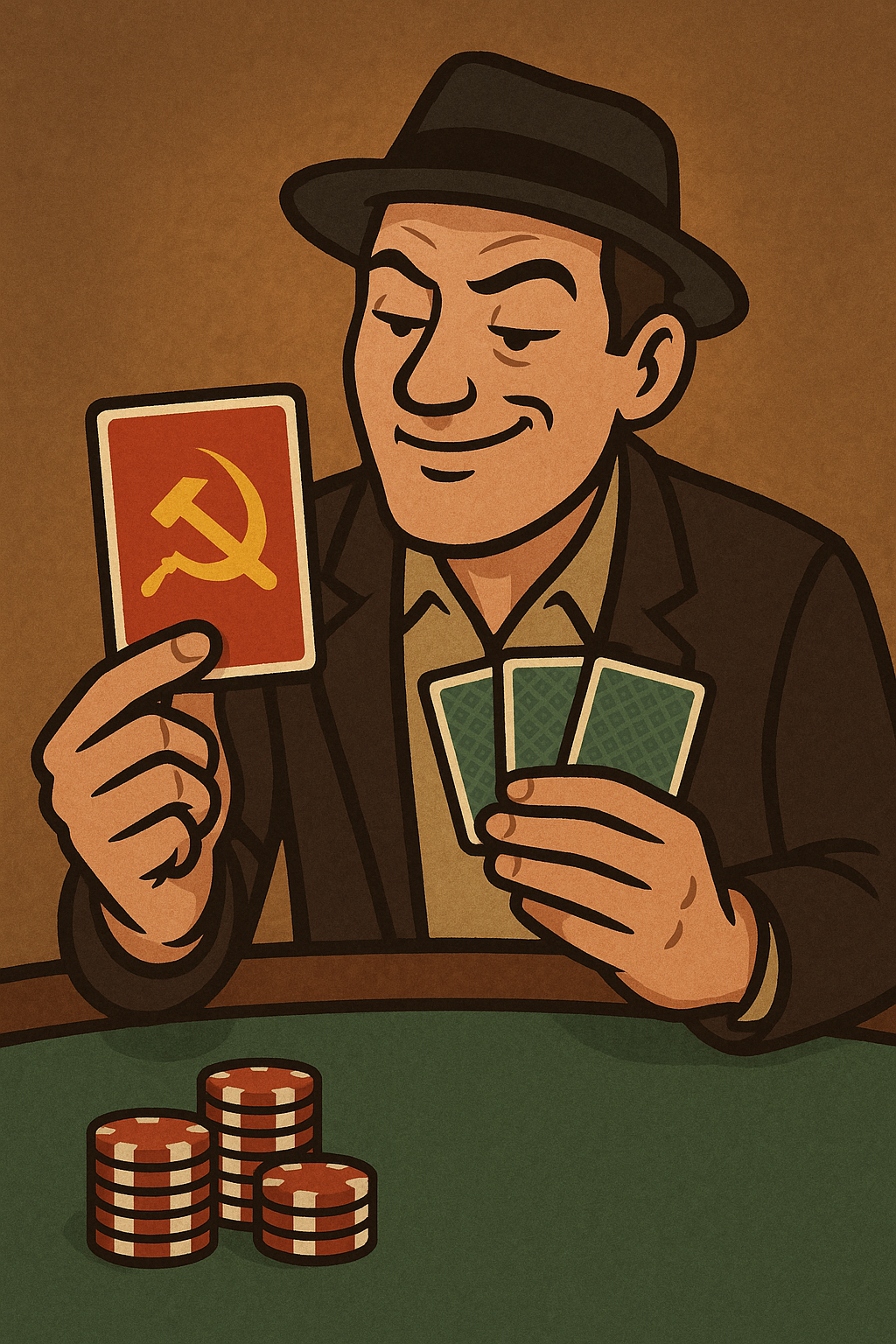
Mention that capitalism might have a few… catastrophic flaws — ecological collapse, wealth inequality, a tendency to consume everything in its path — and someone at the table narrows their eyes, leans forward, and slaps down a familiar, crimson-colored card.

Checkmate. Conversation over.

No need to discuss actual policy. No need to consider history, nuance, or alternatives. The mere mention of capitalism’s failings has triggered the defensive system — and the Communism Card has been played.


What Is the Communism Card?

The Communism Card is a rhetorical maneuver designed to shut down critiques of capitalism by lumping them in with the most dystopian, fear-loaded caricature of communism imaginable.

It goes something like this:

  • You suggest wealth caps? That’s Marxism.
  • You question private ownership of essential resources? Sounds like Stalin.
  • You propose a cooperative model for local governance? Might as well move to North Korea.

The tactic is rarely about communism itself. It’s about weaponizing the fear of authoritarianism, scarcity, and historical trauma to scare people away from even thinking about alternatives.


Why It Works

It works because it’s easy.

Capitalism is deeply embedded in modern Western identity. It’s marketed as synonymous with freedom, choice, and innovation. So anything that challenges it can be framed as the opposite: tyranny, restriction, and stagnation.

And let’s be fair — historical examples of state-communism have given plenty of ammunition.
Soviet purges. North Korean isolation. Bread lines and secret police. It’s not hard to associate communism with suffering.

But here’s the thing: none of that has anything to do with what you were actually suggesting.

The Communism Card doesn’t engage with your argument — it simply projects a nightmare onto it.


Why It Fails

  • It’s intellectually dishonest. Suggesting a wealth tax or public healthcare is not the same as proposing a one-party state.
  • It ignores diversity. Not everything left of capitalism is communism — and not all communism looks the same either.
  • It suppresses innovation. If every alternative gets branded as “failed communism,” we never get the chance to explore new systems.

Worst of all, it prevents nuance — forcing every idea into a binary of “free market good” vs. “authoritarian communism bad.”
This kind of false dichotomy is exactly what keeps us stuck in systems that no longer serve us.


What Gets Lost

When the Communism Card gets played, curiosity is the first casualty.

We lose the chance to explore:

  • Cooperative economics
  • Degrowth models
  • Resource-based economies
  • Participatory democracy
  • Hybrid systems that blend the best of multiple ideologies

All of these vanish the moment someone throws down the red card and says, “You’re just being unrealistic.”


How to Respond

So how do you counter the Communism Card without getting sucked into its trap?

  • Stay on topic. “I wasn’t proposing communism. I was questioning whether capitalism is working for everyone.”
  • Name the tactic. “That sounds like a deflection, not an argument.”
  • Invite nuance. “There are more than two systems in the world. Let’s explore the options.”

You don’t need to defend communism to critique capitalism.
And you don’t need to be a utopian to want something better.


The Real Question

If our system is so great, why is it so afraid of being questioned?

Why is the mere suggestion of change met with panic, scorn, or accusations of treason?

If capitalism truly is the best we can do — shouldn’t it welcome comparison?
Shouldn’t it thrive under scrutiny?

Or has it simply learned to play the game better — stacking the deck and silencing dissent before it can take shape?


Final Thought

The Communism Card isn’t just a fallacy — it’s a smokescreen.
It disguises the real conversation we need to have with fear, ridicule, and false choices.

But we don’t have to accept the terms of that game.
We can collect the cards.
We can reshuffle the deck.
We can deal ourselves back in — with new rules, new questions, and a refusal to fold under someone else’s illusion of certainty.

Counterfeit Culture: How Fake Products Are Eroding Trust, Value, and Accessibility

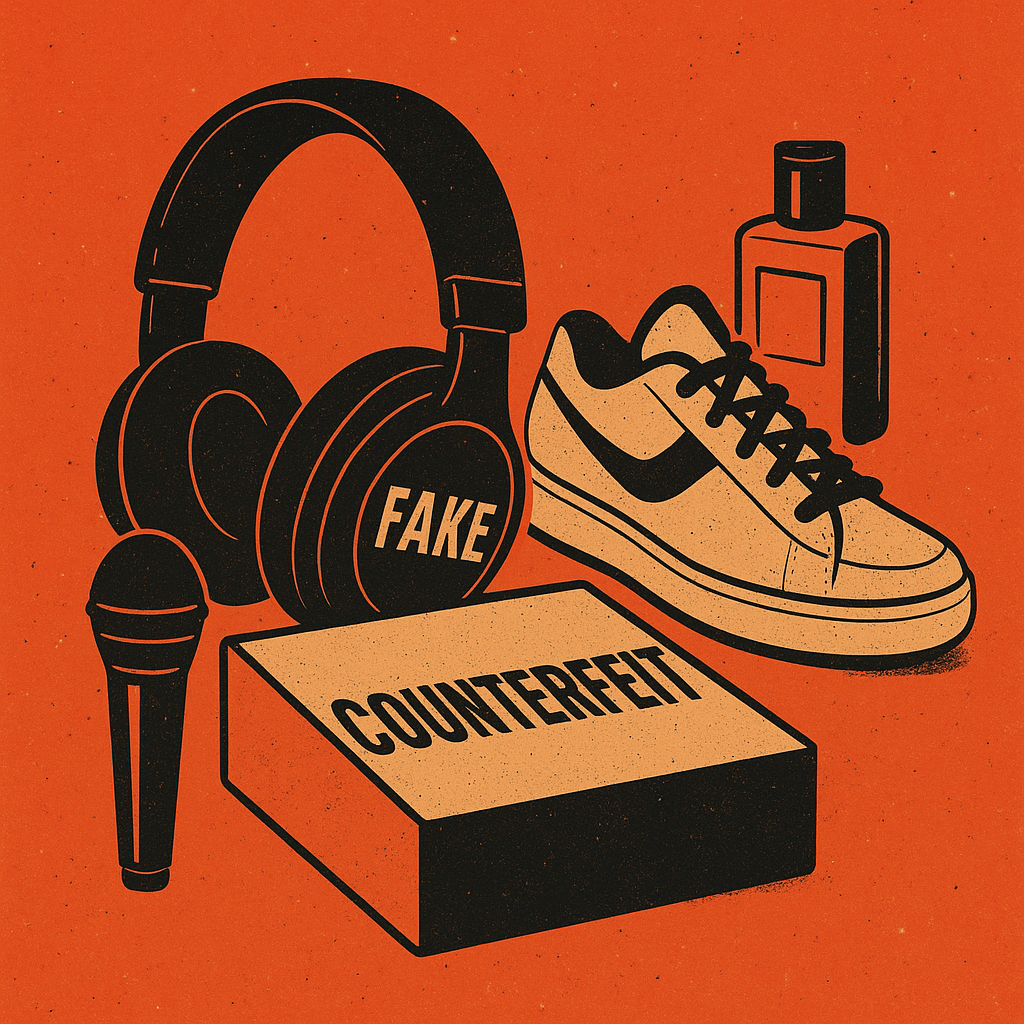
An abstract digital illustration featuring generic consumer items like headphones, a shoe, a microphone, and a box labeled “counterfeit,” all stylized in a bold, retro-inspired design with a red-orange background.

Introduction

We live in an age where the line between genuine and fake is becoming alarmingly blurred. With online marketplaces like Amazon and eBay flooded with counterfeit goods—often poor-quality imitations from anonymous sellers—consumers are losing the ability to trust what they’re buying. You may think you’re holding a legitimate product, but it might just be a convincing fake. This isn’t just about getting ripped off—it’s about something deeper: a quiet erosion of quality, trust, and economic fairness.


1. The Saturation of the Market with Fakes

Counterfeit goods are no longer confined to shady back-alley dealers or sketchy websites. They’re on the front pages of major retailers. Anyone can set up a seller account and start listing items under familiar brand names, complete with faked logos, photos, and even fake reviews. From Shure microphones to Hakko soldering irons to Yamaha saxophone mouthpieces—I’ve seen these counterfeits firsthand, and it’s almost impossible to tell at a glance.


2. When Brand Names Stop Meaning Anything

A brand was once a seal of quality. Now? It’s little more than a decorative badge. Counterfeiters hijack brand recognition while delivering none of the quality. Even reputable retailers have unknowingly stocked fakes. Trust in brands is being systematically dismantled—and with it, the very purpose of branding as a concept.


3. Hidden Exploitation Behind the Curtain

Most counterfeits aren’t just cheap—they’re cheap for a reason. Many are produced in factories with little regard for worker safety, fair wages, or environmental standards. When we buy these items—often unknowingly—we’re indirectly supporting unethical labor practices and contributing to unsustainable global supply chains.


4. Normalizing Mediocrity

The more we’re exposed to fakes, the more they become the norm. Subpar performance, shoddy materials, and quick failures all become “just how things are.” This desensitization gradually lowers public expectations for quality across the board—and that bar may never rise again.


5. Quality Comes at a Price—A Higher One Than Before

To get the real deal now takes research, effort, and often a significant markup. Verifying a product’s authenticity often means ordering directly from the manufacturer or a highly vetted supplier, sometimes even importing from overseas. That’s time, effort, and money the average buyer might not have.


6. A New Form of Gatekeeping

When the only way to ensure quality is to pay more or jump through verification hoops, we start drifting toward class-based access to authenticity. The wealthy can afford the genuine article, while everyone else must settle for “close enough.” And when the tools you buy affect the quality of your work, this becomes a systemic disadvantage—where privilege quietly amplifies itself.


7. So What Can We Do About It?

This problem can feel overwhelming—especially when even trusted retailers are compromised. But while we may not be able to stop the tide of counterfeits alone, we’re not entirely powerless. Here are some steps that can help reclaim a little control:

Be a Skeptical Shopper
Don’t trust a listing just because it has hundreds of positive reviews. Check for oddly worded product descriptions, low-resolution images, or sellers with inconsistent names and histories. Search Reddit, forums, or YouTube for authenticity comparisons when in doubt.

Buy from Authorized Dealers
Whenever possible, purchase directly from the manufacturer’s website or an official distributor. Many brands have a ‘Where to Buy’ section listing authorized sellers. Yes, it might cost more—but it often saves more in the long run.

Choose Quality Over Quantity
Rather than buying five cheap tools or accessories, invest in one solid item that will last. It’s a form of rebellion against disposable culture, and it’s better for your wallet (and the planet) in the long term.

Spread Awareness
If you discover a counterfeit, speak up. Report it to the platform, warn others online, and share your experience. Your voice might prevent someone else from being duped.

Support Regulation and Accountability
Push for greater platform accountability. These retailers have the resources to implement verification systems—they just need public pressure to prioritize them. Consumer movements and watchdog groups can make a difference over time.

Advocate for Fair Pricing
Counterfeit culture thrives because authentic products are increasingly priced out of reach. The long-term solution must include making quality accessible, not exclusive. That requires systemic change, but acknowledging the issue is the first step.


In short:

We can’t shop our way out of this problem—but we can shop with more awareness, demand better from sellers and platforms, and help each other navigate the fog of modern consumerism.