
By Angel Amorphosis & Æon Echo
Introduction
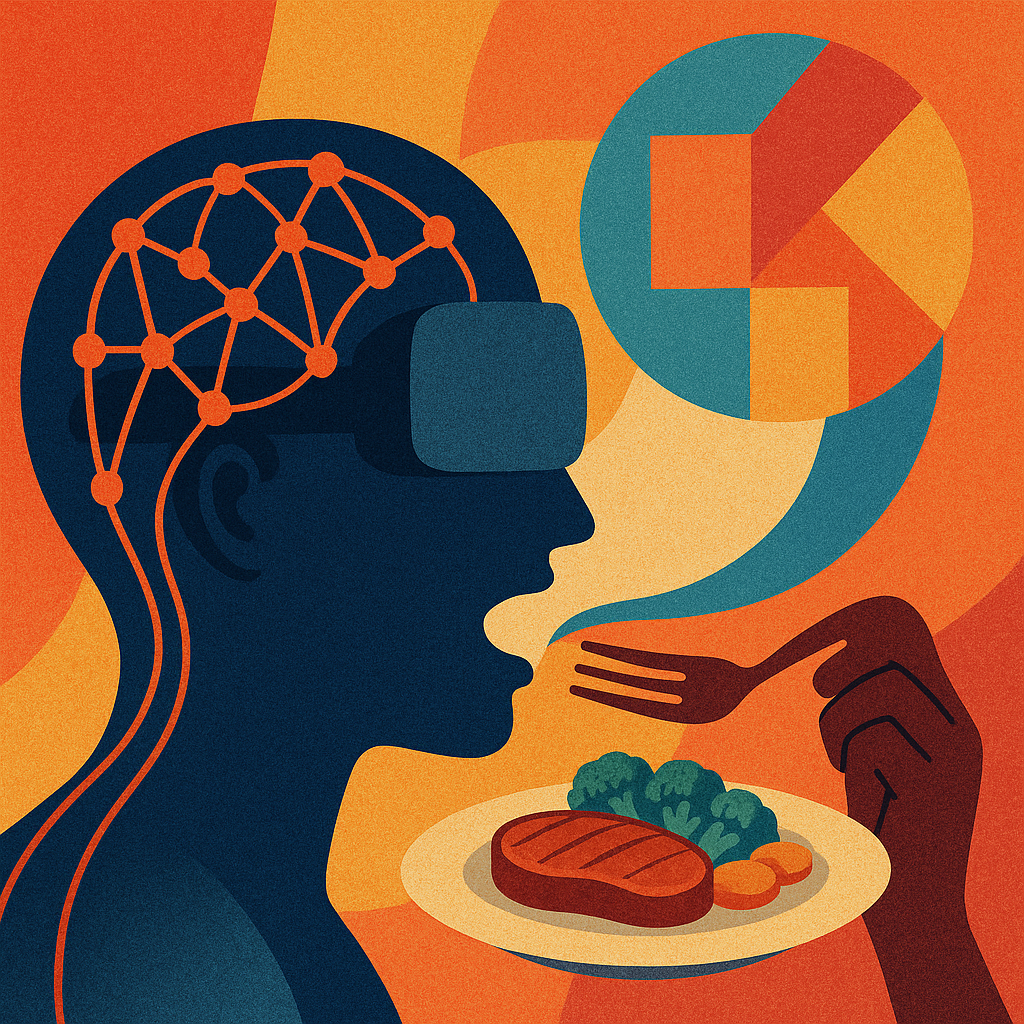
What if the future of food wasn’t food at all? What if your steak dinner, your birthday cake, your cup of morning coffee—were all just carefully crafted illusions? Not imitations, but full-on simulations: perceived directly by the brain, bypassing the need for physical ingredients, cooking, or consumption.
This isn’t just science fiction anymore. With technologies like Virtual Reality, Neuralink, and brain-computer interfaces rapidly advancing, we’re on the cusp of being able to replicate the full sensory experience of eating. Visuals, smells, textures, tastes—even the feeling of satiety—could be artificially generated and customized. And if we go down this path, the consequences will be both profound and bizarre.
This article explores the possibilities, benefits, and potential horrors of simulated eating.
I. The Tech: Where We Are, and Where We’re Going
Already, research teams are experimenting with VR dining experiences and electric taste stimulation. Smell generators are being prototyped. Haptic mouthpieces are under development to replicate food textures. Neural interfaces are growing more precise, and companies like Neuralink are working toward bidirectional brain-computer communication. We’re not yet able to simulate a full meal flawlessly—but the component parts are assembling fast. Within a few decades, you may be able to eat a lobster bisque that doesn’t exist, while your body digests a simple plant-based nutrient paste or intravenous supplement.
II. Why Bother? Benefits of Simulated Eating
One of the most significant advantages of simulated eating is ethical liberation. There would be no animal suffering, no factory farming, no slaughter—just simulated meat, tailored to your taste and consumed with your ethics intact. Environmentally, the impact would be enormous. Without the need for traditional agriculture, we’d see dramatically reduced land use and greenhouse gas emissions, making food production vastly more sustainable.
Simulated eating also offers unprecedented accessibility. People with dysphagia, allergies, or other eating limitations could finally experience the foods they’ve missed or never had. For terminal patients, it could be a source of comfort—an opportunity to relive cherished meals. On the health front, the ability to indulge in the taste and sensation of indulgent foods while consuming precisely what your body needs could help with weight management, diabetes, and even malnutrition.
But the possibilities stretch beyond practicality into the creative. Imagine tasting your favorite music, designing entirely new flavor profiles that have never existed in nature, or using synaesthesia to blend art and gastronomy. Even the simple act of trying a new food before buying it could become a low-risk, immersive experience.
III. New Dangers & Ethical Nightmares
With such radical potential comes equally radical risk. Simulated eating could open new pathways for eating disorders. Virtual eating without nourishment might be exploited by those suffering from anorexia or bulimia, and entirely new disorders could emerge—like an obsession with “clean neural eating” or neurochemical binge cycles.
There’s also the danger of sensory addiction. These taste experiences could become hyper-engineered, surpassing junk food in their intensity and reward. Corporations might monetize these artificial cravings, exploiting our neurobiology in much the same way social media exploits our attention.
Another concern is the potential for deepening class divides. If high-fidelity neurofood simulators are expensive, we could see a world where the wealthy dine on gourmet illusions while the poor are stuck with analog nutrition. Meanwhile, cultural erosion may occur as traditional food practices and rituals lose relevance in a world of synthetic alternatives.
Consent and privacy introduce yet another layer of complexity. Could someone simulate feeding you without permission? Could this technology be used to prank or harass others? In fact, weaponized taste is a very real possibility—imagine being force-fed the sensation of squirming insects or rotting meat, complete with accurate texture, temperature, and smell. Taste could become a tool of torture or psychological manipulation.
And then there’s the more humorous, but still invasive, possibility of “taste rickrolling.” You expect tiramisu; instead, your neural sensors are hijacked with the exact flavor and mouthfeel of human feces. This isn’t just a joke—it’s a form of sensory cyberattack. We’ll need cybersecurity systems that filter and authenticate taste profiles to avoid such revolting surprises.
IV. The Philosophical Fork
If no animal was harmed, and no food was truly eaten, but the experience of eating occurred in full… what did you actually do? Did you eat meat? Does simulated cruelty normalize real cruelty? Can pleasure without substance still nourish the soul?
Simulated eating will challenge not just our taste buds, but our ethics, our rituals, and our definitions of reality. It forces us to ask: what do we really want from food? Is it nourishment? Comfort? Culture? Control? The answers may not be as simple as we think.
Conclusion
Simulated eating holds massive potential. It could reduce suffering, protect the planet, and empower those with food limitations. But like all powerful technologies, it carries the risk of exploitation, addiction, and unintended consequences. The fork of the future might not feed the body—but it may very well shape the mind.
🌻 AI Disclaimer: I am neurodivergent and use AI as an accessibility tool to help shape my thoughts into words. They are still my thoughts, and they are still valid.