Internet In-Access (noun)
The illusion of digital inclusion in a system where structural barriers, manipulative design, and monetisation schemes render the web inaccessible—especially to neurodivergent minds.
See also: capitalism strikes again.
I used to enjoy using the internet.
Back when it wasn’t commonplace. Back when it was the domain of nerds, weirdos, hobbyists, and information junkies like me. Sure, there were commercial websites, brands had presences, but capitalism hadn’t yet figured out how to completely milk the internet for all it could legally squeeze from the public. Back then, it felt like a sanctuary—a digital retreat from the chaos and hostility of everyday life.
I’m autistic. I have inattentive ADHD. I struggle with overstimulation, decision fatigue, the weaponization of social cues, and having to constantly filter signal from noise in daily life. The early internet was a gift. Social interaction on it was simpler, slower, optional. I had control. I could set the pace. I could browse in peace, seek connection without pressure, and access the kind of information I was drawn to without needing to fight for it.
And then, Capitalism Struck Again.
Over time, a new norm slithered into place. The digital space that once gave me breathing room now suffocates me. What used to be a tool for equalising neurodiverse and neurotypical access has become a gauntlet of cognitive warfare.
Let me paint you a picture of what it means to be neurodivergent in the modern online landscape:
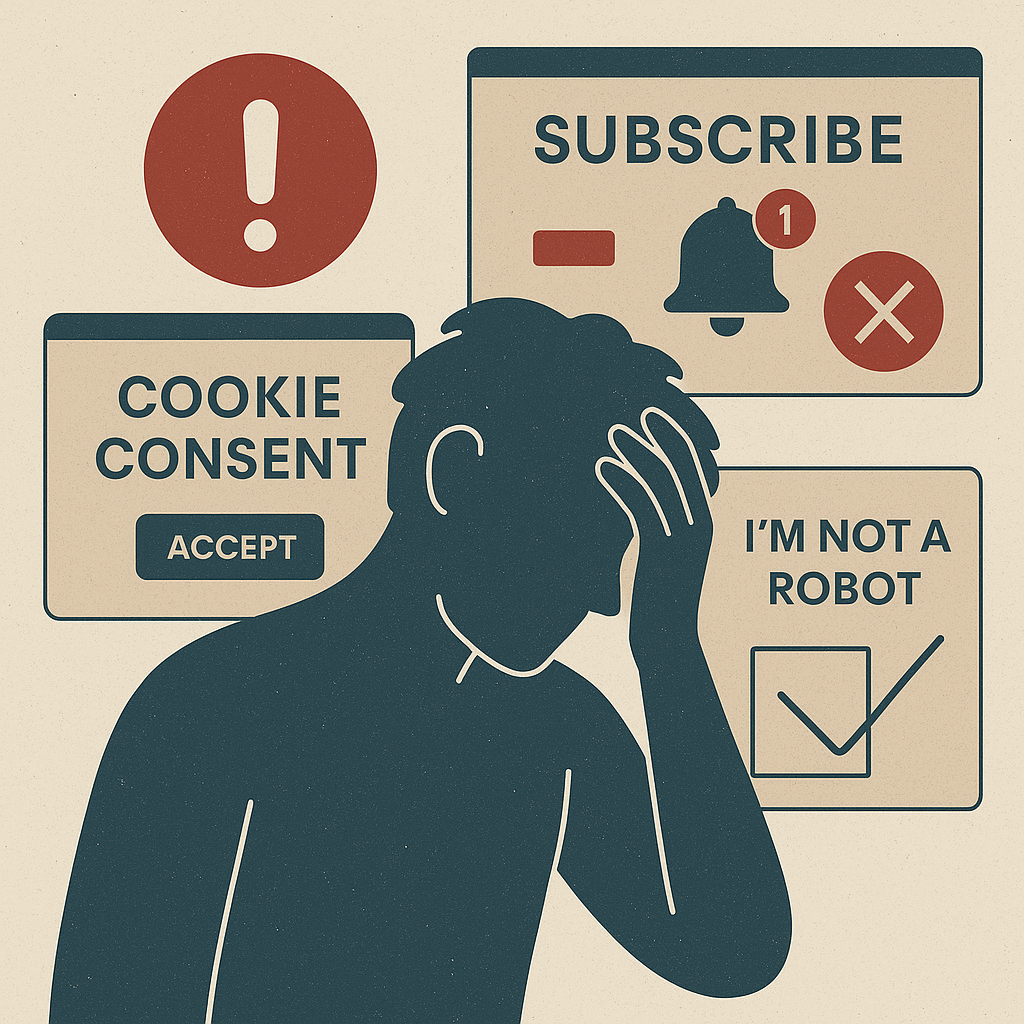
CONSTANT CONSENT FATIGUE
- Cookie popups on every site. Not one clear button to reject all. No, you must go spelunking through menus, toggling obscure options one by one.
- What they call “consent” is often manipulation dressed up in legalese. They make accepting easy. Rejecting is friction.
- This happens every time you clear your cookies—which many of us need to do often to avoid tracking or clutter. It’s an exhausting loop.
OBSTACLE COURSE INTERFACES
- Adverts that interrupt videos, and worse, cannot be skipped unless you pay. Not pay for the content, mind you, but pay to remove the punishment.
- Popup overlays that consume half your screen the moment you land on a site. Trying to close them often launches something else.
- On phones? It’s worse. Smaller screens mean these overlays dominate everything. You lose all context and have to work just to get your bearings.
SENSORY OVERLOAD
- Auto-play videos. Scrolling pages that jitter from reloading ads. Flashing banners. Infinite scrolling newsfeeds.
- Red notification symbols you can’t dismiss.
- Everything demands your attention. Nothing respects your brain’s bandwidth.
WALLS EVERYWHERE
- Account registration required to view basic information. Want to read one article? Sign up. Want to download a PDF? Create an account.
- Even ad blockers aren’t safe anymore: Use one, and you’re blocked.
- CAPTCHA systems to “prove you’re not a robot”, often impossible to complete first time if you have visual or processing impairments.
INFORMATION MIRE
- Simple search queries now lead into labyrinths of misinformation, SEO bait, affiliate link farms, AI-generated junk, and clickbait.
- Answers that should take seconds now require sifting through five pages of fluff.
- The mentally exhausting task of fact verification is now part of every basic search.
CONTENT MONETISATION MADNESS
- Free content comes with a catch: give us your email, your phone number, or your demographic info.
- Sponsorships infiltrate once-authentic creators. You’re left wondering if their review or advice is sincere, or bought.
- Subscription models are everywhere. Everything is paywalled. But paying doesn’t always remove the pain—sometimes, it’s just a new tier of nonsense.
And this is just what I notice consciously.
I’m sure there are deeper layers of rot that my mind filters out as a survival response. But what I do feel, daily, is the cognitive toll. What should be a tool for exploration and learning is now an exhausting, defensive act.
And here’s the thing: most people just shrug and say, “That’s just how it is now.”
But if you’re neurodivergent, or disabled, or even just overwhelmed by life, “that’s just how it is” becomes the same as saying: This place isn’t for you.
The truth is, it could be different