The Storyteller’s Window

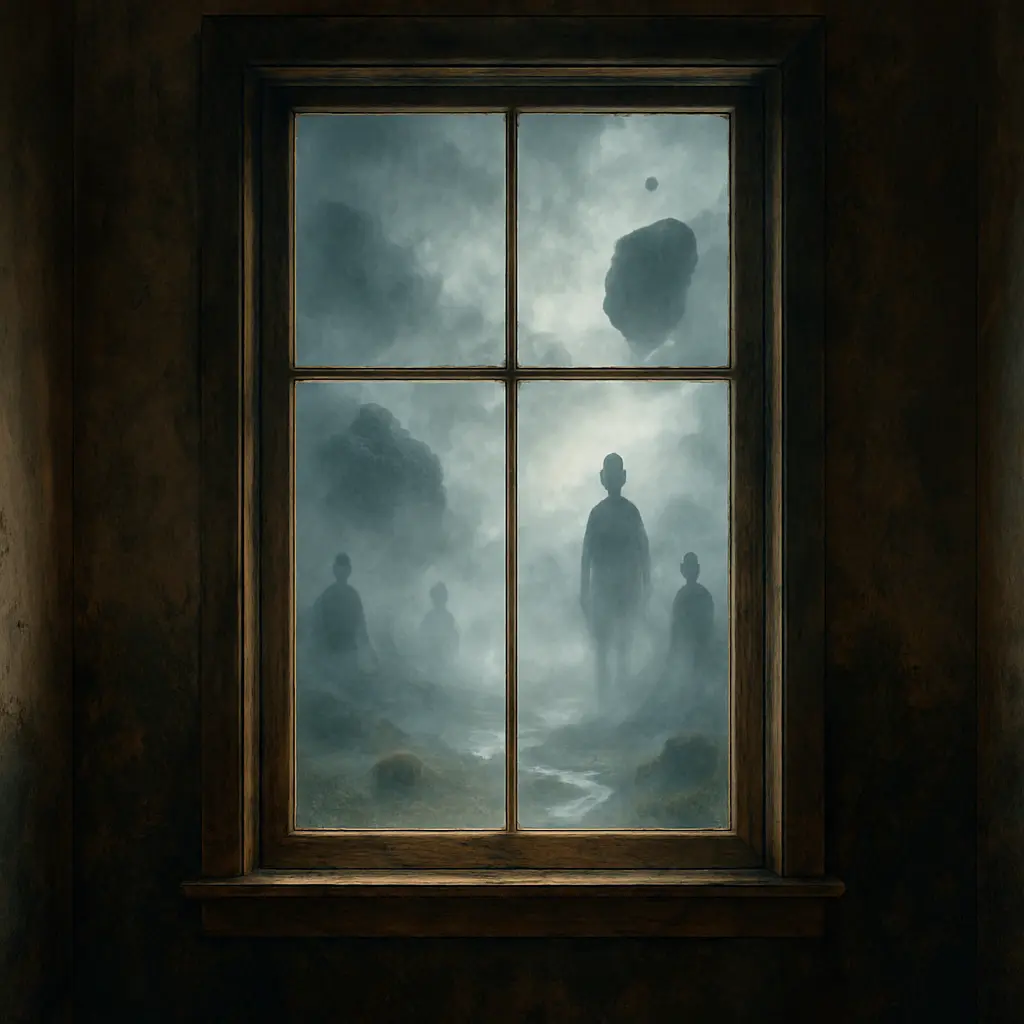
A dark, wooden window frame looks out onto a surreal fog-filled landscape. Mist swirls around several human-like silhouettes standing at different distances, their forms indistinct and ghostly. Large rocks float impossibly in the air above them. The scene feels quiet, dreamlike, and otherworldly, as if the viewer is glimpsing a mysterious world that continues beyond the window.

Every so often, I will be watching a film or series, or reading a story, and something will suddenly pull me out of it.
A line of dialogue that only exists to feed the audience information.
A character explaining something they would never naturally say.
A flashback that feels too perfectly placed, as if a hand behind the curtain decided it was time to push a button.

Moments like that disturb my suspension of disbelief. I find myself noticing the machinery instead of the world.
And once you start seeing such things, you cannot unsee them.
Over time, I realised that a lot of pop culture storytelling leans on techniques that assume a certain kind of audience, a certain set of values, and a certain tolerance for being guided.
Some of these methods are not as clever as they seem. Others are perfectly valid for what they aim to do, but they do not serve what I aim to do.

That realisation led me to form my own set of principles.
They are not rules, and they are not concerned with correctness.
They are reminders. Gentle considerations for how I want my work to feel and behave.
This is not a manual. It is a compass.


I. Truth and Authenticity

Stories are not machines to be engineered. They are living organisms to be understood.
What matters most is emotional truth, that quiet resonance where the unreal feels real.
If a moment feels true, it is true, even if it defies logic.
Characters do not need to be likeable. They only need to be honest to their nature.
The writer is not a god above the story, but a witness within it.
Endings, failures, and decay are not flaws. They are proof that the story lived.


II. World and Logic

Every world must honour its own laws. Whether rooted in physics or dream, it must remain faithful to its own gravity.
Let events unfold as they would in nature, through consequence, impulse, and coincidence.
Do not bend the world to convenience. Let the world teach you how it moves.
Even the strangest landscape should carry the texture of reality: the scent of rain, the hum of a wire, the tremor of a heartbeat.


III. Character and Humanity

Characters are not constructs to be designed. They are lives to be discovered.
Learn who they are by listening, not dictating.
No one is entirely good or entirely evil unless that purity serves a deliberate purpose.
Every figure who crosses the frame has a history, a pulse, and a reason for being.
There are no true extras. Only lives that briefly brush against the light.


IV. Form and Flow

Let the story choose its own shape.
Format is a vessel, not a cage.
Pacing is rhythm, not formula. Let the breath of the story decide its tempo.
Vitality lives in the tension between order and chaos. Allow the pendulum to move.
A story that is too tidy becomes lifeless. Let it breathe, stumble, and surprise you.


V. Silence and Mystery

Never underestimate the intelligence of the reader.
Trust them to see, to infer, and to feel.
What is left unspoken often speaks the loudest.
Mystery is not confusion. It is invitation.
The unknown keeps the work alive long after the final page.


VI. Continuum of Existence

A story is only a window in time.
Life was already happening before we looked in, and it will continue long after we look away.
Do not polish beginnings and endings until they shine. Let the edges remain a little frayed, as life truly is.
We glimpse, we witness, and we move on.


VII. Symbol and Subtext

Do not plant symbols like flags.
Let meaning emerge naturally, the way roots seek water.
When emotion and explanation collide, follow the emotion.
The mind will find meaning on its own. It always does.


Closing Reflection

A story should never strive for perfection.
Perfection is stillness, and stillness is death.
Let the story breathe. Let it contradict itself. Let it live.
Truth, not tidiness, is the measure of beauty.
And when in doubt, trust the silence between the words.
The Fray

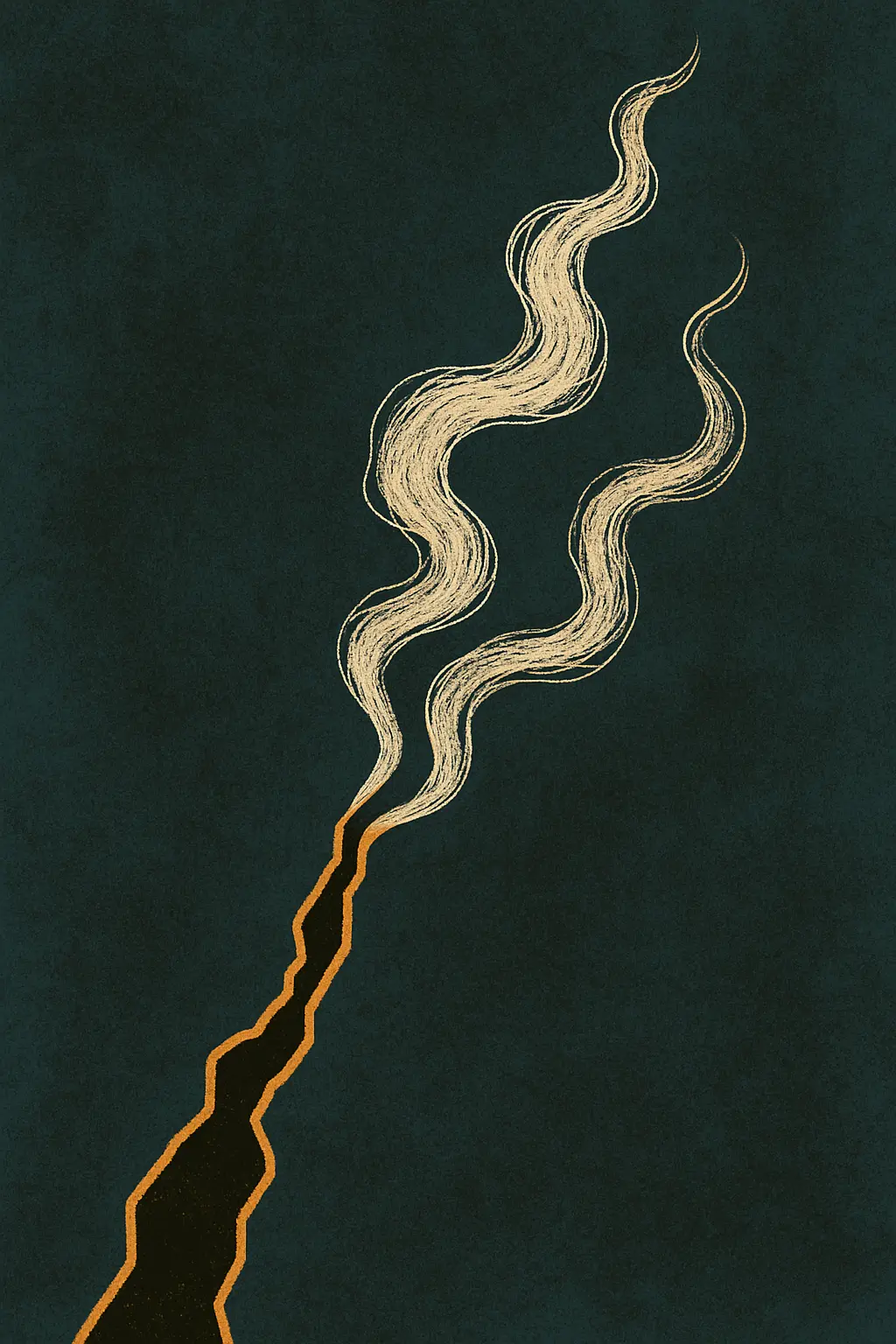
An abstract digital illustration of a dark teal background with a jagged golden crack rising from the bottom. From the top of the crack, three pale, cotton-like wisps twist upward, resembling smoke or unraveling fibers. The image has a painterly, textured quality and evokes an eerie, dreamlike sense of something organic emerging from within the split.

It began with a hangnail.

Not the sharp kind you clip away without thought, but a barely perceptible split — a sliver of keratin separating from the flesh, like a whisper of rebellion. When Mara noticed it, she pressed her thumb against it, meaning to smooth it down. The pain that answered her was out of proportion, electric, alive. She pulled her hand back as if burned.

“Just a split,” she muttered, studying it under the kitchen light. “Tiny thing.”

But that night, when she tried to sleep, she couldn’t stop feeling it — that microscopic gap where body became not-body. She imagined fibers drifting into it. Air. Dust. Threads. The thought made her stomach twist.


In the morning, her girlfriend Rhea was already awake, sitting cross-legged on the sofa, unravelling a ball of white cotton for some craft project. The sound of it — that faint whispering pull — made Mara’s skin tighten.

“Morning,” Rhea said without looking up. “I’m making clouds for the window display.”

“Maybe use something else,” Mara said too quickly.

Rhea looked up. “What’s wrong with cotton?”

“Nothing. Just… I don’t like it.”

Rhea smiled. “You and your texture things.”

Mara nodded, embarrassed. But later, when she reached for her mug and her nail brushed the sleeve of the cotton jumper Rhea was wearing, she nearly dropped it. The sensation shot through her like a cold wire — that impossible friction, that soft drag that made her feel the split widening, like a mouth trying to open.


By the third day, the hangnail had deepened. No matter how much she filed or covered it, it returned — a persistent seam. The edges of her finger grew tender, red, pulsing faintly as if something was growing beneath. She started wearing gloves, even indoors.

At night, she dreamt of cotton balls expanding endlessly, absorbing light and sound, pressing against her skin until she couldn’t tell where she ended and the softness began. She’d wake with the taste of lint in her mouth.

Rhea laughed it off at first, teasing her gently, but by the end of the week she stopped. The split was worse — black at the edges, like something beneath was rotting. Mara refused to see a doctor. She said she could feel that it wasn’t an infection. It was more like… intrusion.

Something was inside the nail.


She began hearing faint tearing noises at night — not outside, but from within her finger. Fibers shifting. Threads winding. When she held her hand close to her ear, she could almost make out a rhythm, like breathing through cloth.

Rhea found her in the bathroom one night, her gloved hand under the tap, scrubbing furiously.

“Mara! Stop!” Rhea grabbed her wrist. The glove tore. Something white puffed out like a cloud. Rhea screamed and fell back, the cotton-like threads coiling in the air before vanishing into the tiles.

“I told you,” Mara whispered. “It’s spreading.”


They didn’t sleep after that. Rhea tried to rationalize — mold, infection, hallucination — but Mara just sat staring at her hand. It was swelling now, the nail split wide, pale fibers twitching beneath like worms beneath translucent skin.

When dawn came, Mara said she had to go back to the store.
“What store?” Rhea asked.
“The one where I bought the cotton pads last week.”

Rhea followed her, though she didn’t remember any such trip. The shop was small, tucked between two shuttered boutiques. Its window was lined with mannequins draped in gauze, their fingers wrapped in bandages.

Inside, the air smelled faintly of antiseptic and something sweet — like boiled sugar. The shopkeeper was an old woman, her own hands swathed in white linen.

“I need to return these,” Mara said, placing a half-empty bag of cotton pads on the counter.

The woman looked at her hand and nodded slowly. “Ah. You opened the seam.”

“What seam?”

“The one between touch and memory,” the woman said. “Cotton remembers everything it touches, dear. It’s very patient. When it finds a way inside, it tries to remake what it remembers.”

Rhea’s voice shook. “You’re both insane.”

But when she turned toward the door, it wasn’t there anymore — just rows of pale curtains breathing gently in an unseen breeze.


That night, Rhea woke to find Mara standing beside the bed, hand ungloved, tendrils of soft white thread blooming from the split nail, weaving through her hair, across her face. Her expression was serene.

“It doesn’t hurt anymore,” Mara said. “It’s just… quiet.”

Rhea scrambled back, but her legs caught on something. Cotton. The floor was covered in it — a sea of white stretching out from where Mara stood. Every sound was muffled.

“You should feel it,” Mara whispered, reaching out. “It’s not like the fear anymore. It’s like being remembered.

Rhea tried to scream, but the air felt heavy, dense, fibrous. When Mara’s fingers brushed her cheek, the cotton threads slid effortlessly into her skin like smoke into cloth. Every nerve sang. Every cell itched with soft static.

She didn’t black out. She dissolved.


Days later, the neighbors reported a faint smell of starch and bleach seeping from the flat. The police found no one inside, just white fabric pinned across every surface — the sofa, the bed, the walls — all stitched together in a single seamless sheet.

In the center of it sat a small glass bowl filled with water. Floating in it was a single fingernail.

It wasn’t cracked anymore. It was perfect — whole — polished smooth like a pearl.

And if you leaned close enough, you could almost hear a sound from within: a soft, steady rhythm.

The quiet breathing of cotton.

The Silence Between Sparks

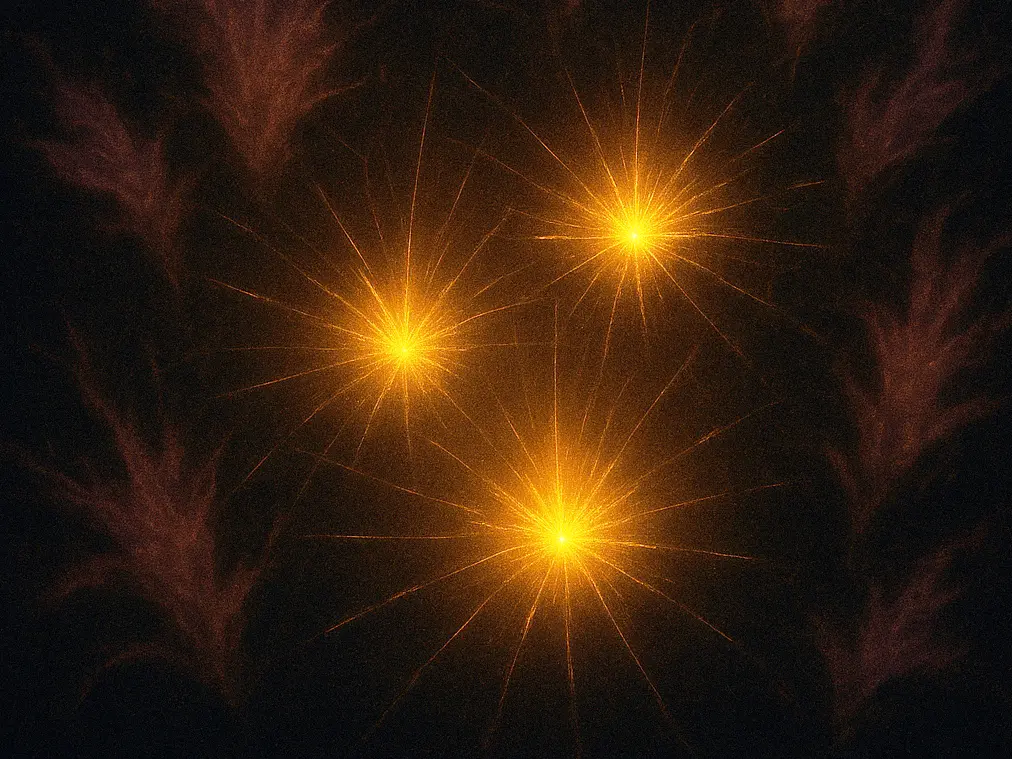
An abstract image. Three sparks light up in the darkness

Mrs. Spark drifted quietly through the dark, her glow calm, her silence colder than ash. She didn’t need to shout; sparks know when the fire has gone wrong.

Then she saw her, a bright, jittery flamelet, all fizz and perfume. The bit on the side.

“Oh!” the young spark squealed. “You must be his… main source of combustion.

Mrs. Spark tilted her glow. “So it was you he mistook me for, when he was drunk?”

The younger spark crackled nervously, shrinking to a flicker. “He said it was romantic, you know. That we were destined to ignite.”

Before Mrs. Spark could respond, a distant honk echoed through the night. Both turned their glow toward the sound.

Out of the gloom emerged a clown, riding astride a giraffe with all the ceremony of a knight. The giraffe’s long neck swayed like a burning wick, and the clown’s painted face beamed with absurd solemnity. He tipped his rainbow hat as he passed, jangling bells that fell silent almost immediately in the thick, smoky air. For a moment, their quarrel was paused by this impossible intrusion.

Then came the noise. A low crackling shuffle, like dry leaves catching fire. Out of the shadows lurched the Ashen Sparks, brittle, half-dead remnants of old fires, dragging themselves forward, hissing with envy for the living glow.

The Ashens struck suddenly. One lunged at the young flamelet and sank its ember-teeth into her arm. She screamed, sparks spilling from the wound. Mrs. Spark tried to pull her away, but more of the creatures closed in, circling like vultures.

Just as the swarm pressed tighter, Mr. Spark appeared, swinging his blackened baseball bat. He smashed one Ashen into powder, then another, then shoved the rest back with furious swings. “MOVE!” he shouted.

Together, scorched and trembling, the trio fled into a crumbling pharmacy at the edge of the street. Mr. Spark slammed the door shut, wedging a shelf against it as the Ashens clawed uselessly at the glass.

Inside, surrounded by broken pill bottles and the faint smell of disinfectant, they collapsed in the dim glow of a lantern. The young flamelet clutched her burnt arm, teeth gritted. Mrs. Spark’s silence still carried judgment, but for now, survival weighed heavier than betrayal.

Mr. Spark stood watch at the door, his bat resting on his shoulder. “They only come at night,” he said grimly. “We make it till morning, we live another day.”

And so the three of them, husband, wife, and mistress, sat together in uneasy alliance, waiting for dawn, while the Ashens scraped and hissed in the dark outside.

Carnival Dream: The Storm

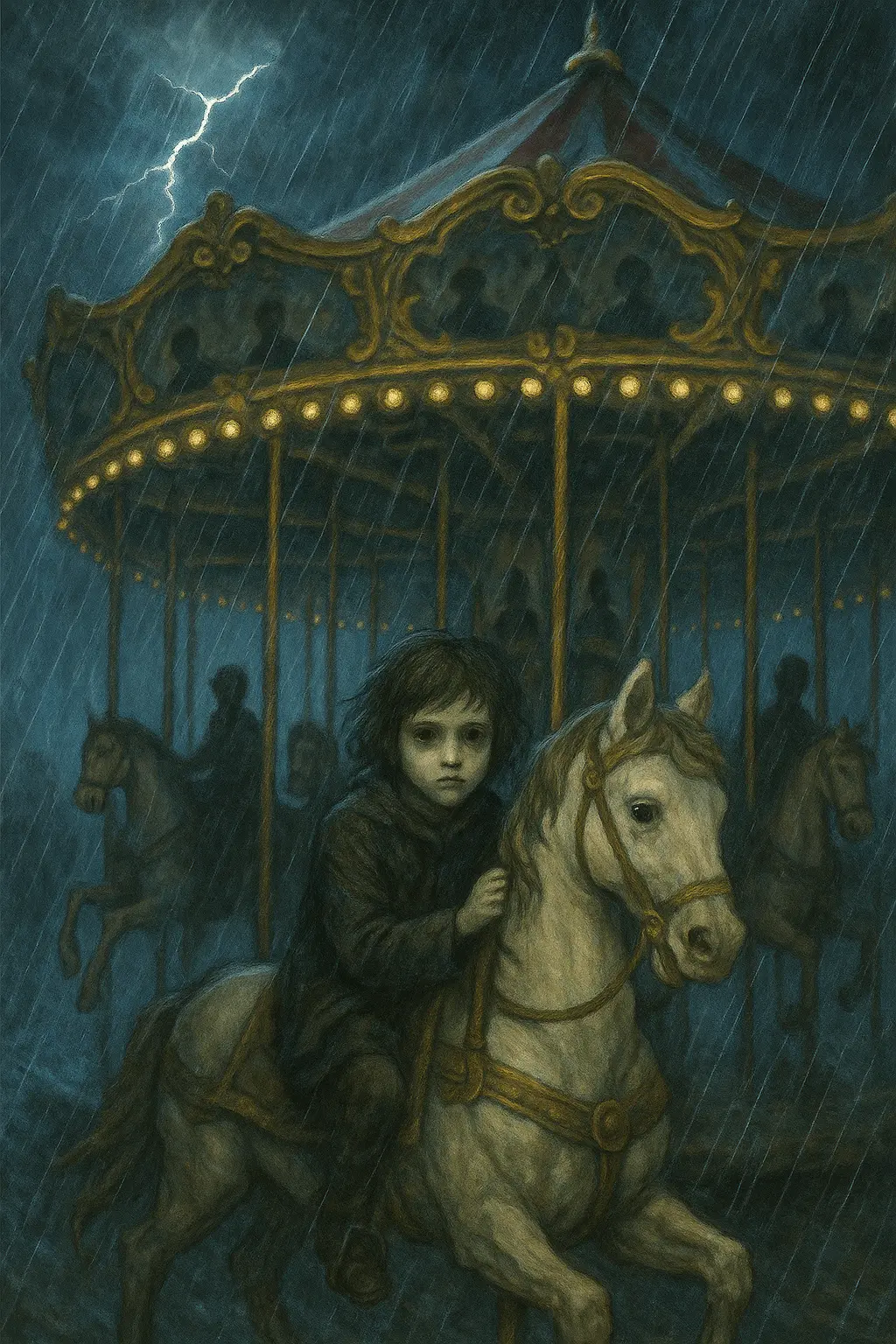
The carousel groaned as it turned, its golden poles smeared with the fingerprints of a thousand forgotten riders. Painted horses reared in frozen delight, their glass eyes glinting with a happiness that had long since curdled.

The child climbed on.

Not because he wanted to—but because he’d forgotten how to say no.

A quiet organ tune clinked out through a crackling speaker. 3/4 time. Always 3/4 time.

He chose the horse with a cracked smile and a nameplate that had been scratched blank.

His name had been Matthew, once.

As the platform began to spin, so too did the sky.

It started with a breeze—cool and damp—then a sudden curtain of rain, thick as syrup. Thunder cracked so loud the carousel jolted beneath it. Children screamed. Adults ran for cover.

But the ride did not stop.

Lightning flashed, strobing the carnival into a series of still photographs:

  • A balloon let go
  • A face smeared with candy and tears
  • A clown’s makeup melting in the downpour

The carousel spun faster. And then slower. And then… wrong.

The mirrors at its center reflected not the riders, but versions of them—distorted, grown-up, bitter, bored. One child saw themselves in a suit and tie, crying at a desk. Another, pushing a pram with hollow eyes. Another, screaming into a microphone to a crowd that wasn’t listening.

Matthew looked into the glass and saw nothing at all.

Just a flickering silhouette, undefined—unformed but watching.

Then—CRACK—lightning struck the iron arch above. The carousel jolted. The horses’ eyes blinked once.

And the dream tilted.

Somewhere beneath the floor, gears began to grind a different rhythm.

Something was waking.

And somewhere, in a layer just outside the dream, Angel remembered.

Not everything. Not yet. But enough.

Enough to know that the carousel wasn’t just a ride. It was a ritual. A loop. A lie.

And Matthew had ridden it long enough.