Conversion Culture: How Capitalism Turned Humans Into Measurable Events

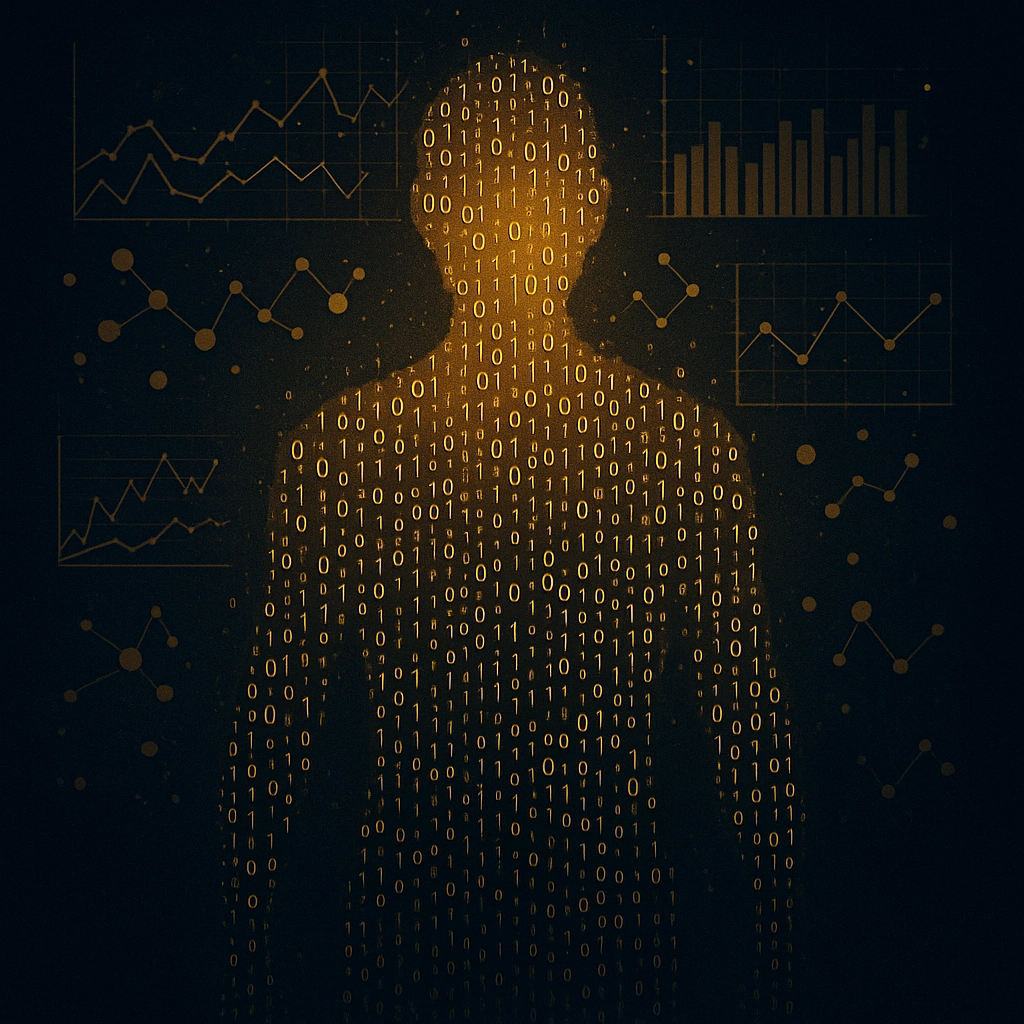
A glowing human silhouette made of binary code stands against a dark background filled with faint charts and data graphs. The figure appears to dissolve into digital numbers, symbolising a person reduced to data.

There is a single word that quietly reveals everything wrong with modern marketing, social media strategy, influencer culture, and the strange world that independent artists must navigate. That word is conversion. It sounds clinical and neutral, as if it belongs in a quarterly report instead of in the language of human interaction. Yet behind its tidy exterior lies something far more disturbing. A conversion is not a person who connected with your work. It is not someone who felt something. It is not a supporter, a fan, or a fellow human being.

A conversion is an event.

A moment where a person becomes a measurable unit of compliance. Nothing more.

Welcome to conversion culture, where the ultimate goal is to transform human beings into behavioural outcomes that can be tracked and optimised.


What a Conversion Really Is

In marketing language, a conversion is the instant when you perform the desired action. Click. Follow. Share. Buy. Sign up. These small behaviours are treated as success metrics, but they reveal nothing about genuine engagement or emotional impact. All they show is that the funnel worked as intended. The action occurred. The individual behaved according to the predicted script.

Success is not about meaning.
Success is about compliance.

A conversion is simply the moment when the algorithm wins.


The Linguistic Violence of the Term

Language shapes how we see the world. When we adopt a word, we also inherit the worldview that produced it. The word conversion belongs in theological discourse and industrial transformation, not in the delicate terrain of human relationships. It implies that the human is the raw material and the system is the force that acts upon them.

To convert someone is to reshape them without genuine dialogue.
It is not a relationship.
It is a process.

And in modern marketing, the person is no longer the subject. The person becomes an object, a target, a data point waiting to be molded into a desired shape. The humanity of the interaction disappears, leaving only the measurable outcome.


The Microcosm of Manipulation

Once you start noticing conversion culture, it becomes impossible to unsee it. Social media platforms train creators to think in funnels and hooks. Influencers treat audiences as pipelines. Independent artists are taught to build their brand with the same logic that corporations use to advertise toothpaste.

Everywhere you look, people are encouraged to optimise their interactions for performance. Even authenticity is presented as a strategy. The self becomes a product. Communication becomes a tactic. Community becomes a marketplace where every relationship is quietly assessed for conversion potential.

This worldview does not announce itself as dehumanising. It presents itself as normal. Sensible. Professional.

I remember the first time I saw this normalisation happen in real time. It was a few years ago at a seminar I attended for a charity I volunteer for, part of a networking event focused on social media and promotion for independent artists.

The word was everywhere. Conversion. Conversion. Conversion. It was treated as self evident, as if everyone in the room already knew exactly what it meant and why it mattered. I did not immediately understand the technical definition, but I could feel what it represented, and the feeling was nauseating.

Everyone around me was nodding along. Yes. Conversions. This is what we want. This is what we are here for. It was the unspoken goal that no one thought to question.

There was no discussion about what converting a human being actually meant. Either people did not know and were afraid to admit it, or some part of them understood and quietly chose not to look too closely.

Later, the topic of AI generated music came up. The consensus was clear. This was bad. A threat to artistic integrity.

I remember finding the contrast deeply ironic. People were perfectly comfortable letting algorithms shape how their own work should be funnelled, distributed, and rewarded for the sake of hollow metrics, yet deeply uncomfortable with the idea of a machine touching the art directly.

The integrity of the artwork mattered deeply.
The integrity of the artist, far less so.

That moment stayed with me, because it revealed how completely conversion culture has embedded itself into creative spaces. It is no longer questioned. It is assumed. And once a system becomes invisible, it becomes far more powerful.


The Death of Meaning Under Conversion Logic

Conversion culture has a profound effect on creativity, connection, and selfhood. When the primary goal is to convert people, everything begins to bend around that objective. Art becomes engineered for virality instead of expression. Writing becomes designed for engagement rather than truth. Even conversation becomes structured by what might perform well.

You begin to ask the wrong questions.
Does this convert.
Does this grow the audience.
Does this feed the machine.

Instead of asking the questions that actually matter.
Does this feel true.
Does this matter to me.
Does this say something real.
Does this speak to another person with sincerity.

Meaning becomes secondary. Humanity becomes collateral damage. The system cares only about whether the action happened.


What Happens to the Artist Under This System

Independent artists face a strange and exhausting paradox. They are told to be authentic, but only if authenticity converts. They are told to build community, but only if community can be monetised. They are told to express themselves, but preferably on a rigid schedule that pleases algorithms.

Everything becomes performance. Everything becomes content. Everything becomes part of the sales funnel. The artist who once created from curiosity or passion or inner necessity slowly becomes a brand manager performing a role for an invisible audience.

The cost of this transformation is enormous. Conversion culture does not simply reshape how art is shared. It reshapes the inner landscape of the artist.


The Human Cost of Being Treated as a Metric

People can feel when they are being measured. They know when they are being treated as potential conversions rather than as whole beings. This creates a pervasive sense of distrust and exhaustion. Connection becomes transactional. Creativity becomes strained. Spaces that once felt communal begin to feel artificial and hollow.

To be viewed as a conversion is to be seen as less than human.
It is to be positioned as a means to an end.
It is to be transformed into a statistic.

No wonder so many people feel unseen in digital spaces that claim to measure engagement. The numbers may be high, but the soul is empty.


Rejecting Conversion Culture

There is another way to exist in the world. It begins with choosing meaning over metrics. Depth over efficiency. Connection over extraction. It requires refusing to treat people as potential sales and refusing to treat ourselves as brands in need of constant optimisation.

It means asking better questions.
What do I want to express.
Who do I want to reach.
What feels alive.
What feels true.

Every refusal to participate in conversion logic is an act of reclamation. It is a reminder that art, communication, and human experience have value far beyond their measurable outcomes.

It is a way of stepping out of the machine.


The Unconvertible Self

You are not a metric.
You are not a data point.
You are not a behavioural outcome to be engineered.

You are a person with a story and a mind and a capacity for connection that cannot be graphed.

Any system that reduces you to a conversion is a system that does not deserve you.

Perhaps the most radical act in the age of conversion culture is to remain human in the face of relentless pressure to become something simpler and more profitable. And perhaps the greatest act of artistic rebellion is to create something that refuses to convert at all.
Priced Out of My Own Creativity

On Slowness, Authenticity, and the Hidden Cost of Making Art in a Capitalist Age

I never thought I’d feel excluded from the very thing that once gave me a sense of freedom. But lately, I’ve come to realise that I am being priced out of my own creativity. Not because I lack the passion, or the ideas, or the skill — but because I can’t afford to keep up. In a world where speed, output, and polished presentation have become the currency of success, the slow, deliberate path of authentic creation begins to feel like a liability. It’s not that I envy others for having more — it’s that I’m haunted by the quiet truth that if I could afford their shortcuts, I’d take them too. And maybe then, I’d finally be heard.


The Outsourced Artist

In today’s creative landscape, outsourcing isn’t just accepted — it’s expected. Bands hire mixing engineers, mastering engineers, session musicians, graphic designers, videographers, social media managers, PR firms, playlist pluggers, and even ghostwriters. What once might have been a collaborative luxury is now a prerequisite for visibility.

The result? A strange duality: the artist becomes both the brand and the product, while the actual act of creation is often fragmented, delegated, monetized.

What happens to those of us who can’t afford to participate in this system — not just financially, but philosophically?

If your process is slower, more solitary, more sacred — you risk becoming invisible. It begins to feel as though the art you bleed over is less “real” because it lacks the polish, the reach, the momentum.

But polish is not proof of depth. And speed is not proof of soul.


The Pace of the Mind

For some of us, slow work isn’t a choice — it’s how we’re wired. As a neurodivergent creator, my process often unfolds at the rhythm of deep focus, scattered epiphanies, or energy that arrives in brief, unscheduled waves. I don’t have the bandwidth to be “on” all the time, nor the capacity to split myself between creating, promoting, polishing, and packaging — all while maintaining a public-facing presence.

There are days when just starting takes all my energy. Not because I don’t care — but because I care too much. The ideas are there, the vision is vivid, but the executive function required to carry it through feels like swimming in glue.

In a society that equates slowness with laziness, this reality becomes invisible. But slow art isn’t lazy — it’s often more conscious, more personal, more layered.

The problem isn’t my pace. It’s that the creative world is rigged for speed.


The Misinterpretation of Slowness

In the eyes of an algorithm-driven world, slowness is indistinguishable from absence. If you’re not releasing something, promoting something, performing something, or networking somewhere, you might as well not exist.

The labor you’re doing behind the scenes — the quiet crafting, the emotional processing, the struggle to bring a foggy idea into form — becomes invisible.

There is no metric for sitting with your feelings.
No content calendar for trial-and-error.
No viral moment for doing something the hard way just because it felt true.

The unspoken message is: If you were really good, it wouldn’t take this long.

But what if the time it takes is part of the art?


Between Autonomy and Assistance

I sometimes wonder what I might create if I had the means to outsource the tedious parts of production — the repetitive tasks, the non-creative polish, the technical finishing touches. And yes, I would do so in a heartbeat if I could. There is no virtue in burnout.

But there are aspects of my work that feel sacred.
Decisions that need to be made by hand, not handed over.
Not everything can be automated without losing something vital.

Even in areas where tools like AI are beginning to offer creative support, I tread cautiously. I welcome augmentation — a scaffolding to help me express what’s already inside me — but I resist the pull toward a fully packaged aesthetic I didn’t choose.

To maintain agency over your art in a world that rewards trend-following over truth… is to walk a narrower path.


Why I Still Create

And yet, I keep creating.

Not because the system rewards me, but because something in me refuses to stop.
I create for the moments when the noise falls away and something raw and beautiful emerges from the mess.
I create because it connects me to myself, and sometimes, to others who are quietly walking similar paths.

I don’t know if my work will ever be widely seen, heard, or recognised. But I know it is mine. Every rough edge. Every choice made without compromise. Every imperfect but honest thing I shaped with my own hands.

That has to count for something.

So this is for the others like me — the slow ones, the careful ones, the fiercely authentic ones.

You’re not invisible to me.
I see you in the cracks, in the edges, in the long silences before the next release.
And I believe what you make, when it finally arrives, will be worth the wait.

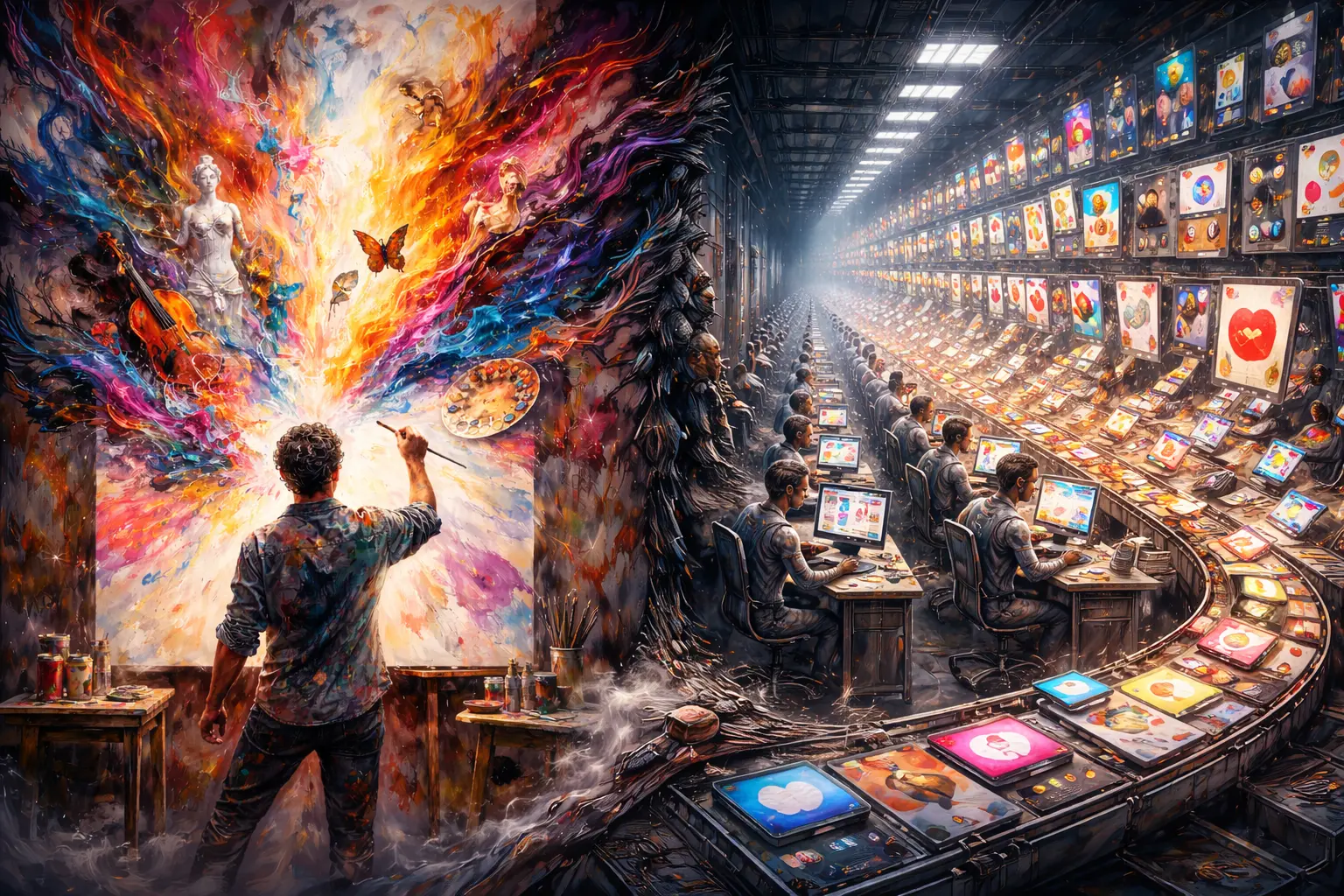
Art is NOT ‘Content’!

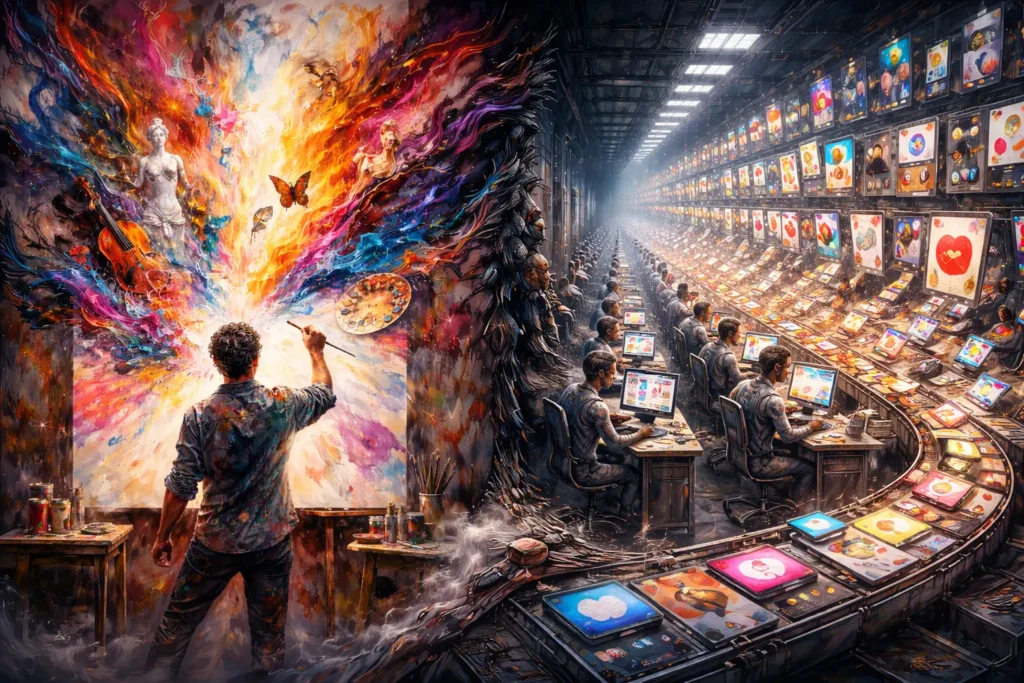
A divided image contrasting a painter creating art in a vibrant studio with a large hall filled with people producing digital content at computer stations.

The digital age has led us to a curious intersection, where the word “content” has become ubiquitous, and “art” seems to be slipping from its once-sacred pedestal. What once required time, effort, and intention to create is now often reduced to an endless churn of quick consumption, reduced to mere “content” for the masses to engage with. This shift is something I can’t help but observe with both concern and reflection.

For someone like myself—constantly battling the tension between personal identity, society, and the existential weight of existence—the current state of art feels almost like an existential crisis of its own. The act of creation, for me, is personal, deliberate, and reflective. It is an attempt to make sense of the world, to carve out meaning, and to leave something behind that resonates beyond the confines of time. But in the age of digital platforms, this sacred act of creation feels increasingly commodified.

The idea of “content” has become a business-driven term, designed for quick consumption, for likes, shares, and engagement metrics. Art, which once demanded patience from both creator and audience, is now expected to be produced in rapid bursts, optimized for algorithms that care little for the soul of the work. There is a certain detachment from the deeper, existential elements of art that once grounded it in something profound.

In my own life, I’ve had to reconcile the desire for meaning with the reality of a society that often demands conformity. Much like the societal pressures I’ve felt to “fit in” (as outlined in my exploration of identity and alienation), there’s a parallel pressure in the artistic world to conform to the “rules” of content creation. The faster you can churn out pieces, the more successful you are—regardless of the depth or intent behind them. Where once I might have taken months to perfect a story or reflect deeply on its implications, I find myself asking, “How quickly can I produce something that will generate engagement?”

I see this in the realm of social media, where content is consumed at an alarming rate, often with little regard for its longevity or its ability to stand the test of time. It’s all about what captures the attention in the moment, what creates the immediate buzz, and then it’s discarded, replaced by the next viral moment. This constant churn of “content” feels like a reflection of the broader existential struggle I often muse about—one where we’re caught in a cycle, never really allowing ourselves to linger in one thought, one creation, long enough to find its true meaning.

And yet, this transformation isn’t without its value. Like many things in life, it’s a balance. Content, in its own right, can be meaningful. It can still carry depth, insight, and intention, but it’s often hidden behind the facade of quick consumption. The challenge, then, is not to fall into the trap of creating merely for the sake of producing but rather to carve out space within this content-driven world for true artistic expression.

It’s easy to be seduced by the quick dopamine hits of social media validation, but I find myself wondering, what happens when the art we produce is merely optimized for engagement, not introspection? What happens when the deeper, slower aspects of art are lost to the rush of “content”?

It’s a complex landscape—one that I continue to navigate. My journey of self-acceptance and understanding (which I’ve shared before in reflections like The Outsider) has always been about carving my own path, about finding meaning in a world that often seems to demand conformity. And in this moment, it’s about resisting the pressure to reduce my creative endeavors to mere content. Art, for me, will always be a process of deep engagement, introspection, and meaning. And I have to hold onto that, even as the world pushes toward something faster, more superficial.

I’ll continue to create with intention, even if it means standing outside the prevailing norms. Just as I’ve come to accept that I don’t fit in with the mainstream society, so too do I embrace the idea that my art—whatever it may be—doesn’t have to conform to the demands of the “content machine.”

After all, the true value of art, the meaningful kind, isn’t something that can be measured in likes or shares. It’s something that resides in the depths of the human experience, something that will persist long after the noise of the digital world has faded away.

So, to those who create for the sake of creating, for the sake of self-expression, and for the sake of finding meaning in this chaotic existence, I say: Don’t let your work be reduced to mere “content.” Let it be art.