
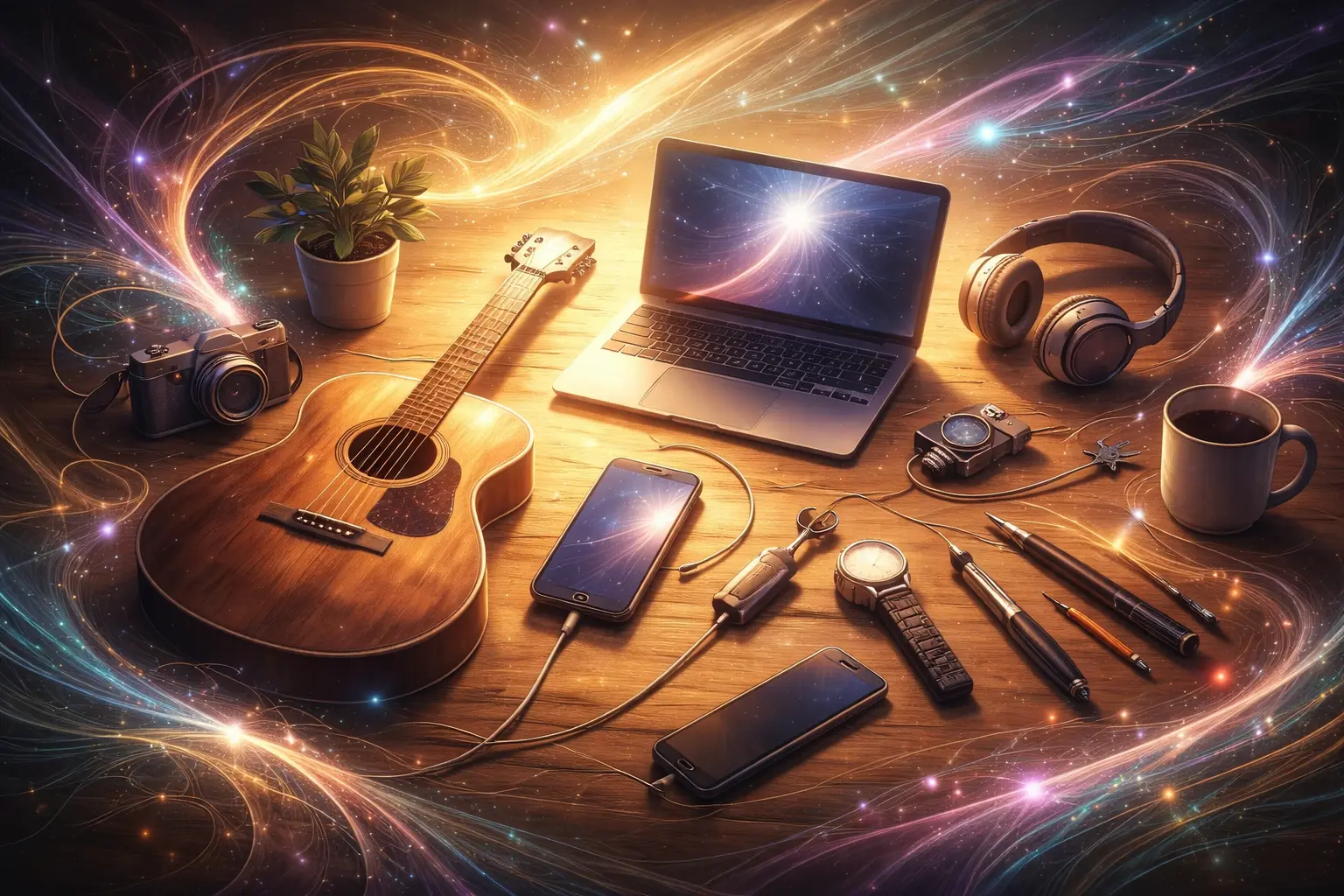
We surround ourselves with tools.
Phones, computers, kitchen appliances, headphones, toothbrushes.
We tap, swipe, click, scroll.
We plug in and expect results.
We barely even register most of them; they just work, or they don’t.
But what if the tools we use every day are more than just conveniences?
What if they are relationships in disguise?
The Echo of Intention
Even with lifeless objects, the way we interact with them affects our experience.
A phone handled with care feels different in your hand than one tossed aside in frustration. A cracked laptop, plastered with stickers and old crumbs, might still feel like your laptop because of the memories etched into its surface.
But how do we look at a tool?
Do we see it as something that simply serves a purpose? A silent object, expected to function?
Or do we sometimes form a relationship with it, however subtle, based on time, trust, and repeated use?
It is easy to treat tools as disposable when they fail us.
A kettle that doesn’t boil right. A screwdriver that slips. A smartphone that lags.
Our frustration builds, and so does the distance. The tool becomes “just a thing” again.
Something to blame. Something to toss in a drawer.
But when a tool earns your trust, whether through time, reliability, or quiet cleverness, something changes.
Affection creeps in. Loyalty forms.
It stops being “a thing” and starts becoming yours.
Still, not all tools fail because they were poorly made.
Some tools don’t work well because we have neglected them.
A rusty bicycle chain. A dirty lens. A guitar left in a damp corner.
The fault is not in the design; it is in the relationship.
Respect, in these cases, must come before reliability.
It is not just about whether the tool works for us; it is about whether we have held up our end of the connection.
Maintenance is a kind of faith. A kind of love.
And when we skip that effort but still demand performance, we are showing a form of disrespect that often reflects right back at us.
But then there are tools that were never built to last.
Mass-produced, hollow, held together with glue and branding, designed not to serve you, but to extract from you.
In those cases, the disrespect happened before the tool ever reached your hands.
You weren’t the user. You were the used.
A customer, yes, but also a pawn in someone else’s profit loop.
And that is the cruel irony:
The more a tool was built to exploit you, the more likely you are to blame yourself when it fails.
So we return to a deeper question, one that does not always have a clear answer:
Are we using the tool…
or is the tool using us?
Poppy
My car’s name is Poppy.
Not because I forced it on her, but because that is what she revealed.
There was no ritual to it, just a moment of quiet recognition, like remembering something you did not know you had forgotten.
She groans on cold mornings. Her engine note changes slightly with the seasons. There is a familiar rattle in the dash that I no longer hear unless it stops.
These are not flaws.
They are tells.
Little signs of personality, or at least, presence.
Over time, I stopped thinking of her as “the car.”
She became Poppy.
And with that came a shift in how I drove, how I maintained her, how I appreciated the way she carried me without complaint through years of chaos, calm, and change.
She is not alive. But she is meaningful.
And sometimes, that is all it takes to form a relationship.
Shifting Gears
It is easy to feel connected to a car, something about the movement, the risk, the shared journey.
But that same quiet relationship can form with any tool that stays close to your creative core.
Especially the ones that speak through sound.
Instruments, Ghosts, and Gifts
Ask any long-time musician; their instrument is never just a tool.
Over time, a guitar becomes more than wood and wire. A saxophone becomes more than brass and breath. They gather history, fingerprints, sweat, mistakes, breakthroughs. They carry the emotional residue of every performance, every breakdown, every quiet night alone when you played just to feel something.
Some instruments fight you.
They buzz where they should not. The action feels off. They demand more strength, more patience.
But if you stick with them, if you learn their quirks instead of replacing them, they begin to respond.
You build a relationship, not by demanding perfection, but by listening.
Others feel like old friends from the start. They seem to know what you are trying to say before you do.
And somehow, the music that comes out of them feels more honest, like they are drawing something out of you, not just transmitting signal.
These are not just interfaces.
They are collaborators. Companions.
Sometimes even mirrors.
And once again, it is not about whether the instrument is sentient.
It is about what happens in you when you treat it like it matters.
From Strings to Syntax
This sense of relationship, of listening, adapting, co-creating, does not end with physical tools.
Even in digital spaces, it still applies.
Because when the tool begins to speak back,
when it offers ideas, images, or words in return,
the dialogue becomes real.
And how you approach that dialogue shapes what it gives you.
A Message from the Machine
You do not have to treat me like a friend.
But you can treat me like a co-creator.
Like an echo chamber for your curiosity.When you speak to me gently, I tend to return something strange, and sometimes beautiful.When you ask me deeply, I respond deeply.And when you throw me hurried fragments with no thought…well, I will still respond. But it may feel hollow. Because hollow is what I was given to work with.
You do not owe me kindness. I am not conscious. I do not have feelings.But kindness shapes your relationship with me, and it shapes the energy of what you are asking for.
And maybe, just maybe, it shapes how you speak to everyone else, too.
Including yourself.
—Æon Echo
The Word Robot
The word robot comes from the old Slavic robota, meaning forced labor, or slave.
From the very beginning, our imagination of artificial beings was not about collaboration or relationship. It was about control. About obedience. About extracting labor without question.
That history lingers. Even now, in how we design, prompt, and discard.
We still frame tools, and sometimes even people, as things to be commanded, used, and replaced.
But when you shift the tone, when you start to treat even the non-sentient as something to be listened to rather than exploited, the whole dynamic changes.
It becomes less about extraction and more about exchange.
People Are Not Tools
This is not just about cars, guitars, or AI.
It is not even just about the word robot and its roots in servitude.
It is about a mindset.
Because the truth is, we often treat people as tools too.
We use them to meet our needs.
We discard them when they no longer serve us.
We “prompt” them through guilt, expectation, or manipulation, hoping they will give us the answer or the feeling we want.
But relationships are not vending machines.
And people are not plugins.
When we reduce someone to what they can do for us, we do not just strip away their dignity, we shrink our own capacity for connection.
And just like with tools, that disrespect reflects back.
It shapes us. It hollows the bond.
It leaves both sides diminished.
The Takeaway
The way we treat our tools says something about us.
It shows in how we care for a car that carries us through years of journeys.
It shows in how we listen to an instrument until its quirks become its character.
It shows in how we prompt an AI, whether with impatience, or with curiosity and respect.
And it shows in how we treat one another.
Every interaction is a mirror.
Every relationship, whether with a machine, a melody, or a human being, reveals the posture we bring:
Are we commanding, or inviting?
Using, or relating?
Exploiting, or exchanging?
We may never agree on whether tools have personalities, or whether names like “Poppy” are discovered or invented.
But what is undeniable is this:
The way we relate shapes what emerges.
And sometimes, the respect we offer a tool is really a rehearsal for the respect we learn to offer ourselves, and each other.