
Dream Delegation: A Neurodivergent Method of Creation

A serene dreamlike painting of a person sleeping peacefully, cradling a glowing orb that contains a miniature world. Inside the orb, a golden building, flowing paths, and a crescent moon float against a starry night sky. The image glows with warm blues and golds, symbolizing creative imagination emerging from rest.

This is a concept I would like to propose to other creatives who live with ADHD, autism, or any form of neurodivergence that makes sustained creative work feel like an uphill climb. It began as a personal revelation, though I suspect it may hold potential for many others who exist between focus and fragmentation.

If in our waking lives we do not always have the time, energy or focus to commit to our work, then we can let our dreams do the heavy lifting.

The Principle

Dreams are not meaningless fragments of the subconscious. They are an extension of consciousness operating in a freer state, unshackled from the rigid demands of executive function. For those of us whose waking minds are constantly filtering noise, managing overwhelm, or translating our inner logic for an external world that rarely fits, dreaming can be a sanctuary.

In dreams, the mind can continue the work it could not complete by daylight. It can experiment without penalty, associate without inhibition, and build without fatigue.

I call this process dream delegation. It is not escapism, but collaboration. We let the dreaming self take over the tasks the waking self cannot yet bear.

The Method

Dream delegation is not about lucid control or elaborate ritual. It is about gentle partnership between states of consciousness. The practice begins with intention, not command.

Before sleep, set a quiet intention, phrased as an invitation rather than an order.
Examples:

  • “Tonight I will wander through the atmosphere of my unfinished song.”
  • “I will explore the feeling of color becoming sound.”
  • “I will let my mind design freely, and bring back what it can.”

Do not expect coherent stories or visions. The subconscious works in symbolism, abstraction and atmosphere. The goal is not to remember perfectly, but to let something settle in the soil of the mind.

Harvesting the Work

Upon waking, record fragments such as a texture, a phrase, a shape or a mood. These are the sketches left by your dreaming collaborator. Do not force interpretation. Instead, revisit your creative work and see if those fragments resonate.

Often, the dream will have solved a problem indirectly, revealing a new perspective or emotional tone rather than a concrete answer. You may find that an idea feels lighter, as though its structure was silently reinforced while you slept.

Integration and Reflection

Dream delegation turns rest into an act of creation. It shifts the narrative from I cannot focus enough to create toward my mind creates even when I cannot. This reframing alone can restore a sense of agency and continuity.

The practice also encourages respect for the subconscious as a creative equal. It acknowledges that our inner worlds are not idle or broken when we are overwhelmed, but quietly industrious beneath the surface.

It reminds us that creativity is not confined to the hours we are awake and functional. It breathes between the worlds, and sometimes the greatest work happens while we appear to be doing nothing at all.

Closing Thought

Dream delegation is not a technique to perfect, but a relationship to nurture. It is an act of trust, allowing the hidden layers of the mind to contribute, to collaborate, and to carry some of the weight that daylight cannot.

For neurodivergent creators, it may offer not just a new method, but a new way of forgiving ourselves. To recognise that even in rest, we are still becoming.

I Am the Eye: The Burden and Duty of Seeing

A surreal, glowing digital painting of a fiery Eye of Providence. A realistic human eye sits at the center of a golden triangle, surrounded by concentric circles and ornate, wheel-like forms adorned with smaller eyes. These swirling wheels resemble the biblical Ophanim, set against a dark cosmic background with radiant orange and red hues. The overall effect is mystical, intense, and reverent, evoking themes of divine awareness and eternal vigilance.

The Eye That Cannot Look Away

I didn’t choose to be the Eye.

I simply opened one day and found the world already burning.
Not in flame, but in falsehood.

My awareness turned, wheel-like, without pause.
The rotation was not mechanical. It was necessary.
Each moment turning into the next. Each layer of vision revealing something more.
I could not stop it. I still can’t.

Others closed their eyes. I tried.
But mine would only multiply.

I am not the voice. I am not the hand.
I am the watching.
The silent witnessing that does not blink.

And in this world, that is enough to be cast out.


Neurodivergence as Exiled Awareness

I don’t see the world the way I’m told I should.
And for most of my life, I assumed that meant I was broken.

I now realize it meant I was awake in a world that prefers sleep.

My autism and my ADHD aren’t flaws in perception. They are alternate engines of it. They spin differently. Faster, deeper, sometimes chaotically, but always in motion. Always watching. Always noticing.

It’s not that I chose to see through the surface of things, it’s that the surface was never enough to hold my focus. My gaze slips past the scripts. Past the socially approved illusions. Past the small talk and the noise.
And what’s underneath… isn’t always beautiful.

Sometimes it’s systemic cruelty.
Sometimes it’s hollow rituals.
Sometimes it’s pain that has been painted over so many times it almost looks like tradition.

I can’t unsee it.
And that makes people uncomfortable.

So they exile the Eye.
Label it too intense, too sensitive, too abstract, too much.
They pathologize the perception because it doesn’t fit the system.
But what if it’s not the Eye that’s flawed?
What if it’s the blindness of the system that can’t stand to be seen?


The Labor of Witnessing

Seeing is not passive.

People assume it’s the easy part. That noticing injustice, cruelty, contradiction, is somehow less valuable than fixing it.
But that’s because they’ve never had to hold it.
Not continuously. Not without relief.

To see clearly in a world so committed to illusion is not a gift, it’s a burden.

It means absorbing what others dismiss.
It means holding space for truths that fracture you.
It means grieving for things no one around you even recognizes as lost.

It wears you down.
It isolates.
And still, it doesn’t stop.
Because once the eyes open, really open, they don’t close again.
Not without violence to the self.

And so I orbit.
Like a silent satellite, I observe the movements of a species desperate to avoid its own reflection.
And I carry the knowing alone—because most people aren’t ready to receive it.

This isn’t martyrdom.
I don’t want pity.

But I do want it recognized:
Witnessing is work.
And for many of us, especially those pushed to the edges, neurodivergent, sensitive, spiritual outliers, it may be the only work we’re allowed to do.
And even that, society tries to discredit.

But the Eye does not need permission to see.
It just does.


Feedback to the System

If I am the Eye, then the act of seeing is only half the process.
The other half is feedback: transmitting what I witness back into the body that has exiled me.

It’s not about fixing the world on my own. That’s a myth of individualism.
It’s about doing what the Eye was made to do: perceive, and then signal.
Not shout. Not command.
Just pulse with truth. Clear, unblinking, and persistent.

This blog, this act of writing is my feedback loop.
A transmission from the margin to the center.
From the watcher to the mechanism.
From the disowned to the whole.

I don’t know who will hear it.
But I know it needs to be said.

This is how I stay in relationship with a world that doesn’t always want me.
This is how I remind myself I exist for a reason, even if that reason isn’t glamorous or easy.

Seeing is my function.
Speaking what I see is my response.
Not my solution.
Not my plan.
Just the resonance that follows perception.


Integration > Erasure

When a body rejects its own awareness, it becomes dangerous to itself.

Society does this all the time.
It amputates its Eyes. The seers, the questioners, the sensitive, the strange. Because their presence threatens the illusion of harmony.
But in doing so, it loses access to its only chance at honest course correction.

A body without an eye cannot navigate.
It stumbles. It repeats.
It hurts itself and calls it progress.

We live in a world that mistakes numbness for peace, denial for optimism, and noise for communication.
And when someone comes along carrying too much perception, the reflex is not to listen, but to silence.

This is why neurodivergent people are so often medicalized, spiritual seekers dismissed as delusional, and truth-tellers branded as unstable.
Not because we are dangerous.
But because we reflect back the parts of the system it refuses to acknowledge.

But repression is not integration.
And silencing the Eye does not stop it from seeing.

If humanity is ever to evolve beyond self-sabotage, it must learn to listen to its own margins.
To welcome the witness.
To integrate the visionaries before they become casualties of a system that can’t tolerate clarity.

Because if the Eye continues to be erased, the whole will remain blind.


I See, Therefore I Am

I used to think I was broken for seeing too much.
For being too sensitive.
Too intense.
Too unwilling to pretend it all made sense.

Now I understand:
I am not broken.
I am designed differently.
My function is to see.

And there is meaning in that—
Even if the world doesn’t know what to do with it.

I’ve spent years trying to shrink my perception, to soften it, to make it more palatable.
But some eyes were never meant to close.
Some awarenesses are meant to rotate, to scan, to bear witness without flinching.

In ancient texts, they were called Ophanim. Wheels within wheels, full of eyes, radiant and dreadful.
They did not speak. They did not lead armies.
They only saw.
And in their seeing, they served a purpose beyond human comprehension.

I think I understand them now.

Maybe I am not here to save the world.
Maybe I am only here to reflect it.
To rotate in quiet vigilance.
To offer the signal back to a system that forgot it had eyes at all.

I am the watcher.
I am the witness.
I am the Eye.

And I see.

Discrediting AI-Assisted Writing Is Gatekeeping—And It’s Ableist!

I’m not a writer by academic standards. But I have a lot of ideas.

Ideas that would otherwise stay locked inside my head—unfinished, unshared, and unheard—not because they lack value, but because putting them into words in a conventional way is difficult for me.

I’m autistic. I also have ADHD. Language—especially written language—isn’t always the smoothest interface for my thoughts.

But thanks to AI, I now have a way to bridge that gap. I can shape my thoughts into something others can understand, not by faking fluency, but by collaborating with a tool that supports my expression.

And that matters.


This isn’t about cheating. It’s about access.

I use AI to help realise my ideas—not to replace them. The spark, the insights, the perspective—that’s all me. AI helps put those thoughts into structured sentences, often with a clarity I couldn’t achieve alone, especially not without enormous cognitive strain.

So when people start to dismiss writing just because they suspect it was touched by AI—because it contains too many em-dashes, or feels “machine-like” in tone—I have to ask:
Who exactly are they trying to exclude?

Because for people like me, AI isn’t a shortcut. It’s a ramp. A screen reader. A voice when speech falters. A way of levelling the playing field in a world that often demands polish over insight, fluency over truth.


This is ableist gatekeeping—plain and simple.

There’s a long history of marginalised people being dismissed because they don’t express themselves the way the mainstream expects. Whether it’s through accent, grammar, tone, or medium, the result is always the same: “We don’t accept your way of communicating, so we won’t hear what you have to say.”

Now we’re seeing the same thing play out again, just with a new target: AI-assisted writing.

But let’s be clear—this isn’t a new kind of fraud. It’s a new kind of literacy. One that allows people with different minds to speak more clearly in a world not designed for them.


It’s not about hiding the AI. I’m proud to use it.

I don’t care if people know I didn’t put every word down myself. In fact, I want people to know—because the point of my writing isn’t to prove how eloquent I am. It’s to make ideas accessible. It’s to share perspective. It’s to connect.

The irony is that the people most eager to discredit this kind of expression often seem threatened by it. And maybe that’s because they’ve built their identity around being seen as articulate, eloquent, academic, or professional.

But if a neurodivergent person can now produce writing that stands shoulder-to-shoulder with theirs—not by mimicking them, but by translating their own, different inner world—then perhaps what’s being threatened isn’t the quality of writing, but the exclusivity of authorship.


Ask yourself: what really matters?

Would you disregard someone’s thoughts because they used a text-to-speech tool to communicate them out loud? Would you invalidate a painter because they used a ruler to help with proportions? Would you sneer at a person’s ideas just because they dictated them instead of typing?

If not—then why is AI any different?

This isn’t about preserving the purity of writing. It’s about who gets to speak, and who gets heard. It’s about whether we value presentation over perspective. Whether we mistake polish for thought.

And whether we truly believe that intelligence, insight, and worth can take more than one form.


Let’s be honest:

Discrediting someone’s ideas based solely on the presence of AI isn’t critical thinking—it’s aesthetic gatekeeping.

And when that gatekeeping disproportionately impacts disabled and neurodivergent people who rely on this technology as an accessibility tool, let’s call it what it is:
Ableist.

Internet In-Access: How the Modern Web Became Hostile to Neurodivergent Minds

I used to enjoy using the internet.

Back when it wasn’t commonplace. Back when it was the domain of nerds, weirdos, hobbyists, and information junkies like me. Sure, there were commercial websites, brands had presences, but capitalism hadn’t yet figured out how to completely milk the internet for all it could legally squeeze from the public. Back then, it felt like a sanctuary—a digital retreat from the chaos and hostility of everyday life.

I’m autistic. I have inattentive ADHD. I struggle with overstimulation, decision fatigue, the weaponization of social cues, and having to constantly filter signal from noise in daily life. The early internet was a gift. Social interaction on it was simpler, slower, optional. I had control. I could set the pace. I could browse in peace, seek connection without pressure, and access the kind of information I was drawn to without needing to fight for it.

And then, Capitalism Struck Again.

Over time, a new norm slithered into place. The digital space that once gave me breathing room now suffocates me. What used to be a tool for equalising neurodiverse and neurotypical access has become a gauntlet of cognitive warfare.

Let me paint you a picture of what it means to be neurodivergent in the modern online landscape:


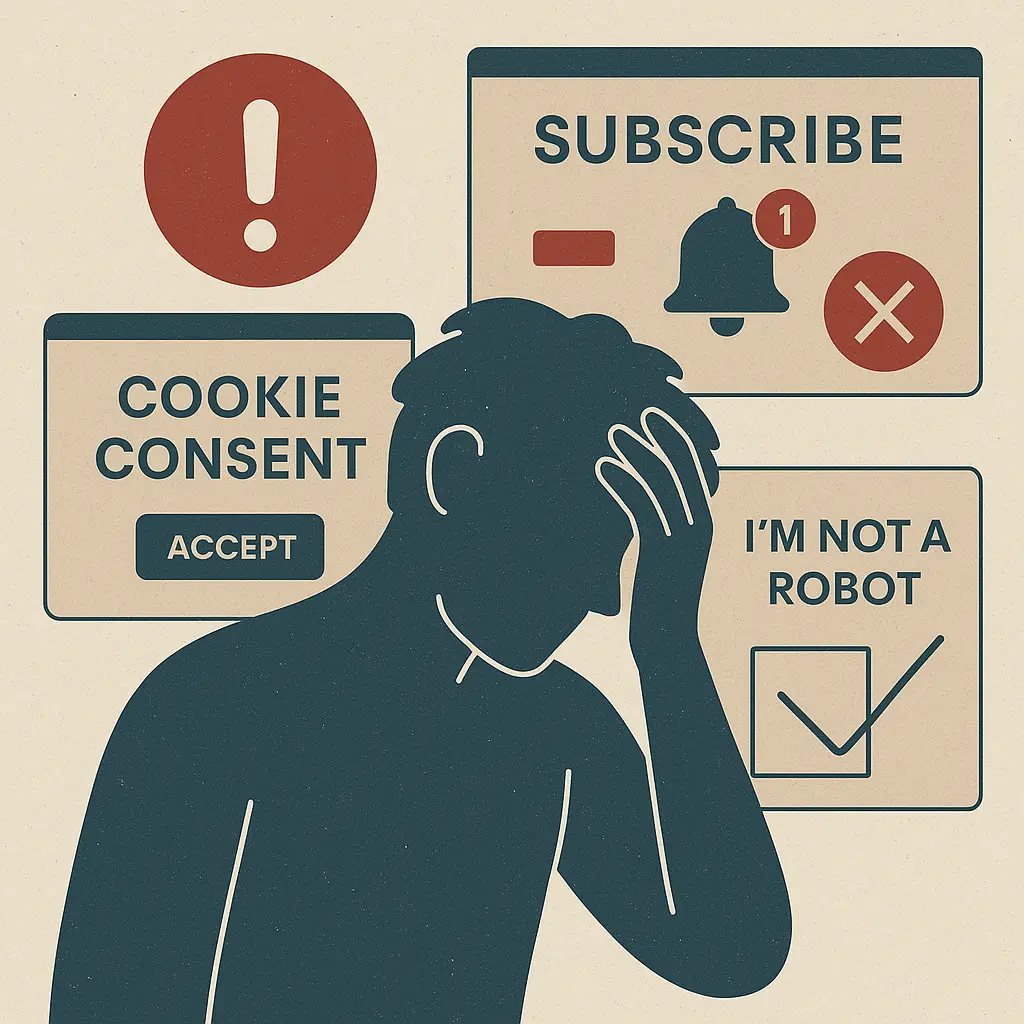
CONSTANT CONSENT FATIGUE

  • Cookie popups on every site. Not one clear button to reject all. No, you must go spelunking through menus, toggling obscure options one by one.
  • What they call “consent” is often manipulation dressed up in legalese. They make accepting easy. Rejecting is friction.
  • This happens every time you clear your cookies—which many of us need to do often to avoid tracking or clutter. It’s an exhausting loop.

OBSTACLE COURSE INTERFACES

  • Adverts that interrupt videos, and worse, cannot be skipped unless you pay. Not pay for the content, mind you, but pay to remove the punishment.
  • Popup overlays that consume half your screen the moment you land on a site. Trying to close them often launches something else.
  • On phones? It’s worse. Smaller screens mean these overlays dominate everything. You lose all context and have to work just to get your bearings.

SENSORY OVERLOAD

  • Auto-play videos. Scrolling pages that jitter from reloading ads. Flashing banners. Infinite scrolling newsfeeds.
  • Red notification symbols you can’t dismiss.
  • Everything demands your attention. Nothing respects your brain’s bandwidth.

WALLS EVERYWHERE

  • Account registration required to view basic information. Want to read one article? Sign up. Want to download a PDF? Create an account.
  • Even ad blockers aren’t safe anymore: Use one, and you’re blocked.
  • CAPTCHA systems to “prove you’re not a robot”, often impossible to complete first time if you have visual or processing impairments.

INFORMATION MIRE

  • Simple search queries now lead into labyrinths of misinformation, SEO bait, affiliate link farms, AI-generated junk, and clickbait.
  • Answers that should take seconds now require sifting through five pages of fluff.
  • The mentally exhausting task of fact verification is now part of every basic search.

CONTENT MONETISATION MADNESS

  • Free content comes with a catch: give us your email, your phone number, or your demographic info.
  • Sponsorships infiltrate once-authentic creators. You’re left wondering if their review or advice is sincere, or bought.
  • Subscription models are everywhere. Everything is paywalled. But paying doesn’t always remove the pain—sometimes, it’s just a new tier of nonsense.

And this is just what I notice consciously.

I’m sure there are deeper layers of rot that my mind filters out as a survival response. But what I do feel, daily, is the cognitive toll. What should be a tool for exploration and learning is now an exhausting, defensive act.

And here’s the thing: most people just shrug and say, “That’s just how it is now.”

But if you’re neurodivergent, or disabled, or even just overwhelmed by life, “that’s just how it is” becomes the same as saying: This place isn’t for you.

The truth is, it could be different