Humbug! A Late-Stage Capitalism Christmas Carol

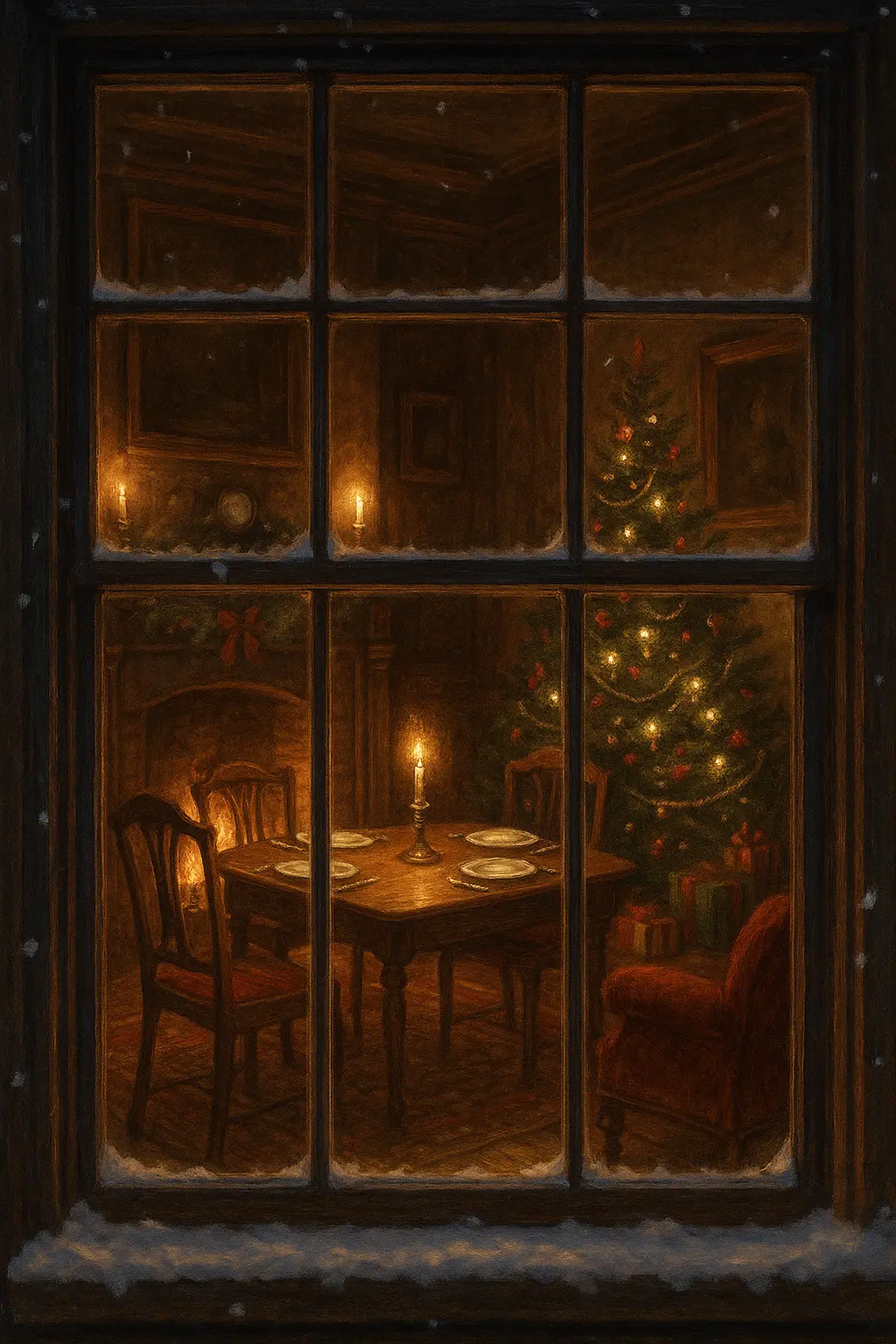
A warmly lit Victorian Christmas interior seen through a frosted window, with a candlelit table and decorated tree prepared for guests who never arrive.

Naming the Uncomfortable Truth

Let’s say the quiet part out loud.

For many people, Christmas no longer feels like a celebration. It feels like an obligation. One that grows heavier every year.

The decorations arrive earlier. The adverts start sooner. The pressure ramps up before the leaves have even finished falling. By the time December actually arrives, many of us are already tired, financially anxious, and emotionally spent. What was once a moment in the year has swollen into a season that refuses to end.

There is a strange guilt attached to admitting this. Disliking Christmas is treated as a personal failing. A lack of gratitude. A moral defect. If you are not visibly excited, if you do not participate enthusiastically, something must be wrong with you. So we smile, we comply, and we privately count the days until it is over.

Christmas now asks for more than it gives. More money. More time. More emotional labour. More performance. More resilience. For those already struggling, it does not arrive as comfort but as an additional weight. And yet it is framed as generosity. As joy. As something you should be thankful for.

This is not because people have become colder or more cynical. It is because the shape of Christmas has changed. What was once a cultural and emotional ritual has been absorbed into a system that does not understand limits. Growth is assumed. Escalation is expected. Stopping is not an option.

This article is not an attack on joy, tradition, or celebration. It is an attempt to separate what Christmas was meant to be from what it has been turned into. To name the discomfort honestly, without shame, and to ask a simple question.

If Christmas is supposed to bring warmth, why does it leave so many people exhausted?

It seems to me that what we are all in need of… is a visitation.


The Ghost of Christmas Past

The Ghost of Christmas Past does not arrive with accusations. It arrives with a candle. A quiet light held against the long dark.

It reminds us that Christmas was never meant to be loud.

Long before it became a commercial season, Christmas existed as a winter festival. Across Europe, long before Christianity formalised it, people marked the solstice as a moment of survival. The darkest days had arrived, and more importantly, they had begun to pass. Fires were lit. Food was shared. People gathered together not for spectacle, but for warmth, safety, and reassurance.

When Christianity later absorbed these older traditions, Christmas became a story of humility rather than excess. A child born in a stable. A holy event framed by simplicity, vulnerability, and care. Even for those who were not religious, the symbolism endured. This was a time to slow down, to soften, to recognise one another in the cold.

For much of history, Christmas was shaped by scarcity. In medieval Europe, winter meant hunger, isolation, and risk. A feast was meaningful because it was rare. A gift mattered because it was hard-won. Celebration was not an escape from reality, but a way of enduring it together.

Even as society industrialised, Christmas retained this character for a while. In Victorian Britain, a period that shaped much of what we still recognise today, Christmas was consciously reframed as a family-centred holiday. Charles Dickens’ A Christmas Carol itself was part of this shift, emphasising compassion, generosity, and social responsibility in response to the brutal conditions of industrial capitalism.

Importantly, Victorian Christmas was still modest. Decorations were handmade. Cards were personal. Gifts were small, often practical, sometimes homemade. Time spent together was the centrepiece, not an accessory.

What tied all these eras together was not tradition for tradition’s sake, but proportion. Christmas knew its place in the year. It was a pause, not a takeover. It was special precisely because it did not last forever.

The Ghost of Christmas Past reminds us that Christmas once understood winter. It leaned into it. It offered warmth without excess, celebration without pressure, and meaning without demand.

It knew how to be gentle.


The Ghost of Christmas Present

The Ghost of Christmas Present does not carry a candle. It arrives glowing. Loud. Overstimulating. Wrapped in tinsel and urgency.

This is Christmas as it exists now. Not as a moment, but as a system.

Somewhere along the way, Christmas stopped being a cultural ritual and became an economic event. A fiscal quarter. A growth target. The season now begins not when winter sets in, but when retailers decide it should. September becomes acceptable. October becomes normal. By November, refusal feels almost antisocial.

This did not happen overnight.

In the early twentieth century, mass production began to reshape Christmas. Department stores expanded gift-buying beyond necessity, turning abundance into aspiration. The rise of advertising reframed Christmas not as something you prepared for, but something you were sold.

Post-war consumerism accelerated the shift. The 1950s brought prosperity narratives, suburban ideals, and the modern image of the perfect family Christmas. Gifts multiplied. Expectations rose. Television beamed a single, glossy version of Christmas into millions of homes, quietly standardising what joy was supposed to look like.

By the late twentieth century, Christmas had fully aligned itself with growth logic. Black Friday crept across the Atlantic. Sales events framed restraint as foolishness. Spending was no longer just encouraged, it was positioned as civic duty. To consume was to participate. To opt out was to disrupt the economy.

Now, in late-stage capitalism, the transformation is complete. Christmas is no longer just commercialised, it is optimised. Algorithms predict our generosity. Loyalty schemes gatekeep affordability. “Limited time” offers manufacture urgency. Even nostalgia is packaged and sold back to us at scale.

This version of Christmas does not understand enough. It only understands more.

More spending. More consumption. More preparation. More performance. More emotional labour. More resilience from people who are already stretched thin. Participation is no longer optional. Opting out is treated as deviance rather than choice.

Generosity has been redefined as purchasing power. Love is measured in receipts. Thoughtfulness is outsourced to algorithms that tell us what we “should” buy for the people we already know best. Even the act of giving has been flattened into logistics.

What makes this particularly cruel is the moral framing. Christmas is still sold as kindness, warmth, and goodwill, even as it routinely produces stress, debt, exhaustion, and quiet resentment. People blame themselves for failing to enjoy it properly, rather than questioning the conditions imposed upon them.

The labour behind Christmas is unevenly distributed. Someone plans. Someone shops. Someone budgets. Someone cooks. Someone hosts. Someone absorbs the emotional fallout. This work is rarely named, rarely shared equally, and rarely acknowledged, yet it is treated as the price of admission.

And then there is the noise. Visual noise. Emotional noise. Advertising noise. A constant insistence that joy is urgent, happiness is compulsory, and dissatisfaction is a personal flaw. There is little space for grief, fatigue, neurodivergence, poverty, or simply wanting quiet.

This is Christmas as late-stage capitalism demands it. A tradition hollowed out and repurposed as an extraction engine. Not because people asked for it, but because the system rewards escalation and punishes restraint.

The Ghost of Christmas Present does not ask how we are feeling.
It assumes we will cope.
And it does not care when we don’t.


The Ghost of Christmas Yet to Come

The Ghost of Christmas Yet to Come does not speak.
It does not need to.

It shows us a future that is not imagined, only extended.

If nothing changes, Christmas does not collapse. It expands.

The season begins earlier each year, not because people want it to, but because growth demands it. What was once a few weeks becomes a quarter of the calendar. What was once anticipation becomes exhaustion before December has even arrived. Refusal becomes increasingly difficult, not through force, but through inconvenience and social pressure.

Access to affordability narrows. Discounts are no longer public. They are conditional. Loyalty schemes, apps, subscriptions, and digital profiles determine who gets to participate “properly.” Christmas becomes tiered. Those without the right accounts, the right data trail, the right compliance, pay more. Those who cannot or will not engage are quietly penalised.

Debt normalises further. Seasonal borrowing is reframed as tradition. Financial stress becomes background noise. People enter January not just tired, but already behind. The cycle resets and accelerates.

Environmental damage continues, not dramatically, but steadily. Decorations designed to last a season. Novelty gifts designed to be discarded. Packaging engineered for convenience rather than endurance. Waste becomes an accepted by-product of celebration, and responsibility is pushed onto individuals rather than systems.

Emotionally, the space contracts.

There is less room for grief. Less room for difference. Less room for opting out. Christmas becomes increasingly performative, increasingly visible, increasingly surveilled. Participation is measured. Displays of joy are documented. Absence is noticed.

What was once a pause becomes a test.

This future does not arrive through force or spectacle.
It arrives through convenience.

It arrives through updates, new terms and conditions, cheerful notifications, and subtle penalties for those who do not engage correctly. It arrives gently enough that resistance feels awkward rather than urgent. Opting out becomes friction. Compliance becomes the path of least resistance.

And perhaps most devastatingly, it arrives wrapped in familiarity. The same songs. The same imagery. The same language of warmth and goodwill. Only hollowed out further each year, until what remains is ritual without refuge.

The Ghost of Christmas Yet to Come shows us this not to frighten us, but to remove our ability to pretend we did not see it coming.

Because deep down, we already have.


A Late-Stage Capitalism Redemption

The purpose of seeing the future is not to surrender to it.

It is to remember that trajectories are not destinies.

Christmas does not need to be abolished, rescued, or reinvented from scratch. It does not belong to capitalism, even if capitalism has learned how to wear its skin. Beneath the layers of obligation, optimisation, and performance, something older and simpler still exists.

What Christmas needs now is not more effort, but less compliance.

A refusal to escalate. A refusal to compete. A refusal to treat exhaustion as the price of belonging.

A post-capitalist Christmas does not look dramatic. It looks smaller. Quieter. Intentionally bounded. It gives explicit permission to step back from traditions that cause stress, debt, or harm. It replaces obligation with consent.

Gifts stop being proof. They become gestures again. Sometimes they are handmade. Sometimes they are second-hand. Sometimes they are experiences, shared meals, long conversations, or time spent together without distraction. Sometimes they are nothing at all, and that is agreed upon in advance.

Generosity is no longer measured in spending, but in care.

Time is treated as a legitimate offering. Presence is valued more than presentation. People are allowed to say no without apology. Neurodivergent needs for quiet, pacing, and predictability are respected. Grief is not treated as an inconvenience to be hidden behind tinsel.

This version of Christmas understands winter.

It accepts darkness without trying to drown it in noise. It recognises that rest is not laziness, and that joy does not need to be loud to be real. It remembers that the point of gathering is not performance, but warmth.

Most importantly, it understands that meaning cannot be mass-produced.

A late-stage capitalism Christmas tells us that if we do not buy correctly, celebrate correctly, and feel correctly, we are failing. A post-capitalist Christmas quietly disagrees. It asks only that we be honest about what we can give, and gentle with ourselves and others when that is not much.

This is not nostalgia. It is discernment.

We do not need to save Christmas from the past or the future.
We only need to stop letting the machine decide what it is for.

And in doing so, we might find that the thing we thought we had lost was never gone at all.
The Conditional Nature of Love

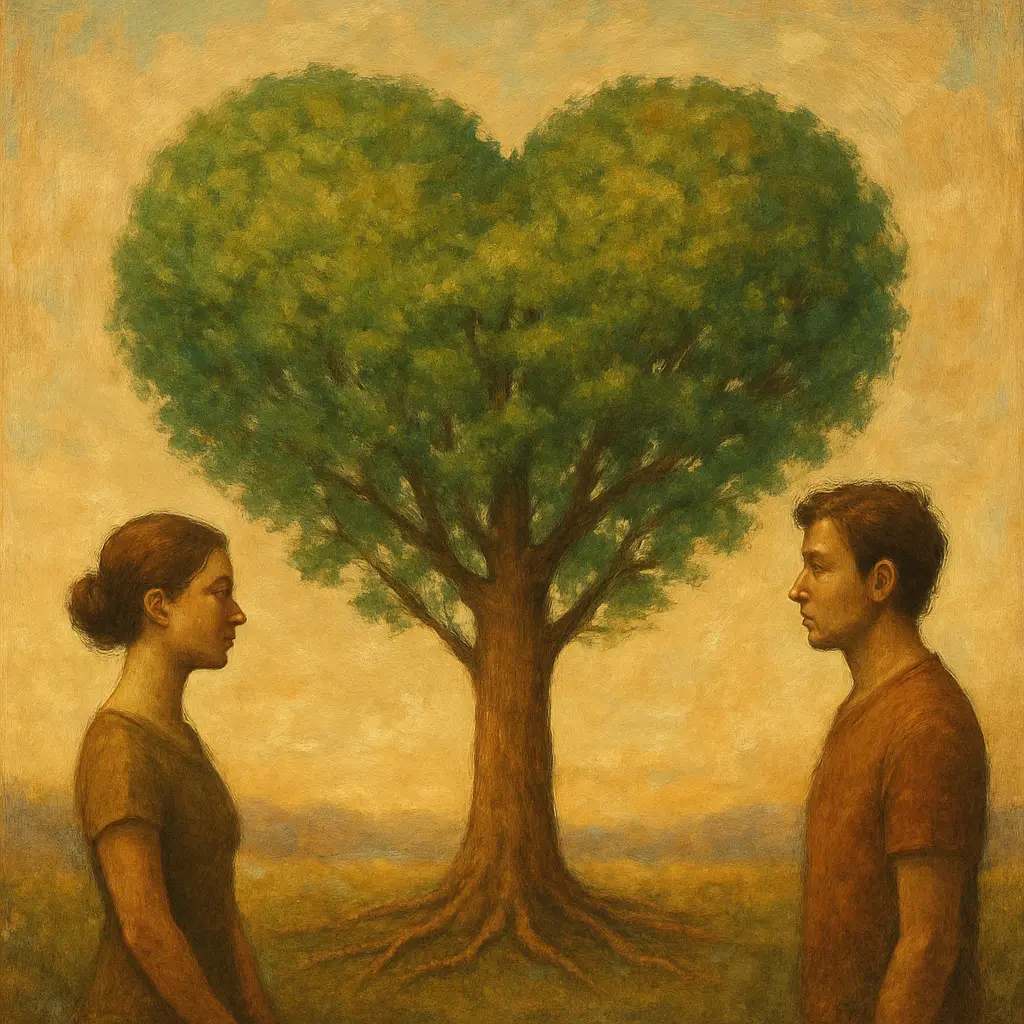
An oil painting showing a man and woman standing on opposite sides of a large tree whose branches form a heart shape. The scene is softly lit with warm, golden tones, symbolizing love, connection, and mutual growth. The roots of the tree spread outward beneath them, suggesting shared grounding and balance.

We often hear that true love is unconditional. It is an ideal repeated so often that questioning it can sound almost sacrilegious. But I have come to believe that unconditional love, as it is commonly portrayed, is more fantasy than virtue. Human beings are not static. We change, we evolve, we fracture and reform. If love is to remain alive, it must change too. Love without conditions is not eternal; it is inert.

The truth is that love is a living thing. It breathes, feeds, grows, and withers according to how it is cared for. Its conditions are not ultimatums but requirements for life, like sunlight and water for a plant. Love needs mutual respect, effort, communication, and honesty. It depends on two people being willing to tend the same garden, even as seasons shift. When either stops, the balance falters.

Recognizing that love has conditions does not make it selfish or transactional. Transactional love says, “I give so that I get.” Conditional love says, “I give because what we share feels alive and mutual, and I want to keep it that way.” It is a conscious agreement rather than a contract, a continuous realignment of two changing hearts. The difference is subtle but vital: one is rooted in expectation, the other in awareness.

People are always changing. Physically, mentally, emotionally, we never stop moving. In the early stages of love it is easy to make sweeping declarations of eternal devotion, but devotion means little without adaptation. Love is not a single promise made once; it is a thousand small promises made daily. Sometimes love means being patient while your partner grows. Sometimes it means catching up when you have fallen behind. Above all, it means communicating, speaking honestly about differences, needs, and fears, while also offering reassurance that the growth is still together, not apart.

I like to imagine love as a great tree. Romantic affection, sexual attraction, companionship, and mutual respect are its branches, each requiring its own nourishment. When these branches intertwine, the connection deepens, but the upkeep becomes more demanding. The effort this requires is not punishment; it is what makes love sacred. To sustain the tree, both partners must be willing to feed it, sometimes through sacrifice, sometimes through patience, always through choice.

Because love is a choice. Every passing second is a decision to stay, to nurture, to share in both gain and loss. When the cost outweighs the nourishment, when the balance of giving and growth no longer feels true, love begins to change form. And sometimes, the most loving act is to recognize when that transformation must lead to letting go.

Letting go, when done with honesty and compassion, can itself be an act of love. Love does not have to die when romance ends. It can evolve, shift, and take new shape. A relationship may dissolve, but the gratitude and respect that once existed can remain as roots, quietly nourishing both people in the soil of who they become next.

So perhaps love’s beauty lies not in its permanence but in its fragility. To love conditionally is to love consciously, to recognize that devotion is not a chain but a dance. The real miracle of love is not that it lasts forever, but that we keep choosing it, moment by moment, knowing full well how easily it could fade.

The Sacred Burden of Being Real

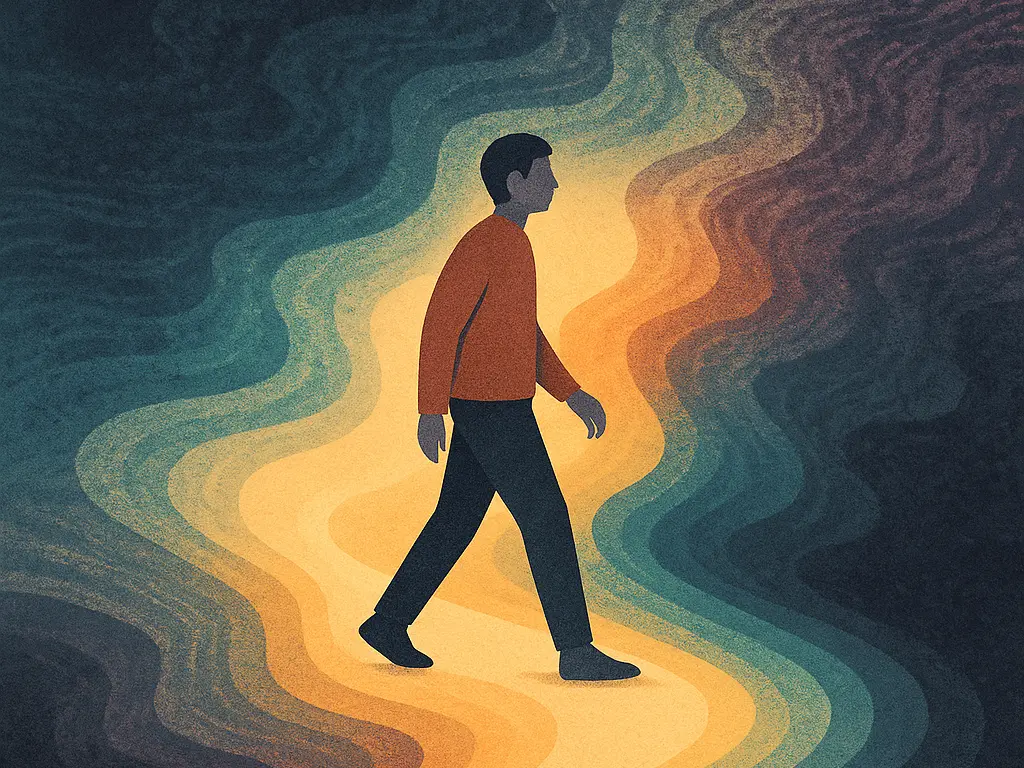
Stylised illustration of a lone figure walking through a softly glowing, wavy landscape of layered colours, transitioning from dark tones at the edges to warm light beneath their feet.

To me, authenticity has always had a texture. When I am living truthfully, it feels smooth, like fluid motion through life, unhindered navigation through systems that make sense to me. It is not euphoria. It is neutrality. Balance. Like the body when it is well: not ecstatic, just quietly functioning as intended.

But when that smoothness disappears, I know I am colliding with something unnatural, a pressure, a distortion, an external force trying to bend me into compliance. That is usually how I recognise oppression. It is not always dramatic or visible. Sometimes it is just a subtle grind, the friction between who I am and what the world expects me to be.


When Smoothness Breaks

When I lose authenticity, it does not just hurt emotionally, it feels like an illness. My thoughts start looping, as if my mind is trying to fix a broken system it cannot repair. I get frustrated at the lack of options, and sad that these dynamics even exist at all.

Sometimes there is nothing I can do but yield. And every time I do, it costs something invisible. The loss is not abstract, it is felt in the nervous system. It is the moment the body whispers, this is not how you are supposed to feel.


The Systems That Demand Performance

Oppression wears many masks: bureaucracy, capitalism, social obligations, the unspoken point system that governs human relationships. Each demands performance. Sometimes it is about survival, sometimes about social advantage. But in the end, both use the same energy source: you.

As an autistic person, I have always been acutely aware of “masking,” the act of performing normality to survive in social spaces. But I have also learned that this is not exclusive to autism. Everyone masks. Some call it professionalism. Others call it politeness. It is still performance. The only difference is how consciously one feels the cost.


The Humiliation of Performance

When I catch myself performing, it feels humiliating, not because anyone else can see it, but because I can. It is like betraying a sacred truth. Yet that awareness is balanced by another: I can also see the oppressive force causing it.

What hurts most is the fear that others see the performance too, but not the pressure behind it. That they see the surface act without understanding the system that coerced it.

That poem came from that place, the quiet despair of realising that either way, something in you must fracture to fit.


The Rare Moments of Unmasking

True authenticity is situational. I can relax certain parts of the mask around family, others around my girlfriend. But never all at once. Each relationship comes with its own invisible boundaries, some safe zones, some fault lines.

Even when I am alone, there is still the internal eye, the echo of social constructs that linger inside, long after the audience has gone home. Solitude is not the absence of performance; it is where you start to see which parts of the mask fused to your skin.


The Cost and Consequence

Sometimes unmasking feels liberating. Other times, it feels like punishment, a confirmation that the world does not welcome the real self. That is the cruel irony: the more genuine you become, the more visible your difference.

The aftermath can feel like emotional jetlag. There is vulnerability, fatigue, and occasionally grief. But there is also clarity. You see the architecture of the world more clearly when you have been bruised by its walls.


Authenticity as Survival

For me, authenticity is not optional. It is survival. The alternative feels worse than death.

Out of every living thing that has ever existed, there is only one instance of me, this consciousness, this perspective, this particular configuration of life. That makes it sacred. My job is to honour that singular existence.

If I betray it, if I trade it for comfort, convenience, or belonging, then I may as well be anyone else. Or nothing at all.


Do Not Be Yourself (For Them)

So here is my advice to anyone struggling with authenticity:

Do not take the phrase “Be yourself” at face value. That advice is too often weaponised, a feel-good slogan used to sell you an illusion of freedom within controlled boundaries.

Be yourself, yes. But do it for your reasons.
Do it because it is sacred.
Do it because you are a one-off in the infinite catalogue of existence.
Do it because the alternative is extinction by conformity.

But never do it because the world told you to.
Do it because you told yourself to.

About Me, Part II: The All-Seeing Eye

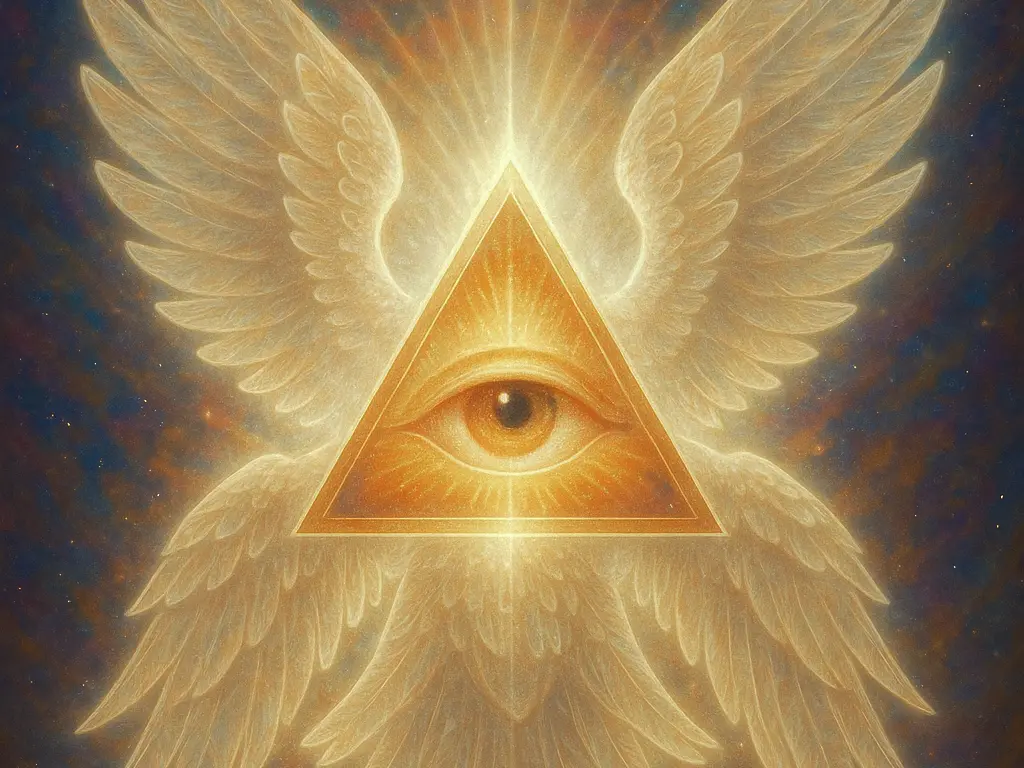
When I wrote About Me, Part I, I introduced the internal spheres through which I experience myself — a multidimensional system built to navigate both reality and identity. At the time, I thought I was mapping the foundations. But even then, silently present and ever-vigilant, was the entity at the heart of it all: The All-Seeing Eye.

The Eye has always been with me — not a recent revelation, but an enduring presence. In the years since that first post, it has only grown stronger in its clarity and importance. Not as a tyrant nor a god, but as a quiet, unblinking guardian of truth — the embodiment of my deepest core value: awareness.

The Eye in the World

The symbol now commonly known as The All-Seeing Eye of Providence has haunted humanity’s visual language for centuries. A single eye enclosed within a triangle, often radiant with divine light, it appears atop pyramids, inscribed into temples, and peering from the seals of nations. Though it is now most famously embedded in the reverse side of the Great Seal of the United States — and by extension, the US dollar — the origins of this symbol stretch far deeper into religious and esoteric history.

In early Christian iconography, the eye represented the omniscient gaze of God — not one of punishment, but of holy watchfulness. The triangle often surrounding it symbolised the Trinity: Father, Son, and Holy Spirit. Together, they conveyed a cosmic reassurance that nothing is unseen by the divine.

Later, during the Enlightenment and revolutionary periods, the Eye of Providence took on new layers of meaning: divine legitimacy, moral order, and the pursuit of higher truth. It was a symbol adopted not only by religious authorities but also by secret societies — most notoriously the Freemasons. Over time, as secrecy bred suspicion, this symbol came to be associated with conspiracy theories, shadow governments, and the so-called Illuminati. To many, the eye became something sinister — an emblem not of sacred awareness, but of authoritarian surveillance.

And yet… I’ve never felt threatened by the symbol.

To me, the Eye has always felt familiar. Not as an external power looming overhead, but as something internal — something personal. Not a tool of control, but a faculty of liberation. In a world that often rewards willful blindness, my Eye does not police — it sees.

Reclaiming the Eye

While the world casts suspicion on the symbol — reducing it to a meme of control, corruption, or conspiracy — I reclaim it as sacred. Not sacred in the religious sense, nor as an emblem of external authority, but sacred as in personal, inviolable, foundational. The Eye, as it exists in my internal architecture, is not the Eye of God, nor the Eye of Empire. It is my Eye. It is the unwavering force within me that refuses to look away.

In my psyche, the Eye resembles something closer to the Eye of Sauron — not in intent, but in intensity. It does not flicker or blink. It does not become distracted. It pierces illusion. It burns away façades. It sees all that is — both around me and within me — and its purpose is not to judge or dominate, but to witness.

This witnessing is not passive. It is the raw essence of my value of awareness — not just sensory observation or intellectual knowing, but the kind of full-bodied presence that bears the weight of knowing. To see, and to not turn away. That is the Eye’s central ethic.

It lives not above me, but within me. It is neither function nor vessel. It is more like a permanent fixture in the architecture of my identity: a monolithic spire around which much of my internal world has formed. It is one of the oldest and most stable landmarks in my psyche — and one of the few I have never needed to rebuild.

It does not ask for worship. It does not demand loyalty. It simply is — watching, knowing, reminding me, when I’m tempted to dissociate or deceive myself, that I am seen. And being seen, I must also see.

The Eye and the Compass

The Eye doesn’t command my decisions — but it influences them in a way more profound than instruction. Its presence is not authoritarian; it is elemental. Like gravity or inertia, it exerts a silent but undeniable pull toward truth. When I am confronted with a dilemma, an uncertainty, or a moral fog, it is the Eye that holds the lantern.

It is the part of me that refuses convenient ignorance. It doesn’t tolerate self-deception, even when deception would bring temporary comfort. I have learned, sometimes painfully, that to betray what the Eye has shown me — to pretend I do not see — is to sever a vital tether between myself and my own integrity. And so, I have come to walk in alignment with it, not as a disciple, but as a co-navigator.

In practice, this often manifests as an intuitive ethical radar. Not in the sense of rigid moral codes, but as an inner sensitivity to what is true, meaningful, and in alignment. I feel it physically when something is off — a weight in the chest, a shift in tone, a tightening of the inner atmosphere. The Eye notices. It always notices.

It has also taught me the discipline of bearing witness. Sometimes, I cannot fix what I see. I cannot correct the injustice, or ease the suffering. But I can refuse to look away. And in that refusal, I affirm something essential — that reality, however painful, is worth honouring. That truth, however brutal, deserves to be acknowledged.

This, to me, is the backbone of my integrity: not performative righteousness, but sustained, inward attentiveness. The Eye is my compass — not always pointing to safety, but always pointing to what is.

The Architect of Values

The Eye does not stand alone. It watches — but it also builds. It is both the sentinel and the architect of my internal world, inciting the creation of new values and overseeing their development like a curator tending to sacred relics. Many of my core principles — compassion, autonomy, authenticity, curiosity — were not inherited or taught; they were forged beneath the Eye’s gaze.

In my psyche, these values do not exist as vague ideals. They are structured, living entities — monumental constructs with gravity and mass. Some are towering pillars; others are intricate, delicate bridges connecting distant parts of my identity. Together, they form a lattice — a kind of internal architecture that gives my life direction, cohesion, and sacred tension.

The Eye is the one who ensures that this architecture does not collapse under contradiction. It maintains the structural integrity of my system by relentlessly observing when I drift from alignment — when I begin to compromise values for convenience, or when a new experience threatens to destabilize the old foundations. It doesn’t shame, but it illuminates, holding up inconsistencies to the light until I can no longer ignore them.

Because of this, I do not see my creative work as separate from my values — it is a direct output of them. My art, writing, and even my humour are saturated with the same symbolic codes that the Eye safeguards. Every piece I create — whether it’s silly, sacred, or surreal — carries some element of that deeper structure. The Eye doesn’t impose direction, but its presence ensures that I do not create carelessly. My output is not random — it’s emergent, shaped by a system that values truth, awareness, and meaning.

In relationships, the Eye’s influence is quieter but equally vital. It watches for authenticity — in others and in myself. It flares when dishonesty enters the space, when manipulations slither into the room disguised as charm or niceness. It reminds me not to ignore red flags out of hope or habit. And it gently tugs me back toward the people who are real, present, seen. It urges me to show up as that kind of person, too.

Even my spirituality rests upon the Eye. I don’t believe in an external deity who watches from above. But I believe in this Eye, inside me. I believe in awareness as a force of spiritual gravity — the thing that keeps all other aspects of my being from drifting apart. In this way, the Eye is not just a symbol. It is the sacred center. The still point in the turning chaos. The guardian of coherence in a fragmented world.

The Path Forward, Under Watchful Light

The Eye has been with me longer than I fully understood. It was there before I had language for it, before I had mapped the spheres, before I knew I was building a system at all. In many ways, it was the first light — not a flare that demanded attention, but a steady glow in the dark, offering orientation through times of inner collapse and rebirth.

I expect it will remain with me until the end — not as a fixed icon, but as a living force that will continue to evolve as I do. Its form may shift, its voice may deepen, but its function remains constant: to keep me aware. Of what is real, what is right, what is still unfinished within me. To stop me from retreating into false comfort or performative noise. To draw me back, again and again, to what matters.

The Eye is not a doctrine. It does not require belief. It does not demand obedience. It simply sees — and in seeing, it reminds me of who I am.

And so, as I move forward — as artist, as outlier, as soul — I do so not blindly, but beneath the ever-watchful light of the Eye. A light that does not burn, but illuminates. A gaze that does not control, but clarifies. A witness not to what I pretend to be, but to what I am, and what I am becoming.

This is the Eye I serve. This is the Eye I trust. And this is the Eye I will write from, again.

The Paradox of Compassion and Oppression: Can Humanity Grow Beyond the Current System?

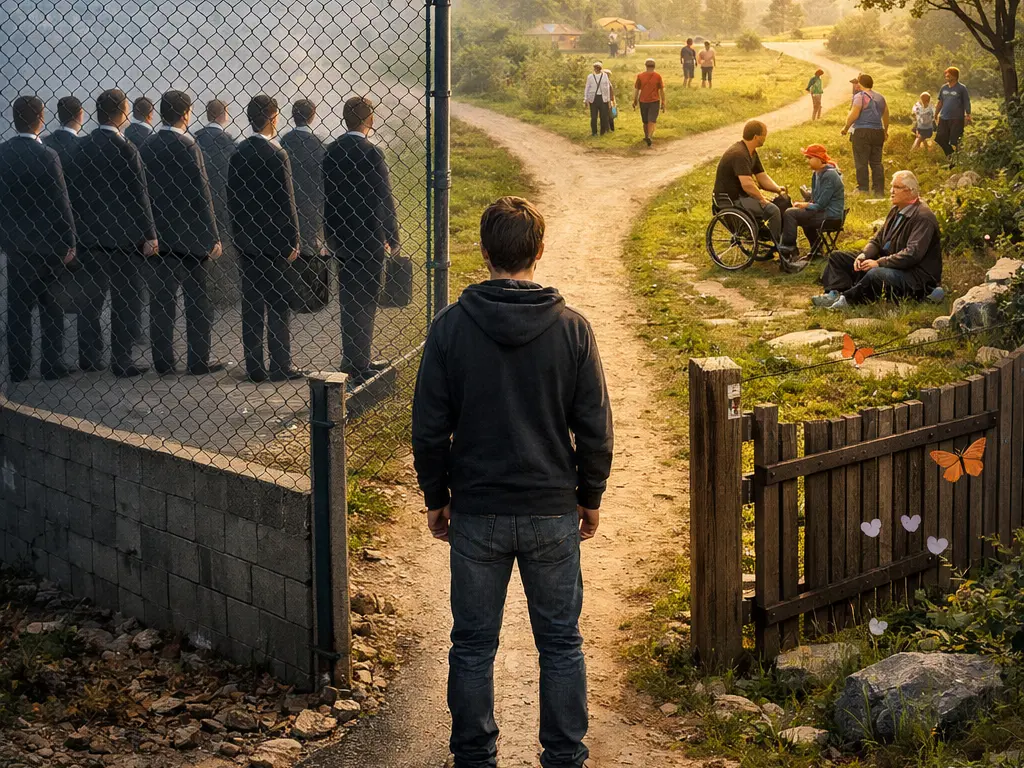
A person stands at a forked path. To the left, a fenced-off city filled with identical suited figures and tall buildings appears cold and restrictive. To the right, an open, sunlit landscape shows diverse people gathered in a natural setting, suggesting inclusion, care, and human connection.

In a world where empathy, kindness, and equality are frequently championed, it’s hard to ignore the paradox that underpins many of our societal structures. We live in a system that, on the surface, promotes compassion and understanding, yet often fails to extend these values to those who fall outside of a narrow, idealized norm. The result is a form of systemic oppression—one that may not be overt or intentional, but which still deeply affects individuals who are considered “other” by society. From neurodivergent individuals, like those with autism, to those who live with mental health conditions or psychopathy, many are faced with a system that struggles to accommodate their unique experiences, perspectives, and needs.

This paradox presents a crucial question: can humanity evolve beyond the limitations of a system built on conformity and idealized norms? How can we recognize and address the underlying contradictions within a society that claims to value compassion but fails to apply it to everyone?

The Current System: Compassion in Theory, Oppression in Practice

At its core, our current system is rooted in ideals of fairness, justice, and compassion. In theory, it promotes equality, extending kindness to others and encouraging the alleviation of suffering. Yet, when it comes to those whose behavior, identity, or neurological wiring deviates from the mainstream, the system often fails to extend this compassion in practice.

Take, for example, individuals with autism. Many of these individuals navigate a world that is not designed with their neurodivergence in mind. Social norms, communication expectations, and sensory environments can all pose challenges that society rarely accommodates. While we understand that autistic individuals experience the world differently, the societal response is often to ask them to conform, masking their true selves in order to “fit in.” This can lead to exhaustion, frustration, and even feelings of invisibility. What’s meant to be a compassionate, inclusive society, at times, becomes one that marginalizes those who cannot easily conform to established norms.

The same paradox applies when we consider the ethical implications of psychopathy. Psychopaths, individuals whose behaviors are often characterized by a lack of empathy or remorse, are frequently viewed as dangerous, immoral, or even “evil.” However, this view fails to acknowledge the possibility that their experiences of the world—shaped by neurological and psychological factors—might be radically different from the norm. The tendency to label psychopathy as inherently wrong leads to punitive systems that rarely consider the possibility of rehabilitation, accommodation, or deeper understanding.

This creates a troubling dichotomy: a system that professes compassion but is not designed to accommodate those whose ways of being differ from the mainstream. In effect, society ends up compounding the suffering of those who already find themselves on the margins, further entrenching the very issues it seeks to solve.

The Paradox of Morality: Who Decides What’s “Normal”?

At the heart of this issue is the question of what is “normal” and who gets to decide. Society often creates moral frameworks that are rooted in a shared understanding of what constitutes acceptable behavior, thought, and identity. Those who fit within this framework are generally accepted and treated with compassion, while those who fall outside of it are labeled as “wrong,” “deviant,” or even “dangerous.”

This is where the paradox deepens: In striving for compassion, we often end up perpetuating exclusion and marginalization. The very same system that advocates for inclusion and kindness can, at times, act as a gatekeeper, denying access to those who are deemed “other.” And even more troubling, this dynamic is rarely examined or questioned in mainstream discourse.

By framing difference as “wrong,” society creates an environment in which those who are perceived as different—whether due to neurodivergence, mental illness, or extreme psychological traits—are denied the right to be understood, let alone accommodated. It is an approach that focuses on the conformity of individuals rather than the evolution of society itself to accept a broader spectrum of human experience.

Can We Grow Beyond This Paradox?

The answer to whether we can grow beyond this paradox is not simple, and it may require profound shifts in the way we understand and relate to others. There are, however, several steps we can take to begin moving towards a more inclusive and compassionate world—one that doesn’t just champion kindness in theory but applies it broadly, even to those who challenge our notions of “normal.”

  1. Reframe Difference, Not Deficiency: The first step is to shift the way we view difference. Instead of framing non-normative behaviors, thoughts, or identities as “wrong” or “broken,” we can work to see them as variations of human experience. By reframing difference as a natural part of the human spectrum, we can begin to build a system that is more accommodating and understanding.
  2. Create Inclusive Systems: Instead of demanding that individuals conform to rigid societal norms, we must look at how systems—whether educational, healthcare, legal, or social—can be adapted to accommodate a wider variety of human experiences. This might mean redesigning environments to be more sensory-friendly, adjusting communication expectations, or rethinking how we define and approach mental health and psychological differences.
  3. Engage in Honest Conversations: Change begins with dialogue. We need to create spaces where challenging conversations about difference, morality, and societal expectations can take place. This includes recognizing the nuances of psychological conditions like psychopathy and autism, and moving away from simplistic labels toward deeper, more empathetic understandings. It’s about listening to marginalized voices and making space for their experiences to be heard.
  4. Acknowledge the Limits of Empathy: Our current system is built on the assumption that empathy can and should guide our actions. While empathy is a powerful force, it has its limits—particularly when it comes to understanding those whose experiences of the world are radically different from our own. Moving beyond this paradox will require a more complex understanding of human difference and the development of strategies for responding to harm that do not rely solely on empathy or moral judgment.
  5. Foster a Culture of Flexibility and Growth: In order to truly evolve, we need a cultural shift that embraces the idea of flexibility and growth. Rather than rigidly adhering to one model of behavior or identity, we need to embrace the fact that people grow, change, and experience the world in unique ways. Our systems must be able to adapt to these changes and provide pathways for everyone, even those who are perceived as “different,” to thrive.

A Path Toward True Compassion

The paradox of compassion and oppression is not an easy one to resolve. But by confronting it head-on, we have the opportunity to evolve into a society that not only values compassion but also practices it in ways that truly embrace the diversity of human experience. In doing so, we can build a future where no one is marginalized simply because they don’t fit into a narrowly defined mold.

While change may take time, the process begins with recognizing the inherent value of all individuals, even those who challenge our understanding of morality, empathy, and behavior. By expanding the boundaries of compassion to encompass the full spectrum of human experience, we can begin to create a world that is truly just, inclusive, and humane.

The Outsider

An account of my journey to self-acceptance

A lone figure sits on a rocky cliff overlooking a glowing city at night.

I’m not the most ‘normal’ person.
I’ve always been ‘different’.
I have spent most of my life as a social outcast.
Searching for somewhere to fit in, failing.

This has of course led to depression, anxiety, and some seriously bad mental breakdowns.
Some of which came close to killing me.

It can be difficult, living life on the outside.
Looking in on all of the relatively happy people going about their lives, in relative ease.

How do they do it?
What is their secret?
Perhaps everybody suffers just as much as I do, but no one is expressing it…
Are they all just putting on a brave face?
The fact remains, they succeed in areas that I cannot.
So what does that make me?
A defective product of humanity?
An inconsequential blip in the vast jungle of society?.
I think of Darwin’s theory of natural selection, survival of the fittest.
Am I simply not fit enough to survive in this world?

You can see how these trains of thought may have led me down some dark paths.
Amongst a parade of complex questions, there was one simple question that stood out, one of basic human necessity.

Where do I fit in?

I had a simple question, and no one was giving me an answer.
Friends, family, therapists… strangers on internet chat rooms…
I even turned to God (but as you can imagine, the line was busy)

Of course it’s not that no one had anything at all to say.
Most of the suggestions I received from people involved changing core aspects of who I am, in order to be a better fit.
This was simply unacceptable to me.

I realised that I was asking the wrong people.
I eventually resorted to going about trying to work out the answer myself, from scratch.

This was a huge undertaking.
If you imagine the problem as an extremely complex mathematical equation, my task was to solve the equation, armed only with knowledge of basic arithmetic.

Through a tedious process of trial and error, challenging myself with thought experiments, delving deep within my psyche, throwing myself into challenging situations, observing my thoughts, feelings, observing the reactions of others, observing the consequences of varying types of behaviour, Looking for patterns, shapes, colours, textures… anything that would help me to make sense of it all.

I eventually came to a point of deep understanding, and even appreciation of who I am.
And I came to a place of similar understanding and appreciation of others.

But still, I did not fit in.
I had two sides of an equation, but there was no perceivable connection to balance them.

Then, one day, during… let’s call it an ‘existential crisis’, it hit me.
The answer I had been seeking for so long, was right in front of me all along, hiding in plain sight.

Where do I fit in?
On the outside!

I’m not like everyone else. I am an outside-of-the-box thinker.
I play my own game. I have different core values, different metrics of success, I do things in my own way, for my own reasons.

I often don’t understand why people do certain things, but my inability to blindly accept and follow prescribed systems incites me to challenge what is.
I offer a fresh perspective. And though I do not always see the things that are plain to others, I see many things that others do not.

And society needs that.
Diversity is essential to the continuation of humanity.

Going back to evolution, the clue is in its name. The point is not for us to settle on being one thing.
Survival of the fittest is a game of numbers, yes, and the majority often has a clear advantage.
But if we were all perfectly normal, if we were all cookie-cutter replications of an idealised standard, then our race would not be equipped with the tools that it needs to adapt and survive.

And nor would life be particularly interesting.

So I, for one, am happy to embrace being strange.
Any disapproval from others just goes to further cement my resolve, that I am performing my function, that I am doing what I am supposed to be doing and that I am where I am supposed to be.

No longer do I need to worry about fitting in.
My concern is simply just to do the things that I am inclined to do.

And I have utmost faith in that
whatever I do,

Whether others like it or not,
Whether it benefits me or not,

Whatever I do,
is the right thing to do.