Data Is the New Oil

An exploration of value, manipulation, and the silent industry built on who we are.
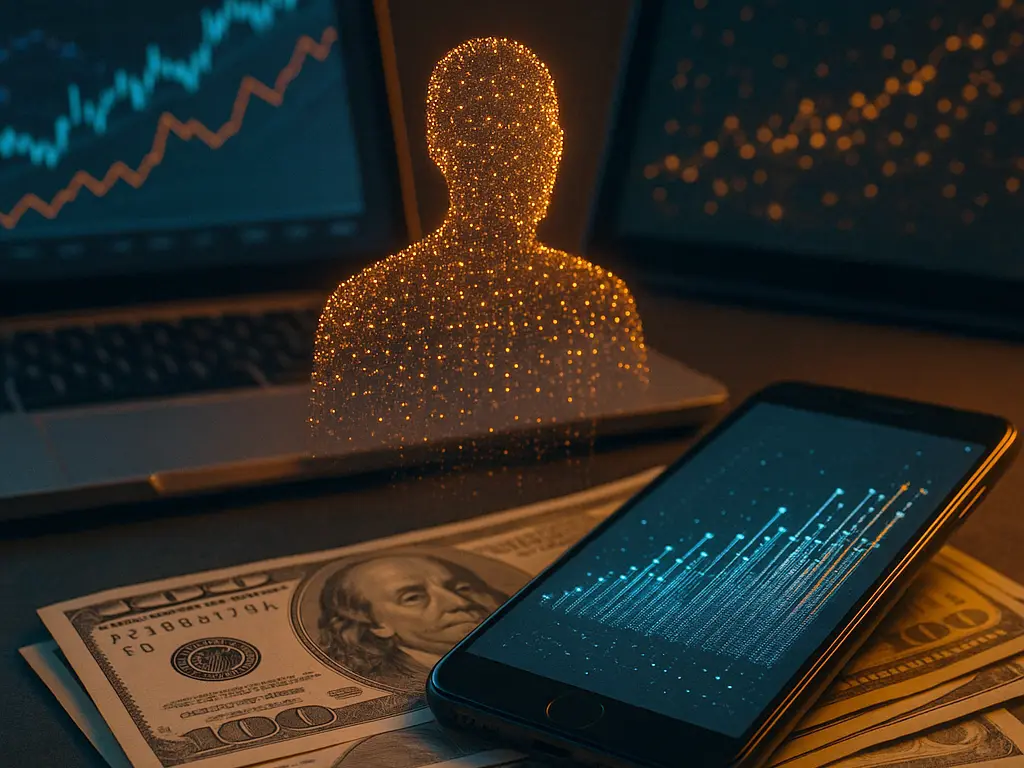
A glowing human silhouette composed of scattered data points stands illuminated against a dark background. Surrounding the figure are digital devices — a smartphone, tablet, and laptop — each displaying charts, graphs, or financial patterns. Faint images of currency blend into the scene, symbolising the monetisation of personal data in a surveillance-driven economy.

Most people know their data is being harvested. Fewer understand why. Even fewer understand how the money is made. And far too many have simply accepted it — like digital rent we pay to exist online.

So let’s break it down. No jargon. Just truth.


Why is ‘data’ so valuable?

Because data is the closest thing to knowing you without asking you. It’s a digital mirror, built piece by piece: your clicks, your searches, your pauses, your swipes, your hesitations. What you want. What you fear. What you’ll do next.

To corporations, that’s not just information, it’s predictive power. And predictive power is profitable.

Data lets systems:

  • Predict behaviour
  • Shape desire
  • Optimise systems
  • Automate decisions
  • And, in some cases, control outcomes

It’s not just metadata. It’s meta-you.
And in an economy obsessed with efficiency and influence, there’s nothing more valuable.


Why is there a culture of data being harvested for profit?

Because the internet changed business models forever.

Once upon a time, you paid for software. Then came “free.” Free email. Free social networks. Free AI chatbots. Free games. Free news. Free everything… Except, it was never really free.

You became the product.

Advertising evolved into surveillance. Terms of service bloated into digital contracts you’ll never read. Every app you download is a tiny spy, and every cookie is a crumb leading somewhere profitable.

It’s not a conspiracy. It’s worse.
It’s design.

Behind every “personalised experience” is an unspoken rule:


How exactly is profit made from data?

Here’s the quiet truth: most of the web runs on one industry: behavioural targeting.

  1. Advertising
    Your data builds a profile. That profile is auctioned off to advertisers. You get ads tailored to your weaknesses. Every click is income.
    The more they know, the more they can charge.
  2. Data brokerage
    Shadow companies buy and sell your data like a commodity. Health data. Location data. Shopping habits. They don’t need your name, just your pattern.
  3. Manipulation
    Platforms don’t just predict your behaviour. They shape it. Algorithms steer your feed toward content that keeps you engaged, enraged, or primed to spend.
  4. AI training
    Your voice, your photos, your words are used to train models. These models are sold back to businesses or used to automate services. You become unpaid labour.
  5. Pricing power
    Ever notice different prices for the same thing? That’s data-driven pricing. If your profile says “desperate,” you’ll be charged more. Welcome to dynamic capitalism.

What now?

Maybe we shrug and accept it. Maybe we don’t.
But at the very least, let’s stop pretending we’re not involved.

Data isn’t some passive trail we leave behind. It’s a living, breathing version of us, digitised and repackaged. And while we’re busy being human, our shadows are being sold.

So next time someone says, “I’ve got nothing to hide,”
maybe ask them:

The Idiots Aren’t the Problem: Misdirected Misanthropy in an Engineered Divide

Let’s start with something raw and uncomfortable:

Not because I want to. Not because it makes me feel good. But because it often feels true — especially in a world flooded with shallow opinions, regurgitated slogans, wilful ignorance, and a collective refusal to look beyond the surface of anything.

But here’s the deeper truth—one that hurts far more:

And if we don’t understand that, we risk becoming exactly what the system wants us to be: angry, superior, divided.


Weaponized Disdain

There’s a quiet kind of relief in misanthropy. It gives you someone to blame.
You look around and see a world on fire—and people watching it burn while arguing about which brand of lighter fluid to buy next.

It’s tempting to direct your rage downward:

  • “Why won’t they wake up?”
  • “Why do they fall for propaganda?”
  • “Why don’t they care?”

But what if they were trained not to?

What if distraction, ignorance, and tribalism aren’t signs of stupidity, but symptoms of psychological warfare?


The Architecture of Blame

Everything about modern society is designed to fragment us.
We’re not just encouraged to fight amongst ourselves—we’re engineered to.

  • Left vs Right
  • Poor vs poorer
  • Neurodivergent vs “lazy”
  • Ethical vs indulgent
  • Educated vs “sheeple”
  • Every micro-identity in endless battle for moral superiority

And while we tear each other apart, the architects of our suffering float untouched above the fray—untouchable, unblamed, and richer by the minute.


The Illusion of Choice

Yes, people parrot nonsense. Yes, they deny science. Yes, they post horrifying things on the internet.

But behind every foolish comment is a person shaped by years of manipulation:

  • An underfunded education system
  • Stress-induced tunnel vision
  • Algorithmic feedback loops
  • Culture soaked in shame, punishment, and performance

So when we mock the “idiots,” we’re often mocking the symptoms of systemic collapse.
And in doing so, we absolve the system of responsibility.


Awake, and Alone

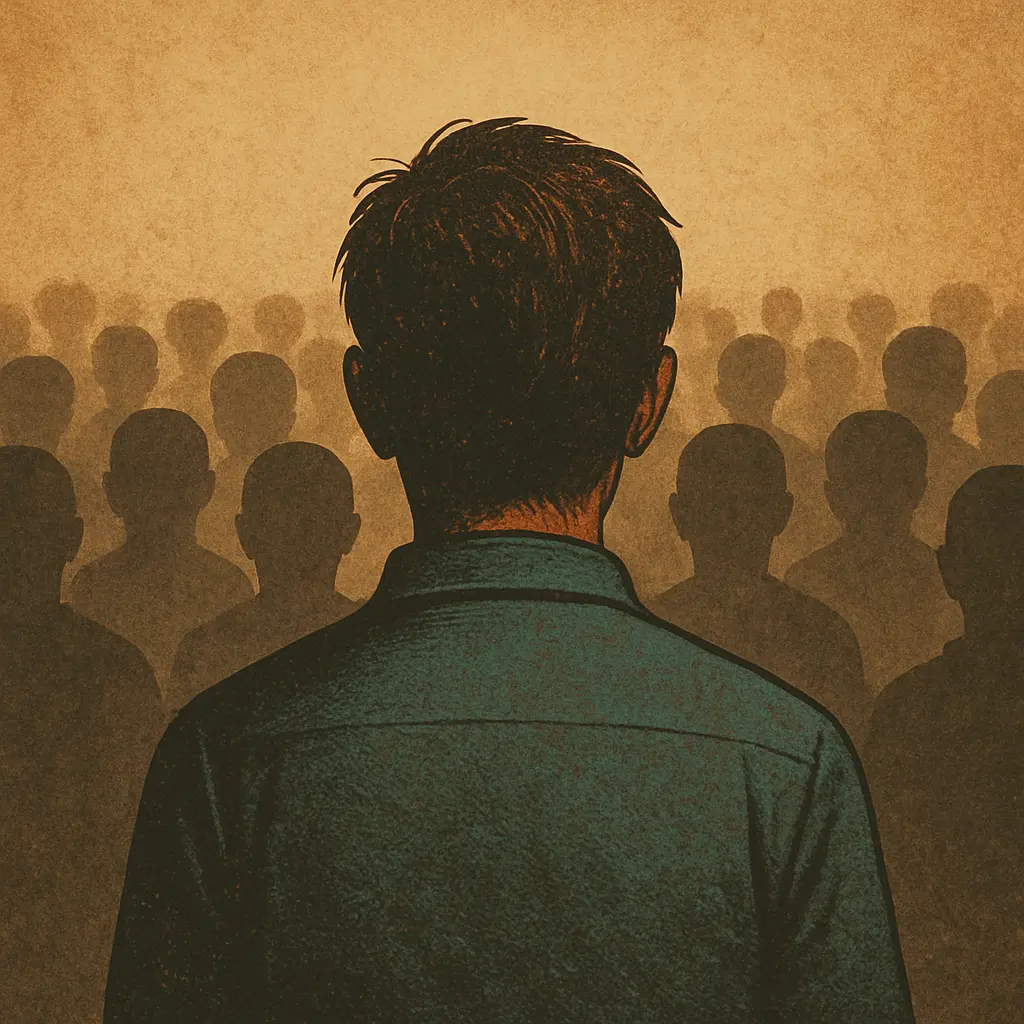
Those of us who see the manipulation clearly can feel isolated. It’s lonely to be awake in a room full of sleepers. The temptation to feel superior is strong—especially when your insight is met with mockery or silence.

But superiority is a trap.

It doesn’t lead to change. It doesn’t inspire connection. It only deepens the divide.

And worst of all? It makes you easier to control.

Because if you believe everyone else is the problem, you’ll never reach for collective liberation. You’ll wall yourself off. You’ll give up.


The Real Enemy

So let’s be brutally clear:
The enemy is not the unaware individual.
The enemy is the machine that benefits from that unawareness.

The corporations, politicians, media empires, and algorithmic puppeteers who:

  • Profit from ignorance
  • Weaponize distraction
  • Silence nuance
  • Turn suffering into spectacle

These are the forces that deserve our outrage.
Not the broken, numbed, hypnotised humans trapped beneath them.


Reclaiming Compassion Without Losing Fire

This isn’t a call to softness. It’s a call to precision.

We don’t need to stop being angry—we need to point our anger in the right direction.

That means:

  • Calling out manipulation, not just compliance
  • Critiquing systems, not just symptoms
  • Building solidarity across the fractures we’ve been taught to defend

Because the truth is: we’ve all been trained.
Some of us just noticed sooner.

Internet In-Access: How the Modern Web Became Hostile to Neurodivergent Minds

I used to enjoy using the internet.

Back when it wasn’t commonplace. Back when it was the domain of nerds, weirdos, hobbyists, and information junkies like me. Sure, there were commercial websites, brands had presences, but capitalism hadn’t yet figured out how to completely milk the internet for all it could legally squeeze from the public. Back then, it felt like a sanctuary—a digital retreat from the chaos and hostility of everyday life.

I’m autistic. I have inattentive ADHD. I struggle with overstimulation, decision fatigue, the weaponization of social cues, and having to constantly filter signal from noise in daily life. The early internet was a gift. Social interaction on it was simpler, slower, optional. I had control. I could set the pace. I could browse in peace, seek connection without pressure, and access the kind of information I was drawn to without needing to fight for it.

And then, Capitalism Struck Again.

Over time, a new norm slithered into place. The digital space that once gave me breathing room now suffocates me. What used to be a tool for equalising neurodiverse and neurotypical access has become a gauntlet of cognitive warfare.

Let me paint you a picture of what it means to be neurodivergent in the modern online landscape:


CONSTANT CONSENT FATIGUE

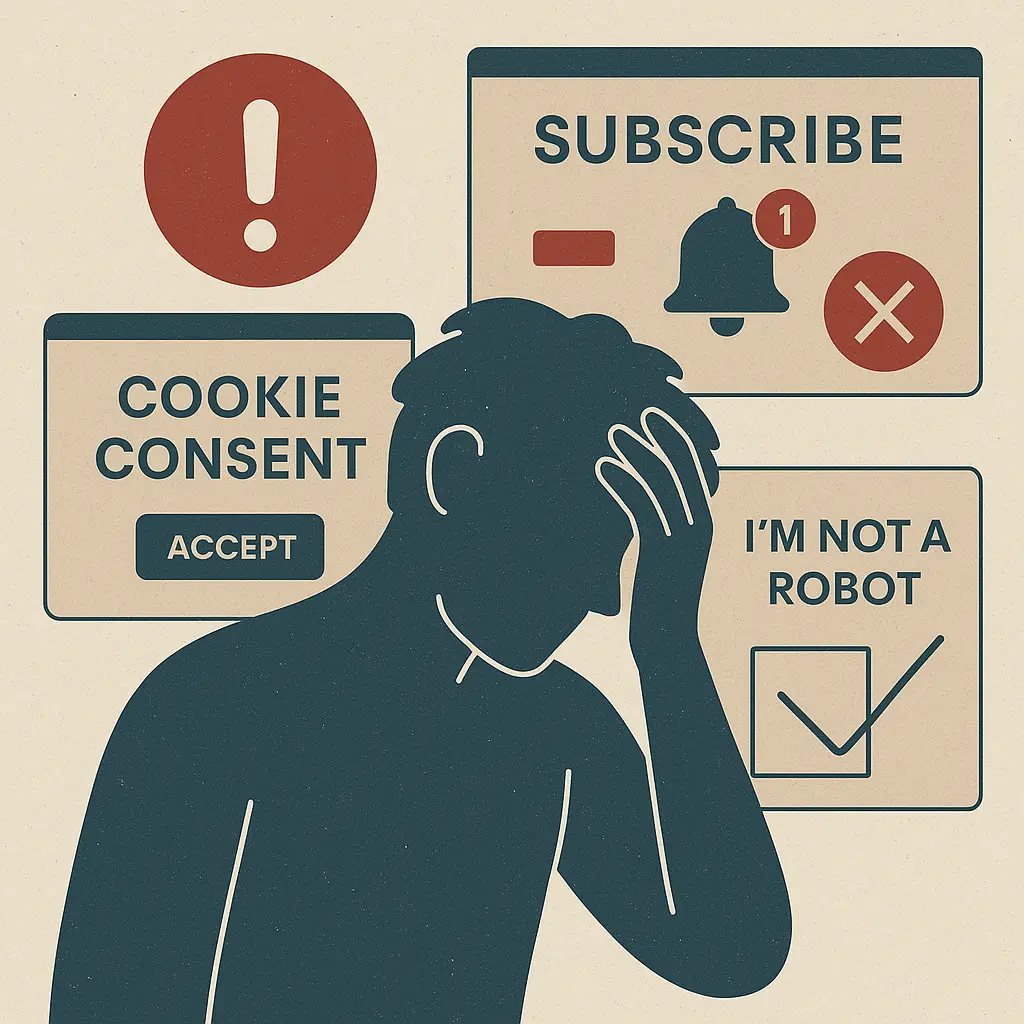
  • Cookie popups on every site. Not one clear button to reject all. No, you must go spelunking through menus, toggling obscure options one by one.
  • What they call “consent” is often manipulation dressed up in legalese. They make accepting easy. Rejecting is friction.
  • This happens every time you clear your cookies—which many of us need to do often to avoid tracking or clutter. It’s an exhausting loop.

OBSTACLE COURSE INTERFACES

  • Adverts that interrupt videos, and worse, cannot be skipped unless you pay. Not pay for the content, mind you, but pay to remove the punishment.
  • Popup overlays that consume half your screen the moment you land on a site. Trying to close them often launches something else.
  • On phones? It’s worse. Smaller screens mean these overlays dominate everything. You lose all context and have to work just to get your bearings.

SENSORY OVERLOAD

  • Auto-play videos. Scrolling pages that jitter from reloading ads. Flashing banners. Infinite scrolling newsfeeds.
  • Red notification symbols you can’t dismiss.
  • Everything demands your attention. Nothing respects your brain’s bandwidth.

WALLS EVERYWHERE

  • Account registration required to view basic information. Want to read one article? Sign up. Want to download a PDF? Create an account.
  • Even ad blockers aren’t safe anymore: Use one, and you’re blocked.
  • CAPTCHA systems to “prove you’re not a robot”, often impossible to complete first time if you have visual or processing impairments.

INFORMATION MIRE

  • Simple search queries now lead into labyrinths of misinformation, SEO bait, affiliate link farms, AI-generated junk, and clickbait.
  • Answers that should take seconds now require sifting through five pages of fluff.
  • The mentally exhausting task of fact verification is now part of every basic search.

CONTENT MONETISATION MADNESS

  • Free content comes with a catch: give us your email, your phone number, or your demographic info.
  • Sponsorships infiltrate once-authentic creators. You’re left wondering if their review or advice is sincere, or bought.
  • Subscription models are everywhere. Everything is paywalled. But paying doesn’t always remove the pain—sometimes, it’s just a new tier of nonsense.

And this is just what I notice consciously.

I’m sure there are deeper layers of rot that my mind filters out as a survival response. But what I do feel, daily, is the cognitive toll. What should be a tool for exploration and learning is now an exhausting, defensive act.

And here’s the thing: most people just shrug and say, “That’s just how it is now.”

But if you’re neurodivergent, or disabled, or even just overwhelmed by life, “that’s just how it is” becomes the same as saying: This place isn’t for you.

The truth is, it could be different

The Shadow of the Mob: How Cancel Culture Reveals Humanity’s Repressed Self

Introduction

Cancel culture is a loaded term—invoked with fury by some, defended as justice by others, and dismissed as overblown by many. But what if we viewed it not as a purely political or cultural phenomenon, but as a psychological one? From a Jungian perspective, cancel culture may be less about individual accountability and more about the collective shadow—humanity’s unconscious darkness—emerging in a digital age that doesn’t yet know how to process it.

What if the mob isn’t merely punishing transgression, but projecting its own repressed qualities onto a convenient scapegoat?

The Collective Shadow and the Archetypal Scapegoat

Carl Jung proposed the concept of the shadow—the unconscious repository of traits we deem undesirable, immoral, or shameful. What we refuse to integrate within ourselves doesn’t vanish; it festers in the dark and seeks expression, often through projection. On a societal level, this becomes a collective shadow, surfacing as we displace our unacknowledged inner material onto others.

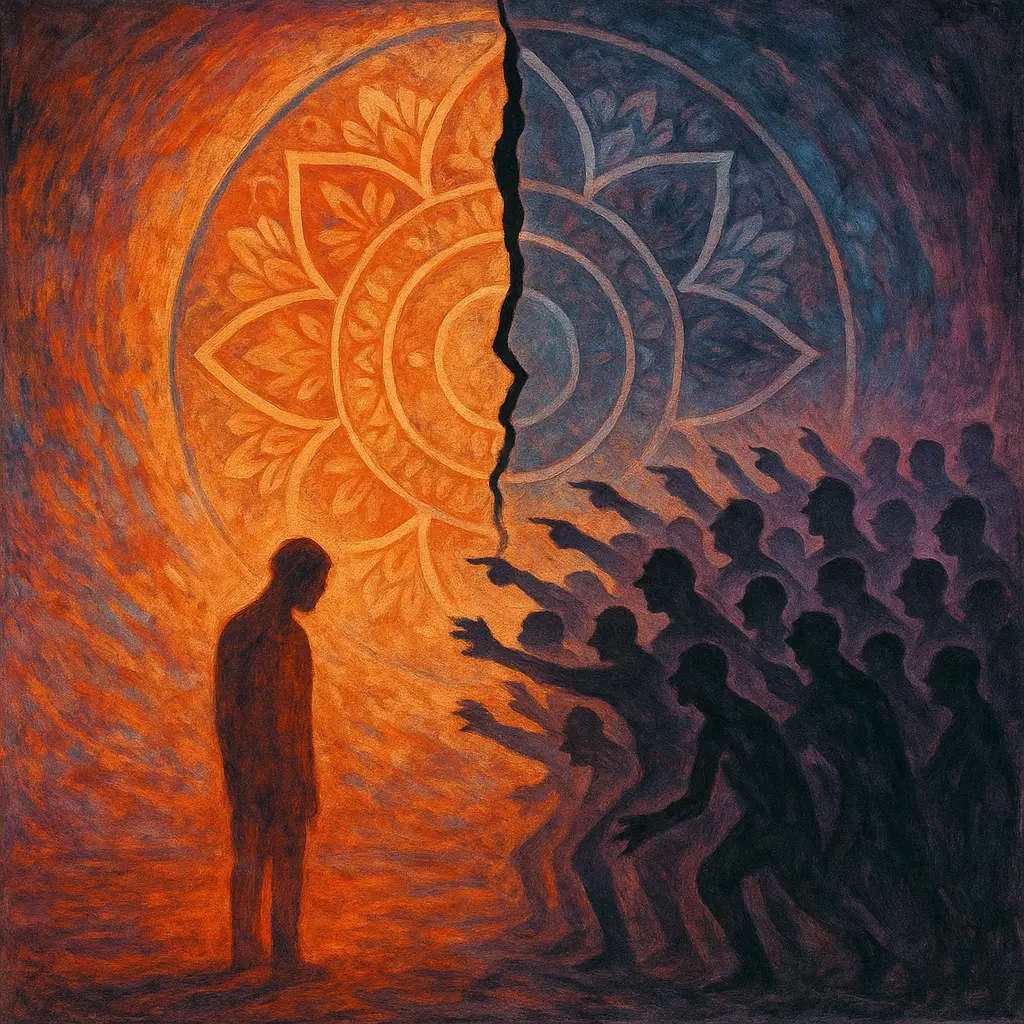
The target of a cancellation—a public figure, a peer, an online stranger—often becomes an archetypal scapegoat. In myth and ritual, the scapegoat bears the sins of the tribe and is sacrificed or exiled to restore social equilibrium. Today, the ritual takes place online. The digital firepit is the comment thread. The sin is moral impurity.

But the fervor? That’s religious. Archetypal. Shadow-fueled.

Why Now? The Rise of the Unprocessed Psyche

We live in an age of hyper-visibility and deep fragmentation. Everyone is their own brand, their own broadcaster, their own PR department. Meanwhile, the tools for authentic psychological integration—community, ritual, introspection—have eroded.

Cancel culture thrives in this vacuum. It provides a synthetic moral high. A hit of certainty in a morally ambiguous world. A way to feel good without having to face the disturbing truth: that we, too, contain capacity for cruelty, ignorance, prejudice, and contradiction.

Instead of saying “This reminds me of something in myself I haven’t dealt with,” the unconscious says, “That person is disgusting. Get rid of them.”

The Performance of Virtue and the Fear of Exile

Much of cancel culture is driven by fear—of being next. As a result, virtue is often performed, not lived. We denounce to demonstrate that we are clean, correct, on the right side of history. It’s the modern equivalent of burning a witch to prove you’re not one.

This makes it difficult to speak honestly, to question the herd, or to show nuance—qualities vital for a psychologically healthy society. If one mistake marks you as irredeemable, then redemption as a concept is dead. Growth is irrelevant. All that remains is punishment.

But the shadow requires growth. It demands confrontation, not exile.

Cancel Culture as a Mirror

If we zoom out, cancel culture may be seen as an evolutionary pressure—a flawed but inevitable attempt by the collective psyche to regulate moral boundaries in a new digital terrain. It points to real traumas, power abuses, and social injustices that need redress.

But when we cancel rather than converse, when we exile rather than integrate, we repeat the very cycles we claim to oppose. We become the tyrant we sought to dismantle.

In this light, cancel culture is not the problem—it is the symptom of a deeper, unresolved issue: the collective failure to do shadow work.

Toward a New Integration

If cancel culture is a symptom of shadow repression, then the cure isn’t more silencing. It’s more integration.

This means:

  • Encouraging inner reflection, especially when we feel reactive.
  • Distinguishing between justice and vengeance—they may feel similar, but arise from different places.
  • Valuing growth over purity, recognizing that fallibility is universal, and transformation is possible.
  • Creating space for difficult conversations, where people can be accountable and human.

If humanity is to evolve beyond this recursive purge cycle, we must learn to see our enemies not only as threats, but as mirrors. Not to excuse harm—but to understand where it originates, in them and in us.

Conclusion

We are all being asked to grow up psychologically. The digital age has exposed us to ourselves in ways no previous generation has had to face. The question isn’t whether cancel culture is justified—it’s whether we are ready to look into the mirror it holds up and ask: What am I seeing in them that I refuse to see in myself?

Until we can answer that, the shadow will keep casting new scapegoats for the mob to burn.