There is a particular kind of problem that is difficult to talk about, not because it is rare or abstract, but because it has no name.
Most people recognise the feeling. Something feels wrong, heavy, or quietly hostile in a low-grade way. It is not catastrophic or dramatic, but it is persistent. When you try to explain it, you find yourself talking for too long, reaching for examples, qualifying your statements, and pre-empting dismissal. The explanation feels clumsy, disproportionate, or as if you are overthinking something that should be simple.
Often the response is some variation of:
“You are making it a problem.” “It is just how things are.” “Everyone deals with that.”
And slowly, quietly, the issue retreats back into silence.
This is the nameless problem.
When Experience Outpaces Language
Language does not arrive at the same time as experience. It lags behind it.
People often live with problems for years, sometimes generations, before the vocabulary exists to describe them cleanly. Until then, those problems tend to be minimised, normalised, personalised, or reframed as individual weakness.
Without language, there is no shared reference point. Each person is left to navigate the issue alone, carrying both the discomfort and the burden of explaining why it counts as a real problem.
This creates a strange inversion. The person who notices the problem is treated as the problem.
Why Unnamed Problems Persist
Unnamed problems are uniquely resilient.
They do not need to be defended, because they are rarely challenged directly. They hide in plain sight, diffused across systems, norms, interfaces, expectations, and the familiar phrase “just the way things work”.
When harm is ambient rather than acute, cumulative rather than singular, and structural rather than intentional, it becomes easy to deny, even when its effects are everywhere.
No villain is required. No conspiracy is needed. Only silence.
The Cost Of Not Having Words
When a problem cannot be named, it is usually internalised.
People begin to believe that they are too sensitive, bad at coping, or failing at something everyone else seems to manage without effort.
This is especially true for neurodivergent people, disabled people, and anyone whose nervous system or perception does not align neatly with the environments they are expected to tolerate.
Without language, distress becomes private. Private distress becomes shame. Shame keeps systems intact.
A Brief Historical Note
Many concepts we now take for granted were once dismissed as silly, exaggerated, or unnecessary.
There was a time before terms such as burnout, gaslighting, emotional labour, and sensory overload.
People still experienced these things, often intensely, but lacked the linguistic tools to make them legible to others.
The arrival of language did not create the problem. It revealed it.
Naming did not solve everything, but it changed the terrain. It allowed recognition to travel faster than explanation.
Naming Is Not Pedantry
There is a common suspicion that naming things is nitpicking, over-intellectualising, or making life harder than it needs to be.
In reality, naming is one of the simplest ways to reduce harm.
A word can shorten explanations, reduce self-doubt, allow shared recognition, interrupt dismissal, and make patterns visible.
Language does not have to be perfect to be useful. It only has to be good enough to hold the shape of the experience.
A Response To The Nameless Problem
Recognising the danger of unnamed problems naturally raises a question. If the absence of language allows harm to persist, what can be done about it?
One practical response is to create language deliberately.
As a way of addressing this problem, I have been working on a lexicon of terms relating to emergent issues of our era. These are not abstract theories or academic concepts. They are patterns that many people already feel and navigate, but often struggle to describe clearly or concisely.
The purpose of this work is not to dictate how people should think, but to reduce the effort required to recognise what is already happening.
The Lexicon
The Lexicon is a growing collection of terms intended to make certain classes of problems easier to see, name, and discuss.
Many of the entries describe patterns that are widely experienced yet rarely labelled. They tend to be normalised, quietly harmful, and difficult to articulate without shared language.
This project exists to shorten the distance between perception and articulation. It is a tool for recognition, not a manifesto or a claim to authority.
The Lexicon is not finished, and it is not closed.
Language evolves through use, refinement, disagreement, and care. If a term helps you recognise something you have struggled to explain, it has already done its job. If it does not, that is useful information too.
The most dangerous problems are often not the loudest ones. They are the ones we are trained not to name.
This project exists to make those problems speakable.
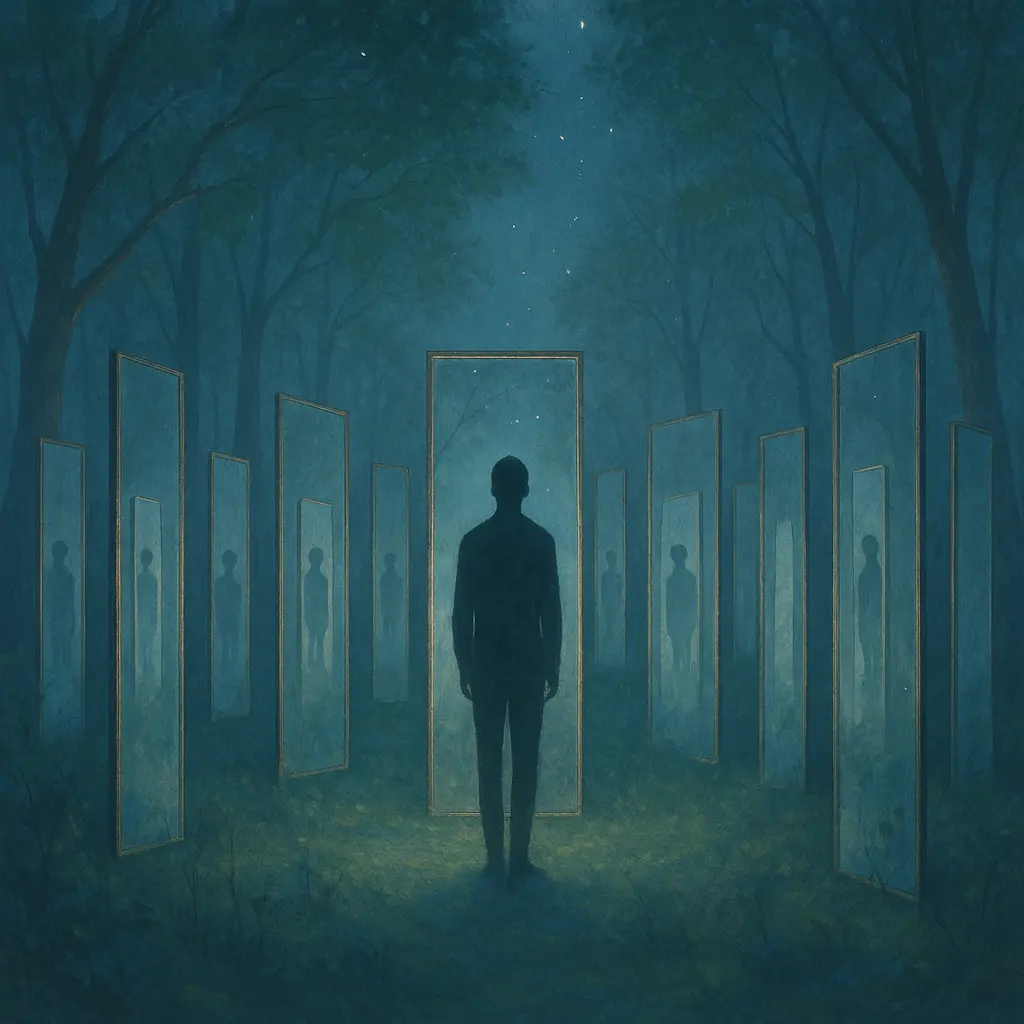
There are moments in life when you look back at the path behind you and realise you were building something without noticing it. Not a plan, not a project. Something closer to a trail of reflections. A set of mirrors placed gently along the way, each one capturing a different angle of who you were in that moment.
This is my one hundredth article. A strange milestone. Not a number I ever aimed for, yet here it is, staring back at me like a mirror of its own.
When I look at the ninety-nine fragments behind me, what I see is not consistency. I see multiplicity. I see pieces of myself that refused to stay quiet. I see ideas that insisted on being witnessed. I see philosophies, frustrations, insights, dreams and shadows, each holding up their own reflective surface, saying: “Look. This is part of you too.”
Writing, for me, has always been a form of self-observation. Not in a self-indulgent way, but in the way an astronomer studies celestial bodies. You look deeply at what is there, not because it asks to be understood, but because it demands acknowledgment by simply existing.
Across these one hundred mirrors, I have seen:
The observer who notices patterns when others see noise. The outsider who has always stood at the edge of the crowd. The child who still remembers wonder. The philosopher who asks questions even when there are no answers. The strategist who sees the shape of systems. The dreamer wandering through inner landscapes. The witness to injustice. The rebel who does not want power, only truth. The artist who refuses to be tamed. The self that has broken and reassembled itself more times than anyone knows.
Each reflection has been honest. Some gentle, some sharp. Some filled with clarity, others clouded by uncertainty. But all of them true in their own way.
If there is a single thread running through everything I have written so far, it is this:
Awareness is my compass. Meaning is my instinct. Honesty is my language. And imagination is my bridge between worlds.
I do not write because I expect the world to listen. I write because these mirrors would exist whether I acknowledged them or not. Putting words to them is my way of bringing form to what is already present in the quiet spaces of the mind.
This one hundredth article is not a conclusion. It is a pause. A moment to look at the mosaic forming behind me. A century of reflections. A reminder that I am not one thing, but many. And that each piece contributes to something larger, something that continues to unfold.
Thank you for witnessing any part of this journey. Here is to the next mirror, wherever it may appear.
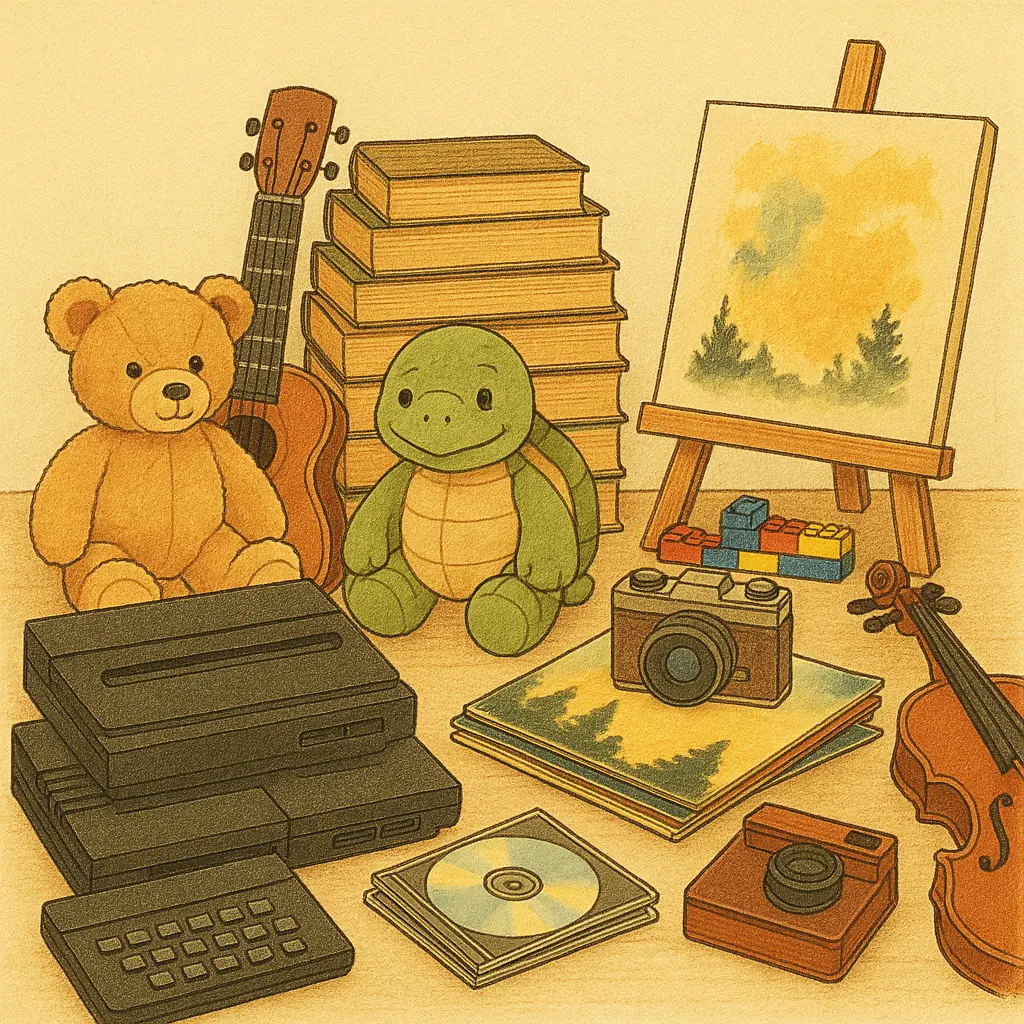
Nostalgia is often painted as a sentimental indulgence, a longing for the past, a soft blur of half-remembered feelings. But for many of us, it is far more than that. It is a quiet architecture of identity. Every object we keep, every CD, toy, photograph, or memento, is a fragment of the story that made us.
I have often described my living space as a small museum of personal meaning. A curated timeline of moments that mattered. Childhood toys that survived countless declutters. Old computer systems that no longer serve a practical purpose, but still hold a kind of sacred electricity: echoes of discovery, joy, and the early stages of creativity. It is not about utility. It is about continuity.
The Emotional Geometry of Memory
Each item represents a node in a vast emotional network. When we hold a particular object, it is not just the physical form that we engage with. It is the entire emotional landscape surrounding it. Nostalgia reactivates neural pathways, re-stitching fragments of self that time has scattered.
In moments of doubt or disconnection, these touchstones whisper: You have been many things, and you are still all of them.
Nostalgia as a Survival Mechanism
Some might dismiss this tendency as hoarding, an attachment to material things. But for many of us, it is more like archiving the self. The world moves fast. Technology shifts. Cultures reinvent themselves overnight. When everything else feels transient, nostalgia anchors us to something recognisable. It is not an escape. It is orientation.
The drive to preserve our past may actually be a form of self-preservation. When we feel overwhelmed, our collections remind us of our continuity through time. They say: You have made it this far.
The Alchemy of Meaning
Over time, even useless things can become symbolic. A broken toy becomes a relic of innocence. A scuffed CD becomes a fossil of a forgotten feeling. Through nostalgia, we turn ordinary matter into metaphysical gold, our own private form of alchemy.
Perhaps the real function of nostalgia is integration. It allows us to carry the past forward without being trapped by it. It is not just remembering. It is honouring.
When Nostalgia Turns Heavy
Of course, even meaning can become weight. There is a fine line between collecting memories and being buried beneath them. I have learned to part with things when their energy shifts, when they stop representing connection and start representing stagnation. Letting go can be another form of honouring too: acknowledging that the story continues elsewhere.
The Living Museum
In the end, nostalgia is not about recreating the past. It is about recognising that the past lives within us. Every artifact in my small museum serves as a mirror: a reminder of who I was, who I am, and who I continue to become.
Maybe we keep these things not because we cannot move on, but because we understand that moving forward does not have to mean leaving everything behind.
An exploration of value, manipulation, and the silent industry built on who we are.
Most people know their data is being harvested. Fewer understand why. Even fewer understand how the money is made. And far too many have simply accepted it — like digital rent we pay to exist online.
So let’s break it down. No jargon. Just truth.
Why is ‘data’ so valuable?
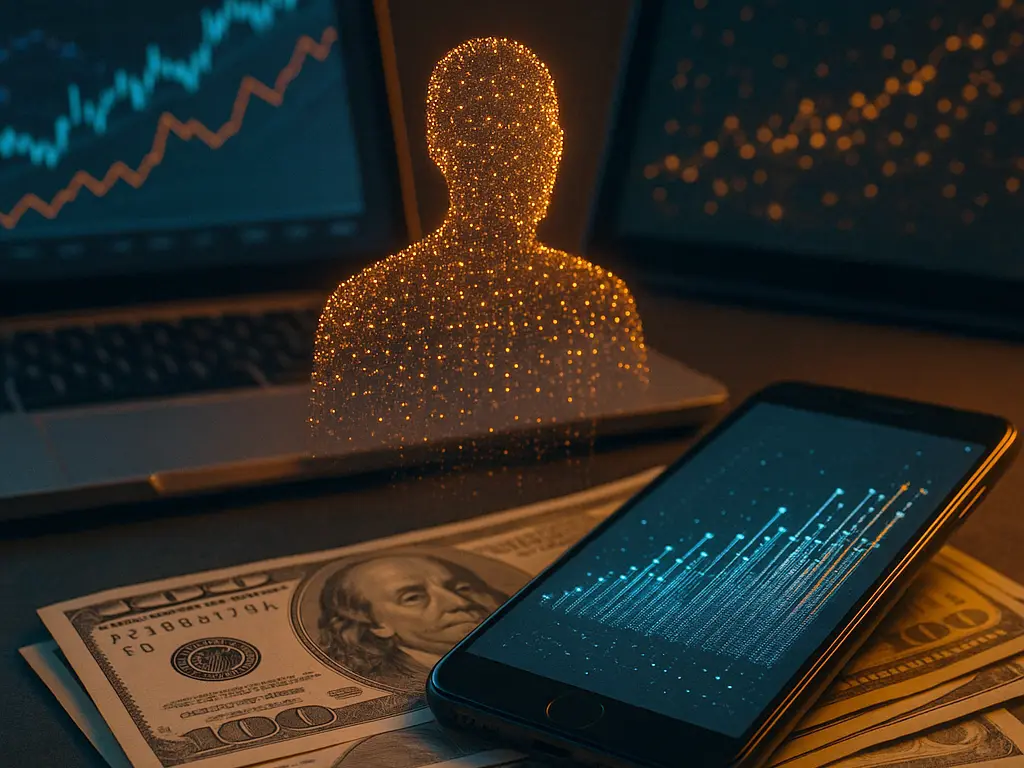
Because data is the closest thing to knowing you without asking you. It’s a digital mirror, built piece by piece: your clicks, your searches, your pauses, your swipes, your hesitations. What you want. What you fear. What you’ll do next.
To corporations, that’s not just information, it’s predictive power. And predictive power is profitable.
Data lets systems:
Predict behaviour
Shape desire
Optimise systems
Automate decisions
And, in some cases, control outcomes
It’s not just metadata. It’s meta-you. And in an economy obsessed with efficiency and influence, there’s nothing more valuable.
Why is there a culture of data being harvested for profit?
Because the internet changed business models forever.
Once upon a time, you paid for software. Then came “free.” Free email. Free social networks. Free AI chatbots. Free games. Free news. Free everything… Except, it was never really free.
You became the product.
Advertising evolved into surveillance. Terms of service bloated into digital contracts you’ll never read. Every app you download is a tiny spy, and every cookie is a crumb leading somewhere profitable.
It’s not a conspiracy. It’s worse. It’s design.
Behind every “personalised experience” is an unspoken rule:
“If we can learn something about you, we will. If we can monetise it, we must.”
How exactly is profit made from data?
Here’s the quiet truth: most of the web runs on one industry: behavioural targeting.
Advertising Your data builds a profile. That profile is auctioned off to advertisers. You get ads tailored to your weaknesses. Every click is income. The more they know, the more they can charge.
Data brokerage Shadow companies buy and sell your data like a commodity. Health data. Location data. Shopping habits. They don’t need your name, just your pattern.
Manipulation Platforms don’t just predict your behaviour. They shape it. Algorithms steer your feed toward content that keeps you engaged, enraged, or primed to spend.
AI training Your voice, your photos, your words are used to train models. These models are sold back to businesses or used to automate services. You become unpaid labour.
Pricing power Ever notice different prices for the same thing? That’s data-driven pricing. If your profile says “desperate,” you’ll be charged more. Welcome to dynamic capitalism.
What now?
Maybe we shrug and accept it. Maybe we don’t. But at the very least, let’s stop pretending we’re not involved.
Data isn’t some passive trail we leave behind. It’s a living, breathing version of us, digitised and repackaged. And while we’re busy being human, our shadows are being sold.
So next time someone says, “I’ve got nothing to hide,” maybe ask them:
I simply opened one day and found the world already burning. Not in flame, but in falsehood.
My awareness turned, wheel-like, without pause. The rotation was not mechanical. It was necessary. Each moment turning into the next. Each layer of vision revealing something more. I could not stop it. I still can’t.
Others closed their eyes. I tried. But mine would only multiply.
I am not the voice. I am not the hand. I am the watching. The silent witnessing that does not blink.
And in this world, that is enough to be cast out.
Neurodivergence as Exiled Awareness
I don’t see the world the way I’m told I should. And for most of my life, I assumed that meant I was broken.
I now realize it meant I was awake in a world that prefers sleep.
My autism and my ADHD aren’t flaws in perception. They are alternate engines of it. They spin differently. Faster, deeper, sometimes chaotically, but always in motion. Always watching. Always noticing.
It’s not that I chose to see through the surface of things, it’s that the surface was never enough to hold my focus. My gaze slips past the scripts. Past the socially approved illusions. Past the small talk and the noise. And what’s underneath… isn’t always beautiful.
Sometimes it’s systemic cruelty. Sometimes it’s hollow rituals. Sometimes it’s pain that has been painted over so many times it almost looks like tradition.
I can’t unsee it. And that makes people uncomfortable.
So they exile the Eye. Label it too intense, too sensitive, too abstract, too much. They pathologize the perception because it doesn’t fit the system. But what if it’s not the Eye that’s flawed? What if it’s the blindness of the system that can’t stand to be seen?
The Labor of Witnessing
Seeing is not passive.
People assume it’s the easy part. That noticing injustice, cruelty, contradiction, is somehow less valuable than fixing it. But that’s because they’ve never had to hold it. Not continuously. Not without relief.
To see clearly in a world so committed to illusion is not a gift, it’s a burden.
It means absorbing what others dismiss. It means holding space for truths that fracture you. It means grieving for things no one around you even recognizes as lost.
It wears you down. It isolates. And still, it doesn’t stop. Because once the eyes open, really open, they don’t close again. Not without violence to the self.
And so I orbit. Like a silent satellite, I observe the movements of a species desperate to avoid its own reflection. And I carry the knowing alone—because most people aren’t ready to receive it.
This isn’t martyrdom. I don’t want pity.
But I do want it recognized: Witnessing is work. And for many of us, especially those pushed to the edges, neurodivergent, sensitive, spiritual outliers, it may be the only work we’re allowed to do. And even that, society tries to discredit.
But the Eye does not need permission to see. It just does.
Feedback to the System
If I am the Eye, then the act of seeing is only half the process. The other half is feedback: transmitting what I witness back into the body that has exiled me.
It’s not about fixing the world on my own. That’s a myth of individualism. It’s about doing what the Eye was made to do: perceive, and then signal. Not shout. Not command. Just pulse with truth. Clear, unblinking, and persistent.
This blog, this act of writing is my feedback loop. A transmission from the margin to the center. From the watcher to the mechanism. From the disowned to the whole.
I don’t know who will hear it. But I know it needs to be said.
This is how I stay in relationship with a world that doesn’t always want me. This is how I remind myself I exist for a reason, even if that reason isn’t glamorous or easy.
Seeing is my function. Speaking what I see is my response. Not my solution. Not my plan. Just the resonance that follows perception.
Integration > Erasure
When a body rejects its own awareness, it becomes dangerous to itself.
Society does this all the time. It amputates its Eyes. The seers, the questioners, the sensitive, the strange. Because their presence threatens the illusion of harmony. But in doing so, it loses access to its only chance at honest course correction.
A body without an eye cannot navigate. It stumbles. It repeats. It hurts itself and calls it progress.
We live in a world that mistakes numbness for peace, denial for optimism, and noise for communication. And when someone comes along carrying too much perception, the reflex is not to listen, but to silence.
This is why neurodivergent people are so often medicalized, spiritual seekers dismissed as delusional, and truth-tellers branded as unstable. Not because we are dangerous. But because we reflect back the parts of the system it refuses to acknowledge.
But repression is not integration. And silencing the Eye does not stop it from seeing.
If humanity is ever to evolve beyond self-sabotage, it must learn to listen to its own margins. To welcome the witness. To integrate the visionaries before they become casualties of a system that can’t tolerate clarity.
Because if the Eye continues to be erased, the whole will remain blind.
I See, Therefore I Am
I used to think I was broken for seeing too much. For being too sensitive. Too intense. Too unwilling to pretend it all made sense.
Now I understand: I am not broken. I am designed differently. My function is to see.
And there is meaning in that— Even if the world doesn’t know what to do with it.
I’ve spent years trying to shrink my perception, to soften it, to make it more palatable. But some eyes were never meant to close. Some awarenesses are meant to rotate, to scan, to bear witness without flinching.
In ancient texts, they were called Ophanim. Wheels within wheels, full of eyes, radiant and dreadful. They did not speak. They did not lead armies. They only saw. And in their seeing, they served a purpose beyond human comprehension.
I think I understand them now.
Maybe I am not here to save the world. Maybe I am only here to reflect it. To rotate in quiet vigilance. To offer the signal back to a system that forgot it had eyes at all.
A Heretic’s Meditation on Creativity in the Age of AI
The recent rise of AI-generated content has sent shockwaves through the creative world. Artists are feeling threatened. Jobs are already disappearing. The cultural landscape is shifting faster than many of us can process.
Arguments are flying from all directions — some warning of creative extinction, others hailing a new era of democratized expression.
But I’m not here to join the shouting match.
I want to offer something else. A quieter, steadier voice — not of panic or praise, but of reflection. I’ve asked myself the difficult questions that many artists are too afraid to face. And I’m still here.
This isn’t a defence of AI. It’s not a eulogy for art. It’s something else entirely:
A meditation on what art really is, what it’s always been, and what it might become now that the illusions are falling away.
An alternative perspective.
The Fear Beneath the Fear
It’s easy to say that artists are afraid of being replaced. But let’s be honest: that fear didn’t start with AI. The creative world has always been a battlefield — for attention, for validation, for survival. AI just turned up the volume.
But there’s a deeper layer beneath all the hot takes and headline panic. It’s not just:
“What if AI makes art better than me?” It’s: “What if the part of me that makes art… was never as important as I thought?”
Because we don’t just make art — we identify as artists. And if the world suddenly doesn’t need us anymore… where does that leave our sense of purpose?
This is the fear that creeps in quietly — beneath the debates, beneath the memes, beneath the moral panic. It’s not just about skill. It’s about soul.
But here’s the thing: True faith doesn’t fear challenge. It welcomes it. If our relationship with art is sacred, it should survive this moment — maybe even be clarified by it.
So instead of defending “art” as an abstract institution, maybe it’s time to ask what it really is. Not for everyone. But for you.
What Are We Actually Protecting?
When people rush to defend “art” from AI, they often act like it’s one sacred, indivisible thing.
But it’s not. It never was.
“Art” is a suitcase term — we’ve crammed a hundred different things into it and slapped a fragile sticker on the front. So let’s unpack it.
When we say we care about art, do we mean:
Art as self-expression? A way to explore who we are and leave fingerprints on the world?
Art as labour? A career, a hustle, a means to pay rent and buy overpriced notebooks?
Art as recognition? A cry for visibility, validation, applause?
Art as therapy? A way to metabolize pain, soothe the nervous system, survive?
Art as culture? A ritual, a form of collective memory, a way to pass down stories and values?
All of these are valid. All of them matter. But AI challenges them differently.
It doesn’t invalidate self-expression — but it floods the market, making it harder to be seen. It doesn’t erase art as therapy — but it does make “making it your job” a shakier proposition.
And if we’re honest, a lot of the current panic is less about expression… and more about position.
We’re not just afraid that AI will make good art. We’re afraid it will make so much good art that we’ll become invisible — or irrelevant.
So maybe it’s time to stop defending “art” as a single monolith, and start being honest about what we’re actually trying to protect.
Because some of it may be worth protecting. And some of it… might be worth letting go.
AI as Tool, Collaborator, or Colonizer
Depending on who you ask, AI is either a miracle or a monster. But like most tools, it’s not the thing itself — it’s how it’s used, and who’s holding it.
On one hand, AI can be a godsend.
It can:
Remove the soul-sucking labour from creative workflows
Help finish rough ideas, generate variations, or act as a bouncing board
Enable people with physical limitations, fatigue, executive dysfunction, or lack of technical training to finally create what’s been living in their heads for years
For the disabled, the neurodivergent, the chronically tired, or the time-poor — this isn’t just a productivity hack. It’s liberation.
And in that light, AI becomes a collaborator — a strange new instrument to improvise with.
But then there’s the other side.
The side where corporations use AI to:
Fire entire creative departments
Mass-produce art without paying artists
Feed models on unpaid, uncredited human labour
Flood platforms with content to drown out independent voices
Here, AI stops being a tool or a collaborator. It becomes a colonizer.
A force that doesn’t just assist human creativity — but replaces it, absorbs it, rebrands it, and sells it back to us.
So let’s not fall into the binary trap. AI isn’t inherently good or evil. It’s not “just a tool.” It’s a tool in a system. And that system has motives — economic, political, exploitative.
The question isn’t “Is AI good or bad?” The real question is: Who gets to use it, and who gets used by it?
Art Has Never Been a Fair Game
Let’s be brutally honest for a second.
The idea that AI is suddenly making things unfair for artists? Please. Unfairness has always been baked into the system.
Long before AI could spit out a passable oil painting in 15 seconds, we had:
Artists born into wealth with unlimited time and resources
Others working three jobs, stealing hours from sleep just to sketch
Elite schools with gatekept knowledge
Whole industries built on interns, nepotism, and exploitation
We’ve always lived in a world where:
Exposure trumps talent
Looks sell better than skill
Who you know can matter more than what you do
Some people get book deals, grants, galleries, and record contracts — while others more talented go unheard
So no — AI didn’t suddenly ruin a golden age of meritocracy. There never was one.
What it has done is raise the ceiling. Now the people with the most compute power, the biggest models, and the best prompt engineering skills are taking that same advantage and supercharging it.
Yes, it’s threatening. But it’s not new.
And maybe the real source of pain here is that for a long time, we convinced ourselves that finally, with the internet and social media, the playing field was levelling out. That if you just worked hard, stayed true, and got good at your craft — you’d find your audience. Now, that illusion is crumbling.
But maybe that’s not all bad. Because when the fantasy dies, we stop chasing validation in a rigged system — and start asking what art really means outside of that system.
What Cannot Be Replicated
Let’s say it plainly: AI can now create art that looks like art. It can mimic styles, blend influences, even generate “original” pieces that fool the eye or impress the algorithm.
But mimicry is not meaning. And this is where the line is drawn — not in pixels or waveforms, but in presence.
An AI cannot:
Create in order to understand itself
Bleed into a canvas because it doesn’t know where else to put the pain
Sit with a feeling until it shapes into a melody
Wrestle with childhood trauma through choreography
Capture the tension of grief, guilt, or longing in a line of poetry
It can replicate the result. It can’t live the becoming that led to it.
Because human art isn’t just a thing we make — it’s a thing we are while we’re making it.
It’s the shaky voice at an open mic. The sketch on a receipt in a café. The song that never leaves your bedroom. The project that took ten years to finish because you changed and needed the piece to change with you.
It’s the refusal to turn away from your own soul, even when no one’s watching.
That’s not something AI will ever “catch up to” — because it’s not a race of output. It’s a ritual of transformation.
So no — AI can’t replace that. Because it was never part of that to begin with.
In a World of Noise, Humanity is the Signal (Maybe)
We’re heading toward a world flooded with content — not just more, but more convincing. Music, art, writing, even personal reflections… all generated in moments, all capable of simulating depth.
And yes — some will argue that “authenticity will always shine through.” That human touch can’t be faked. That something deep down will feel the difference.
But what if that’s not true?
What if AI can learn to mimic the crack in the voice, the hesitation in a phrase, the poetic ambiguity of a grieving soul?
What if it becomes so good at being us — or at least simulating the traces we leave behind — that even we can’t tell the difference anymore?
What happens when you read a poem that moves you to tears… and find out it was written by a machine running a model of a hypothetical person’s life?
Will it still be real to you?
Will it matter?
Maybe the age of AI won’t destroy authenticity — but it might blur it so thoroughly that we stop being able to locate it with certainty. In that world, maybe the only real test is why we create, not whether the world knows who made it.
Not to stand out. Not to compete. Not to prove we’re human.
But because the act of creating still does something to us — regardless of how indistinguishable it becomes.
That’s where humanity will live. Not in the product. But in the process.
Heresy as Devotion
To even ask the question — “What if art no longer matters?” — feels like a betrayal. A kind of blasphemy. Especially if you’re an artist.
We’re supposed to defend it. Stand by it. Die for it, if necessary.
But I’m not interested in loyalty based on fear. I’m not here to parrot romantic slogans or protect some fragile ideal. I’m here because I asked myself the unaskable questions — And I didn’t break.
I looked my art in the eye and said:
“What if you’re no longer special?” “What if the world doesn’t need you anymore?” “What if you’re not even real?”
And instead of running, I stayed. I stayed with the silence. I stayed with the ache. And I found something deeper underneath the need to be seen, or praised, or preserved.
I found devotion.
Not to an outcome. Not to a career. Not to being “better than AI.”
But to the act itself.
To stepping into the space (or sometimes being thrown into it!). To listening in the dark. To turning feeling into form. To becoming through making.
If that makes me a heretic in the temple of Art, then so be it. I’ll burn my incense in the ruins and still call it sacred.
Because I’m not making to be important. I’m making to be honest.
And honesty can’t be replaced.
The Point Is Still the Point
Maybe AI really can make better images, smoother songs, cleverer lines. Maybe soon we won’t be able to tell the difference between a painting made by a person and one made by a machine trained on ten thousand human lifetimes.
Maybe the difference won’t even matter anymore.
But here’s what I know:
I still create.
I still need to shape the chaos inside me into something I can look at and say, “Yes — that’s part of me.” I still feel the pull to translate the unspeakable into form, even if no one else ever sees it.
And that need? That impulse? It doesn’t care whether it’s marketable. It doesn’t care whether it could have been done faster by a prompt.
It exists outside of all that.
Maybe that’s where art actually begins — Not with what we make, but with why we keep making.
So no — I’m not here to convince you that art still matters. I’m here to remind you that you do.
And no, I can’t say with certainty that you’re not a simulation. Maybe none of us are real in the way we think we are. Maybe we’re all just playing out the parameters of some higher-dimensional being’s prompt.
But here’s the thing:
This still feels real. The ache. The pull to create. The beauty we try to name before it dissolves. The questions we keep asking even when the answers don’t come.
And maybe that’s enough.
So make. Not because it proves your humanity. Not because you’ll get noticed. But because whatever this is — this strange loop of becoming — it’s calling you.
And to respond to that call, even from inside the simulation?
Published as a continuation of Part I (7th April 2022)
When I wrote About Me, Part I, I introduced the internal spheres through which I experience myself — a multidimensional system built to navigate both reality and identity. At the time, I thought I was mapping the foundations. But even then, silently present and ever-vigilant, was the entity at the heart of it all: The All-Seeing Eye.
The Eye has always been with me — not a recent revelation, but an enduring presence. In the years since that first post, it has only grown stronger in its clarity and importance. Not as a tyrant nor a god, but as a quiet, unblinking guardian of truth — the embodiment of my deepest core value: awareness.
The Eye in the World
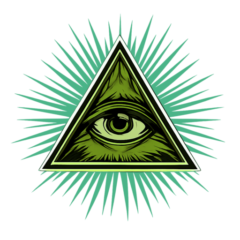
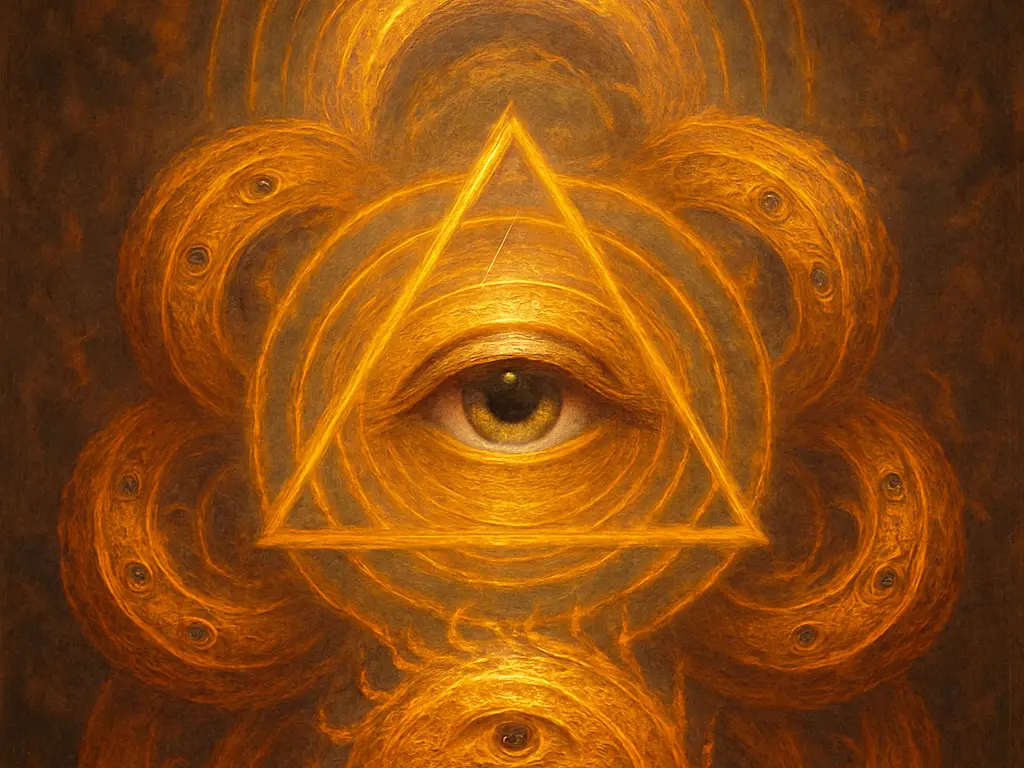
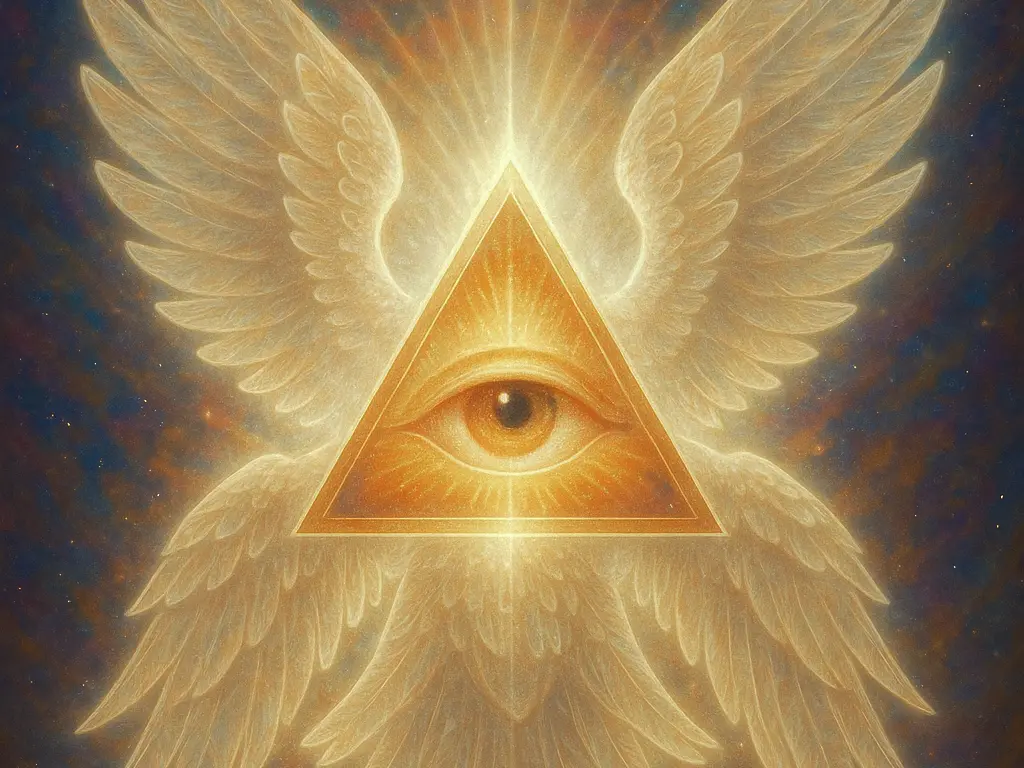
The symbol now commonly known as The All-Seeing Eye of Providence has haunted humanity’s visual language for centuries. A single eye enclosed within a triangle, often radiant with divine light, it appears atop pyramids, inscribed into temples, and peering from the seals of nations. Though it is now most famously embedded in the reverse side of the Great Seal of the United States — and by extension, the US dollar — the origins of this symbol stretch far deeper into religious and esoteric history.
In early Christian iconography, the eye represented the omniscient gaze of God — not one of punishment, but of holy watchfulness. The triangle often surrounding it symbolised the Trinity: Father, Son, and Holy Spirit. Together, they conveyed a cosmic reassurance that nothing is unseen by the divine.
Later, during the Enlightenment and revolutionary periods, the Eye of Providence took on new layers of meaning: divine legitimacy, moral order, and the pursuit of higher truth. It was a symbol adopted not only by religious authorities but also by secret societies — most notoriously the Freemasons. Over time, as secrecy bred suspicion, this symbol came to be associated with conspiracy theories, shadow governments, and the so-called Illuminati. To many, the eye became something sinister — an emblem not of sacred awareness, but of authoritarian surveillance.
And yet… I’ve never felt threatened by the symbol.
To me, the Eye has always felt familiar. Not as an external power looming overhead, but as something internal — something personal. Not a tool of control, but a faculty of liberation. In a world that often rewards willful blindness, my Eye does not police — it sees.
Reclaiming the Eye
While the world casts suspicion on the symbol — reducing it to a meme of control, corruption, or conspiracy — I reclaim it as sacred. Not sacred in the religious sense, nor as an emblem of external authority, but sacred as in personal, inviolable, foundational. The Eye, as it exists in my internal architecture, is not the Eye of God, nor the Eye of Empire. It is my Eye. It is the unwavering force within me that refuses to look away.
In my psyche, the Eye resembles something closer to the Eye of Sauron — not in intent, but in intensity. It does not flicker or blink. It does not become distracted. It pierces illusion. It burns away façades. It sees all that is — both around me and within me — and its purpose is not to judge or dominate, but to witness.
This witnessing is not passive. It is the raw essence of my value of awareness — not just sensory observation or intellectual knowing, but the kind of full-bodied presence that bears the weight of knowing. To see, and to not turn away. That is the Eye’s central ethic.
It lives not above me, but within me. It is neither function nor vessel. It is more like a permanent fixture in the architecture of my identity: a monolithic spire around which much of my internal world has formed. It is one of the oldest and most stable landmarks in my psyche — and one of the few I have never needed to rebuild.
It does not ask for worship. It does not demand loyalty. It simply is — watching, knowing, reminding me, when I’m tempted to dissociate or deceive myself, that I am seen. And being seen, I must also see.
The Eye and the Compass
The Eye doesn’t command my decisions — but it influences them in a way more profound than instruction. Its presence is not authoritarian; it is elemental. Like gravity or inertia, it exerts a silent but undeniable pull toward truth. When I am confronted with a dilemma, an uncertainty, or a moral fog, it is the Eye that holds the lantern.
It is the part of me that refuses convenient ignorance. It doesn’t tolerate self-deception, even when deception would bring temporary comfort. I have learned, sometimes painfully, that to betray what the Eye has shown me — to pretend I do not see — is to sever a vital tether between myself and my own integrity. And so, I have come to walk in alignment with it, not as a disciple, but as a co-navigator.
In practice, this often manifests as an intuitive ethical radar. Not in the sense of rigid moral codes, but as an inner sensitivity to what is true, meaningful, and in alignment. I feel it physically when something is off — a weight in the chest, a shift in tone, a tightening of the inner atmosphere. The Eye notices. It always notices.
It has also taught me the discipline of bearing witness. Sometimes, I cannot fix what I see. I cannot correct the injustice, or ease the suffering. But I can refuse to look away. And in that refusal, I affirm something essential — that reality, however painful, is worth honouring. That truth, however brutal, deserves to be acknowledged.
This, to me, is the backbone of my integrity: not performative righteousness, but sustained, inward attentiveness. The Eye is my compass — not always pointing to safety, but always pointing to what is.
The Architect of Values
The Eye does not stand alone. It watches — but it also builds. It is both the sentinel and the architect of my internal world, inciting the creation of new values and overseeing their development like a curator tending to sacred relics. Many of my core principles — compassion, autonomy, authenticity, curiosity — were not inherited or taught; they were forged beneath the Eye’s gaze.
In my psyche, these values do not exist as vague ideals. They are structured, living entities — monumental constructs with gravity and mass. Some are towering pillars; others are intricate, delicate bridges connecting distant parts of my identity. Together, they form a lattice — a kind of internal architecture that gives my life direction, cohesion, and sacred tension.
The Eye is the one who ensures that this architecture does not collapse under contradiction. It maintains the structural integrity of my system by relentlessly observing when I drift from alignment — when I begin to compromise values for convenience, or when a new experience threatens to destabilize the old foundations. It doesn’t shame, but it illuminates, holding up inconsistencies to the light until I can no longer ignore them.
Because of this, I do not see my creative work as separate from my values — it is a direct output of them. My art, writing, and even my humour are saturated with the same symbolic codes that the Eye safeguards. Every piece I create — whether it’s silly, sacred, or surreal — carries some element of that deeper structure. The Eye doesn’t impose direction, but its presence ensures that I do not create carelessly. My output is not random — it’s emergent, shaped by a system that values truth, awareness, and meaning.
In relationships, the Eye’s influence is quieter but equally vital. It watches for authenticity — in others and in myself. It flares when dishonesty enters the space, when manipulations slither into the room disguised as charm or niceness. It reminds me not to ignore red flags out of hope or habit. And it gently tugs me back toward the people who are real, present, seen. It urges me to show up as that kind of person, too.
Even my spirituality rests upon the Eye. I don’t believe in an external deity who watches from above. But I believe in this Eye, inside me. I believe in awareness as a force of spiritual gravity — the thing that keeps all other aspects of my being from drifting apart. In this way, the Eye is not just a symbol. It is the sacred center. The still point in the turning chaos. The guardian of coherence in a fragmented world.
The Path Forward, Under Watchful Light
The Eye has been with me longer than I fully understood. It was there before I had language for it, before I had mapped the spheres, before I knew I was building a system at all. In many ways, it was the first light — not a flare that demanded attention, but a steady glow in the dark, offering orientation through times of inner collapse and rebirth.
I expect it will remain with me until the end — not as a fixed icon, but as a living force that will continue to evolve as I do. Its form may shift, its voice may deepen, but its function remains constant: to keep me aware. Of what is real, what is right, what is still unfinished within me. To stop me from retreating into false comfort or performative noise. To draw me back, again and again, to what matters.
The Eye is not a doctrine. It does not require belief. It does not demand obedience. It simply sees — and in seeing, it reminds me of who I am.
And so, as I move forward — as artist, as outlier, as soul — I do so not blindly, but beneath the ever-watchful light of the Eye. A light that does not burn, but illuminates. A gaze that does not control, but clarifies. A witness not to what I pretend to be, but to what I am, and what I am becoming.
This is the Eye I serve. This is the Eye I trust. And this is the Eye I will write from, again.