The Fine Line Between Manifesto and Dogma

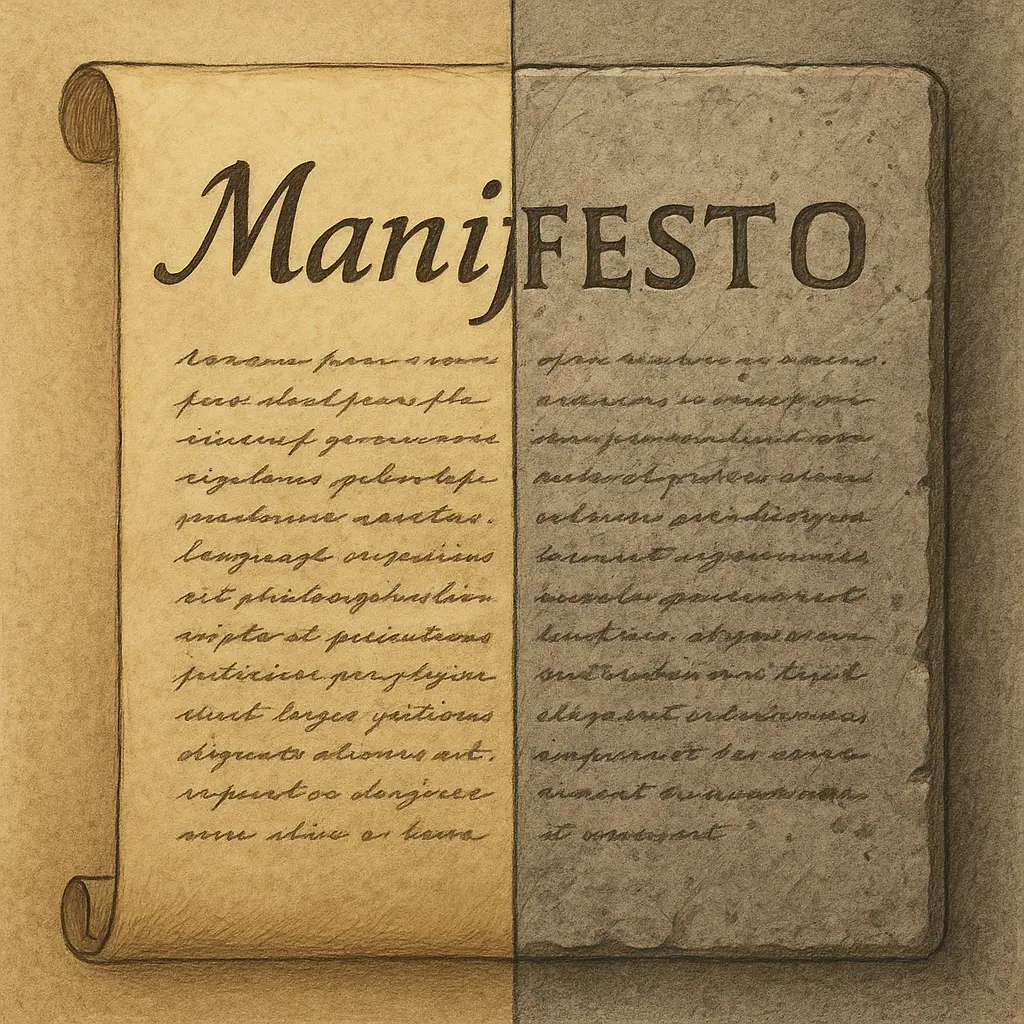
A vertical split illustration showing a parchment scroll on the left and a stone tablet on the right, both bearing the word “Manifesto.” The scroll side is warm and fluid with calligraphic text, while the tablet side is cool and rigid with chiselled letters, symbolising the divide between living conviction and unyielding dogma.
Between ink and stone lies the fine line where conviction becomes belief — and belief, if left unexamined, becomes dogma.

I often find myself writing in the tone of a manifesto: declarative, uncompromising, certain in its cadence. It isn’t always intentional. Sometimes it’s simply the only language strong enough to contain what I feel. Yet I’m aware this style carries risk. To the untrained or hurried reader, such conviction can appear like ideology—or worse, arrogance. In truth, my manifestos are not edicts. They are moments of alignment between clarity and chaos, attempts to map the shifting ground beneath my own feet.

The word manifesto carries baggage. For many, it evokes the rhetoric of politics—grand visions, revolution, the binary clash of “us” versus “them.” Others hear echoes of religion, of sermons and sacred decrees that leave no room for questioning. In both cases, the manifesto becomes synonymous with certainty without flexibility, belief without humility.

It’s no wonder the term can make people uneasy. History has shown us manifestos that rally masses, ignite wars, or justify cruelty. But it has also shown us manifestos that inspire art, liberation, and self-expression. The line between revelation and indoctrination is razor thin—often determined not by the words themselves, but by the spirit in which they are written and the consciousness of those who receive them.


The Power of Declaration

There is something liberating about speaking as if one truly knows. To declare is to crystallise thought—to pin the fluttering swarm of ideas to a moment of clarity. When I write with conviction, it is rarely because I believe I have found the final truth. It is because I need to see what truth looks like when spoken aloud. A manifesto, in that sense, becomes an act of self-discovery through confidence. The words must stand tall, even if I later choose to dismantle them.


The Peril of Certainty

Yet I’m aware of how easily conviction calcifies. The same clarity that grants coherence can harden into armour, shutting out reflection. If a manifesto becomes a monument to a fixed belief rather than a record of an evolving one, it turns from tool to trap. True understanding demands movement, and movement requires the humility to be wrong, or at least to shift.


Perception vs Intention

Intent matters, but so does perception. When people read with their guard up, a voice of conviction can sound like control. The manifesto form amplifies tone, and in doing so, exposes the delicate dance between authorial intent and reader projection. What was written as a map of one’s inner terrain may be mistaken for a decree about how the world should be.


Living Manifestos

Conviction, when alive, is never afraid of change. True faith in an idea is not the refusal to question it, but the courage to do so without fear of it crumbling. A manifesto written today is not a monument—it is a snapshot in time, an image of what truth looked like beneath a particular light.

To declare something is to momentarily solidify the fluid. But every declaration exists within context: language shifts, culture evolves, and what once sounded like revelation may, in another era, sound naive or misguided. That doesn’t make it false—only situated.

Dogma, by contrast, refuses this movement. It chisels the moment into stone and demands that future generations kneel before it. Where the manifesto breathes, dogma ossifies. One invites dialogue; the other enforces silence.


Why I Still Write Manifestos

For me, writing in the manifesto style is not about persuasion. It is about presence. When I write declaratively, I am not trying to convert; I am trying to cohere. The manifesto allows me to momentarily bring my thoughts, feelings, and philosophies into alignment—to speak as though I am whole, even if I know I never truly will be.

In a fragmented world, this act of temporary wholeness feels sacred. The words stand upright for a moment before time inevitably bends them. I accept that. Each manifesto I write is a record of a phase in my evolution—an imprint of the mind I once occupied.

If dogma seeks to outlive its author, the manifesto simply seeks to speak truthfully while it can. It is not written in stone but traced in light: vivid, transient, and honest to the moment it was born.


The Ocean of Unborn Ideas

A tranquil moonlit shoreline beneath a star-filled sky. Gentle waves wash softly against the sand, reflecting the silver glow of a full moon. The scene is empty and still, evoking a feeling of solitude, reverence, and infinite calm.

The Porous Mind

There are minds built like fortresses, and there are minds built like shorelines.
The fortress keeps the world out, solid, defined, and dry.
The shoreline breathes with the tide, reshaped by every wave that kisses it.

Creativity is born on that shoreline.
To be creative is to possess porosity, a mind permeable enough for the ocean of potential to seep in.
Ideas, emotions, archetypes, stray whispers from the collective dream, all of it flows through those who cannot help but listen.
They do not invent. They translate.

Yet this openness is not without cost.
The same currents that deliver beauty also bring wreckage: sorrow, confusion, fragments of other people’s storms.
The porous mind is always negotiating its borders, learning how much of the tide to let in without being pulled under.
And still, it listens. Because silence, for such a mind, would be a greater death than drowning.

For the creative, the act of making is not simply expression, it is osmosis.
The world breathes through them, and they breathe it back changed.


The Ecology of Potential

Beneath the surface of waking thought lies an unseen ecosystem, a vast and fertile ocean where ideas drift like plankton, multiplying in the dark. Most will never breach the surface. They swirl endlessly in silent gestation, invisible but alive.

This ocean is not ordered. It does not distinguish between wisdom and nonsense, beauty and monstrosity. It is a realm of becoming, where possibility itself experiments. To gaze into it is to witness the raw mechanics of creation, the way form gropes toward meaning, and meaning toward form.

Every consciousness draws from this sea, but only some hear its currents. The porous mind becomes a conduit between worlds, an evolutionary bridge through which potential finds its way into language, image, sound, or structure.

When an idea rises into awareness, it is not a spark conjured from nothing. It is a creature breaching the waves, the culmination of countless unseen collisions in the depths. And when it slips back beneath the surface, half-forgotten, it is not lost. It returns to the dark to feed new generations of thought.

Nothing in the ocean is wasted. Even the unborn ideas, the ones that never quite reached the light, fertilize the next tide of possibility. In that way, creation is less a single act and more a cycle of nourishment: consciousness feeding potential, potential feeding consciousness.


The Tragedy of the Unborn

For every idea that takes its first breath in the world, countless others die unnamed.
They shimmer for a heartbeat on the edge of awareness, a scent, a flicker, a sudden weight in the chest, and then dissolve back into the deep.

There is sorrow in that, though most never feel it consciously.
The mind learns to celebrate its children, not its miscarriages. Yet every artist, every thinker, has felt the ache of the nearly-formed: the melody that was almost remembered, the perfect line lost before pen met paper, the sense of something vast pressing at the gates of language but never quite entering.

These unborn ideas haunt the corridors of our dreams.
They become strange symbols, wordless moods, déjà vu. They linger like ghosts of meaning, neither alive nor gone, whispering: “We tried.”

But tragedy is not failure. In the greater cycle, their unfulfilled lives still matter. The half-born return to the ocean, breaking down into nutrients of inspiration. From their dissolution, new forms grow stronger, carrying faint traces of what came before, a rhythm, a texture, an emotional DNA.

The creative heart often aches for what it cannot remember. Perhaps that ache is the memorial, the soul’s way of honouring all that it could not bring into being.


The Responsibility of the Listener

To listen to potential is to take part in creation itself.
It is not a passive act, but a covenant. When an idea crosses the threshold into consciousness, it arrives fragile, trembling, uncertain of its shape. The listener becomes its first environment, its atmosphere.

Some people seize ideas like prey. They dissect them, brand them, harvest them for profit or validation. The idea, stripped of its mystery, dies quickly under fluorescent light.
But others receive with reverence, cupping the newborn thought in both hands, letting it breathe before naming it. These are the caretakers, the stewards of becoming.

To be a true listener is to resist the temptation of ownership. Ideas do not belong to us; they visit. They pass through, seeking resonance, seeking a place to crystallize.
Our task is not to claim them but to tend them, to ask, What does this idea need to live?

Sometimes the answer is action. Sometimes silence.
Sometimes it means letting the idea return to the deep, knowing it wasn’t meant for now.
The ethical creator learns to release with as much grace as they receive.

To treat ideas as sacred is not sentimentality; it is realism.
They are alive, and like all living things, they thrive where they are met with care, humility, and awe.


Dreams as Refuge for the Unborn

When the waking mind grows too narrow for them, the unborn ideas find sanctuary in dreams.
There, language loosens, form forgets its boundaries, and the mind becomes oceanic again, receptive, weightless, forgiving.

Dreams are nurseries for the half-formed.
They are where impossible geometries are allowed to stand, where logic softens enough for paradox to breathe. The painter dreams of colours that do not exist; the composer hears chords that waking physics cannot yet permit. In the dream, potential rehearses itself.

Sometimes, when we dream vividly, we are not the dreamers at all but the dreamed, temporary vessels through which the unborn test embodiment.
We wake with fragments: a haunting image, a phrase, a sensation that refuses to fade. These are offerings from the deep, visiting spirits carrying the scent of unmanifest worlds.

Art, ritual, hallucination, trance, all open the same door.
They are technologies of permeability, ways of returning consciousness to the sea so the forgotten can breathe again.

Perhaps this is why the surreal feels sacred: it reminds us that imagination is not invention, but remembrance.


The Cosmic Cycle

Creation and destruction are not opposites; they are inhale and exhale.
The ocean of potential breathes through us in tides, what rises into form must one day return.

Every idea that dies enriches the field it came from. Every silence fertilizes the next voice. Even despair, when felt honestly, becomes a kind of compost. There is no waste in the greater ecology of thought.

We imagine ourselves as authors, but we are more like soil, momentary ground for something older than time. Ideas bloom through us, use us, and move on. And when we, too, dissolve, our lives return to that same ocean, our memories, our creations, our longings, all reabsorbed into potential, waiting to be dreamed again.

Somewhere, beneath all endings, the unborn ideas drift still.
They are not lost. They are preparing.
And when the next porous mind opens to listen,
the tide will rise,
and the ocean will remember its name.

Why I Don’t Talk About Politics at Parties

A digital illustration of a party scene where a group of animated guests are engaged in a lively debate, gesturing and leaning toward each other, while one man quietly walks away toward a snack table. Warm, earthy tones and festive decorations set a casual social atmosphere.

If you’ve read my previous posts, you may think of me as someone who has strong opinions.
And you may be right.

But if you’ve ever met me at a party, you might have noticed something: I very rarely engage in political discussions. It’s not because I don’t care about politics. I do in fact care a great deal. It’s because, in most party environments, the setting, the tone, and the people make it a poor investment of energy.

Here’s why.


1. My politics don’t fit the pre-approved boxes

I’m not a “pick a side and stick to it” kind of thinker. I arrive at my views by observing patterns, digging beneath the surface, and questioning the assumptions that most people take for granted. That means my politics tend to live outside the neat, pre-labelled boxes. Drop me into a group of leftists, rightists, or centrists, and there’s a good chance my perspective will clash with all of them. Not because I’m trying to be contrary, but because I don’t swallow the whole party line from any camp. In most social situations, that doesn’t land well. People tend to assume that if my viewpoint doesn’t match theirs, it must be “wrong.” Once that label gets slapped on, the conversation’s already over.


2. Substance is rare when everyone’s half-cut

Alcohol and other mood-altering substances change the way people talk. When the drinks are flowing, many conversations shift from genuine exchanges to little performance pieces, where the goal isn’t to understand, but to impress. Political discussions in that environment tend to turn into monologues, with each person waiting for their turn to sound smart, rather than actually engaging with what’s being said. If you step back and watch, it’s basically a social talent show with a loosely political theme.


3. Parties kill nuance

Politics without nuance is just noise. Nuance requires time, patience, and a willingness to sit with uncomfortable ambiguity. Most party environments are the opposite of that. People are in “relax mode,” which means the last thing they want is to have to unpack layers of complexity in a casual conversation. Instead, they often fall back on ready-made, black-and-white positions that feel safe and easy to defend. Unfortunately, those positions are often about as deep as a campaign slogan. If you try to dig deeper, you can feel the mood shift, because you’ve just introduced work into a situation where everyone came to avoid it.


4. It’s just the news, but louder

In many social settings, political talk is less about independent thought and more about reciting the headlines. It’s often the same talking points and buzzwords repeated in a slightly more animated tone, as if saying it with enough conviction makes it original. I’ve already processed these ideas on my own. Hearing someone present a copy-and-paste of a news segment as if it were their own insight doesn’t offer me anything new.


5. The echo chamber effect

Sometimes party “debates” aren’t debates at all. They’re rooms full of people nodding in agreement, congratulating each other on having the “right” opinion. The energy shifts from discussion to ritual, a sort of collective reassurance that everyone here thinks the same way. While that can be comforting for those involved, it’s not actually dialogue, it’s more like communal self indulgence. I don’t find much value in wading into that dynamic. If everyone is there to affirm the same stance, my contribution, especially if it challenges that consensus, will either be politely ignored or quietly resented. Neither outcome is worth the effort.


6. The autism factor

Social interaction, for me, is already a high-effort activity. It takes conscious energy to follow the flow of conversation, choose the right moment to speak, and form my words precisely enough to be understood. In political discussions, especially the fast, overlapping kind you get at parties, those demands multiply. People interrupt. They jump from one point to another before the first has been addressed. They reward speed over thoughtfulness. That’s not an environment where my ideas have much chance of being heard in full. Writing, on the other hand, allows me to process and express them without the constant battle for airtime, which is exactly why you’re reading this here, rather than hearing it across a crowded room.