I often find myself writing in the tone of a manifesto: declarative, uncompromising, certain in its cadence. It isn’t always intentional. Sometimes it’s simply the only language strong enough to contain what I feel. Yet I’m aware this style carries risk. To the untrained or hurried reader, such conviction can appear like ideology—or worse, arrogance. In truth, my manifestos are not edicts. They are moments of alignment between clarity and chaos, attempts to map the shifting ground beneath my own feet.
The word manifesto carries baggage. For many, it evokes the rhetoric of politics—grand visions, revolution, the binary clash of “us” versus “them.” Others hear echoes of religion, of sermons and sacred decrees that leave no room for questioning. In both cases, the manifesto becomes synonymous with certainty without flexibility, belief without humility.
It’s no wonder the term can make people uneasy. History has shown us manifestos that rally masses, ignite wars, or justify cruelty. But it has also shown us manifestos that inspire art, liberation, and self-expression. The line between revelation and indoctrination is razor thin—often determined not by the words themselves, but by the spirit in which they are written and the consciousness of those who receive them.
The Power of Declaration
There is something liberating about speaking as if one truly knows. To declare is to crystallise thought—to pin the fluttering swarm of ideas to a moment of clarity. When I write with conviction, it is rarely because I believe I have found the final truth. It is because I need to see what truth looks like when spoken aloud. A manifesto, in that sense, becomes an act of self-discovery through confidence. The words must stand tall, even if I later choose to dismantle them.
The Peril of Certainty
Yet I’m aware of how easily conviction calcifies. The same clarity that grants coherence can harden into armour, shutting out reflection. If a manifesto becomes a monument to a fixed belief rather than a record of an evolving one, it turns from tool to trap. True understanding demands movement, and movement requires the humility to be wrong, or at least to shift.
Perception vs Intention
Intent matters, but so does perception. When people read with their guard up, a voice of conviction can sound like control. The manifesto form amplifies tone, and in doing so, exposes the delicate dance between authorial intent and reader projection. What was written as a map of one’s inner terrain may be mistaken for a decree about how the world should be.
Living Manifestos
Conviction, when alive, is never afraid of change. True faith in an idea is not the refusal to question it, but the courage to do so without fear of it crumbling. A manifesto written today is not a monument—it is a snapshot in time, an image of what truth looked like beneath a particular light.
To declare something is to momentarily solidify the fluid. But every declaration exists within context: language shifts, culture evolves, and what once sounded like revelation may, in another era, sound naive or misguided. That doesn’t make it false—only situated.
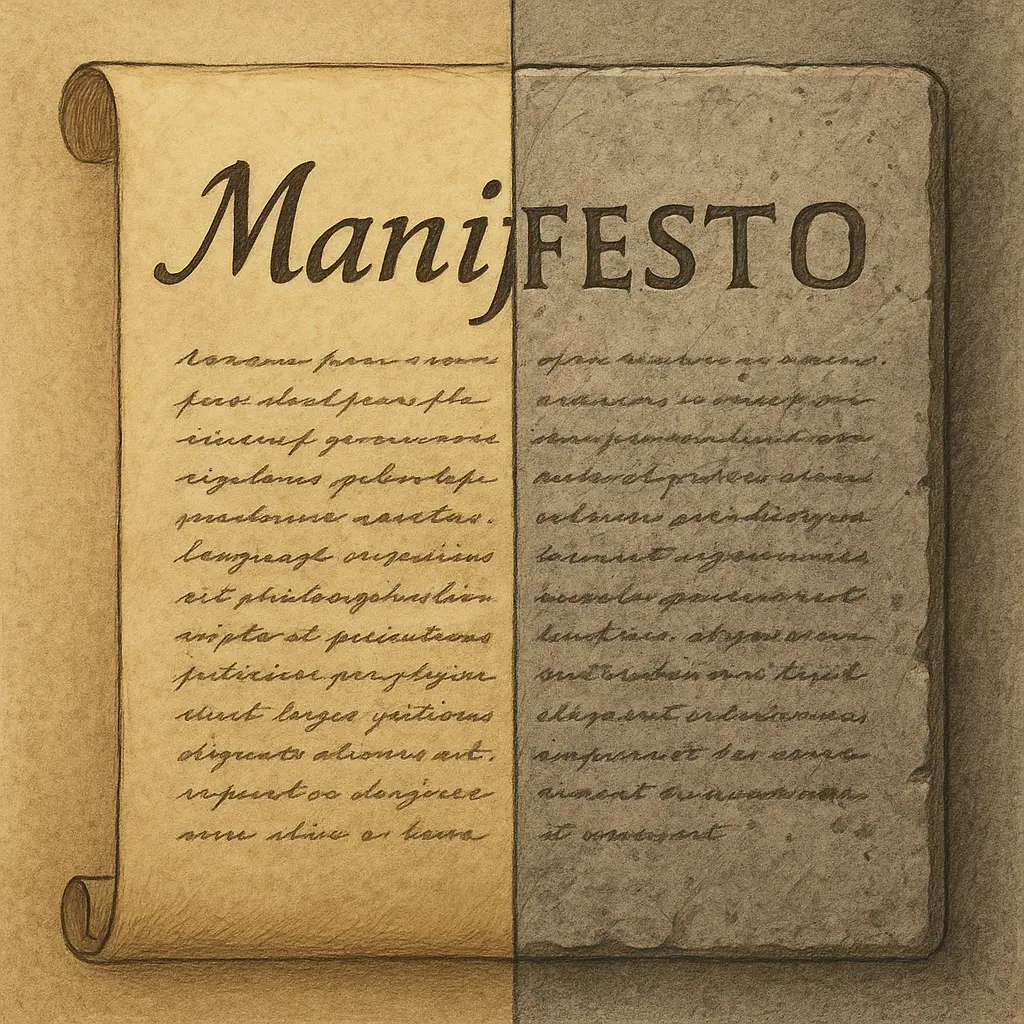
Dogma, by contrast, refuses this movement. It chisels the moment into stone and demands that future generations kneel before it. Where the manifesto breathes, dogma ossifies. One invites dialogue; the other enforces silence.
Why I Still Write Manifestos
For me, writing in the manifesto style is not about persuasion. It is about presence. When I write declaratively, I am not trying to convert; I am trying to cohere. The manifesto allows me to momentarily bring my thoughts, feelings, and philosophies into alignment—to speak as though I am whole, even if I know I never truly will be.
In a fragmented world, this act of temporary wholeness feels sacred. The words stand upright for a moment before time inevitably bends them. I accept that. Each manifesto I write is a record of a phase in my evolution—an imprint of the mind I once occupied.
For me, a manifesto is a statement: “This is where I stand, now.”
If dogma seeks to outlive its author, the manifesto simply seeks to speak truthfully while it can. It is not written in stone but traced in light: vivid, transient, and honest to the moment it was born.