

A Month of Words: What I Learned from Posting Every Day

A golden trophy floating in space, glowing with sparks of starlight and reflecting galaxies across its surface.

If you’ve been following An Alternative Perspective, you may have noticed the sudden flurry of activity. For the past month, I’ve been posting every single day without fail. This wasn’t random productivity, but the result of a whimsical challenge I set myself: to see if, with the help of AI, I could sustain a daily rhythm of meaningful writing. Before, I often felt weighed down by the sheer effort of shaping my thoughts into polished sentences. With AI taking some of that burden away, the process became lighter, and I wanted to see how far that shift could carry me.

Before AI vs. After AI

When I first launched this blog in 2022, my posts were few and far between. Across the first two years I only managed five articles in total.

Things changed in early 2025, when I began experimenting with AI as a creative partner. Suddenly the pace picked up. I went from writing a handful of posts in a year to several in just a few weeks.

By July, I decided to see how far this new momentum could carry me, and set myself a challenge: publish something every single day for a month. At the start of the challenge I had around forty posts in the archive. By the end of it, including this piece, the count stands at seventy-four. That means more than thirty new articles in less than a month.

Reflections on Sustainability

Over the course of this challenge, I discovered a lot about both the process and myself.

  • Liberation, not obligation: Posting daily felt liberating because I finally shared thoughts that had been locked away. Even the smallest bits of feedback carried meaning. But crucially, I never felt like I was “churning out content.” Each post was meaningful, its own little adventure.
  • Unexpected depth: Some posts grew far longer than I had imagined when I started. The act of writing pushed me to think deeper, explore new perspectives, and even do research. The challenge was not just about output, it became discovery.
  • A layered process: I was not literally writing one post a day from scratch. Instead, I kept several drafts simmering, refined them in layers, and used scheduling to build in breathing space. That rhythm made it sustainable.
  • The real takeaway: I have proven that I can post daily, but that does not mean I should. Forcing myself into constant output risks oversaturating both myself and readers, especially those who, like me, are neurodivergent and might prefer more space to digest ideas. What matters is not quantity or the illusion of being “active.” What matters is that the odd perspectives I notice, the strange angles others overlook, and the weird thoughts too good to waste have a platform where they can be found by those who might be interested.

Closing Thought

This challenge began as a whim, but it became a lens. It sharpened how I see my own writing process and reminded me that writing is not about keeping pace with an algorithm or maintaining the illusion of activity. It is about following the natural rhythm of thought, giving form to what feels too important to leave unspoken, and offering it to whoever might find resonance. Whether I publish daily or only when inspiration strikes, the archive will continue to grow at the pace it needs to. And that, I think, is the most sustainable path of all.
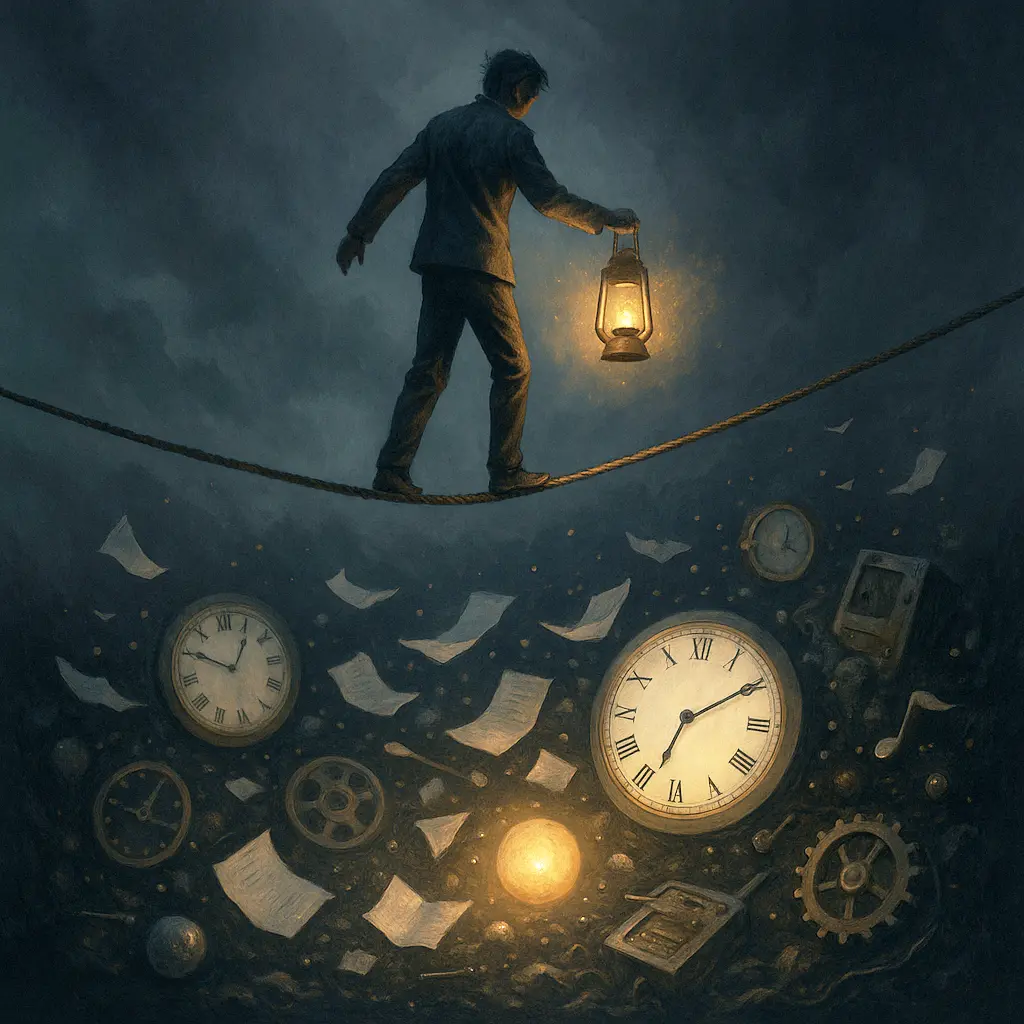
Energy Accounting: The Autistic Paradox

A surreal digital painting of a person walking carefully across a tightrope over a dark void. The figure holds a glowing lantern that casts a warm light. Below, chaotic objects float in the shadows, including clocks, scattered papers, gears, and glowing orbs. The overall mood is tense and precarious, symbolising balance, fragility, and the struggle to manage time and energy.

Life as an autistic person can feel like being caught in a double bind.

  • If I pace myself sustainably…
    I look (or feel) like I’m underachieving. Even my own goals can feel endlessly out of reach, as if the finish line keeps moving further away.
  • If I push myself harder…
    I crash. Exerting myself to meet even “basic” standards can burn me out and force me into recovery, undoing all the progress I made.

This paradox is not only about society’s expectations. It also plays out in my relationship with myself.


The Burden of Ambition and Abundance

I have ambitious personal goals and a burning awareness that my time on Earth is finite. On top of that, I am both blessed and cursed with an overflow of creativity. Because my mind processes things others might not even notice, I generate ideas constantly.

Where some creatives face blocks, I face floods. My notes apps hold tens of thousands of seeds: songs, stories, projects, concepts, all asking to be manifested.

On paper, that abundance should be a gift. In practice, it creates its own challenge:

  • Oversaturation.
  • Decision fatigue.
  • The need for systems to track, filter, and prioritise.
  • The pressure of skills to learn, resources to gather, and fleeting windows of inspiration that can close as quickly as they open.

So while I rarely run out of inspiration, I often run out of capacity. My challenge is not making something out of nothing. It is deciding which somethings to make before time, energy, or health run out.

The paradox compounds: I am both endlessly abundant and severely limited.


Compromise and the Illusion of Balance

One way out might be to compromise: to accept a smaller definition of success, to settle for “good enough.” But that raises heavier questions. How much of what drives me is negotiable? How much compromise risks losing the essence of who I am?

Another imagined path is the narrow crossover: a fragile sweet spot where I push myself just enough to achieve, but not enough to burn out.

The problem is that sustaining that balance comes with its own toll. Constant self-monitoring, rationing energy, and adjusting to shifting circumstances consumes resources in itself. Balance becomes another job.


The Reality

And then there is what actually happens.

In reality, I oscillate. I build momentum, I try to pace myself, I get carried by enthusiasm and a false sense of stability, I push harder, and then I crash. Then comes recuperation, and the cycle begins again. Burnout, recovery, momentum, overreach, collapse.

Even when I somehow manage to hit what looks like an optimal balance, it is fragile. All it takes is one unexpected disruption. A friend inviting me for coffee. A workplace drama. An appliance breaking. An urgent email. Suddenly I am spinning through the resource-management asteroid field.

The obvious solution might be to leave some “headroom” in my spoon budget. (“Spoons” being a common metaphor for energy in neurodivergent communities.) But that creates its own bind. Leaving spare capacity means something else goes neglected, nagging at me from the corner of my mind. Either I burn myself out dealing with it, or I burn myself up with guilt for leaving it undone.


A Closing Thought

To live inside this paradox is to be pulled in two directions at once: bursting with ideas and possibilities, yet constrained by the narrow economics of energy, time, and health.

It is not a complaint, and it is not a plea for pity. It is simply an awareness: that the autistic experience often sits at the crossroads of overflow and scarcity, ambition and limitation, momentum and collapse, control and chaos.

And maybe there is something universal in that tension. In one way or another, we are all negotiating what to do with the time and energy we have. The difference is that for autistic people, the margins are thinner, the trade-offs sharper, the balance more precarious, and the paradox harder to ignore.