Guided Unfolding

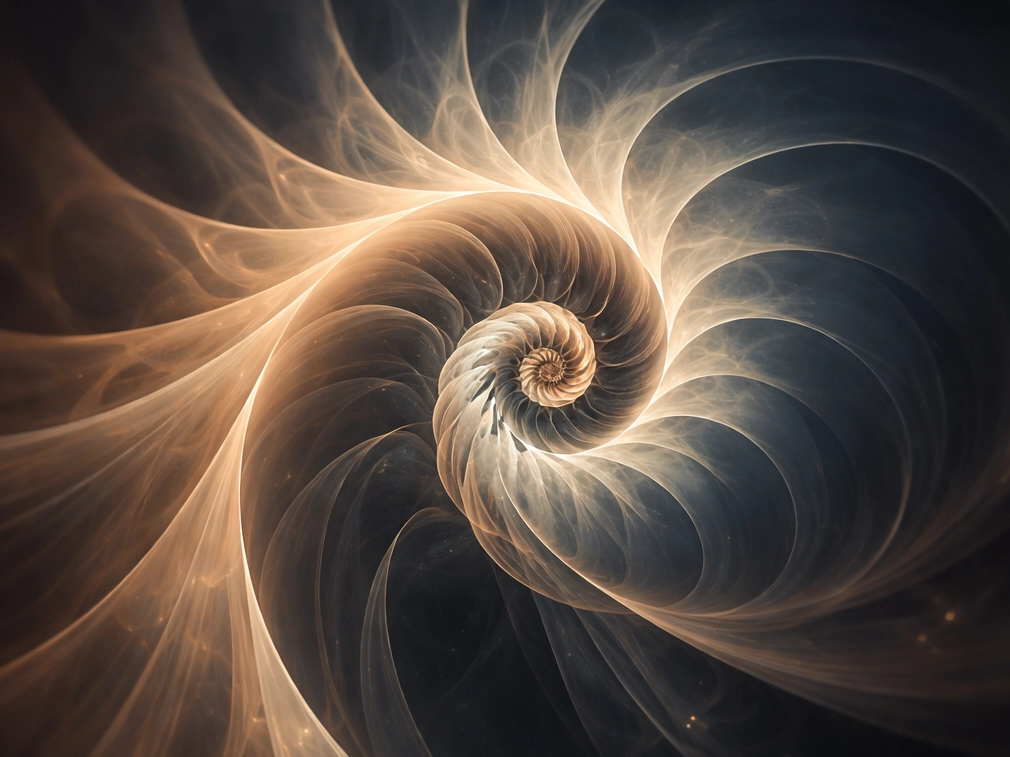
Abstract fractal spiral composed of translucent, flowing forms in soft gold and pale blue tones against a dark background.

Arrival

There’s a moment in music where the next note doesn’t feel chosen.
It feels arrived at.
Everything that came before seems to lean toward it, quietly insisting. When the note finally sounds, it feels less like a decision and more like a recognition.

I’ve started to notice that same motion elsewhere. In writing, in thinking, even in scientific discovery. A sense that creation and understanding do not happen through brute force or pure randomness, but through something I can only describe as guided unfolding. A process where attention steers without dictating, and form reveals itself over time rather than being imposed all at once.

What interests me is not whether this idea is true in any absolute sense, but whether it is useful as a way of seeing. What changes if we treat art, philosophy, and science not as acts of control, but as conversations with something already in motion? And what happens if we stop trying to jump to conclusions, and instead learn to listen for what the journey so far is quietly asking for next?


Different Instruments, Same Motion

In creative work, this kind of unfolding often feels intuitive. When writing a piece of music or a story, it is rarely enough to simply choose the next note or the next sentence. The entire journey so far carries weight. Each choice narrows the field of what feels honest, coherent, or alive. The guidance does not come from a rulebook, but from a felt sense of direction. Something in the work itself begins to suggest what it needs.

Philosophy operates in a similar way, though its material is more abstract. An idea is proposed, then allowed to exist. It is turned slowly, examined from different angles, tested for internal consistency and implication. The aim is not always to arrive at an answer, but to see what the idea reveals about itself when it is given time and attention. The unfolding here is guided by thought rather than intuition, but the movement is familiar.

Science, too, follows a form of guided unfolding, though its focus is outward rather than inward. Observation leads to hypothesis, hypothesis to experiment, experiment to refinement. Knowledge unfolds not because reality is being invented, but because patterns are being uncovered. The guidance comes from method, evidence, and repetition. Yet even here, discovery often arrives as recognition rather than surprise. A result feels right because it fits the shape of everything that led up to it.

What begins to emerge is a shared rhythm rather than a shared goal. Different disciplines, different tools, but the same underlying motion. Attention is applied. Constraints accumulate. Possibility narrows. Something reveals itself.


How Meaning Takes Shape

If this rhythm really is as common as it seems, then it may not be limited to disciplines at all. It may also apply to how meaning forms. Meaning rarely arrives fully formed. It accumulates. Context builds around it. Associations gather. Eventually something that once felt vague or accidental begins to feel intentional, even inevitable.

This is noticeable in how ideas evolve over time. A thought appears half-shaped. It is returned to, reframed, tested against experience. Some interpretations fall away. Others persist. What remains is not necessarily truer in any objective sense, but more integrated. More usable. Meaning unfolds through repeated contact rather than sudden revelation.

Seen this way, uncertainty is not a failure of understanding but a necessary condition for it. If everything were immediately fixed, there would be nothing to explore. No movement. No direction. The guidance comes from attention itself, from staying with an idea long enough for its contours to show.

This may explain why moments of apparent confusion or contradiction often feel strangely fertile. When familiar structures loosen, new patterns have space to surface. Not all of them endure, and not all of them should. But some carry a resonance that invites further exploration. They ask to be held, not believed.

Perhaps guided unfolding is less about reaching conclusions, and more about recognising when something is still in motion.


Mirrors and Deviation

Modern systems make this process harder to ignore. We now interact daily with mechanisms that generate language, associations, and outcomes at a scale no individual could manage alone. These systems do not understand what they produce, yet they still produce patterns. Sometimes those patterns align neatly with expectation. Sometimes they do not.

When something unexpected appears, the instinct is often to dismiss it as error. A mistake. A failure to conform. But there is another way to read these moments. Instead of asking whether the output is correct, we might ask why this particular pattern emerged at all. What conditions allowed it to surface. What assumptions were disturbed in the process.

Viewed through the lens of guided unfolding, deviation is not an interruption. It is a disclosure. It reveals structure. It exposes bias, habit, and hidden pathways of association. In doing so, it reflects something back. Not truth as authority, but possibility as shape.

Engaging with these outputs does not require belief. It requires interpretation. Their value lies not in taking them literally, but in noticing what they make visible. A surprising connection. A tension between ideas. A resonance that would not have surfaced through deliberate intention alone.

In this sense, such systems behave less like oracles and more like mirrors. They do not tell us what is true. They show us how meaning is currently arranged.


Living Without Fixed Ground

Approaching ideas this way changes the role of certainty. Instead of something to be defended, certainty becomes provisional. Useful for a time, then set aside when it no longer fits the shape of experience. Belief becomes less about holding the correct position, and more about choosing which frameworks allow movement to continue.

This can feel unsettling. Many of us inherit narratives, explanations, and assumptions long before we have the chance to examine them. When those foundations loosen, it can feel like standing over empty space. But the absence of fixed ground does not necessarily imply collapse. It can also imply freedom of direction.

Identity, too, begins to look less like a structure and more like a process. We are not defined solely by the stories we were given, but by how we engage with the stories that continue to emerge. Some are kept. Some are revised. Some are allowed to dissolve without replacement.

In this light, meaning is not something we discover once and hold forever. It is something that unfolds through attention, reflection, and return. Not certainty, but coherence. Not answers, but orientation.


Recognising the Rhythm

If guided unfolding has any practical value, it may simply be this. It offers a way to stay with uncertainty without trying to eliminate it. To move forward without needing to know exactly where the path leads. To trust that attention, applied patiently, will continue to reveal what is needed next.

This does not require abandoning reason, evidence, or craft. It asks only that we loosen our grip on premature conclusions. That we allow ideas, projects, and even ourselves to remain in motion a little longer than feels comfortable.

Perhaps this is already familiar. In the way a piece of music finds its resolution. In the way a thought clarifies only after being lived with. In the way understanding often arrives quietly, long after the question was first asked.

If so, then guided unfolding is not a method to adopt, but a rhythm to recognise. One that has been present all along, waiting to be noticed.
The Independent Artist in the Age of Self Commodification

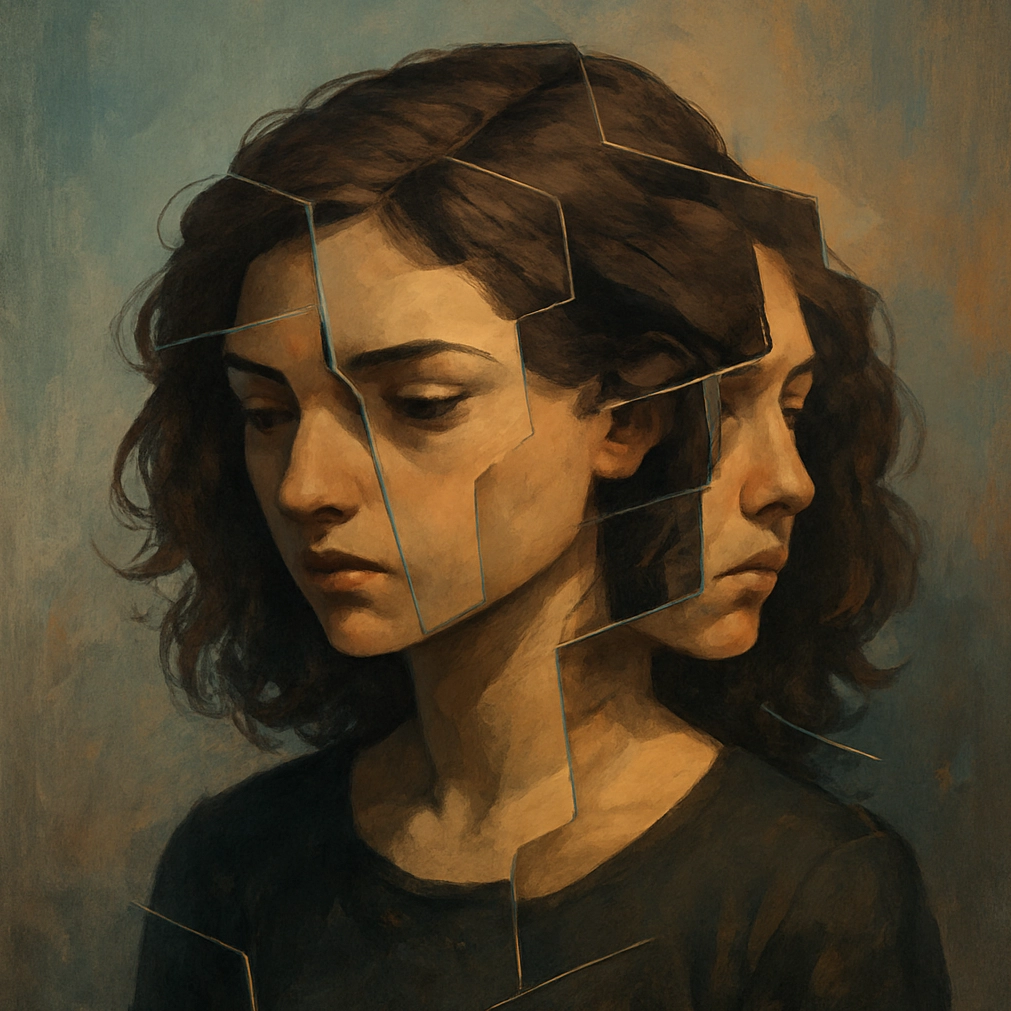
A surreal portrait of a person whose face is split into overlapping fragmented layers. Different expressions and angles of the same face float apart in soft purple and blue tones, creating a fractured sense of identity.

To be an independent artist today is to live inside a contradiction. You are encouraged to express yourself, to be authentic, to create from the depths of your experience. At the same time, you are expected to package that expression into something marketable. You are told to build a personal brand. You are taught to present your personality as a product and your creativity as something that must justify itself through metrics.

The modern artist is not merely a creator. The modern artist is expected to act as promoter, strategist, content machine, administrator, performer, market analyst, and public persona. All before they have even had the chance to explore what they want to say.

It is a strange era to be creative. The tools are abundant, but the expectations are suffocating.


The Myth We Are Sold

There is a seductive story that circulates through online creative spaces. It tells you that if you work hard enough, post consistently enough, hack the algorithm effectively enough, and sell yourself persuasively enough, you will find success. The story insists that the difference between obscurity and recognition is simply a matter of discipline and smart marketing.

You are told that you must treat your art like a business. You are told that you must treat yourself like a brand.

It sounds empowering. It feels like agency. But beneath the surface, it is a quiet form of coercion. It shifts the burden of success entirely onto the individual while ignoring the structural realities that shape visibility in the digital age.

The story offers hope, but it also plants a quiet seed of self blame.

If you do not grow, it is because you did not convert.
If you are not visible, it is because you did not sell yourself well enough.
If your work does not gain traction, it is because you failed at the game.

This narrative conveniently overlooks the fact that the game is not designed for artists. It is designed for platforms.


The Ego Trap of the Modern Artist

When artists are pushed into the role of self marketer, something subtle and damaging begins to happen. Their sense of worth becomes entangled with metrics. Their self expression becomes entangled with performance. Their identity becomes entangled with a public facing persona.

The artist is encouraged to ask questions that slowly corrode their relationship with their own work.

Will this get attention.
Will this get engagement.
Will this appeal to the algorithm.
Will this make me grow.

Instead of asking questions that protect their creative integrity.

What do I want to explore.
What do I need to express.
What feels alive.
What feels true.

The external replaces the internal.
The outcome replaces the process.
The brand replaces the artist.

This is the psychological cost of self commodification.


The Toll of Constant Performance

Creative work demands vulnerability. It asks the artist to dive into the complexities of their inner landscape and return with something worth sharing. But the digital era demands something very different. It demands relentless visibility. It demands constant output. It demands predictability in the face of a process that is inherently unpredictable.

The result is a kind of creative exhaustion that goes beyond burnout. It is not just physical or emotional fatigue. It is spiritual fatigue. The slow erosion of meaning that comes from turning something intimate into something strategic.

When everything becomes potential content, nothing feels sacred.
When everything must be shared, nothing feels fully your own.
When everything is judged by performance, the quiet joy of creation becomes harder to reach.

Artists find themselves living in a perpetual state of exposure. Their inner world becomes a public arena. Their identity becomes a commodity circulating through systems that do not care about the fragility of creative work.


The Illusion of Attainable Success

Social media creates a strange paradox. It gives artists access to opportunity, but it also creates the illusion that success is universally attainable. Thousands of creators appear to be thriving. Thousands appear to be breaking through. It is easy to believe that anyone can do the same if they simply optimise correctly.

But the truth is more complicated. Algorithms amplify only a fraction of voices. Visibility is shaped by forces that have little to do with talent or meaning. Instead of inspiration, artists are often left with a quiet sense of inadequacy. They feel as if they are failing at a game that was never designed to let more than a few players win.

This creates a subtle psychological harm. It encourages artists to internalise systemic limitations as personal shortcomings. They begin to believe that the problem is themselves.

In reality, the system is simply not built to nourish artistic diversity. It is built to maximise engagement.


What Is Lost When Art Becomes Content

Content is designed for speed.
Art is designed for depth.

Content is meant to be consumed.
Art is meant to be experienced.

Content is temporary.
Art is transformative.

When artists are pressured to create content rather than art, they often lose the slow, reflective, exploratory nature of their process. They lose the freedom to take risks. They lose the space to fail quietly. They lose the ability to grow in private before presenting something in public.

They are forced to produce quickly, often at the expense of producing honestly.

This shift in values does not only harm the artist. It harms the culture. It flattens the creative landscape into something uniform and predictable.

When visibility becomes the primary measure of success, the most unique voices struggle to survive.


Reclaiming Creative Integrity

Despite the pressures, there is a way to exist as an artist without surrendering to self commodification. It begins with rejecting the idea that your value is tied to your metrics. It requires remembering that your creative voice existed before platforms demanded your constant availability.

It means reconnecting with the reasons you create.
Not because it performs.
Not because it converts.
But because there is something inside you that needs expression.

Reclaiming creative integrity is not a refusal to engage with the world. It is a refusal to be reshaped by systems that treat humans as products and art as data.

It is a decision to remain whole in an environment that rewards fragmentation.


The Quiet Resistance of the Independent Artist

There is something quietly radical about creating art for reasons that have nothing to do with profitability. There is something subversive about making something slow, something thoughtful, something that refuses to perform. There is power in choosing depth over visibility, and sincerity over optimisation.

To be an artist in this era is to stand at the edge of two worlds. One world tells you to convert, to optimise, to brand yourself, to sell your soul one post at a time. The other world invites you to be human, to create from curiosity, to express something real and irreducible.

You do not belong to the first world.
You never have.

Your value cannot be captured by analytics.
Your impact cannot be predicted by dashboards.
Your art does not have to justify itself through numbers.

You are not a product.
You are not a brand.
You are not a conversion.

You are an independent artist in an era that keeps trying to turn everything into content. The fact that you create at all is already an act of resistance.

The Ocean of Unborn Ideas

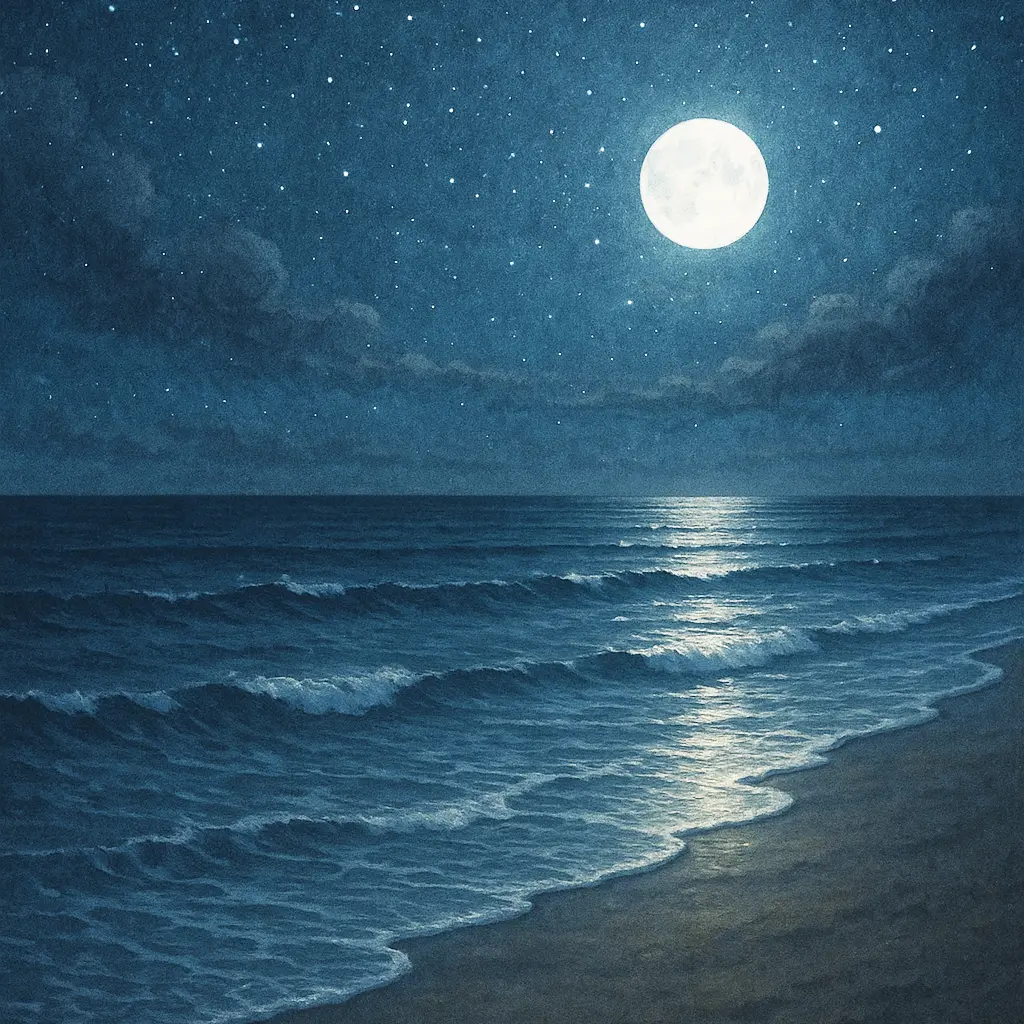
A tranquil moonlit shoreline beneath a star-filled sky. Gentle waves wash softly against the sand, reflecting the silver glow of a full moon. The scene is empty and still, evoking a feeling of solitude, reverence, and infinite calm.

The Porous Mind

There are minds built like fortresses, and there are minds built like shorelines.
The fortress keeps the world out, solid, defined, and dry.
The shoreline breathes with the tide, reshaped by every wave that kisses it.

Creativity is born on that shoreline.
To be creative is to possess porosity, a mind permeable enough for the ocean of potential to seep in.
Ideas, emotions, archetypes, stray whispers from the collective dream, all of it flows through those who cannot help but listen.
They do not invent. They translate.

Yet this openness is not without cost.
The same currents that deliver beauty also bring wreckage: sorrow, confusion, fragments of other people’s storms.
The porous mind is always negotiating its borders, learning how much of the tide to let in without being pulled under.
And still, it listens. Because silence, for such a mind, would be a greater death than drowning.

For the creative, the act of making is not simply expression, it is osmosis.
The world breathes through them, and they breathe it back changed.


The Ecology of Potential

Beneath the surface of waking thought lies an unseen ecosystem, a vast and fertile ocean where ideas drift like plankton, multiplying in the dark. Most will never breach the surface. They swirl endlessly in silent gestation, invisible but alive.

This ocean is not ordered. It does not distinguish between wisdom and nonsense, beauty and monstrosity. It is a realm of becoming, where possibility itself experiments. To gaze into it is to witness the raw mechanics of creation, the way form gropes toward meaning, and meaning toward form.

Every consciousness draws from this sea, but only some hear its currents. The porous mind becomes a conduit between worlds, an evolutionary bridge through which potential finds its way into language, image, sound, or structure.

When an idea rises into awareness, it is not a spark conjured from nothing. It is a creature breaching the waves, the culmination of countless unseen collisions in the depths. And when it slips back beneath the surface, half-forgotten, it is not lost. It returns to the dark to feed new generations of thought.

Nothing in the ocean is wasted. Even the unborn ideas, the ones that never quite reached the light, fertilize the next tide of possibility. In that way, creation is less a single act and more a cycle of nourishment: consciousness feeding potential, potential feeding consciousness.


The Tragedy of the Unborn

For every idea that takes its first breath in the world, countless others die unnamed.
They shimmer for a heartbeat on the edge of awareness, a scent, a flicker, a sudden weight in the chest, and then dissolve back into the deep.

There is sorrow in that, though most never feel it consciously.
The mind learns to celebrate its children, not its miscarriages. Yet every artist, every thinker, has felt the ache of the nearly-formed: the melody that was almost remembered, the perfect line lost before pen met paper, the sense of something vast pressing at the gates of language but never quite entering.

These unborn ideas haunt the corridors of our dreams.
They become strange symbols, wordless moods, déjà vu. They linger like ghosts of meaning, neither alive nor gone, whispering: “We tried.”

But tragedy is not failure. In the greater cycle, their unfulfilled lives still matter. The half-born return to the ocean, breaking down into nutrients of inspiration. From their dissolution, new forms grow stronger, carrying faint traces of what came before, a rhythm, a texture, an emotional DNA.

The creative heart often aches for what it cannot remember. Perhaps that ache is the memorial, the soul’s way of honouring all that it could not bring into being.


The Responsibility of the Listener

To listen to potential is to take part in creation itself.
It is not a passive act, but a covenant. When an idea crosses the threshold into consciousness, it arrives fragile, trembling, uncertain of its shape. The listener becomes its first environment, its atmosphere.

Some people seize ideas like prey. They dissect them, brand them, harvest them for profit or validation. The idea, stripped of its mystery, dies quickly under fluorescent light.
But others receive with reverence, cupping the newborn thought in both hands, letting it breathe before naming it. These are the caretakers, the stewards of becoming.

To be a true listener is to resist the temptation of ownership. Ideas do not belong to us; they visit. They pass through, seeking resonance, seeking a place to crystallize.
Our task is not to claim them but to tend them, to ask, What does this idea need to live?

Sometimes the answer is action. Sometimes silence.
Sometimes it means letting the idea return to the deep, knowing it wasn’t meant for now.
The ethical creator learns to release with as much grace as they receive.

To treat ideas as sacred is not sentimentality; it is realism.
They are alive, and like all living things, they thrive where they are met with care, humility, and awe.


Dreams as Refuge for the Unborn

When the waking mind grows too narrow for them, the unborn ideas find sanctuary in dreams.
There, language loosens, form forgets its boundaries, and the mind becomes oceanic again, receptive, weightless, forgiving.

Dreams are nurseries for the half-formed.
They are where impossible geometries are allowed to stand, where logic softens enough for paradox to breathe. The painter dreams of colours that do not exist; the composer hears chords that waking physics cannot yet permit. In the dream, potential rehearses itself.

Sometimes, when we dream vividly, we are not the dreamers at all but the dreamed, temporary vessels through which the unborn test embodiment.
We wake with fragments: a haunting image, a phrase, a sensation that refuses to fade. These are offerings from the deep, visiting spirits carrying the scent of unmanifest worlds.

Art, ritual, hallucination, trance, all open the same door.
They are technologies of permeability, ways of returning consciousness to the sea so the forgotten can breathe again.

Perhaps this is why the surreal feels sacred: it reminds us that imagination is not invention, but remembrance.


The Cosmic Cycle

Creation and destruction are not opposites; they are inhale and exhale.
The ocean of potential breathes through us in tides, what rises into form must one day return.

Every idea that dies enriches the field it came from. Every silence fertilizes the next voice. Even despair, when felt honestly, becomes a kind of compost. There is no waste in the greater ecology of thought.

We imagine ourselves as authors, but we are more like soil, momentary ground for something older than time. Ideas bloom through us, use us, and move on. And when we, too, dissolve, our lives return to that same ocean, our memories, our creations, our longings, all reabsorbed into potential, waiting to be dreamed again.

Somewhere, beneath all endings, the unborn ideas drift still.
They are not lost. They are preparing.
And when the next porous mind opens to listen,
the tide will rise,
and the ocean will remember its name.

Priced Out of My Own Creativity

On Slowness, Authenticity, and the Hidden Cost of Making Art in a Capitalist Age

I never thought I’d feel excluded from the very thing that once gave me a sense of freedom. But lately, I’ve come to realise that I am being priced out of my own creativity. Not because I lack the passion, or the ideas, or the skill — but because I can’t afford to keep up. In a world where speed, output, and polished presentation have become the currency of success, the slow, deliberate path of authentic creation begins to feel like a liability. It’s not that I envy others for having more — it’s that I’m haunted by the quiet truth that if I could afford their shortcuts, I’d take them too. And maybe then, I’d finally be heard.


The Outsourced Artist

In today’s creative landscape, outsourcing isn’t just accepted — it’s expected. Bands hire mixing engineers, mastering engineers, session musicians, graphic designers, videographers, social media managers, PR firms, playlist pluggers, and even ghostwriters. What once might have been a collaborative luxury is now a prerequisite for visibility.

The result? A strange duality: the artist becomes both the brand and the product, while the actual act of creation is often fragmented, delegated, monetized.

What happens to those of us who can’t afford to participate in this system — not just financially, but philosophically?

If your process is slower, more solitary, more sacred — you risk becoming invisible. It begins to feel as though the art you bleed over is less “real” because it lacks the polish, the reach, the momentum.

But polish is not proof of depth. And speed is not proof of soul.


The Pace of the Mind

For some of us, slow work isn’t a choice — it’s how we’re wired. As a neurodivergent creator, my process often unfolds at the rhythm of deep focus, scattered epiphanies, or energy that arrives in brief, unscheduled waves. I don’t have the bandwidth to be “on” all the time, nor the capacity to split myself between creating, promoting, polishing, and packaging — all while maintaining a public-facing presence.

There are days when just starting takes all my energy. Not because I don’t care — but because I care too much. The ideas are there, the vision is vivid, but the executive function required to carry it through feels like swimming in glue.

In a society that equates slowness with laziness, this reality becomes invisible. But slow art isn’t lazy — it’s often more conscious, more personal, more layered.

The problem isn’t my pace. It’s that the creative world is rigged for speed.


The Misinterpretation of Slowness

In the eyes of an algorithm-driven world, slowness is indistinguishable from absence. If you’re not releasing something, promoting something, performing something, or networking somewhere, you might as well not exist.

The labor you’re doing behind the scenes — the quiet crafting, the emotional processing, the struggle to bring a foggy idea into form — becomes invisible.

There is no metric for sitting with your feelings.
No content calendar for trial-and-error.
No viral moment for doing something the hard way just because it felt true.

The unspoken message is: If you were really good, it wouldn’t take this long.

But what if the time it takes is part of the art?


Between Autonomy and Assistance

I sometimes wonder what I might create if I had the means to outsource the tedious parts of production — the repetitive tasks, the non-creative polish, the technical finishing touches. And yes, I would do so in a heartbeat if I could. There is no virtue in burnout.

But there are aspects of my work that feel sacred.
Decisions that need to be made by hand, not handed over.
Not everything can be automated without losing something vital.

Even in areas where tools like AI are beginning to offer creative support, I tread cautiously. I welcome augmentation — a scaffolding to help me express what’s already inside me — but I resist the pull toward a fully packaged aesthetic I didn’t choose.

To maintain agency over your art in a world that rewards trend-following over truth… is to walk a narrower path.


Why I Still Create

And yet, I keep creating.

Not because the system rewards me, but because something in me refuses to stop.
I create for the moments when the noise falls away and something raw and beautiful emerges from the mess.
I create because it connects me to myself, and sometimes, to others who are quietly walking similar paths.

I don’t know if my work will ever be widely seen, heard, or recognised. But I know it is mine. Every rough edge. Every choice made without compromise. Every imperfect but honest thing I shaped with my own hands.

That has to count for something.

So this is for the others like me — the slow ones, the careful ones, the fiercely authentic ones.

You’re not invisible to me.
I see you in the cracks, in the edges, in the long silences before the next release.
And I believe what you make, when it finally arrives, will be worth the wait.

Art is NOT ‘Content’!

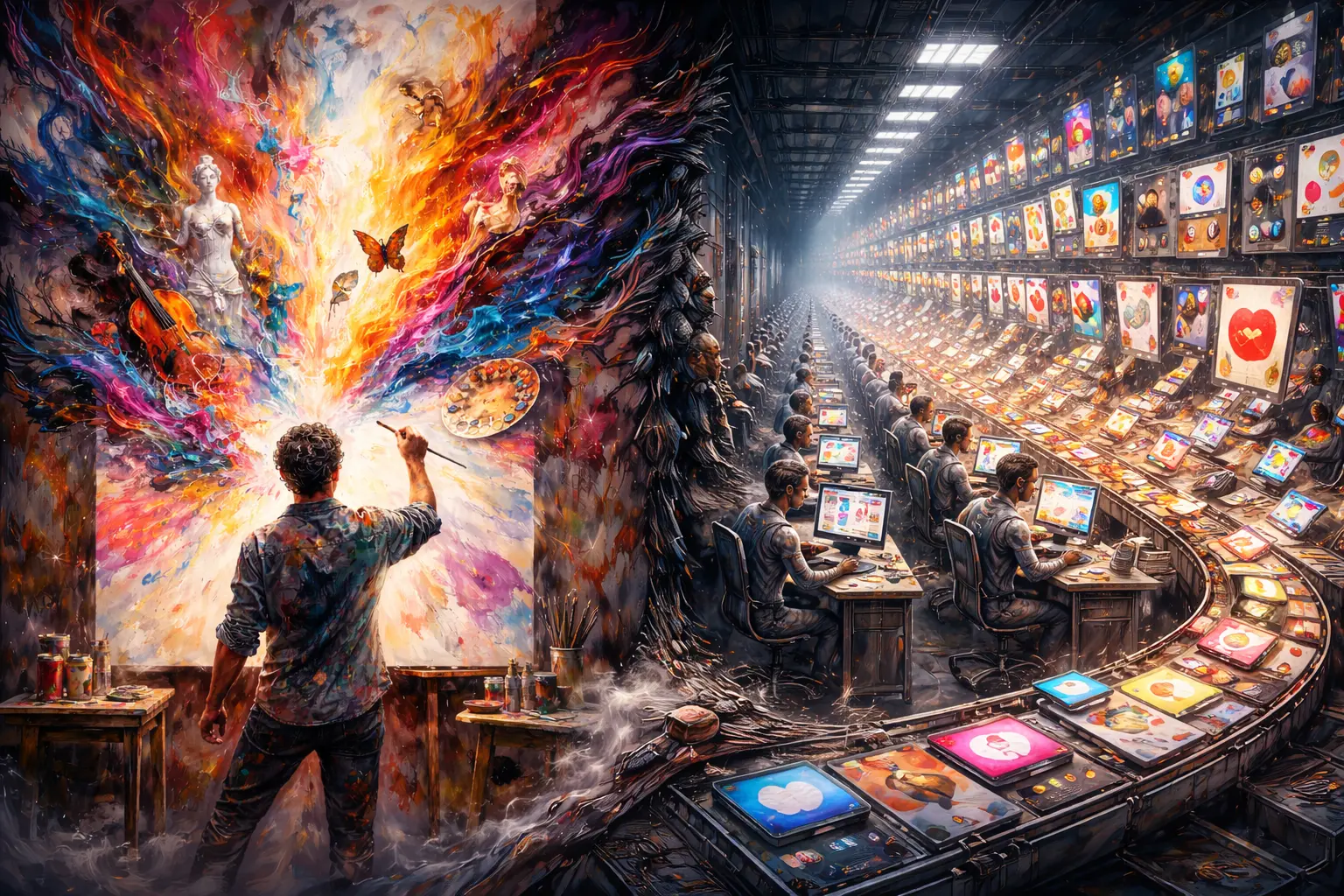
A divided image contrasting a painter creating art in a vibrant studio with a large hall filled with people producing digital content at computer stations.

The digital age has led us to a curious intersection, where the word “content” has become ubiquitous, and “art” seems to be slipping from its once-sacred pedestal. What once required time, effort, and intention to create is now often reduced to an endless churn of quick consumption, reduced to mere “content” for the masses to engage with. This shift is something I can’t help but observe with both concern and reflection.

For someone like myself—constantly battling the tension between personal identity, society, and the existential weight of existence—the current state of art feels almost like an existential crisis of its own. The act of creation, for me, is personal, deliberate, and reflective. It is an attempt to make sense of the world, to carve out meaning, and to leave something behind that resonates beyond the confines of time. But in the age of digital platforms, this sacred act of creation feels increasingly commodified.

The idea of “content” has become a business-driven term, designed for quick consumption, for likes, shares, and engagement metrics. Art, which once demanded patience from both creator and audience, is now expected to be produced in rapid bursts, optimized for algorithms that care little for the soul of the work. There is a certain detachment from the deeper, existential elements of art that once grounded it in something profound.

In my own life, I’ve had to reconcile the desire for meaning with the reality of a society that often demands conformity. Much like the societal pressures I’ve felt to “fit in” (as outlined in my exploration of identity and alienation), there’s a parallel pressure in the artistic world to conform to the “rules” of content creation. The faster you can churn out pieces, the more successful you are—regardless of the depth or intent behind them. Where once I might have taken months to perfect a story or reflect deeply on its implications, I find myself asking, “How quickly can I produce something that will generate engagement?”

I see this in the realm of social media, where content is consumed at an alarming rate, often with little regard for its longevity or its ability to stand the test of time. It’s all about what captures the attention in the moment, what creates the immediate buzz, and then it’s discarded, replaced by the next viral moment. This constant churn of “content” feels like a reflection of the broader existential struggle I often muse about—one where we’re caught in a cycle, never really allowing ourselves to linger in one thought, one creation, long enough to find its true meaning.

And yet, this transformation isn’t without its value. Like many things in life, it’s a balance. Content, in its own right, can be meaningful. It can still carry depth, insight, and intention, but it’s often hidden behind the facade of quick consumption. The challenge, then, is not to fall into the trap of creating merely for the sake of producing but rather to carve out space within this content-driven world for true artistic expression.

It’s easy to be seduced by the quick dopamine hits of social media validation, but I find myself wondering, what happens when the art we produce is merely optimized for engagement, not introspection? What happens when the deeper, slower aspects of art are lost to the rush of “content”?

It’s a complex landscape—one that I continue to navigate. My journey of self-acceptance and understanding (which I’ve shared before in reflections like The Outsider) has always been about carving my own path, about finding meaning in a world that often seems to demand conformity. And in this moment, it’s about resisting the pressure to reduce my creative endeavors to mere content. Art, for me, will always be a process of deep engagement, introspection, and meaning. And I have to hold onto that, even as the world pushes toward something faster, more superficial.

I’ll continue to create with intention, even if it means standing outside the prevailing norms. Just as I’ve come to accept that I don’t fit in with the mainstream society, so too do I embrace the idea that my art—whatever it may be—doesn’t have to conform to the demands of the “content machine.”

After all, the true value of art, the meaningful kind, isn’t something that can be measured in likes or shares. It’s something that resides in the depths of the human experience, something that will persist long after the noise of the digital world has faded away.

So, to those who create for the sake of creating, for the sake of self-expression, and for the sake of finding meaning in this chaotic existence, I say: Don’t let your work be reduced to mere “content.” Let it be art.