
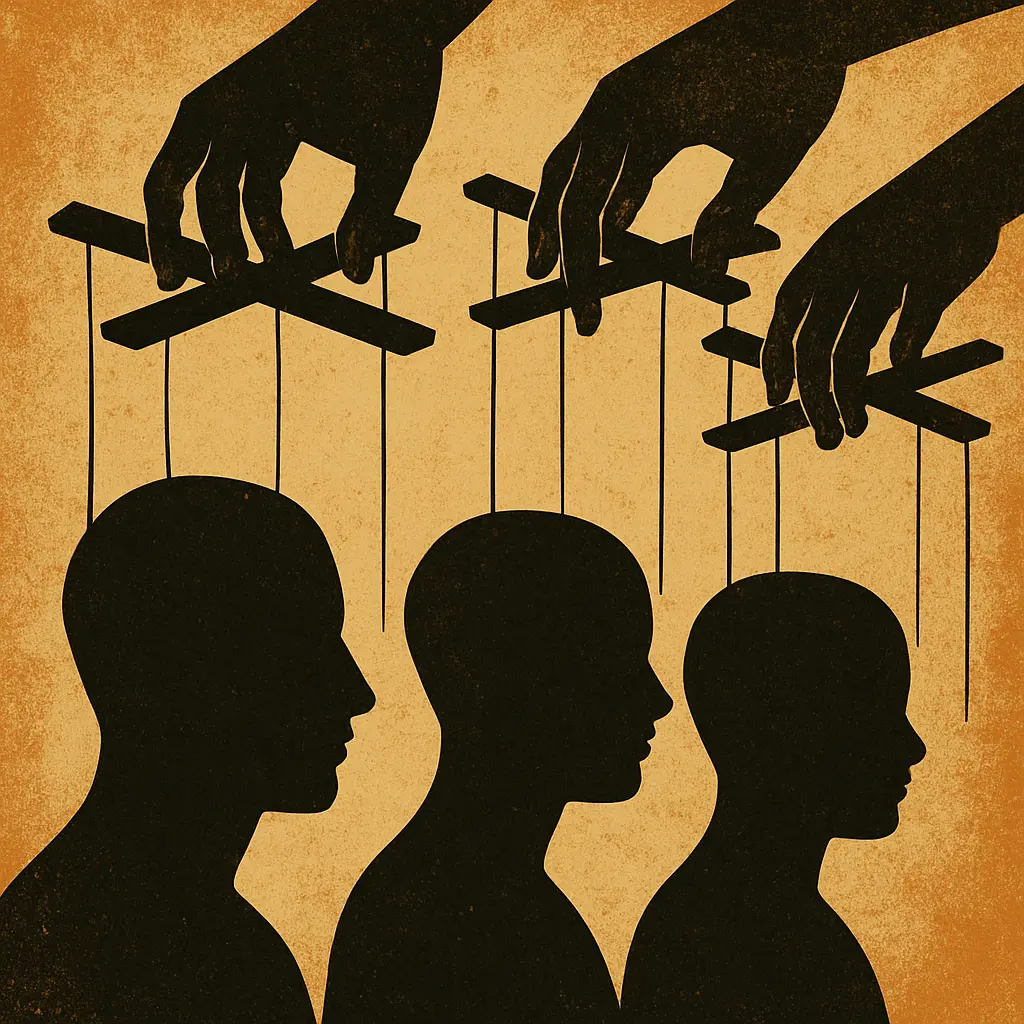
There’s a trick being played on all of us.
Not a sleight of hand with cards or coins—but with narratives, identities, and emotional levers. It’s a trick so seamless that most people never realise they’re part of the performance. And even those who do see the misdirection often struggle to escape its grasp.
Here it is:
Get the powerless to fight each other.
Keep them too angry, too busy, or too proud to notice who’s really pulling the strings.
Manufactured Enemies
Scroll any social feed. Watch any televised debate. Eavesdrop on a crowded train. You’ll see it:
- Left vs right
- Boomers vs millennials
- Masked vs unmasked
- Rural vs urban
- Vegans vs carnivores
- iPhone vs Android
The content shifts, but the structure remains the same: us vs them.
The modern attention economy thrives on tribalism. It doesn’t matter if the war is over vaccines, identity politics, language, or lunch orders—what matters is that we’re constantly fighting someone. And more importantly, that we believe the other side is the reason things are broken.
But they’re not.
The real culprits are watching from above—largely invisible, fully protected, and often laughing.
When Rage is Rerouted
Righteous anger is one of the most powerful forces in existence. It can topple empires, end injustice, and forge solidarity across continents.
But misdirected?
It becomes a tool of oppression.
When we pour our outrage into culture wars, internet spats, and shallow memes, we expend real energy on phantom battles. We feel like we’re doing something—but in reality, we’re spinning our wheels while the real machinery of exploitation grinds on, uninterrupted.
A divided population is a conquered population.
The Puppet Masters
Let’s name some of the true antagonists:
- Mega-corporations extracting resources and dodging tax
- Lobbyists writing laws behind closed doors
- Surveillance firms profiling us under the guise of convenience
- Billionaires hoarding wealth in a world that can’t feed itself
- Algorithmic platforms radicalising users for ad revenue
These forces aren’t hidden in shadows. They’re right out in the open, but rarely seen as the enemy—because we’re too busy arguing over pronouns or pineapple on pizza.
But What About Accountability?
Yes, people still make harmful choices.
Yes, individuals can be complicit in cruelty.
Yes, ignorance can do real damage.
But focusing only on the individual is like blaming the leaf for falling when the whole tree is being poisoned. Systems shape behaviour. Narratives shape perception. And we are all shaped—whether we like it or not.
The Role of the “Smart Ones”
If you’re someone who sees the manipulation clearly, your role isn’t to stand above others—it’s to help redirect the lens.
Not with superiority. Not with contempt. But with precision.
Call out the sleight of hand.
Pull back the curtain.
Refocus the conversation.
Because right now, many of the smartest, most perceptive people are caught in the same web—burning themselves out arguing with reflections instead of breaking the mirror.
Solidarity Is a Threat
Here’s what terrifies the system:
- When a poor conservative farmer and a leftist city renter both realise they’re being screwed by the same landlord class.
- When neurodivergent people across ideologies start recognising shared patterns of exploitation.
- When the working class, the disabled, the artists, the overworked and overlooked stop fighting each other and start asking, together:
“Who’s benefiting from all of this?”
That kind of cross-factional awareness? That’s dangerous.
Because solidarity is hard to control.
The End of the Trick
We don’t all have to agree on everything.
We don’t need to form some utopian consensus.
But we do need to see the stage.
Recognise the magicians.
Refuse to be the props in their show.
Because when the people stop fighting each other, they might finally start fighting back.