One Hundred Mirrors: A Century of Myself

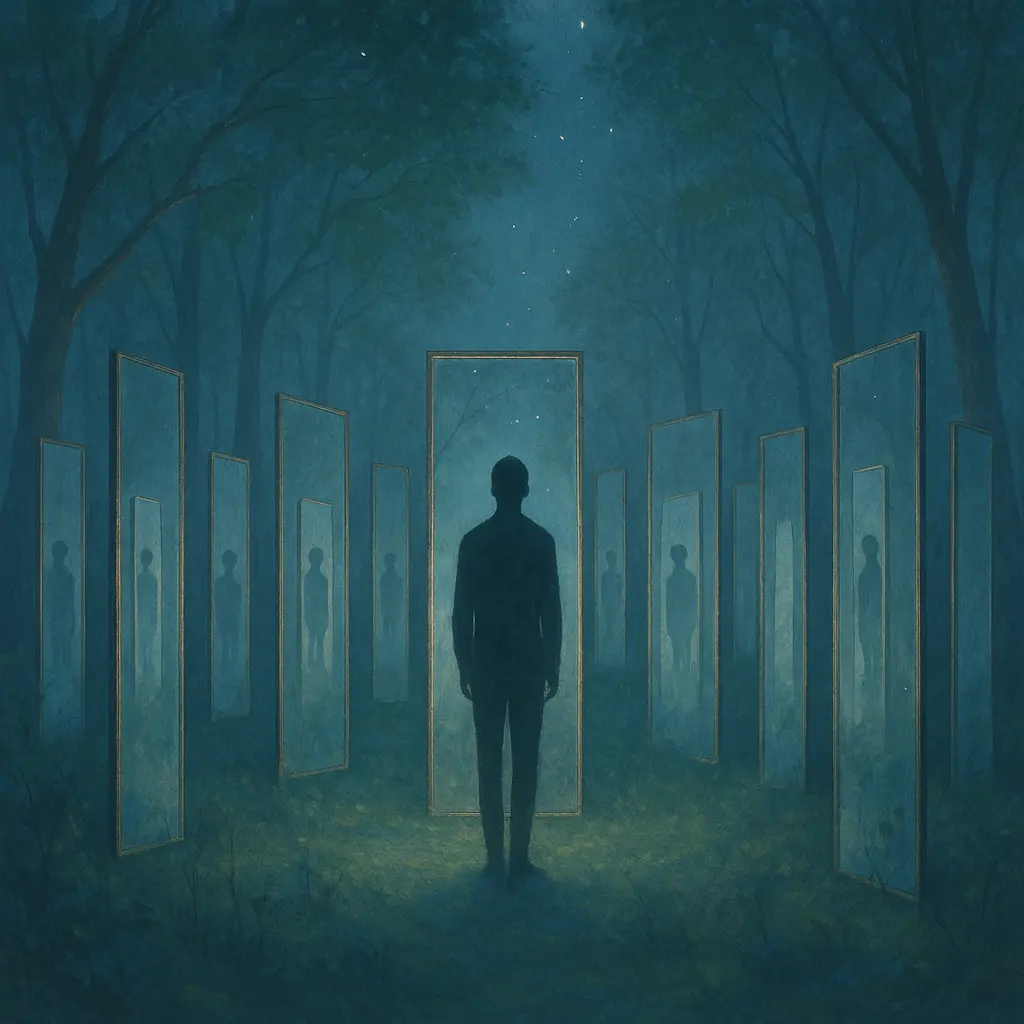
A twilight forest clearing filled with tall, slender mirrors rising from the ground like spectral trees. A solitary silhouetted figure stands at the centre, facing the largest mirror. Each mirror reflects a slightly different angle of the figure, creating a quiet sense of multiplicity and introspection. Soft blue and green tones, subtle stars overhead, and a dreamlike atmosphere evoke reflection, mystery, and inner depth.

There are moments in life when you look back at the path behind you and realise you were building something without noticing it. Not a plan, not a project. Something closer to a trail of reflections. A set of mirrors placed gently along the way, each one capturing a different angle of who you were in that moment.

This is my one hundredth article. A strange milestone. Not a number I ever aimed for, yet here it is, staring back at me like a mirror of its own.

When I look at the ninety-nine fragments behind me, what I see is not consistency. I see multiplicity. I see pieces of myself that refused to stay quiet. I see ideas that insisted on being witnessed. I see philosophies, frustrations, insights, dreams and shadows, each holding up their own reflective surface, saying: “Look. This is part of you too.”

Writing, for me, has always been a form of self-observation. Not in a self-indulgent way, but in the way an astronomer studies celestial bodies. You look deeply at what is there, not because it asks to be understood, but because it demands acknowledgment by simply existing.

Across these one hundred mirrors, I have seen:

The observer who notices patterns when others see noise.
The outsider who has always stood at the edge of the crowd.
The child who still remembers wonder.
The philosopher who asks questions even when there are no answers.
The strategist who sees the shape of systems.
The dreamer wandering through inner landscapes.
The witness to injustice.
The rebel who does not want power, only truth.
The artist who refuses to be tamed.
The self that has broken and reassembled itself more times than anyone knows.

Each reflection has been honest. Some gentle, some sharp. Some filled with clarity, others clouded by uncertainty. But all of them true in their own way.

If there is a single thread running through everything I have written so far, it is this:

Awareness is my compass.
Meaning is my instinct.
Honesty is my language.
And imagination is my bridge between worlds.

I do not write because I expect the world to listen. I write because these mirrors would exist whether I acknowledged them or not. Putting words to them is my way of bringing form to what is already present in the quiet spaces of the mind.

This one hundredth article is not a conclusion. It is a pause. A moment to look at the mosaic forming behind me. A century of reflections. A reminder that I am not one thing, but many. And that each piece contributes to something larger, something that continues to unfold.

Thank you for witnessing any part of this journey.
Here is to the next mirror, wherever it may appear.
A Month of Words: What I Learned from Posting Every Day

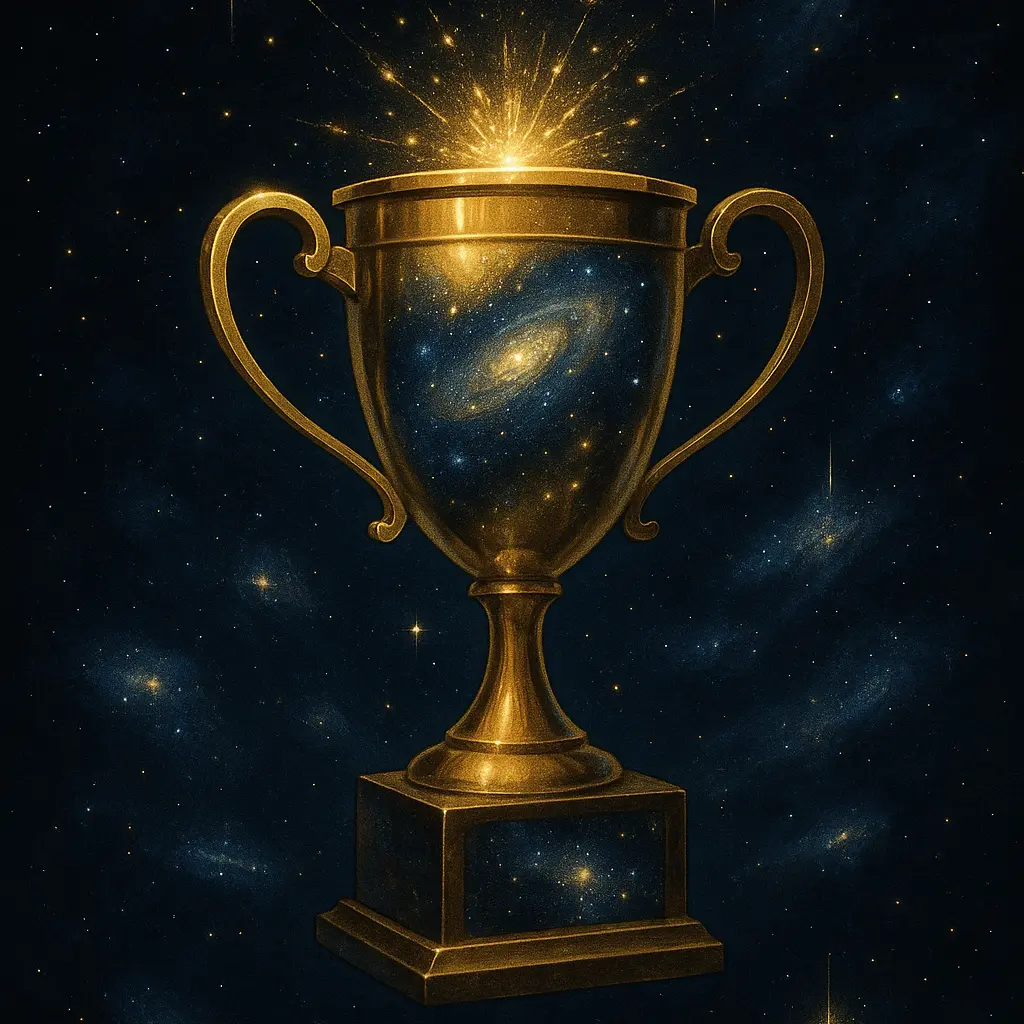
A golden trophy floating in space, glowing with sparks of starlight and reflecting galaxies across its surface.

If you’ve been following An Alternative Perspective, you may have noticed the sudden flurry of activity. For the past month, I’ve been posting every single day without fail. This wasn’t random productivity, but the result of a whimsical challenge I set myself: to see if, with the help of AI, I could sustain a daily rhythm of meaningful writing. Before, I often felt weighed down by the sheer effort of shaping my thoughts into polished sentences. With AI taking some of that burden away, the process became lighter, and I wanted to see how far that shift could carry me.

Before AI vs. After AI

When I first launched this blog in 2022, my posts were few and far between. Across the first two years I only managed five articles in total.

Things changed in early 2025, when I began experimenting with AI as a creative partner. Suddenly the pace picked up. I went from writing a handful of posts in a year to several in just a few weeks.

By July, I decided to see how far this new momentum could carry me, and set myself a challenge: publish something every single day for a month. At the start of the challenge I had around forty posts in the archive. By the end of it, including this piece, the count stands at seventy-four. That means more than thirty new articles in less than a month.

Reflections on Sustainability

Over the course of this challenge, I discovered a lot about both the process and myself.

  • Liberation, not obligation: Posting daily felt liberating because I finally shared thoughts that had been locked away. Even the smallest bits of feedback carried meaning. But crucially, I never felt like I was “churning out content.” Each post was meaningful, its own little adventure.
  • Unexpected depth: Some posts grew far longer than I had imagined when I started. The act of writing pushed me to think deeper, explore new perspectives, and even do research. The challenge was not just about output, it became discovery.
  • A layered process: I was not literally writing one post a day from scratch. Instead, I kept several drafts simmering, refined them in layers, and used scheduling to build in breathing space. That rhythm made it sustainable.
  • The real takeaway: I have proven that I can post daily, but that does not mean I should. Forcing myself into constant output risks oversaturating both myself and readers, especially those who, like me, are neurodivergent and might prefer more space to digest ideas. What matters is not quantity or the illusion of being “active.” What matters is that the odd perspectives I notice, the strange angles others overlook, and the weird thoughts too good to waste have a platform where they can be found by those who might be interested.

Closing Thought

This challenge began as a whim, but it became a lens. It sharpened how I see my own writing process and reminded me that writing is not about keeping pace with an algorithm or maintaining the illusion of activity. It is about following the natural rhythm of thought, giving form to what feels too important to leave unspoken, and offering it to whoever might find resonance. Whether I publish daily or only when inspiration strikes, the archive will continue to grow at the pace it needs to. And that, I think, is the most sustainable path of all.

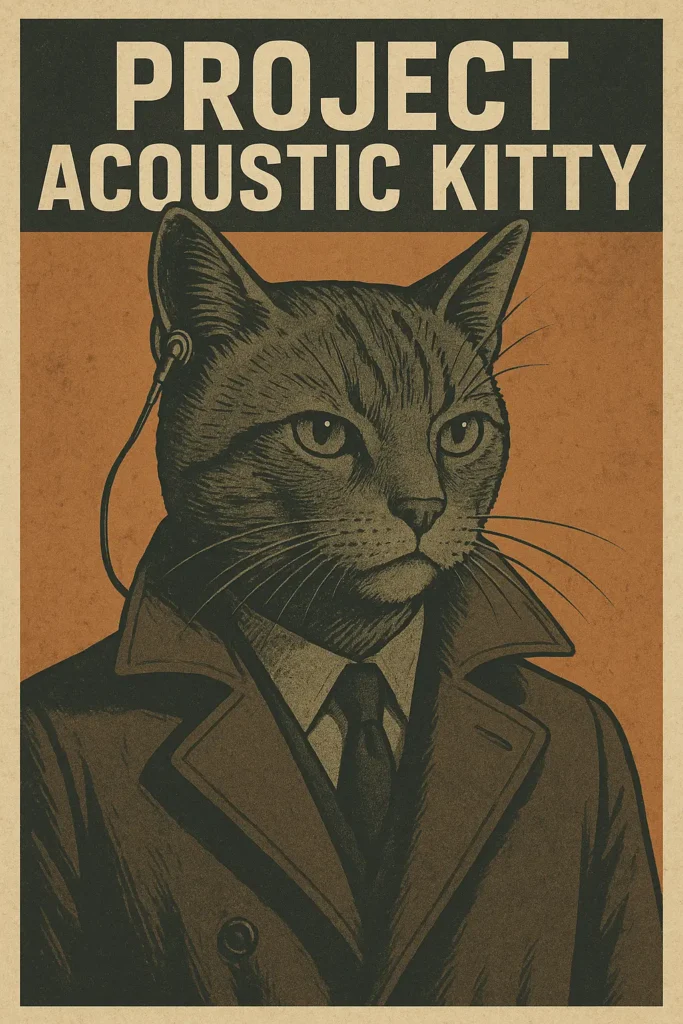
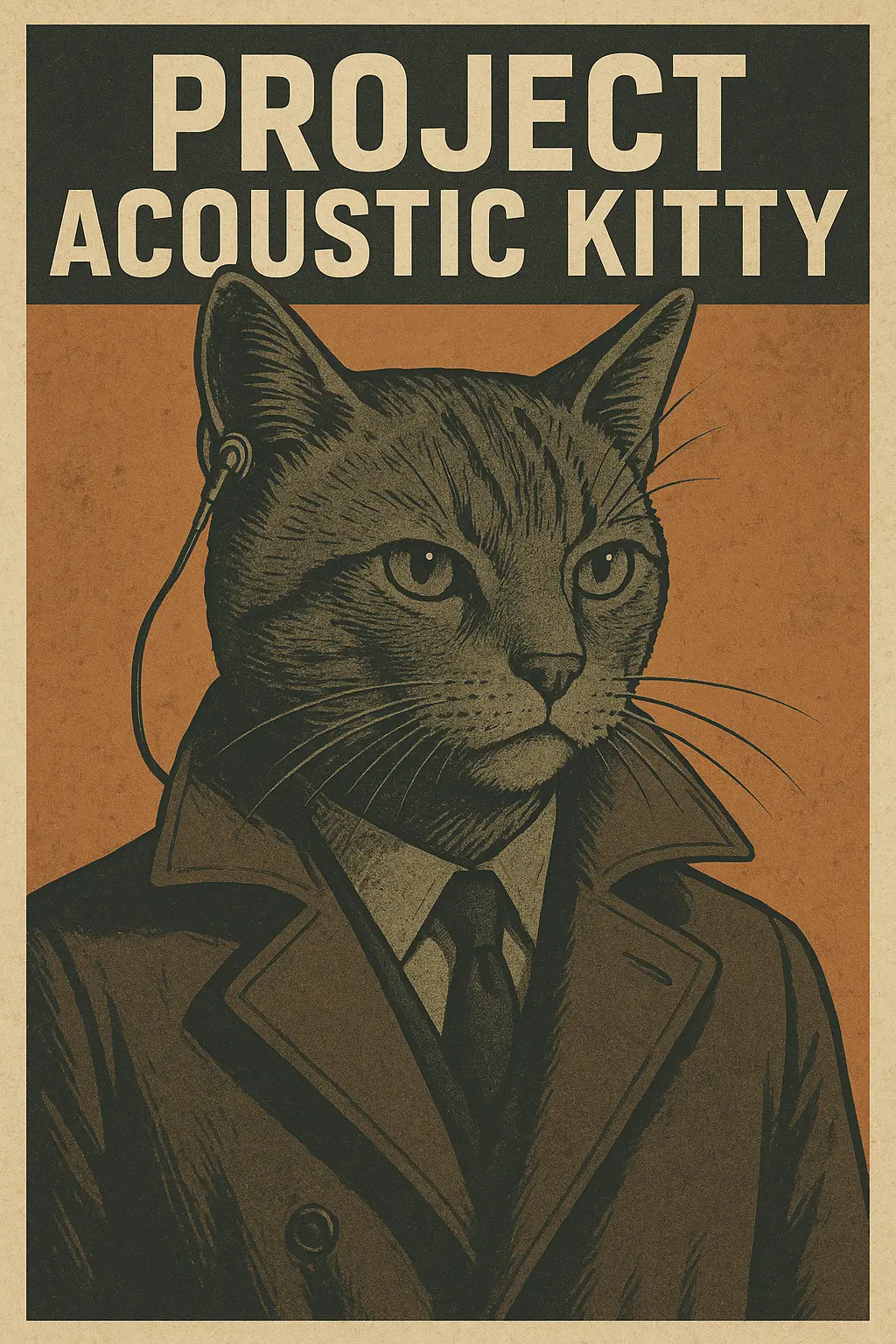
Project Acoustic Kitty

A cautionary tale of espionage, absurdity, and the limitations of control

What do you get when you combine Cold War paranoia, cutting-edge surveillance tech, and a total disregard for feline autonomy? You get Project Acoustic Kitty—a very real CIA operation from the 1960s that feels like a rejected subplot from Archer.

The idea was simple in its madness: turn a cat into a mobile spy. Why? Because cats can go places humans can’t. They’re small. Stealthy. Adorable, even. Perfect for infiltration, thought someone in a very expensive suit.

So they did what the CIA does best: they poured millions of taxpayer dollars into it. They implanted a microphone in the cat’s ear, a radio transmitter at the base of its skull, and a battery along its spine. The poor creature was wired like a Cold War cyborg—but without consent, purpose, or understanding. It didn’t sign up for any of this. It just wanted to nap.

After extensive testing and surgical tinkering, the big moment came: the cat was released in Washington, D.C., near a park bench where two Soviet agents were reportedly sitting.

Seconds later, the cat wandered into the road and was immediately hit by a taxi.

That was it. Millions of dollars, years of research, and the life of a living creature—all flattened in an instant. The mission was aborted, the project scrapped, and the moral of the story was quietly buried beneath layers of government embarrassment.

But here’s the part that lingers:

This wasn’t just a failed experiment. It was a moment of grotesque poetry—a feline martyr sacrificed at the altar of control and surveillance. It exposes something all too human: our obsession with dominating the unpredictable, even when the subject is, by nature, uncontrollable.

Cats are not obedient tools. They are chaos in fur.
And no matter how clever the tech, you can’t program agency out of nature.


Project Acoustic Kitty reminds us:
Not everything can be wired, tracked, or turned into an asset.
Some things just want to wander. And that, too, is sacred.

The Outsider

An account of my journey to self-acceptance

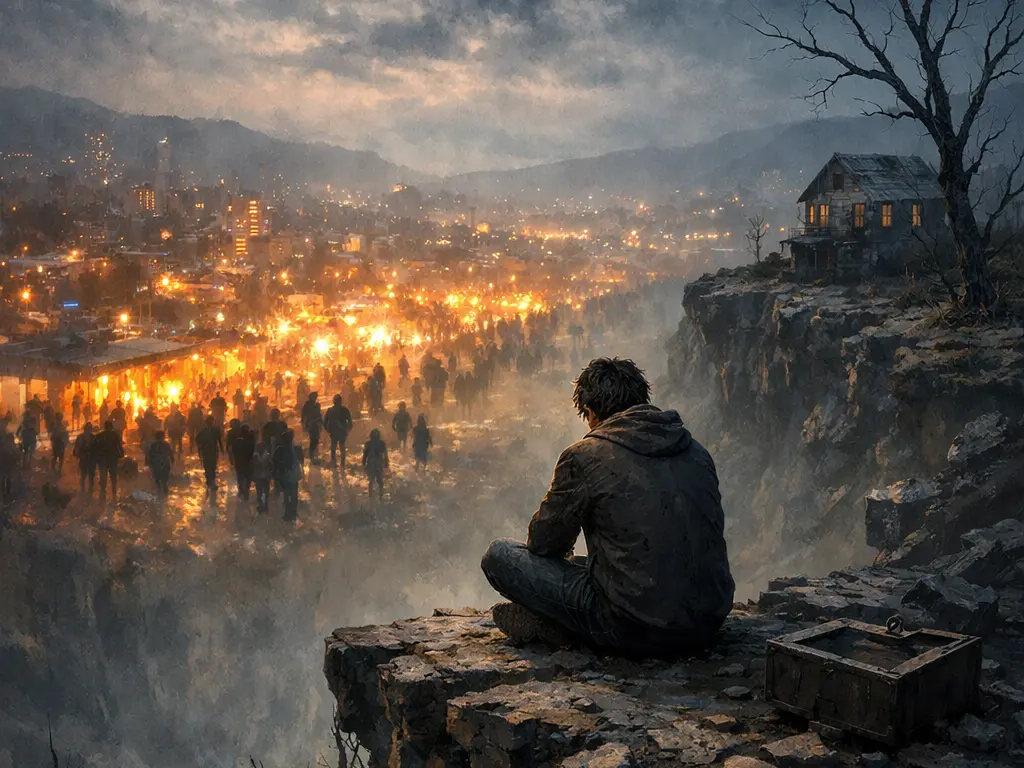
A lone figure sits on a rocky cliff overlooking a glowing city at night.

I’m not the most ‘normal’ person.
I’ve always been ‘different’.
I have spent most of my life as a social outcast.
Searching for somewhere to fit in, failing.

This has of course led to depression, anxiety, and some seriously bad mental breakdowns.
Some of which came close to killing me.

It can be difficult, living life on the outside.
Looking in on all of the relatively happy people going about their lives, in relative ease.

How do they do it?
What is their secret?
Perhaps everybody suffers just as much as I do, but no one is expressing it…
Are they all just putting on a brave face?
The fact remains, they succeed in areas that I cannot.
So what does that make me?
A defective product of humanity?
An inconsequential blip in the vast jungle of society?.
I think of Darwin’s theory of natural selection, survival of the fittest.
Am I simply not fit enough to survive in this world?

You can see how these trains of thought may have led me down some dark paths.
Amongst a parade of complex questions, there was one simple question that stood out, one of basic human necessity.

Where do I fit in?

I had a simple question, and no one was giving me an answer.
Friends, family, therapists… strangers on internet chat rooms…
I even turned to God (but as you can imagine, the line was busy)

Of course it’s not that no one had anything at all to say.
Most of the suggestions I received from people involved changing core aspects of who I am, in order to be a better fit.
This was simply unacceptable to me.

I realised that I was asking the wrong people.
I eventually resorted to going about trying to work out the answer myself, from scratch.

This was a huge undertaking.
If you imagine the problem as an extremely complex mathematical equation, my task was to solve the equation, armed only with knowledge of basic arithmetic.

Through a tedious process of trial and error, challenging myself with thought experiments, delving deep within my psyche, throwing myself into challenging situations, observing my thoughts, feelings, observing the reactions of others, observing the consequences of varying types of behaviour, Looking for patterns, shapes, colours, textures… anything that would help me to make sense of it all.

I eventually came to a point of deep understanding, and even appreciation of who I am.
And I came to a place of similar understanding and appreciation of others.

But still, I did not fit in.
I had two sides of an equation, but there was no perceivable connection to balance them.

Then, one day, during… let’s call it an ‘existential crisis’, it hit me.
The answer I had been seeking for so long, was right in front of me all along, hiding in plain sight.

Where do I fit in?
On the outside!

I’m not like everyone else. I am an outside-of-the-box thinker.
I play my own game. I have different core values, different metrics of success, I do things in my own way, for my own reasons.

I often don’t understand why people do certain things, but my inability to blindly accept and follow prescribed systems incites me to challenge what is.
I offer a fresh perspective. And though I do not always see the things that are plain to others, I see many things that others do not.

And society needs that.
Diversity is essential to the continuation of humanity.

Going back to evolution, the clue is in its name. The point is not for us to settle on being one thing.
Survival of the fittest is a game of numbers, yes, and the majority often has a clear advantage.
But if we were all perfectly normal, if we were all cookie-cutter replications of an idealised standard, then our race would not be equipped with the tools that it needs to adapt and survive.

And nor would life be particularly interesting.

So I, for one, am happy to embrace being strange.
Any disapproval from others just goes to further cement my resolve, that I am performing my function, that I am doing what I am supposed to be doing and that I am where I am supposed to be.

No longer do I need to worry about fitting in.
My concern is simply just to do the things that I am inclined to do.

And I have utmost faith in that
whatever I do,

Whether others like it or not,
Whether it benefits me or not,

Whatever I do,
is the right thing to do.