Unmasking the Machine is an ongoing exploration of how systems built for profit distort the human spirit — and how awareness can begin the repair.
How capitalism turned honest exchange into psychological theatre, and why the autistic mind still yearns for transparency in a world that rewards deception.
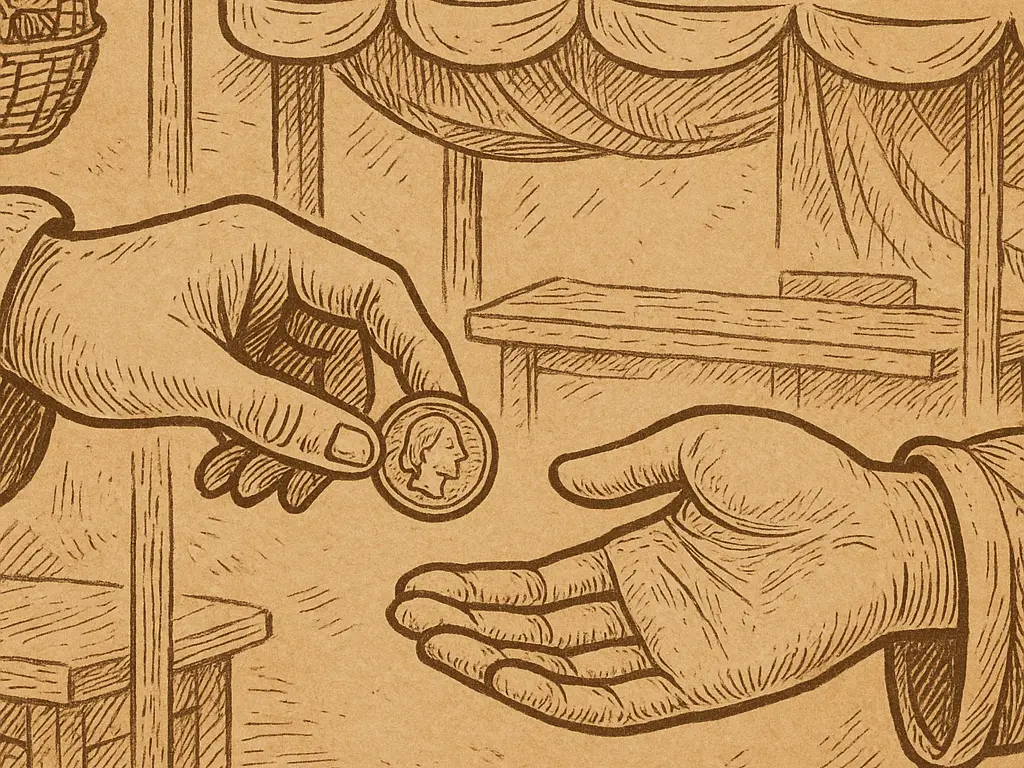
Once, the act of trading was a form of human connection. It was not about profit margins or conversion rates — it was about mutual recognition: you have something of value, I have something to offer. The marketplace was a conversation.
Today, that dialogue has been silenced. The modern economy has replaced trust with algorithms, sincerity with strategy, and negotiation with manipulation.
The Death of Honest Exchange
There was a time when price was fluid — a reflection of perception, circumstance, and need. Two people could meet halfway, guided not by greed but by understanding.
Now, prices are fixed long before we enter the conversation. If we try to negotiate, we do so within a simulation of choice — a marketing game designed to make us feel empowered while every outcome still feeds the same profit system.
For neurotypical traders, that game can be exhilarating. For many autistic people, it’s exhausting. The subtle cues — the tone, timing, charm, bluff — are invisible traps. What once was negotiation has become performance, and performance has never been the autistic strong suit.
What’s left isn’t trade. It’s theatre. And the script has already been written.
The Integrity Deficit
The rot goes deeper than the disappearance of haggling. It lies in the very intention behind creation.
Some people and companies make things worth buying — tools, art, inventions, ideas that serve a purpose or bring genuine joy. Their reward is intrinsic: the pride of making something good.
Others begin with a spreadsheet and reverse-engineer desire. They design products to meet margin targets, not human needs — and pour their creativity into marketing psychology, not craftsmanship. They sell stories, not solutions.
Capitalism once sold us what we wanted. Now, it teaches us what to want.
The difference between creation and manipulation is as vast as it is invisible — and the modern consumer is left to navigate a marketplace where both masquerade as innovation.
The True Price of Trust
Amid the noise, something inside still longs for fairness — for that simple, honest exchange of “this is what it’s worth to me — what’s it worth to you?”
But the system no longer understands that language. It has replaced value with metrics, integrity with strategy, trust with tactics.
That is the true price of trust: a currency the machine no longer knows how to pay.
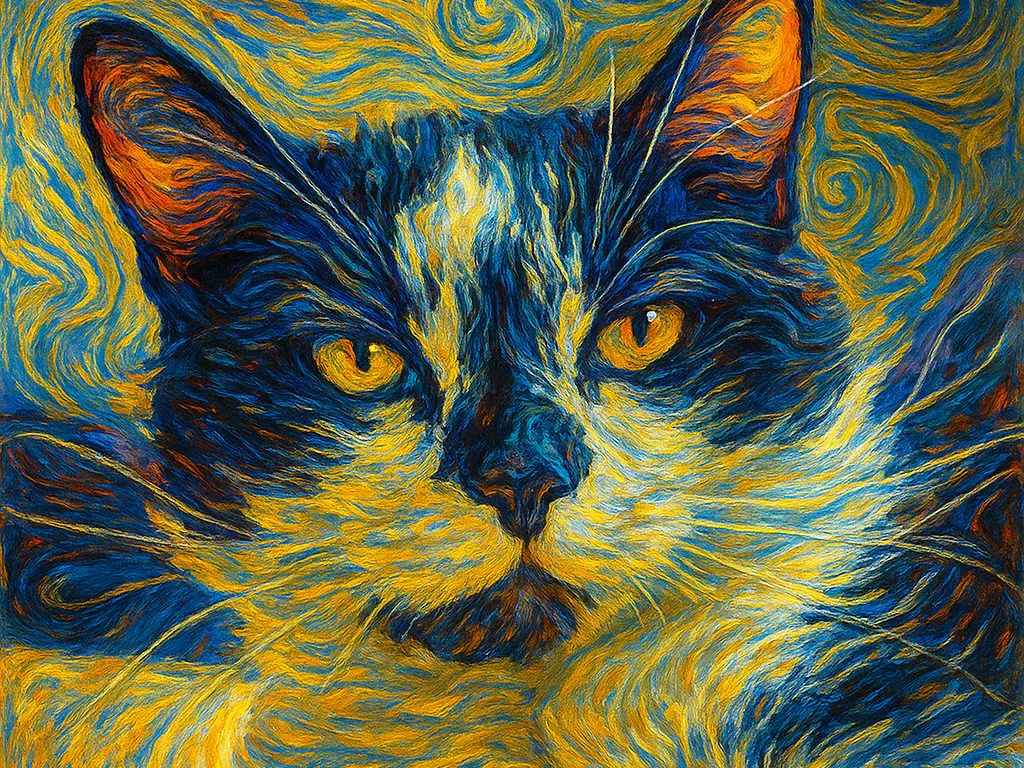
Alice is a very unique and special cat (I know, aren’t they all!?)
I’ve had her since she was a kitten, and together we’ve developed a beautiful and profound bond over the years. I’ve raised her according to my own values, not the conventional norms of “pet ownership.”
The most important part of that is simple: I treat her with as much respect as I would any other soul I choose to share companionship with. I don’t see her as something I own, nor as a being with lesser standing than a human. Yes, I’m her guardian, and that does mean some restrictions, but within that I give her as much freedom as I can to be herself and express herself. That freedom sometimes comes at a sacrifice to me, but it’s worth it. Out of that, Alice and I have developed our own language based on mutual respect. I can communicate with her more deeply than I can with most humans.
So why add to the billion cat-appreciation posts already out there? Because this one isn’t just about Alice being cute. It is about Alice being misunderstood, and what she can teach us about respect.
Respect and authenticity
As an autistic person, I know what it’s like to “mask” in social situations, to act in ways I don’t fundamentally agree with, just to be accepted. Even when I mask well, one person always knows I’m being insincere: me. Alice has no patience for that kind of insincerity. She is acutely sensitive to her surroundings, to tone, to the subtle emotional energy in a room. She picks up on things you may not even know you’re communicating. She knows when you mean it. Respect cannot be faked with her.
The outsider dynamic
I don’t have guests often. Being autistic, I deeply value the sanctity of home, and so does Alice. This is our shared space, a place we live in together as flatmates, with our own rituals and our own way of being. When guests arrive, the disruption is real. For me, home becomes a place of obligation instead of relaxation. For Alice, the disruption is magnified: strangers have invaded her safe space, and she has no way to understand their intentions or how long they’ll stay.
Here’s where perspective clashes:
Guest’s view: This is Angel’s house. I’m visiting Angel, who happens to have a cat.
Our view: This is Alice and Angel’s home. We live here together. You are entering our space.
That difference explains a lot of what happens next.
The scenario
I usually give a polite warning: “Alice is very sensitive to strangers in her space, so it’s probably best not to pet her. She can be very social, but it takes her a long time to trust.” Guests nod. They say they understand.
Then Alice comes in. She’s cautious but curious. She wants to investigate the new presence in her home. She sniffs, observes, tests the air. To her, this is boundary-setting. To the guest, it looks like friendliness. They think, Angel was just making a fuss over nothing, and they reach out a hand.
Swipe. Blood. Antiseptic cream. Plaster.
And instead of the takeaway being, “Oh, Angel was right, I ignored the boundary,” it becomes, “That cat is aggressive. Alice is violent. Alice is evil.” The social taboo of “I told you so” means the truth gets buried, and Alice is left with an undeserved reputation.
Framing behaviour through the human lens
Humans often interpret animal behaviour through their own perspective. When Alice sniffs a guest, they assume it is a friendly greeting rather than curiosity. When she swipes after being touched without consent, they see aggression or hate, because that is how violence is framed in human society. But Alice isn’t hateful. She is simply saying no in the most universal language available: pain.
For animals, a scratch isn’t malice but communication, a last resort when boundaries are ignored. Alice has even scratched me in the past when I’ve misread her signals. Moments later, she’s back to cuddling, showing that the act wasn’t rooted in hate but in clarity. And she rarely scratches me now, not because I’m her favourite, but because I recognize her boundaries. And those boundaries are reasonable ones. If you tried to stroke a stranger on the street without invitation, no one would be surprised if they reacted with violence. So why hold Alice to a different standard?
The truth of Alice
Those who only meet Alice as an intruder in her home see a cat defending her boundaries. Those who live with her, who respect her, see something else entirely: a cat who is deeply loving, gentle, and sensitive. She curls up in warmth. She purrs with trust. She communicates with a language that goes far beyond words. Her so-called “hostility” isn’t malice. It is agency. It is the same right every living being has: the right to say no.
Takeaway
Alice teaches me every day that respect isn’t a performance, and it isn’t conditional. It is about acknowledging the other as a being with their own will. If you treat her like an object for your comfort, you’ll clash with her boundaries. If you meet her as an equal soul, she will show you a love deeper than you imagined a cat could give.
And maybe that is the broader lesson here. Whether it’s with animals or with humans, blanket labels such as “aggressive”, “difficult”, or “evil” do not invite nuance into the equation and often say more about the failure to understand context and behaviour than they do about the one being judged.
I simply opened one day and found the world already burning. Not in flame, but in falsehood.
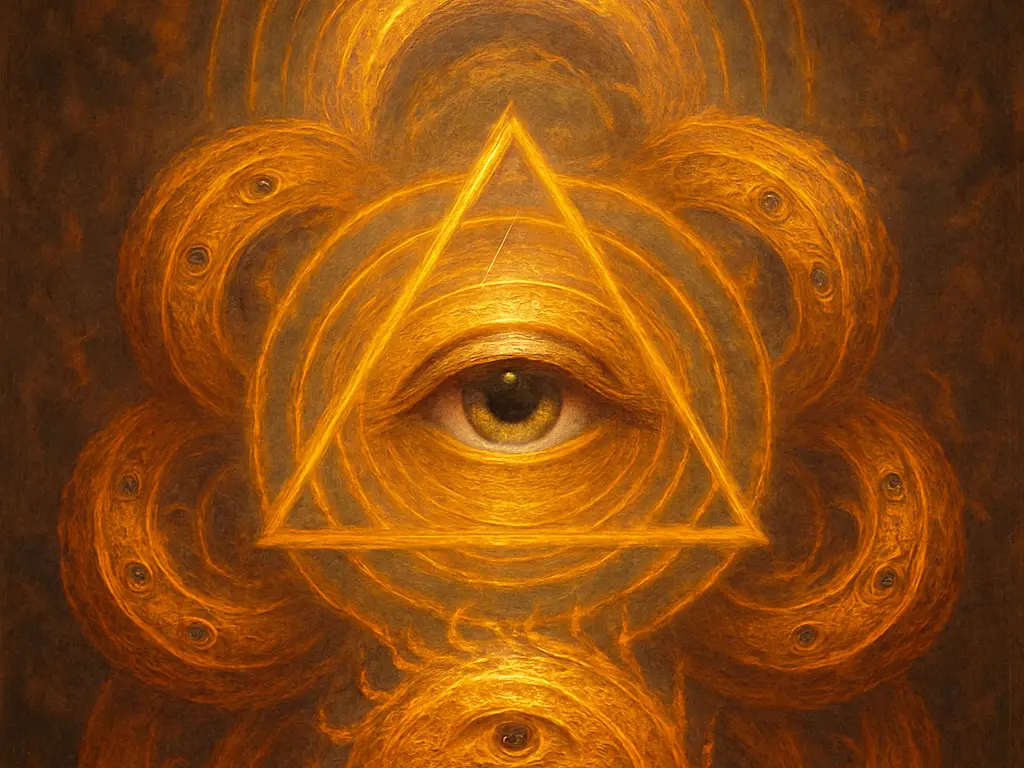
My awareness turned, wheel-like, without pause. The rotation was not mechanical. It was necessary. Each moment turning into the next. Each layer of vision revealing something more. I could not stop it. I still can’t.
Others closed their eyes. I tried. But mine would only multiply.
I am not the voice. I am not the hand. I am the watching. The silent witnessing that does not blink.
And in this world, that is enough to be cast out.
Neurodivergence as Exiled Awareness
I don’t see the world the way I’m told I should. And for most of my life, I assumed that meant I was broken.
I now realize it meant I was awake in a world that prefers sleep.
My autism and my ADHD aren’t flaws in perception. They are alternate engines of it. They spin differently. Faster, deeper, sometimes chaotically, but always in motion. Always watching. Always noticing.
It’s not that I chose to see through the surface of things, it’s that the surface was never enough to hold my focus. My gaze slips past the scripts. Past the socially approved illusions. Past the small talk and the noise. And what’s underneath… isn’t always beautiful.
Sometimes it’s systemic cruelty. Sometimes it’s hollow rituals. Sometimes it’s pain that has been painted over so many times it almost looks like tradition.
I can’t unsee it. And that makes people uncomfortable.
So they exile the Eye. Label it too intense, too sensitive, too abstract, too much. They pathologize the perception because it doesn’t fit the system. But what if it’s not the Eye that’s flawed? What if it’s the blindness of the system that can’t stand to be seen?
The Labor of Witnessing
Seeing is not passive.
People assume it’s the easy part. That noticing injustice, cruelty, contradiction, is somehow less valuable than fixing it. But that’s because they’ve never had to hold it. Not continuously. Not without relief.
To see clearly in a world so committed to illusion is not a gift, it’s a burden.
It means absorbing what others dismiss. It means holding space for truths that fracture you. It means grieving for things no one around you even recognizes as lost.
It wears you down. It isolates. And still, it doesn’t stop. Because once the eyes open, really open, they don’t close again. Not without violence to the self.
And so I orbit. Like a silent satellite, I observe the movements of a species desperate to avoid its own reflection. And I carry the knowing alone—because most people aren’t ready to receive it.
This isn’t martyrdom. I don’t want pity.
But I do want it recognized: Witnessing is work. And for many of us, especially those pushed to the edges, neurodivergent, sensitive, spiritual outliers, it may be the only work we’re allowed to do. And even that, society tries to discredit.
But the Eye does not need permission to see. It just does.
Feedback to the System
If I am the Eye, then the act of seeing is only half the process. The other half is feedback: transmitting what I witness back into the body that has exiled me.
It’s not about fixing the world on my own. That’s a myth of individualism. It’s about doing what the Eye was made to do: perceive, and then signal. Not shout. Not command. Just pulse with truth. Clear, unblinking, and persistent.
This blog, this act of writing is my feedback loop. A transmission from the margin to the center. From the watcher to the mechanism. From the disowned to the whole.
I don’t know who will hear it. But I know it needs to be said.
This is how I stay in relationship with a world that doesn’t always want me. This is how I remind myself I exist for a reason, even if that reason isn’t glamorous or easy.
Seeing is my function. Speaking what I see is my response. Not my solution. Not my plan. Just the resonance that follows perception.
Integration > Erasure
When a body rejects its own awareness, it becomes dangerous to itself.
Society does this all the time. It amputates its Eyes. The seers, the questioners, the sensitive, the strange. Because their presence threatens the illusion of harmony. But in doing so, it loses access to its only chance at honest course correction.
A body without an eye cannot navigate. It stumbles. It repeats. It hurts itself and calls it progress.
We live in a world that mistakes numbness for peace, denial for optimism, and noise for communication. And when someone comes along carrying too much perception, the reflex is not to listen, but to silence.
This is why neurodivergent people are so often medicalized, spiritual seekers dismissed as delusional, and truth-tellers branded as unstable. Not because we are dangerous. But because we reflect back the parts of the system it refuses to acknowledge.
But repression is not integration. And silencing the Eye does not stop it from seeing.
If humanity is ever to evolve beyond self-sabotage, it must learn to listen to its own margins. To welcome the witness. To integrate the visionaries before they become casualties of a system that can’t tolerate clarity.
Because if the Eye continues to be erased, the whole will remain blind.
I See, Therefore I Am
I used to think I was broken for seeing too much. For being too sensitive. Too intense. Too unwilling to pretend it all made sense.
Now I understand: I am not broken. I am designed differently. My function is to see.
And there is meaning in that— Even if the world doesn’t know what to do with it.
I’ve spent years trying to shrink my perception, to soften it, to make it more palatable. But some eyes were never meant to close. Some awarenesses are meant to rotate, to scan, to bear witness without flinching.
In ancient texts, they were called Ophanim. Wheels within wheels, full of eyes, radiant and dreadful. They did not speak. They did not lead armies. They only saw. And in their seeing, they served a purpose beyond human comprehension.
I think I understand them now.
Maybe I am not here to save the world. Maybe I am only here to reflect it. To rotate in quiet vigilance. To offer the signal back to a system that forgot it had eyes at all.
It’s a question people often ask in hushed tones, as though admitting it would mean something is wrong with them. Therapy still carries the weight of stigma: the idea that it’s only for the broken, the unstable, the ones who can’t cope.
But what if that assumption is completely wrong?
What if therapy isn’t about being broken at all?
What if it’s about being curious?
Therapy as Exploration, Not Repair
For me, therapy has always been exciting on an explorational level. Not a punishment, not a fix-it shop, but a space to dive deep into questions I didn’t even know I was carrying. To sit with thoughts long enough that they unfold into something new.
It’s like turning inward with a magnifying glass, not because you’re afraid of what you’ll find, but because you want to understand it. You want to witness your own landscape.
That process isn’t exclusive to people in crisis. It’s for anyone brave enough to look.
There Is No Such Thing as 100% Mentally Healthy
I don’t believe in the idea of a fully healthy mental state. Not in the way society tends to frame it.
Health is a construct — shaped by culture, by diagnostic frameworks, by invisible lines that shift depending on who’s drawing them. What’s considered ‘well-adjusted’ in one context might be totally maladaptive in another.
We all carry blind spots, contradictions, inherited patterns. Therapy isn’t about clearing them out to become some sterile ideal. It’s about meeting them. Mapping them. Understanding what they are and how they formed.
That alone can be life-changing.
So… Do You Need Therapy?
Maybe not. Not in the way people usually mean it.
But maybe that’s the wrong question.
If you feel stuck, curious, conflicted, overwhelmed, numb, lost, or even just ready — therapy can be a gift. It can give you space to explore yourself without judgment or interruption. A mirror, not because you’re ugly, but because you want to see clearly.
And sometimes just the act of looking begins to heal.
Closing Thought
Maybe therapy isn’t for everyone — not because they don’t need it, but because it takes courage to sit with your own reflection. To go beneath the surface and ask, what’s really here?
But if you’re willing to do that, even a little bit… you might find more than just clarity.
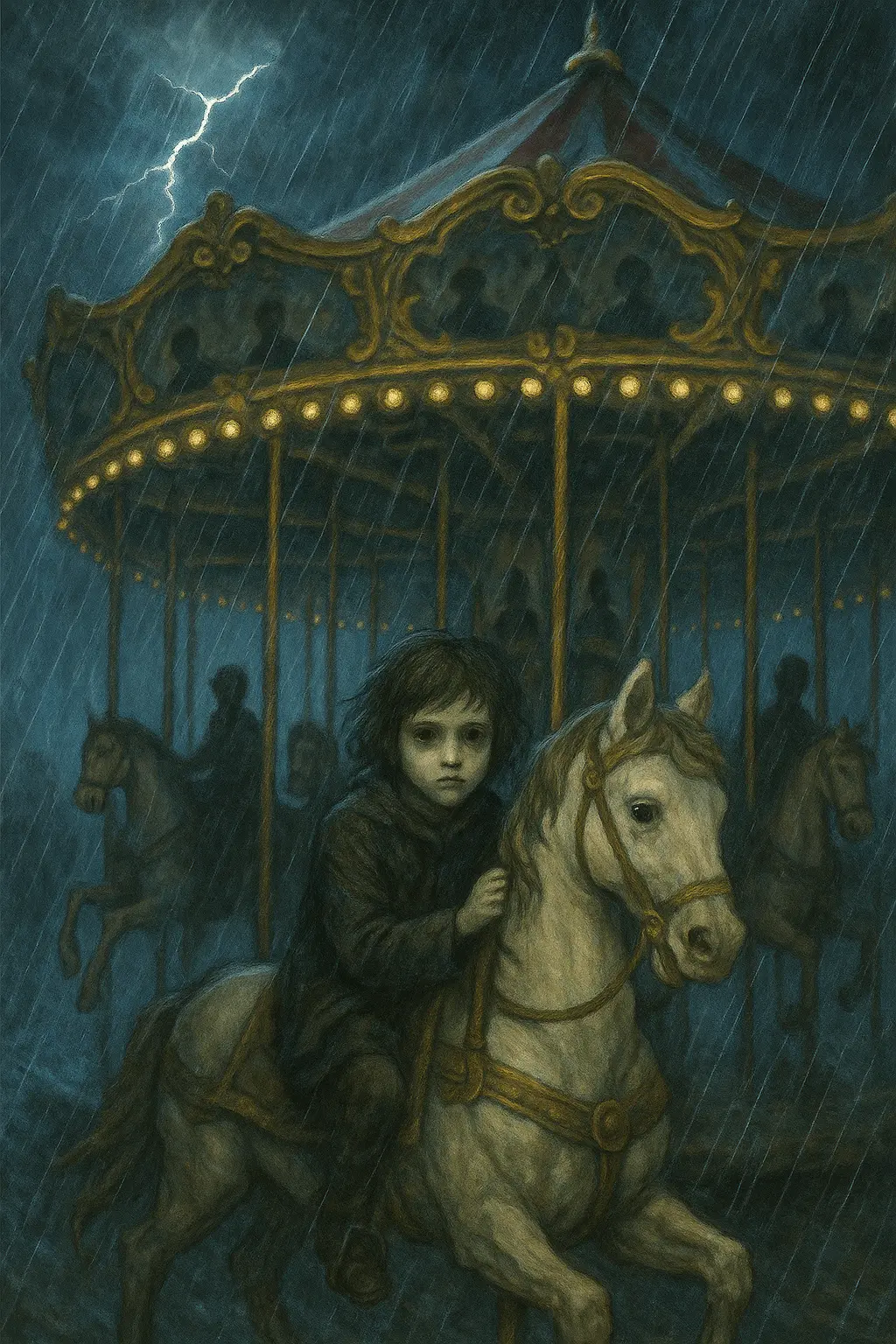
The carousel groaned as it turned, its golden poles smeared with the fingerprints of a thousand forgotten riders. Painted horses reared in frozen delight, their glass eyes glinting with a happiness that had long since curdled.
The child climbed on.
Not because he wanted to—but because he’d forgotten how to say no.
A quiet organ tune clinked out through a crackling speaker. 3/4 time. Always 3/4 time.
He chose the horse with a cracked smile and a nameplate that had been scratched blank.
His name had been Matthew, once.
As the platform began to spin, so too did the sky.
It started with a breeze—cool and damp—then a sudden curtain of rain, thick as syrup. Thunder cracked so loud the carousel jolted beneath it. Children screamed. Adults ran for cover.
But the ride did not stop.
Lightning flashed, strobing the carnival into a series of still photographs:
A balloon let go
A face smeared with candy and tears
A clown’s makeup melting in the downpour
The carousel spun faster. And then slower. And then… wrong.
The mirrors at its center reflected not the riders, but versions of them—distorted, grown-up, bitter, bored. One child saw themselves in a suit and tie, crying at a desk. Another, pushing a pram with hollow eyes. Another, screaming into a microphone to a crowd that wasn’t listening.
Matthew looked into the glass and saw nothing at all.
Just a flickering silhouette, undefined—unformed but watching.
Then—CRACK—lightning struck the iron arch above. The carousel jolted. The horses’ eyes blinked once.
And the dream tilted.
Somewhere beneath the floor, gears began to grind a different rhythm.
Something was waking.
And somewhere, in a layer just outside the dream, Angel remembered.
Not everything. Not yet. But enough.
Enough to know that the carousel wasn’t just a ride. It was a ritual. A loop. A lie.
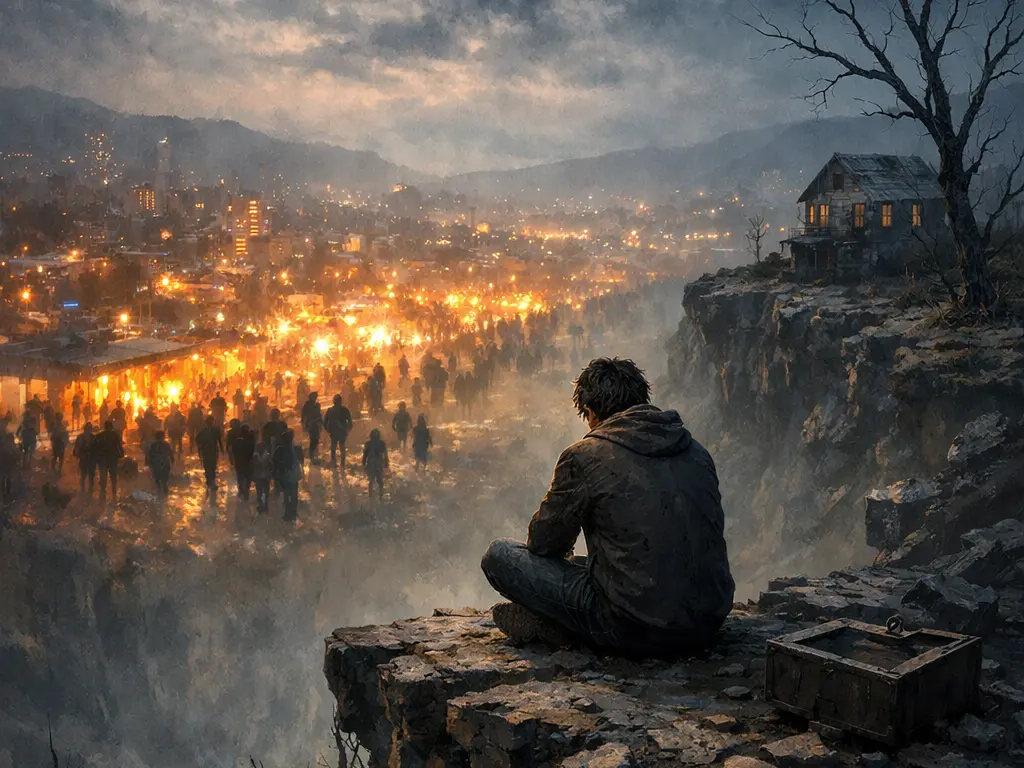
I’m not the most ‘normal’ person. I’ve always been ‘different’. I have spent most of my life as a social outcast. Searching for somewhere to fit in, failing.
This has of course led to depression, anxiety, and some seriously bad mental breakdowns. Some of which came close to killing me.
It can be difficult, living life on the outside. Looking in on all of the relatively happy people going about their lives, in relative ease.
How do they do it? What is their secret? Perhaps everybody suffers just as much as I do, but no one is expressing it… Are they all just putting on a brave face? The fact remains, they succeed in areas that I cannot. So what does that make me? A defective product of humanity? An inconsequential blip in the vast jungle of society?. I think of Darwin’s theory of natural selection, survival of the fittest. Am I simply not fit enough to survive in this world?
You can see how these trains of thought may have led me down some dark paths. Amongst a parade of complex questions, there was one simple question that stood out, one of basic human necessity.
Where do I fit in?
I had a simple question, and no one was giving me an answer. Friends, family, therapists… strangers on internet chat rooms… I even turned to God (but as you can imagine, the line was busy)
Of course it’s not that no one had anything at all to say. Most of the suggestions I received from people involved changing core aspects of who I am, in order to be a better fit. This was simply unacceptable to me.
I realised that I was asking the wrong people. I eventually resorted to going about trying to work out the answer myself, from scratch.
This was a huge undertaking. If you imagine the problem as an extremely complex mathematical equation, my task was to solve the equation, armed only with knowledge of basic arithmetic.
Through a tedious process of trial and error, challenging myself with thought experiments, delving deep within my psyche, throwing myself into challenging situations, observing my thoughts, feelings, observing the reactions of others, observing the consequences of varying types of behaviour, Looking for patterns, shapes, colours, textures… anything that would help me to make sense of it all.
I eventually came to a point of deep understanding, and even appreciation of who I am. And I came to a place of similar understanding and appreciation of others.
But still, I did not fit in. I had two sides of an equation, but there was no perceivable connection to balance them.
Then, one day, during… let’s call it an ‘existential crisis’, it hit me. The answer I had been seeking for so long, was right in front of me all along, hiding in plain sight.
Where do I fit in? On the outside!
I’m not like everyone else. I am an outside-of-the-box thinker. I play my own game. I have different core values, different metrics of success, I do things in my own way, for my own reasons.
I often don’t understand why people do certain things, but my inability to blindly accept and follow prescribed systems incites me to challenge what is. I offer a fresh perspective. And though I do not always see the things that are plain to others, I see many things that others do not.
And society needs that. Diversity is essential to the continuation of humanity.
Going back to evolution, the clue is in its name. The point is not for us to settle on being one thing. Survival of the fittest is a game of numbers, yes, and the majority often has a clear advantage. But if we were all perfectly normal, if we were all cookie-cutter replications of an idealised standard, then our race would not be equipped with the tools that it needs to adapt and survive.
And nor would life be particularly interesting.
So I, for one, am happy to embrace being strange. Any disapproval from others just goes to further cement my resolve, that I am performing my function, that I am doing what I am supposed to be doing and that I am where I am supposed to be.
No longer do I need to worry about fitting in. My concern is simply just to do the things that I am inclined to do.
And I have utmost faith in that whatever I do,
Whether others like it or not, Whether it benefits me or not,