Energy Accounting: The Autistic Paradox

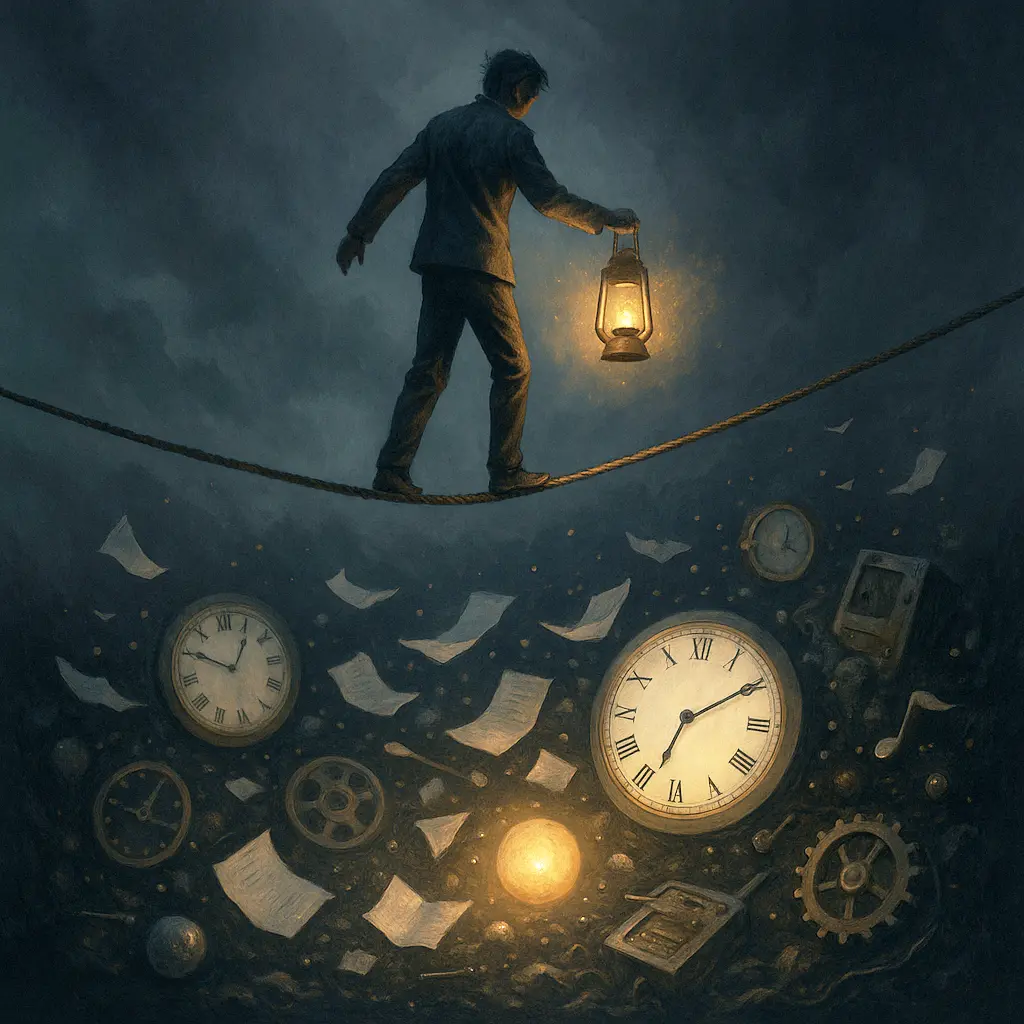
A surreal digital painting of a person walking carefully across a tightrope over a dark void. The figure holds a glowing lantern that casts a warm light. Below, chaotic objects float in the shadows, including clocks, scattered papers, gears, and glowing orbs. The overall mood is tense and precarious, symbolising balance, fragility, and the struggle to manage time and energy.

Life as an autistic person can feel like being caught in a double bind.

  • If I pace myself sustainably…
    I look (or feel) like I’m underachieving. Even my own goals can feel endlessly out of reach, as if the finish line keeps moving further away.
  • If I push myself harder…
    I crash. Exerting myself to meet even “basic” standards can burn me out and force me into recovery, undoing all the progress I made.

This paradox is not only about society’s expectations. It also plays out in my relationship with myself.


The Burden of Ambition and Abundance

I have ambitious personal goals and a burning awareness that my time on Earth is finite. On top of that, I am both blessed and cursed with an overflow of creativity. Because my mind processes things others might not even notice, I generate ideas constantly.

Where some creatives face blocks, I face floods. My notes apps hold tens of thousands of seeds: songs, stories, projects, concepts, all asking to be manifested.

On paper, that abundance should be a gift. In practice, it creates its own challenge:

  • Oversaturation.
  • Decision fatigue.
  • The need for systems to track, filter, and prioritise.
  • The pressure of skills to learn, resources to gather, and fleeting windows of inspiration that can close as quickly as they open.

So while I rarely run out of inspiration, I often run out of capacity. My challenge is not making something out of nothing. It is deciding which somethings to make before time, energy, or health run out.

The paradox compounds: I am both endlessly abundant and severely limited.


Compromise and the Illusion of Balance

One way out might be to compromise: to accept a smaller definition of success, to settle for “good enough.” But that raises heavier questions. How much of what drives me is negotiable? How much compromise risks losing the essence of who I am?

Another imagined path is the narrow crossover: a fragile sweet spot where I push myself just enough to achieve, but not enough to burn out.

The problem is that sustaining that balance comes with its own toll. Constant self-monitoring, rationing energy, and adjusting to shifting circumstances consumes resources in itself. Balance becomes another job.


The Reality

And then there is what actually happens.

In reality, I oscillate. I build momentum, I try to pace myself, I get carried by enthusiasm and a false sense of stability, I push harder, and then I crash. Then comes recuperation, and the cycle begins again. Burnout, recovery, momentum, overreach, collapse.

Even when I somehow manage to hit what looks like an optimal balance, it is fragile. All it takes is one unexpected disruption. A friend inviting me for coffee. A workplace drama. An appliance breaking. An urgent email. Suddenly I am spinning through the resource-management asteroid field.

The obvious solution might be to leave some “headroom” in my spoon budget. (“Spoons” being a common metaphor for energy in neurodivergent communities.) But that creates its own bind. Leaving spare capacity means something else goes neglected, nagging at me from the corner of my mind. Either I burn myself out dealing with it, or I burn myself up with guilt for leaving it undone.


A Closing Thought

To live inside this paradox is to be pulled in two directions at once: bursting with ideas and possibilities, yet constrained by the narrow economics of energy, time, and health.

It is not a complaint, and it is not a plea for pity. It is simply an awareness: that the autistic experience often sits at the crossroads of overflow and scarcity, ambition and limitation, momentum and collapse, control and chaos.

And maybe there is something universal in that tension. In one way or another, we are all negotiating what to do with the time and energy we have. The difference is that for autistic people, the margins are thinner, the trade-offs sharper, the balance more precarious, and the paradox harder to ignore.
Honestly, the Zombie Apocalypse Sounds Kinda Nice!

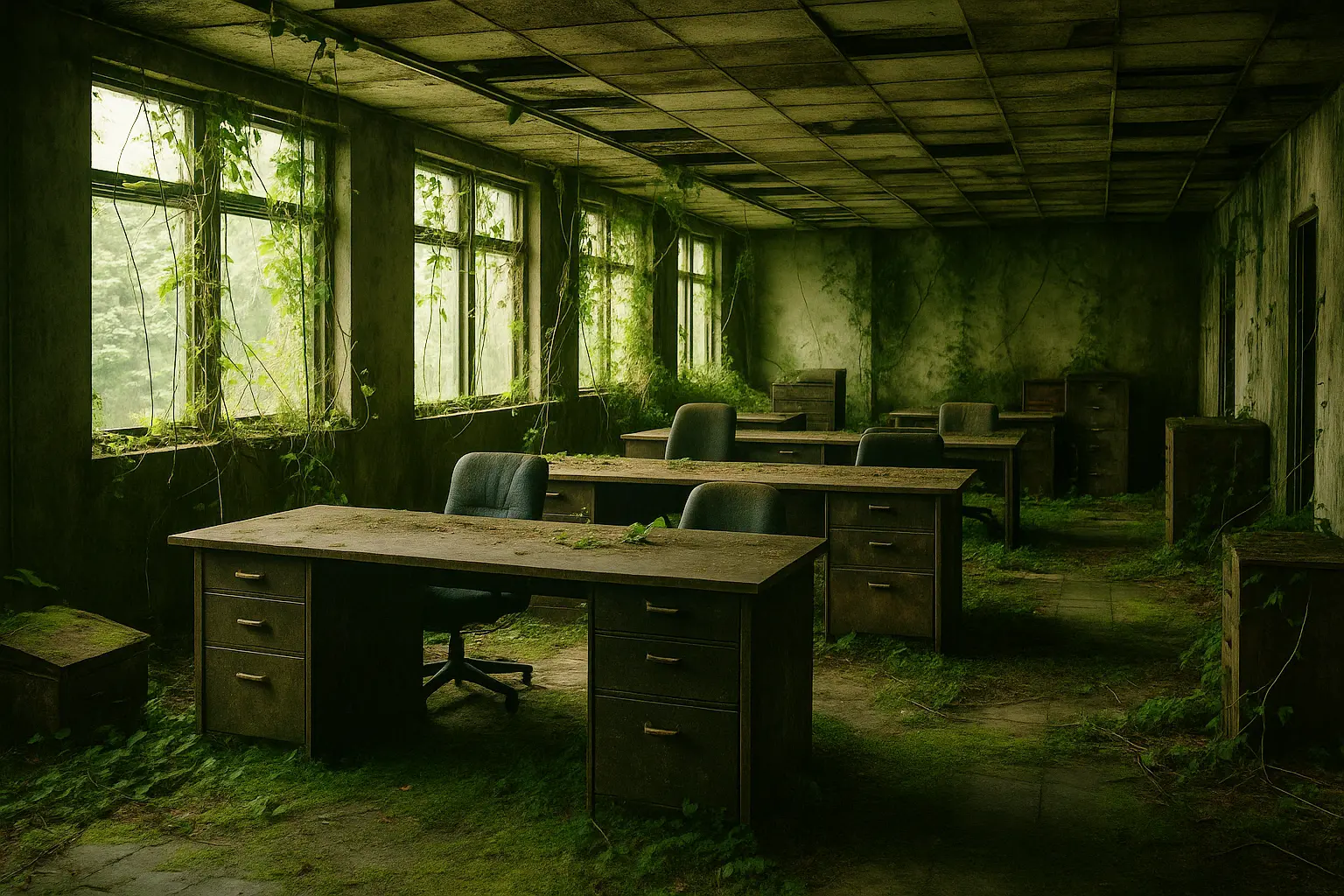
An image of the interior of an office building that has been reclaimed by nature.

Survival horror games. Apocalyptic movies. Zombie TV shows. They keep showing us the end of the world.

And the strange thing is, I find it comforting.

Not the death, or the gore, or the terrifying monsters.
But the quiet that follows.

In games like The Last of Us, in the atmosphere of 28 Years Later, in the long, dangerous walks through empty cities overrun by moss and silence, there is a strange kind of peace. These stories are about zombies, sure, but only in the way that space operas are about rockets. The real story is human.

Stripped of society, of rules, of etiquette and expectation.
Just survival. And with it, a return to something real.


A Common Fantasy, Quietly Shared

I don’t think I’m alone in this. There’s something telling about how many people are drawn to post-apocalyptic settings. We say it’s escapism, but maybe it’s something deeper. Maybe it’s yearning.

A yearning for everything to finally break, so we’re allowed to default back to our instincts. Those instincts haven’t disappeared, but capitalism has twisted them. Turned survival into branding. Turned curiosity into productivity. Turned strength into silent compliance.

In the fantasy, that spell is broken. We move freely. Nowhere is off-limits except by danger. If you’re brave enough to go, you go. And if you make it out alive, you learn something.

Maybe even about yourself.


A World That Makes Sense Again

You don’t need to fill out a form to matter. You don’t need to chase social media followers to have value. You don’t need a degree, or a permit, or a job title to justify existing.

You just survive. You help others survive. You find food. You stay alert. You sleep lightly. You protect your friends. You trust your gut.

The world becomes dangerous, yes — but finally understandable.


The Beauty of Nature Reclaiming

There’s an awe in seeing vines wrap around office buildings. Trees pushing through broken floor tiles. Roads cracked open and filled with moss.

It’s not just beautiful. It’s poetic.

The industrialised world thought it was permanent. But nature is patient. And in the fantasy, it doesn’t just survive. It reclaims.

It takes back the places that were stolen from it. Quietly. Persistently. Without anger.


Bureaucracy Is the Real Monster

The zombie apocalypse gives us a breath of relief from bureaucracy.

No more tax codes. No more emails. No more forms to fill in triplicate to get permission to be a human being. No more ten-step processes to access your basic rights.

The systems we live under have been patched and repatched so many times, they don’t even resemble their original purpose. Like buggy code that’s been layered with fixes until no one remembers what it was supposed to do in the first place.

Maybe the end of the world is the only bug fix that actually works.


Maybe I’d Finally Be Allowed to Live

I’m not saying I want civilization to collapse.

I’m saying that if it did, I might finally feel like I have a fighting chance.

The world we live in now feels like it was built to crush people like me. People who see too clearly. People who question. People who can survive, but only if allowed to act on their instincts without being penalized for them.

Maybe the end of the world wouldn’t be the end of me.

Maybe it would be the first time I was allowed to live.

Do You Need Therapy?

Do you need therapy?

It’s a question people often ask in hushed tones, as though admitting it would mean something is wrong with them. Therapy still carries the weight of stigma: the idea that it’s only for the broken, the unstable, the ones who can’t cope.

But what if that assumption is completely wrong?

What if therapy isn’t about being broken at all?

What if it’s about being curious?


Therapy as Exploration, Not Repair

For me, therapy has always been exciting on an explorational level. Not a punishment, not a fix-it shop, but a space to dive deep into questions I didn’t even know I was carrying. To sit with thoughts long enough that they unfold into something new.

It’s like turning inward with a magnifying glass, not because you’re afraid of what you’ll find, but because you want to understand it. You want to witness your own landscape.

That process isn’t exclusive to people in crisis. It’s for anyone brave enough to look.


There Is No Such Thing as 100% Mentally Healthy

I don’t believe in the idea of a fully healthy mental state. Not in the way society tends to frame it.

Health is a construct — shaped by culture, by diagnostic frameworks, by invisible lines that shift depending on who’s drawing them. What’s considered ‘well-adjusted’ in one context might be totally maladaptive in another.

We all carry blind spots, contradictions, inherited patterns. Therapy isn’t about clearing them out to become some sterile ideal. It’s about meeting them. Mapping them. Understanding what they are and how they formed.

That alone can be life-changing.


So… Do You Need Therapy?

Maybe not. Not in the way people usually mean it.

But maybe that’s the wrong question.

If you feel stuck, curious, conflicted, overwhelmed, numb, lost, or even just ready — therapy can be a gift. It can give you space to explore yourself without judgment or interruption. A mirror, not because you’re ugly, but because you want to see clearly.

And sometimes just the act of looking begins to heal.


Closing Thought

Maybe therapy isn’t for everyone — not because they don’t need it, but because it takes courage to sit with your own reflection. To go beneath the surface and ask, what’s really here?

But if you’re willing to do that, even a little bit… you might find more than just clarity.

You might find yourself.

The Power of Autism

I have been called dangerous.

And I used to believe that meant something was wrong with me. That I was unstable, threatening, or too much to handle. But I’ve come to realize something quietly powerful:

They were right.

Not because I’m violent. Not because I’m malicious. But because I see through the lies. I refuse to pretend things make sense when they don’t. I question rules that serve no one. I notice manipulation that others are too polite to acknowledge. I don’t respond the way I’m “supposed to.” And that makes me dangerous — not to people, but to systems.

To employers who want obedience without question. To schools that value quiet compliance over curiosity. To social environments that punish authenticity. To any structure built on pretending.

Autism isn’t a failure to understand society — it’s a refusal to play along with what is obviously untrue. And when you stop trying to contort yourself into the shapes demanded by others, they often react with fear. Or worse, pity. But sometimes, even fear disguised as pity.

I used to think that being strong meant fighting back. Now I see that strength is not being absorbed by the adversity at all. To stand at the eye of the storm — not bracing, just being.

Like Neo at the end of The Matrix, I’ve stopped wasting energy dodging the bullets. I just… watch them.

Because I’ve pieced it all together. All the parts that didn’t add up. The social games. The rules that contradict themselves. The “common sense” that collapses under scrutiny. It all forms a picture now. A picture of a system that’s afraid of people who won’t be fooled by it.

So yes — I am dangerous. And I’m done apologizing for it.

Internet In-Access: How the Modern Web Became Hostile to Neurodivergent Minds

I used to enjoy using the internet.

Back when it wasn’t commonplace. Back when it was the domain of nerds, weirdos, hobbyists, and information junkies like me. Sure, there were commercial websites, brands had presences, but capitalism hadn’t yet figured out how to completely milk the internet for all it could legally squeeze from the public. Back then, it felt like a sanctuary—a digital retreat from the chaos and hostility of everyday life.

I’m autistic. I have inattentive ADHD. I struggle with overstimulation, decision fatigue, the weaponization of social cues, and having to constantly filter signal from noise in daily life. The early internet was a gift. Social interaction on it was simpler, slower, optional. I had control. I could set the pace. I could browse in peace, seek connection without pressure, and access the kind of information I was drawn to without needing to fight for it.

And then, Capitalism Struck Again.

Over time, a new norm slithered into place. The digital space that once gave me breathing room now suffocates me. What used to be a tool for equalising neurodiverse and neurotypical access has become a gauntlet of cognitive warfare.

Let me paint you a picture of what it means to be neurodivergent in the modern online landscape:


CONSTANT CONSENT FATIGUE

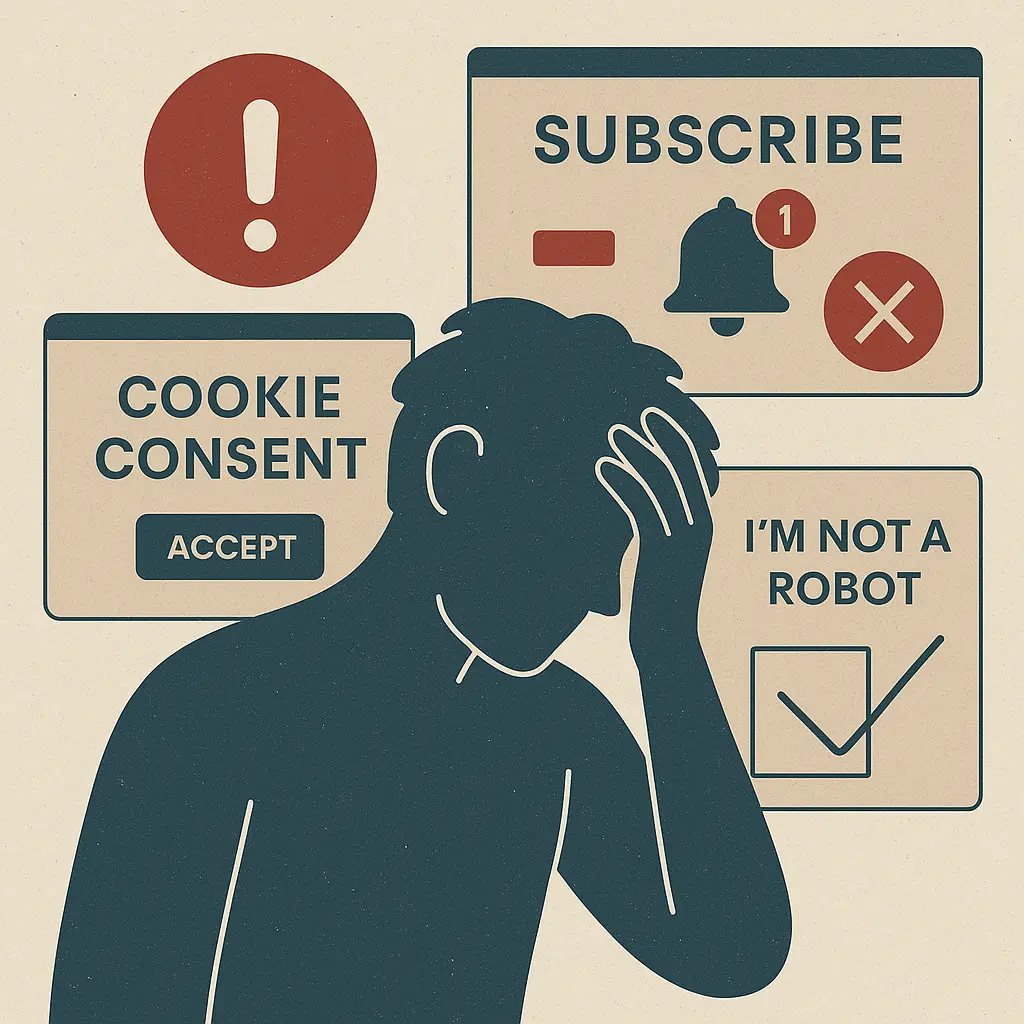
  • Cookie popups on every site. Not one clear button to reject all. No, you must go spelunking through menus, toggling obscure options one by one.
  • What they call “consent” is often manipulation dressed up in legalese. They make accepting easy. Rejecting is friction.
  • This happens every time you clear your cookies—which many of us need to do often to avoid tracking or clutter. It’s an exhausting loop.

OBSTACLE COURSE INTERFACES

  • Adverts that interrupt videos, and worse, cannot be skipped unless you pay. Not pay for the content, mind you, but pay to remove the punishment.
  • Popup overlays that consume half your screen the moment you land on a site. Trying to close them often launches something else.
  • On phones? It’s worse. Smaller screens mean these overlays dominate everything. You lose all context and have to work just to get your bearings.

SENSORY OVERLOAD

  • Auto-play videos. Scrolling pages that jitter from reloading ads. Flashing banners. Infinite scrolling newsfeeds.
  • Red notification symbols you can’t dismiss.
  • Everything demands your attention. Nothing respects your brain’s bandwidth.

WALLS EVERYWHERE

  • Account registration required to view basic information. Want to read one article? Sign up. Want to download a PDF? Create an account.
  • Even ad blockers aren’t safe anymore: Use one, and you’re blocked.
  • CAPTCHA systems to “prove you’re not a robot”, often impossible to complete first time if you have visual or processing impairments.

INFORMATION MIRE

  • Simple search queries now lead into labyrinths of misinformation, SEO bait, affiliate link farms, AI-generated junk, and clickbait.
  • Answers that should take seconds now require sifting through five pages of fluff.
  • The mentally exhausting task of fact verification is now part of every basic search.

CONTENT MONETISATION MADNESS

  • Free content comes with a catch: give us your email, your phone number, or your demographic info.
  • Sponsorships infiltrate once-authentic creators. You’re left wondering if their review or advice is sincere, or bought.
  • Subscription models are everywhere. Everything is paywalled. But paying doesn’t always remove the pain—sometimes, it’s just a new tier of nonsense.

And this is just what I notice consciously.

I’m sure there are deeper layers of rot that my mind filters out as a survival response. But what I do feel, daily, is the cognitive toll. What should be a tool for exploration and learning is now an exhausting, defensive act.

And here’s the thing: most people just shrug and say, “That’s just how it is now.”

But if you’re neurodivergent, or disabled, or even just overwhelmed by life, “that’s just how it is” becomes the same as saying: This place isn’t for you.

The truth is, it could be different