
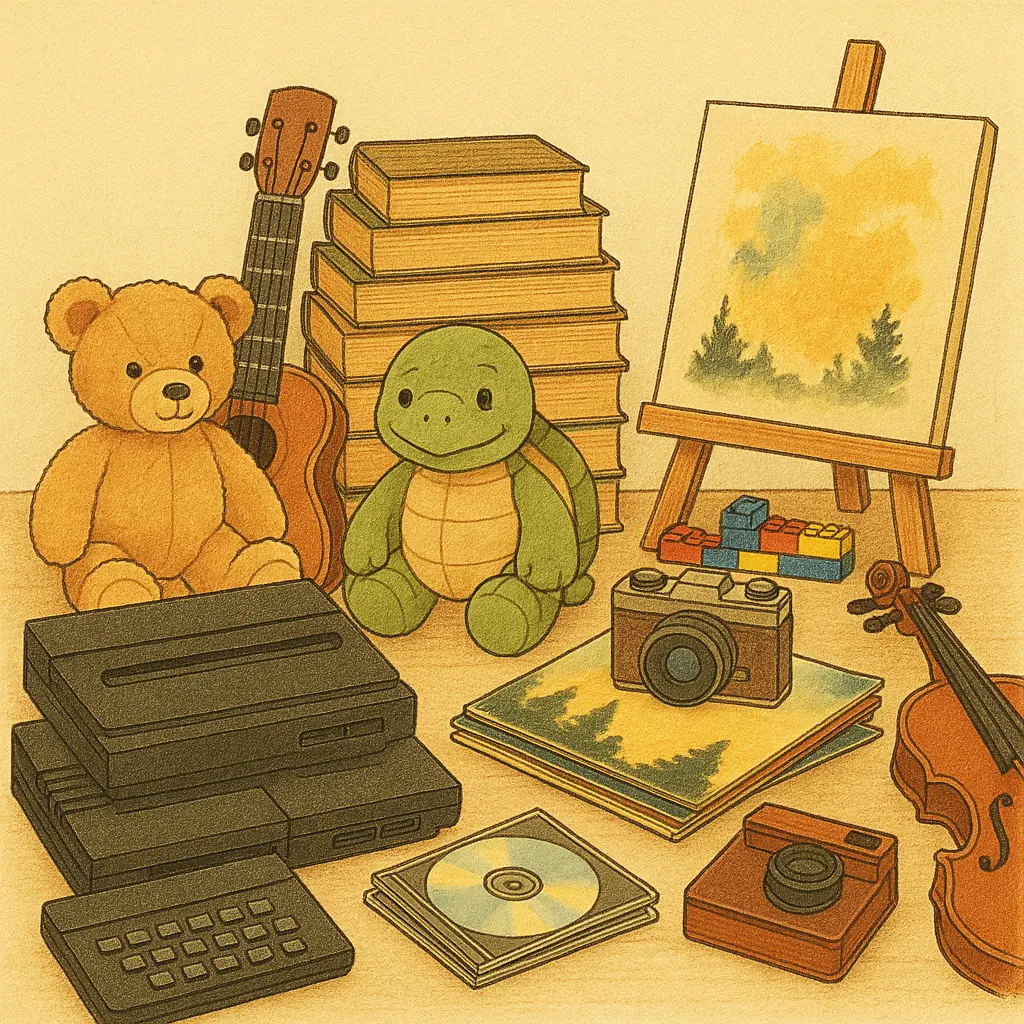
Nostalgia is often painted as a sentimental indulgence, a longing for the past, a soft blur of half-remembered feelings. But for many of us, it is far more than that. It is a quiet architecture of identity.
Every object we keep, every CD, toy, photograph, or memento, is a fragment of the story that made us.
I have often described my living space as a small museum of personal meaning. A curated timeline of moments that mattered. Childhood toys that survived countless declutters. Old computer systems that no longer serve a practical purpose, but still hold a kind of sacred electricity: echoes of discovery, joy, and the early stages of creativity.
It is not about utility. It is about continuity.
The Emotional Geometry of Memory
Each item represents a node in a vast emotional network. When we hold a particular object, it is not just the physical form that we engage with. It is the entire emotional landscape surrounding it. Nostalgia reactivates neural pathways, re-stitching fragments of self that time has scattered.
In moments of doubt or disconnection, these touchstones whisper: You have been many things, and you are still all of them.
Nostalgia as a Survival Mechanism
Some might dismiss this tendency as hoarding, an attachment to material things. But for many of us, it is more like archiving the self.
The world moves fast. Technology shifts. Cultures reinvent themselves overnight. When everything else feels transient, nostalgia anchors us to something recognisable. It is not an escape. It is orientation.
The drive to preserve our past may actually be a form of self-preservation. When we feel overwhelmed, our collections remind us of our continuity through time. They say: You have made it this far.
The Alchemy of Meaning
Over time, even useless things can become symbolic. A broken toy becomes a relic of innocence. A scuffed CD becomes a fossil of a forgotten feeling. Through nostalgia, we turn ordinary matter into metaphysical gold, our own private form of alchemy.
Perhaps the real function of nostalgia is integration. It allows us to carry the past forward without being trapped by it. It is not just remembering. It is honouring.
When Nostalgia Turns Heavy
Of course, even meaning can become weight. There is a fine line between collecting memories and being buried beneath them. I have learned to part with things when their energy shifts, when they stop representing connection and start representing stagnation.
Letting go can be another form of honouring too: acknowledging that the story continues elsewhere.
The Living Museum
In the end, nostalgia is not about recreating the past. It is about recognising that the past lives within us.
Every artifact in my small museum serves as a mirror: a reminder of who I was, who I am, and who I continue to become.
Maybe we keep these things not because we cannot move on, but because we understand that moving forward does not have to mean leaving everything behind.