
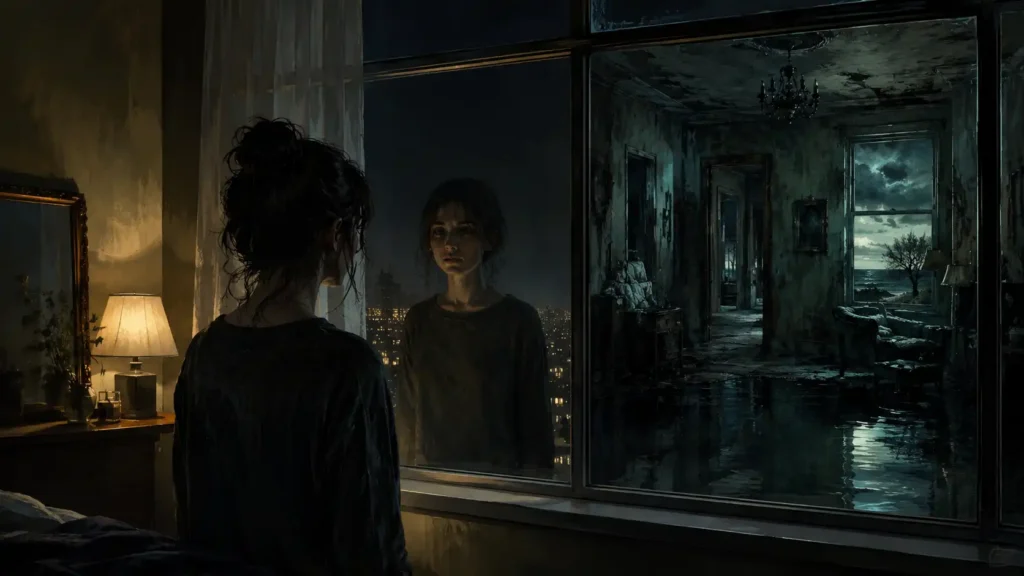
“Let’s reflect about mirrors.”
It sounds like a silly pun at first, but the more you sit with it, the stranger it becomes. Mirrors are so ordinary, so deeply embedded into daily life, that we rarely stop to think about how philosophically unsettling they actually are. We pass them in hallways, bathrooms, elevators, and shop windows without a second thought. We use them while shaving, brushing our hair, adjusting clothing, or checking our expressions before interacting with other people. They have become so familiar that they almost disappear into the background of existence.
And yet mirrors are profoundly strange objects.
A mirror gives us back an image of ourselves, but not quite ourselves. It creates the illusion of direct self-perception while simultaneously distorting what it shows. Even the version of ourselves we become most emotionally familiar with is reversed. We spend our lives recognising a face that nobody else actually sees.
There is something deeply symbolic in that.
The Illusion of Honest Reflection
Mirrors feel truthful. Unlike paintings or photographs, they do not appear to interpret reality. They reflect instantly and mechanically, without obvious emotional bias. A mirror does not care whether we are tired, ageing, attractive, insecure, confident, ill, or exhausted. It simply presents an image back to us.
This gives mirrors an aura of honesty.
But the honesty of mirrors is incomplete. They reveal surfaces while concealing almost everything else that matters. A mirror can show your facial expression, but not your thoughts. It can show tears, but not grief itself. It can show the shape of your body, but not your memories, fears, humour, imagination, compassion, or consciousness.
A mirror reflects appearance, not essence.
And yet human beings often treat mirrors as though they are authoritative tools of self-understanding. We allow reflections to shape confidence, self-worth, identity, and emotional state. Entire industries are built around the relationship between human beings and reflective surfaces. Cosmetics, fashion, fitness culture, plastic surgery, social media aesthetics, and advertising all depend heavily upon the psychological authority we grant to visual self-perception.
The mirror quietly teaches us to evaluate ourselves externally.
The Performance of Identity
There is a subtle psychological shift that occurs whenever we look into a mirror. We stop merely existing and begin observing ourselves existing. The self becomes divided into performer and audience simultaneously.
Instead of simply being, we begin asking questions.
Do I look acceptable?
Do I look strange?
Do I appear confident?
Do I appear attractive?
Do I look normal?
The mirror encourages self-surveillance. It transforms identity into presentation.
For many people this process becomes automatic, but for neurodivergent individuals, particularly autistic people who consciously mask social behaviour, this relationship with reflection can become especially intense. The mirror becomes less a tool of self-care and more a rehearsal space. Facial expressions are studied manually. Eye contact is practised. Smiles are adjusted. Body language becomes something consciously calibrated rather than naturally performed.
In this context, the mirror can begin to feel less like a reflection of the authentic self and more like a training device for social survival.
The irony is that mirrors are often associated with self-knowledge, yet they may actually encourage distance from the self. They prioritise appearance over experience and presentation over internal reality. The reflection becomes a socially translated version of identity rather than identity itself.
The Uncanny Nature of Reflection
There is a reason mirrors appear so frequently in horror stories, dreams, myths, and psychological symbolism.
Most people have experienced the strange discomfort that emerges when staring into their own reflection for too long. After enough time, the face begins to feel unfamiliar. Expressions seem detached. The reflection starts to feel slightly independent, as though it belongs to somebody else entirely.
Psychologists have studied this phenomenon. Under prolonged mirror-gazing conditions, people can experience derealisation, distortions, and even mild hallucinations. The mind struggles with the recursive act of observing itself observing itself.
The mirror becomes philosophically unstable.
When looking into a mirror, you are both subject and object simultaneously. You are the observer and the observed. Consciousness is attempting to perceive itself externally through reflected light, yet something about the process never fully resolves. The image is recognisable, but never completely satisfying.
Perhaps this is because consciousness itself cannot truly be reduced to appearance. No matter how long we stare into a mirror, we never actually encounter the full reality of ourselves there. We only encounter surfaces carrying hints of something much deeper.
Breaking the Mirror
One of the oldest mirror superstitions claims that breaking a mirror brings seven years of bad luck.
At first glance this seems irrational, but many superstitions survive because they contain symbolic or psychological truths beneath their literal claims. Historically, mirrors were often believed to reflect aspects of the soul itself. In Ancient Rome, it was believed that life renewed every seven years, so damaging a reflection symbolically damaged the self until the next renewal cycle.
Even today, a shattered mirror carries emotional weight far beyond broken household glass.
Seeing your own reflection fragmented into disconnected shards is psychologically disturbing. The face ceases to appear unified. Identity becomes visually fractured. Something primal reacts to this instantly.
Perhaps this is because human beings rely heavily upon the illusion of personal coherence. We construct narratives about who we are in order to maintain psychological stability. A broken mirror symbolically threatens that coherence. It suggests fragmentation, instability, and the possibility that the self is less solid than we would like to believe.
But there may also be another interpretation.
Perhaps breaking the mirror can represent liberation rather than destruction. If mirrors encourage obsessive identification with appearance, then shattering one could symbolise a rejection of surface-level identity altogether. The destruction of the reflection might represent freedom from the tyranny of external self-perception.
The shattered mirror can symbolise collapse, but it can also symbolise escape.
Mirrors and Windows
Mirrors have an interesting philosophical relationship with windows.
Physically, they are remarkably similar. Both are panes of glass. Both manipulate light. Both create framed experiences of reality. Both exist at boundaries between spaces.
But psychologically they point in opposite directions.
A window directs attention outward toward the world. It invites curiosity, possibility, distance, and exploration. A mirror redirects attention inward toward the self. It encourages introspection, self-awareness, self-criticism, and identity construction.
A window allows us to observe what exists beyond us. A mirror forces us to confront what appears to be ourselves.
And yet even this distinction becomes unstable under certain conditions. At night, when the outside world grows dark, windows begin turning into mirrors. The external landscape disappears, and suddenly our own reflection stares back at us from the glass.
There is something strangely symbolic about that transformation.
Perhaps when the external world becomes impossible to perceive clearly, consciousness inevitably turns inward.
Mirrors as Portals
Across mythology, literature, and horror fiction, mirrors are rarely treated as simple objects. They are presented as thresholds, gateways, portals, and symbolic boundaries between realities.
This symbolism persists because mirrors already feel liminal by nature. A mirror creates the illusion of depth where no depth exists. It presents an entire visual world that cannot be entered physically. Part of the mind understands this intellectually, while another part responds emotionally as though there truly is another space behind the glass.
Mirrors occupy an uncanny middle ground between reality and illusion.
They hint at the possibility that identity itself may function similarly. We experience ourselves as coherent beings, but much of what we call “the self” may actually be a reflective construct assembled from memory, social interaction, internal narrative, and perception.
The mirror becomes a metaphor for consciousness itself. Something that appears stable and unified while concealing immense complexity beneath the surface.
Reflection Without Resolution
Perhaps mirrors are unsettling because they offer partial truths with such convincing clarity.
They show us enough to feel meaningful, but never enough to fully understand ourselves. Human beings are infinitely more than surfaces, expressions, symmetry, or appearance, yet we increasingly live within cultures obsessed with visual identity. Cameras, selfies, branding, curated profiles, avatars, and social media have expanded the logic of the mirror far beyond the bathroom wall.
Modern life constantly encourages people to observe themselves externally.
In many ways, society itself has become reflective.
Perhaps the real danger of mirrors is not that they lie, but that they persuade us to mistake appearance for essence. They encourage the belief that the visible self is the complete self, when in reality the deepest parts of human existence cannot be fully photographed, measured, reflected, or displayed.
Something far more mysterious looks through your eyes than any mirror could ever truly capture.