
Scarcity as a Condition of Life
Scarcity is often presented as one of the most unavoidable realities of existence. There is only so much food, so much land, so much time, and so much energy. At a basic level, this is obviously true. Every living system exists within limits, and human civilisation has always had to organise itself around the management of finite resources. Scarcity itself is not ideological. It is a condition of life.
But somewhere along the way, scarcity stopped being treated purely as a problem to navigate and began to function as something else entirely.
In modern societies, scarcity is not only endured. It is organised around, institutionalised, and in many cases quietly defended.
This is where the conversation becomes uncomfortable, because it requires separating two ideas that are usually blended together as though they are the same thing: scarcity as an unavoidable condition, and scarcity as a mechanism of advantage. Those are not necessarily identical.
When Scarcity Becomes Power
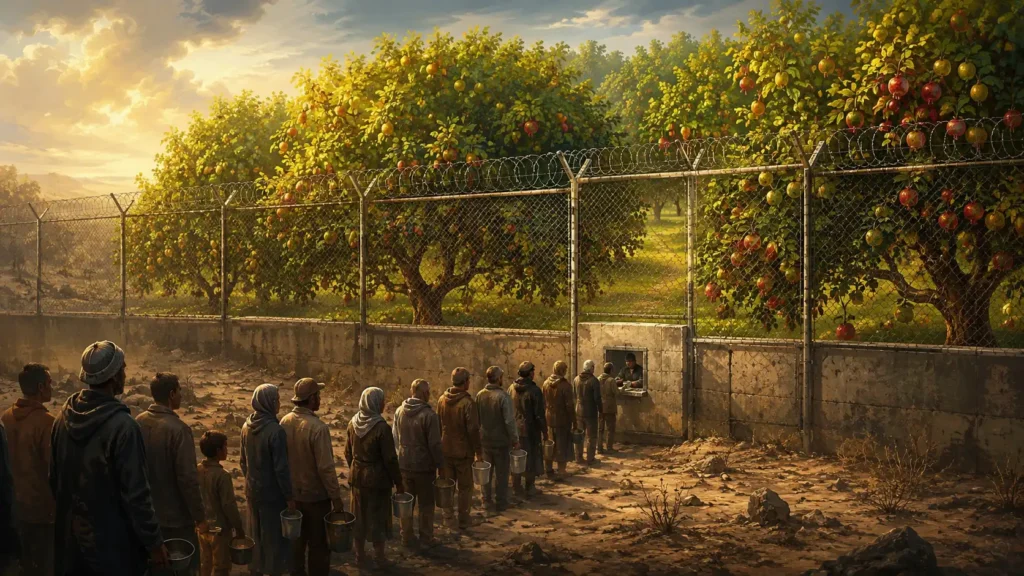
Once access to important resources becomes gated through systems of control, scarcity begins to produce asymmetry. Some people gain the ability to distribute access while others become dependent upon it. Some people wait in queues while others decide how long the queues are allowed to become. At that point, scarcity stops being neutral and begins to generate power.
Once power begins to depend upon scarcity, abundance starts to become dangerous. Not dangerous in the sense that abundance itself is harmful, but dangerous to systems built upon leverage, dependency, and controlled access. A person who has alternatives is harder to control than a person who has none. A population that can comfortably refuse participation is far less predictable than one forced into compliance by necessity.
Abundance weakens leverage, and that simple reality quietly reshapes entire systems.
This is why many institutions behave in ways that can seem irrational at first glance. Problems are often addressed just enough to prevent collapse, but not enough to fundamentally dissolve dependency. Access expands, but usually through layers of conditions, subscriptions, permissions, and procedural gates. Technologies capable of dramatically reducing labour or increasing quality of life frequently arrive alongside new forms of precarity rather than genuine liberation.
The contradiction begins to make more sense when viewed through the lens of power preservation rather than problem solving. A system that materially benefits from scarcity has no natural incentive to eliminate it entirely. In fact, it may gradually develop incentives to preserve it.
The Machine Without Villains
This does not require conspiracy. That point is important. Discussions like this often collapse into the assumption that systems like these must be consciously orchestrated by a small number of openly malicious individuals. Reality is usually far less dramatic and far more structurally unsettling.
People adapt to incentives. Institutions adapt to self-preservation. Systems that reward control over access gradually select for behaviours that maintain control over access. No single person needs to consciously design the machine for the machine to continue reproducing itself.
This is one of the reasons systems can feel so difficult to meaningfully challenge. Many of the people operating within them are not consciously trying to create suffering. They are simply responding to pressures, incentives, and survival structures that already exist. Over time, this creates systems that can perpetuate harmful conditions without requiring deliberate cruelty from every participant involved.
The Suppression of Abundance
Once scarcity becomes advantageous, several predictable patterns begin to emerge.
The first is the sabotage or suppression of abundance before it fully arrives. Sometimes this appears as underfunding, neglect, regulatory obstruction, intentional inefficiency, or the slow decay of public infrastructure. Solutions are delayed, diluted, or endlessly debated while the underlying dependency remains intact. From the outside this often looks like incompetence, but incompetence alone struggles to explain why genuinely transformative solutions so often stall at the threshold of implementation.
The second pattern is the capture and privatisation of abundance. If abundance cannot be prevented, it can still be enclosed. Resources that could function as commons become owned spaces instead. Access becomes conditional. A naturally abundant process is converted into a managed service. The abundance still exists in a technical sense, but it no longer exists freely.
The internet provides an interesting example of this transformation. Early internet culture carried a genuine feeling of abundance. Information flowed freely. Communities formed organically. Creative work circulated outside many traditional gatekeeping structures. Over time, however, much of this space became increasingly platformised, monetised, algorithmically managed, and enclosed behind subscriptions, visibility systems, and behavioural incentives. Abundance remained present underneath the surface, but access to visibility and participation became progressively mediated.
Manufacturing False Scarcity
The third response is perhaps the most sophisticated: the manufacture of false scarcity. When material scarcity becomes difficult to maintain, procedural scarcity can take its place. Artificial limitations appear. Tier systems emerge. Features are locked away. Planned obsolescence is introduced. Digital goods with effectively infinite reproducibility become tied to controlled access models. Even where abundance technically exists, systems are built to preserve the feeling of insufficiency.
At this point, scarcity stops functioning merely as an economic condition and becomes psychological architecture. People begin organising their lives around access anxiety and the fear of falling behind, exclusion, economic invisibility, or losing access to stability, dignity, healthcare, housing, community, or meaning.
Importantly, this psychological pressure does not only affect the poor. It scales upward through the entire structure. Even relatively comfortable individuals often remain trapped within systems of perpetual maintenance, optimisation, competition, and self-preservation. Scarcity culture reproduces itself socially long before genuine deprivation arrives materially.
Abundance in a Scarcity-Driven World
One of the strangest consequences of all this is that societies can become technologically abundant while remaining emotionally and structurally scarcity-driven. We live in a world capable of extraordinary production. Food waste exists alongside hunger. Empty homes exist alongside homelessness. Automation increases productivity while insecurity continues to spread. Communication technology connects billions of people while loneliness intensifies.
The issue is often not pure material impossibility. It is access, and access is power.
This is where scarcity and abundance stop being purely economic concepts and become deeply political and psychological ones. Whoever controls access does not simply control resources. They influence behaviour, shape priorities, determine acceptable risks, and ultimately help define what kinds of lives are realistically possible for other people.
Under such conditions, abundance becomes destabilising because abundance reduces dependency, and dependency is one of the foundational engines of systemic leverage. A society where people can comfortably say “no” is much harder to govern through pressure. A society where people are less afraid becomes less predictable.
The Preservation of Scarcity
This does not mean all structure is inherently oppressive, nor that every form of hierarchy is malicious. Human societies will always require coordination, organisation, and systems of distribution. The point is not that scarcity itself is fictional. The point is that once systems become dependent upon scarcity for the preservation of power, solving scarcity completely may begin to conflict with the interests of those most advantaged by the system.
At that stage, scarcity stops being merely a problem to solve. It becomes an asset to manage, and assets, especially profitable ones, tend to be defended.