
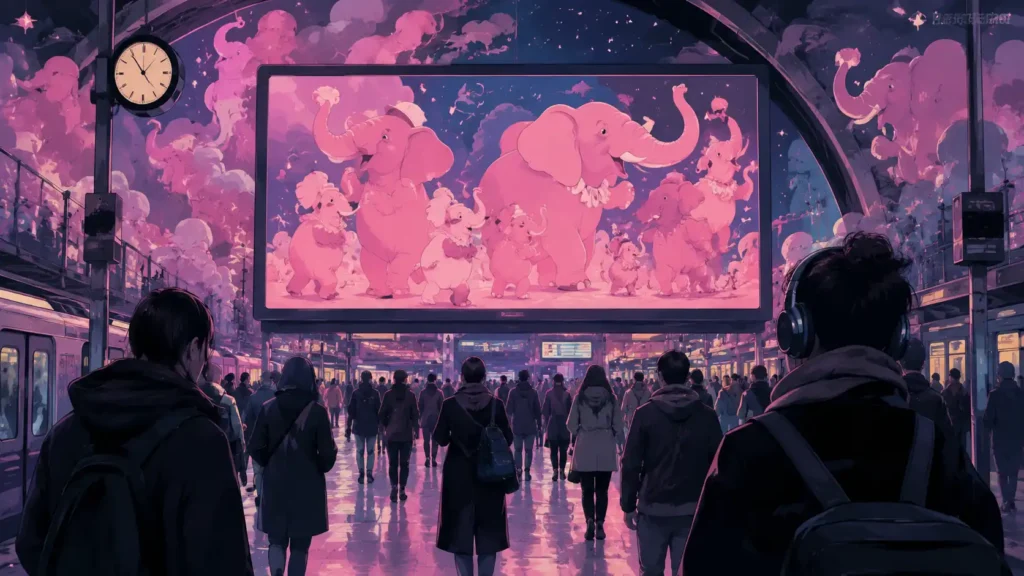
Recently I had a dream that Disney’s animated classic, Dumbo (1941) was being broadcast on a large digital poster frame in a train station.
Not in a cinema or a child’s bedroom, but amongst advertisements and public information screens while crowds of commuters moved past beneath it. When I woke up, the image stayed with me. Something about it felt strangely appropriate. Not because the film belonged there, but because its placement seemed to reveal something about the world we live in. A story about conformity, exploitation, spectacle and social rejection quietly looping inside one of the modern temples of routine movement and economic function.
The more I thought about it, the more I began to realise how deeply unsettling Dumbo actually is beneath its surface. Like many older children’s films, it carries truths that are often felt emotionally long before they are consciously understood.
The Circus as Society
The circus in Dumbo is not merely a setting. It functions as a complete social system. The ringmaster controls the structure, the audience consumes the spectacle, and the performers exist under constant pressure to fulfil their assigned roles. Even the clowns, who outwardly appear rebellious or chaotic, are still ultimately serving the machinery of the circus itself.
What becomes particularly interesting is that the cruelty within this system is not imposed solely from above. Much of it is reinforced horizontally by the participants themselves. The other elephants ridicule and reject Dumbo not because he has harmed anyone, but because he violates their expectations of normality. His difference creates discomfort. His existence threatens the social cohesion that allows the group to feel stable within an already unstable environment.
Rather than questioning the values of the system itself, they attempt to pressure the anomaly back into conformity.
This is something we see repeatedly within human society. People who are themselves struggling within exploitative or unhealthy systems will often still defend those systems and police the behaviour of others who fall outside accepted norms. Sometimes this happens consciously, but often it happens automatically, almost instinctively, because belonging itself becomes tied to survival.
And survival can make people fiercely protective of structures that are quietly damaging them.
Difference and Usefulness
One of the darkest aspects of Dumbo is that society does not truly learn to accept him. Instead, it simply changes the terms under which his difference is evaluated.
At first, Dumbo’s ears are treated as a deformity. They make him a target for ridicule, exclusion and humiliation. His difference lowers his social value in the eyes of those around him. Yet the moment that same trait becomes economically useful, the entire dynamic shifts. Suddenly the thing that made him unacceptable becomes the source of his worth.
This is not genuine acceptance. It is commodification.
The system does not embrace Dumbo because it has developed empathy or understanding. It embraces him because his uniqueness can now generate spectacle, profit and attention. His value becomes conditional upon performance.
I think many people who feel different in some way recognise this dynamic instinctively. Society often does not ask whether your uniqueness is meaningful, beautiful or deeply human. Instead, it asks whether it is useful. Whether it can be monetised. Whether it can become productive within the existing structure.
The pressure is not always to become normal. Sometimes the pressure is to become marketable.
Passive Participation and Internalised Systems
What strikes me most about the other elephants is that they are also trapped within the same system that harms Dumbo. They too are performers. They too are controlled, displayed and used for entertainment. Yet rather than recognising their shared condition, they reinforce the hierarchy by distancing themselves from the outsider.
This reflects something psychologists and sociologists have observed repeatedly throughout history. People often internalise the logic of the systems they exist within. Even harmful systems can begin to feel natural, inevitable or morally correct simply because they are reinforced socially and culturally over long periods of time.
Questioning the structure itself becomes frightening because it risks social exclusion. In many cases, attacking the outsider becomes psychologically easier than confronting the instability of the system that governs everyone.
This is part of how unhealthy societies sustain themselves across generations. The system no longer requires constant direct enforcement from authority figures because people begin enforcing it upon one another. The machinery becomes self-perpetuating.
Timothy Q. Mouse and the Outsider Perspective
One of the most important characters in the film is Timothy Q. Mouse. Ironically, the mouse becomes the one figure who sees Dumbo with genuine empathy rather than social judgement.
Because Timothy stands slightly outside the elephant hierarchy, he is able to perceive its cruelty more clearly. He is not emotionally invested in maintaining its norms, and that distance gives him a different perspective.
Sometimes those who exist outside dominant social structures are able to see their absurdities more clearly than those fully embedded within them.
Timothy does not magically dismantle the system itself, but he does provide something profoundly important. He offers recognition, encouragement and a refusal to reduce Dumbo to the role society assigned him. Sometimes that alone can radically alter the course of a life.
Pink Elephants and Psychological Collapse
Then there is the infamous “Pink Elephants on Parade” sequence.
Even outside the context of psychedelics, the scene feels deeply uncanny. The film temporarily dissolves into psychological and symbolic chaos as identity, form and reality begin mutating into endless spectacle.
Watching it now, the sequence feels strangely modern. It resembles the fragmentation of contemporary media environments where entertainment, advertising, symbolism and emotional manipulation blur together into one overwhelming stream of stimulation. Familiar forms lose stability and become part of a shifting sensory landscape that constantly demands attention.
Which brings me back to the dream itself.
Dumbo on the Billboard
There was something profoundly symbolic about seeing Dumbo displayed on a digital advertising frame inside a train station.
A film about exploitation embedded directly into the architecture of modern economic movement. A story about performance and conformity glowing silently above exhausted commuters moving between obligations. A warning transformed into ambient background noise.
That is what disturbed me most about the dream. Not that people were watching Dumbo, but that nobody seemed to truly see it. The film had become environmental texture, just another screen competing for attention within a culture already saturated by spectacle.
And perhaps that is one of the strangest things about society.
Sometimes the truths are not hidden from us at all. Sometimes they are displayed openly in public while everybody walks past pretending not to notice.