
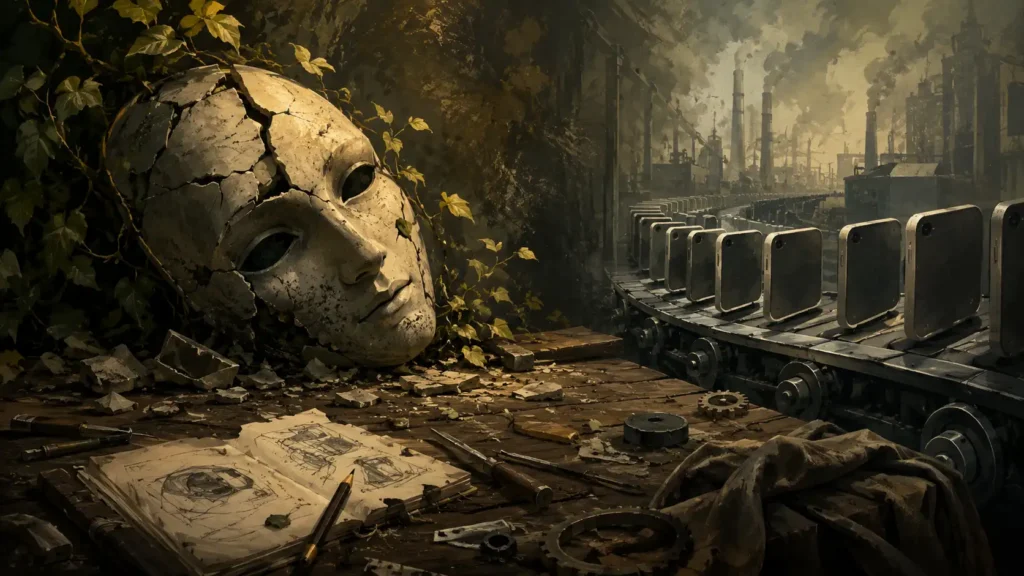
I didn’t expect to cry over design.
But one evening, as I thought about the objects that fill our lives, from headphones to furniture to cars, I felt a wave of grief rise up in me. It wasn’t nostalgia for “the good old days,” but something deeper: a sense that we’ve lost the honesty that once bound creators, objects, and users together.
A century ago, a product’s purpose was to serve. It was designed to endure, to be repaired, to stand as a testament to craftsmanship. Today, most products are designed to expire, to be replaced rather than respected. Somewhere along the way, integrity stopped being part of the blueprint.
This isn’t just about durability. It’s about intention, about whether a thing was made with care, or calculated indifference.
We live surrounded by artifacts that could have been better, stronger, cleaner, or fairer, but weren’t, because someone decided that honesty wasn’t profitable.
What follows is a reflection on what happens when design loses its conscience, and on how those of us who still feel the world deeply can continue to live, and create, with integrity, even in its absence.
The Ethics of Intention in Design
Not every missing feature is a flaw. Sometimes, restraint itself is the highest form of respect.
A well-designed object doesn’t have to do everything; it just has to do what it does with honesty and precision. There’s a quiet beauty in tools that serve a singular purpose with complete devotion, refusing to dilute their essence for the sake of appearing “more advanced.”
But there’s a difference between purposeful simplicity and manufactured deficiency.
One stems from understanding; the other from manipulation.
When a designer chooses to omit something because it distracts from the core experience, that’s integrity. It’s a declaration that clarity and usability matter more than novelty.
But when a company withholds a feature that could have been included, not to improve the product, but to protect an artificial hierarchy of versions and upgrades, that’s deceit disguised as design.
The ethics of intention lie in the why.
Limitation, when born from artistic or functional discipline, can be a virtue.
Limitation, when born from commercial strategy, is a betrayal.
Integrity as Relationship
Integrity isn’t a technical trait; it’s a relationship, between creator, creation, and user.
Every product, however simple, carries within it an invisible conversation: a designer’s intent, a manufacturer’s compromise, a user’s trust. When that dialogue is honest, you can feel it. The object resonates. It doesn’t need to justify itself because it simply works, gracefully, within its purpose.
But when that dialogue is corrupted, when decisions are made to mislead, to extract, or to manipulate perception, the object feels hollow. Even before it breaks, it’s already broken. You can sense the absence of care, as if the soul of the design has been outsourced.
True integrity acknowledges consequence. It recognises that design doesn’t end at the point of sale. It continues through the hands, minds, and environments it touches.
A thing made without care teaches carelessness.
A thing made with sincerity becomes part of a moral ecosystem, nurturing the same awareness that created it.
The tragedy of modern design is that we’ve forgotten this reciprocity.
We’ve been conditioned to see objects as disposable and, in turn, we begin to see ourselves that way: replaceable, interchangeable, marketable.
But every time we create, repair, or even cherish something built with care, we reaffirm that the relationship still matters.
That honesty can still live in the physical world.
That design, at its best, is a quiet act of love.
Living with Integrity in an Age Without It
To live with integrity in a world that rewards its absence is not easy. It asks you to stay awake in a culture that depends on your numbness. To keep caring when indifference is the path of least resistance.
There may be no way back to the age of craftsmanship, the world that built things to last, to be repaired, to be loved. But perhaps that isn’t what’s needed. Perhaps what’s needed is to carry its spirit forward, not as nostalgia, but as rebellion.
Integrity today must begin on the smallest scale: in the way we choose, the way we use, and the way we create.
It’s in the musician who refuses to fake emotion for clicks.
The writer who still edits for meaning, not engagement.
The engineer who optimises for truth, not profit.
The person who, before throwing something away, wonders if it can be mended.
Each act of care is a refusal, a refusal to participate in the quiet deceit that governs modern production.
Each honest creation becomes a seed of resistance, proof that sincerity still has a pulse.
Maybe integrity will never again be the foundation of industry.
But it can still be the foundation of us.
And perhaps that’s enough to keep the flame alive, to remind the world, gently but stubbornly, that beauty, truth, and empathy were never meant to be market categories.