
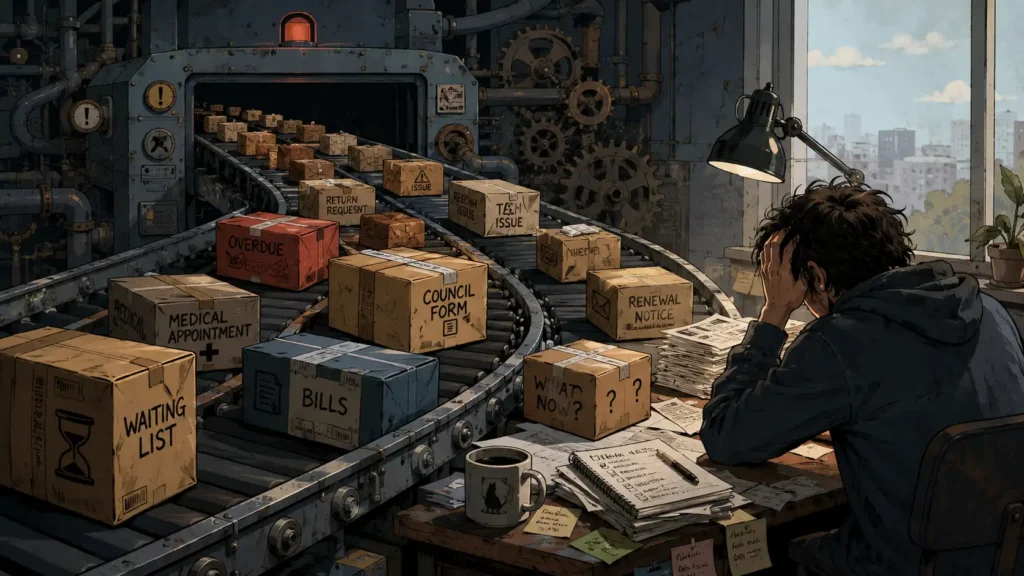
The Arrival of the Parcels
Every day, the machine rolls on. A rattling belt carries new packages into my life, each one stamped with the label: Problem.
I do not order these parcels, yet they keep arriving.
One day it is an Amazon package marked “delivered” but missing in reality, forcing me through layers of blame-shifting customer service scripts. Another day it is a council form demanding fresh medical evidence, as though my existence requires constant re-verification. Sometimes the parcels arrive duplicated and confusing, like ADHD reassessment paperwork appearing despite an already established diagnosis, threatening to undermine the support systems that keep me functioning. Other times the conveyor belt delivers physical side effects, nausea and dizziness from a medication that was supposed to help solve another problem entirely.
The belt does not discriminate between the catastrophic and the trivial. A missing parcel. A broken appliance. A leaking tap. A heating system that never quite warms the whole house. Bureaucratic forms with arbitrary deadlines. A supermarket “offer” that scans at the wrong price. A technical issue with a server. A 42-week waiting list for a guitar bridge. A letter that needs answering. An email that needs chasing. A password reset. A renewal. A cancellation. A correction.
None of these things individually qualify as great tragedies. That is precisely what makes them so insidious. They accumulate quietly. Each one demands attention, energy, emotional regulation, executive function, memory, organisation. Every parcel on the conveyor belt must be opened, assessed and dealt with, often before the next one arrives.
And the next one always arrives.
The Hidden Machine
It is not enough to simply be alive. Modern life already comes with the official grind: work, bills, responsibilities, survival. But running alongside this is another hidden machine entirely. The Problem Conveyor Belt.
The strange thing is that many of these problems should not exist at all. In theory, if the systems of society were functioning smoothly, many aspects of daily life would simply work. Parcels would arrive where they are supposed to. Bureaucracy would be streamlined. Infrastructure would be maintained proactively. Technology would reduce friction rather than create it.
Except the machine does not run smoothly.
In fact, some systems are specifically designed in ways that solve problems for one group by creating problems for another. Not on a one-to-one basis either. A millionaire’s inconvenience may be solved by making thousands of poorer people absorb additional stress, labour, cost, or instability. Convenience itself often functions like a transfer of burden. Someone else somewhere pays for the smoothness of another person’s experience.
Even beyond deliberate design, problems endlessly breed new problems. Solutions create side effects. Shortcuts create vulnerabilities. Bureaucracies create further bureaucracy to manage the failures of the previous bureaucracy. Entire industries emerge whose sole purpose is managing complications generated by other industries.
Some problems exist to obscure deeper problems. Some are accidents. Some are symptoms. Some are unavoidable consequences of nature itself. Illness. Decay. Aging. Entropy. The universe has its own conveyor belt independent of human civilisation.
And yet civilisation somehow manages to add an additional belt on top.
The Different Shapes of Problems
There are many different categories of problems. Some are avoidable through maintenance and future planning. Others are unpredictable. Some are recurring. Some are one-offs. Some arrive with hard deadlines attached. Others linger indefinitely, slowly transforming from “problem” into accepted background reality.
A dripping tap eventually stops feeling like an emergency and simply becomes part of the soundtrack of the home. A poorly insulated room becomes “the cold room.” A buggy piece of software becomes something people build workarounds around. Entire populations adapt themselves psychologically to systems that do not function properly.
Human beings are astonishingly adaptable creatures. Sometimes too adaptable.
Because eventually we stop asking why the conveyor belt is running at all.
Everybody has a different conveyor belt. Different speeds. Different parcels. Different weights. One person’s belt may mostly deliver financial anxiety. Another’s health complications. Another’s social conflict. Another’s bureaucratic confusion. Some people inherit conveyor belts already overloaded before adulthood even begins.
And some people are expected to manage these belts with fewer resources than others.
Neurodivergence and Overload
For neurodivergent people especially, the conveyor belt can become overwhelming very quickly. Every unresolved task occupies mental space. Every small complication consumes processing power. What appears to others as “just a quick phone call” may involve hours of anticipatory stress, emotional regulation, rehearsing scripts, recovery afterwards, and lingering anxiety. Multiple simultaneous problems do not merely add together. They compound.
Sometimes solving one problem directly interferes with solving another. You miss one deadline while trying to meet another. You become so busy surviving administratively that you lose the energy required to maintain yourself emotionally or creatively. Parcels begin piling up faster than you can open them.
And when that happens, society often responds not with understanding, but judgement.
Why did you miss the letter?
Why did you forget the form?
Why did you not respond sooner?
Why can’t you keep up?
Because the conveyor belt never stops.
Maintenance Worker for Reality
There is something psychologically exhausting about living in a world where new problems are generated continuously, often faster than old ones can be resolved. It creates a subtle permanent tension beneath daily life. Even during moments of peace, part of the mind remains braced for the next parcel to arrive.
The next email.
The next unexpected expense.
The next bureaucratic absurdity.
The next failure notification.
The next “we attempted delivery.”
The next demand for proof that you are still struggling in exactly the approved format.
Over time, this can fundamentally alter a person’s relationship with existence itself. You stop feeling like a participant in life and start feeling like a maintenance worker for reality. Less a human being, more a technician endlessly patching leaks in an unstable machine.
And perhaps this is one of the great hidden costs of modern existence. Not simply suffering itself, but fragmentation. The endless slicing apart of attention and energy into administrative debris. The gradual erosion of the mental space required for reflection, creativity, curiosity, community, or genuine rest.
Because every moment spent wrestling with unnecessary problems is a moment not spent truly living.
Carrying Each Other’s Parcels
Yet despite all of this, people continue creating. Continue loving. Continue making art. Continue helping each other carry parcels that were never theirs to begin with.
Maybe that is one of the few meaningful acts of resistance available to us.
Not pretending the conveyor belt does not exist. Not romanticising struggle. Not framing exhaustion as virtue. But recognising the machine for what it is, while still trying to carve out moments of humanity between its endless rotations.
Even if only long enough to breathe before the next parcel arrives.