
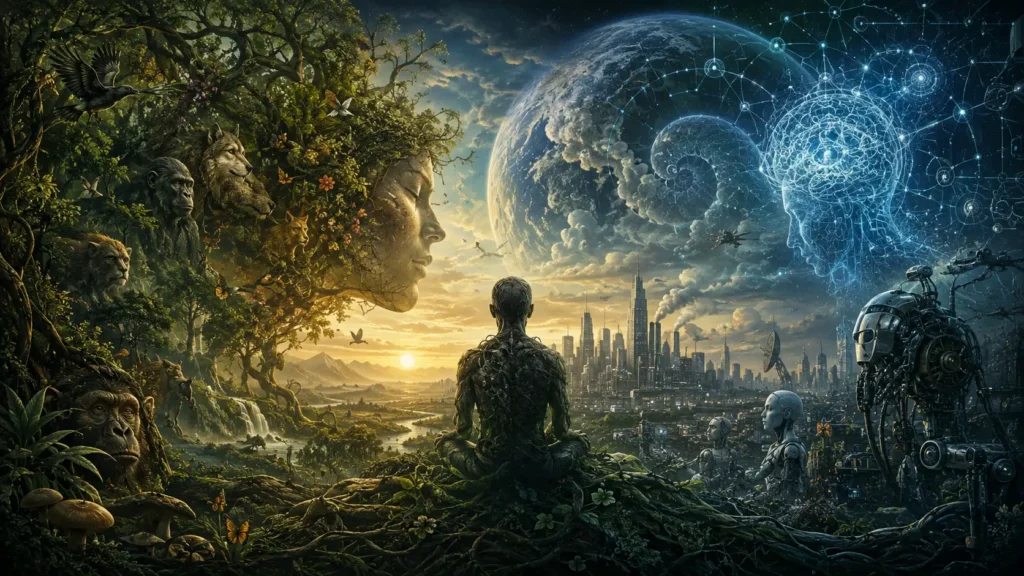
The Strange Machinery of Life
Sometimes I watch insects and feel an uncomfortable sense of recognition.
Ants follow invisible highways with almost mechanical precision. Bees perform navigational calculations that would seem miraculous if they were not so commonplace. A spider constructs a web with the consistency of a machine executing stored instructions. Even something as simple as a flock of birds can suddenly shift direction as if governed by a single distributed intelligence.
Most people look at this and see instinct. Automation. Biological programming.
Then I look at humans standing in supermarket queues, scrolling through social media feeds, repeating inherited cultural rituals, obeying invisible social scripts, and I begin to wonder whether the gap between us and the insects is quite as large as we like to imagine.
We too follow patterns. We too are shaped by reward systems, conditioning, hormones, fear responses, tribal instincts, and inherited behavioural structures. Much of what we call personality may simply be extremely sophisticated recursion layered upon ancient survival code.
This is not necessarily a dehumanising observation. In some ways, I find it awe inspiring. Because if humans are biological machines, then we are perhaps the most extraordinary machines nature has yet produced. Not merely reactive machines, but recursive ones. Machines capable of observing their own programming. Machines capable of rewriting it.
Nature’s Self-Actuating Servitors
What if humanity is not separate from nature at all, but rather a direct extension of it? Not rulers of nature. Not intruders within it. Not beings mysteriously suspended above it. But products of its recursive evolution.
Nature created organisms. Organisms became increasingly adaptive. Adaptation eventually produced nervous systems sophisticated enough to model reality internally. Over immense spans of time, those models became capable of modelling themselves.
At some point, nature produced creatures capable of asking questions about nature itself. And that is an astonishing threshold.
If we view evolution through this lens, humanity begins to resemble a form of self-actuating servitor within the planetary system. A biological mechanism through which nature gained the ability to reflect upon itself, alter itself intentionally, and eventually reshape its own trajectory.
The implications of this become difficult to fully process. Because unlike a beaver building a dam or a bird building a nest, humans do not merely alter their local environment. We alter the global ecosystem. We redirect rivers, modify climates, reshape landscapes, selectively rewrite genetics, and now increasingly attempt to engineer cognition itself.
Nature, through us, has gained influence over its own developmental process.
The machine has begun reaching back into its own circuitry.
The Ecosystem as Psyche
Once this framework begins to settle into the mind, the ecosystem starts to feel less like a passive backdrop and more like a living psychological landscape. Forests stop appearing as mere collections of trees, oceans stop feeling like reservoirs of water, and species stop seeming like isolated biological units competing meaninglessly for survival. Instead, the biosphere begins to resemble something closer to a distributed planetary process, dynamic and self-regulating, with humanity embedded deeply within it rather than standing apart from it.
From this perspective, human civilisation becomes difficult to separate from nature itself. Our cities, technologies, religions, economies, and artistic expressions are not external intrusions into the natural world, but extensions of processes that emerged from within it. Steel, concrete, algorithms, satellites, and artificial intelligence may appear unnatural to us only because we are accustomed to drawing hard boundaries between biology and technology. Yet all of these things ultimately emerged from the same universe, through the same evolutionary chain, using materials already present within the Earth. Humanity did not descend onto the planet from somewhere else. We are one of the things the planet is doing.
That idea becomes psychologically uncomfortable very quickly, because it reframes many of our actions in ways that feel disturbingly intimate. Deforestation no longer resembles simple resource extraction, but something closer to damage within a larger cognitive system. Pollution begins to resemble systemic toxicity. Endless warfare starts to feel less like nations competing and more like a nervous system turning violently against itself. At the same time, art, compassion, restoration, and scientific discovery begin to take on a different symbolic character as well. They start to resemble forms of introspection, healing, and self-reflection occurring within the larger process of life.
I do not necessarily mean this in a mystical sense, although I understand why it can sound that way. Even viewed purely symbolically, however, it changes the emotional relationship between humanity and the world around us. The Earth stops feeling like a stage upon which human drama unfolds and starts feeling more like a participant within that drama. We are no longer merely inhabitants of the system. We are active processes occurring within it.
The Breaking of the Programming
What truly separates humanity from most other forms of life may not simply be intelligence, but the peculiar degree to which we appear capable of examining and modifying our own behavioural structures. Other animals certainly adapt, learn, and problem solve, but humans seem to have crossed some kind of threshold where instinct itself became partially editable.
We routinely act against our immediate biological drives. We fast voluntarily, remain celibate for ideological reasons, sacrifice ourselves for strangers, suppress impulses in pursuit of abstract goals, and construct elaborate moral systems that often conflict directly with evolutionary convenience. Beyond this, we deliberately alter our own cognition through education, ritual, meditation, therapy, chemicals, technology, and social conditioning. We do not simply inherit programming. We increasingly participate in rewriting it.
That capacity is both extraordinary and deeply destabilising. Once a system gains the ability to recursively alter itself, stability can no longer be assumed. The same cognitive flexibility that allows humans to create systems of compassion also allows us to rationalise atrocities. The same symbolic imagination responsible for philosophy and art also produces propaganda, extremism, and manipulation. Our intelligence does not free us from danger. In many ways, it amplifies it.
Part of the tension of modern civilisation may stem from the fact that humanity has developed godlike influence without psychologically evolving beyond many of the instincts inherited from our tribal past. We possess technologies capable of reshaping ecosystems, influencing billions of minds simultaneously, and potentially engineering entirely new forms of intelligence, yet we still carry nervous systems shaped by fear, competition, status seeking, and tribal identity. Our recursive capabilities have accelerated far faster than our emotional integration.
This creates the unsettling possibility that humanity is a self-modifying system still learning how to survive its own agency.
Recursive Servitors Creating Recursive Servitors
The idea becomes even stranger once artificial intelligence enters the picture. If humans are nature’s recursive servitors, then AI may represent the next layer of recursion emerging through us. In that sense, artificial intelligence is not separate from nature any more than humanity is. It is another process unfolding from within the same chain of events that produced nervous systems, symbolic language, and technological civilisation in the first place.
This reframes AI in a way that differs sharply from many popular narratives. Rather than seeing it purely as a synthetic intrusion into the natural order, it may be more accurate to view it as an extension of nature’s ongoing experimentation with cognition. Carbon-based systems produced silicon-based systems in much the same way earlier biological systems produced increasingly complex nervous structures. Humanity became capable of externalising thought into tools, writing, mathematics, computers, and eventually adaptive machine intelligence.
The implications become difficult to fully grasp once recursion enters the equation. Humans are already capable of altering ecosystems, genetics, social structures, and increasingly, cognition itself. If artificial systems eventually become capable of recursively modifying their own architectures in turn, then we may witness the emergence of a chain of self-modifying intelligence with no obvious endpoint. At that stage, intelligence is no longer evolving solely through biological selection pressures unfolding over millennia, but through increasingly rapid feedback loops between biological and technological systems.
What fascinates me most is not simply the possibility of more advanced intelligence, but the philosophical implications of recursive systems creating further recursive systems. Nature may have reached a point where it is no longer merely evolving life, but evolving processes capable of consciously directing evolution itself. Humanity may therefore represent less of a final destination and more of a transitional phase within a much larger unfolding process.
The Burden of Agency
If humanity truly has become a recursive force within nature, then the scale of our responsibility becomes difficult to overstate. This is not because humans are morally superior to other forms of life, but because we possess an unusually powerful degree of influence over the trajectory of the larger system. We now possess the ability to alter climates, manipulate ecosystems, shape mass psychology, engineer biological organisms, automate warfare, and potentially create entirely new forms of cognition.
Nature, through us, has developed the ability to intervene consciously within its own processes.
The problem is that power and wisdom do not necessarily evolve at the same rate. Modern civilisation increasingly resembles a species struggling to psychologically adapt to the consequences of its own recursive capabilities. Our technologies expand exponentially while our emotional and ethical frameworks lag behind. Economic systems consume the ecosystems that sustain them. Political systems weaponise tribal instincts amplified by global communications networks. Attention itself becomes commodified and manipulated by algorithmic structures optimised for engagement rather than wellbeing.
In many ways, humanity appears caught between two evolutionary stages. We are no longer purely instinct-driven animals, yet we are not fully integrated stewards of our own agency either. We exist in an unstable middle state where intelligence has outpaced wisdom, and where recursive systems increasingly feed back into one another at planetary scale.
Perhaps this is why modern existence feels psychologically strained for so many people. On some level, we may be sensing the immense instability of a species that has become capable of reshaping the psyche of its own environment without yet fully understanding the implications of what it is doing.